Starting a business in Pakistan requires more than choosing a brand name, opening a shop or creating a website.
One of the first and most important decisions is selecting the correct legal business structure.
Should you register your business as a Sole Proprietorship, a Single Member Company (SMC), or a Private Limited Company?
Your decision can affect registration procedures, personal liability, income tax rates, banking, ownership, investors, annual compliance costs and future expansion.
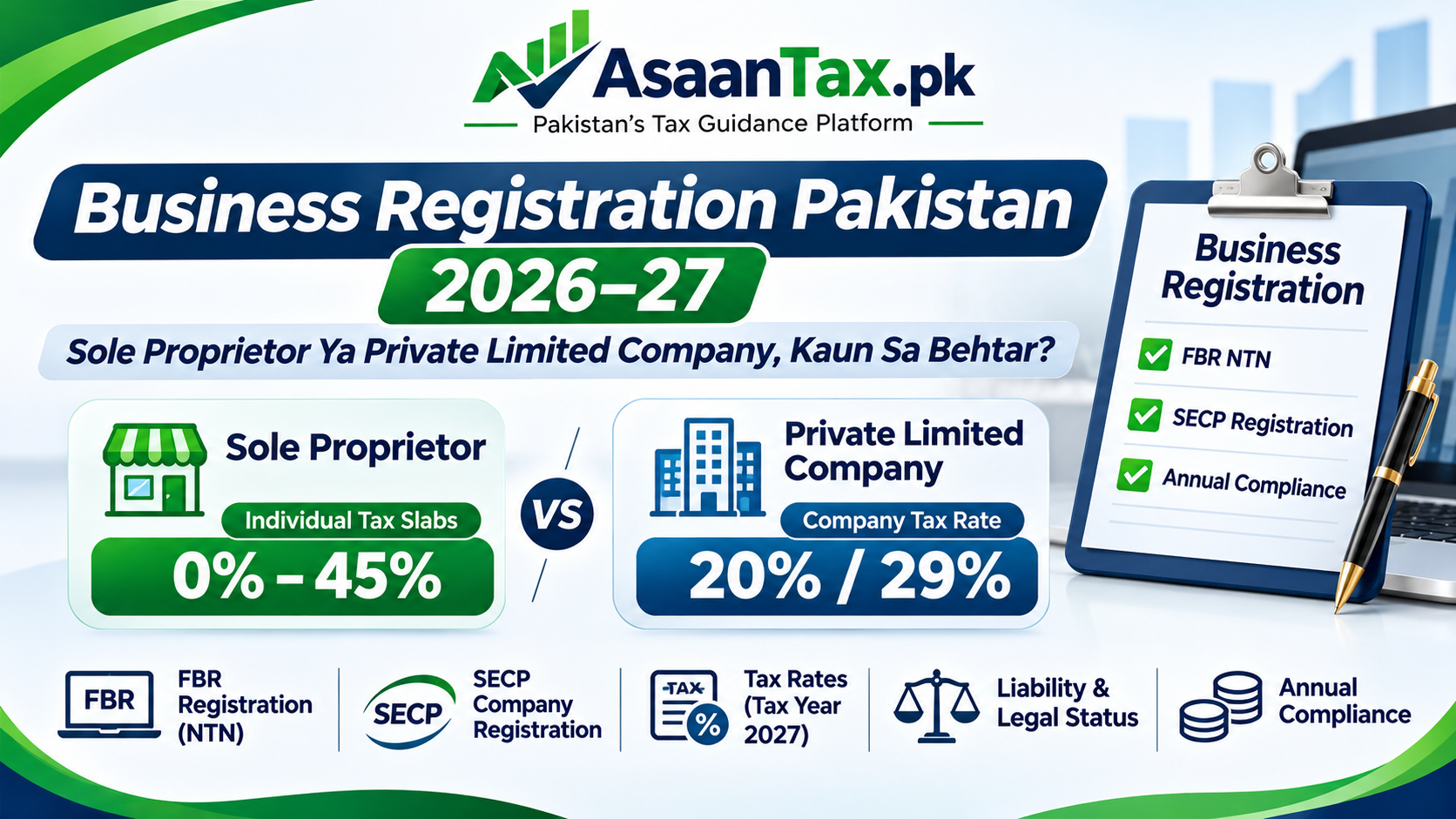
For Financial Year 2026–27, also known as Tax Year 2027, a sole proprietor is generally taxed under the individual income tax regime, while qualifying small companies may be taxed at 20% and ordinary companies at 29%, subject to the applicable legislation.
However, selecting a company does not automatically mean you will pay less tax.
This comprehensive AsaanTax.pk guide explains the differences between a Sole Proprietor and Private Limited Company, how to register each type of business, applicable FBR and SECP requirements, tax rates, documents, costs, advantages and disadvantages.
What Is Business Registration in Pakistan?
Business registration means completing the relevant legal, tax and regulatory requirements to operate a business.
Depending on the nature of the business, registration may involve:
- Federal Board of Revenue (FBR).
- Securities and Exchange Commission of Pakistan (SECP).
- Provincial business registration authorities.
- Sales tax authorities.
- Local government or professional licensing bodies.
- Labour and social security departments.
- Industry-specific regulators.
The required registrations depend on business structure, activities, location, employees and turnover.
Important: FBR income tax registration, SECP company incorporation, sales tax registration and trade licensing are different processes.
Completing one does not automatically mean that every other business requirement has been fulfilled.
Types of Business Registration in Pakistan
Common business structures include:
1. Sole Proprietorship
A business owned and operated by one individual.
2. Single Member Company (SMC)
A company with one member, registered under the Companies Act, 2017.
3. Private Limited Company
A separate legal entity generally formed by at least two members.
4. Partnership Firm
A business operated by partners under the applicable partnership law.
5. Association of Persons (AOP)
A tax classification that can apply to partnerships and other qualifying arrangements.
6. Limited Liability Partnership (LLP)
A registered structure combining certain partnership characteristics with separate legal status and limited liability features.
For this article, the main comparison is between Sole Proprietorship and Private Limited Company, with SMC explained as an additional option.
What Is a Sole Proprietorship in Pakistan?
A Sole Proprietorship is a business owned by one person.
The proprietor conducts business in their own legal capacity, potentially using a registered business or trading name.
Examples include:
- Small retail shops.
- Freelancing businesses.
- Independent consultants.
- Online stores.
- Service providers.
- Home-based businesses.
- Small trading operations.
- Owner-operated agencies.
A sole proprietorship generally does not require incorporation as a company with SECP.
However, the proprietor must meet applicable FBR registration, tax filing, sales tax and local licensing requirements.
Legal Status of Sole Proprietorship
A sole proprietorship does not create a legal person separate from its owner.
The business owner's rights, responsibilities and liabilities remain connected to the individual.
This is one of the most important differences from a limited company.
Advantages of Sole Proprietorship
1. Simple Registration
FBR income tax registration is generally less complex than SECP company incorporation.
2. Lower Setup Cost
There are generally fewer company incorporation expenses.
However, local trade registrations, professional fees and industry-specific permits may still create costs.
3. Full Ownership and Control
The proprietor makes business decisions without requiring a board of directors or other shareholders.
4. Simpler Administration
Compared with a company, there are generally fewer corporate governance and statutory filing requirements.
5. Suitable for Small Businesses
It can be practical for a business being tested with limited initial capital and manageable commercial risk.
Disadvantages of Sole Proprietorship
1. Unlimited Personal Liability
The proprietor generally remains personally liable for business obligations.
Personal assets may be exposed to legally enforceable business debts and claims.
2. Limited Equity Investment Options
Investors cannot simply acquire shares in the same manner as a company.
3. Business Continuity Challenges
The business is closely connected to the owner.
Ownership transfers and succession can be less straightforward than transferring shares in a company.
4. Individual Income Tax Rates
Sole proprietorship income generally forms part of the owner's taxable income and is assessed under the applicable individual tax regime.
5. Greater Risk for Certain Businesses
Businesses involving significant borrowing, contractual obligations or product liability may need stronger risk separation.
How to Register a Sole Proprietorship in Pakistan
Step 1: Choose Your Business Name
Select a suitable trading name.
Check that it does not infringe another person's trademark or violate relevant registration rules.
A business name used by a sole proprietor does not automatically receive the same legal protection as an incorporated company's registered name or a registered trademark.
Step 2: Prepare Your Identification Documents
Gather the relevant personal identification and registration details.
Step 3: Open FBR IRIS
Visit the official FBR portal:
Step 4: Register for Income Tax
Complete the relevant individual registration or e-enrolment process.
Step 5: Enter Business Information
Provide the required business details, such as:
- Business name.
- Business address.
- Principal business activity.
- Accounting period.
- Other registration information requested by IRIS.
Step 6: Submit Supporting Documents
FBR may require bank account information, business premises evidence and other documents depending on the registration process.
Step 7: Complete Any Provincial Registration
If applicable, register through the relevant provincial business portal.
For example, Punjab provides a business registration facility linked with FBR registration.
Step 8: Check Sales Tax Requirements
Determine whether the business must register for federal sales tax or provincial sales tax on services.
Step 9: Open an Appropriate Business Bank Account
Follow the bank's requirements for an individual trading under a business name.
Step 10: Maintain Accounts and File Returns
Keep records of sales, expenses, assets, liabilities and tax payments.
Submit income tax and other applicable returns when legally required.
Documents Required for Sole Proprietorship Registration
Common documents and information include:
| Document or Information | Purpose |
|---|---|
| CNIC / NICOP, as applicable | Owner identification |
| Email and personal verification details | FBR registration |
| Business name | Trading identity |
| Business address | Business location |
| Principal business activity | Tax classification |
| Bank account certificate, where required | Banking identification |
| Rent agreement or ownership evidence | Business premises |
| Utility bill, where required | Address verification |
| Relevant trade or professional licence | Sector-specific compliance |
Exact requirements depend on the FBR procedure, province and business activity.
What Is a Private Limited Company?
A Private Limited Company is a separate legal entity incorporated under the Companies Act, 2017.
According to SECP, a private company is generally formed by two or more persons.
It is subject to legal restrictions concerning the transfer of shares and offering shares to the public.
A private company can own assets, enter contracts and sue or be sued in its own name.
Examples
A Private Limited Company may be appropriate for:
- Software development companies.
- IT agencies.
- Manufacturing companies.
- E-commerce companies.
- Trading businesses.
- Professional service businesses.
- Businesses with multiple founders.
- Startups seeking external equity investors.
However, incorporation does not automatically grant every regulatory licence required for the business's specific activity.
Advantages of a Private Limited Company
1. Separate Legal Entity
The company has its own legal identity distinct from its shareholders.
2. Limited Liability
Shareholders' ordinary liability is generally limited to their share obligations.
However, personal guarantees, fraud, unlawful conduct and other statutory exceptions may create separate personal exposure.
3. Better Structure for Investors
A company can issue and transfer shares subject to its articles and applicable law.
4. Business Continuity
The company can continue despite changes in its shareholders or management.
5. Defined Ownership
Shareholding provides a formal ownership structure.
6. Suitable for Growth
A company may be more appropriate when bringing in co-founders, raising capital or entering substantial contracts.
7. Separate Corporate Taxation
The company is taxed as a separate legal person.
The applicable tax rate depends on its classification.
Disadvantages of Private Limited Company
1. Higher Setup and Compliance Costs
SECP incorporation fees and additional administration may apply.
2. Annual Statutory Filings
Companies must comply with applicable annual return, financial statement and reporting requirements.
3. Corporate Governance Responsibilities
Directors and officers have statutory duties under the Companies Act.
4. Accounting and Record-Keeping
Companies generally need more formal accounting records and financial reporting.
5. Separate Tax Compliance
The company must meet its own FBR obligations.
Shareholders and directors may also have separate personal filing obligations.
6. Company Funds Are Not Automatically Personal Funds
Shareholders should not treat all money in the company's bank account as their own personal savings.
Payments of salary, dividends, loans and other transactions require proper legal and accounting treatment.
What Is a Single Member Company (SMC)?
A Single Member Company is a private company formed by one member under the Companies Act, 2017.
It provides a formal corporate structure for a person who wishes to operate through a limited company without adding a second shareholder merely to meet the ordinary private-company membership requirement.
An SMC is registered with SECP.
Its corporate status is different from a sole proprietorship.
Sole Proprietor vs SMC
| Feature | Sole Proprietor | Single Member Company |
|---|---|---|
| Owner | One individual | One member |
| Separate legal person | No | Yes |
| Registration | FBR and relevant local authorities | SECP and FBR |
| Personal liability | Generally unlimited | Generally limited, subject to exceptions |
| Taxation | Individual tax regime | Company tax regime |
| SECP annual compliance | Not applicable as a company | Applicable |
| Ownership structure | Personal business | Corporate shares |
A single founder who wants limited liability should consider an SMC rather than assuming that a second shareholder is always necessary.
How to Register a Private Limited Company in Pakistan
Company incorporation is administered by the Securities and Exchange Commission of Pakistan.
The current digital incorporation platform is SECP eZfile.
Step 1: Visit SECP eZfile
Open the official SECP portal:
Step 2: Create a User Account
Register as an eligible Pakistani or foreign applicant.
Complete the required identity and electronic-signature verification process.
Step 3: Choose Company Type
Select the appropriate category, such as:
- Single Member Company.
- Private Limited Company.
- Other permitted company types.
Step 4: Reserve a Company Name
Check name availability and submit the proposed company name through the applicable process.
SECP provides combined and separate name-reservation and incorporation options.
Step 5: Enter Company Information
Prepare the required details, including:
- Proposed registered office.
- Business objects.
- Share capital.
- Subscribers.
- Directors.
- Ownership details.
- Other information requested by SECP.
Step 6: Prepare Constitutional Documents
Submit the Memorandum of Association and Articles of Association using the applicable SECP procedure.
Step 7: Upload Identification and Supporting Documents
Provide the identification and supporting records of the proposed members and directors.
Step 8: Pay the SECP Fee
Generate and pay the applicable fee calculated under SECP's current schedule.
Step 9: Electronically Sign the Application
Each relevant subscriber must complete the applicable digital authentication and signing process.
Step 10: Submit for Incorporation
Submit the complete application to SECP.
Step 11: Obtain Incorporation Certificate
After successful approval, SECP issues the Certificate of Incorporation.
Step 12: Complete Post-Incorporation Requirements
Check NTN integration, bank account setup, tax registrations, sector licences and applicable corporate compliance.
Documents Required for Private Limited Company Registration
| Document | Purpose |
|---|---|
| Proposed company name | Name reservation |
| CNIC / NICOP / Passport | Member and director identity |
| Registered office details | Statutory address |
| Memorandum of Association | Company's permitted objects |
| Articles of Association | Internal governance |
| Shareholding details | Ownership structure |
| Director information | Management registration |
| Share capital details | Capital structure |
| Required declarations | Statutory compliance |
| Other SECP-requested documents | Application-specific requirements |
The precise documentation depends on company type, ownership and sector.
How Much Does Business Registration Cost in Pakistan?
There is no single registration cost that applies to every business.
Sole Proprietorship
The FBR individual income tax e-registration process generally does not involve an SECP company incorporation fee.
However, the business may still incur:
- Local registration charges.
- Trade or professional licence costs.
- Bank charges.
- Documentation expenses.
- Consultant or accountant fees.
- Sector-specific permissions.
Private Limited Company
Costs may include:
- SECP name reservation or combined application fee.
- Incorporation fee determined by capital and filing method.
- Additional regulatory or licensing fees.
- Professional documentation services.
- Subsequent annual filing expenses.
Important: Do not rely on a single fixed SECP fee quoted on an old website.
The exact payable fee depends on the current official schedule and company details.
Use SECP's current fee calculator before submitting an incorporation application.
Sole Proprietor vs Private Limited Company – Full Comparison
| Feature | Sole Proprietorship | Private Limited Company |
|---|---|---|
| Owners | One | Generally 2–50 |
| Regulator | FBR and relevant authorities | SECP plus relevant authorities |
| Legal identity | Owner and business not separate | Separate legal entity |
| Liability | Generally unlimited | Generally limited |
| Business control | Owner controls | Directors and shareholders |
| Setup complexity | Lower | Higher |
| Income tax | Individual regime | Corporate regime |
| Small-company corporate rate | Not applicable | 20% if qualified |
| Ordinary corporate rate | Not applicable | 29% |
| Annual SECP returns | No | Applicable |
| Statutory accounts | Generally simpler | Corporate requirements apply |
| Equity investment | Less flexible | More structured |
| Future expansion | Possible, but less formal | Usually more suitable |
| Closure | Often simpler | Formal winding-up or exit procedure |
Income Tax Rates for Sole Proprietors – Tax Year 2027
For Tax Year 2027, sole proprietors generally fall under the non-salaried individual income tax regime, subject to applicable special provisions.
| Annual Taxable Income | Income Tax |
|---|---|
| Up to Rs. 600,000 | Nil |
| Rs. 600,001–1,200,000 | 15% above Rs. 600,000 |
| Rs. 1,200,001–1,600,000 | Rs. 90,000 + 20% above Rs. 1,200,000 |
| Rs. 1,600,001–3,200,000 | Rs. 170,000 + 30% above Rs. 1,600,000 |
| Rs. 3,200,001–5,600,000 | Rs. 650,000 + 40% above Rs. 3,200,000 |
| Above Rs. 5,600,000 | Rs. 1,610,000 + 45% above Rs. 5,600,000 |
The slabs apply to the relevant taxable income, not automatically to total sales.
Special regimes, minimum tax, credits and applicable surcharge provisions can affect the final tax liability.
Income Tax Rates for Private Limited Companies – Tax Year 2027
A registered company's normal corporate tax rate depends on its statutory classification.
| Company Category | Ordinary Income Tax Rate |
|---|---|
| Qualifying Small Company | 20% |
| Other Ordinary Company | 29% |
Special sectors may have separate rules.
What Is a Small Company for Tax Purposes?
The Income Tax Ordinance contains a specific definition of a small company.
Qualifying conditions include requirements concerning:
- Relevant incorporation date.
- Paid-up capital and reserves.
- Number of employees.
- Annual turnover.
- Whether the business was formed through prohibited splitting or reconstruction.
- Other statutory exclusions, including relevant SME classification.
A company does not automatically qualify for the 20% rate merely because its name contains Private Limited or its turnover is relatively low.
Taxpayers must verify the full legal definition before applying the reduced rate.
Example: Sole Proprietor vs Company Tax on Rs. 2 Million Profit
Suppose a business reports Rs. 2,000,000 of taxable income.
Assume ordinary tax treatment with no special exemptions, minimum tax adjustments, tax credits or surcharge.
Sole Proprietor
Applicable non-salaried individual calculation:
Rs. 170,000 + 30% of the amount exceeding Rs. 1,600,000.
Tax = Rs. 170,000 + Rs. 120,000.
Illustrative income tax = Rs. 290,000.
Qualifying Small Company
Taxable profit = Rs. 2,000,000.
Tax at 20%:
Rs. 400,000.
Ordinary Company
Taxable profit = Rs. 2,000,000.
Tax at 29%:
Rs. 580,000.
Comparison
| Business Structure | Illustrative Tax |
|---|---|
| Sole Proprietor | Rs. 290,000 |
| Qualifying Small Company | Rs. 400,000 |
| Ordinary Company | Rs. 580,000 |
This example illustrates why incorporating a company does not automatically reduce business income tax.
It also excludes potential shareholder-level tax when profits are distributed as dividends.
Example: Business Tax on Rs. 5 Million Profit
Suppose annual taxable business profit is Rs. 5,000,000.
Sole Proprietor
Rs. 650,000 + 40% × (Rs. 5,000,000 − Rs. 3,200,000)
Tax = Rs. 1,370,000.
Small Company
20% × Rs. 5,000,000
Tax = Rs. 1,000,000.
Ordinary Company
29% × Rs. 5,000,000
Tax = Rs. 1,450,000.
| Structure | Illustrative Normal Income Tax |
|---|---|
| Sole Proprietor | Rs. 1,370,000 |
| Qualifying Small Company | Rs. 1,000,000 |
| Ordinary Company | Rs. 1,450,000 |
However, company incorporation costs, annual compliance and taxation of money withdrawn or distributed to shareholders must also be considered.
The business owner's complete financial outcome cannot be determined from the company tax rate alone.
Is a Private Limited Company Always Better for Tax Savings?
No.
A company may have a lower normal tax rate in some circumstances, particularly where it qualifies as a small company.
However, the following factors matter:
- Actual taxable profit.
- Shareholder withdrawals.
- Dividends.
- Company operating costs.
- Minimum tax.
- Withholding tax.
- Super tax, where applicable.
- Eligibility for sector-specific concessions.
- Accounting and professional compliance costs.
Company income and the shareholder's personal income must be considered separately.
Choosing a legal structure based only on the lowest headline percentage can produce an incorrect result.
Does a Business Need Sales Tax Registration?
Income tax registration and sales tax registration are different obligations.
A business may require federal sales tax registration where it makes taxable supplies of goods and meets the relevant statutory conditions.
Certain services may fall under provincial or Islamabad Capital Territory sales tax laws.
Relevant authorities include:
- Federal Board of Revenue.
- Punjab Revenue Authority.
- Sindh Revenue Board.
- Khyber Pakhtunkhwa Revenue Authority.
- Balochistan Revenue Authority.
The appropriate authority depends on the nature and place of the taxable activity.
A business should determine its tax classification before issuing sales tax invoices.
Can a Sole Proprietor Open a Business Bank Account?
Banks in Pakistan may offer accounts for sole proprietorship businesses.
The bank may request:
- CNIC.
- NTN or FBR registration record.
- Business name and address.
- Business registration evidence, where applicable.
- Proof of business activity.
- Other due diligence information.
Because the proprietor and business are not separate legal persons, the account's legal classification differs from a corporate bank account.
A company normally opens its account in the registered company name and supplies its incorporation and authorized signatory documents.
Does a Private Limited Company Need an NTN?
Yes.
A company must satisfy applicable tax registration and reporting requirements.
SECP and FBR have integrated systems for company incorporation and tax registration, allowing NTN registration information to be processed through the appropriate integrated workflow.
The company should verify that the relevant FBR registration is complete and accurate.
Having an incorporation certificate alone should not be taken as proof that all other tax obligations are completed.
Annual Compliance for Sole Proprietorship
Typical requirements can include:
- Filing the required annual income tax return.
- Maintaining records of business income and expenses.
- Submitting a wealth statement, where applicable.
- Making relevant advance income tax payments.
- Filing withholding statements, where applicable.
- Filing sales tax returns if registered and required.
- Maintaining necessary business licences.
A sole proprietor ordinarily does not file SECP company annual returns merely because they use a business trading name.
Annual Compliance for Private Limited Company
Depending on company classification and applicable requirements, obligations may include:
- Annual FBR income tax return.
- Corporate accounting records.
- Financial statements.
- Applicable audit requirements.
- SECP annual return.
- Changes in directors, officers or registered information.
- Beneficial ownership disclosures where applicable.
- Withholding tax compliance.
- Applicable sales tax returns.
- Other corporate filings and licences.
SECP's statutory requirements vary by company size, capital, classification and applicable exemptions.
Not every small private company is required to file the same audited financial statements as a listed public company.
The relevant provisions of the Companies Act, 2017 and current SECP guidance must be followed.
Which Business Structure Is Better for Freelancers?
For an individual freelancer beginning with a limited client base and relatively low business risk, Sole Proprietorship can be a practical starting point.
Possible examples include:
- Graphic designers.
- Content writers.
- Individual developers.
- Digital marketers.
- Independent consultants.
However, freelancers with substantial contractual risks, a growing team or future investment needs may benefit from an SMC or Private Limited Company.
Certain IT and IT-enabled service export income may qualify for special tax treatment under Section 154A when its conditions are satisfied.
The applicable export regime should be reviewed separately from the choice of legal entity.
Which Structure Is Better for E-Commerce?
A small online shop operated by one owner may choose Sole Proprietorship where suitable.
However, a rapidly expanding e-commerce business may prefer a company for:
- Formal shareholder ownership.
- Investment.
- Multiple founders.
- Commercial contracts.
- Separate business liabilities.
- Long-term growth.
E-commerce businesses also need to assess relevant sales tax, withholding and digital-commerce compliance requirements.
Being registered as a company does not automatically satisfy those obligations.
Which Structure Is Better for Import and Export?
An importer or exporter may operate through different permitted business structures, depending on the relevant legal and banking requirements.
A Sole Proprietorship may be legally suitable for some smaller operations.
A company may be preferable where the business involves:
- Larger contracts.
- Significant trade financing.
- Multiple owners.
- External investors.
- Substantial commercial liabilities.
Import/export operators must also check relevant customs and trade registration requirements.
Can a Sole Proprietorship Be Converted Into a Private Limited Company?
A business owner may reorganize operations by forming a new company and transferring the relevant business assets, contracts and activities in accordance with applicable law.
However, the process should not be described as a simple automatic conversion of one legal entity into another.
Important considerations include:
- Company incorporation.
- Transfer of business assets.
- Contractual consents.
- Tax treatment of transfers.
- Banking arrangements.
- Employee obligations.
- Sales tax and other registration changes.
- Relevant licences.
Professional legal and tax advice is advisable before transferring a substantial existing business into a company.
How to Choose Between Sole Proprietorship and Private Limited Company
Consider the following practical questions.
Are You the Only Owner?
If yes, Sole Proprietorship or an SMC may be suitable.
Do You Have Co-Founders?
A Private Limited Company can provide a formal shareholding structure.
Is the Business Risk Significant?
Limited liability may be particularly valuable where the business enters major contracts or incurs substantial debts.
Do You Expect Outside Investors?
A company is generally better structured for equity investment.
What Is Your Estimated Taxable Profit?
Compare individual and corporate tax outcomes after all applicable provisions and costs.
Can You Manage Annual Compliance?
A company has greater statutory filing and governance requirements than an ordinary sole proprietorship.
Do You Need Separate Legal Ownership?
A company can hold assets and contracts in its own legal name.
Which Option Is Best for Small Businesses in Pakistan?
There is no universal answer.
Sole Proprietorship May Be Suitable When:
- There is only one owner.
- The business is small or experimental.
- The business has manageable liability exposure.
- The owner wants simpler administration.
- External equity investors are not currently planned.
Single Member Company May Be Suitable When:
- There is one founder.
- Separate legal status is desired.
- Liability separation is important.
- The founder is prepared for corporate compliance.
Private Limited Company May Be Suitable When:
- There are two or more owners.
- Investors may join.
- Long-term ownership continuity matters.
- The business enters larger contracts.
- A formal corporate governance structure is needed.
The decision should be based on legal risk, financing, growth, taxation and administration together.
Common Business Registration Mistakes in Pakistan
Avoid these mistakes:
- Assuming FBR registration is the same as SECP incorporation.
- Thinking every one-person business must be a sole proprietorship.
- Ignoring the Single Member Company option.
- Registering a company only because the 20% small-company rate appears attractive.
- Assuming every Private Limited Company qualifies for the 20% tax rate.
- Forgetting sales tax registration where required.
- Mixing personal and company bank transactions.
- Ignoring provincial professional or trade licences.
- Failing to keep business accounts.
- Missing annual FBR or SECP filings.
- Assuming limited liability protects against fraud or personal guarantees.
- Quoting outdated SECP incorporation fees.
- Confusing turnover with taxable profit.
- Choosing a structure without considering future investors and liability.
Tax with Naeem – Business Registration Tutorials
For Urdu-language tax education, explore the YouTube channel Tax with Naeem.
The channel is relevant to learning about FBR registration, NTN, income tax returns and other Pakistan tax compliance procedures.
Find business registration and NTN tutorials:
https://www.youtube.com/results?search_query=Tax+with+Naeem+Business+Registration+NTN
You can look for tutorials covering:
- Sole proprietorship registration.
- FBR NTN registration.
- Business information in IRIS.
- Company registration and SECP.
- Tax returns for business owners.
- Active Taxpayer List status.
Note: Use a verified video from the actual Tax with Naeem channel before embedding it as an official channel tutorial. A YouTube search-results link is included here for readers, not a verified individual video.
How AsaanTax.pk Can Help With Business Registration
Planning to start a new business in Pakistan?
Unsure whether Sole Proprietorship, SMC or Private Limited Company is suitable?
AsaanTax.pk provides guidance and assistance with:
- Sole proprietorship tax registration.
- NTN registration.
- Business tax classification.
- Private Limited Company registration guidance.
- Single Member Company registration guidance.
- FBR income tax return preparation.
- Sales tax registration guidance.
- Tax rate comparisons.
- Wealth Statement preparation.
- Active Taxpayer List verification.
- General business tax compliance.
Need Help Selecting a Business Structure?
Visit AsaanTax.pk for information on business registration, FBR requirements and tax compliance in Pakistan.
Website: https://www.asaantax.pk/
AsaanTax.pk is an independent tax service provider and is not an official website of FBR or SECP.
Official Sources and References
- SECP – Company Incorporation
- SECP – Company Incorporation and Compliance
- SECP – Annual Returns
- SECP – Annual Financial Statements
- SECP – eZfile Portal
- FBR – Register for Income Tax
- FBR – Income Tax Ordinance, 2001
- FBR – Finance Act 2026
- FBR – IRIS Portal
- Punjab Business Registration Portal
Last updated: November 3, 2026.
Disclaimer: This article provides general information. Actual registration, filing and tax obligations depend on the chosen legal structure, business activity, jurisdiction, taxable income, statutory classification and current law. Tax examples exclude special regimes, minimum tax, withholding adjustments, shareholder-level taxation and other applicable provisions. Obtain qualified legal and tax advice before establishing or restructuring a significant business.