Overseas Pakistanis living in Saudi Arabia, UAE, Qatar, Kuwait, Oman, Bahrain, the United Kingdom, United States, Canada and other countries often need a convenient way to send money, maintain savings and invest in Pakistan.
The Roshan Digital Account (RDA) is a banking initiative of the State Bank of Pakistan (SBP), offered through participating Pakistani banks, that allows eligible non-resident persons to open and operate accounts digitally.
An RDA can be used for international remittances, bank deposits, Naya Pakistan Certificates, stock market investments, mutual funds and certain property transactions.
However, one of the most common questions is:
Is Roshan Digital Account tax-free in Pakistan?
The answer depends on whether the money is an ordinary deposit, profit on savings, investment income, capital gains or proceeds from a property transaction.
For Tax Year 2027, overseas Pakistanis should distinguish between the simplified RDA tax framework, ordinary federal income tax rules and the special treatment available to qualifying non-resident taxpayers.
In this complete guide, AsaanTax.pk explains Roshan Digital Account tax rates, Naya Pakistan Certificates, account opening requirements, property investment, return filing and the latest 2026 State Bank regulatory changes.
What Is a Roshan Digital Account?
Roshan Digital Account is a banking facility introduced by the State Bank of Pakistan in cooperation with participating commercial banks.
It enables eligible overseas Pakistanis and other qualifying non-resident persons to access Pakistani banking services remotely.
An RDA can be used for:
- Receiving funds remitted from abroad.
- Maintaining Pakistani rupee or foreign-currency balances.
- Making permitted payments in Pakistan.
- Purchasing Naya Pakistan Certificates.
- Investing in shares and eligible mutual funds.
- Purchasing residential or commercial property.
- Accessing selected banking and financing products.
- Repatriating eligible funds overseas.
Both conventional and Islamic banking options are available through participating banks.
Who Can Open a Roshan Digital Account?
Under the State Bank's framework, eligible customers include:
- Non-resident Pakistani citizens.
- Eligible overseas NICOP holders.
- Qualifying non-resident POC holders.
- Non-resident individuals with Pakistani identification documents permitted under the framework.
- Other eligible foreign individuals.
- Qualifying foreign legal entities under the expanded 2026 framework.
- Certain resident Pakistanis who have declared assets abroad, subject to special account and onboarding conditions.
The precise account type and investment eligibility depend on the applicant's legal status and the bank's requirements.
New 2026 RDA Eligibility Update
On March 24, 2026, SBP issued BPRD Circular Letter No. 09 of 2026.
This change expanded the RDA framework to additional non-resident persons, including qualifying foreign entities.
SBP clarified that the account-opening process for non-resident Pakistanis and POC holders remained unchanged.
Important: Broader eligibility to open an account does not necessarily mean every new customer receives the same personal income tax concessions as an eligible non-resident Pakistani.
Types of Roshan Digital Accounts
Two main account arrangements are available.
1. Foreign Currency Value Account (FCVA)
A Foreign Currency Value Account allows customers to maintain eligible foreign-currency balances.
It can be useful for overseas Pakistanis who wish to retain foreign-currency exposure or invest in permitted foreign-currency products.
2. NRP Rupee Value Account (NRVA)
An NRP Rupee Value Account enables eligible non-residents to maintain Pakistani rupees and undertake permitted local payments and investments.
FCVA vs NRVA
| Feature | FCVA | NRVA |
|---|---|---|
| Account currency | Supported foreign currencies | Pakistani Rupees |
| Overseas remittances | Yes | Yes |
| Permitted local payments | Subject to banking rules | Yes |
| Naya Pakistan Certificates | Eligible foreign-currency products | Eligible rupee products |
| Local securities investments | Product-specific | Eligible investments |
| Repatriation | Permitted under RDA framework | Permitted under RDA framework |
Choose the account type based on currency needs, investment objectives and the participating bank's available products.
Is Money Deposited in an RDA Taxable?
Transferring a person's own existing foreign savings into an eligible Roshan Digital Account is not automatically taxable income simply because the money reaches Pakistan.
The tax treatment of the original earnings depends on their source and the individual's tax residency.
For example, a qualifying non-resident Pakistani who earned salary abroad and transfers previously accumulated savings to their own RDA is not necessarily earning new Pakistani taxable income at the time of transfer.
However, an RDA cannot be used to convert otherwise taxable business income into tax-free personal savings merely by routing the money through a foreign bank.
The actual source of funds must remain legally supportable.
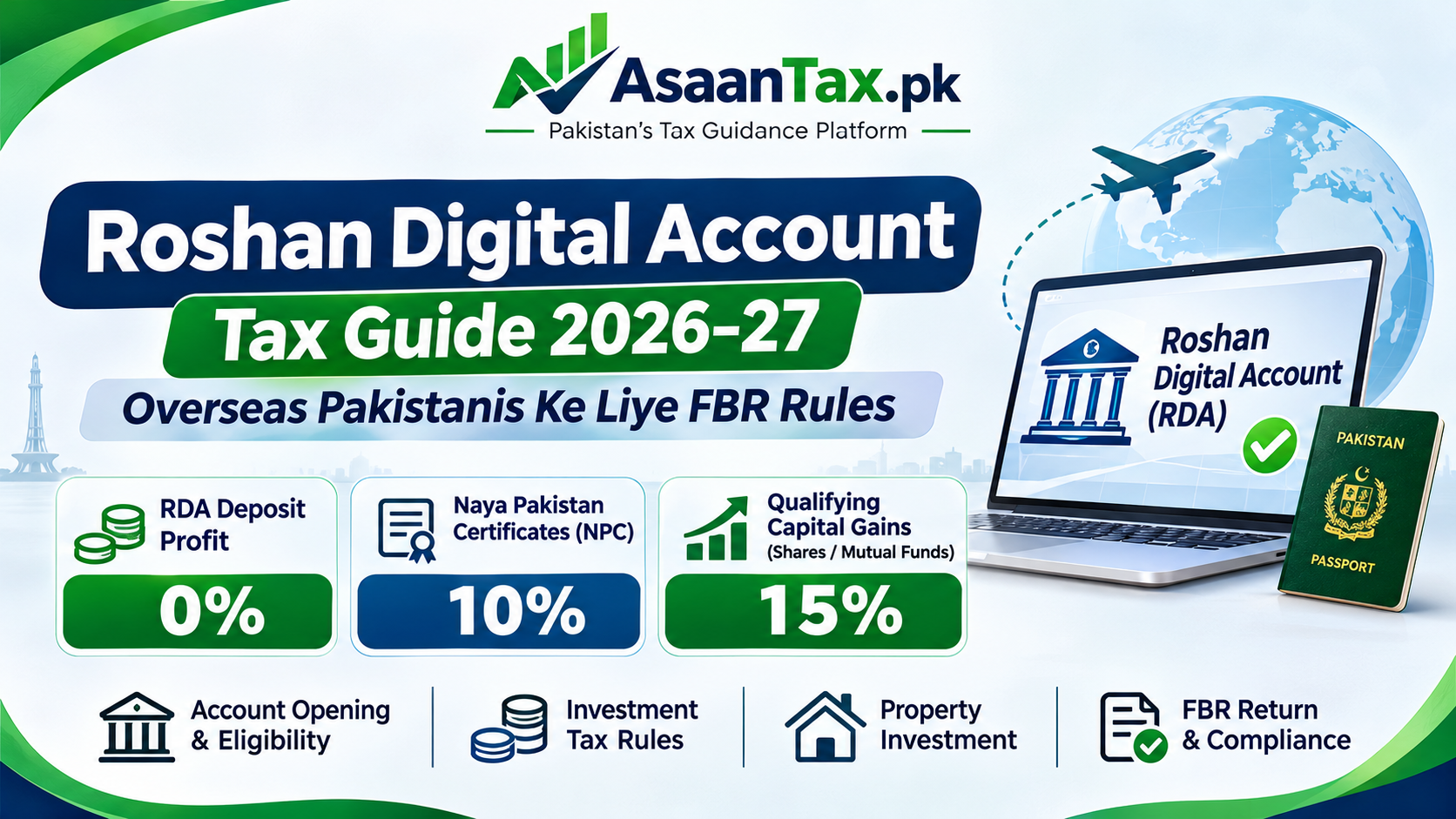
Latest Roshan Digital Account Tax Rates 2026–27
The State Bank of Pakistan publishes a simplified income tax framework for qualifying non-resident Pakistani RDA holders.
| Investment or Transaction | General Treatment for Eligible NRPs |
|---|---|
| Ordinary inward transfer of existing savings | No automatic income tax on transfer |
| Eligible RDA bank deposit profit | Exempt |
| Naya Pakistan Certificates | 10% final tax on profit |
| Qualifying shares capital gains | 15% final tax |
| Qualifying mutual fund capital gains | 15% final tax |
| Ordinary qualifying dividends | Generally 15% final tax |
| Specified IPP dividends | 7.5% |
| Certain tax-exempt-company dividends | 25% |
| Property investment | Applicable RDA and Income Tax Ordinance provisions |
| Qualifying cash withdrawals | No ordinary withdrawal withholding tax |
The actual rates and special treatments depend on the investor's eligibility, instrument and governing law.
This table should not be applied automatically to resident taxpayers or foreign companies.
Tax on Profit From RDA Savings Accounts
Under SBP's published simplified regime, qualifying profit earned by a non-resident Pakistani on RDA deposits is exempt from Pakistan income tax.
SBP states that:
- No withholding income tax is deducted from qualifying RDA deposit profit.
- No separate FBR exemption certificate is required.
- No Pakistan return is required solely in respect of that exempt deposit profit.
Example
Suppose an eligible non-resident Pakistani holds funds in an RDA savings account.
Hypothetical annual bank profit: Rs. 200,000.
Applicable qualifying RDA deposit-profit tax: 0%.
Illustrative Pakistan income tax on that profit: Rs. 0.
This example assumes the account and holder meet the exemption conditions.
Resident taxpayers and other account categories may have different treatment.
What Are Naya Pakistan Certificates?
Naya Pakistan Certificates (NPCs) are government-issued investment instruments available to eligible investors through the prescribed RDA framework.
They can be offered in supported currencies including Pakistani rupees and selected foreign currencies.
Both conventional and Shariah-compliant versions are available.
Their investment terms, maturity periods and profit rates depend on the current government and SBP product terms.
How Much Tax Applies to Naya Pakistan Certificates?
For qualifying investors covered by the special regime:
NPC profit is subject to 10% final withholding income tax.
The amount is generally deducted at source.
For a non-resident Pakistani whose only relevant Pakistan income is qualifying NPC profit, SBP states that a separate tax return is not required solely for that profit.
Example 1: NPC Profit of Rs. 100,000
Gross profit: Rs. 100,000.
Tax rate: 10%.
Tax deducted: Rs. 10,000.
Net profit after tax: Rs. 90,000.
Example 2: NPC Profit of Rs. 500,000
Gross profit: Rs. 500,000.
Tax deducted at 10%: Rs. 50,000.
Net profit: Rs. 450,000.
These calculations concern the profit, not the entire investment principal.
Naya Pakistan Certificate Tax Calculation Table
| Gross NPC Profit | Final Tax at 10% | Net Profit |
|---|---|---|
| Rs. 50,000 | Rs. 5,000 | Rs. 45,000 |
| Rs. 100,000 | Rs. 10,000 | Rs. 90,000 |
| Rs. 200,000 | Rs. 20,000 | Rs. 180,000 |
| Rs. 300,000 | Rs. 30,000 | Rs. 270,000 |
| Rs. 500,000 | Rs. 50,000 | Rs. 450,000 |
| Rs. 1,000,000 | Rs. 100,000 | Rs. 900,000 |
These are illustrative tax calculations and do not represent guaranteed investment returns.
Tax on Shares Purchased Through RDA
Eligible non-resident Pakistani investors can invest in Pakistan's stock market through the relevant RDA investment arrangements.
Under SBP's published simplified regime, qualifying capital gains on shares attract:
15% final tax on capital gains.
For example:
Purchase cost of shares: Rs. 1,000,000.
Sale proceeds: Rs. 1,300,000.
Illustrative gain: Rs. 300,000.
Tax at 15%: Rs. 45,000.
Net gain after tax: Rs. 255,000.
Actual gain calculations may involve eligible transaction costs and the applicable securities-tax rules.
Do not calculate 15% tax on the entire sale value when the relevant tax is imposed on a capital gain.
Dividend Tax on RDA Investments
SBP's simplified framework provides specific final withholding treatment for qualifying dividends received by eligible non-resident Pakistani investors.
The general published rates include:
| Dividend Category | Published Tax Treatment |
|---|---|
| Ordinary qualifying company dividends | 15% |
| Qualifying mutual fund dividends | Generally 15% |
| Specified Independent Power Producer dividends | 7.5% |
| Dividends from specified tax-exempt companies | 25% |
These special rates depend on the legal category of the company, investment and taxpayer.
Not every dividend automatically qualifies for the same 15% rate.
Tax on Mutual Funds Through RDA
Eligible non-resident Pakistani investors may invest in approved mutual funds through the RDA framework.
Under the simplified regime:
- Qualifying capital gains are generally subject to 15% final tax.
- Ordinary qualifying dividends are generally subject to 15% final tax.
- Special classifications can produce different outcomes.
Example
Original mutual fund investment: Rs. 2,000,000.
Illustrative redemption value: Rs. 2,400,000.
Gain before relevant adjustments: Rs. 400,000.
Tax at 15%: Rs. 60,000.
Net illustrative gain: Rs. 340,000.
Market values can rise or fall, and taxes do not eliminate investment risk.
Can Overseas Pakistanis Buy Property Through RDA?
Yes.
The RDA framework supports eligible real-estate transactions through participating banks, including the Roshan Apna Ghar facility.
Eligible investors may use their overseas funds to acquire residential or commercial property in Pakistan.
Some banks also offer permitted financing arrangements.
However, property acquisition and sale involve legal requirements beyond simply opening an RDA.
These may include:
- Property ownership and title verification.
- Applicable purchaser advance income tax.
- Seller advance income tax.
- Capital Gains Tax.
- Stamp duty and registration fees.
- Banking documentation.
- Repatriation conditions.
RDA Property Purchase and Sale Tax – Tax Year 2027
Property tax must be checked separately from bank deposit and NPC tax.
The Finance Act 2026 changed ordinary property withholding rates, including the ordinary filer sale rate under Section 236C.
In general, the ordinary filer rate under Section 236C for Tax Year 2027 is 2.75% of the relevant gross sale consideration.
The ordinary filer purchase rate under Section 236K is determined by the enacted Finance Act 2026 rate schedule.
Non-ATL rates and special exceptions may differ.
Furthermore, the special RDA property tax framework and the NICOP/POC non-resident filer-rate facility are distinct legal mechanisms.
Important Warning About Older RDA Property Rates
Some older SBP brochures and FAQs contain simplified RDA property tax figures, including historic 1% arrangements.
Do not automatically treat an old brochure's property rates as the current Finance Act 2026 rates for every transaction.
Before a property purchase or sale, obtain written confirmation of the correct treatment for the particular RDA-funded transaction from the relevant bank, FBR or qualified tax adviser.
Does an Overseas Pakistani Need to File an FBR Income Tax Return for RDA?
Not necessarily.
SBP's published framework explains that eligible non-resident Pakistani investors generally do not need to file a return solely in respect of specified exempt or final-tax RDA investment income.
For example:
- Qualifying RDA deposit profit may be exempt.
- NPC profit may be subject to 10% final tax.
- Qualifying share and mutual fund capital gains may be subject to final tax.
- Certain property gains have special RDA treatment.
However, this relief is not an unlimited exemption from every possible filing obligation.
A person may still be required to file because of other Pakistan-source income, business activities, registration status, statutory notices or another applicable filing test.
How to Report RDA Income in Tax Year 2027
If a taxpayer is otherwise required to file an income tax return, RDA transactions must be reviewed according to their actual legal category.
Step 1: Determine Pakistan Tax Residency
Establish whether the taxpayer qualifies as resident or non-resident for Tax Year 2027.
Tax residency is determined under the Income Tax Ordinance rather than nationality alone.
Step 2: Identify the Account and Investment Type
Separate:
- Ordinary RDA bank balances.
- Exempt deposit profit.
- NPC profit.
- Dividends.
- Securities capital gains.
- Property income and gains.
- Transfers of existing savings.
Step 3: Identify Exempt and Final-Tax Amounts
Determine whether an amount qualifies for exemption or a specific final-tax regime.
Step 4: Check Other Taxable Income
Review any Pakistan-source salary, business, rental or other income that may independently require filing.
Step 5: Reconcile Assets Where Required
Where the taxpayer is legally required to submit a wealth statement, disclose relevant assets, liabilities and transfers according to the prescribed form.
Step 6: Retain Bank and Investment Records
Keep investment certificates, bank statements, withholding certificates and remittance evidence.
Step 7: Submit the Applicable Return
Use the official FBR IRIS form for Tax Year 2027 once available.
Do not report an ordinary transfer of existing savings as new business income merely because the funds were received through an RDA.
What Is the Tax Difference Between Resident and Non-Resident RDA Holders?
The applicable concession may depend on residency.
Non-Resident Pakistani
A qualifying non-resident may benefit from the simplified RDA tax framework, subject to investment conditions.
Resident Pakistani With Declared Foreign Assets
Certain residents with qualifying declared foreign assets may access specified foreign-currency accounts or investments.
However, they must not assume that all non-resident tax exemptions apply to them automatically.
For example, ordinary deposit-profit tax treatment may differ.
Foreign Individuals or Entities
The expanded RDA framework allows additional qualifying non-resident persons to open accounts.
However, their tax obligations are determined under the specific provisions applicable to them.
The special individual NRP tax concessions should not automatically be extended to a foreign company.
How to Open a Roshan Digital Account Online
Step 1: Choose a Participating Bank
Visit the SBP RDA website and select a participating bank.
Step 2: Open the Bank's Digital Application
Complete the online account-opening form.
Step 3: Choose the Account Type
Select an eligible FCVA or NRVA account.
Step 4: Upload Identity Documents
Provide the required identification documents.
Step 5: Provide Residency Evidence
Submit proof of non-resident status where required.
Step 6: Provide Source-of-Funds Information
The bank may require employment, business or other relevant financial documents.
Step 7: Complete Digital Verification
Follow the bank's identity and customer-verification process.
Step 8: Receive Account Confirmation
SBP states that participating banks are expected to complete normal individual account opening within two working days after receipt of complete information, subject to due diligence.
Step 9: Transfer Funds From Abroad
Transfer money through the bank's permitted overseas banking channels.
Documents Required for Opening an RDA
Common requirements include:
- CNIC, NICOP or POC, as applicable.
- Passport, where relevant.
- Proof of non-resident status.
- Employment letter or salary slip.
- Foreign bank statements.
- Business registration or relevant professional records.
- Source-of-funds evidence.
- Digital photograph or identity verification.
- Applicable tax declarations, including FATCA documentation for relevant US customers.
The bank may request additional information for due diligence.
Can Money Be Deposited Locally Into an RDA?
RDA funding rules are designed to preserve the account's foreign-remittance and repatriation character.
Under SBP's published framework, ordinary local funds cannot simply be deposited into these accounts.
Permitted exceptions include eligible returns on investments made through RDA funds, disinvestment proceeds and other specified credits.
Example
An overseas Pakistani sends USD 10,000 from a foreign bank account to an eligible RDA.
That is generally within the intended funding framework.
However, a separate Rs. 2 million cash deposit from unrelated local funds cannot automatically be added to the RDA.
Always follow the bank's permitted funding instructions.
Can RDA Funds Be Transferred Back Abroad?
SBP provides repatriation facilities for eligible RDA balances and related funds.
This is a major attraction for overseas Pakistanis investing in Pakistan.
However, the remittance remains subject to the applicable account terms, transaction verification and other banking compliance requirements.
A transfer facility should not be interpreted as an exemption from tax on otherwise taxable income.
Is an RDA Better Than an Ordinary Pakistani Bank Account?
That depends on the person's goals.
An eligible overseas Pakistani may prefer an RDA for:
- Remote account opening.
- Holding permitted foreign-currency balances.
- International banking access.
- Repatriation facilities.
- Access to Naya Pakistan Certificates.
- Eligible securities and property investments.
An ordinary bank account may be more suitable for some domestic transactions or customers who do not qualify for RDA.
Customers should compare exchange rates, account charges, investment risks, currency exposure and tax treatment before deciding.
Are RDA Savings and Naya Pakistan Certificates Risk-Free?
Not all products carry the same risk.
Bank deposits, sovereign certificates, mutual funds, listed shares and real estate have different risk profiles.
Investors should consider:
- Exchange-rate changes.
- Changes in market value.
- Investment maturity.
- Early redemption rules.
- Applicable bank charges.
- Tax on investment returns.
- Product-specific terms.
Never select an investment based solely on its advertised gross return.
New State Bank RDA Rules in 2026
The State Bank's March 24, 2026 regulatory changes expanded RDA account-opening eligibility.
The expanded framework includes qualifying non-resident persons, including legal entities incorporated or registered abroad.
This development broadens access to Pakistan's banking and investment system.
However:
- Individual and corporate eligibility requirements differ.
- Tax treatment continues to depend on law and investor category.
- Existing non-resident Pakistani onboarding arrangements remain in place.
- Banks must continue to perform relevant customer due diligence.
- Investment products remain subject to their respective rules.
The account eligibility expansion should not be described as a universal tax holiday.
Common Roshan Digital Account Tax Mistakes
Avoid these common mistakes:
- Assuming every RDA transaction is completely tax-free.
- Confusing bank deposit profit with Naya Pakistan Certificate profit.
- Applying the 10% NPC rate to all RDA investments.
- Applying the 15% capital gains rate to an entire investment principal.
- Using historical property tax rates without checking Finance Act 2026.
- Assuming all RDA holders receive identical tax concessions.
- Ignoring tax residency.
- Treating ordinary local funds as eligible foreign remittances.
- Assuming RDA eligibility automatically means no income tax return is ever required.
- Losing investment and remittance records.
- Confusing repatriation rights with exemption from underlying tax.
- Investing without considering currency or market risk.
Tax with Naeem – Property Tax and Overseas Investment Video
For Urdu guidance on property tax and overseas Pakistani investment-related issues, see the relevant Tax with Naeem video:
236C Property Tax 2026–27 – Filer and Non-Filer Property Sale Tax
https://www.youtube.com/watch?v=Aizklp2P5qE
This video covers Section 236C and general property sale withholding rates, which are useful when understanding property transactions in Pakistan.
Important: This is a related property-tax video, not a dedicated tutorial on opening a Roshan Digital Account or on NPC taxation. RDA-specific rules should be checked using the State Bank's official guidance.
For additional RDA-specific tutorials from Tax with Naeem, search:
https://www.youtube.com/results?search_query=Tax+with+Naeem+Roshan+Digital+Account
How AsaanTax.pk Can Help Overseas Pakistanis
Overseas Pakistanis may need assistance in understanding tax residency, FBR return filing and the documentation of remittances and investments.
AsaanTax.pk provides guidance on:
- Pakistani tax residency and income tax obligations.
- Foreign remittance reporting.
- RDA-related investment tax classification.
- Naya Pakistan Certificate tax treatment.
- Property sale and purchase advance taxation.
- Capital Gains Tax guidance.
- FBR income tax return filing.
- Wealth Statement preparation.
- NTN registration and ATL status.
- General FBR compliance procedures.
Need Help Understanding RDA Tax Rules?
Visit AsaanTax.pk for guidance on Pakistani tax filing, overseas income and investment-related compliance.
Website: https://www.asaantax.pk/
AsaanTax.pk is an independent tax services website. It is not affiliated with the Federal Board of Revenue or the State Bank of Pakistan.
Official Sources and References
- State Bank of Pakistan – Roshan Digital Account
- State Bank of Pakistan – RDA FAQs
- SBP – March 24, 2026 RDA Eligibility Circular
- FBR – Income Tax Ordinance, 2001
- FBR – Finance Acts
- FBR – Overseas Pakistani Property Tax FAQs
- FBR – IRIS Tax Filing Portal
- Tax with Naeem – Section 236C Property Tax Video
Last updated: November 3, 2026.
Disclaimer: This guide provides general information. RDA tax concessions depend on the customer's eligibility, tax residency, account type, investment instrument and applicable legislation. Tax treatment of properties, companies and other categories may differ from simplified individual NRP examples. Confirm the current legal treatment and transaction-specific rate with the participating bank, FBR or a qualified tax professional before investing or filing a return.