Millions of overseas Pakistanis own residential plots, houses, apartments, commercial properties and agricultural or other immovable assets in Pakistan.
If you live in Saudi Arabia, UAE, Qatar, Oman, the United Kingdom, the United States, Canada or another country and are planning to sell property in Pakistan, you should understand the applicable Federal Board of Revenue (FBR) property tax rules.
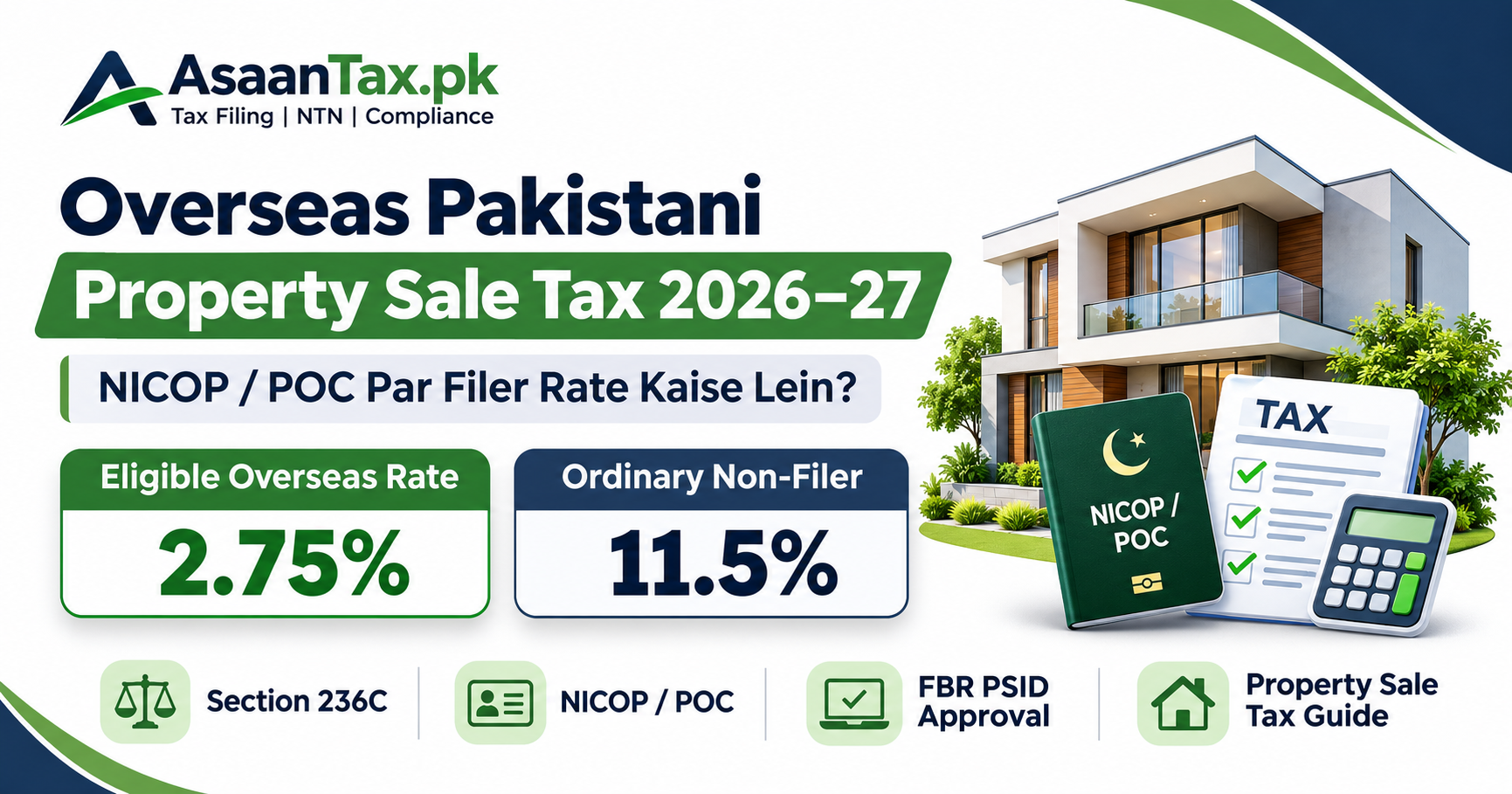
One of the most important facilities available to eligible overseas Pakistanis is the ability to obtain filer-rate advance income tax on property sales under Section 236C, even when they do not appear on the FBR Active Taxpayers List (ATL).
This concession is available to qualifying non-resident persons holding a National Identity Card for Overseas Pakistanis (NICOP) or Pakistan Origin Card (POC), subject to the prescribed FBR verification and approval procedure.
For Financial Year 2026–27, also known as Tax Year 2027, the ordinary Section 236C filer rate is 2.75%, while the ordinary non-filer rate is 11.5%.
This complete AsaanTax.pk guide explains the latest property sale tax rates, NICOP/POC eligibility, FBR approval procedures, PSID creation, tax calculations, Capital Gains Tax, documentation and income tax return reporting.
What Is Property Sale Tax Under Section 236C?
Section 236C of the Income Tax Ordinance, 2001 deals with advance income tax collected at the time of sale or transfer of immovable property.
The tax is generally collected from the seller by the relevant registration or transferring authority in accordance with the law.
It can apply to transactions involving:
- Residential plots.
- Houses and bungalows.
- Apartments and flats.
- Commercial shops.
- Offices.
- Commercial buildings.
- Other qualifying immovable properties.
The applicable rate depends on the current law and the seller's tax status, including any legally available overseas Pakistani concession.
Section 236C is advance income tax on the property transaction. It should not be confused with Capital Gains Tax on the profit arising from the disposal of property.
Latest Property Sale Tax Rates in Pakistan 2026–27
Finance Act 2026 introduced a reduced flat rate of 2.75% for ordinary ATL property sellers under Section 236C.
The ordinary non-filer withholding rate is 11.5%.
| Seller Status | Section 236C Rate |
|---|---|
| Active Taxpayer / Filer | 2.75% |
| Ordinary Non-Filer | 11.5% |
| Eligible overseas non-resident NICOP/POC holder with FBR approval | 2.75% |
Effective period: Financial Year 2026–27 / Tax Year 2027.
The 2.75% rate is applied to the relevant gross amount of consideration received.
Actual amounts should be determined according to the law and the documentation of the transaction.
Who Can Claim Filer Rate on Property Sale Using NICOP or POC?
An overseas Pakistani who does not appear on ATL can potentially obtain the ordinary filer rate under the special provisions applicable to qualifying non-residents.
The FBR facility is based on Clause 111AC of Part IV of the Second Schedule to the Income Tax Ordinance.
The essential requirements include:
1. Valid NICOP or POC
The person must hold a valid National Identity Card for Overseas Pakistanis or Pakistan Origin Card.
An ordinary Pakistani CNIC alone should not be assumed to satisfy the specific NICOP/POC condition.
2. Non-Resident Tax Status
The applicant must qualify as non-resident in Pakistan for the relevant period under the applicable income tax residency rules.
FBR's overseas property concession guidance refers to a stay in Pakistan of fewer than 183 days during the financial year.
However, Section 82 contains the statutory tests governing individual tax residency, and these must also be considered.
3. Supporting Documents
The applicant must provide the identification and residency documents required by FBR.
4. Approval Through the Prescribed Process
The relevant registrar, housing society or transferring authority initiates the special PSID procedure.
FBR verifies the submitted details before allowing the applicable filer-rate payment.
Important: The concession does not automatically make the person an active filer for every other transaction or remove unrelated income tax obligations.
NICOP vs POC – What Is the Difference?
NICOP and POC are identity documents used by different categories of overseas persons with Pakistani connections.
NICOP
NICOP is generally issued to eligible Pakistani citizens residing overseas.
POC
Pakistan Origin Card is generally available to specified foreign nationals with qualifying Pakistani connections.
For the relevant property transfer facility, FBR recognizes both NICOP and POC, provided the individual also meets the applicable non-resident and verification requirements.
How to Get Filer Rate on Property Sale Without ATL Status
FBR provides a special electronic procedure to obtain filer-rate treatment for eligible overseas Pakistanis.
Step 1: Contact the Property Transfer Authority
The concerned housing society, registrar, development authority or other authorized property transferring office starts the procedure.
Tell the officer that you are an eligible overseas Pakistani seeking the NICOP/POC non-resident filer-rate concession.
Step 2: Open FBR's Overseas Pakistani Facility
The authorized person accesses the Overseas Pakistanis option through the FBR web portal to initiate the applicable payment slip process.
Official information is available at:
https://www.fbr.gov.pk/overseas/174240/174241
Step 3: Enter NICOP or POC Details
The system requests the applicant's NICOP or POC number.
Where supported, the system retrieves the registered name and address.
Check that the details are correct.
Step 4: Upload the Identity Document
A scanned copy of the valid NICOP or POC must be uploaded.
Make sure the copy is clear and readable.
Step 5: Declare Non-Resident Status
Provide the applicable residency declaration and upload evidence if requested.
Examples of useful supporting documentation may include passport travel history, foreign residence information and employment or other residency records.
The Commissioner determines whether the submitted evidence is sufficient.
Step 6: Generate the Provisional PSID
The system generates the relevant provisional PSID and forwards the case electronically for approval.
This is not necessarily the same as a fully approved payment instruction.
Step 7: Commissioner Verification
The relevant Commissioner reviews the submitted documents and non-resident status.
If the application satisfies the requirements, the Commissioner approves the concession.
Step 8: Receive Approval Notification
FBR's published procedure provides for notification to the person who initiated the PSID through email and SMS after approval.
Step 9: Pay at the Approved Filer Rate
Following approval, the system permits payment of the relevant advance income tax at the ordinary filer rate.
Step 10: Obtain the CPR
Complete payment through an authorized channel and retain the Computerized Payment Receipt.
Provide the approved payment evidence to the relevant property transferring authority.
How Much Tax Can Overseas Pakistanis Save?
An eligible overseas Pakistani selling property can face a substantially smaller upfront Section 236C tax payment by obtaining the filer rate.
Consider a property sold for Rs. 20,000,000.
Ordinary Non-Filer
Rs. 20,000,000 × 11.5%
Tax = Rs. 2,300,000.
Approved Overseas NICOP/POC Seller
Rs. 20,000,000 × 2.75%
Tax = Rs. 550,000.
Difference
Difference in advance tax = Rs. 1,750,000.
This is a reduction in upfront withholding, not necessarily the seller's final income tax saving.
Final Capital Gains Tax, any applicable minimum tax provisions and other liabilities must be evaluated separately.
Property Sale Tax Calculation Examples
The following table uses hypothetical gross sale amounts.
| Property Sale Value | Filer / Eligible Overseas 2.75% | Ordinary Non-Filer 11.5% | Difference |
|---|---|---|---|
| Rs. 5,000,000 | Rs. 137,500 | Rs. 575,000 | Rs. 437,500 |
| Rs. 10,000,000 | Rs. 275,000 | Rs. 1,150,000 | Rs. 875,000 |
| Rs. 15,000,000 | Rs. 412,500 | Rs. 1,725,000 | Rs. 1,312,500 |
| Rs. 20,000,000 | Rs. 550,000 | Rs. 2,300,000 | Rs. 1,750,000 |
| Rs. 30,000,000 | Rs. 825,000 | Rs. 3,450,000 | Rs. 2,625,000 |
| Rs. 50,000,000 | Rs. 1,375,000 | Rs. 5,750,000 | Rs. 4,375,000 |
| Rs. 100,000,000 | Rs. 2,750,000 | Rs. 11,500,000 | Rs. 8,750,000 |
The figures illustrate Section 236C withholding tax only.
They do not include any separate Capital Gains Tax, stamp duty, transfer charges or other applicable transaction costs.
Does the NICOP/POC Concession Apply to Property Purchase?
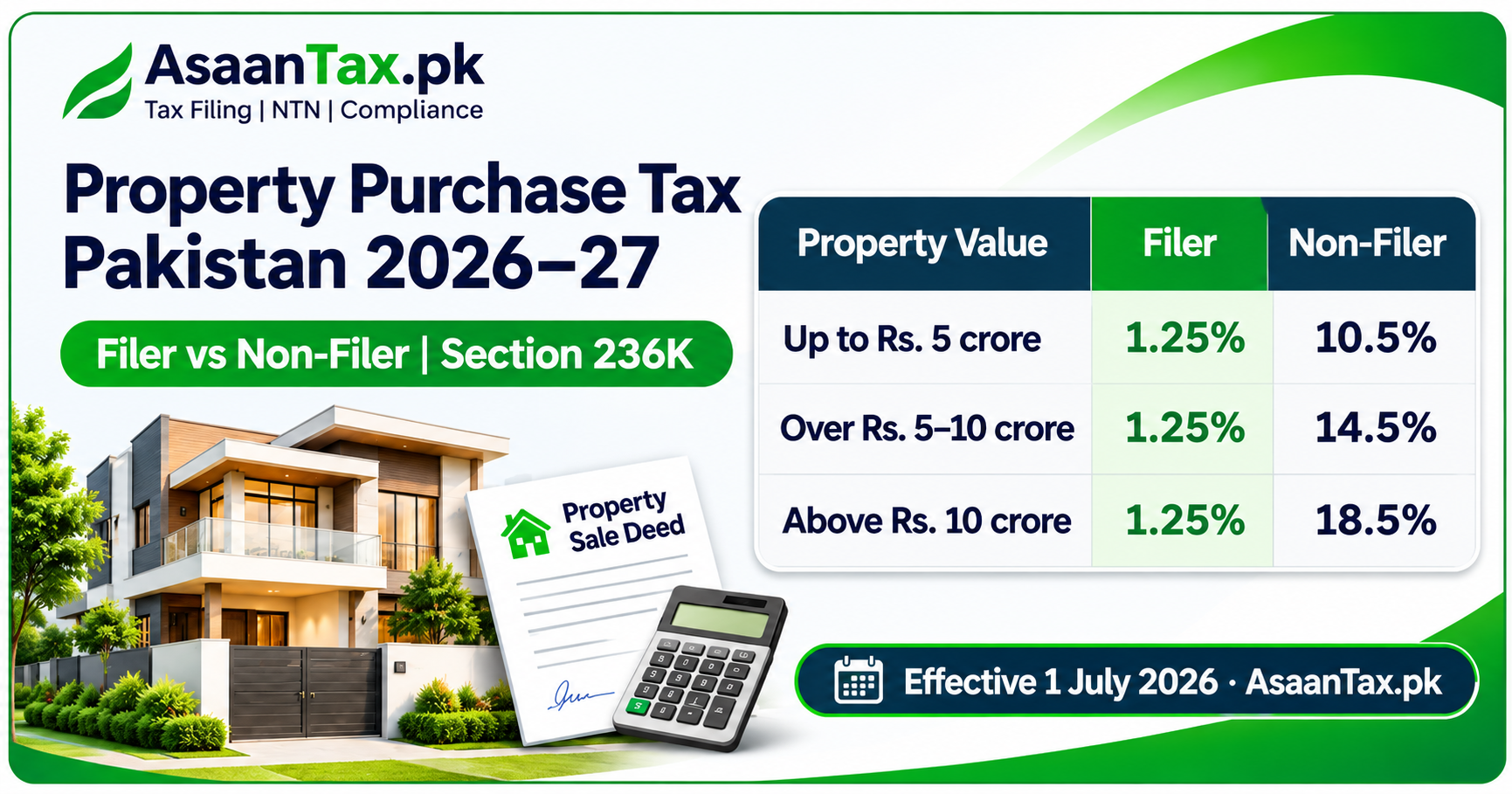
Yes. FBR's overseas concession framework covers qualifying purchases and sales of immovable property under Sections 236K and 236C respectively.
Section 236C
Advance income tax collected from the seller when property is sold or transferred.
Section 236K
Advance income tax collected from the purchaser when property is acquired.
The two sections have different tax rates and applicable valuation rules.
A seller should not use the Section 236K purchase rate to calculate tax on their property sale.
The NICOP/POC verification facility may be used for the relevant eligible purchase or sale transaction.
What If an Overseas Pakistani Does Not Have NICOP or POC?
The special concession requires the relevant qualifying identification document.
A foreign residence visa, overseas employment contract or Pakistani passport alone should not automatically be treated as meeting the NICOP/POC requirement.
If a person is eligible to obtain NICOP or POC, they should complete the relevant identity registration process before relying on this facility.
If the special concession cannot be established, the applicable ordinary tax status and withholding rules must be determined separately.
What Documents Are Required?
The following documents are commonly useful when applying for the overseas property sale concession:
| Document | Purpose |
|---|---|
| NICOP / POC | Establish qualifying identity |
| Passport | Travel and identity information |
| Foreign residence permit or visa | Support foreign residency |
| Entry and exit travel records | Support Pakistan stay calculation |
| Foreign employment or residence evidence | Additional non-resident proof |
| Property ownership documents | Establish ownership |
| Sale agreement | Establish transaction details |
| Property transfer documentation | Support transfer procedure |
| Tax registration details, where available | Identify taxpayer |
| Approved PSID and CPR | Confirm advance tax payment |
The Commissioner or transferring authority may require additional evidence depending on the facts.
Can Someone Else Complete the Procedure for an Overseas Seller?
An overseas Pakistani may appoint an authorized representative where legally permitted.
This may require a valid power of attorney and other prescribed documents.
The housing society or registrar still follows the applicable FBR verification process.
Using an agent does not remove the need for genuine NICOP/POC documentation and correct non-resident status.
The seller should review the PSID, approval and payment receipts before the property transfer is completed.
What Is the Difference Between Section 236C and Capital Gains Tax?
A very important distinction must be understood.
Section 236C – Advance Withholding Tax
Section 236C tax is collected in connection with the gross property sale consideration.
For an eligible overseas Pakistani, the ordinary filer rate can apply after the special verification process.
Capital Gains Tax – Section 37
Capital Gains Tax concerns the taxable gain derived from disposing of an asset, subject to acquisition date, holding period, exemptions and other relevant rules.
The tax on gross sale consideration and the tax on the gain are not the same calculation.
Example
Original property acquisition cost: Rs. 10,000,000.
Gross property sale consideration: Rs. 15,000,000.
Illustrative gross gain before applicable deductions and adjustments: Rs. 5,000,000.
Section 236C advance tax at 2.75%:
Rs. 15,000,000 × 2.75% = Rs. 412,500.
This advance tax is separate from determining the tax treatment of the Rs. 5,000,000 gain.
The applicable Capital Gains Tax rate must be established under the law relevant to the acquisition and disposal.
Capital Gains Tax Depends on Property Acquisition Date
For immovable property in Pakistan, Capital Gains Tax treatment can differ significantly according to when the property was acquired.
Property Acquired Before July 1, 2024
The applicable rules generally involve the property's classification and holding period.
Different provisions can apply to plots, constructed property and flats.
Property Acquired on or After July 1, 2024
A different framework applies, with treatment depending on taxpayer status and the applicable provisions of the First Schedule.
The specific outcome can also be affected by later legislative amendments.
Important: Obtaining a 2.75% rate under Section 236C does not automatically mean that the same rate applies to the capital gain.
Before selling, calculate both the advance property sale tax and the applicable Capital Gains Tax separately.
Is Section 236C Tax Adjustable?
Section 236C generally operates as advance income tax, subject to the applicable adjustment and minimum-tax provisions.
Where the law permits, the amount collected may be credited against the person's income tax liability.
However, the exact treatment depends on the seller's circumstances, property holding period, tax residency and current legislation.
A taxpayer should not assume that the entire payment is automatically refundable.
Maintain the official payment documentation and seek an appropriate final tax calculation.
Must an Overseas Pakistani File an Income Tax Return After Selling Property?
The obligation to file depends on the person's residency, Pakistan-source income, assets and applicable statutory filing tests.
Being a non-resident and obtaining filer-rate withholding under the NICOP/POC concession does not automatically exempt the seller from every return filing obligation.
Similarly, receiving the special Section 236C withholding rate does not by itself make the seller an active taxpayer for all other purposes.
Property sale income and gains may require appropriate reporting in Pakistan.
A person should evaluate their specific obligations under Section 114 and related income tax provisions.
How to Report Property Sale in Tax Year 2027
When preparing the applicable FBR return:
Step 1: Determine Tax Residency
Confirm resident or non-resident status for the relevant tax year.
Step 2: Identify Property Acquisition Date
Keep the original purchase documents and acquisition cost records.
Step 3: Determine Gross Sale Consideration
Use accurate transaction documents and the applicable statutory rules.
Step 4: Calculate Capital Gain
Determine the legally relevant cost, adjustments and gain.
Step 5: Apply the Relevant Capital Gains Tax Rules
Consider the acquisition date, holding period and relevant legal provisions.
Step 6: Report Advance Tax Under Section 236C
Record the payment supported by the official CPR and withholding documentation in the applicable return or tax-payment records.
Step 7: Report Relevant Asset Disposal
Where a wealth statement is required, reconcile the disposal of property and the resulting cash, bank balances or other assets.
Step 8: Submit and Retain Records
Complete the return and any required statements through FBR IRIS.
The actual Tax Year 2027 return form should be checked when released by FBR.
What If the Overseas Property Sale PSID Is Rejected?
A PSID application may require correction if the submitted information is incomplete or inconsistent.
Possible issues include:
- Expired or unreadable NICOP/POC.
- Incorrect identification number.
- Mismatch in registered information.
- Inadequate non-resident evidence.
- Incorrect residency declaration.
- Missing supporting documents.
- Errors in property or taxpayer information.
Ask the relevant registrar or transferring authority to review the application status and the reason communicated through the official system.
Resolve the identified issue and follow the applicable resubmission process.
Do not make a payment under an incorrect tax category merely to complete a transfer urgently.
How Long Does FBR Approval Take?
FBR's November 2024 operational instructions requested priority processing of non-resident status verification, with a target of one business day.
However, this is an administrative processing instruction and should not be treated as a guarantee that every application will be approved within one day.
Approval depends on the completeness and verification of the submitted documents.
Begin the procedure before the planned transfer date.
Is Money Received From Overseas Property Sale Tax-Free?
No.
Selling property in Pakistan and sending the sale proceeds abroad are distinct issues.
Income tax on the disposal may still apply.
The movement of funds through a bank does not automatically exempt the underlying gain.
An overseas Pakistani who intends to repatriate property sale proceeds should also check applicable State Bank of Pakistan foreign exchange rules, bank documentation and any transaction-specific restrictions.
Do not assume that all property proceeds can be transferred abroad without regulatory requirements.
Does the Special Overseas Concession Make Someone a Filer?
No.
The benefit allows eligible non-resident NICOP/POC holders to receive the ordinary filer withholding rate for specified property transactions even if they are not on ATL.
It is a targeted legal concession, not automatic inclusion in FBR's Active Taxpayers List.
Other transactions may still be subject to ordinary taxpayer-status rules unless a separate exemption applies.
Common Mistakes Overseas Pakistanis Should Avoid
- Using outdated Finance Act 2025 property sale tax rates.
- Assuming NICOP ownership alone guarantees the concession.
- Ignoring non-resident eligibility.
- Generating an ordinary non-filer PSID before checking the special process.
- Failing to upload a valid NICOP or POC.
- Not retaining foreign residency evidence.
- Confusing Section 236C with Section 236K.
- Assuming the 2.75% withholding rate is also the Capital Gains Tax rate.
- Failing to check the actual property acquisition date.
- Ignoring income tax return filing obligations.
- Losing the PSID or CPR.
- Transferring property without verifying the approved tax treatment.
Watch Property Sale Tax Video – Tax with Naeem
For a practical Urdu-language explanation of Section 236C and the latest property sale tax rates, watch the video published on Tax with Naeem:
236C Property Tax 2026–27 | Property Sale Tax 2.75% Filer & 11.5% Non-Filer | Pakistan
https://www.youtube.com/watch?v=Aizklp2P5qE
This video explains:
- What Section 236C means.
- How property sale advance tax is calculated.
- Filer and non-filer property sale tax rates.
- Gross sale consideration.
- Tax calculation examples for Tax Year 2027.
Important: The video explains general Section 236C property sale rates. The NICOP/POC overseas approval procedure must additionally be verified through FBR's special overseas taxpayer facility.
How AsaanTax.pk Helps Overseas Pakistani Property Sellers
Are you an overseas Pakistani planning to sell property in Pakistan?
Unsure whether you qualify for the NICOP/POC filer-rate concession?
AsaanTax.pk provides guidance on Pakistani income tax compliance, property tax calculations and supporting documentation.
Our services include:
- Section 236C property sale tax guidance.
- NICOP/POC filer-rate eligibility review.
- Overseas Pakistani tax status guidance.
- General PSID and CPR assistance.
- Income tax return filing.
- Capital Gains Tax calculation guidance.
- Property sale tax reporting.
- Wealth statement preparation and reconciliation.
- FBR registration and ATL verification guidance.
- General property taxation compliance.
Need Help Understanding Overseas Property Sale Tax?
Visit AsaanTax.pk for information about property taxes, income tax returns and non-resident Pakistani tax compliance.
Website: https://www.asaantax.pk/
AsaanTax.pk is an independent tax services provider and is not an official website of FBR or the Government of Pakistan.
Official Sources and References
- FBR – Overseas Pakistani Filer-Rate FAQs
- FBR – Overseas Pakistanis Portal
- FBR – Withholding Tax Rate Cards
- FBR – Finance Acts
- FBR – Income Tax Ordinance, 2001
- FBR – IRIS Taxpayer Portal
- Tax with Naeem – Section 236C Property Sale Tax Video
Last updated: November 3, 2026.
Disclaimer: This article provides general information. The NICOP/POC filer-rate concession depends on non-resident status, statutory eligibility, verification and approval by FBR. Advance tax under Section 236C is distinct from Capital Gains Tax, and income tax filing or other liabilities may still apply. Always verify applicable rates and documentation with FBR, the property transferring authority or a qualified tax professional before completing a sale.