The Federal Board of Revenue (FBR) has introduced significantly higher Active Taxpayers List (ATL) surcharges for people who file their income tax returns after the prescribed deadline.
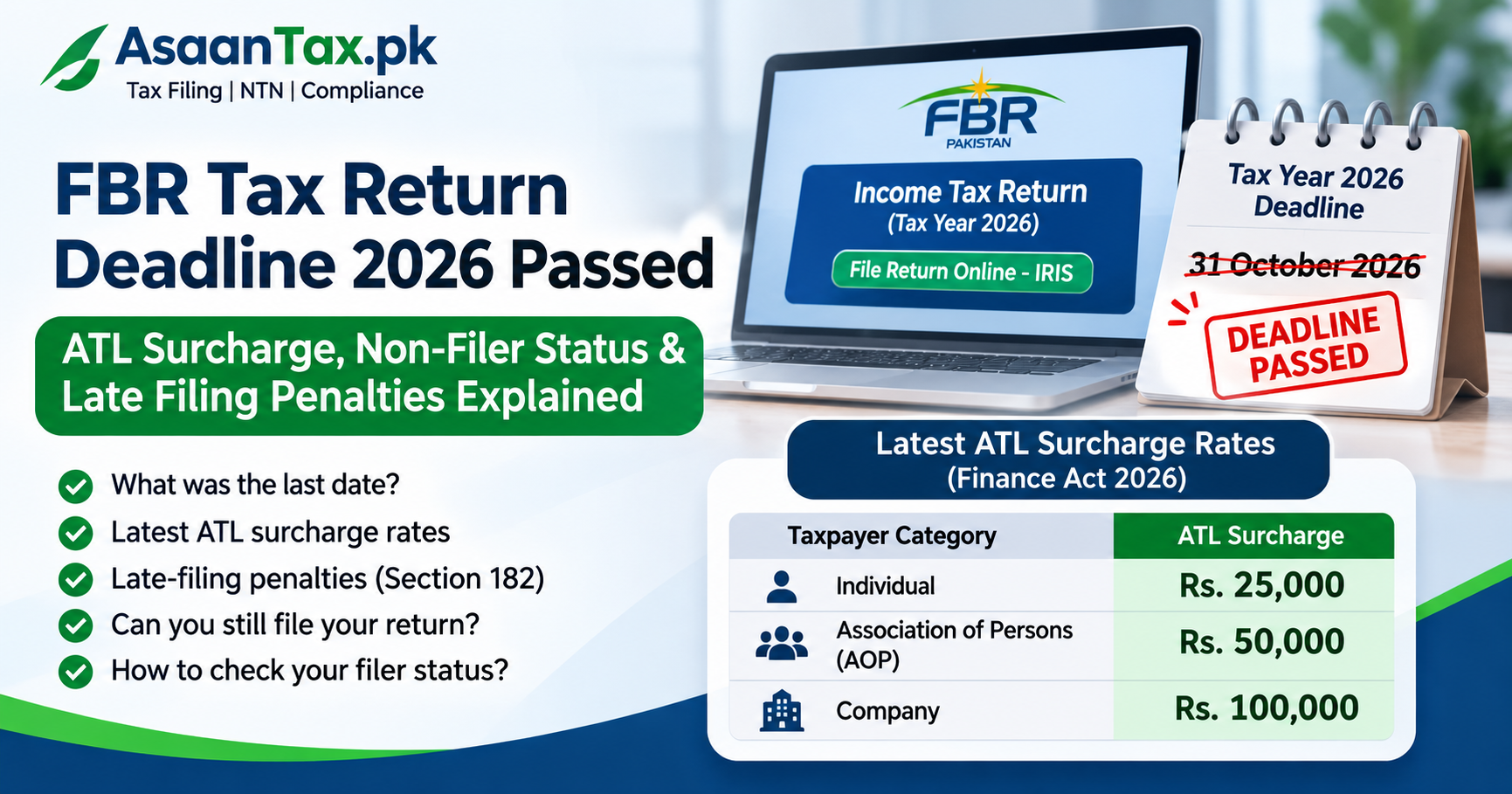
For Tax Year 2026, the extended general return filing deadline was October 31, 2026.
Following the deadline, many individuals discovered that their income tax return could be submitted successfully through IRIS while their Active Taxpayer List status remained inactive.
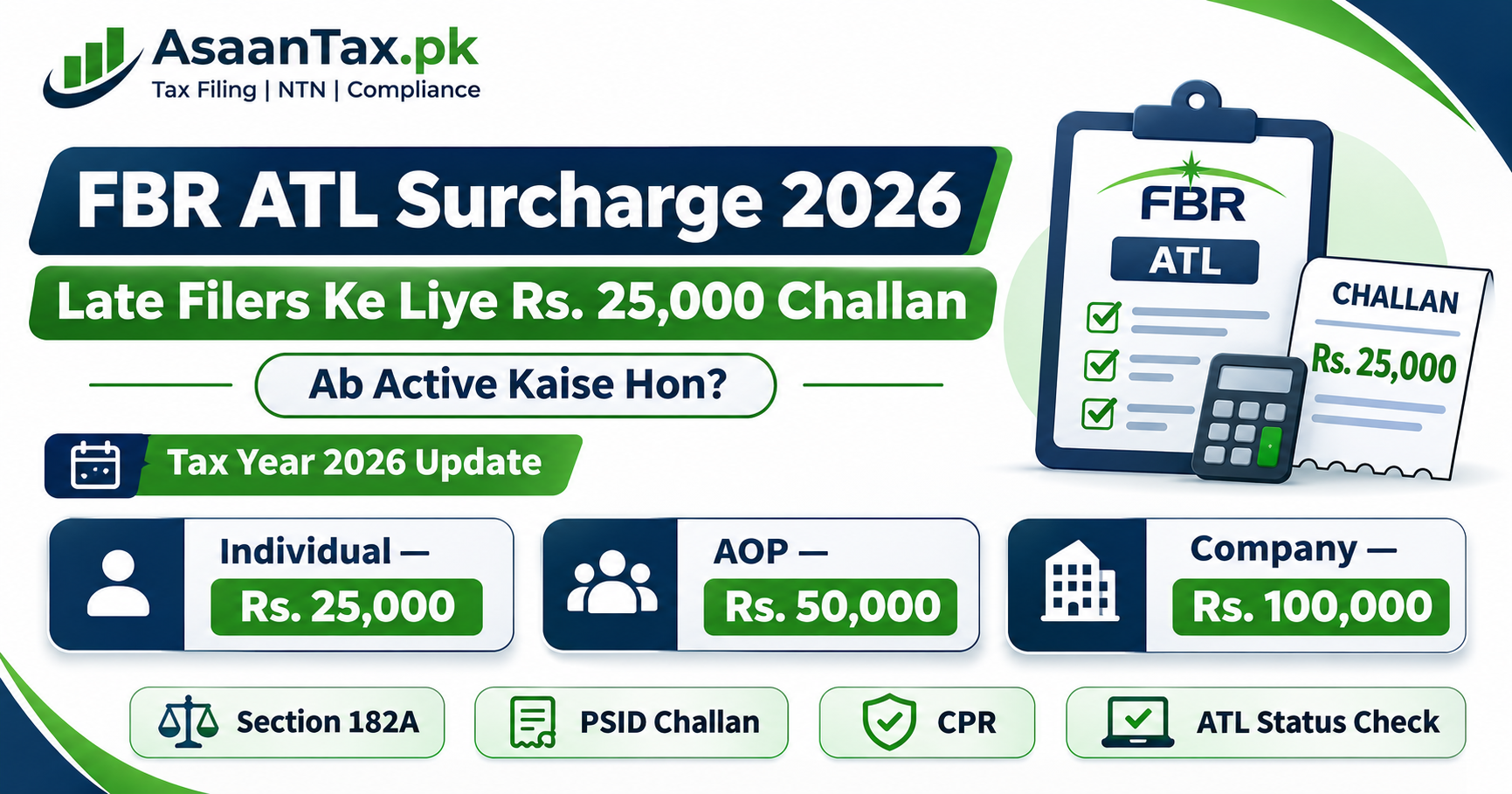
The major concern is the Rs. 25,000 ATL surcharge for late-filing individuals, introduced under the revised Section 182A framework through Finance Act 2026.
Different surcharge amounts apply to Associations of Persons (AOPs) and companies.
This AsaanTax.pk guide explains the latest surcharge rates, why a return can be filed but ATL status may remain inactive, how to generate a PSID, how to pay the ATL surcharge, how to verify the CPR and how to check whether a legally available surcharge-free undertaking option applies.
What Is the FBR Active Taxpayers List?
The Active Taxpayers List, commonly called ATL, is maintained by FBR for income tax purposes.
It identifies taxpayers who meet the applicable conditions for active taxpayer status.
Banks, property registration authorities, motor vehicle registering authorities and other withholding agents use ATL information to determine relevant withholding tax treatment.
An active taxpayer can qualify for favorable withholding tax rates on specified transactions.
However, ATL status does not mean complete exemption from income tax.
What Happened After October 31, 2026?
The ordinary income tax return deadline for Tax Year 2026 was initially September 30, 2026.
FBR subsequently extended the general deadline for the relevant taxpayers to October 15, 2026 and then October 31, 2026.
Following expiry of the deadline, the ATL was updated.
Taxpayers whose returns were not filed by the applicable deadline, or a validly extended deadline, could find that their ATL status was inactive.
Important
A taxpayer with an individually approved extension under Section 119 may have a different position.
The actual approval and applicable extended date should be verified before treating a person as a late filer.
Latest FBR ATL Surcharge Rates in 2026
Finance Act 2026 increased the surcharge payable for late inclusion in ATL.
| Taxpayer Category | Old Surcharge | Revised Surcharge |
|---|---|---|
| Individual | Rs. 1,000 | Rs. 25,000 |
| AOP | Rs. 10,000 | Rs. 50,000 |
| Company | Rs. 20,000 | Rs. 100,000 |
The revised amounts apply under the relevant Section 182A framework.
Important: These figures concern late inclusion in ATL. They are not automatically the complete income tax liability or total penalties for failing to file.
What Is Section 182A of the Income Tax Ordinance?
Section 182A deals with restrictions on appearing in the Active Taxpayers List following late compliance with relevant income tax return requirements.
The provision allows qualifying late filers to obtain ATL inclusion through payment of the prescribed surcharge, subject to the applicable legal conditions.
Example
An individual was required to submit the Tax Year 2026 return by October 31, 2026.
The individual files on November 5, 2026.
The return may be accepted by the IRIS system.
However, the person may still show as inactive on ATL until the requirements of Section 182A are satisfied.
For an individual required to pay the ordinary revised surcharge, the amount is Rs. 25,000.
Is the Rs. 25,000 ATL Surcharge for Everyone?
No.
The Rs. 25,000 revised surcharge is the relevant individual rate.
AOPs and companies have different amounts.
Also, the rules depend on whether the person has actually failed to meet the applicable filing deadline.
For example, a validly approved extension can affect whether a return is late.
In addition, Section 182A(3) contains a special undertaking-based relief provision for individuals, subject to prescribed implementation requirements.
Therefore, the correct amount and legal position should be checked before paying.
Is Filing the Return Enough to Become an Active Filer?
For a timely return, the taxpayer may be included in ATL once the prescribed requirements and system processing are completed.
However, filing after the applicable deadline can trigger the surcharge requirement.
Example
Person A files the required return by October 31, 2026.
Person B files the same type of return on November 5, 2026.
Under the ordinary rules:
- Person A can qualify for ATL inclusion without a late-inclusion surcharge.
- Person B may need to satisfy Section 182A surcharge or an applicable legally recognized relief mechanism.
A submitted return and active ATL status are not always the same thing.
How to Generate the Rs. 25,000 ATL Surcharge Challan
FBR provides an electronic payment facility through IRIS.
The general surcharge payment process is as follows.
Step 1: Open FBR IRIS
Visit the official portal:
Step 2: Sign In
Enter the taxpayer's registered credentials.
Step 3: Confirm the Return Is Filed
Check that the relevant Tax Year 2026 return has been successfully submitted.
Do not confuse a saved draft with a filed return.
Step 4: Open the Payment Facility
Use the available e-payment or payment creation section.
Step 5: Select Income Tax
Choose the appropriate income tax payment category.
Step 6: Locate the ATL Surcharge Payment Nature
FBR's published payment guidance describes the ATL surcharge under the Miscellaneous (Misc) payment nature.
Select the available option corresponding to Surcharge for ATL or the equivalent current IRIS description.
The exact screen wording may change.
Step 7: Select the Relevant Period
Choose the period or tax year prescribed by the current payment interface.
Do not automatically select Tax Year 2027 simply because payment is being made during financial year 2026–27.
The late return concerned is Tax Year 2026.
Step 8: Verify the Taxpayer Category
Confirm whether the payer is an individual, AOP or company.
Step 9: Verify the Applicable Amount
For an ordinary late-filing individual subject to the revised surcharge:
Rs. 25,000.
For AOPs and companies, use the applicable revised amounts.
Step 10: Generate the PSID
Review the information and generate the payment slip.
Step 11: Complete Payment
Use an authorized banking or electronic payment channel supported by FBR.
Step 12: Obtain the CPR
After successful payment, retain the Computerized Payment Receipt.
Step 13: Verify ATL Status
Check the Active Taxpayers List after the payment has been recorded and the relevant processing is complete.
Important: The actual PSID controls should be followed as displayed. Do not manually invent a payment reference, tax code or challan category.
Difference Between PSID and CPR
| Term | Meaning |
|---|---|
| PSID | Payment Slip ID created before payment |
| CPR | Computerized Payment Receipt generated after successful payment |
| ATL | Active Taxpayers List |
| Section 182A | Statutory late-ATL inclusion provisions |
Example
A person generates an ATL surcharge PSID for Rs. 25,000.
The person has not yet paid it.
This does not prove that the surcharge has been deposited.
After successful payment, the corresponding CPR is issued.
FBR states that CPR information generally reflects in IRIS within approximately 24 hours after payment.
How to Pay an ATL Challan Online
After generating the correct PSID, check which banking channels the current payment screen supports.
The process generally involves:
- Open the authorized bank or payment application.
- Select the supported government tax payment facility.
- Enter the PSID.
- Verify the displayed taxpayer and amount.
- Confirm payment.
- Save the payment acknowledgment.
- Obtain or verify the FBR CPR.
- Check ATL status.
Never send a surcharge payment to a personal bank account or an unofficial payment link.
How to Check Whether You Are Active on ATL
FBR provides online and SMS verification facilities.
Online ATL Verification
Open the official FBR IRIS verification portal.
Select the Active Taxpayer List (Income Tax) option.
Enter the required identification details and complete verification.
SMS Verification
For an individual, the standard FBR SMS format is:
ATL 1234567890123
Send the message to 9966, replacing the example with the taxpayer's actual 13-digit CNIC without dashes.
The official FBR site also publishes the latest ATL files.
Important
The ATL is updated daily under the rules introduced in October 2024.
However, an individual payment may require system processing and reconciliation before the active status is visible.
What If the Rs. 25,000 Challan Is Paid but ATL Remains Inactive?
A payment may be successful while ATL status has not yet updated.
Possible reasons include:
- Payment reconciliation is pending.
- Incorrect taxpayer identifier was entered.
- Incorrect payment nature was selected.
- Incorrect relevant period was used.
- The return is still a draft.
- Return or registration information does not match.
- The payment has not yet appeared in the relevant FBR records.
- Another legal compliance issue applies.
Recommended Action
First, verify the CPR.
Second, check that the Tax Year 2026 return was submitted.
Third, confirm the PSID and CPR match the correct taxpayer.
Fourth, recheck ATL after the normal processing period.
If the issue persists, raise it through the official FBR support process with proper documentation.
Do not pay a second Rs. 25,000 challan merely because the status did not update immediately.
Can Individuals Become Active Without Paying Rs. 25,000?
Section 182A(3), introduced through Finance Act 2026, contains a special mechanism involving an undertaking by an individual not to acquire property for six months.
In October 2026, FBR published proposed procedural rules through Draft S.R.O. 1691(I)/2026.
The draft proposed the use of Form ATL-U through IRIS.
What Would the Undertaking Require?
An eligible individual would undertake not to purchase, acquire or otherwise obtain ownership or beneficial interest in property for six months.
In exchange, the statutory surcharge condition could be relieved according to the applicable framework.
Is Form ATL-U Already Operational?
As of November 5, 2026, the draft procedural notification has been identified, but a final implementing notification or universally operational Form ATL-U facility has not been independently confirmed.
Therefore, taxpayers should not assume the draft online process is already available.
Important Risks
If the undertaking is lawfully given and then breached, the relief can be affected under the relevant legislation and prescribed procedure.
Do not give an undertaking that you do not intend to honor.
The relief is specifically directed toward eligible individuals; it should not automatically be extended to AOPs or companies.
Can a Late Filer Purchase Property?
Filing a tax return late does not itself create a universal ban on purchasing property.
However, higher withholding rates and other statutory restrictions may apply depending on the person's status and circumstances.
An individual who gives the special six-month undertaking must comply with its terms.
A person planning to acquire property during the next six months should carefully review whether the undertaking route is appropriate.
ATL Surcharge vs Late Filing Penalty
These are separate concepts.
ATL Surcharge – Section 182A
Paid to satisfy the applicable conditions for late inclusion in the Active Taxpayers List.
Late Filing Penalty – Section 182
May arise where the law imposes a penalty for failing to furnish a return within the required period.
Outstanding Income Tax
Any actual tax payable under the annual return is a separate liability.
Default Surcharge
May apply on certain unpaid tax liabilities according to the relevant provisions.
Paying the ATL surcharge does not automatically settle every income tax liability, default surcharge or penalty.
Why Is ATL Status Important?
Being on ATL can affect withholding tax on certain financial transactions.
Examples include:
- Property purchase.
- Property sale.
- Vehicle registration.
- Specified banking and investment transactions.
- Certain business payments.
- Other transactions covered by ATL-sensitive withholding rates.
The benefit depends on the relevant section and current withholding tax schedule.
Not every tax is zero for a filer.
What Documents Should a Late Filer Keep?
| Document | Purpose |
|---|---|
| Tax Year 2026 filed return | Proof of filing |
| Return acknowledgment | Submission evidence |
| Valid extension approval, where applicable | Filing deadline verification |
| ATL surcharge PSID | Payment reference |
| CPR | Completed payment evidence |
| ATL status verification | Confirmation of active status |
| FBR correspondence | Resolve discrepancies |
| Relevant financial statements | Support accurate tax filing |
Common Mistakes When Paying the ATL Surcharge
Avoid these mistakes:
- Using the old Rs. 1,000 individual surcharge.
- Treating Rs. 25,000 as the surcharge for companies.
- Paying before confirming whether the return is actually late.
- Ignoring an approved filing extension.
- Selecting the wrong tax year or payment type.
- Confusing an unpaid PSID with a CPR.
- Paying an unofficial intermediary rather than FBR.
- Assuming the payment instantly updates ATL.
- Paying the same surcharge twice.
- Treating the proposed Form ATL-U as automatically operational.
- Making a property-purchase undertaking without understanding the restriction.
- Ignoring separate late-filing penalties or tax liabilities.
- Using an incorrect CNIC or NTN.
- Failing to preserve the CPR.
Tax with Naeem – Related Income Tax Filing Video
For Urdu guidance on income tax return filing and tax reporting, watch this related video associated with Tax with Naeem:
Income Tax Return Filing in Pakistan | Salary | Rental | Capital Gain | Dividend Explained
https://www.youtube.com/watch?v=VX88o1N1AfA
This video explains general return-filing concepts.
It is not a dedicated Tax Year 2026 Rs. 25,000 ATL surcharge tutorial.
For videos specifically about the new ATL surcharge, search:
https://www.youtube.com/results?search_query=Tax+with+Naeem+ATL+Surcharge+25000+2026
How AsaanTax.pk Can Help With ATL Issues
AsaanTax.pk provides guidance on:
- Late income tax return filing.
- FBR ATL status verification.
- Section 182A surcharge procedures.
- PSID payment documentation.
- CPR verification.
- Income tax return reconciliation.
- Individual, AOP and company return preparation.
- FBR notice and filing compliance guidance.
Need Help Understanding Your FBR ATL Status?
Visit AsaanTax.pk for assistance with Pakistan income tax return filing and general ATL compliance procedures.
Website: https://www.asaantax.pk/
AsaanTax.pk is an independent tax services platform and is not affiliated with the Federal Board of Revenue or the Government of Pakistan.
Official Sources and References
- FBR – Income Tax Ordinance, 2001
- FBR – Finance Act 2026
- FBR – Active Taxpayers List
- FBR – Daily Updated ATL
- FBR – Pay Income Tax and ATL Surcharge
- FBR – SRO Notifications, Including Draft 1691(I)/2026
- FBR – IRIS Portal
- Tax with Naeem – Related Income Tax Tutorial
Last updated: November 5, 2026.
Disclaimer: This article is for general educational purposes. The actual filing deadline, surcharge requirement, eligibility for exceptions and online payment procedure depend on current legislation, valid extensions, final notifications and individual taxpayer circumstances. The October 2026 Form ATL-U implementing rules were published as a draft; their operational availability should be confirmed before relying on that procedure. Verify payment details through FBR IRIS and consult a qualified tax professional where necessary.