FBR Tax Return Deadline 2026 Passed – Updated ATL Surcharge, Non-Filer Status & Late Filing Penalties in Pakistan
Published: November 2, 2026 | Tax Year: 2026 | By AsaanTax Editorial Team
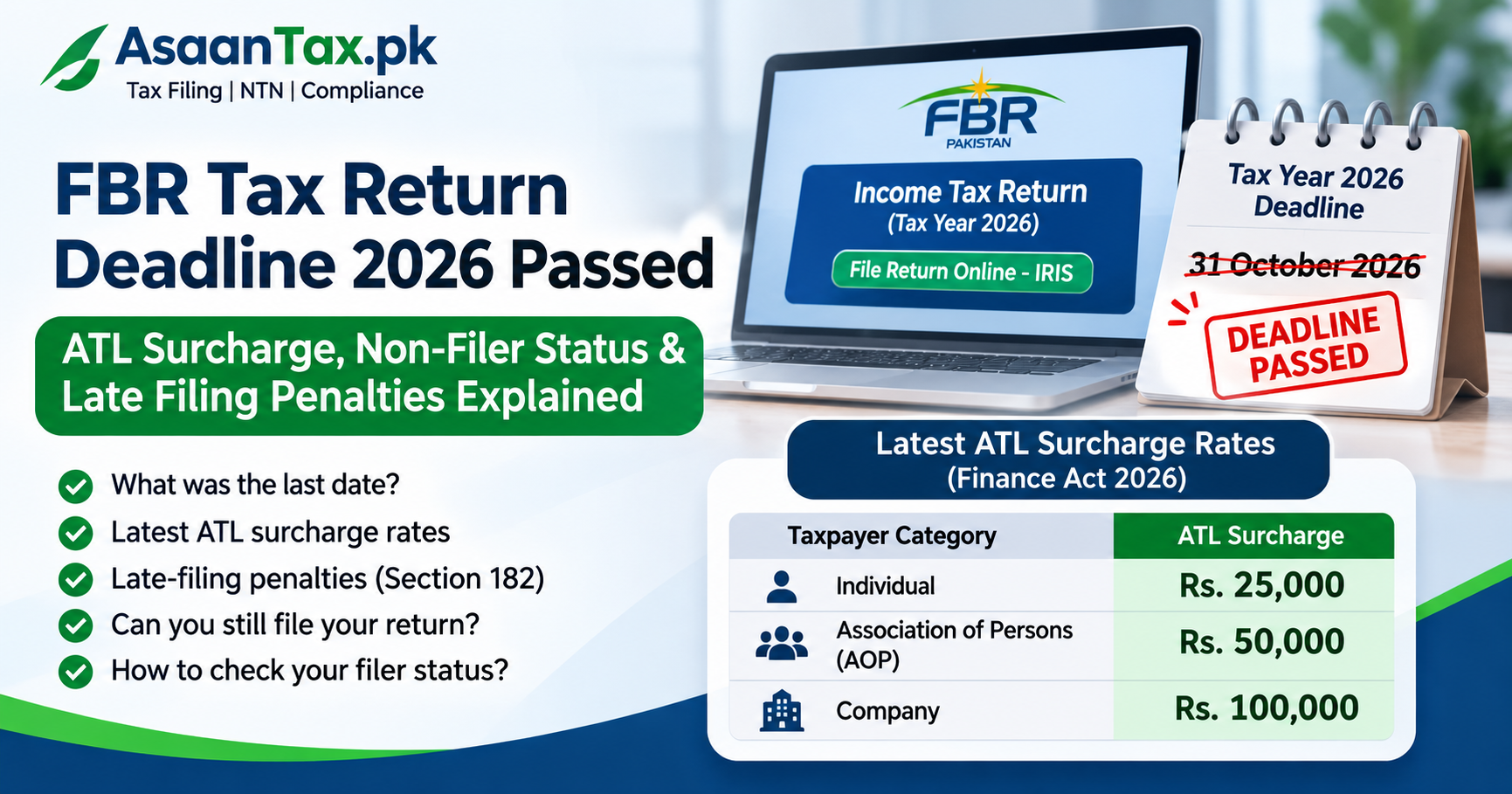
The Federal Board of Revenue (FBR) extended the income tax return filing deadline for Tax Year 2026 to October 31, 2026, for taxpayers covered by its latest general extension. The deadline has now passed.
If you have not submitted your income tax return, you may be concerned about your filer status, late-filing penalties, higher withholding taxes and the cost of becoming an active taxpayer.
The Finance Act 2026 also introduced a significant increase in the Active Taxpayer List (ATL) surcharge for late filers.
Under the amended rates, the ATL surcharge can be Rs. 25,000 for individuals, Rs. 50,000 for Associations of Persons (AOPs), and Rs. 100,000 for companies, subject to the applicable legal conditions.
However, these amounts should not be confused with the separate late-filing penalties under Section 182 of the Income Tax Ordinance, 2001.
This guide from AsaanTax.pk explains the latest filing deadlines, surcharge rates, possible penalties, filer verification procedures and the steps you can take after missing the deadline.
FBR Income Tax Return Deadline 2026 – What Was the Last Date?
The original general deadline for filing Tax Year 2026 income tax returns for individuals and AOPs was September 30, 2026.
FBR subsequently announced extensions for eligible taxpayers.
| Announcement | Filing Deadline |
|---|---|
| Original general deadline | September 30, 2026 |
| First extension | October 15, 2026 |
| Further extension | October 31, 2026 |
According to FBR Circular No. 04 of 2026–27, issued on October 15, 2026, the deadline was extended to October 31, 2026, for persons whose original deadline was September 30 and whose deadline had previously been extended to October 15.
The extension does not necessarily apply to every company or taxpayer with a different statutory filing date.
As of November 2, 2026, the October 31 extended filing deadline has passed.
Taxpayers who missed their applicable deadline should review their position and arrange filing as soon as possible.
Are You Automatically a Non-Filer After October 31, 2026?
Not necessarily.
Missing a filing deadline and being absent from the FBR Active Taxpayer List are related but distinct matters.
Your ATL status depends on the relevant tax year, filing history, applicable rules and the information processed by FBR.
A taxpayer who filed a return by the applicable deadline may remain eligible for active taxpayer status.
A taxpayer who files late may need to satisfy additional requirements, including an applicable ATL surcharge, before inclusion in the list.
A person who has never filed a required return may also have outstanding registration or filing obligations.
Therefore, do not assume that you have automatically become a non-filer simply because October 31 has passed.
Check your status using the official FBR Active Taxpayer List verification service.
Latest ATL Surcharge Rates in Pakistan – Finance Act 2026
One of the important changes introduced through the Finance Act 2026 is the increase in the surcharge under Section 182A of the Income Tax Ordinance, 2001.
The updated surcharge amounts are:
| Taxpayer Category | Previous ATL Surcharge | Updated ATL Surcharge |
|---|---|---|
| Individual | Rs. 1,000 | Rs. 25,000 |
| Association of Persons (AOP) | Rs. 10,000 | Rs. 50,000 |
| Company | Rs. 20,000 | Rs. 100,000 |
These are the amended statutory surcharge amounts, not a universal fine imposed automatically on everyone who missed the filing deadline.
Important Exception Under Section 182A
Finance Act 2026 also introduced a provision concerning individuals who furnish a prescribed undertaking before the Commissioner declaring that they will not purchase, acquire or otherwise obtain ownership or beneficial interest in any property for six months from the date of the undertaking.
Where the statutory conditions are met, the surcharge payment requirement under Section 182A may not apply to that individual.
This exception should not be assumed to apply automatically. Taxpayers should verify the prescribed procedure, eligibility and consequences before relying on it.
Is Rs. 25,000 Mandatory for Every Individual?
No.
The Rs. 25,000 amount is the amended ATL surcharge for individuals in cases where the surcharge requirement applies.
The actual amount a person must pay depends on their circumstances, legal eligibility, filing history and the requirements for ATL inclusion.
Always verify the payable amount through FBR and the applicable law before making a payment.
ATL Surcharge vs Late-Filing Penalty – What Is the Difference?
Many taxpayers confuse these two charges.
ATL Surcharge – Section 182A
The ATL surcharge is associated with inclusion in the Active Taxpayer List after a return is filed late, subject to statutory conditions and exceptions.
Late-Filing Penalty – Section 182
A late-filing penalty is a separate consequence that can arise when a person fails to submit a legally required income tax return within the applicable deadline.
Section 182 provides for a penalty calculation based on the higher of:
- 0.1% of the relevant tax payable for each day of default; or
- Rs. 1,000 for each day of default.
The law also contains minimum penalty provisions, a maximum limit, and reductions linked to filing within specified periods after the due date.
For relevant salaried individuals, the general minimum penalty is Rs. 10,000. In other cases, the general minimum is Rs. 50,000, subject to the applicable statutory provisions and their interaction with other limits.
Early Late-Filing Relief
Section 182 contains provisions under which the calculated penalty may be reduced depending on how soon the return is filed after the applicable due date:
| Time of Filing After Due Date | Statutory Penalty Reduction |
|---|---|
| Within 1 month | 75% |
| Within 2 months | 50% |
| Within 3 months | 25% |
These reductions relate to the applicable late-filing penalty, not automatically to the ATL surcharge.
The calculation and applicability of any penalty must follow the law. Penalties under Section 182 generally involve the prescribed determination process and an opportunity of being heard, rather than being automatically collected merely because the return is submitted one day late.
How Much Will You Pay If You Missed the Tax Year 2026 Deadline?
There is no single fixed total applicable to every taxpayer.
For example, consider an individual who missed the October 31, 2026 deadline and wants to file a return in November.
The following elements may need to be considered:
- Any outstanding income tax liability for Tax Year 2026.
- The ATL surcharge under Section 182A, where applicable.
- A separate late-filing penalty under Section 182, where legally imposed.
- Any applicable default surcharge on unpaid tax.
- Professional tax preparation charges, if a tax consultant is engaged.
An individual subject to the ordinary ATL surcharge provision may need to pay Rs. 25,000 for ATL inclusion, but this does not establish the person's total tax liability.
Likewise, the mere passage of two days after the deadline does not establish that every taxpayer owes a fixed late-filing penalty.
For an accurate assessment, review the taxpayer category, income, tax payable, previous returns, date of submission and relevant legal provisions.
Can You Still File Your Income Tax Return After October 31, 2026?
Yes. Taxpayers can generally file an overdue income tax return through FBR IRIS.
The expiry of the filing deadline does not mean the return filing facility is permanently closed.
In fact, if you have an outstanding filing obligation, it is usually sensible to address it promptly rather than leave the matter unresolved.
Late filing may allow you to regularize your records and take steps toward ATL inclusion, subject to the statutory requirements.
However, submitting a late return does not automatically eliminate tax liabilities, default surcharge or penalties.
How to File a Late Income Tax Return Through FBR IRIS
Follow these steps to submit your return.
Step 1: Access the FBR IRIS Portal
Visit the official FBR online filing portal:
Step 2: Register or Log In
If you are already registered, log in using your credentials.
If you are a new taxpayer, complete the applicable registration procedure.
Step 3: Select Tax Year 2026
Choose the correct income tax return for Tax Year 2026.
Avoid submitting a return for the wrong year.
Step 4: Enter Your Income and Tax Details
Depending on your situation, provide:
- Salary and employment income.
- Business or professional income.
- Rental income.
- Bank profit and investment income.
- Capital gains and other taxable income.
- Applicable deductions and tax credits.
- Tax already deducted or paid.
Step 5: Complete Your Wealth Statement
Where required, disclose assets, liabilities, expenses and changes in wealth.
The wealth statement and reconciliation should be supported by accurate information.
Step 6: Submit Your Return
Review the figures carefully before submission.
Confirm that the return has been successfully submitted and retain the acknowledgment.
Step 7: Review Applicable Payments
Check whether income tax, ATL surcharge or another legally applicable amount remains payable.
Use the correct payment category and official payment facilities.
Step 8: Verify Your ATL Status
After completing the required steps, check the official FBR Active Taxpayer List rather than relying solely on the return submission acknowledgment.
How to Check Filer or Non-Filer Status Online in Pakistan
FBR provides official facilities for checking active taxpayer status.
To verify your status:
- Open the FBR IRIS portal or the official FBR online verification service.
- Select the Active Taxpayer List (Income Tax) verification option.
- Choose the relevant identification type, such as CNIC or NTN.
- Enter the requested details.
- Complete the verification and review your status.
If you have filed your return but your status is still inactive, check the tax year, filing acknowledgment, surcharge requirements and processing status.
What Are the Disadvantages of Remaining a Non-Filer?
Not appearing on the Active Taxpayer List can result in less favorable withholding tax treatment for certain transactions.
Depending on the transaction and applicable legislation, these may include:
- Purchase or transfer of immovable property.
- Purchase or registration of vehicles.
- Certain financial and banking transactions.
- Selected investment and other payments subject to withholding tax.
The applicable withholding rates can vary significantly by transaction and by the taxpayer's classification.
Not every person outside the ATL is subject to the same rates or restrictions.
For exact rates, consult the relevant FBR withholding tax rate card and the applicable Finance Act.
Documents Required for Late Income Tax Return Filing
Before starting your Tax Year 2026 return, gather the available supporting documents.
For Salaried Individuals
- CNIC and registered mobile number.
- Salary certificate or annual salary statement.
- Employer's tax deduction certificate.
- Bank statements.
- Details of investments and relevant assets.
- Previous income tax return, if available.
For Business Owners and Self-Employed Persons
- CNIC or NTN.
- Business income and expense records.
- Bank statements.
- Sales and purchase information.
- Withholding tax certificates.
- Details of business assets and liabilities.
- Previous returns and financial records.
For Property Owners and Investors
Additional information may be required about rental income, property transactions, capital gains and investment returns.
The documents needed depend on the person's actual sources of income and reporting obligations.
Why Filing Your Tax Return Late Is Better Than Ignoring It
If you are legally required to file an income tax return, ignoring the obligation can create ongoing compliance problems.
Filing an overdue return can help you:
- Update your FBR tax records.
- Address an outstanding statutory filing requirement.
- Take steps toward ATL inclusion.
- Maintain more accurate income and asset records.
- Respond more effectively to compliance inquiries.
- Understand and resolve any outstanding tax liabilities.
It is important to file accurately. Do not enter fictitious income, assets or withholding tax credits simply to obtain filer status.
How AsaanTax.pk Can Help You With Late Tax Return Filing
Have you missed the FBR deadline for Tax Year 2026?
Are you unsure whether you are a filer, late filer or non-filer?
AsaanTax.pk offers tax filing and compliance assistance for individuals and businesses in Pakistan.
Our services include:
- Income tax return filing for salaried individuals.
- Late income tax return filing.
- FBR registration and NTN assistance.
- Business and self-employed income tax returns.
- Active Taxpayer List verification guidance.
- ATL surcharge and payment assistance.
- Wealth statement preparation and reconciliation.
- Tax compliance support and notice assistance.
Our team can help you understand the applicable process and organize the information needed for an accurate filing.
Missed the FBR Deadline? Get Assistance Today
Don't leave your overdue Tax Year 2026 return unresolved.
Contact AsaanTax.pk for guidance on your income tax return, filer status and applicable charges.
Website: https://www.asaantax.pk/
Call or WhatsApp: 0308-4781532
AsaanTax.pk is an independent tax services platform and is not affiliated with or operated by the Federal Board of Revenue.
Official Sources and References
For further verification, consult:
- FBR Finance Act 2026
- FBR IRIS Online Filing Portal
- FBR Section 182 — Offences and Penalties
- FBR Withholding Tax Rate Cards
- Associated Press of Pakistan — FBR Deadline Extended to October 31, 2026
Last updated: November 2, 2026.
Disclaimer: This article is intended for general information. Actual filing obligations, surcharge requirements, penalties and relief depend on the taxpayer's circumstances and the legislation applicable to the relevant period. Verify your position with FBR or a qualified tax professional before making a payment or relying on an exception.