Receiving a notice from the Federal Board of Revenue (FBR) can be concerning, especially if you do not understand the legal section mentioned in the notice or the documents being requested.
However, receiving an FBR income tax notice does not automatically mean that you have committed tax fraud, that a penalty has already been imposed, or that you must immediately pay the amount mentioned.
An FBR notice may simply require you to file a missing return, explain a transaction, submit supporting documents, respond to a proposed tax adjustment or participate in an audit.
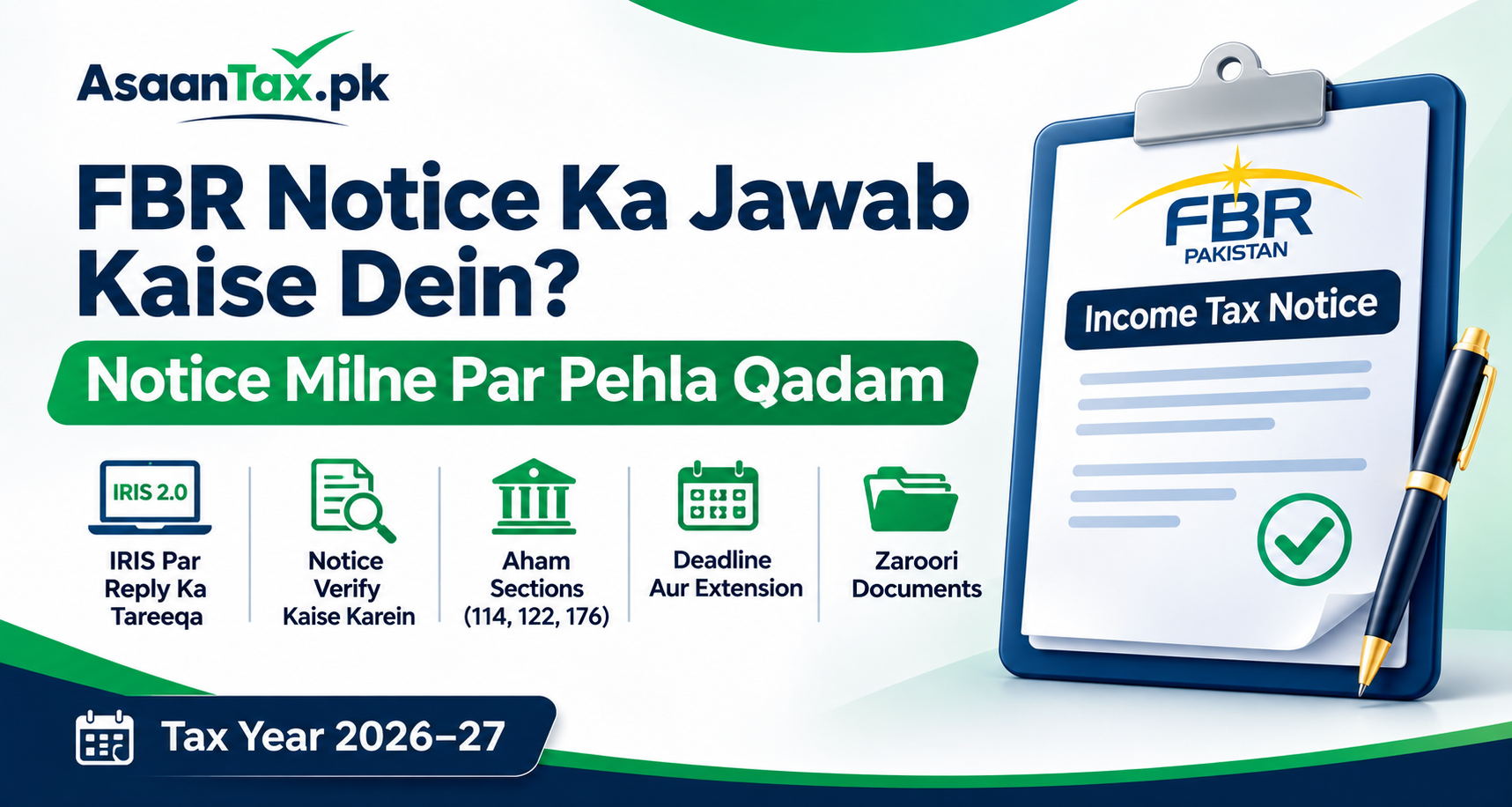
The first step after receiving any FBR notice is to verify its authenticity, identify the relevant legal section and note the response deadline.
In this guide, AsaanTax.pk explains how to respond to FBR notices through IRIS 2.0, the different notice types under the Income Tax Ordinance, 2001, documents required, applicable legal procedures and common mistakes taxpayers should avoid.
This guidance incorporates developments through November 2026, including FBR's new electronic faceless audit and assessment initiative.
What Is an FBR Income Tax Notice?
An FBR income tax notice is a formal communication issued under the relevant provisions of the Income Tax Ordinance, 2001.
The notice may ask a taxpayer to:
- Submit an outstanding income tax return.
- Provide a wealth statement.
- Explain unexplained assets or deposits.
- Produce documents and financial records.
- Respond to an audit inquiry.
- Explain a discrepancy in reported income.
- Respond to a proposed amendment of assessment.
- Explain a failure to comply with a legal requirement.
- Respond to proposed penalty proceedings.
Every notice should be evaluated according to its exact legal section and contents.
Notices issued under different sections cannot always be answered using the same procedure.
FBR Notice Milne Par Pehla Qadam Kya Hai?
If you receive an FBR notice, follow these steps before preparing your reply.
Step 1: Verify the Notice
Open the official FBR IRIS portal:
Log in and check whether the notice appears in your official account.
You can also use the Notices/Orders Verification service where the relevant notice details are available.
If you receive an unfamiliar SMS, email, WhatsApp message or payment demand, do not rely solely on that message.
Verify the communication through an official FBR channel.
Step 2: Read the Legal Section
Identify the section cited in the notice.
For example, a Section 114(4) notice may require filing an income tax return, while a Section 176 notice may demand records or information.
A Section 122(9) show-cause notice requires a different response focused on proposed tax adjustments.
Step 3: Check the Tax Year
Confirm whether the notice concerns Tax Year 2024, 2025, 2026, 2027 or another relevant period.
Never assume that a notice received in 2026 concerns only Tax Year 2026.
Step 4: Note the Response Deadline
Read the notice carefully and identify the final date and time for responding.
The deadline depends on the legal provision, the notice and any applicable extension.
Do not assume that every FBR notice allows exactly 15 or 30 days.
Step 5: Identify the Documents Requested
Review the notice and prepare only the information necessary to address its requirements, while preserving complete supporting records.
Step 6: Prepare an Accurate Reply
Your response should address each question or allegation separately.
Provide relevant explanations and documentary evidence.
Step 7: Submit and Save Proof
Submit the reply through the applicable IRIS task or another legally prescribed channel.
Save the submission acknowledgment and all supporting documents.
Common Types of FBR Notices in Pakistan
| Legal Section | Main Purpose |
|---|---|
| Section 114(4) | Notice requiring an income tax return |
| Section 116 | Wealth statement and related information |
| Section 122(9) | Opportunity to respond before an amended assessment |
| Section 176 | Information or evidence request |
| Section 177 | Income tax audit |
| Section 111 | Inquiry concerning unexplained income or assets |
| Section 182 | Penalty-related proceedings |
These sections can interact. For example, an inquiry into bank deposits may involve information requested under Section 176 and a proposed adjustment under Section 111 and Section 122.
How to Reply to an FBR Notice Through IRIS 2.0
FBR's IRIS portal is the central electronic system for many income tax proceedings.
Step 1: Visit the Official Portal
Open https://iris.fbr.gov.pk/ and sign in using your registered credentials.
Step 2: Open the Relevant Inbox or Task
Depending on the notice, you may find the assignment in the Inbox, Declaration, task list or another relevant module.
Step 3: Locate the Notice
Identify the correct section, reference number, tax period and issuing authority.
Step 4: Open and Read the Notice
Review the complete notice, not just the subject line.
Download a copy for your records.
Step 5: Select Reply or the Relevant Action
Use the Reply or related action associated with that notice.
A Section 114 notice requiring a return may open a return-filing task, while another notice may require written explanations and attachments.
Step 6: Enter Your Response
Provide a clear written answer addressing the points raised.
Where applicable, submit the required return or statement through the notice-linked workflow.
Step 7: Attach Relevant Documents
Upload supporting documents in the format and file-size limits accepted by IRIS.
Step 8: Submit the Reply
Complete the required verification and submission process.
Do not leave the response in draft status.
Step 9: Save the Acknowledgment
Keep a copy of the filed reply, submission date, attachments and acknowledgment.
Step 10: Monitor the Case
Continue checking IRIS for further notices, hearings or orders.
Important: Simply filing a separate voluntary return or sending an informal email may not automatically satisfy an existing notice-linked task.
Section 114(4) Notice – Income Tax Return Not Filed
Section 114(4) allows the Commissioner to require a return from a person who is considered legally required to file but has not furnished the return.
Example
A taxpayer owns a qualifying vehicle or earns income requiring return filing but has not submitted the relevant annual return.
The Commissioner issues a Section 114(4) notice for that tax year.
What Should the Taxpayer Do?
- Verify the notice.
- Confirm whether a return was legally required.
- Check the relevant tax year.
- Review any filing exception.
- Prepare the required income tax return and wealth statement, where applicable.
- Submit the return through the correct IRIS notice-linked task.
- Retain acknowledgment and supporting records.
If the person believes the notice was issued incorrectly, they should provide a legally supported explanation through the prescribed process.
Do not simply ignore the notice.
Section 116 Notice – Wealth Statement
Section 116 deals with wealth statements and related financial information.
A wealth statement may contain information concerning:
- Property and land.
- Vehicles.
- Bank balances.
- Investments.
- Cash and other assets.
- Loans and liabilities.
- Personal expenses.
- Changes in financial position.
Example
A person reports annual taxable income of Rs. 1.5 million but acquires substantial assets during the tax year.
FBR may require an explanation of the funds used.
The explanation should distinguish between taxable income, existing savings, gifts, loans, proceeds from asset disposals and other legitimate sources.
A wealth statement should be reconciled with supporting records.
Section 122(9) Notice – Show Cause Before Amended Assessment
Section 122 deals with amendment of assessments in specified circumstances.
Before making certain adverse amendments, Section 122(9) requires an appropriate opportunity of being heard.
A taxpayer may receive a show-cause notice identifying proposed changes to an existing assessment.
Example
A person declared Rs. 3 million of business receipts, while FBR identifies additional deposits requiring explanation.
The notice may propose an adjustment.
How to Respond
The taxpayer should examine:
- The calculation used by FBR.
- The relevant bank transactions.
- Whether the same money has been counted twice.
- Loans or capital receipts.
- Transfers between the taxpayer's own accounts.
- Evidence of sales, expenses and other legitimate receipts.
- Whether FBR's interpretation is supported by the law.
Prepare a point-by-point reply supported by evidence.
A proposed tax addition is not automatically a final, established tax liability.
The legal basis and taxpayer's reply must be considered before the relevant order is issued.
Section 176 Notice – Information and Records
Section 176 allows authorized tax authorities to require information, documents or evidence within the scope of the provision.
A notice may seek:
- Bank statements.
- Business ledgers.
- Sale and purchase invoices.
- Contract records.
- Property documents.
- Details of investments.
- Evidence relating to a specific transaction.
How Should You Reply?
First identify the precise information requested and the time period concerned.
Prepare accurate and organized documents.
If a requested document is unavailable, explain the reason truthfully.
If the request raises a genuine legal objection concerning its scope, seek professional advice and respond through the proper procedure.
Failure to comply without a valid basis can have statutory consequences.
Section 177 Notice – Income Tax Audit
Section 177 concerns income tax audits.
During an audit, FBR may examine records to determine whether a return and related declarations are accurate.
Audit records may include:
- Financial statements.
- Invoices.
- Bank statements.
- Expense vouchers.
- Inventory records.
- Contracts.
- Withholding tax records.
- Other relevant accounting documents.
What Happens During an Audit?
The relevant authority examines the records and may request explanations of differences or inconsistencies.
An audit does not automatically prove concealment of income.
Where the law permits an amendment after audit findings, the required assessment procedure and opportunities to respond must be observed.
2026 Faceless Audit Update
In September 2026, FBR announced the National Faceless Centre for a new electronic audit and assessment framework.
Under this model, applicable notices, replies and hearings are intended to be managed through IRIS.
Taxpayers should follow the official electronic proceedings and any case-specific instructions.
Section 111 – Unexplained Income and Assets
Section 111 concerns unexplained income, investments, assets and certain expenditure.
The provision can become relevant where FBR questions the disclosed source of funds.
Example: Bank Deposit of Rs. 5 Million
Suppose FBR identifies a Rs. 5 million bank deposit that does not appear clearly explained by a taxpayer's return.
The amount is not automatically proof of concealed taxable income.
The taxpayer should investigate the actual source.
Possible supporting documents include:
- Earlier savings records.
- Loan agreements and banking trails.
- Property sale documentation.
- Genuine gift records.
- Business receipts and invoices.
- Foreign remittance evidence.
- Transfers between personal accounts.
The evidence should support the actual transaction.
A source should never be invented merely to explain an account balance.
Section 182 – Penalties for Non-Compliance
Section 182 contains penalties for specified tax-related defaults.
Consequences may arise from failure to submit required returns, failure to provide documents or other defined violations.
However, the relevant amount and conditions depend on the particular default.
A taxpayer should distinguish between:
- Proposed penalties.
- Legally determined penalties.
- Outstanding income tax.
- Default surcharge.
- ATL surcharge under Section 182A.
These are not necessarily the same liability.
Where a penalty is proposed, review the statutory basis and available opportunity to respond.
How Much Time Do You Have to Reply to an FBR Notice?
There is no universal response period for every FBR notice.
The time limit can depend on:
- The section cited.
- The legally prescribed period.
- The notice's stated deadline.
- The method and date of valid service.
- Any extension granted by the competent authority.
The safest approach is to review the notice immediately and submit a complete response within the applicable deadline.
If additional time is genuinely required, request an extension through the appropriate channel before the deadline where possible.
Submitting an extension request does not automatically mean it has been approved.
How to Request More Time for an FBR Notice
If supporting records cannot reasonably be collected before the response deadline:
- Identify the notice and reference number.
- Explain why additional time is required.
- Specify the documents being collected.
- Request a reasonable extension.
- Submit the request through the prescribed method.
- Preserve proof of submission.
- Monitor whether the authority approves the request.
Unless a valid extension is granted, the original deadline may remain relevant.
Documents Required to Reply to an FBR Notice
The following checklist covers common records.
| Document | Why It May Be Needed |
|---|---|
| CNIC / NTN | Taxpayer identification |
| FBR notice copy | Section, reference and deadline |
| Income tax return | Previously declared income |
| Wealth statement | Assets and wealth reconciliation |
| Bank statements | Evidence of deposits and transfers |
| Salary certificate | Employment income verification |
| Business invoices | Sales and expense verification |
| Property documents | Ownership and transaction details |
| Loan agreements | Evidence of genuine borrowings |
| Remittance records | Evidence of foreign transfers |
| Withholding tax certificates | Tax deduction reconciliation |
| Previous correspondence | History of the case |
Only records relevant to the notice and the legal requirements should be submitted. Maintain complete originals or reliable copies for your records.
Example: FBR Notice About an Unexplained Bank Deposit
Suppose a taxpayer receives a notice concerning Rs. 3 million deposited into a bank account.
After reviewing the transactions, the taxpayer identifies:
| Source | Amount |
|---|---|
| Transfer from another own bank account | Rs. 1,200,000 |
| Documented loan | Rs. 800,000 |
| Recorded business receipts | Rs. 1,000,000 |
| Total | Rs. 3,000,000 |
The taxpayer should provide genuine records supporting each amount.
An internal transfer between two accounts should not automatically be treated as a new sale merely because it appears as a bank credit.
A legitimate loan should be supported by appropriate documents.
Business receipts must be reported according to the applicable tax rules.
The response must reconcile the entire amount accurately without concealing taxable receipts.
Sample FBR Notice Reply Format
A professional response generally includes:
Subject: Reply to Notice Under Section [Applicable Section] – Tax Year [Year]
Reference Number: [FBR Notice Reference]
Taxpayer: [Registered Name]
NTN/CNIC: [Relevant Identification]
Respected Commissioner Inland Revenue,
With reference to the above notice, I respectfully submit the following explanation and supporting documents.
Point 1 – Issue Raised
[State the issue identified in the notice.]
Reply
[Provide the accurate factual and legal explanation.]
Supporting Documents
[Identify relevant evidence and attachments.]
Point 2 – Issue Raised
[Address any additional issue separately.]
I respectfully request that the submitted information and supporting documents be considered before any further action is taken in accordance with applicable law.
Yours faithfully,
[Taxpayer or Authorized Representative]
Note: This is a general writing structure, not a substitute for a notice-specific legal reply. Different sections require different procedures and supporting arguments.
Can an FBR Notice Be Wrong?
A notice may contain an incorrect tax year, inaccurate amount, duplicate transaction or other factual error.
It may also raise an issue requiring legal interpretation.
A taxpayer should assess whether:
- The underlying information is accurate.
- The relevant section applies.
- The notice was properly served.
- The tax year and period are correct.
- The amounts were calculated properly.
- There are relevant exemptions or legal objections.
If an error is identified, it should be explained professionally with supporting evidence.
Avoid making unsupported allegations or submitting an incomplete response.
What Happens If You Ignore an FBR Notice?
Ignoring a valid notice can have consequences depending on the section and the stage of the proceedings.
Possible consequences include:
- Penalty proceedings.
- Assessment or amendment based on available information.
- Further document requests.
- Audit-related actions.
- Recovery steps following a legally enforceable demand.
- Other remedies or enforcement actions authorized by law.
The consequences are not identical for every notice.
An initial information request does not mean that immediate bank account attachment or asset seizure will automatically follow.
Nevertheless, missing a legally prescribed deadline can prejudice your position.
What If an FBR Assessment Order Has Already Been Issued?
Receiving a final or amended assessment order is different from receiving an initial inquiry or show-cause notice.
A taxpayer should identify whether the document is:
- An information request.
- A show-cause notice.
- An assessment order.
- A penalty order.
- A demand or recovery notice.
- An appeal-related communication.
If an adverse order has already been issued, a simple explanatory reply may not be the correct remedy.
The taxpayer may need to consider the applicable appeal, rectification or other statutory procedure within the prescribed deadline.
Legal advice is particularly important at this stage.
How to Recognize Fake FBR Notices
Taxpayers should exercise care when receiving unexpected links or messages claiming to be from FBR.
Common warning signs include:
- Requests for payment to an individual's bank account.
- Suspicious website addresses.
- Requests for IRIS passwords or one-time verification codes.
- Unofficial attachments requesting confidential information.
- Pressure to pay immediately without an official reference.
- A notice that cannot be verified using the relevant FBR facility.
FBR's official website provides a Notices/Orders Verification facility.
Always independently open the genuine FBR website rather than relying solely on a link in an unsolicited message.
Taxpayer Rights When Responding to FBR
Depending on the applicable provision, taxpayers may have rights relating to:
- Receiving relevant legal notice.
- Being informed of proposed adjustments.
- Providing explanations and evidence.
- Having an opportunity of being heard.
- Seeking an extension where permitted.
- Receiving a reasoned order.
- Pursuing appeals or other lawful remedies.
The precise rights and deadlines differ by proceeding.
Taxpayers should preserve all documents and acknowledgments.
New FBR Faceless Audit and Assessment Rules in 2026
FBR announced the National Faceless Centre on September 25, 2026.
The initiative introduces a digital workflow in which applicable audit and assessment responsibilities are separated across different officials.
FBR described the following elements:
- Computerized risk-based case selection.
- Automated allocation of cases.
- Separate audit and assessment responsibilities.
- Quality review of proceedings.
- Electronic notices and replies.
- Electronic hearings through IRIS.
- Separate field operations where legally required.
Taxpayers should review the actual procedure applicable to their case and follow any official instructions.
This reform does not remove the taxpayer's obligation to respond accurately and within the legally applicable period.
Common Mistakes While Replying to FBR Notices
Taxpayers should avoid:
- Ignoring the notice.
- Assuming every notice is a final tax demand.
- Missing the stated response deadline.
- Replying under the wrong tax year.
- Submitting an unrelated voluntary return rather than responding to a linked notice.
- Attaching documents that do not support the explanation.
- Providing false loan or gift documentation.
- Failing to reconcile bank transactions.
- Submitting only a draft reply.
- Failing to retain the submission acknowledgment.
- Ignoring a subsequent hearing or order.
- Paying an unofficial person to cancel a notice.
The quality and completeness of the response can be more important than its length.
Watch FBR Tax Tutorials – Tax with Naeem
For practical tax education in Urdu, visit the YouTube channel Tax with Naeem.
The channel covers Pakistan's income tax rules, FBR tax returns, IRIS procedures, wealth statements, property taxation and other tax compliance topics.
Find the channel's FBR notice and IRIS tutorials on YouTube:
https://www.youtube.com/results?search_query=Tax+With+Naeem+FBR+Notice
When a specific notice-related tutorial is available, it can be embedded directly in this article.
Always verify the video's publication date and applicable legal provisions, as the FBR IRIS interface and tax laws may change.
How AsaanTax.pk Helps With FBR Notices
Received a notice and unsure what to do next?
AsaanTax.pk provides tax compliance guidance and assistance with income tax documentation and filing procedures.
Services include:
- FBR notice review and initial guidance.
- Income tax return filing assistance.
- Wealth statement preparation.
- Section 114 filing notice assistance.
- Section 116 wealth statement guidance.
- Section 176 documentation assistance.
- Section 122 show-cause response preparation support.
- Bank transaction reconciliation.
- Audit documentation assistance.
- General FBR compliance guidance.
Complex disputes, appeals and legal proceedings should be reviewed by an appropriately qualified and authorized tax professional or legal representative.
Need Help Understanding an FBR Notice?
Visit AsaanTax.pk for information about tax compliance, income tax filing and document preparation.
Website: https://www.asaantax.pk/
AsaanTax.pk is an independent tax service provider and is not affiliated with the Federal Board of Revenue or the Government of Pakistan.
Official Sources and References
- FBR – Income Tax Ordinance, 2001
- FBR – Income Tax Rules, 2002
- FBR – IRIS 2.0
- FBR – IRIS Help and User Guides
- FBR – Section 182 Penalties
- FBR – National Faceless Centre Announcement, September 2026
- FBR – Official Website
Last updated: November 3, 2026.
Disclaimer: This guide is for educational purposes. The correct reply, legal deadline, penalty exposure and appeal procedure depend on the notice's specific section, facts and current law. Taxpayers should verify official communications and obtain qualified professional advice for disputed assessments, significant tax liabilities, penalties or appeals.