Millions of overseas Pakistanis live and work in Saudi Arabia, the UAE, Qatar, Oman, Bahrain, Kuwait, the United Kingdom, Canada, the United States and other countries.
Many of them hold a National Identity Card for Overseas Pakistanis (NICOP), maintain bank accounts in Pakistan, own property or send money to their families.
However, one important tax issue is often overlooked:
Does your FBR record correctly reflect your overseas status, identity details and actual tax residency?
Having a valid NICOP does not automatically mean that the Federal Board of Revenue (FBR) treats a person as a non-resident taxpayer for every tax year.
Similarly, being a non-resident does not automatically mean appearing on the Active Taxpayers List (ATL).
For Tax Year 2027, incorrect records or misunderstanding these categories can create problems with property transactions, withholding tax, income tax returns and documentary compliance.
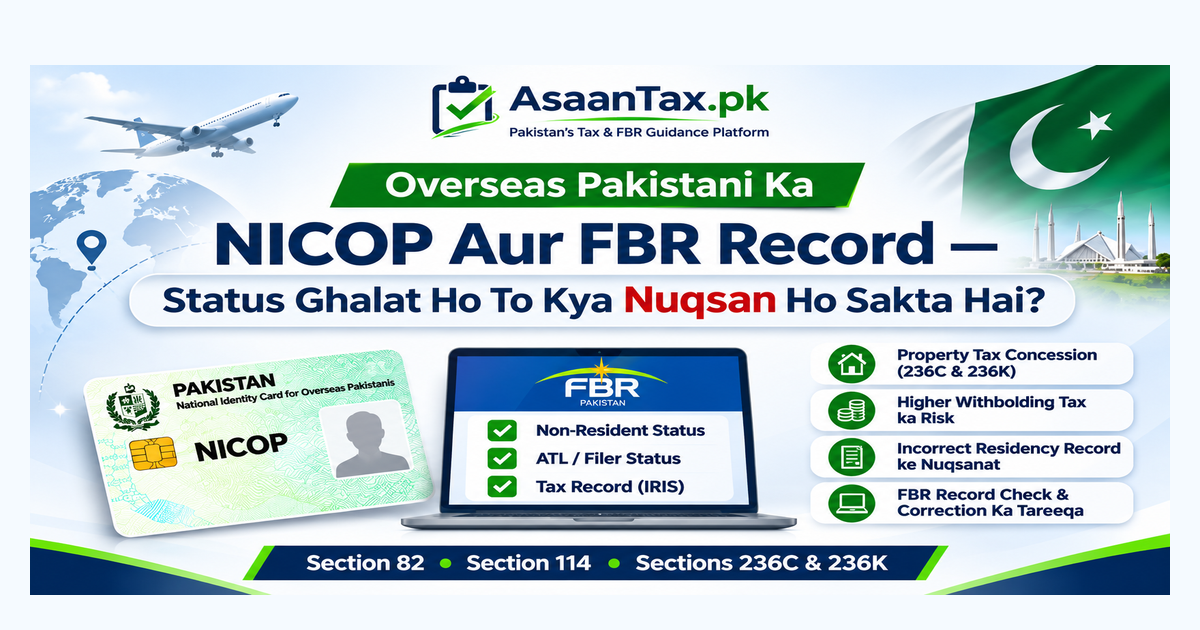
This AsaanTax.pk guide explains the difference between NICOP, tax residency and filer status, the disadvantages of incorrect records, the overseas property tax concession under Sections 236C and 236K, and how to check and correct relevant details.
What Is NICOP in Pakistan?
NICOP stands for National Identity Card for Overseas Pakistanis.
It is an identity document issued by the National Database and Registration Authority (NADRA) to eligible Pakistani citizens residing abroad.
NICOP helps overseas Pakistanis establish their identity and Pakistani nationality.
It may be used for banking, property ownership and other services requiring identification.
NADRA offers services for:
- New NICOP applications.
- NICOP renewal.
- Modification of identity information.
- Reprinting a lost card.
- Updating certain identity details.
The official NADRA PakID service supports many of these applications online.
Important: NICOP is an identity document, not an income tax exemption certificate.
What Is the Difference Between CNIC and NICOP?
CNIC and NICOP are both Pakistani national identity documents, but NICOP is specifically designed for eligible overseas Pakistani citizens.
CNIC
Generally used by Pakistani citizens for national identity verification.
NICOP
Designed for eligible Pakistani citizens living abroad, including qualifying dual nationals and other eligible categories.
FBR Implication
FBR's tax system uses identification and taxpayer registration information to maintain records.
If a person's details are inaccurate or inconsistent between NADRA, IRIS and supporting documents, verification difficulties can arise.
However, the card type does not by itself conclusively determine tax residency.
Does Having NICOP Automatically Make You Non-Resident for FBR?
No.
This is one of the most important distinctions for overseas Pakistanis.
Tax residency is determined under Sections 81 and 82 of the Income Tax Ordinance, 2001.
A person's tax residency depends on the relevant statutory conditions, including presence in Pakistan during the tax year and other applicable rules.
A NICOP holder may qualify as a resident or non-resident depending on the circumstances.
Example
A Pakistani citizen has a NICOP but has returned to Pakistan and now lives in Lahore throughout the year.
The person should not assume that the NICOP automatically provides non-resident income tax status.
The statutory residency test must be applied.
How Is Non-Resident Status Determined in Pakistan?
Tax Year 2027 generally covers:
July 1, 2026 to June 30, 2027.
Section 82 contains the legal rules for determining whether an individual is resident in Pakistan.
The core presence test concerns a stay of 183 days or more during the tax year.
Other statutory residency provisions may also be relevant, including specified government employees posted abroad and additional conditions in the applicable amended law.
Example 1: Overseas Employee
A Pakistani citizen works in Saudi Arabia and visits Pakistan for 25 days during the tax year.
The person may qualify as non-resident, subject to the complete statutory rules and other relevant facts.
Example 2: Returning Overseas Pakistani
A NICOP holder returns to Pakistan and remains there for 220 days during the same tax year.
The person would generally satisfy the ordinary 183-day residence test.
Important
Do not rely only on nationality, NICOP, foreign employment or a residential address.
Determine tax residency separately for each relevant tax year.
What Is the Difference Between Filer and Non-Resident?
These terms describe different matters.
| Classification | Main Meaning |
|---|---|
| NICOP Holder | Identity documentation |
| Resident | Tax residency classification |
| Non-Resident | Tax residency classification |
| Filer / ATL | Active taxpayer status |
| Non-ATL | Not currently appearing on ATL |
A non-resident Pakistani may appear on ATL if they meet the applicable conditions.
An individual may also be legally non-resident without appearing on ATL.
Likewise, an active taxpayer can be either resident or non-resident depending on the facts.
Filer status and non-resident status should never be used interchangeably.
Why Is Correct FBR Residency Status Important?
A person's residency classification can affect:
- Which income is chargeable to income tax in Pakistan.
- The relevant return-filing requirements.
- Reporting of foreign-source income.
- Applicable tax treaty provisions.
- Property transaction concessions.
- Wealth and financial disclosure obligations.
- Supporting documentation requested by FBR.
Incorrect information can result in unnecessary delays, errors or tax disputes.
Does FBR Tax Overseas Salary Income?
A person's Pakistan tax residency is important when determining the treatment of foreign employment income.
Under Section 11, a resident person's income calculation generally considers both Pakistan-source and foreign-source income, subject to relevant exemptions and special provisions.
For a non-resident, the calculation generally concerns Pakistan-source income.
Example
A qualifying non-resident Pakistani works in the UAE and receives salary for employment performed there.
That salary is not automatically Pakistan-source income merely because the person holds Pakistani nationality or NICOP.
However, a resident Pakistani receiving foreign salary may need to examine additional rules, including applicable exemptions and foreign tax credits.
Important: Sending foreign earnings to Pakistan through a bank does not automatically change the original source or tax treatment of the earnings.
Is Every Overseas Pakistani Required to File an FBR Return?
No universal filing requirement applies solely because someone has a NICOP.
The obligation to file an income tax return must be determined under Section 114 and other applicable legal provisions.
Relevant circumstances may include:
- Pakistan-source taxable income.
- Income exceeding relevant thresholds.
- Business activities.
- Property ownership or other statutory filing tests.
- Taxpayer registration and return requirements.
- Notices issued under the law.
- Other prescribed conditions.
Example
An overseas Pakistani has no income or business activity in Pakistan and is not otherwise covered by a statutory filing requirement.
It would be incorrect to state that the person automatically owes Pakistan income tax simply because they have a NICOP.
However, the complete Section 114 filing tests should still be examined before concluding that no return is required.
Can an Overseas Pakistani Be on ATL?
Yes.
An eligible overseas Pakistani may appear on FBR's Active Taxpayers List by meeting the applicable requirements.
However, ATL membership must be checked separately from NICOP and residency status.
A person who filed a return late may also need to review the relevant ATL surcharge provisions and current rules.
How to Check ATL
Visit:
Use the Active Taxpayer List verification facility.
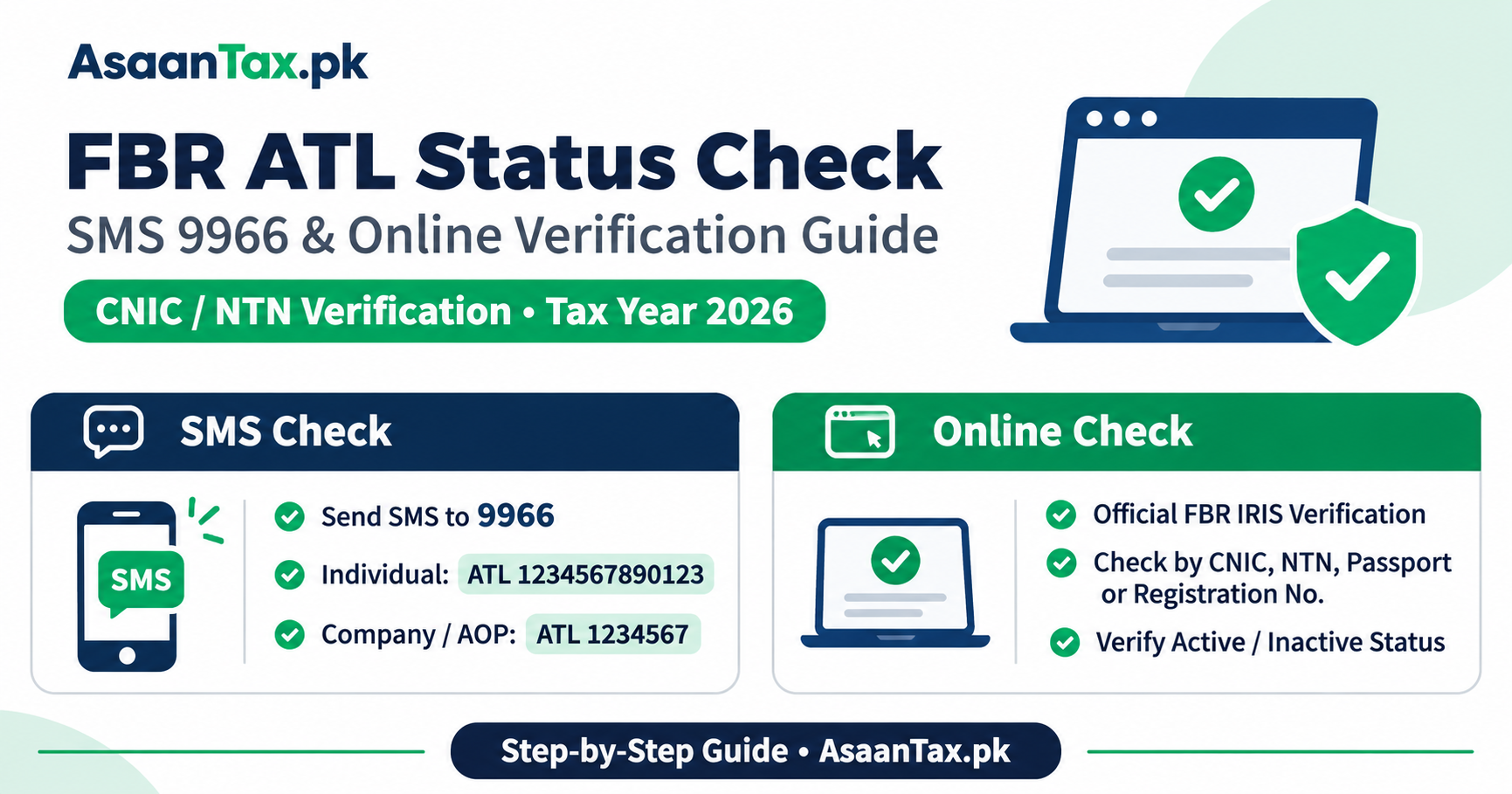
For individual CNIC verification, FBR also publishes an SMS method using the CNIC number and shortcode 9966.
How Can Wrong FBR Status Cause Higher Property Tax?
Property purchase and sale transactions are important for overseas Pakistanis.
Ordinary property withholding tax may differ according to taxpayer status.
The main federal provisions are:
- Section 236K: Advance income tax on purchase of immovable property.
- Section 236C: Advance income tax on sale of immovable property.
However, FBR provides a special facility for certain non-resident NICOP and POC holders.
An eligible person may receive the ordinary filer withholding rate for a qualifying property transaction even without being on ATL.
Conditions
According to FBR's overseas property tax guidance, the applicant must:
- Hold a valid qualifying NICOP or POC.
- Satisfy the applicable non-resident conditions.
- Provide the required documents.
- Complete the special FBR verification and PSID approval procedure.
This concession is transaction-specific.
It does not automatically turn the person into an ATL filer for every other tax purpose.
Overseas Pakistani Property Tax Concession – Sections 236C and 236K
FBR's special procedure is available for qualifying overseas Pakistani property transactions.
The process generally works as follows.
Step 1: Contact the Transfer Authority
The relevant registrar, development authority or housing society initiates the prescribed overseas applicant process.
Step 2: Enter NICOP or POC Details
The required identity information is entered into the FBR system.
Step 3: Upload Identity Documents
A scanned NICOP or POC is provided.
Step 4: Provide Non-Resident Evidence
The applicant provides supporting records showing qualifying non-resident status.
Step 5: Generate the Provisional PSID
The transaction is forwarded through the prescribed system.
Step 6: Commissioner Verification
The relevant Commissioner reviews the submitted documentation.
Step 7: Receive Approval
After approval, the system allows the applicable payment using the approved filer rate.
Step 8: Complete the Property Transfer
The transaction proceeds through the relevant authority according to legal and banking requirements.
Do not assume that simply showing a NICOP at the registry office is always sufficient without completing FBR's prescribed procedure.
What If the FBR System Shows the Wrong Status?
An overseas Pakistani may encounter one or more of the following situations:
- Identity information does not match supporting documents.
- Address or contact details are outdated.
- A return contains the wrong residence classification.
- The relevant tax year was incorrectly selected.
- A person is incorrectly assumed to be an ATL filer.
- An overseas property concession application lacks supporting evidence.
- Historical tax records differ from the person's current circumstances.
The appropriate correction depends on whether the issue concerns NADRA identification, FBR registration, a submitted tax return or a transaction-specific application.
How to Check Your FBR Record Online
Step 1: Open IRIS
Visit:
Step 2: Sign In
Use the taxpayer's registered credentials.
Step 3: Review Registration Information
Check the available taxpayer profile and registration information.
Step 4: Verify Identity Details
Compare the registered name, identification number and other relevant fields with current NADRA records.
Step 5: Check Tax Returns
Review the submitted returns for the relevant tax years.
Step 6: Review ATL Status
Verify the actual ATL position separately.
Step 7: Check Notices
Look for pending notices or compliance requests.
Step 8: Identify the Error
Determine whether the problem is an identity-data error, tax-residency issue, incorrect income classification or procedural verification issue.
How to Correct NICOP Details With NADRA
If the underlying identity record is incorrect, use NADRA's official facilities.
Step 1: Open NADRA PakID
Visit:
Step 2: Select the Relevant Service
Choose renewal, modification or another appropriate service.
Step 3: Enter the Required Information
Provide accurate identification details.
Step 4: Upload Supporting Documents
Submit the documents required by NADRA.
Step 5: Complete Identity Verification
Follow the applicable biometric or other verification requirements.
Step 6: Submit and Track
Complete the application and preserve its reference details.
After the NADRA record is corrected, review whether a corresponding FBR record correction is needed.
How to Correct FBR Registration Information
If the issue concerns the FBR taxpayer profile rather than the NICOP itself, follow the applicable IRIS registration amendment procedure.
The precise steps depend on the type of change.
Step 1: Identify the Incorrect Information
For example, outdated address or incorrect registration details.
Step 2: Collect Supporting Documents
Use current, genuine identity and relevant residency records.
Step 3: Open the Relevant Amendment Facility
Use the registration amendment service available to the taxpayer.
Step 4: Submit Accurate Information
Enter the correct details and attach documents where required.
Step 5: Obtain Acknowledgment
Preserve the submission details.
Step 6: Check the Updated Record
Verify whether the correction has been accepted.
Important
If a previously filed return itself contains incorrect residency or income information, a simple profile amendment may not correct that return.
The taxpayer may need to examine the applicable return revision procedure and statutory requirements.
Documents Useful for Proving Non-Resident Status
Depending on the case, useful supporting documents may include:
| Document | Purpose |
|---|---|
| NICOP or POC | Identity and overseas document category |
| Passport | Identity and travel history |
| Entry and exit records | Days spent in Pakistan |
| Foreign residence permit | Overseas residency evidence |
| Employment contract | Employment abroad |
| Foreign tax residency certificate | Relevant foreign tax status |
| Foreign lease or residence evidence | Supporting presence abroad |
| Relevant bank statements | Financial documentation |
| FBR registration and return records | Existing tax history |
A single document may not resolve every residency question.
For example, a foreign residence permit does not by itself override Pakistan's statutory day-count and other residence rules.
Example: Overseas Pakistani Buying Property Worth Rs. 2 Crore
Suppose a non-resident Pakistani holding NICOP wishes to buy a qualifying residential property for Rs. 20,000,000.
The buyer is not currently on ATL.
Without applying the special overseas concession, the ordinary non-ATL withholding category may otherwise be considered.
However, if the person meets FBR's conditions and receives approval through the special overseas procedure, the relevant filer rate may be available.
Illustrative Calculation
Assume, solely for illustration, that the applicable approved filer purchase rate for the transaction is 1.5%.
Property value: Rs. 20,000,000.
Advance tax: 1.5%.
Illustrative tax:
Rs. 300,000.
This is a rate-assumption example only. The actual Tax Year 2027 purchase rate must be confirmed from the current Section 236K schedule and the specific property valuation category.
The non-resident concession concerns the rate category; it does not automatically eliminate the underlying advance tax.
Does Wrong FBR Status Affect Roshan Digital Account?
A Roshan Digital Account is a separate banking arrangement regulated by the State Bank of Pakistan.
RDA eligibility, banking due diligence and income tax classification are related but distinct issues.
An eligible overseas account holder should ensure that:
- Banking identification is accurate.
- Non-resident eligibility is properly documented.
- Tax records correctly reflect relevant income.
- Investment returns are classified according to the applicable regime.
- Property transactions are documented correctly.
Holding an RDA does not automatically make every investment tax-free, and NICOP alone does not guarantee every RDA tax concession.
Can FBR Question Overseas Remittances?
Yes, where relevant under the applicable law.
However, not every bank remittance is automatically taxable income.
Money sent to Pakistan may represent:
- Existing overseas savings.
- Foreign salary.
- Business income.
- Genuine family support.
- A loan.
- Investment proceeds.
- Other legitimate receipts.
The tax treatment depends on the actual source, residence status, recipient and statutory provisions.
Keep banking records and appropriate supporting documents.
Does Non-Resident Status Remove Every FBR Filing Obligation?
No.
A non-resident may still have Pakistan-source taxable income or another applicable statutory return obligation.
Examples can include:
- Rental income from Pakistani property.
- Qualifying business income earned in Pakistan.
- Taxable capital gains.
- Other Pakistan-source income.
- Transactions requiring specific withholding or reporting.
The applicable final-tax and other special regimes must also be examined.
A non-resident should not automatically file a false nil return merely to obtain ATL status.
How Should an Overseas Pakistani File Tax Year 2027 Return?
Where a return is legally required, the taxpayer should:
- Determine tax residency under the current law.
- Identify Pakistan-source and foreign-source income.
- Review any applicable exemptions or treaty provisions.
- Gather bank and income documents.
- Select the correct tax year.
- Use the appropriate IRIS return.
- Report income in its correct legal category.
- Claim only legally eligible tax payments.
- Complete any applicable financial statements or schedules.
- Submit and retain the acknowledgment.
The Tax Year 2027 return interface and applicable fields should be checked when available.
Wealth Statement Rules for Overseas Pakistanis
Section 116 establishes Wealth Statement requirements in specified circumstances.
Whether an individual must submit a Wealth Statement depends on the relevant law and filing situation.
A taxpayer should not assume that every overseas Pakistani is always required to submit the same wealth disclosures as every resident individual.
Where a statement is required, assets and liabilities should be reported according to the legally prescribed scope.
Keep proper records of property, bank balances, loans and financial transfers.
What If FBR Sends a Notice to an Overseas Pakistani?
A valid FBR notice should be examined carefully.
Step 1: Verify the Notice
Check it through official FBR facilities.
Step 2: Identify the Section
Determine the legal provision and type of information requested.
Step 3: Review the Tax Year
Confirm the specific period concerned.
Step 4: Confirm Tax Residency
Prepare the relevant day-count and supporting documentation.
Step 5: Reconcile Income and Transactions
Identify relevant Pakistan-source income and other financial records.
Step 6: Prepare an Accurate Reply
Provide the genuine facts and applicable legal explanation.
Step 7: Respond Within the Required Period
Submit through the appropriate official channel.
Do not ignore a notice simply because the recipient lives outside Pakistan.
Common Mistakes Overseas Pakistanis Should Avoid
- Assuming NICOP automatically makes the holder a non-resident for tax.
- Confusing non-resident status with ATL status.
- Assuming every overseas Pakistani must file a nil return.
- Ignoring the full Section 82 residency conditions.
- Using an incorrect tax year.
- Treating every foreign remittance as tax-free without checking its source.
- Claiming an overseas property concession without the required approval.
- Assuming filer property rates are automatically zero.
- Using outdated Section 236C or 236K rates.
- Failing to maintain foreign residence and travel records.
- Filing returns with inaccurate income details.
- Assuming RDA banking eligibility equals tax residency.
- Ignoring FBR notices.
- Failing to correct identity or registration mistakes.
- Not retaining property transaction documents.
Watch Tax with Naeem – Overseas Property Tax Guidance
For Urdu guidance on property taxation affecting overseas Pakistanis, watch the related video from Tax with Naeem:
236C Property Tax 2026–27 – Filer and Non-Filer Property Sale Tax
https://www.youtube.com/watch?v=Aizklp2P5qE
This video explains the ordinary property sale withholding tax system under Section 236C.
It is useful background for understanding why the correct taxpayer category matters in property transactions.
Important: This is not a dedicated tutorial on NICOP record correction or the overseas PSID verification concession. Use FBR's official overseas property FAQs for that procedure.
For other NICOP and overseas status tutorials from Tax with Naeem:
https://www.youtube.com/results?search_query=Tax+with+Naeem+Overseas+NICOP+FBR
How AsaanTax.pk Can Help Overseas Pakistanis
Overseas Pakistanis may require assistance when handling FBR residency, return filing, property transactions and financial records.
AsaanTax.pk provides guidance on:
- FBR non-resident tax classification.
- NICOP-related FBR verification issues.
- ATL status checks.
- Property purchase and sale withholding tax.
- Overseas property filer-rate concession procedures.
- Income tax return preparation.
- Foreign remittance tax guidance.
- Wealth Statement and asset reconciliation.
- FBR notices and documentation.
- General overseas Pakistani tax compliance.
Need Help Checking Your FBR Status?
Visit AsaanTax.pk for guidance on overseas taxpayer registration, correct income tax classification and related FBR procedures.
Website: https://www.asaantax.pk/
AsaanTax.pk is an independent tax services website and is not affiliated with NADRA or the Federal Board of Revenue.
Official Sources and References
- FBR – Overseas Pakistani Property Tax FAQs
- FBR – Overseas Pakistanis Facilitation
- FBR – Income Tax Ordinance, 2001
- FBR – Relevant Provisions for Non-Residents
- FBR – IRIS Portal
- FBR – Active Taxpayer List
- NADRA – NICOP Information
- NADRA – PakID Services
- Tax with Naeem – Property Tax Tutorial
Last updated: November 4, 2026.
Disclaimer: This article is intended for general education. Tax residency, income tax obligations, ATL eligibility and property withholding concessions depend on the specific legal conditions and supporting documents. NICOP or overseas residence alone does not guarantee non-resident status. Verify the current law and individual circumstances with FBR or a qualified tax professional before making tax declarations or property transactions.