15 December Advance Tax Instalment 2026 — Who Must Pay and How Much? Complete FBR Section 147 Guide
Published: November 9, 2026
Tax Year: 2027
Relevant Quarter: October–December 2026
Individual Payment Deadline: December 15, 2026
Company and AOP Deadline: December 25, 2026
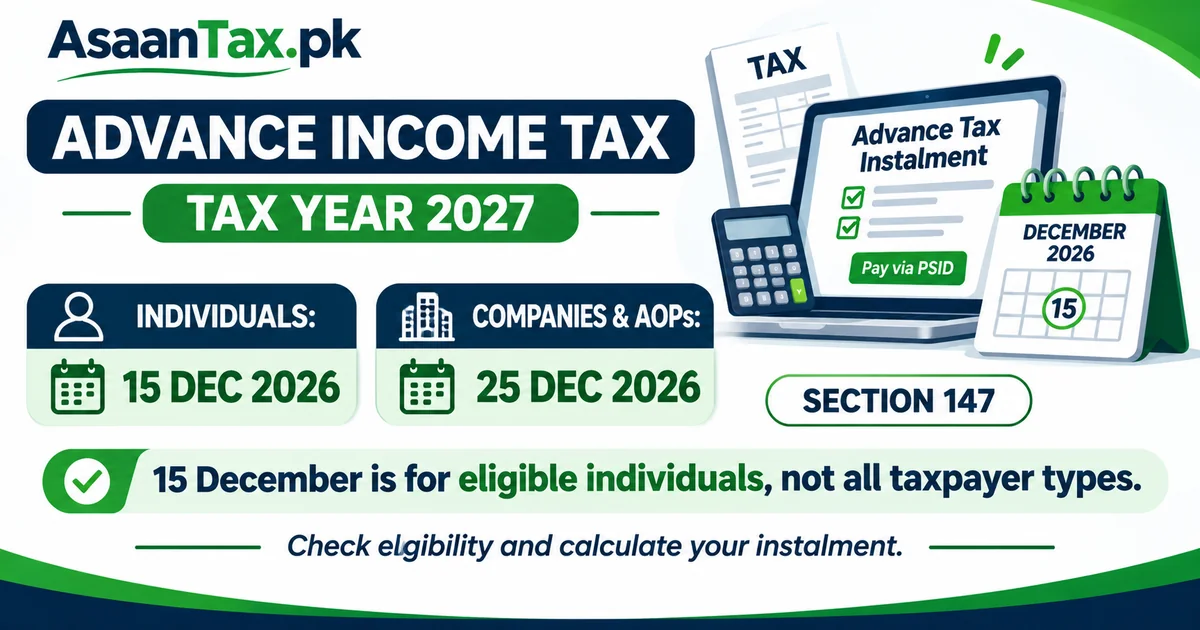
The second quarterly advance income tax instalment for Pakistan's Tax Year 2027 is approaching. Eligible individual taxpayers must pay their December-quarter advance income tax by December 15, 2026, in accordance with Section 147 of the Income Tax Ordinance, 2001.
For companies and Associations of Persons (AOPs), the regular December-quarter deadline is December 25, 2026.
Advance income tax is an important part of Pakistan's tax collection system. Instead of paying the entire annual liability at the end of the tax year, taxpayers covered by Section 147 make payments during the year.
However, not every filer or salaried employee is required to pay a separate quarterly instalment.
This detailed guide explains who is required to pay advance income tax, how much tax is payable, the Rs 1 million individual threshold, calculation methods, online payment procedures, and the consequences of late payment.
1. What Is Advance Income Tax Under Section 147?
Advance income tax is a tax payment made during the relevant tax year against the taxpayer's income tax liability.
Section 147 of the Income Tax Ordinance, 2001, regulates advance tax payments by eligible individuals, companies, and Associations of Persons.
For taxpayers following the normal tax year, Tax Year 2027 covers the period from July 1, 2026, to June 30, 2027.
Advance tax payments are generally made in quarterly instalments according to the applicable statutory schedule.
The amount payable depends on the taxpayer's category, previous assessed tax, current turnover where applicable, allowable withholding tax credits, and other relevant legal requirements.
Important: Advance tax under Section 147 is not an additional tax imposed merely because someone is a filer. It is generally a payment against the taxpayer's income tax liability, subject to the law's credit and adjustment provisions.
2. Advance Tax Payment Deadlines for Tax Year 2027
Section 147 provides different quarterly payment dates for individuals and for companies or AOPs.
| Quarter | Individuals | Companies and AOPs |
|---|---|---|
| September Quarter | 15 September 2026 | 25 September 2026 |
| December Quarter | 15 December 2026 | 25 December 2026 |
| March Quarter | 15 March 2027 | 25 March 2027 |
| June Quarter | 15 June 2027 | 15 June 2027 |
The December-quarter instalment is the second instalment for the normal Tax Year 2027.
Important Holiday Notice: December 25 is a public holiday in Pakistan. Companies and AOPs should make payment arrangements before the holiday and check any applicable official extension or payment rules.
Taxpayers following a special tax year or subject to special statutory rules should verify the schedule relevant to their circumstances.
3. Who Must Pay Advance Tax by December 15, 2026?
The December 15 instalment principally concerns individuals who meet the requirements of Section 147.
This may include eligible:
- Sole proprietors and individual business owners.
- Self-employed professionals.
- Freelancers conducting taxable business activities.
- Consultants with relevant taxable income.
- Individuals earning income from a business.
- Individuals with other non-excluded taxable income.
However, belonging to any of these categories does not automatically establish an advance tax liability.
A taxpayer must meet the relevant requirements of Section 147, including the applicable taxable income threshold and statutory exclusions.
Rs 1 Million Threshold for Individuals
Under Section 147(2), the provision generally does not apply to an individual whose latest assessed taxable income, after excluding the specified categories of income, is less than Rs 1,000,000.
The threshold is based on the relevant assessed taxable income, not simply total bank deposits, gross business receipts, or personal assets.
Example:
An individual has relevant assessed taxable income of Rs 1.5 million for the latest tax year.
If other Section 147 conditions apply, that individual may be required to pay advance income tax.
Conversely, an individual whose relevant assessed taxable income is Rs 800,000 would generally fall below the individual threshold.
The rules for companies and AOPs are different and should not be confused with the individual threshold.
4. Do Salaried Employees Need to Pay the December Advance Tax Instalment?
Individuals earning only salary income that is subject to withholding under Section 149 generally do not have to pay a separate quarterly advance tax instalment on that salary.
This is because the Section 147 rules exclude income subject to tax deduction at source under Section 149.
Employers normally deduct the applicable salary income tax through payroll.
What If an Employee Also Has Business Income?
An employee who also operates a business or earns other taxable income may need to consider Section 147 separately.
For example, a salaried employee running a profitable side business should examine whether their relevant non-excluded assessed taxable income meets the statutory threshold.
Being salaried does not automatically exempt a taxpayer's other qualifying taxable income.
5. Do Freelancers Have to Pay Advance Income Tax?
Freelancers may fall within the scope of Section 147 if their income is taxable under the relevant provisions and they meet the applicable requirements.
However, freelancers should not assume that every foreign remittance or freelance receipt is automatically subject to quarterly advance income tax.
The treatment depends on factors such as:
- The nature of the services performed.
- Whether income is taxed under a normal or special tax regime.
- Whether tax deducted is adjustable or final.
- The taxpayer's residency and income classification.
- The latest assessed taxable income.
- Any applicable exemptions or statutory exclusions.
Freelancers receiving foreign payments should review the applicable export-of-services provisions before determining their advance tax liability.
6. Do Companies and AOPs Pay Advance Tax on December 15?
Generally, no.
For companies and AOPs covered by the ordinary Section 147 quarterly schedule, the December instalment falls on December 25, 2026, rather than December 15.
Companies and AOPs are subject to a different calculation method from eligible individuals.
Their advance tax computation generally uses current-quarter turnover and previous-year assessed tax, with applicable credits and adjustments.
AOPs and companies should not apply the Rs 1 million individual exemption threshold to themselves.
Special rules may apply to particular entities, including banking companies.
7. How Much Advance Income Tax Must an Individual Pay?
Section 147(4B) provides the general calculation method for eligible individuals.
Individual Advance Tax Formula
Quarterly Advance Tax = (A ÷ 4) − B
Where:
A: Tax assessed for the latest tax year, including applicable amounts identified under Section 147.
B: Tax paid during the relevant quarter for which credit is allowed under Section 168, excluding salary tax deducted under Section 149.
This means an individual generally begins with one-quarter of the relevant assessed annual tax and reduces it by eligible tax already paid during that quarter.
Example 1: Individual Business Owner
Assume the following:
| Description | Amount |
|---|---|
| Latest Assessed Annual Tax | Rs 400,000 |
| One-Quarter Tax | Rs 100,000 |
| Eligible Quarterly Tax Credit | Rs 25,000 |
| Advance Tax Instalment | Rs 75,000 |
Calculation:
Rs 400,000 ÷ 4 = Rs 100,000
Rs 100,000 − Rs 25,000 = Rs 75,000
The illustrative advance tax instalment is Rs 75,000.
This example assumes that the taxpayer meets the Section 147 conditions and that the credit is legally allowable.
Example 2: Self-Employed Professional
Assume:
- Latest assessed annual tax: Rs 240,000.
- One-quarter amount: Rs 60,000.
- Eligible tax credit during the quarter: Rs 15,000.
Advance Tax = Rs 60,000 − Rs 15,000 = Rs 45,000
The illustrative December instalment is Rs 45,000.
These examples use assumed figures for educational purposes. The actual calculation must reflect the taxpayer's assessed income, legally relevant tax liability, and applicable credits.
8. How Is Advance Tax Calculated for Companies and AOPs?
Under Section 147(4), companies and AOPs generally use a turnover-based calculation.
Company and AOP Formula
Quarterly Advance Tax = (A × B ÷ C) − D
Where:
- A: Turnover during the relevant quarter.
- B: Tax assessed for the latest tax year, including applicable liabilities under the relevant provisions.
- C: Turnover for the latest tax year.
- D: Eligible tax paid during the quarter for which credit is allowed under Section 168.
Example: Private Limited Company
Assume:
| Description | Amount |
|---|---|
| Current Quarter Turnover | Rs 10,000,000 |
| Latest Assessed Annual Tax | Rs 1,200,000 |
| Previous Annual Turnover | Rs 40,000,000 |
| Eligible Quarterly Tax Credits | Rs 100,000 |
Step 1: Calculate the turnover-based amount.
Rs 10,000,000 × Rs 1,200,000 ÷ Rs 40,000,000 = Rs 300,000
Step 2: Deduct eligible credits.
Rs 300,000 − Rs 100,000 = Rs 200,000
The illustrative quarterly advance tax amount is Rs 200,000.
This example does not override other statutory requirements concerning minimum tax, super tax, estimates, or specific taxpayer categories.
Where current-quarter turnover is unavailable, the law provides a prescribed alternative calculation.
9. What If Business Income Has Decreased in Tax Year 2027?
A business may experience lower income or turnover compared with the previous tax year.
In certain circumstances, Section 147 allows taxpayers to submit an estimate of their lower expected tax liability, subject to applicable conditions and documentation.
This can help ensure that advance tax payments are aligned with a legally supportable estimate rather than an unrealistic amount.
However, a taxpayer should not simply reduce the payment without following the proper statutory procedure.
Documents That May Support an Estimate
- Updated profit and loss statements.
- Current turnover records.
- Sales and purchase summaries.
- Relevant expense records.
- Supporting business documentation.
- A reasonable calculation of expected annual tax liability.
Where the law permits a revised estimate, taxpayers should submit it through the prescribed procedure and retain supporting evidence.
An unsupported or significantly understated estimate may create additional tax and surcharge exposure.
10. How to Pay Advance Income Tax Online Through FBR
Eligible taxpayers can generally make advance income tax payments through FBR's electronic payment facilities.
Step 1: Open the Official FBR Portal
Visit the Federal Board of Revenue website:
Access the relevant IRIS or electronic payment service.
Step 2: Log In With Your Taxpayer Credentials
Use your authorized taxpayer account.
Verify that the relevant taxpayer registration information is correct.
Step 3: Select the Appropriate Payment Type
Choose the applicable income tax payment category for advance income tax under Section 147.
The exact screen labels may differ depending on the current FBR portal interface.
Step 4: Select Tax Year 2027
Confirm that the payment is being made against Tax Year 2027 and the relevant advance tax liability.
Step 5: Enter the Payment Amount
Calculate the payment using the applicable Section 147 formula.
Review any eligible withholding tax credits and prior adjustments before entering the amount.
Step 6: Generate the PSID
Create the Payment Slip ID (PSID) through the official electronic payment facility.
Check the taxpayer details, tax year, payment category, and amount before proceeding.
Step 7: Make the Payment
Complete the payment using an officially supported banking or electronic payment method.
Step 8: Save the CPR
After the payment is successfully processed, retain the Computerized Payment Receipt (CPR) or applicable official confirmation.
Review the transaction in your FBR records when available.
Important: Generating a PSID alone does not prove that the tax has been paid. The actual payment must be completed and confirmed.
11. What Happens If Advance Tax Is Paid Late?
Failure to pay the required advance tax by the applicable deadline may result in default surcharge and other recovery consequences under the Income Tax Ordinance, 2001.
Section 205 contains provisions relating to default surcharge, including shortfalls in advance tax payments.
The amount and period of surcharge depend on the relevant statutory provision and the taxpayer's circumstances.
Where applicable, the law may also consider the proportion of the taxpayer's eventual annual tax liability covered by advance payments.
Taxpayers should therefore calculate their liability carefully and avoid assuming that late payment is penalty-free.
12. Is Advance Tax Adjustable Against the Annual Income Tax Return?
Advance tax properly paid under Section 147 is generally credited against the taxpayer's income tax liability, subject to applicable legal provisions.
Practical Example
Assume a taxpayer has:
| Description | Amount |
|---|---|
| Final Annual Income Tax Liability | Rs 500,000 |
| Advance Tax Already Paid | Rs 320,000 |
| Other Eligible Tax Credits | Rs 80,000 |
| Remaining Tax Payable | Rs 100,000 |
The simplified calculation is:
Rs 500,000 − Rs 320,000 − Rs 80,000 = Rs 100,000
The taxpayer would have an illustrative remaining tax liability of Rs 100,000.
If total allowable tax credits exceed the final liability, the treatment of the excess depends on applicable adjustment and refund provisions.
13. Common Mistakes Taxpayers Should Avoid
Before paying the December 2026 advance tax instalment, review these common errors.
Using the Wrong Tax Year
Ensure that the payment is recorded against Tax Year 2027.
Applying the Wrong Deadline
Individuals and companies or AOPs generally have different December-quarter payment deadlines.
Confusing Gross Turnover With Taxable Income
The individual threshold concerns relevant assessed taxable income, not simply total sales or bank deposits.
Using the Individual Formula for a Company
Companies and AOPs generally use the turnover-based formula prescribed under Section 147(4).
Claiming Ineligible Withholding Tax Credits
Only legally allowable credits should reduce the instalment.
Ignoring Changes in Current Business Income
Where relevant, consider the lawful estimated-tax procedure.
Paying Without Verifying the PSID
Confirm the taxpayer identity, tax year, payment category, and amount.
Failing to Retain the CPR
Keep official proof of payment for future tax reconciliation and compliance.
14. Final Checklist Before 15 December 2026
Before the deadline, eligible individual taxpayers should complete the following checks.
- Verify whether Section 147 applies.
- Check the latest assessed taxable income.
- Confirm whether the Rs 1 million individual threshold is met.
- Review applicable income exclusions.
- Obtain the latest assessed tax figure.
- Identify eligible quarterly withholding tax credits.
- Calculate the December instalment.
- Consider any lawful revised estimate procedure.
- Confirm Tax Year 2027.
- Generate the correct PSID.
- Complete payment by the applicable deadline.
- Save the CPR and payment confirmation.
For companies and AOPs, use the relevant turnover-based calculation and verify the December 25 deadline and any official holiday arrangements.
15. Watch Tax With Naeem — Pakistan Income Tax Guidance
For practical educational guidance on Pakistan's income tax system, income reporting, withholding tax, and return filing, watch the following video from Tax With Naeem.
Video: Income Tax Return Filing in Pakistan — Salary, Rental Income, Capital Gains and Dividends Explained
https://www.youtube.com/watch?v=VX88o1N1AfA
This is a related income tax education video rather than a dedicated Section 147 advance-tax instalment tutorial.
For an exact advance tax calculation, viewers should always refer to the current FBR legislation and their individual tax records.
16. Official FBR Sources and Further Reading
For reliable and updated tax information, use the following official resources.
FBR Official Website
Income Tax Ordinance, 2001 — Latest Updated Legislation
https://www.fbr.gov.pk/Categ/Income-Tax-Ordinance/326/1000
FBR IRIS Portal
FBR Advance Tax Payment Calendar
https://www.fbr.gov.pk/DisplayDocs/158
AsaanTax.pk — Pakistan Income Tax Guides
Taxpayers should rely on the updated Income Tax Ordinance and relevant official notifications where older FBR informational pages contain outdated thresholds or schedules.
17. Conclusion
The 15 December 2026 advance income tax instalment is an important compliance deadline for eligible individual taxpayers in Pakistan.
Under Section 147, individuals who meet the relevant statutory requirements, including the Rs 1 million assessed taxable income threshold, may be required to make quarterly advance income tax payments.
Companies and AOPs generally follow a different calculation method and have a December-quarter deadline of December 25, 2026.
The amount payable is not a single fixed percentage for every taxpayer. It depends on the relevant assessed tax, turnover where applicable, allowable tax credits, and other provisions of the law.
Taxpayers should calculate their liability carefully, pay through an authorized FBR payment service, retain the CPR, and maintain complete tax records.
For more professional guides on Pakistan income tax, FBR notices, tax return filing, tax deadlines, and compliance, visit AsaanTax.pk.
Editorial Disclaimer: This article provides general tax information for Tax Year 2027 based on the income tax legislation and standard quarterly payment rules reviewed as of November 9, 2026. The information does not replace individualized professional tax advice. Taxpayers should verify their applicable obligations using current FBR legislation and official notifications before making a payment.