Real Estate Gets Rs 34 Billion Tax Relief While Salaried Class Pays Rs 193 Billion — Latest FBR Figures 2026
Published: November 9, 2026
Financial Year: 2026–27
Reporting Period: July–October 2026
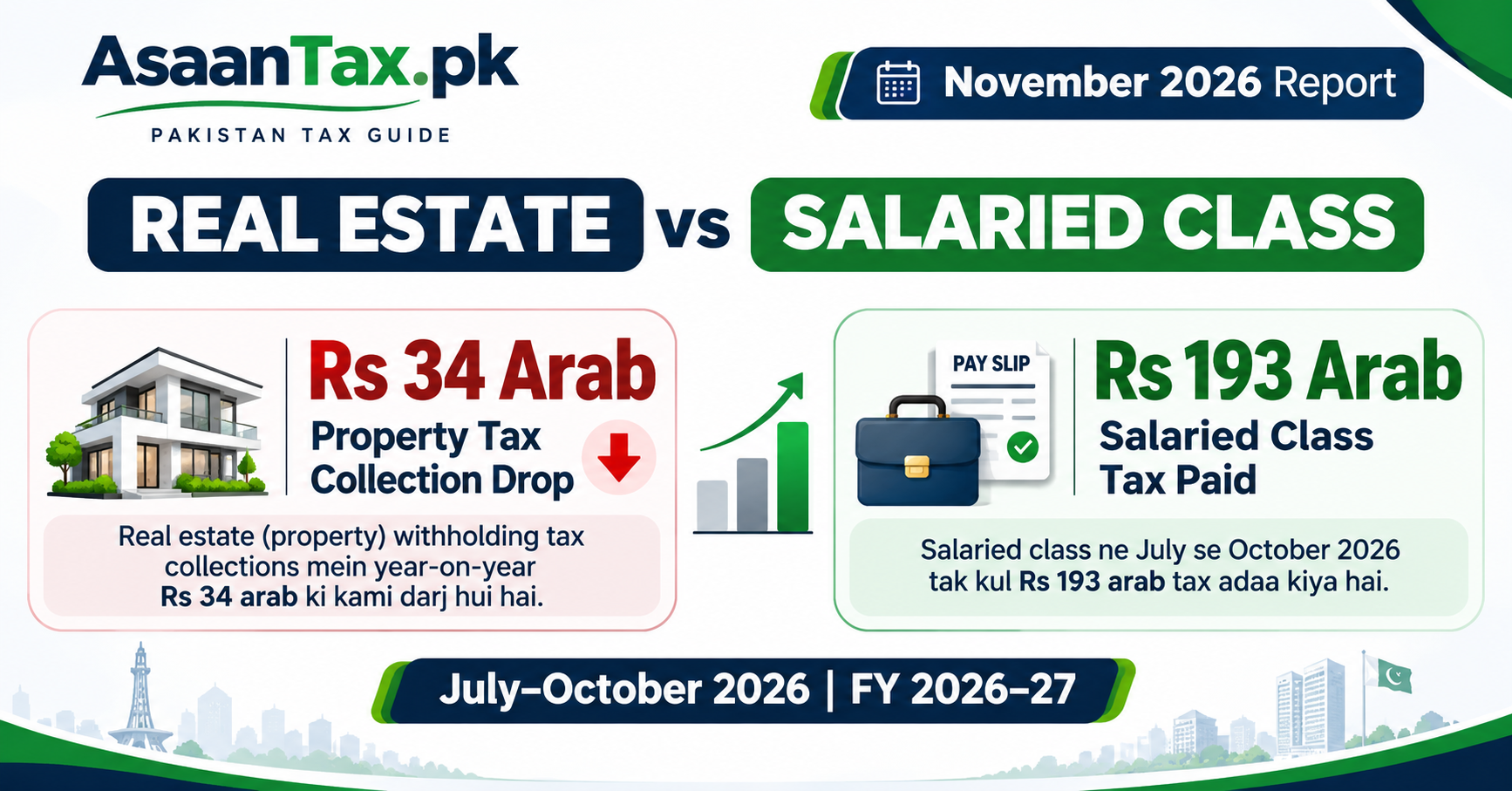
Pakistan's latest tax collection figures have sparked an important debate about the distribution of the country's tax burden. According to media reports published in November 2026, salaried individuals contributed approximately Rs 193 billion in income tax during the first four months of the current financial year, while withholding tax collections from real estate transactions declined by approximately Rs 34 billion compared with the corresponding period last year.
The figures, reported by The Express Tribune, highlight contrasting trends in tax collection from salaried employees and property transactions.
However, an important distinction must be made: the Rs 34 billion figure represents a decline in property-related withholding tax collections, not a direct cash subsidy paid to the real estate sector.
This article examines the latest reported FBR figures, changes in property-related taxes, the contribution of salaried taxpayers, and the implications for Pakistan's economy.
1. Latest FBR Tax Collection Figures for FY 2026–27
According to provisional figures reported in November 2026, salaried individuals paid approximately Rs 193 billion in income tax between July and October 2026.
During the same period, withholding tax collected on property purchases and sales declined from approximately Rs 76 billion to Rs 42 billion.
Tax Collection Comparison: July–October 2025 vs 2026
| Tax Category | July–October 2025 | July–October 2026 | Change |
|---|---|---|---|
| Salaried Class Income Tax | Approx. Rs 179 billion | Approx. Rs 193 billion | Rs 13.5 billion increase (reported) |
| Real Estate Withholding Tax | Approx. Rs 76 billion | Approx. Rs 42 billion | Rs 34 billion decrease |
| Property Sale Advance Tax | Rs 52.7 billion | Rs 27.3 billion | Rs 25.4 billion decrease |
| Property Purchase Advance Tax | Rs 23.1 billion | Rs 14.7 billion | Rs 8.4 billion decrease |
Note: These are provisional, rounded figures reported in the media. Final official collections may differ.
The figures indicate that tax collected from salaried individuals increased, while advance income tax receipts from property transactions declined significantly.
2. Why Did Real Estate Tax Collections Decline by Rs 34 Billion?
The federal budget for FY 2026–27 introduced reductions in certain advance income tax rates applicable to property transactions.
According to the reported comparisons, selected property sale withholding tax rates were reduced from 5.5% to 2.75%, while selected property purchase rates were reduced from 2.5% to 1.25%.
These comparisons do not represent the applicable rate for every property transaction.
Actual withholding tax depends on several factors, including:
- Whether the taxpayer appears on the Active Taxpayer List (ATL).
- The declared or applicable value of the property.
- Whether the transaction involves a purchase or sale.
- The date of the transaction.
- The applicable provisions of the Income Tax Ordinance, 2001.
Impact on Government Revenue
The reported figures show that withholding tax collected on property sales declined from Rs 52.7 billion to Rs 27.3 billion.
Similarly, withholding tax collected on property purchases declined from Rs 23.1 billion to Rs 14.7 billion.
Together, these reductions explain most of the reported Rs 34 billion decrease in real estate withholding tax collections.
However, a reduction in collections does not necessarily mean that the number or value of property transactions declined by the same percentage.
3. Property Sale and Purchase Taxes: Sections 236C and 236K
Two important provisions of Pakistan's Income Tax Ordinance, 2001, govern advance income tax on property transactions.
Section 236C — Advance Tax on Property Sales
Section 236C deals with advance income tax collected from a person selling or transferring immovable property.
The applicable rate depends on the relevant legal provisions, transaction value, date, and taxpayer category.
Property sellers should check the latest FBR withholding tax rates before completing a transaction.
Section 236K — Advance Tax on Property Purchases
Section 236K deals with advance income tax collected from a person purchasing immovable property.
The withholding tax treatment can differ according to the buyer's taxpayer status and the applicable legal schedule.
Being an active filer may provide access to lower withholding tax rates for certain transactions, but it does not automatically exempt a person from tax.
For additional tax guidance, visit AsaanTax.pk.
4. Why Did Salaried Individuals Pay Rs 193 Billion in Income Tax?
Salaried employees are among Pakistan's most consistently documented categories of income taxpayers.
Under Section 149 of the Income Tax Ordinance, employers generally deduct applicable income tax from employees' salaries.
According to the reported figures, salary income tax collection increased from approximately Rs 179 billion during July–October 2025 to approximately Rs 193 billion during July–October 2026.
The reported increase was Rs 13.5 billion.
Reasons for Consistent Salary Tax Collection
1. Employer Withholding
Employers normally deduct income tax through their payroll systems.
2. Documented Salary Income
Employee salaries and tax deductions are recorded through payroll and accounting systems.
3. Regular Tax Deduction
Unlike some taxes collected during individual transactions, salary tax is generally deducted throughout the financial year.
4. Employer Reporting
Employers are required to meet applicable withholding tax reporting obligations.
5. Changes in Taxable Income
Changes in salary levels, employment, taxable income distribution, and compliance can affect total salary tax collections.
An increase in total salary tax collection does not necessarily mean that the income tax rate increased for every salaried employee.
5. Salaried Class vs Real Estate: Who Paid More Tax?
The reported July–October 2026 figures provide the following comparison:
| Description | Amount |
|---|---|
| Salaried Class Income Tax | Rs 193 billion |
| Property-Related Withholding Tax | Rs 42 billion |
| Difference | Rs 151 billion |
| Collection Ratio | Approximately 4.6 times |
This means salary income tax collection was approximately 360% higher than property-related withholding tax collection during the reporting period.
However, this comparison should not be interpreted as a measurement of the total tax burden borne by the entire real estate industry.
Salary income tax and property transaction withholding taxes apply to different tax bases and collection mechanisms.
Other taxes paid by developers, companies, investors, and property owners are not fully captured by this comparison.
6. Is Pakistan's Tax System Fair to Salaried Employees?
The figures have renewed discussion about fairness in Pakistan's taxation system.
Salaried employees generally have income tax deducted before receiving their net salaries, leaving limited opportunities for underreporting employment income.
In contrast, taxation of business activities, property transactions, and other income sources involves different reporting systems, exemptions, and enforcement challenges.
The policy debate therefore extends beyond simply comparing two tax collection figures.
A fair and sustainable tax system should aim to:
- Broaden the tax base across economic sectors.
- Improve documentation of taxable income.
- Reduce tax evasion and underreporting.
- Apply tax legislation consistently.
- Maintain predictable tax policies.
- Protect compliant taxpayers from unnecessary administrative burdens.
Evaluating tax fairness also requires consideration of income levels, total liabilities, compliance, and each sector's economic contribution.
7. How Could Property Tax Relief Affect Pakistan's Economy?
Reducing advance tax rates on property transactions may influence investment decisions and market activity.
Potential Economic Benefits
Lower Transaction Costs
Reduced advance taxes can lower the immediate cash required to complete certain property transactions.
Support for Property Investment
Lower transaction costs may encourage some investors and buyers to enter the documented property market.
Construction Sector Activity
Higher property market activity may indirectly support construction, building materials, and related services.
Improved Transaction Documentation
Lower transaction-related costs may encourage formal registration in some circumstances.
Potential Challenges
Lower Immediate Revenue
Reducing withholding tax rates may decrease short-term government receipts.
Pressure on Revenue Targets
Lower collections can make government revenue targets more difficult to achieve.
Unequal Distribution of Benefits
The financial advantages of tax reductions may vary across taxpayer groups.
Uncertain Impact on Transaction Volumes
Lower tax rates do not guarantee that property transaction volumes will rise sufficiently to compensate for lost revenue.
The overall outcome depends on market activity, tax compliance, transaction values, and economic conditions.
8. Why Is Tax Collection From Salaried Employees Easier?
Salary income is generally easier to track because employers maintain structured payroll records.
Tax authorities can use employer withholding statements and other available records to examine salary-related tax compliance.
By comparison, property transactions involve variations in transaction values, taxpayer categories, documentation, and applicable tax rules.
These differences affect how taxes are assessed and collected.
However, salary withholding and property transaction withholding are different mechanisms and should not be treated as identical forms of taxation.
9. Example: Understanding the Effect of a Property Tax Rate Reduction
Consider a hypothetical property transaction with a relevant withholding tax base of Rs 10 million (Rs 1 crore).
Assume the applicable advance tax rate changes from 2.5% to 1.25%.
| Description | Amount |
|---|---|
| Illustrative Tax Base | Rs 10,000,000 |
| Advance Tax at 2.5% | Rs 250,000 |
| Advance Tax at 1.25% | Rs 125,000 |
| Difference | Rs 125,000 |
In this example, the immediate advance tax payment would be Rs 125,000 lower.
Important: This is a mathematical illustration, not a statement that 1.25% applies to every property transaction. Actual withholding tax and final tax treatment must be determined using the current legislation.
10. What Should Salaried Taxpayers Do in Tax Year 2027?
Salaried taxpayers should ensure their income tax records are accurate and complete.
Verify Annual Salary and Tax Deductions
Obtain an annual salary certificate or equivalent tax deduction statement from your employer.
Check Applicable Income Tax Slabs
Calculate annual taxable salary using the relevant Tax Year 2027 provisions.
File an Accurate Income Tax Return
Where filing is required, ensure that salary income and tax already deducted are correctly reported.
Declare Additional Taxable Income
Other sources of income, such as rental income, business income, and bank profit, should be treated according to their applicable tax rules.
Review Eligible Tax Credits
Taxpayers should check whether they qualify for any deductions, adjustments, or tax credits allowed under the law.
For further guidance, visit AsaanTax.pk — Pakistan Income Tax Guides.
11. What Should Property Buyers and Sellers Do?
Before buying or selling immovable property in Pakistan, taxpayers should review their applicable advance income tax obligations.
Recommended steps include:
- Verify Active Taxpayer List (ATL) status.
- Confirm the applicable property value and transaction details.
- Identify whether Section 236C or Section 236K applies.
- Review current withholding tax rates.
- Obtain and retain evidence of applicable tax payments.
- Consider any additional provincial charges and registration costs.
- Seek professional guidance for complicated or high-value transactions.
Accurate documentation can help taxpayers avoid unnecessary disputes and compliance difficulties.
12. FBR Revenue Targets and Pakistan's Tax Collection Challenges
The November 2026 reports also highlighted pressure on FBR revenue collection.
According to the reporting, the July–October period recorded a revenue shortfall of approximately Rs 95 billion against the relevant target, while revenue growth was reported at approximately 6.5%.
These figures illustrate the challenge of meeting government revenue requirements while balancing tax relief and economic growth.
Sustainable revenue collection requires more than higher withholding rates on existing compliant taxpayers.
Improved enforcement, broader documentation, administrative efficiency, and greater participation across economic sectors may help strengthen Pakistan's tax system.
13. Watch Tax With Naeem — Pakistan Income Tax Guide
For practical guidance on salary income, rental income, capital gains, dividends, and income tax return filing in Pakistan, watch the educational video from the Tax With Naeem YouTube channel.
Video Title: Income Tax Return Filing in Pakistan | Salary | Rental | Capital Gain | Dividend Explained
YouTube Video: https://www.youtube.com/watch?v=VX88o1N1AfA
This video explains the reporting of different sources of income. It is not a dedicated analysis of the November 2026 Rs 34 billion and Rs 193 billion tax collection figures. Viewers should check the latest Tax Year 2027 provisions when applying any tax guidance.
14. What Do These Figures Mean for Pakistan's Future Tax Policy?
The reported figures raise important questions about Pakistan's tax structure.
Should the government rely heavily on documented salary income? How can taxation of other economic activities become more effective? Can property transaction tax reductions encourage enough additional economic activity to support revenue growth?
These questions require detailed analysis of tax rates, actual taxable income, transaction volumes, compliance, and government revenues.
A balanced policy should support investment while ensuring that taxpayers with comparable economic capacity are treated fairly under the law.
15. Conclusion
Pakistan's reported tax collection figures for July–October 2026 highlight a significant difference between salaried taxpayers and property-related withholding tax collections.
During the period, salaried individuals contributed approximately Rs 193 billion in income tax, while withholding tax collections from property sales and purchases totaled approximately Rs 42 billion.
The property-related figure represented a year-on-year decrease of approximately Rs 34 billion, which media reports linked to reductions in certain advance tax rates.
These developments have brought renewed attention to tax fairness, revenue collection, and the need for broader participation in Pakistan's tax system.
However, the figures compare different types of taxes and should not be used alone to conclude that one entire economic sector pays more or less tax than another.
For updated information on Pakistan's income tax system, property taxation, FBR rules, and return filing, visit www.asaantax.pk.
Sources and References
- The Express Tribune — November 8, 2026: Realty Sector Gets Rs 34 Billion Tax Relief
- ProPakistani — November 9, 2026: Salaried Class and Real Estate Tax Collection Report.
- Federal Board of Revenue: www.fbr.gov.pk — Income Tax Ordinance, 2001, and applicable withholding tax provisions.
- Tax With Naeem: Income Tax Return Filing Tutorial
Editorial Note: This article is based on provisional tax collection figures reported by Pakistani media in November 2026. The exact figures have not been independently verified against a separately published FBR collection dataset and may be subject to revision.
Disclaimer: This article is provided for general educational and informational purposes. Actual tax liabilities depend on applicable legislation, transaction dates, taxpayer status, and individual circumstances. Readers should consult current FBR guidance or a qualified tax professional before making financial or tax decisions.