October Sales Tax Return 2026: Complete These Steps Before the 18 November Deadline
Published: November 9, 2026
Tax Period: October 2026
Financial Year: 2026–27
Return Filing Deadline: November 18, 2026
The deadline for filing the October 2026 Sales Tax Return in Pakistan is November 18, 2026, under the Federal Board of Revenue's (FBR) standard monthly filing schedule.
Businesses registered for federal sales tax should prepare their sales and purchase records, reconcile invoices, calculate their tax liability, and complete the relevant filing requirements before the deadline.
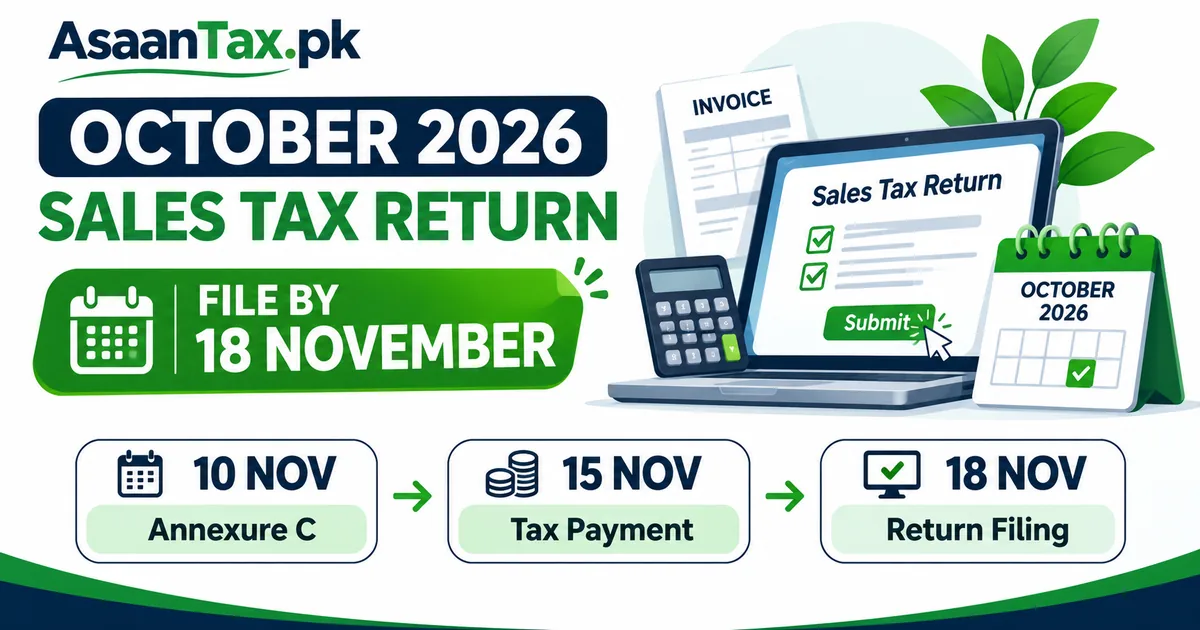
However, businesses must remember that sales tax payment and return submission have different deadlines. The normal payment deadline is November 15, 2026, while the electronic return filing deadline is November 18, 2026.
This comprehensive guide explains the important deadlines, required documents, sales tax calculations, online filing procedure, common mistakes, and steps taxpayers should take to remain compliant.
1. October 2026 Sales Tax Return: Important FBR Deadlines
Under FBR's standard monthly procedure, registered persons generally have three important deadlines during the month following the relevant tax period.
| Compliance Requirement | Deadline | Purpose |
|---|---|---|
| Annexure C Submission | November 10, 2026 | Sales invoice reporting |
| Sales Tax Payment | November 15, 2026 | Payment of applicable tax liability |
| Sales Tax Return Filing | November 18, 2026 | Electronic submission of the return |
Important: November 15, 2026, falls on a Sunday. Taxpayers should arrange payment sufficiently early and verify the applicable payment arrangements rather than assuming that the payment deadline has automatically been extended.
These are the standard federal sales tax dates. Special categories, sector-specific rules, or an official FBR notification may prescribe different requirements.
Taxpayers should check the latest official notifications before relying on any extension.
2. Who Must File the October 2026 Sales Tax Return?
Businesses and individuals registered under the Sales Tax Act, 1990, or relevant federal excise provisions may be required to submit periodic sales tax returns.
Depending on their registration and applicable rules, these may include:
- Manufacturers and industrial businesses.
- Importers and exporters.
- Registered wholesalers and distributors.
- Registered retailers.
- Commercial businesses making taxable supplies.
- Other persons required to file federal sales tax returns.
Not every registered business follows identical monthly filing requirements. Certain taxpayers may be subject to quarterly or other special procedures.
Important: Provincial sales tax on services may be administered by the relevant provincial revenue authority. This article primarily addresses federal sales tax administered by FBR.
3. What Documents Are Required for the October Sales Tax Return?
Before starting the return, businesses should prepare their financial and tax records for October 1–31, 2026.
Sales Invoices
Review all taxable sales invoices issued during October.
Check invoice numbers, transaction dates, customer registration details where required, taxable values, and sales tax amounts.
Purchase Invoices
Collect purchase invoices from suppliers and ensure that any input tax being claimed is supported by valid records.
Import Documents
Importers should reconcile relevant customs documents, import records, and applicable sales tax paid at import stages.
Debit and Credit Notes
Review adjustments arising from returned goods, discounts, corrections, or other qualifying transactions.
Previous Return and Carry-Forward Balances
Check applicable previous-period credit balances and any adjustments that may affect the current return.
Bank and Payment Records
Maintain evidence of tax payments, including relevant payment references and Computerized Payment Receipts (CPRs).
Accounting and Inventory Records
Reconcile sales ledgers, purchase ledgers, and stock records where relevant to the business.
Accurate documentation reduces the risk of reporting errors, unsupported input tax claims, and subsequent compliance problems.
4. Annexure C: What Must Be Completed Before November 10?
Annexure C is an important part of the federal sales tax return process.
It generally contains details of sales and outward supplies reported by a registered taxpayer.
Businesses should ensure that their October 2026 sales records are correctly reflected in the applicable electronic filing system.
Before Submitting Annexure C
- Review all October sales invoices.
- Check invoice numbers and dates.
- Verify buyers' tax registration details where applicable.
- Confirm taxable values and relevant sales tax treatment.
- Reconcile invoices with accounting records.
- Review applicable debit and credit notes.
- Check whether invoice data has been correctly uploaded or synchronized.
- Resolve identified errors before final submission.
FBR's standard monthly filing schedule requires Annexure C information by the 10th day of the following month.
For October 2026, that date is November 10, 2026.
Businesses should avoid postponing invoice reconciliation until the final return filing date.
5. Sales Tax Payment Deadline: November 15, 2026
Another critical requirement is payment of the applicable sales tax liability.
Under the standard federal procedure, payment is generally due by the 15th day of the following month.
For the October 2026 tax period, the normal payment date is November 15, 2026.
How to Prepare for Sales Tax Payment
- Complete applicable output tax calculations.
- Verify allowable input tax.
- Review previous-period adjustments.
- Determine the net liability under current law.
- Generate the appropriate payment reference through the relevant FBR system.
- Pay through an authorized payment channel.
- Retain the payment confirmation and CPR.
Remember: Filing the return by November 18 does not automatically mean payment can also be postponed until November 18.
Where an extension is announced, taxpayers should carefully check whether it applies to return filing, tax payment, or both.
6. How to File the October 2026 Sales Tax Return Online
FBR provides electronic filing services for registered taxpayers through its tax filing systems, including IRIS.
The general procedure involves the following steps.
Step 1: Access the Official FBR IRIS Portal
Visit the official FBR website:
Log in using your authorized taxpayer credentials.
Step 2: Open the Sales Tax Return Section
Navigate to the applicable return declaration option.
FBR's published guidance identifies the sales tax and federal excise return under the relevant Section 26 declaration.
The exact screen layout and options may change following portal updates.
Step 3: Select the Relevant Tax Period
Choose October 2026 as the relevant sales tax period.
Verify that you are not preparing a return for September or November by mistake.
Step 4: Review Sales Information
Check outward supplies and relevant Annexure C information.
Verify tax classifications, transaction values, and available invoice records.
Step 5: Review Purchases and Input Tax
Check eligible purchases and relevant input tax information.
Only claim input tax that meets the applicable legal requirements and is supported by appropriate documentation.
Step 6: Complete Applicable Annexures
Review any other annexures required for your business, such as imports, exports, stock, production, or debit and credit notes.
Not every annexure applies to every taxpayer.
Step 7: Calculate the Tax Liability
Review the calculation produced by the return and reconcile it with your records.
Check whether adjustments and carry-forward credits have been correctly reflected.
Step 8: Make the Required Payment
Where tax is payable, complete the required payment process by the applicable deadline.
Retain the CPR or relevant official payment confirmation.
Step 9: Review the Complete Return
Check the declaration carefully.
Confirm that sales, purchases, tax amounts, adjustments, and payment information are accurate.
Step 10: Submit and Save Confirmation
Submit the return electronically.
Verify that the system shows the return as successfully filed rather than merely saved as a draft.
Download or preserve the return acknowledgment and supporting records.
For the official instructions, consult FBR's Filing of New Sales Tax and Federal Excise Return user guide.
7. How Is Sales Tax Liability Calculated?
A basic sales tax calculation involves output tax and eligible input tax.
Output Tax: Sales tax charged on taxable supplies.
Input Tax: Sales tax paid on eligible business purchases or imports, subject to the applicable law.
The final amount payable may depend on permitted input tax adjustments, carried-forward credits, restrictions, special provisions, and other relevant factors.
Practical Example
Assume a hypothetical registered business has the following figures for October 2026:
| Description | Amount |
|---|---|
| Output Sales Tax | Rs 450,000 |
| Eligible Input Sales Tax | Rs 280,000 |
| Net Difference | Rs 170,000 |
In this simplified example:
Rs 450,000 − Rs 280,000 = Rs 170,000
The preliminary net difference is Rs 170,000.
This is a simplified educational example. The actual amount payable may differ because of minimum value addition requirements, blocked input tax, carry-forward balances, withholding arrangements, adjustments, or special rules.
Taxpayers should not use a basic subtraction alone as a substitute for the statutory return calculation.
8. Common Mistakes to Avoid Before Filing
Errors in sales tax returns can cause compliance problems, financial adjustments, or delays.
Missing Sales Invoices
All reportable sales should be correctly reflected in the relevant period.
Incorrect Purchase Details
Purchase records should match relevant supplier and tax documentation.
Unsupported Input Tax Claims
Input tax should only be claimed when the requirements of the Sales Tax Act and applicable rules are satisfied.
Wrong Tax Period
Verify that the selected return period is October 2026.
Incorrect Tax Classification
Check whether goods or services are taxable, zero-rated, exempt, or subject to a special regime.
Failure to Reconcile Accounting Records
Differences between invoices, accounting ledgers, and electronic tax records should be investigated.
Missing Payment Confirmation
Retain the CPR or other official confirmation for tax payments.
Saving Without Submitting
A draft return is not necessarily a filed return.
Verify successful submission through the official system.
9. What Happens If the October Sales Tax Return Is Filed Late?
Late filing and late payment can result in consequences under the Sales Tax Act, 1990, and applicable rules.
Possible consequences include:
- Statutory penalties for late filing.
- Default surcharge on overdue tax.
- Compliance notices or proceedings.
- Restrictions or complications relating to taxpayer status.
- Additional scrutiny where records are incomplete or inconsistent.
The actual consequences depend on the relevant violation, statutory provisions, taxpayer circumstances, and any applicable relief.
Taxpayers should check the current penalty and default surcharge provisions rather than relying on outdated fixed amounts.
10. Is a Nil Sales Tax Return Required When There Are No Sales?
A registered taxpayer may still have a filing obligation even where no taxable sales occurred during the relevant period.
A nil return may be appropriate if the taxpayer has no reportable taxable transactions or liability, subject to the applicable registration status and filing requirements.
However, businesses should not automatically submit a nil return merely because no sales took place.
Purchases, imports, adjustments, and other reportable transactions may still require disclosure.
The correct return treatment should be determined from the taxpayer's actual records.
11. What If FBR Extends the November 18 Deadline?
FBR may announce extensions for particular tax periods, taxpayer categories, or circumstances.
However, taxpayers should not assume that an extension will be granted.
An extension should only be relied upon when supported by an applicable official notification.
Before relying on an announcement:
- Visit the official FBR website.
- Check the notification date.
- Confirm the relevant sales tax period.
- Verify which taxpayer categories are covered.
- Check whether the payment deadline is also extended.
- Keep a copy of the relevant official notification.
The standard October 2026 electronic return filing date remains November 18, 2026, unless an applicable official notification provides otherwise.
12. Final Checklist Before November 18, 2026
Use this checklist before submitting the October sales tax return.
- Verify your sales tax registration and applicable filing category.
- Confirm the October 2026 tax period.
- Reconcile all sales invoices.
- Verify purchase invoices and eligible input tax.
- Review Annexure C and other applicable annexures.
- Check imports, exports, and debit or credit notes.
- Reconcile accounting records with the return.
- Calculate the correct tax liability.
- Complete payment by the applicable deadline.
- Retain the payment receipt.
- Review the final return.
- Submit electronically by November 18 unless a valid extension applies.
- Save the submitted return acknowledgment.
Completing these checks can reduce the likelihood of filing errors and missed compliance requirements.
13. Watch Tax With Naeem — Tax Return Filing Guidance
For additional guidance on Pakistan's tax system, withholding tax, and return filing, viewers can watch educational videos available on the Tax With Naeem YouTube channel.
Related Video: Income Tax Return Filing in Pakistan — Salary, Rental Income, Capital Gains and Dividends
https://www.youtube.com/watch?v=VX88o1N1AfA
Important: This video covers income tax return filing, not the October 2026 sales tax return procedure. Sales tax taxpayers should follow FBR's official sales tax filing instructions for the relevant period.
14. Official FBR Resources and Related Articles
Taxpayers can obtain further guidance from the following resources.
Federal Board of Revenue
FBR Sales Tax Due Dates
https://fbr.gov.pk/sales-tax-due-dates/51148/101162
Official IRIS Portal
Official FBR IRIS Help and Filing Guides
https://e.fbr.gov.pk/SOP/IRIS/help/index.html
AsaanTax.pk — FBR Tax Deadlines Calendar 2026–27
https://www.asaantax.pk/blog/fbr-tax-deadlines-calendar-2026-2027
AsaanTax.pk — Income Tax and Compliance Guides
Taxpayers should rely on the applicable legal provisions and official notifications when determining their individual compliance requirements.
15. Conclusion
The October 2026 sales tax return filing deadline is November 18, 2026, under FBR's standard monthly filing schedule.
However, businesses should remember the three separate compliance stages: Annexure C on November 10, tax payment on November 15, and electronic return filing on November 18.
Preparing documents early, reconciling invoices, verifying input tax, making timely payments, and confirming electronic submission can help businesses avoid common compliance mistakes.
Registered taxpayers should monitor FBR notifications and complete all applicable requirements without relying on an unconfirmed deadline extension.
For more updates on Pakistan's taxation system, sales tax compliance, tax return filing, and FBR deadlines, visit www.asaantax.pk.
Editorial Disclaimer: This article provides general information about standard federal sales tax obligations in Pakistan as of November 9, 2026. Specific industries and taxpayer categories may be subject to different requirements. Readers should check current FBR notifications, applicable legislation, and professional advice before filing or making tax payments.