Agriculture is one of Pakistan's major economic sectors, supporting farmers, landowners, tenants, crop producers and agricultural businesses across the country.
If you earn income from wheat, rice, cotton, sugarcane, maize, vegetables, fruit orchards, agricultural land rentals or other farming activities, it is important to understand the applicable agricultural income tax rules.
For Financial Year 2026–27, commonly referred to as Tax Year 2027, agricultural income taxation is governed primarily by provincial laws.
Under Section 41 of the Income Tax Ordinance, 2001, qualifying agricultural income is exempt from federal income tax. However, provincial agricultural income tax may still apply.
Recent provincial reforms have introduced progressive agricultural income tax systems, with individual income slabs in some provinces ranging from 0% to 45%.
This guide from AsaanTax.pk explains what qualifies as agricultural income, which farming activities may be taxable, the latest provincial tax framework, agricultural expenses, filing procedures and important compliance requirements.
What Is Agricultural Income Tax in Pakistan?
Agricultural Income Tax (AIT) is a provincial tax imposed on qualifying income arising from agricultural land and related farming activities.
Unlike ordinary federal income tax on salary and business profits, agricultural income is generally governed by the agricultural income tax legislation of the province in which the agricultural land is situated.
Relevant laws include:
- Punjab Agricultural Income Tax Act, 1997, as amended.
- Sindh Agricultural Income Tax Act, 2025, as amended.
- Khyber Pakhtunkhwa Agricultural Income Tax Act, 2025.
- Applicable Balochistan agricultural income tax legislation.
The rules, filing requirements and assessment mechanisms can differ by province.
Taxpayers should identify the relevant provincial jurisdiction before calculating their liability.
Is Agricultural Income Tax-Free in Pakistan?
Agricultural income may be exempt from federal income tax under Section 41 of the Income Tax Ordinance, 2001.
However, this does not mean that every farmer or agricultural landowner pays no tax.
Provincial governments can levy agricultural income tax under their respective laws.
A farmer may therefore have:
- Agricultural income subject to provincial taxation.
- Non-agricultural income subject to federal taxation.
- Relevant reporting obligations under federal and provincial laws.
The correct classification of income is essential.
What Types of Income Are Included in Agricultural Income?
Under the general definition in Section 41 and relevant provincial legislation, qualifying agricultural income commonly includes the following activities.
1. Income From Cultivation of Crops
Income from the cultivation and sale of agricultural produce may qualify as agricultural income.
Examples include:
- Wheat.
- Rice.
- Cotton.
- Sugarcane.
- Maize.
- Vegetables.
- Pulses.
- Oilseeds.
- Other qualifying agricultural crops.
The income should arise from actual agricultural operations on qualifying land.
2. Income From Fruit Orchards
Income earned from orchards may be treated as agricultural income.
Examples include:
- Mango orchards.
- Citrus and kinnow orchards.
- Date palms.
- Guava orchards.
- Apple and other fruit orchards.
The applicable treatment depends on the province, the type of agricultural operation and the legal classification.
3. Agricultural Land Rent
Rent or revenue received from land used for agricultural purposes may qualify as agricultural income.
For example, a landowner receiving income from agricultural land leased to a cultivator may fall within the applicable provincial tax regime.
4. Income From Land Cultivated on Lease
A tenant or lessee farming agricultural land may earn agricultural income.
The fact that the taxpayer does not personally own the land does not automatically exclude their income from the provincial agricultural tax law.
5. Agricultural Produce Sold by the Cultivator
Income from the sale of crops produced by the cultivator may qualify as agricultural income.
Ordinary processes used to prepare crops for market, such as cleaning, drying or grading, may also fall within the relevant statutory definition.
However, independent manufacturing or extensive commercial processing may be treated differently.
6. Certain Agricultural Buildings and Related Receipts
Section 41 also contains specific provisions relating to certain buildings connected with agricultural land.
These provisions are conditional and do not mean that every farmhouse, warehouse, rental building or commercial property automatically generates agricultural income.
Which Income Is Not Automatically Agricultural Income?
The following activities require separate tax classification:
| Income Source | General Treatment |
|---|---|
| Cultivation of wheat on agricultural land | Generally agricultural income |
| Sale of own qualifying crop produce | Generally agricultural income |
| Agricultural land rent | May qualify as agricultural income |
| Fruit orchard income | Generally agricultural income |
| Salary earned by a farm employee | Employment income, not agricultural income |
| Trading crops purchased from other farmers | Generally commercial or business income |
| Flour mill or sugar mill profits | Generally business or industrial income |
| Commission earned by a crop trader | Generally business income |
| Livestock and dairy farming | Province-specific; not automatically qualifying agricultural income |
| Poultry farming | Requires separate legal classification |
| Fisheries and fish farming | Requires separate legal classification |
| Commercial rental income from unrelated buildings | Generally non-agricultural income |
Important: Sindh Revenue Board states that livestock, dairy, poultry and fishery income is currently outside the scope of the Sindh Agricultural Income Tax Act, 2025. That does not automatically mean these activities are exempt from all other applicable taxes.
Latest Agricultural Income Tax Slabs for 2026–27
Reforms introduced in several provinces provide a progressive tax framework for individual agricultural income.
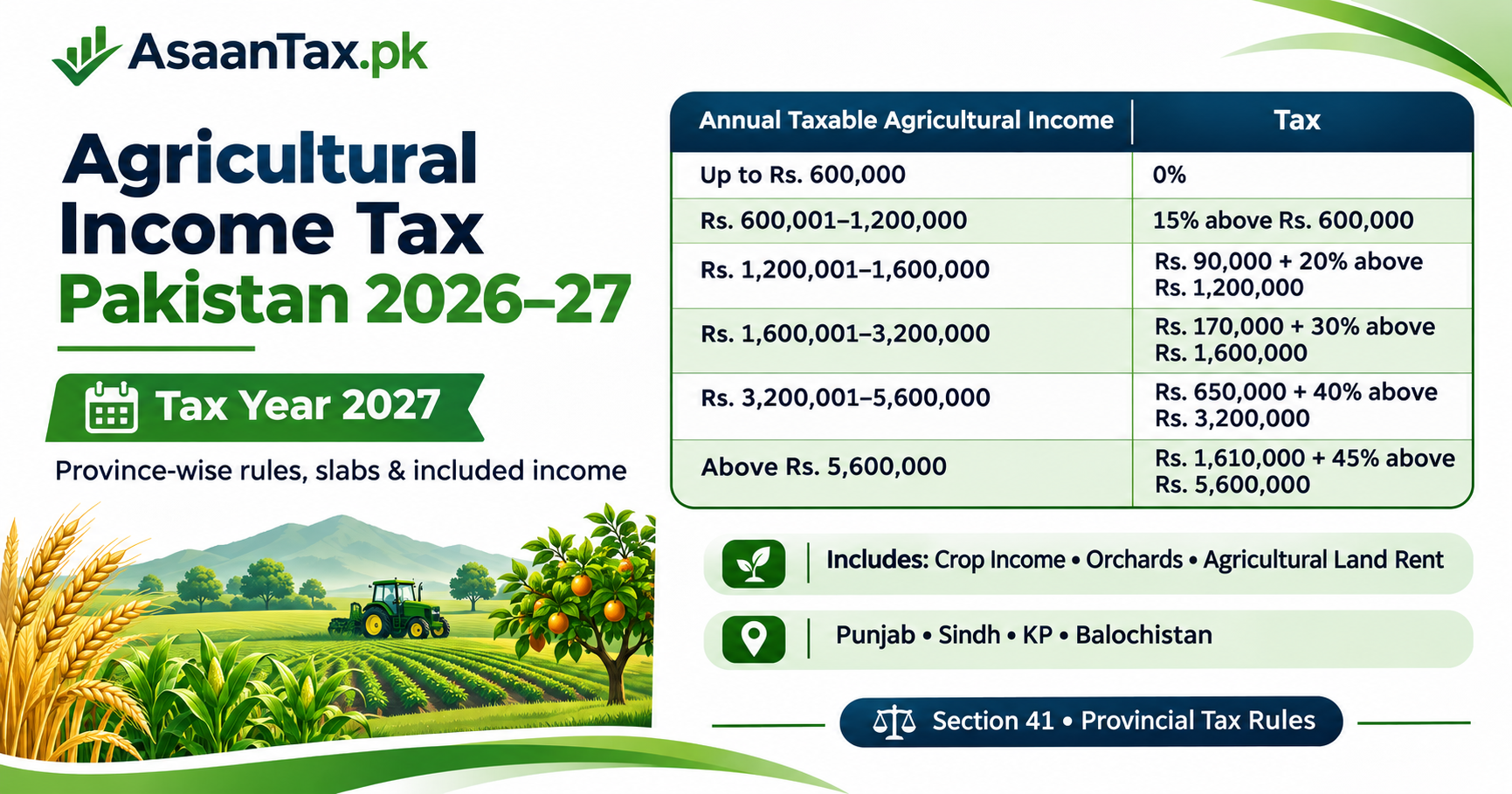
The following slab structure is published in the Sindh agricultural income tax rate schedule and the Khyber Pakhtunkhwa Agricultural Income Tax Act, 2025.
| Annual Taxable Agricultural Income | Applicable Tax |
|---|---|
| Up to Rs. 600,000 | Nil |
| Above Rs. 600,000 up to Rs. 1,200,000 | 15% of amount exceeding Rs. 600,000 |
| Above Rs. 1,200,000 up to Rs. 1,600,000 | Rs. 90,000 + 20% of amount exceeding Rs. 1,200,000 |
| Above Rs. 1,600,000 up to Rs. 3,200,000 | Rs. 170,000 + 30% of amount exceeding Rs. 1,600,000 |
| Above Rs. 3,200,000 up to Rs. 5,600,000 | Rs. 650,000 + 40% of amount exceeding Rs. 3,200,000 |
| Above Rs. 5,600,000 | Rs. 1,610,000 + 45% of amount exceeding Rs. 5,600,000 |
These are marginal tax slabs, not flat percentages on the entire income.
Province-specific caution: The legal position of revised Punjab notifications was disputed in 2026. Agricultural tax in KP may also involve separate cultivated-land and orchard assessments. Applicable rules in Balochistan must be confirmed separately.
Do not use the table as a universal tax demand without checking the relevant province's current law.
Agricultural Income Tax Calculation Examples
The following examples demonstrate the progressive income-tax slab calculation published by Sindh and KP.
They assume that the specified amount is taxable agricultural income after legally admissible deductions and that no additional exemption, super tax or other special provision applies.
Example 1: Agricultural Income of Rs. 500,000
Annual taxable agricultural income = Rs. 500,000.
Applicable income tax slab = Up to Rs. 600,000.
Calculated income tax = Rs. 0.
Example 2: Agricultural Income of Rs. 1,000,000
Annual taxable income = Rs. 1,000,000.
Excess above Rs. 600,000 = Rs. 400,000.
Tax = Rs. 400,000 × 15%.
Calculated income tax = Rs. 60,000.
Example 3: Agricultural Income of Rs. 1,500,000
Applicable slab formula:
Rs. 90,000 + 20% of the amount above Rs. 1,200,000.
Tax = Rs. 90,000 + (Rs. 300,000 × 20%).
Calculated income tax = Rs. 150,000.
Example 4: Agricultural Income of Rs. 2,500,000
Applicable slab formula:
Rs. 170,000 + 30% of the amount above Rs. 1,600,000.
Tax = Rs. 170,000 + Rs. 270,000.
Calculated income tax = Rs. 440,000.
Example 5: Agricultural Income of Rs. 5,000,000
Applicable slab formula:
Rs. 650,000 + 40% of the amount above Rs. 3,200,000.
Tax = Rs. 650,000 + Rs. 720,000.
Calculated income tax = Rs. 1,370,000.
Agricultural Income Tax Calculation Table
| Annual Taxable Income | Illustrative Income Tax |
|---|---|
| Rs. 500,000 | Rs. 0 |
| Rs. 600,000 | Rs. 0 |
| Rs. 800,000 | Rs. 30,000 |
| Rs. 1,000,000 | Rs. 60,000 |
| Rs. 1,200,000 | Rs. 90,000 |
| Rs. 1,500,000 | Rs. 150,000 |
| Rs. 2,000,000 | Rs. 290,000 |
| Rs. 2,500,000 | Rs. 440,000 |
| Rs. 3,000,000 | Rs. 590,000 |
| Rs. 4,000,000 | Rs. 970,000 |
| Rs. 5,000,000 | Rs. 1,370,000 |
| Rs. 6,000,000 | Rs. 1,790,000 |
This table uses the published Sindh/KP individual agricultural income slab formula and is intended for educational illustration.
It does not independently determine a taxpayer's final provincial liability.
Agricultural Income Tax in Punjab – 2026–27
Punjab agricultural income tax is governed by the Punjab Agricultural Income Tax Act, 1997, together with its amendments, rules and applicable notifications.
Punjab's framework can involve both agricultural land-based taxation and income-based taxation.
The law generally provides for payment of the higher applicable amount rather than adding both assessments together.
Punjab Agricultural Income Tax Rates
The revised income-tax slab structure announced in March 2025 included:
- Nil tax on income up to Rs. 600,000.
- Progressive rates starting at 15% above Rs. 600,000.
- Higher marginal rates reaching 45% for income exceeding Rs. 5,600,000.
However, in April 2026, the Punjab Assembly Speaker declared certain agricultural income tax rate notifications legally invalid because of concerns about compliance with statutory legislative procedures.
Subsequent reports discussed possible reinstatement, but the current enforceable notification position must be independently confirmed.
For a Punjab agricultural tax assessment relating to 2026–27, taxpayers should obtain the applicable rates from the Punjab Board of Revenue or the relevant Collector before calculating or paying tax.
Punjab Agricultural Income Tax Portal
Visit the Punjab agricultural income tax portal:
Confirm the current filing process and any applicable official notifications.
Agricultural Income Tax in Sindh – 2026–27
Sindh introduced the Sindh Agricultural Income Tax Act, 2025, with effect from January 1, 2025, subject to subsequent amendments and transitional provisions.
The Sindh Revenue Board administers agricultural income tax.
Under the published rate schedule:
- Income up to Rs. 600,000 is exempt.
- Progressive income tax applies above that threshold.
- The highest published individual marginal rate reaches 45%.
- Separate corporate tax and super tax rules may apply.
- Filing and record-keeping requirements are governed by provincial law.
Sindh has also moved away from its earlier area-based advance tax structure toward an income-based regime.
Sindh Agricultural Income Tax Return
The annual return deadline is generally September 30 following the end of the relevant agricultural income year, subject to applicable changes or extensions.
For an agricultural income year ending June 30, 2027, the ordinary deadline would therefore generally be September 30, 2027, unless subsequently changed.
The Sindh Revenue Board provides an online agricultural income tax portal and filing guidance.
Official website:
Agricultural Income Tax in Khyber Pakhtunkhwa
Khyber Pakhtunkhwa introduced the Agricultural Income Tax Act, 2025, with related rules.
The provincial framework includes provisions relating to:
- Total agricultural income.
- Cultivated agricultural land.
- Irrigated and unirrigated land classifications.
- Mature orchards.
- Agricultural income of individuals and companies.
The provincial revenue department publishes income tax slabs and additional land-based and orchard taxation information.
Therefore, farmers in KP should confirm whether an income-based assessment, land-based assessment or another provision applies to their case.
Official source:
Agricultural Income Tax in Balochistan
Balochistan also introduced changes to its agricultural income tax framework following the provincial reform process.
The framework includes an exemption threshold for smaller agricultural incomes and progressive taxation for higher-income farmers.
However, the exact enforceable rates, corporate treatment and related regulations for 2026–27 should be verified against the latest Balochistan law and official notifications.
A taxpayer should not automatically use Punjab or Sindh rates for land situated in Balochistan.
Agricultural Income Tax for Companies and Corporate Farming
Agricultural income earned by a company can receive different treatment from income earned by an individual.
For example, the published Sindh agricultural income tax schedule provides:
| Company Category | Published Rate |
|---|---|
| Small company | 20% |
| Other company | 29% |
Similar corporate categories appear in provincial reforms, but exact provisions must be checked for each jurisdiction.
Separate super tax provisions may also apply to high-income agricultural taxpayers.
The individual income-tax slab table should not automatically be applied to a corporate farm.
What Agricultural Expenses Can Be Deducted?
Agricultural income tax is generally concerned with the income earned from farming activities, subject to the applicable computation rules.
For example, Section 7 of the Sindh Agricultural Income Tax Act, 2025 identifies several categories of allowable farming expenditure.
These include:
1. Seeds and Fertilizers
Qualifying costs incurred on:
- Seeds.
- Fertilizers.
- Pesticides.
2. Agricultural Labour
Qualifying wages and labour costs for:
- Ploughing.
- Sowing.
- Cultivation.
- Crop maintenance.
- Harvesting.
- Preparing produce for market.
3. Irrigation and Water
Relevant costs may include:
- Abiana and water charges.
- Electricity for agricultural tube wells.
- Fuel for irrigation pumps.
- Watercourse maintenance.
4. Machinery and Equipment
Certain qualifying expenses relating to agricultural machinery may be deductible, while owned machinery and buildings may qualify for depreciation under the provincial rules.
The treatment of purchasing a tractor or other capital asset differs from ordinary running expenses.
5. Land Rent and Agricultural Financing
Qualifying agricultural land rent, agricultural loan mark-up and specified related expenses may be allowable where supported by the law.
Important: Personal expenses, capital purchases and expenses unrelated to agriculture cannot simply be deducted as ordinary farming costs.
Gross Agricultural Receipts vs Taxable Agricultural Income
Farmers should distinguish between the total amount received from crop sales and the taxable income calculated under the provincial law.
Consider the following example.
| Item | Amount |
|---|---|
| Crop sales | Rs. 4,000,000 |
| Seeds and fertilizers | Rs. 450,000 |
| Agricultural labour | Rs. 500,000 |
| Irrigation and fuel | Rs. 250,000 |
| Harvesting and marketing | Rs. 300,000 |
| Other qualifying expenses | Rs. 200,000 |
| Illustrative net agricultural income | Rs. 2,300,000 |
If all listed costs are legally allowable, the income remaining would be Rs. 2,300,000.
Under the published Sindh/KP progressive income slab formula:
Rs. 170,000 + 30% × (Rs. 2,300,000 − Rs. 1,600,000)
Illustrative tax = Rs. 380,000.
Actual taxable agricultural income and deductions must be determined according to the relevant provincial law.
Are Livestock, Dairy, Poultry and Fish Farming Taxable?
This is a common area of confusion.
Income from agriculture does not automatically include every rural or farm-related business.
Livestock Farming
Cattle, goat, sheep and buffalo farming may be treated differently from income derived from cultivating crops on agricultural land.
Dairy Farming
Milk production and commercial dairy operations require their own tax classification.
Poultry Farming
Commercial poultry operations are not automatically covered by the same definition as income from cultivating agricultural land.
Fisheries
Fish farming and fishing businesses also require separate classification.
Sindh-specific position: Sindh Revenue Board's published agricultural income tax FAQs state that livestock, dairy, poultry and fishery income are not currently taxable under the Sindh Agricultural Income Tax Act, 2025.
This exclusion does not establish exemption from federal income tax or other applicable legislation.
Taxpayers operating these businesses should assess the correct legal classification of their income.
Do Farmers Need to File an Agricultural Income Tax Return?
Farmers who meet the applicable provincial filing requirements may need to register, submit a return and pay agricultural income tax.
Filing requirements depend on factors such as:
- Province.
- Agricultural income.
- Cultivated land area.
- Nature of agricultural activity.
- Whether the farmer is an individual, AOP or company.
- Relevant exemptions or concessions.
A person with agricultural income below the income-tax exemption threshold may still have separate registration, land-based or reporting obligations in some circumstances.
How to File an Agricultural Income Tax Return in Pakistan
Step 1: Identify Your Province
Determine the province in which the agricultural income arises.
Step 2: Verify Registration Requirements
Confirm whether you need to register with the relevant provincial agricultural income tax authority.
Step 3: Prepare Agricultural Income Records
Collect information on:
- Crops cultivated.
- Total crop sales.
- Agricultural land rent.
- Orchard income.
- Relevant agricultural receipts.
Step 4: Calculate Allowable Expenses
Identify farming expenses that are deductible under the relevant provincial legislation.
Step 5: Determine the Applicable Tax Rate
Use the current enforceable provincial income-tax, land-based or corporate tax rules as applicable.
Step 6: Prepare and Submit the Return
Complete the required provincial agricultural income tax return using the prescribed form or online portal.
Step 7: Pay Tax and Retain Records
Pay the assessed or self-assessed amount through the authorized payment process.
Retain the filing acknowledgment and payment evidence.
Documents Required for Agricultural Income Tax Filing
Farmers and agricultural landowners should organize:
- CNIC or relevant taxpayer registration documents.
- Agricultural land ownership documents.
- Fard, land record or relevant ownership information.
- Lease or tenancy agreements.
- Crop production records.
- Sales receipts and invoices.
- Agricultural expense records.
- Bank statements.
- Orchard and land classification records.
- Agricultural tax payments.
- Previous tax returns, where applicable.
The documents required can vary by province and the taxpayer's individual circumstances.
Agricultural Income and Federal FBR Income Tax Returns
Agricultural income is generally exempt from federal income tax under Section 41.
However, an individual who is otherwise required to file a federal income tax return may need to disclose agricultural income in the appropriate exempt-income or related reporting sections.
For example, a person may earn:
- Rs. 2,000,000 from agricultural land.
- Rs. 1,500,000 from salary.
- Rs. 500,000 from property rent.
These sources should be classified separately.
The agricultural component may be exempt from federal income tax under Section 41, while the other income may be subject to the relevant federal provisions.
The federal return, provincial agricultural income tax return and wealth statement are not the same document.
In certain circumstances, agricultural income and provincial tax payment records may also be relevant when explaining investments, assets or changes in wealth.
Are Agricultural Subsidies Taxable?
Some agricultural subsidies linked directly to crop production or agricultural land may be included in agricultural income under applicable provincial rules.
The classification depends on the nature and legal treatment of the subsidy.
Farmers should retain the relevant government notification and payment records.
Can Farmers Get Relief After Floods or Crop Damage?
Provincial agricultural tax legislation may provide relief or special treatment for officially notified calamity-hit areas.
For example, Sindh provides rules concerning exemptions and losses associated with notified calamity-affected areas.
However, losses and exemptions are not automatically available merely because a crop suffered damage.
Farmers should check the relevant provincial notification, eligibility conditions and filing process.
What Happens If a Farmer Does Not File or Pay Tax?
Failure to meet applicable provincial agricultural income tax obligations may lead to:
- Late-filing penalties.
- Default surcharge on unpaid tax.
- Assessment or reassessment.
- Requests for agricultural income documentation.
- Recovery proceedings where legally authorized.
The penalty structure depends on the relevant province and statutory conditions.
For example, Sindh's agricultural tax framework includes provisions governing penalties and a default surcharge on late payment.
Taxpayers should verify the exact legal amount rather than assuming a single nationwide penalty applies.
How AsaanTax.pk Can Help Farmers and Agricultural Landowners
Do you earn income from agricultural land, crop cultivation, fruit orchards or farming activities?
Unsure whether your agricultural income is taxable or which return you need to file?
AsaanTax.pk provides assistance with tax registration, income tax return preparation and agricultural income tax compliance guidance in Pakistan.
Our services include:
- Agricultural income classification guidance.
- Agricultural income tax calculation assistance.
- Provincial agricultural tax compliance support.
- Federal FBR income tax return preparation.
- Agricultural income disclosure in federal returns.
- Wealth statement preparation and reconciliation.
- NTN and taxpayer registration assistance.
- Farm income and expense documentation review.
- General tax notices and compliance assistance.
Our team can help you understand the relevant provincial and federal requirements and organize your records for accurate tax reporting.
Need Help With Agricultural Income Tax?
Contact AsaanTax.pk for guidance on agricultural tax obligations, FBR returns and financial documentation.
Website: https://www.asaantax.pk/
Call or WhatsApp: 0308-4781532
AsaanTax.pk is an independent tax service provider and is not affiliated with FBR or any provincial revenue department.
Official Sources and References
- FBR – Income Tax Ordinance, 2001, Section 41
- Sindh Revenue Board – Agricultural Income Tax
- Sindh Revenue Board – Agricultural Income Tax FAQs
- Khyber Pakhtunkhwa Revenue Department – Agricultural Income Tax
- Punjab Agricultural Income Tax Portal
Last updated: November 2, 2026.
Disclaimer: This article provides general information about agricultural income taxation in Pakistan. Provincial laws, applicable tax rates, land assessments, exemptions, filing deadlines and legal notifications may differ. In particular, the enforceability of certain revised Punjab agricultural income tax notifications was disputed in 2026. Confirm the applicable provincial rules with the responsible authority or a qualified tax professional before filing or paying tax.