Rental income is an important source of earnings for property owners across Pakistan. Whether you receive monthly rent from a residential house, apartment, shop, commercial plaza, office, warehouse or another building, you may have income tax obligations under Pakistani law.
For Tax Year 2027 (July 1, 2026 to June 30, 2027), rental income is generally taxable under Section 15 of the Income Tax Ordinance, 2001.
Many taxpayers are confused about the difference between residential and commercial rent, filer and non-filer withholding rates, and the final income tax payable when filing an FBR return.
The most important distinction is that rental income withholding tax under Section 155 is not necessarily the same as the landlord's final annual income tax liability.
This guide by AsaanTax.pk explains the latest rental income tax slabs, residential and commercial property treatment, withholding tax, deductions, practical calculations and Tax Year 2027 return filing procedures.
What Is Rental Income Tax in Pakistan?
Rental income tax is income tax applicable to money earned from allowing another person or business to use land or a building.
Under Section 15 of the Income Tax Ordinance, rent received or receivable by the owner of land or a building is generally chargeable under the head Income from Property.
Common examples include:
- A house rented to a family.
- A flat rented to tenants.
- A shop rented to a retailer.
- An office rented to a company.
- A commercial building rented to a business.
- A warehouse rented to a distributor.
- A portion of a house rented separately.
- Qualifying rent received from land or a building.
Special rules may apply when property is rented together with machinery, equipment or additional services.
Residential vs Commercial Rental Income Tax in Pakistan
A common question is whether residential and commercial rental properties have different income tax slabs.
For ordinary federal income tax under Section 15, there is generally no separate residential-property slab and commercial-property slab.
Both categories are subject to the applicable Income Tax Ordinance provisions.
| Property Type | General Federal Income Tax Treatment |
|---|---|
| Residential house | Income from Property |
| Residential apartment or flat | Income from Property |
| House portion rented to a tenant | Income from Property |
| Commercial shop | Income from Property |
| Office in commercial plaza | Income from Property |
| Commercial building | Income from Property |
| Warehouse or godown | Generally Income from Property |
| Land rented for qualifying non-agricultural use | May fall under Income from Property |
The final tax depends on the taxpayer's circumstances, applicable deductions, annual taxable income and other relevant legal provisions.
Commercial property may also involve separate provincial sales tax on services or other regulatory requirements depending on the transaction and jurisdiction.
These should not be confused with federal rental income tax.
Latest Rental Income Withholding Tax Slabs 2026–27 – Section 155
Section 155 requires specified persons making rental payments to deduct withholding tax at the applicable rates.
For Tax Year 2027, the published withholding tax slabs for rent paid to individuals and Associations of Persons (AOPs) are:
| Annual Gross Rental Income | Filer (ATL) | Non-Filer (Non-ATL) |
|---|---|---|
| Up to Rs. 300,000 | Nil | Nil |
| Above Rs. 300,000 up to Rs. 600,000 | 5% of rent exceeding Rs. 300,000 | 10% of rent exceeding Rs. 300,000 |
| Above Rs. 600,000 up to Rs. 2,000,000 | Rs. 15,000 + 10% above Rs. 600,000 | Rs. 30,000 + 20% above Rs. 600,000 |
| Above Rs. 2,000,000 | Rs. 155,000 + 25% above Rs. 2,000,000 | Rs. 310,000 + 50% above Rs. 2,000,000 |
Rental Income Withholding Tax for Companies
Where the landlord is a company:
| Company Status | Section 155 Withholding Rate |
|---|---|
| Company appearing on ATL | 15% of gross rent |
| Company not appearing on ATL | 30% of gross rent |
Important: These are withholding tax rates applied where Section 155 requires deduction. They are not a separate schedule of final annual tax rates on residential or commercial rental properties.
Final Annual Rental Income Tax Slabs – Tax Year 2027
Income from property is generally included in the taxpayer's overall taxable income after allowable deductions.
For an individual whose salary does not exceed 75% of taxable income, the ordinary non-salaried individual rates generally apply.
The same general slab structure applies to AOPs, subject to relevant legal provisions.
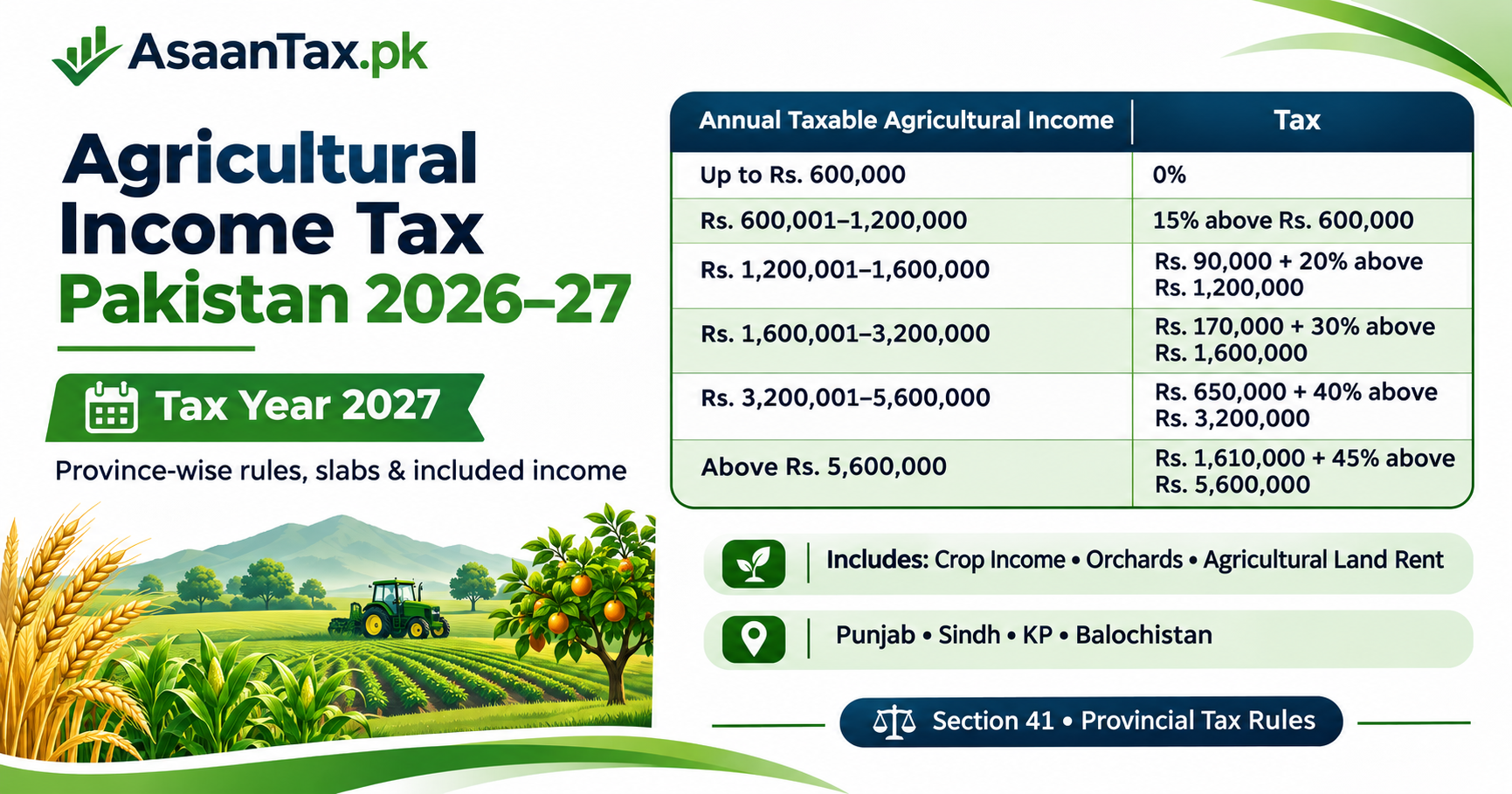
| Annual Taxable Income | Tax Calculation |
|---|---|
| Up to Rs. 600,000 | Nil |
| Rs. 600,001 to Rs. 1,200,000 | 15% above Rs. 600,000 |
| Rs. 1,200,001 to Rs. 1,600,000 | Rs. 90,000 + 20% above Rs. 1,200,000 |
| Rs. 1,600,001 to Rs. 3,200,000 | Rs. 170,000 + 30% above Rs. 1,600,000 |
| Rs. 3,200,001 to Rs. 5,600,000 | Rs. 650,000 + 40% above Rs. 3,200,000 |
| Above Rs. 5,600,000 | Rs. 1,610,000 + 45% above Rs. 5,600,000 |
These are progressive rates applied to taxable income, rather than fixed rates on gross rent.
Other income, tax credits, surcharge provisions and special circumstances may affect the final tax.
Is Rental Income Up to Rs. 300,000 Tax-Free?
This question requires an important distinction.
Section 155 generally provides no rental withholding tax where the annual gross rent paid to an individual or AOP does not exceed Rs. 300,000.
However, Rs. 300,000 is a withholding threshold, not a separate general exemption from annual income tax.
For Tax Year 2027, the ordinary non-salaried individual income tax table provides a nil-tax band for taxable income up to Rs. 600,000.
If a landlord also earns salary, business income or other taxable income, rent may increase their total taxable income even when no Section 155 tax was deducted.
A person should therefore not assume that all rent below Rs. 300,000 is outside the income tax return.
How to Calculate Rental Income Tax in Pakistan
Rental income tax calculations generally involve two separate steps.
Step 1: Calculate Gross Annual Rental Income
Multiply the monthly rent by the number of months for which rent is chargeable.
For example:
Monthly rent = Rs. 80,000
Annual rent = Rs. 80,000 × 12
Gross annual rental income = Rs. 960,000
Step 2: Calculate Allowable Deductions
Section 15A provides specified allowances and deductions for qualifying expenses associated with earning rental income.
For a qualifying rented building, a repair allowance equal to one-fifth of the rent is generally available.
Step 3: Determine Net Income From Property
Deduct the applicable allowances and expenses from gross rent.
Step 4: Include Other Taxable Income
Where applicable, combine income from property with other taxable income under the Income Tax Ordinance.
Step 5: Apply the Correct Annual Tax Slab
Use the applicable salaried, non-salaried or corporate rates based on taxpayer status.
Step 6: Adjust Eligible Withholding Tax
Credit the tax already deducted under Section 155 where properly documented and legally adjustable.
Example 1: Residential House Rent of Rs. 80,000 Per Month
Suppose an individual owns a residential house and rents it to a family for Rs. 80,000 per month.
Assume the landlord has no other taxable income and claims only the standard 20% repairs allowance.
| Description | Amount |
|---|---|
| Monthly house rent | Rs. 80,000 |
| Gross annual rent | Rs. 960,000 |
| Repairs allowance (20%) | Rs. 192,000 |
| Net income from property | Rs. 768,000 |
| Annual income tax | Rs. 25,200 |
Tax Calculation
Taxable income = Rs. 768,000
Amount above Rs. 600,000 = Rs. 168,000
Tax = Rs. 168,000 × 15%
Estimated annual income tax = Rs. 25,200
If the family tenant is not a prescribed withholding agent under Section 155, the family generally does not have to deduct tax merely because it pays rent.
The landlord must nevertheless consider their own return filing and income tax obligations.
Example 2: Commercial Shop Rent of Rs. 200,000 Per Month
Suppose an individual owns a commercial shop and rents it to a company for Rs. 200,000 per month.
Assume the landlord has no other taxable income and only the standard 20% repairs allowance applies.
| Description | Amount |
|---|---|
| Monthly shop rent | Rs. 200,000 |
| Annual gross rent | Rs. 2,400,000 |
| Repairs allowance (20%) | Rs. 480,000 |
| Net taxable property income | Rs. 1,920,000 |
| Estimated annual income tax | Rs. 266,000 |
Annual Income Tax Calculation
Rs. 170,000 + 30% × (Rs. 1,920,000 − Rs. 1,600,000)
Rs. 170,000 + Rs. 96,000
Estimated annual income tax = Rs. 266,000
Section 155 Withholding Tax
Because the tenant is a company, Section 155 withholding generally applies.
Assuming the individual landlord appears on ATL:
Rs. 155,000 + 25% × (Rs. 2,400,000 − Rs. 2,000,000)
Annual withholding tax = Rs. 255,000
If this is the landlord's only income and there are no other tax adjustments:
Estimated tax before credit = Rs. 266,000
Less withholding tax = Rs. 255,000
Illustrative balance = Rs. 11,000
This example assumes proper withholding documentation, ordinary tax treatment and no other tax adjustments.
Residential and Commercial Rent Tax Calculation Comparison
The following table compares two hypothetical properties.
| Detail | Residential House | Commercial Shop |
|---|---|---|
| Monthly rent | Rs. 80,000 | Rs. 200,000 |
| Annual gross rent | Rs. 960,000 | Rs. 2,400,000 |
| Repairs allowance | Rs. 192,000 | Rs. 480,000 |
| Net taxable property income | Rs. 768,000 | Rs. 1,920,000 |
| Estimated annual tax | Rs. 25,200 | Rs. 266,000 |
The difference in tax arises from taxable income amounts, not a separate federal commercial-property income tax slab.
Actual liabilities can differ based on other income, additional expenses and applicable tax rules.
What Expenses Can Landlords Deduct From Rental Income?
Section 15A of the Income Tax Ordinance provides specified deductions and allowances for qualifying income from property.
1. Repairs Allowance – 20%
For a qualifying building, an allowance equal to one-fifth of the relevant gross rent is generally available.
This deduction is distinct from an unrestricted claim for every actual repair expense.
2. Building Insurance
Qualifying insurance premiums paid or payable to protect the building against damage or destruction may be deductible.
3. Local Property Taxes
Certain property-related local taxes, rates, charges or cesses may be deductible, subject to statutory conditions.
Federal income tax itself is not deductible under this category.
4. Ground Rent
Qualifying ground rent paid for the property may be allowed.
5. Financing Costs
Profit or interest on qualifying borrowing used to acquire, construct, renovate, extend or reconstruct the property may be deductible under the relevant provisions.
6. Rent Collection and Administration Costs
Qualifying administration and collection expenses may be deductible up to the statutory limit of 4% of gross rent.
These must be incurred wholly and exclusively for deriving the rent and meet the relevant conditions.
7. Qualifying Legal Expenses
Certain expenses for legal services related to defending title or specified litigation concerning the property may be deductible.
8. Irrecoverable Rent
Bad or irrecoverable rent may be deductible where the specific statutory conditions are satisfied.
Landlords should retain supporting records for expenses and deductions.
What If a Landlord Also Earns Salary?
Many taxpayers receive income from both employment and rental property.
For example:
- Annual taxable salary: Rs. 2,400,000.
- Net taxable property income: Rs. 400,000.
- Total taxable income before other adjustments: Rs. 2,800,000.
The individual may qualify for the salaried rate table if income chargeable under the head Salary exceeds 75% of taxable income.
In this example, salary is more than 75% of the combined taxable income.
Therefore, the relevant salaried income tax table may apply to total taxable income, including rent.
If salary is not more than 75%, the ordinary non-salaried individual rates may apply.
Rental income should not automatically be taxed using a separate isolated rate table when the taxpayer has other taxable income.
Does a Residential Tenant Have to Deduct Rental Withholding Tax?
Not every residential tenant is required to deduct tax.
Section 155 applies to specified prescribed persons making qualifying rental payments.
These can include:
- Federal, provincial and local governments.
- Companies.
- Specified non-profit organizations and charitable institutions.
- Diplomatic missions.
- Certain educational, medical and other prescribed businesses.
- Individuals or AOPs paying gross annual rent of Rs. 1.5 million or more.
- Other persons notified under the law.
Therefore, an ordinary family renting a house for Rs. 50,000 per month is not automatically a withholding agent under Section 155.
However, the landlord's own tax liability still needs to be determined.
Does a Company Renting a Commercial Property Deduct Tax?
Generally, yes.
A company is a prescribed withholding agent under Section 155.
For example, if a company rents an office, shop, warehouse or qualifying building from an individual landlord, the company generally deducts tax according to the applicable Section 155 table.
The landlord should obtain supporting documentation for the withheld tax.
The same principle can apply if a company rents a residential building for an employee or another permitted purpose.
The decisive factor is not simply whether the property is residential or commercial.
Filer vs Non-Filer Rental Withholding Tax
Landlords appearing on the FBR Active Taxpayers List generally face the ordinary Section 155 withholding rates.
For a landlord not appearing on ATL, the withholding rates may be increased under the Tenth Schedule.
For example, on gross annual rent of Rs. 1,200,000 paid by a prescribed withholding agent:
Filer
Rs. 15,000 + 10% × (Rs. 1,200,000 − Rs. 600,000)
Withholding = Rs. 75,000
Non-Filer
Rs. 30,000 + 20% × (Rs. 1,200,000 − Rs. 600,000)
Withholding = Rs. 150,000
The higher withholding amount does not necessarily mean that the non-filer's final annual income tax liability is exactly Rs. 150,000.
Return filing, final tax calculation and allowable credits must be evaluated separately.
Is Rental Income Tax Different From Annual Property Tax?
Yes.
Rental income tax is imposed under the federal Income Tax Ordinance on income earned from property.
Annual property tax is generally a provincial or local levy associated with property ownership, occupation or rental value under separate laws.
Other charges may include:
- Provincial property tax.
- Cantonment property charges.
- Local municipal rates.
- Registration and stamp duties on applicable documents.
- Provincial sales tax on specified services, where applicable.
These should not be treated as one combined rental income tax.
Is Sales Tax Charged on Commercial Property Rent?
Commercial letting may raise separate sales tax on services questions depending on the province or territory and the exact type of transaction.
The applicable treatment can vary between Punjab, Sindh, Islamabad Capital Territory and other jurisdictions.
Not every residential or commercial rental arrangement is automatically subject to the same sales tax rate.
A landlord should confirm whether the particular leasing or related service falls within the relevant sales tax law, whether an exemption applies and who is legally responsible for compliance.
Do not automatically add 18% GST to every shop, office or commercial building rent.
What If Rent Is Paid in Advance?
Advance rent, non-adjustable amounts and deposits may require specific treatment under Sections 15, 16 and 155, depending on the nature of the payment.
For example:
- Ordinary monthly rent.
- Advance rent covering future periods.
- Refundable security deposit.
- Non-adjustable deposit.
- Amount forfeited under a contract.
These amounts should not automatically be treated alike.
Some advance payments or deposits can be brought into income or withholding calculations under specific provisions.
Landlords should maintain the tenancy agreement and detailed payment records.
Can Rent Be Charged Below Fair Market Value?
Section 15 contains rules relating to fair market rent in certain circumstances.
Where rent is below fair market rent, the legislation may require income to be determined using fair market rent, subject to applicable exceptions.
This can be relevant when property is rented to related persons or at an unusually low amount.
Taxpayers should not assume that an artificially reduced rent agreement will always determine taxable rental income.
Are Rental Income Taxes Different for Companies?
Companies generally calculate final income tax using the applicable corporate tax regime rather than the individual income tax slabs.
However, rent paid to a company landlord may attract withholding at 15% where the company appears on ATL or 30% where the enhanced non-ATL rate applies.
Corporate income tax, minimum tax, surcharge and other provisions may also be relevant depending on the company.
The company's withholding tax amount should not be presented as its complete final corporate income tax liability.
How to File Rental Income Tax Return in Pakistan for Tax Year 2027
Step 1: Register or Log In to FBR IRIS
Visit the official FBR portal:
Step 2: Select the Correct Tax Year
For rental income earned from July 1, 2026 to June 30, 2027, the relevant tax year is Tax Year 2027.
Step 3: Prepare Annual Rent Details
Compile rental amounts received or receivable and relevant agreements.
Step 4: Enter Income From Property
Report qualifying rental income under the appropriate Income from Property section.
Step 5: Claim Applicable Deductions
Enter legally allowable deductions supported by the relevant records and provisions.
Step 6: Include Other Taxable Income
Add salary, business income, investment income and other relevant amounts under the correct heads.
Step 7: Enter Tax Withheld Under Section 155
Where withholding tax was deducted, reconcile and report the eligible credit using relevant documentation.
Step 8: Complete the Wealth Statement
Where required, disclose relevant property, assets, liabilities and expenses and reconcile changes in wealth.
Step 9: Review and Submit
Check the return carefully, submit it and retain the acknowledgment.
Note: Tax Year 2027 ends on June 30, 2027. The annual return for that year is ordinarily filed afterward, according to the statutory deadline and any FBR extension.
Documents Required for Rental Income Tax Filing
Landlords should keep:
- CNIC or NTN.
- FBR IRIS account details.
- Property ownership documents.
- Residential or commercial tenancy agreements.
- Monthly rent receipts or bank statements.
- Annual rent calculations.
- Building insurance documents.
- Provincial property tax payment records.
- Loan or mortgage-related records, if applicable.
- Withholding tax certificates.
- Details of other sources of income.
- Prior tax returns and wealth statements.
The exact requirements depend on the taxpayer and transaction.
Has Finance Act 2026 Changed Rental Income Tax?
For Tax Year 2027, rental income remains governed by the Income Tax Ordinance provisions dealing with property income, deductible expenses, ordinary tax rates and withholding.
The Section 155 withholding rate structure described above continues in the Tax Year 2027 rate card.
The Finance Act 2026 also omitted Section 7E, which dealt with deemed income from specified capital assets.
Section 7E deemed-income taxation was a separate concept from ordinary tax on rent actually earned under Section 15.
Its omission does not make genuine rental income tax-free.
Common Rental Income Tax Mistakes
Landlords should avoid:
- Treating Section 155 withholding slabs as final income tax slabs.
- Assuming every residential tenant must deduct tax.
- Assuming shops and houses have separate standard federal rental income slabs.
- Ignoring rental income when filing a salary return.
- Claiming expenses that are not allowed under Section 15A.
- Failing to obtain rent withholding documentation.
- Confusing provincial property tax with federal rental income tax.
- Assuming all deposits and advance payments have identical treatment.
- Reporting gross rent without considering legally allowable deductions.
- Filing the wrong income tax year.
How AsaanTax.pk Can Help With Rental Income Tax
Do you receive rent from a house, flat, apartment, shop, office, plaza or commercial building?
Unsure which rental income tax slab applies to your property?
AsaanTax.pk provides professional assistance with income tax return filing, rental income calculations and FBR compliance in Pakistan.
Our services include:
- Rental income tax calculations.
- Residential property rent reporting.
- Commercial property rental income reporting.
- Section 155 withholding tax guidance.
- Filer and non-filer status verification.
- Section 15A deduction guidance.
- Income tax return preparation.
- Wealth statement preparation and reconciliation.
- NTN and FBR registration assistance.
- Tax notice and compliance support.
Our team can help you identify the appropriate tax treatment and prepare the documents needed for an accurate income tax return.
Need Help Filing Your Rental Income Tax Return?
Contact AsaanTax.pk for assistance with residential or commercial rental income tax, FBR return filing and compliance.
Website: https://www.asaantax.pk/
Call or WhatsApp: 0308-4781532
AsaanTax.pk is an independent tax services provider and is not affiliated with the Federal Board of Revenue or the Government of Pakistan.
Official Sources and References
- FBR – Withholding Tax Rate Cards
- FBR – Income Tax Ordinance, 2001
- FBR – Finance Act 2026
- FBR – IRIS Tax Filing Portal
Last updated: November 3, 2026.
Disclaimer: This article provides general information about Pakistani rental income tax. Actual tax obligations depend on the taxpayer's total taxable income, legal status, deductions, ATL status, withholding agent, applicable tax credits and other statutory provisions. Provincial taxes, commercial letting services and special property arrangements may be subject to separate rules. Verify your individual position with FBR or a qualified tax professional before filing or making a payment.