Pakistan's automobile industry has seen important sales tax changes during 2026. With the introduction of the Finance Act 2026, revisions to vehicle tax notifications and the proposed Auto Policy 2026–31, car buyers need to understand how General Sales Tax (GST) affects new car prices.
One of the most significant recent developments is the reduction in sales tax on eligible locally manufactured Hybrid Electric Vehicles (HEVs) with engine capacities up to 2000cc.
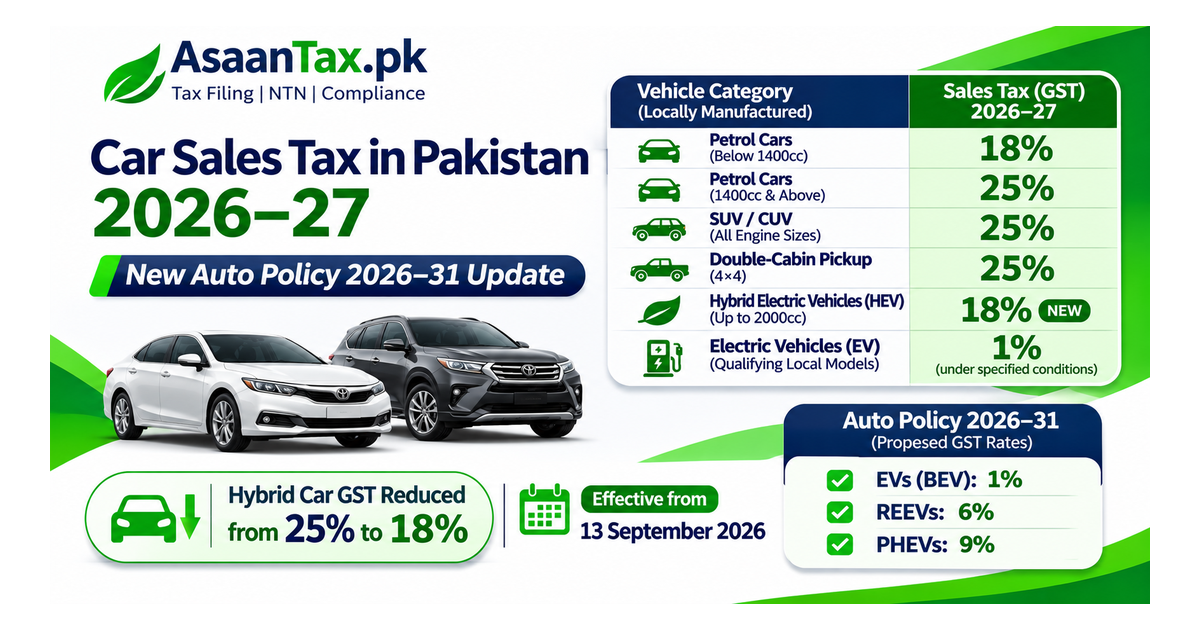
Effective September 13, 2026, the applicable GST on these qualifying hybrid vehicles was reduced from 25% to 18%.
Meanwhile, certain locally manufactured petrol vehicles, SUVs, CUVs and pickup trucks continue to attract the enhanced 25% sales tax rate.
The proposed Auto Policy 2026–31 also discusses future tax incentives for battery electric vehicles, range-extended electric vehicles and plug-in hybrids. However, proposals should not be confused with changes already implemented through law or notification.
In this guide, AsaanTax.pk explains the updated car sales tax rates in Pakistan, vehicle categories by engine capacity, the latest hybrid tax reduction, proposed electric vehicle incentives and the difference between GST, registration tax and customs duty.
What Is Car Sales Tax in Pakistan?
General Sales Tax (GST) on vehicles is governed primarily by the Sales Tax Act, 1990, together with relevant schedules and notifications.
GST is generally included in the price charged by the manufacturer, assembler or importer, subject to the relevant rules.
For locally manufactured passenger vehicles, the applicable sales tax rate depends on factors including:
- Engine capacity.
- Whether the vehicle is a petrol, diesel, hybrid or electric vehicle.
- Whether the vehicle is classified as a sedan, hatchback, SUV, CUV or pickup.
- Whether the vehicle falls under an enhanced-rate notification.
- The vehicle's applicable invoice value.
- Any relevant exemption or concession.
It is important to note that GST is not the same as vehicle registration income tax under Section 231B.
Latest Car GST Rates in Pakistan 2026–27
The following table summarizes important sales tax categories for vehicles in Pakistan.
| Vehicle Category | General GST Treatment |
|---|---|
| Locally assembled petrol car below 1400cc, outside enhanced-rate categories | 18% |
| Locally assembled petrol car 1400cc or above | 25% |
| Locally assembled SUV or CUV | 25% |
| Locally assembled double-cabin 4×4 pickup | 25% |
| Eligible locally manufactured hybrid electric vehicle up to 2000cc | 18% |
| Locally manufactured hybrid above 2000cc falling within enhanced-rate rules | 25% |
| Qualifying locally manufactured small electric vehicle | 1%, subject to conditions |
| Imported completely built-up vehicle | Depends on classification and applicable customs and sales tax provisions |
Important: A vehicle below 1400cc may still fall within an enhanced-rate category because of its invoice value or vehicle type.
The table is a general guide, not a substitute for checking the applicable notification and invoice for a particular model.
Car Sales Tax Table by Engine Capacity (CC)
The following comparison shows how engine capacity interacts with the current sales tax rules.
| Engine Capacity | Conventional Petrol Car | Eligible Locally Made HEV |
|---|---|---|
| Up to 850cc | Normally 18%, unless enhanced-rate conditions apply | 18% if covered by HEV notification |
| 851cc–1000cc | Normally 18%, unless enhanced-rate conditions apply | 18% if covered |
| 1001cc–1300cc | 18% or 25%, depending on category and invoice value | 18% if covered |
| 1301cc–1399cc | 18% or 25%, depending on category and invoice value | 18% if covered |
| 1400cc–1600cc | Normally 25% | 18% if covered |
| 1601cc–1800cc | Normally 25% | 18% if covered |
| 1801cc–2000cc | Normally 25% | 18% if covered |
| Above 2000cc | Normally 25% for covered vehicles | Enhanced-rate treatment may apply |
This comparison assumes locally manufactured or assembled passenger vehicles. SUVs, CUVs, double-cabin pickups, imported vehicles and vehicles with special concessions may be treated differently.
The enhanced 25% rate is associated with specified categories under SRO 297(I)/2023, as amended.
New Hybrid Vehicle Sales Tax Reduction – September 2026
The federal government introduced an important relief measure for eligible locally manufactured hybrid electric vehicles.
Through SRO 1525(I)/2026, dated September 13, 2026, locally manufactured HEVs with engine capacities up to 2000cc were excluded from the enhanced-rate category in Table II of SRO 297(I)/2023.
As a result, qualifying hybrids that previously attracted 25% sales tax became subject to the ordinary 18% rate.
Hybrid GST Before and After the Notification
| Period | Relevant GST Treatment |
|---|---|
| Before June 30, 2026 | Certain hybrid concessions of 8.5% or 12.75%, depending on eligibility |
| After expiry of earlier concessions | Relevant hybrids moved into the 25% category |
| From September 13, 2026 | Eligible locally manufactured HEVs up to 2000cc: 18% |
The September change represents a seven-percentage-point reduction compared with the previously applicable 25% rate.
It does not mean that every hybrid vehicle, regardless of engine capacity or import status, qualifies for 18% GST.
Which Hybrid Cars May Benefit From Lower GST?
The September 2026 notification applies to locally manufactured hybrid electric vehicles with engine capacities up to 2000cc.
Buyers considering locally assembled hybrid versions of vehicles such as the Hyundai Elantra, Hyundai Tucson, Kia Sportage or other hybrid models should confirm whether the exact variant satisfies the notification.
For any specific car, the applicable rate depends on:
- Whether it qualifies as a hybrid electric vehicle under the relevant rules.
- Whether it is locally manufactured or assembled.
- Its actual engine capacity.
- The relevant notification and invoice date.
- The manufacturer's applicable GST treatment.
A particular model name alone does not establish tax eligibility.
How Much Does a Reduction From 25% to 18% Save?
Consider a hypothetical hybrid car with a taxable value of Rs. 8,000,000 before GST.
At the Previous 25% Rate
GST = Rs. 8,000,000 × 25%
GST = Rs. 2,000,000
Total including GST = Rs. 10,000,000.
At the New 18% Rate
GST = Rs. 8,000,000 × 18%
GST = Rs. 1,440,000
Total including GST = Rs. 9,440,000.
Difference
GST reduction = Rs. 560,000
This example assumes the same taxable value before GST. Actual showroom price changes may be different because other costs, taxes, margins and manufacturer pricing decisions can vary.
Car GST Calculation Examples
The following table illustrates the GST amount on different hypothetical taxable vehicle values.
| Value Before GST | GST at 18% | GST at 25% | Difference |
|---|---|---|---|
| Rs. 2,000,000 | Rs. 360,000 | Rs. 500,000 | Rs. 140,000 |
| Rs. 3,000,000 | Rs. 540,000 | Rs. 750,000 | Rs. 210,000 |
| Rs. 4,000,000 | Rs. 720,000 | Rs. 1,000,000 | Rs. 280,000 |
| Rs. 5,000,000 | Rs. 900,000 | Rs. 1,250,000 | Rs. 350,000 |
| Rs. 8,000,000 | Rs. 1,440,000 | Rs. 2,000,000 | Rs. 560,000 |
| Rs. 10,000,000 | Rs. 1,800,000 | Rs. 2,500,000 | Rs. 700,000 |
These calculations are educational examples. The rates must first be confirmed as applicable to the relevant vehicle.
GST on Suzuki Alto, Swift, Toyota Yaris and Corolla
The actual GST treatment of a specific vehicle depends on its configuration and applicable legal category.
Suzuki Alto
A conventional 660cc locally assembled hatchback generally falls under the standard-rate framework unless another enhanced-rate condition applies.
Suzuki Swift
A locally assembled hatchback with an engine below 1400cc may still attract enhanced sales tax if the applicable invoice-value condition is satisfied.
Toyota Yaris
Different Yaris variants may have different engine capacities. Buyers should check the model's exact CC and the applicable invoice-value and sales-tax category.
Toyota Corolla
Conventional Corolla variants with engine capacities of 1400cc or above generally fall within the enhanced-rate category for locally assembled vehicles.
Hybrid Vehicles
Eligible locally manufactured HEVs up to 2000cc may benefit from the 18% sales tax treatment introduced in September 2026.
Always verify the exact vehicle invoice instead of relying on a generic model-wise tax list.
Pakistan Auto Policy 2026–31 – Proposed Sales Tax Changes
Pakistan's proposed automobile policy aims to promote local manufacturing, increase exports, improve safety standards and encourage cleaner vehicles.
The draft discussed in October 2026 includes sales tax proposals for different electric powertrains.
Proposed Electric Vehicle Sales Tax Rates
| Vehicle Technology | Reported Draft Sales Tax Proposal |
|---|---|
| Battery Electric Vehicles (BEVs) | 1% |
| Range-Extended Electric Vehicles (REEVs) | 6% |
| Plug-in Hybrid Electric Vehicles (PHEVs) | 9% |
Important: These are reported proposals in the Auto Policy 2026–31 draft. They should not be used as currently payable rates unless implemented through the relevant law or notification.
Different versions of the draft have been discussed publicly. The final notified treatment may differ.
Is the New Auto Policy 2026–31 Fully Implemented?
As of November 2, 2026, the proposed policy had progressed through government consideration, but the draft was still being submitted for further approvals.
Consequently, the policy's proposed tax reductions should not automatically be treated as current law.
Car buyers should distinguish between:
- Changes already implemented through Finance Act 2026.
- Changes notified through specific SROs.
- Proposals under the draft Auto Policy 2026–31.
The September 13, 2026 hybrid sales tax notification is an example of an implemented change.
The proposed broader BEV, REEV and PHEV tax framework requires separate confirmation through official notifications.
What Is the Sales Tax on Electric Cars in Pakistan?
Certain qualifying locally manufactured four-wheeler electric vehicles benefit from concessional sales tax provisions.
The Finance Act 2026 extended specified electric vehicle concessions through June 30, 2027.
However, eligibility may depend on the type of electric vehicle, battery capacity, local manufacturing conditions and the relevant schedule.
Therefore, a 1% concessional rate should not be applied automatically to every imported or locally supplied electric car.
Buyers should verify whether the exact model qualifies under the relevant Sales Tax Act schedule or notification.
GST vs Federal Excise Duty vs Car Registration Tax
Pakistan applies different types of taxes on automobiles.
1. General Sales Tax (GST)
GST applies to the taxable supply or import of vehicles under the Sales Tax Act, 1990.
2. Federal Excise Duty (FED)
FED may apply to specified vehicles under the Federal Excise Act, 2005, subject to the relevant provisions and amendments.
3. Advance Income Tax – Section 231B
Advance income tax is generally collected under Section 231B at the applicable registration or purchase stage.
Its amount can depend on engine capacity, taxable vehicle value and the buyer's filer status.
4. Customs Duty
Customs duty applies to imported goods, including vehicles, according to the applicable tariff classification and import conditions.
5. Token Tax and Registration Charges
Provincial and territorial vehicle taxation authorities administer token tax, registration fees and other related charges.
These taxes should not be combined into a single percentage without a proper calculation.
Do Filers and Non-Filers Pay Different Sales Tax on Cars?
Filer and non-filer status does not generally create separate ordinary GST rates of 18% and 25% for the same vehicle category.
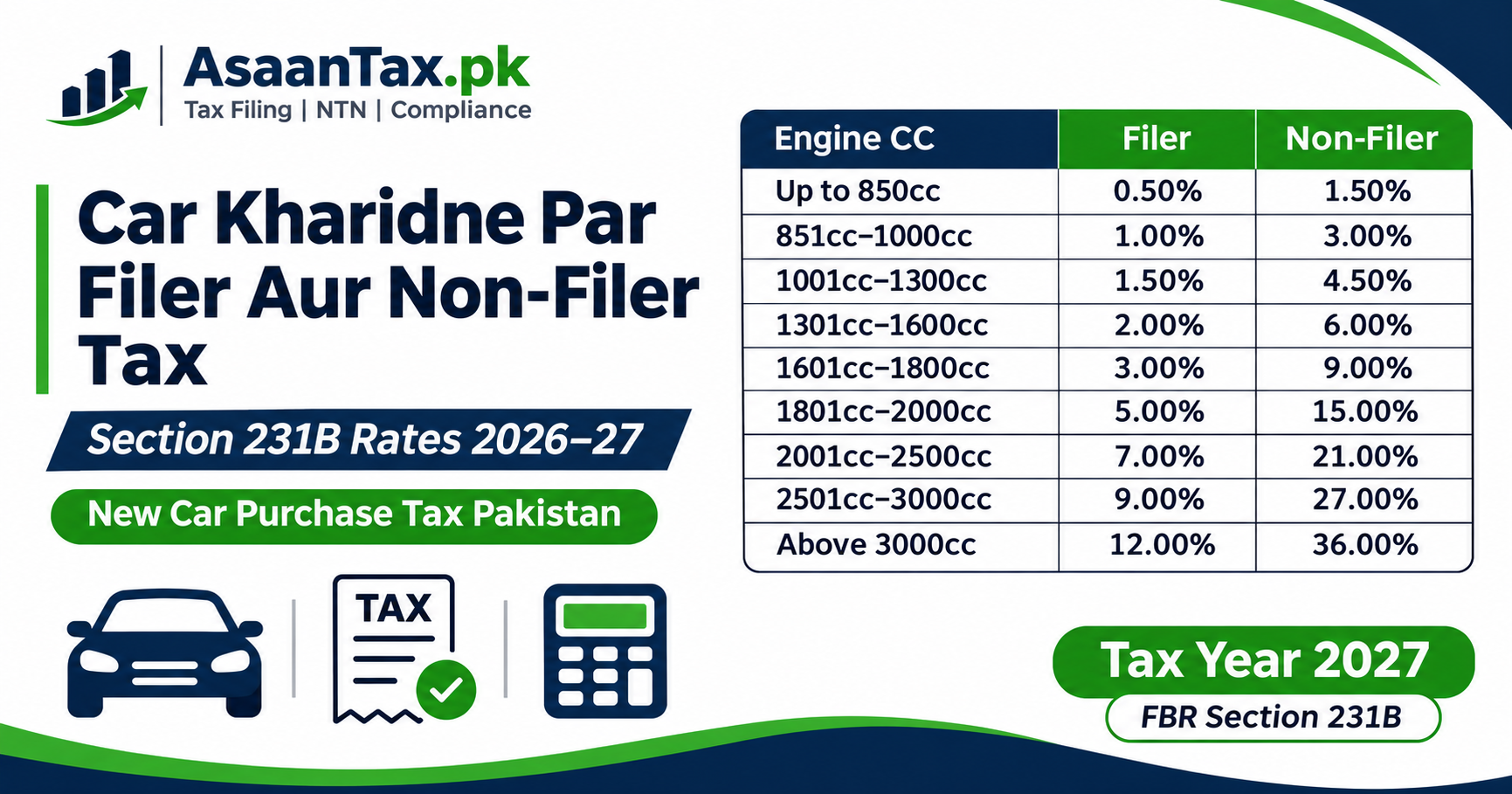
The distinction between filer and non-filer is particularly relevant to advance income tax under Section 231B.
For example, two persons purchasing the same locally manufactured vehicle may face the same GST treatment, but different advance withholding tax rates because of their ATL status.
GST eligibility is determined under the sales tax provisions applicable to the particular vehicle.
How to Check the Tax on a New Car Before Purchase
Before buying a new vehicle, follow these steps:
- Confirm the exact vehicle model and variant.
- Check its engine capacity and powertrain type.
- Determine whether it is locally assembled or imported.
- Obtain the manufacturer's or dealer's current tax invoice.
- Confirm the applicable GST category.
- Verify any hybrid or electric vehicle concession.
- Check whether FED or other vehicle levies apply.
- Confirm your ATL status for applicable withholding income tax.
- Obtain a separate calculation of registration, token tax and other charges.
- Keep all relevant tax invoices and payment records.
How AsaanTax.pk Can Help Car Buyers
Buying a new petrol, hybrid or electric vehicle in Pakistan?
Unsure about the sales tax rate, registration withholding tax or your filer status?
AsaanTax.pk provides tax registration, income tax filing and vehicle taxation guidance for individuals and businesses.
Our services include:
- NTN and FBR registration assistance.
- Income tax return filing.
- Filer and non-filer status verification.
- Vehicle advance withholding tax guidance.
- Review of applicable car tax categories.
- General tax documentation assistance.
- Support with FBR compliance requirements.
Our team can help you understand different tax categories before purchasing a vehicle.
Contact AsaanTax.pk
For tax return filing, ATL guidance and vehicle taxation assistance:
Website: https://www.asaantax.pk/
Call or WhatsApp: 0308-4781532
AsaanTax.pk is an independent tax services provider and is not affiliated with FBR or the Government of Pakistan.
Official Sources and References
- FBR – Sales Tax Act, 1990
- Pakistan Trade Information Portal – SRO 297(I)/2023
- FBR – Finance Act 2026–27 Budget Material
- FBR – Income Tax Ordinance
- Business Recorder – September 2026 Hybrid GST Reduction
- Dawn – Draft Auto Policy Sent to Cabinet
Last updated: November 2, 2026.
Disclaimer: This article is intended for general information. Vehicle sales tax depends on the applicable legislation, notifications, model, engine capacity, vehicle type, taxable value and available concessions. Reported draft automobile policy rates are not automatically effective law. Always verify actual tax treatment through official documents and the relevant manufacturer or authorized dealer before purchasing a vehicle.