Millions of overseas Pakistanis living in Saudi Arabia, the United Arab Emirates, Qatar, Kuwait, Oman, Bahrain, the United Kingdom, the United States, Canada and other countries regularly send money to Pakistan.
These funds support families, education, medical expenses, household needs, savings, property purchases and investments.
However, many overseas Pakistanis and their families have questions about foreign remittance taxation.
Is money sent from abroad taxable in Pakistan? Is there a tax on receiving Rs. 10 lakh, Rs. 50 lakh or Rs. 1 crore? What is Section 111(4)? Do overseas Pakistanis need to file an FBR income tax return?
For Tax Year 2027 (July 1, 2026 to June 30, 2027), the answers depend primarily on the nature and source of the funds, the taxpayer's residency status, applicable tax exemptions and whether the money was transferred through documented banking channels.
A genuine family remittance or transfer of existing foreign savings is not automatically taxable income merely because the amount enters a Pakistani bank account.
However, receiving money from overseas does not automatically make otherwise taxable income exempt.
This comprehensive guide from AsaanTax.pk explains foreign remittance rules, banking methods, Roshan Digital Accounts, documentation, Section 111(4), tax residency and the correct approach to FBR return filing for Tax Year 2027.
What Is a Foreign Remittance in Pakistan?
A foreign remittance is money transferred from a person, bank or institution outside Pakistan to a recipient in Pakistan.
Common examples include:
- An overseas Pakistani sending money to parents.
- A husband transferring money to his family in Pakistan.
- A Pakistani working in Dubai sending savings to a local bank account.
- An overseas worker sending money for children's education.
- A non-resident Pakistani transferring foreign savings to their own Pakistani account.
- An overseas Pakistani funding a property purchase.
- A person receiving payment for professional or freelance services provided to a foreign customer.
Although all these involve money coming from abroad, they do not necessarily receive the same income tax treatment.
A personal family remittance, a transfer of existing capital and a payment earned for services are legally different transactions.
Is Foreign Remittance Taxable in Pakistan in 2026–27?
Genuine foreign remittances sent as family support or transfers of previously accumulated savings are generally not taxed simply because the funds are received in Pakistan.
For example, if a non-resident Pakistani working in Saudi Arabia sends part of their salary savings to their mother in Pakistan for household expenses, the bank transfer itself does not automatically create taxable salary income for the mother.
However, the recipient should be able to explain the source and nature of funds where required.
The following categories must be distinguished:
1. Family Support Remittances
Money sent to family members for maintenance, education, healthcare or household expenses is generally different from income earned by the recipient for providing services.
Its income tax treatment depends on the genuine nature of the transfer and any relevant gift or other legal provisions.
2. Transfer of Overseas Savings
A person transferring their existing foreign savings to Pakistan is not necessarily earning new income at the time of transfer.
The taxation of the original earnings depends on their tax residency and the law applicable when the income arose.
3. Foreign Salary Income
Salary earned outside Pakistan may have different treatment depending on whether the individual was a resident or non-resident for the relevant tax year.
4. Freelance and Business Receipts
Payments received from overseas clients for software development, consultancy, graphic design, marketing or other services may constitute taxable business or professional income.
A transfer through a bank or money transfer service does not automatically make these receipts tax-free.
5. Overseas Investments
Foreign investment income, rental income, dividends and capital gains require separate assessment under the applicable income tax provisions and residency rules.
Foreign Remittance Tax Rates for Tax Year 2027
The following table explains the general treatment of common incoming transfers.
| Remittance Type | General Pakistan Tax Treatment |
|---|---|
| Genuine family maintenance from abroad | No automatic income tax merely on receipt |
| Transfer of previously accumulated overseas savings | No automatic income tax merely on transfer |
| Qualifying remittance under Section 111(4) | Specific protection for source-of-funds inquiries, subject to conditions |
| Foreign salary of a Pakistani non-resident | Generally outside Pakistani taxation where it is foreign-source income |
| Foreign salary of a Pakistani tax resident | Residency and applicable exemptions determine taxability |
| Export proceeds earned by a Pakistan-based freelancer | Applicable export-of-services or business tax rules |
| Rent earned from property in Pakistan | Applicable rental income tax rules |
| Income from investments through Roshan Digital Account | Product-specific tax rules |
| Foreign funds sent for property purchase | Remittance itself and property transaction taxes are separate |
Important: There is no single tax percentage that applies to every inbound foreign remittance. The relevant tax depends on what the money represents.
What Is Section 111(4) of the Income Tax Ordinance?
Section 111 of the Income Tax Ordinance, 2001 deals with unexplained income and assets.
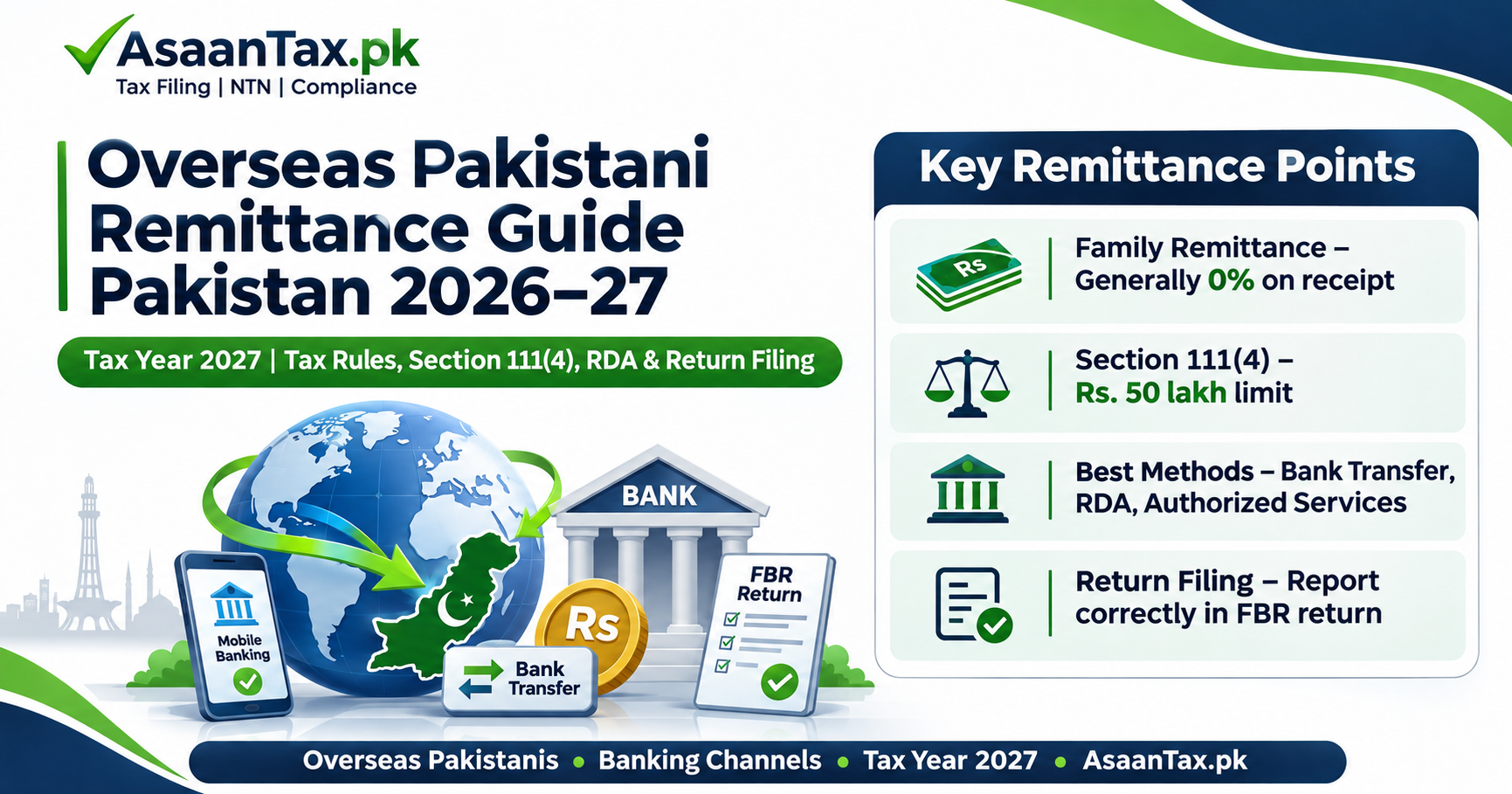
Subsection 111(4) provides a specific protection for qualifying foreign exchange remitted from outside Pakistan through normal banking channels, subject to prescribed conditions.
The relevant statutory limit is generally Rs. 5 million (Rs. 50 lakh) in a tax year.
The provision refers to foreign exchange:
- Remitted from outside Pakistan through qualifying channels.
- Encashed into Pakistani rupees by a scheduled bank.
- Supported by the required banking documentation.
- Within the statutory limit and other applicable conditions.
Legislation and FBR guidance also recognize certain transfers through money service bureaus, exchange companies and money transfer operators for this purpose.
Does Rs. 5 Million Mean All Remittances Are Tax-Free?
No.
The Rs. 5 million amount is not a general exemption threshold for foreign income tax.
Section 111(4) concerns the treatment of certain unexplained income or assets and the burden of explaining the nature and source of qualifying funds.
It does not automatically exempt taxable business income, professional receipts or other income simply because they came from abroad.
What Happens If Remittances Exceed Rs. 5 Million?
Many taxpayers assume that receiving more than Rs. 5 million means that the excess automatically becomes taxable.
This is not correct.
For example, suppose an overseas Pakistani sends Rs. 8 million to Pakistan through documented banking channels.
The statutory protection in Section 111(4) cannot simply be assumed to cover the full Rs. 8 million.
However, the excess does not become taxable merely because it exceeds Rs. 5 million.
The recipient may need to provide satisfactory evidence of the actual source of the funds, such as:
- Employment and salary records.
- Foreign bank statements.
- Transfer confirmations.
- Business records.
- Sale documents for overseas assets.
- Evidence of previously accumulated savings.
- Other relevant supporting documents.
If the source is genuine and legally explained, the amount should be evaluated according to its actual nature and the applicable tax rules.
Foreign Remittance Amount Comparison
The following examples illustrate the distinction between income tax and Section 111(4).
| Amount Received | Automatic Tax on Genuine Remittance | Section 111(4) Consideration |
|---|---|---|
| Rs. 500,000 | Generally none merely on receipt | Within monetary limit, subject to conditions |
| Rs. 1,000,000 | Generally none merely on receipt | Within monetary limit, subject to conditions |
| Rs. 2,000,000 | Generally none merely on receipt | Within monetary limit, subject to conditions |
| Rs. 3,000,000 | Generally none merely on receipt | Within monetary limit, subject to conditions |
| Rs. 5,000,000 | Generally none merely on receipt | At the ordinary statutory limit |
| Rs. 7,500,000 | No automatic tax solely for exceeding limit | Full amount not automatically protected |
| Rs. 10,000,000 | No automatic tax solely for exceeding limit | Additional source documentation important |
| Rs. 20,000,000 | Actual nature and source determine liability | Full amount not automatically protected |
These examples assume genuine transactions and do not cover separately taxable underlying income.
Best Ways to Send Money From Abroad to Pakistan
Overseas Pakistanis can use several regulated channels to transfer money.
The most suitable option depends on the purpose, amount, transfer fees, exchange rate, speed, recipient's banking access and documentation requirements.
Method 1: International Bank Transfer
An overseas Pakistani can transfer money directly from a foreign bank account to a Pakistani bank account.
Commonly required details include:
- Beneficiary name.
- Pakistani bank name.
- IBAN or account number.
- Relevant SWIFT/BIC information.
- Other transfer details requested by the bank.
Best suited for: Larger documented transfers, savings and transactions requiring a clear banking trail.
The actual transfer fee and conversion rate depend on the banks involved.
Method 2: Authorized Money Transfer Services
Authorized money transfer operators and exchange companies can provide remittance services through approved banking or payout partners.
Funds may be deposited into the recipient's Pakistani account or paid through another supported method.
Best suited for: Regular family remittances and transfers where the provider offers competitive fees and exchange rates.
Always confirm that the operator and payout arrangements are legally authorized.
Method 3: Roshan Digital Account
The Roshan Digital Account (RDA) is a State Bank of Pakistan initiative offered through participating banks.
It enables eligible non-residents to open and operate a Pakistani bank account remotely.
RDA facilities can be used for:
- Holding funds in Pakistani rupees or supported foreign currencies.
- Bank transfers and payments.
- Eligible investments.
- Property-related transactions.
- Other permitted banking activities.
Best suited for: Overseas Pakistanis who want a dedicated Pakistani banking and investment account under the RDA framework.
The account's banking and investment features are subject to applicable rules.
Method 4: Direct Bank Account Deposit
Some authorized international remittance providers offer direct deposits into a family member's Pakistani bank account.
Best suited for: Regular household support where the sender wants straightforward transfers and electronic records.
Which Method Is Better?
For regular family support, a regulated transfer operator or bank-to-bank remittance with a competitive effective exchange rate is generally a practical option.
For larger amounts, property funding or business documentation, a direct bank transfer can provide a clear transaction trail.
For eligible overseas Pakistanis managing savings and investments in Pakistan, Roshan Digital Account can be particularly useful.
However, there is no single provider that is always cheapest or fastest. Compare the full cost and the amount the recipient will actually receive.
How to Send Remittances to Pakistan Step by Step
Step 1: Choose an Authorized Service
Select a regulated bank or authorized remittance provider.
Step 2: Verify Recipient Details
Enter the recipient's exact name, bank information and required identification details.
Step 3: Select the Transfer Purpose
Specify the correct purpose, such as:
- Family maintenance.
- Personal savings transfer.
- Education support.
- Investment funding.
- Other legitimate purpose.
Do not describe business payments as family gifts merely to obtain different tax treatment.
Step 4: Compare Costs
Check the transfer fee, foreign exchange margin, estimated delivery time and final rupee amount.
Step 5: Complete the Transfer
Follow the institution's identity verification and payment requirements.
Step 6: Preserve the Record
Retain the transfer confirmation, reference number and bank credit evidence.
Step 7: Obtain Supporting Documentation
Where appropriate, request a Proceeds Realization Certificate (PRC), remittance certificate or equivalent documentary evidence from the receiving bank.
What Is a Proceeds Realization Certificate (PRC)?
A PRC or equivalent bank remittance document can provide evidence that funds were received from abroad through the relevant financial channel.
Depending on the bank and transaction, it can record:
- Remittance amount.
- Currency.
- Exchange rate or converted rupee amount.
- Date of receipt.
- Sender and beneficiary details.
- Relevant remittance purpose or classification.
PRCs and comparable documentation may be useful when explaining foreign remittances in a tax inquiry, preparing financial records or documenting savings.
However, having a PRC does not automatically make otherwise taxable income exempt.
The original source and legal nature of the money remain important.
New State Bank Remittance Rules in 2026
During 2026, the State Bank of Pakistan introduced changes affecting certain banking and remittance procedures.
Revised Remittance Reporting Forms
Through EPD Circular Letter No. 07 of 2026, issued April 6, 2026, SBP revised Form R, the Inward Remittance Voucher (IRV) and Form M.
It also revised relevant Form R and IRV reporting thresholds to USD 25,000 or equivalent, subject to the detailed instructions.
These changes affect banking documentation and transaction reporting.
The USD 25,000 threshold is not an income-tax exemption and is not a substitute for Section 111(4)'s Rs. 5 million rules.
Roshan Digital Account Expansion
In March 2026, SBP expanded the RDA framework to other qualifying non-resident persons, while maintaining the existing onboarding arrangements for non-resident Pakistanis and POC holders.
Home Remittance Incentives
SBP has also maintained a framework for reimbursement of eligible remittance-related transfer charges through authorized institutions.
Such arrangements do not guarantee that every transfer is completely free of all costs.
Always verify the actual charges and conversion rate before sending funds.
Is Foreign Salary Taxable in Pakistan?
The correct tax treatment depends primarily on the individual's residency status and the source of income.
Non-Resident Pakistani
A non-resident individual is generally taxed in Pakistan on Pakistan-source income rather than worldwide income.
For example, a Pakistani who qualifies as non-resident and earns salary from employment performed abroad may generally have foreign-source salary outside Pakistan's taxable income.
Transferring those salary savings to Pakistan does not automatically create a new salary tax liability.
Resident Pakistani
A Pakistan tax resident can generally be subject to tax on both Pakistan-source and foreign-source income, subject to applicable exemptions, foreign tax relief and other provisions.
A resident individual should not assume that employment income is exempt merely because it was paid into an overseas bank account.
Returning Expatriates
Section 51 of the Income Tax Ordinance provides specific relief for certain returning expatriates and qualifying foreign-source income.
The relief depends on the statutory residency history and other conditions.
It does not apply automatically to every overseas Pakistani returning to Pakistan.
How Is Pakistan Tax Residency Determined?
Tax residency is determined under the Income Tax Ordinance, rather than simply by nationality, NICOP ownership or holding a foreign visa.
Relevant considerations include the number of days present in Pakistan, previous years' presence and other statutory tests.
A person who spends 183 days or more in Pakistan during the tax year can generally satisfy one of the residency tests.
Other residency tests and exceptions may also apply.
A Pakistani passport holder is not automatically non-resident simply because they have worked overseas.
Tax residency should be assessed separately for each tax year.
Roshan Digital Account Tax Rules for Overseas Pakistanis
An RDA allows eligible overseas Pakistanis to transfer and hold funds through participating banks.
Transferring one's own money into an RDA is distinct from earning income on an investment made through the account.
The tax consequences of RDA investments depend on the investment product.
These may include:
- Government securities and Naya Pakistan Certificates.
- Bank deposits.
- Listed shares.
- Mutual funds.
- Property purchases and sales.
Certain RDA investments receive special withholding or final-tax treatment.
For example, SBP describes specified final-tax arrangements for dividends and capital gains on investments made through RDA.
However, property transactions and other income categories can have their own tax consequences.
Do not assume that all RDA earnings, deposits, capital gains and property transactions are completely tax-free.
How to Show Foreign Remittances in an FBR Tax Return for Tax Year 2027
A common mistake is reporting every incoming remittance as taxable business income.
The correct approach is to identify what the money actually represents.
Step 1: Confirm Whether You Must File
Determine whether you are required to submit a Pakistan federal income tax return for the relevant tax year.
An overseas Pakistani may still have filing obligations because of Pakistan-source income, assets or other legal conditions.
Step 2: Determine Tax Residency
Identify whether you are a resident or non-resident for Tax Year 2027.
Step 3: Classify the Money Received
Separate transactions into categories such as:
- Family maintenance received.
- Genuine gift received.
- Transfer of your own previously accumulated savings.
- Salary income earned abroad.
- Business or freelance income.
- Investment income.
- Loans or other receipts.
Step 4: Report Taxable Income in the Correct Head
If a remittance represents taxable professional income, salary, rent or other chargeable income, report it under the applicable income category.
Do not classify it as tax-free merely because it originated overseas.
Step 5: Reconcile Wealth and Bank Balances
Where a wealth statement is required, reconcile relevant bank balances, assets, liabilities, expenses and sources of funds.
Genuine remittances or gifts may need to be reflected in the appropriate receipts, reconciliation or capital movement fields according to the taxpayer's circumstances and the IRIS form available for the relevant year.
Step 6: Retain Supporting Documentation
Maintain the source records and remittance documentation.
Step 7: Check Before Submission
Review the return and wealth statement to ensure that the same amount has not been counted twice or incorrectly treated as both income and capital.
Important: IRIS form layouts and field labels can change from one tax year to another. Tax Year 2027 return fields should be checked when the official return form becomes available.
Example 1: Overseas Husband Sends Rs. 2 Million to His Wife
Suppose a Pakistani working abroad transfers Rs. 2,000,000 to his wife's bank account in Pakistan for household maintenance and family savings.
If this is genuine support rather than payment for services, the wife does not automatically earn taxable business income merely by receiving the funds.
The recipient should maintain relevant documentation, including banking records and an explanation of the relationship and purpose.
If the wife files an income tax return and wealth statement, the funds and their use may need to be reflected in the relevant reconciliation records.
Example 2: Overseas Pakistani Sends Rs. 8 Million of Savings
Suppose an overseas Pakistani transfers Rs. 8,000,000 from an overseas salary savings account to their own Pakistani bank account.
The transfer itself is not necessarily new taxable income.
However, the full amount is not automatically covered by Section 111(4)'s Rs. 5 million protection.
The person should maintain evidence of the source, including employment records, salary statements and foreign bank statements.
The correct tax treatment also depends on residency and any applicable exemptions.
Example 3: Pakistan-Based Freelancer Receives Rs. 3 Million
Suppose a Pakistan-resident freelancer receives Rs. 3,000,000 from overseas clients for software development services.
This is not automatically a personal family remittance.
It represents consideration for services and should be classified under the appropriate income tax provisions.
If the freelancer satisfies the requirements for the relevant export-of-services regime, Section 154A may apply.
Otherwise, a different business income tax treatment may be relevant.
Example 4: Overseas Pakistani Buys Property in Pakistan
Suppose a non-resident Pakistani transfers money to Pakistan for purchasing a residential property.
The inward transfer of personal savings and the purchase of property are separate events.
The property acquisition may involve:
- Advance income tax under Section 236K.
- Provincial stamp duty.
- Registration fees.
- Housing society or development authority transfer charges.
- Other legally applicable expenses.
Certain eligible overseas Pakistanis can obtain filer-rate treatment under the prescribed FBR procedure despite not appearing on the ATL.
The exact property tax must be checked separately from the remittance.
Do Overseas Pakistanis Have to File an FBR Income Tax Return?
Not every overseas Pakistani is automatically required to file solely because they hold Pakistani nationality or send money home.
The legal filing obligation depends on the Income Tax Ordinance and the person's individual circumstances.
Relevant factors may include:
- Pakistan tax residency.
- Pakistan-source salary or business income.
- Rental or investment income.
- Property ownership and other statutory criteria.
- Business or company involvement.
- Applicable return filing notices or legal obligations.
A non-resident Pakistani with only qualifying foreign-source salary may have a different filing position from a resident Pakistani earning worldwide income.
What Documents Should Overseas Pakistanis Keep?
For tax compliance and remittance reconciliation, useful documents include:
- Pakistani CNIC, NICOP or POC.
- Passport and overseas residence information.
- Foreign employment contract.
- Salary certificates or payslips.
- Foreign bank statements.
- Pakistani bank statements.
- Remittance receipts.
- PRC or equivalent banking documents.
- Evidence of savings or asset sales.
- Relevant gift documentation where applicable.
- Property or investment purchase documents.
- Previous tax returns and wealth statements.
Actual documentation requirements depend on the transaction and applicable laws.
Common Foreign Remittance Tax Mistakes
Overseas Pakistanis and families should avoid:
- Assuming every incoming bank transfer is automatically tax-free.
- Treating the Rs. 5 million Section 111(4) protection as a universal tax exemption.
- Assuming all transfers over Rs. 5 million are automatically taxable.
- Using undocumented informal channels for major financial transactions.
- Reporting freelance income as family support.
- Omitting taxable Pakistan-source income.
- Confusing inward remittances with outward foreign card payments.
- Ignoring residency status.
- Failing to reconcile foreign funds used to purchase assets.
- Discarding remittance and banking documents.
How AsaanTax.pk Helps Overseas Pakistanis
Are you working in Saudi Arabia, UAE, Qatar, UK, USA, Canada or another country?
Do you send money to Pakistan, maintain a Pakistani bank account or own property in Pakistan?
AsaanTax.pk provides assistance with Pakistani income tax returns, foreign remittance documentation, FBR registration and tax compliance for overseas Pakistanis.
Our services include:
- NTN and FBR registration assistance.
- Non-resident and resident taxpayer classification guidance.
- Income tax return filing.
- Foreign remittance reporting guidance.
- Wealth statement preparation and reconciliation.
- Documentation under Section 111(4).
- Pakistan-source property and rental income reporting.
- ATL verification guidance.
- General Roshan Digital Account tax guidance.
- Overseas Pakistani property tax assistance.
Our team can review the nature of your receipts and help organize the records needed for accurate reporting.
Need Help With Your Overseas Remittance or Tax Return?
Contact AsaanTax.pk for guidance about remittance documentation, Pakistan tax residency and income tax return filing.
Website: https://www.asaantax.pk/
Call or WhatsApp: 0308-4781532
AsaanTax.pk is an independent tax services provider and is not affiliated with FBR, the State Bank of Pakistan or the Government of Pakistan.
Official Sources and References
- FBR – Income Tax Ordinance, 2001
- FBR – Finance Act 2026
- FBR – IRIS Taxpayer Portal
- State Bank of Pakistan – Roshan Digital Account
- State Bank of Pakistan – RDA FAQs
- State Bank of Pakistan – Circular Letter No. 07 of 2026
- State Bank of Pakistan – Home Remittance Charges Scheme
Last updated: November 2, 2026.
Disclaimer: This article provides general information and is not a definitive assessment of any individual's tax liability. The treatment of remittances depends on the underlying source of funds, Pakistan tax residency, legal documentation and current legislation. Section 111(4) concerns specified unexplained-income protections and must not be treated as a general exemption for all foreign-source income. Verify your personal position with FBR or a qualified tax professional before filing a return.