Late Filing Penalties 2026: Asaan Tax Scheme's New Penalty Structure Explained
Published: November 9, 2026
Applicable Tax Year: 2026
Updated Legislation: Finance Act 2026
Relevant Authorities: Federal Board of Revenue (FBR), Pakistan
Pakistan's Federal Board of Revenue (FBR) has introduced stricter tax compliance measures, bringing renewed attention to late income tax return filing penalties, the Asaan Tax Scheme for shopkeepers, and the financial consequences of missing tax deadlines.
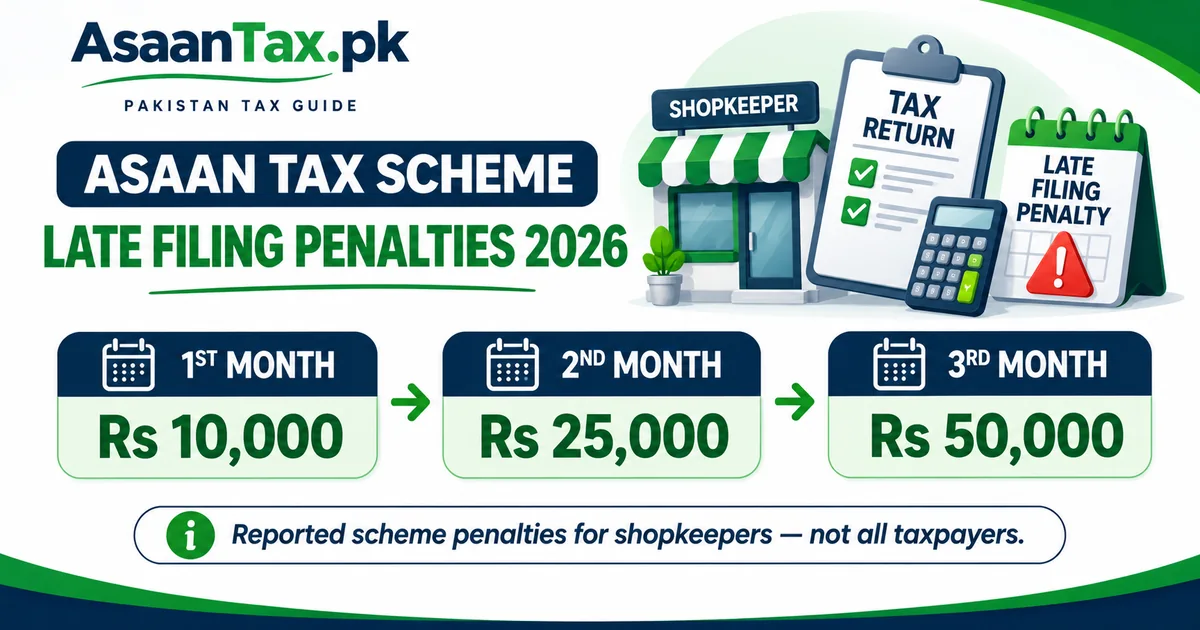
According to a government announcement in September 2026, shopkeepers failing to comply with the prescribed tax filing or payment requirements may face escalating penalties of Rs 10,000 in the first month, Rs 25,000 in the second month, and Rs 50,000 in the third month after the deadline.
These figures were announced as part of the government's efforts to improve tax compliance among traders and small businesses.
At the same time, the Finance Act 2026 introduced significant changes to general income tax return penalties under Section 182 and late-filer Active Taxpayer List (ATL) surcharges under Section 182A.
Important: The Asaan Tax Scheme's announced monthly penalties, the general income tax late-filing penalty, and the ATL surcharge are different compliance matters. They should not be treated as one universal penalty.
This article explains the new penalty structure, who may be affected, how penalties increase, the difference between late filers and non-filers, and how taxpayers can avoid unnecessary financial costs.
1. What Is the Asaan Tax Scheme in Pakistan?
The Asaan Tax Scheme is a simplified tax compliance initiative introduced for shopkeepers and traders in Pakistan.
Its purpose is to make tax registration, return filing, and compliance procedures more accessible to eligible retailers.
The government aims to encourage more shopkeepers to enter the documented tax system and meet their income tax obligations.
The scheme is specifically intended for the shopkeeper segment rather than automatically applying to every salaried employee, freelancer, company, or professional taxpayer.
Main Objectives of the Scheme
- Simplify tax compliance for eligible shopkeepers.
- Encourage registration of previously undocumented businesses.
- Improve income tax return filing.
- Increase awareness of tax obligations.
- Reduce administrative complexity for small traders.
- Improve tax collection and formal business documentation.
The scheme does not mean that every shopkeeper is exempt from tax or automatically qualifies for a fixed payment.
Eligibility, tax calculation, documentation, and return filing requirements must be checked against the applicable FBR rules.
2. New Asaan Tax Scheme Penalties for Late Filing
In September 2026, the government announced an escalating penalty structure for shopkeepers failing to comply with the prescribed deadline under the Asaan Tax Scheme or the relevant regular procedure.
Reported Penalty Structure
| Period After Deadline | Announced Penalty |
|---|---|
| First Month | Rs 10,000 |
| Second Month | Rs 25,000 |
| Third Month | Rs 50,000 |
These figures were reported following a government review meeting concerning the implementation of the simplified scheme for shopkeepers.
How the Penalty Increases
During the first month after the applicable deadline, the reported penalty is Rs 10,000.
In the second month, the reported penalty rises to Rs 25,000.
By the third month, the reported amount reaches Rs 50,000.
The reported third-month amount is five times the first-month amount.
Important clarification: These are announced penalty amounts for successive stages of delay. They should not automatically be added together as Rs 85,000. The precise legal basis, individual assessment, applicable period, and whether other statutory liabilities arise must be verified.
Taxpayers should also distinguish between a government announcement and an enforceable penalty under the relevant legislation or notification.
3. Who Can Be Affected by the New Penalty Structure?
The Asaan Tax Scheme primarily concerns eligible shopkeepers and retail businesses.
Examples may include:
- Grocery and general stores.
- Clothing and garment shops.
- Electronics and mobile phone retailers.
- Hardware and building material shops.
- Small retail businesses.
- Other eligible traders and shopkeepers.
However, the nature of the business alone does not determine eligibility.
The applicable scheme requirements and taxpayer classification must be verified before assuming that the simplified procedure applies.
Does the Scheme Apply to Salaried Employees?
No. Salaried individuals are not automatically covered by the shopkeeper-specific Asaan Tax Scheme.
Their income tax filing requirements and potential penalties are generally determined under the applicable provisions of the Income Tax Ordinance, 2001.
Does the Scheme Apply to Companies?
A company must meet its own income tax compliance obligations. The shopkeeper scheme should not be treated as a replacement for the general company filing requirements.
4. General Income Tax Return Penalties Under Section 182 — Finance Act 2026
Pakistan's general late income tax return penalty framework is governed by Section 182 of the Income Tax Ordinance, 2001.
The Finance Act 2026 updated the penalty rules.
Under the amended provisions, the late-return penalty is calculated using the higher of:
0.1% of the applicable tax payable for each day of default; or Rs 1,000 for each day of default.
The provision also specifies minimum penalties, a maximum limitation, and reductions for filing within specified periods after the due date.
General Late-Return Penalty Rules
| Requirement | Section 182 Provision |
|---|---|
| Daily calculation | Higher of 0.1% of tax payable or Rs 1,000 |
| Minimum for qualifying salaried individuals | Rs 10,000 |
| Minimum for other cases | Rs 50,000 |
| Stated maximum | 200% of tax payable |
| Return filed within one month | 75% penalty reduction |
| Return filed within two months | 50% penalty reduction |
| Return filed within three months | 25% penalty reduction |
The qualifying salaried category generally requires at least 75% of the individual's income to come from salary.
The tax payable used in this provision has a specific statutory definition, including reference to the relevant assessed tax and the preceding tax year.
Note: The interaction of minimum penalties, the statutory maximum, and any applicable reductions requires case-specific legal interpretation. These amounts should not be presented as automatic bills generated immediately after the filing deadline.
5. What Happens If a Taxpayer Files Within One Month?
The amended Section 182 includes a 75% reduction in the calculated penalty where the return is filed within one month after the due date or validly extended deadline.
This provision creates an incentive to correct a late-filing default promptly.
For example, if an otherwise applicable calculated penalty is Rs 40,000 and the statutory reduction is available, a 75% reduction would mathematically leave Rs 10,000.
However, actual enforceable liability must still account for the relevant statutory minimum, maximum, legal conditions, and any formal assessment.
This example illustrates the percentage reduction rather than determining a taxpayer's final penalty.
6. What Happens If the Return Is Filed Within Two or Three Months?
The law also provides reduced penalties for returns filed within specified later periods.
| Time of Filing | Stated Reduction |
|---|---|
| Within 1 month after deadline | 75% |
| Within 2 months after deadline | 50% |
| Within 3 months after deadline | 25% |
| After 3 months | These particular early-filing reductions no longer apply |
These reductions are part of the general Section 182 framework and must not be confused with the separate Rs 10,000, Rs 25,000, and Rs 50,000 amounts announced for the Asaan Tax Scheme.
Even where the original deadline has passed, filing as soon as possible can reduce continuing compliance difficulties.
7. New ATL Surcharge for Late Filers Under Section 182A
Another important change introduced through the Finance Act 2026 concerns the surcharge payable for inclusion in the Active Taxpayer List after late return filing.
Under Section 182A, the amended surcharge amounts are:
| Taxpayer Category | ATL Surcharge |
|---|---|
| Individual | Rs 25,000 |
| Association of Persons (AOP) | Rs 50,000 |
| Company | Rs 100,000 |
These amounts represent the revised statutory surcharge figures under Section 182A.
They differ from the earlier amounts of Rs 1,000 for individuals, Rs 10,000 for AOPs, and Rs 20,000 for companies.
Important: An ATL surcharge is different from a late-filing penalty under Section 182. It is associated with the statutory conditions for inclusion in the Active Taxpayer List following late filing.
The Finance Act 2026 also introduced a specific provision concerning an individual's undertaking not to acquire property for a six-month period. Eligibility for that provision depends on compliance with the prescribed legal conditions.
Taxpayers should check the current statutory requirements before making an ATL surcharge payment.
8. Difference Between an Asaan Tax Penalty, Section 182 Penalty, and ATL Surcharge
Many taxpayers confuse different charges imposed or announced under Pakistan's tax system.
The following comparison explains the distinction.
| Type of Charge | Main Purpose | Applicable Framework |
|---|---|---|
| Asaan Tax Scheme reported penalty | Shopkeeper scheme compliance | Government-announced scheme arrangements and applicable legal provisions |
| General late-return penalty | Failure to file a required income tax return on time | Section 182 |
| ATL surcharge | Inclusion in ATL following late filing | Section 182A |
| Default surcharge | Failure to pay tax within the prescribed period | Section 205 and relevant provisions |
A taxpayer should not assume that payment of one amount automatically removes every other liability.
Similarly, a published announcement should not be interpreted as establishing an additional legal penalty without reference to the applicable statutory authority.
9. Did FBR Extend the Income Tax Return Deadline for Tax Year 2026?
Income tax return filing deadlines can be extended through appropriate legal or administrative measures.
For Tax Year 2026, taxpayers should consider the applicable statutory deadline and any valid extension granted by FBR or the relevant Commissioner.
The correct starting date for calculating a late-filing period is the deadline legally applicable to that particular taxpayer.
A news report or social media announcement alone should not be used as proof of an extension.
How to Verify a Deadline
- Visit the official FBR website.
- Review recent income tax return deadline notifications.
- Confirm the tax year covered by the notification.
- Check the taxpayer categories included.
- Confirm whether any additional extension applies.
- Keep a copy of the relevant notification.
Do not assume that all taxpayers have the same extended deadline.
10. What Happens If a Shopkeeper Does Not File an Income Tax Return?
An eligible shopkeeper who fails to comply with applicable filing or payment obligations may face enforcement measures provided under the relevant law.
Possible consequences include:
- Applicable late-filing penalties.
- Tax notices or compliance reminders.
- Default surcharge on overdue tax where legally applicable.
- Restrictions connected to ATL status.
- Additional tax compliance proceedings.
- Further enforcement action where authorized by law.
The exact consequences depend on the person's registration, applicable scheme, filing obligations, assessment, and statutory provisions.
A taxpayer should not assume that every business receives an immediate Rs 50,000 penalty simply because a deadline has passed.
11. Can a Taxpayer Receive an FBR Notice for Late Filing?
Yes. FBR may issue notices requiring taxpayers to comply with relevant income tax obligations.
If a notice is received, the taxpayer should identify:
- The legal section mentioned in the notice.
- The tax year or period concerned.
- The alleged non-compliance.
- The response deadline.
- Any documents or explanation requested.
Ignoring a valid tax notice can create additional complications.
Taxpayers should review the notice carefully, submit required returns or explanations, and seek qualified assistance where necessary.
12. How to File a Late Income Tax Return Through FBR IRIS
A taxpayer who missed the applicable income tax return deadline should take corrective steps as soon as possible.
Step 1: Access the Official IRIS Portal
Visit:
Sign in using your authorized taxpayer credentials.
Step 2: Select the Relevant Tax Year
For the return generally covering income earned from July 1, 2025, to June 30, 2026, select Tax Year 2026.
Special tax years may follow different periods.
Step 3: Prepare the Income Tax Return
Enter applicable income, expenses, tax deductions, credits, and other required details.
Step 4: Complete the Wealth Statement
Where a wealth statement is required, provide accurate information on assets, liabilities, expenses, and wealth reconciliation.
Step 5: Check Tax Payments
Review the tax payable and any eligible withholding tax already deducted.
Step 6: Submit the Return
Verify all declarations before electronic submission.
Ensure that the portal confirms successful filing rather than leaving the return in draft status.
Step 7: Review ATL Requirements
If the return was filed late, determine whether a surcharge is required under Section 182A and whether any specific statutory exception applies.
Step 8: Respond to Any Outstanding Notices
If FBR has issued a notice or penalty proceedings have begun, follow the relevant legal procedure.
Important: Filing the return late does not automatically cancel previously applicable penalties or surcharges.
13. How Can Shopkeepers Avoid Late Filing Penalties?
Shopkeepers can reduce compliance risks by maintaining organized records and completing the filing process before their applicable deadlines.
Maintain Accurate Business Records
Keep records of relevant sales, purchases, expenses, and other business transactions.
Verify Scheme Eligibility
Confirm whether the business qualifies for the Asaan Tax Scheme or must use the regular tax filing procedure.
Check Filing Deadlines
Monitor official FBR announcements rather than relying on unverified social media information.
File Accurate Returns
Submit correct business and income information based on available documentation.
Pay Taxes Through Authorized Channels
Where payment is required, use FBR-approved electronic payment arrangements.
Keep Supporting Evidence
Retain return acknowledgments, payment receipts, and relevant supporting records.
Respond Promptly to FBR
Do not ignore notices or requests for clarification.
14. Is a Late Filer the Same as a Non-Filer?
No. A person who has filed a return after the applicable deadline is not necessarily in the same factual position as someone who has never filed the required return.
However, whether a person's name appears on the Active Taxpayer List depends on the prevailing legal requirements.
A late return may require satisfaction of additional statutory conditions before ATL inclusion.
Filing status, ATL status, and the legal consequences of late submission should therefore be considered separately.
Taxpayers can verify their ATL status using official FBR verification facilities.
15. Can Late Filing Penalties Be Challenged or Reduced?
Section 182 contains procedural requirements relating to penalty orders.
The law generally requires an appropriate written order and an opportunity to be heard before a penalty is imposed under that section.
A taxpayer receiving a penalty notice should examine the applicable legislation, facts, calculation, and available legal remedies.
Relevant issues may include:
- Whether the return was legally required.
- Whether an applicable extension existed.
- Whether the correct tax year was selected.
- Whether the penalty was correctly calculated.
- Whether a statutory reduction applies.
- Whether the proper procedure was followed.
- Whether an appeal or other relief is available.
A penalty should not be ignored merely because the taxpayer disagrees with it.
16. Watch Tax With Naeem — Income Tax Return Filing Guide
For practical information about Pakistan's income tax return filing system, watch educational content from Tax With Naeem.
Related Video: Income Tax Return Filing in Pakistan — Salary, Rental Income, Capital Gains and Dividends Explained
https://www.youtube.com/watch?v=VX88o1N1AfA
The video explains income tax return filing and the reporting of different types of income.
It is supplementary educational content, not a dedicated tutorial on the Asaan Tax Scheme's new penalties.
For the specific 2026 penalty amounts, readers should consult the official government announcement and the updated Income Tax Ordinance.
17. Official Sources and References
1. Government of Pakistan — Press Information Department
Asaan Tax Scheme Review and Penalty Announcement, September 2026
https://pid.gov.pk/site/press_detail/34073
2. FBR — Income Tax Ordinance, 2001
Official consolidated legislation amended up to June 30, 2026
https://www.fbr.gov.pk/Categ/Income-Tax-Ordinance/326/1000
3. FBR — Official Website
4. FBR — IRIS Tax Filing Portal
5. Government Radio Pakistan — Asaan Tax Scheme Update
6. AsaanTax.pk — Pakistan Tax Guides
18. Conclusion: How Much Can Late Filing Cost in 2026?
The government's September 2026 announcement about the Asaan Tax Scheme highlighted escalating penalties of Rs 10,000, Rs 25,000, and Rs 50,000 for shopkeepers at different stages after the prescribed deadline.
Separately, the Finance Act 2026 amended general income tax return penalties under Section 182 and ATL surcharges under Section 182A.
These changes make timely tax compliance especially important for individuals, business owners, traders, AOPs, and companies.
However, not every taxpayer faces the same penalty, and the announced shopkeeper amounts should not be confused with the general statutory penalties.
Taxpayers should verify their filing obligations, submit accurate returns, review outstanding notices, and check current FBR legislation before determining their financial liability.
For reliable educational guides on FBR penalties, tax return filing, ATL status, and business taxation, visit www.asaantax.pk.
Editorial Note: The Asaan Tax Scheme amounts are based on the government's September 2026 public announcement. A separate scheme-specific legal notification establishing all details of assessment and collection was not independently verified for this article.
Disclaimer: This article provides general educational information as of November 9, 2026. Penalty liabilities, exemptions, reductions, and ATL requirements depend on the applicable law and individual circumstances. Readers should consult FBR's latest legislation or a qualified tax professional before making compliance decisions.