Australia Income Tax Rates 2026–27: ATO Brackets, Stage 3 Cuts and Medicare Levy
Published: 11 November 2026
Country: Australia
Financial Year: 1 July 2026 – 30 June 2027
Tax Authority: Australian Taxation Office (ATO)
Standard Medicare Levy: 2%
Self-Lodgment Deadline: 1 November 2027, under the standard weekend rollover rule
Australia's income tax rates have changed for the 2026–27 financial year, providing additional tax relief for millions of employees, freelancers, sole traders and other taxpayers.
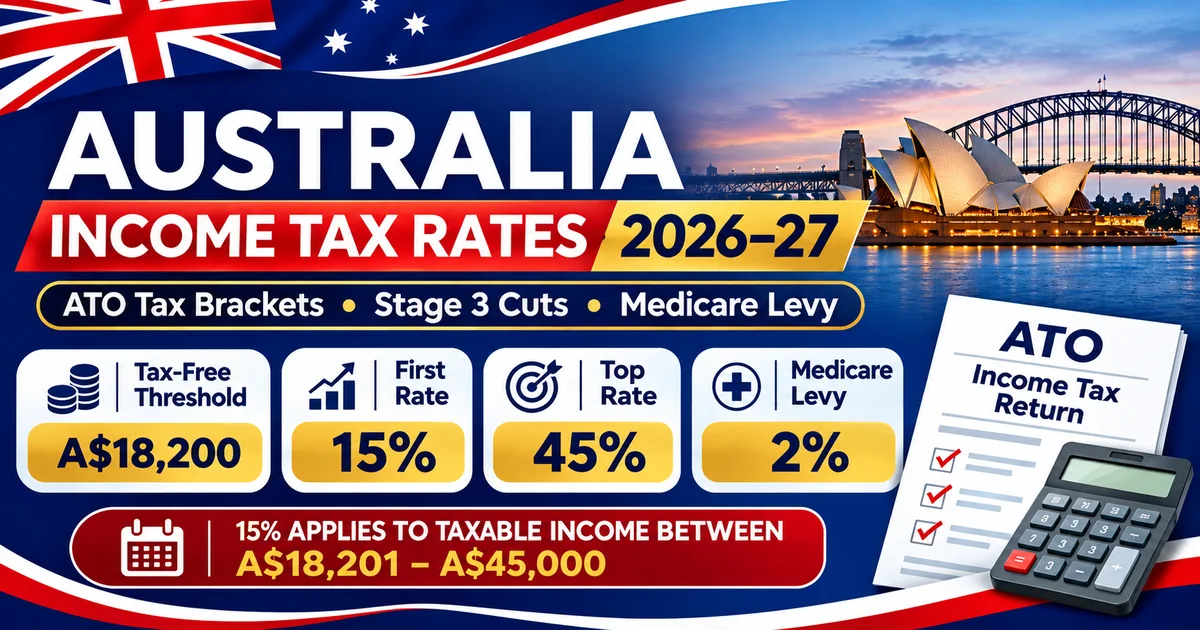
From 1 July 2026, the marginal income tax rate on taxable income between A$18,201 and A$45,000 decreased from 16% to 15%.
The Australian tax-free threshold remains A$18,200, while the higher marginal rates remain 30%, 37% and 45%.
These changes build on the Stage 3 income tax cuts implemented from July 2024.
However, Australians must also consider the Medicare levy, which generally adds 2% of taxable income to their tax liability, subject to applicable low-income reductions and exemptions.
This complete guide explains the 2026–27 Australian income tax brackets, tax reductions, Medicare levy, Medicare levy surcharge, salary calculations, tax offsets, PAYG withholding, filing deadlines and important obligations for overseas Pakistanis living in Australia.
1. Australia Income Tax Rates for 2026–27
Australia uses progressive income tax rates for individual taxpayers.
For eligible Australian residents for tax purposes, the 2026–27 income tax brackets are:
| Annual Taxable Income (AUD) | Marginal Rate | Tax Calculation |
|---|---|---|
| A$0 – A$18,200 | 0% | Nil |
| A$18,201 – A$45,000 | 15% | 15% of amount above A$18,200 |
| A$45,001 – A$135,000 | 30% | A$4,020 + 30% above A$45,000 |
| A$135,001 – A$190,000 | 37% | A$31,020 + 37% above A$135,000 |
| Above A$190,000 | 45% | A$51,370 + 45% above A$190,000 |
These amounts exclude the Medicare levy, Medicare levy surcharge and applicable tax offsets.
The table assumes full-year Australian tax residence and entitlement to the full tax-free threshold.
Foreign residents, working holiday makers and part-year residents may be subject to different rules.
2. What Changed in Australian Income Tax From July 2026?
The most important change for 2026–27 is the reduction in the first positive marginal income tax rate.
Income Tax Rate Comparison
| Taxable Income Band | 2025–26 | 2026–27 | From 2027–28 |
|---|---|---|---|
| A$0–A$18,200 | 0% | 0% | 0% |
| A$18,201–A$45,000 | 16% | 15% | 14% |
| A$45,001–A$135,000 | 30% | 30% | 30% |
| A$135,001–A$190,000 | 37% | 37% | 37% |
| Above A$190,000 | 45% | 45% | 45% |
The 15% rate took effect on 1 July 2026.
A further reduction to 14% is legislated to begin on 1 July 2027.
Important: The 14% rate does not apply to the 2026–27 financial year. It applies from 2027–28.
3. What Were the Stage 3 Income Tax Cuts?
The Stage 3 tax cuts were implemented from 1 July 2024 under Australia's revised personal income tax arrangements.
The reform:
- Reduced the previous 19% rate to 16%.
- Reduced the previous 32.5% rate to 30%.
- Increased the threshold at which the 37% rate begins to A$135,000.
- Increased the threshold at which the 45% rate begins to A$190,000.
The Stage 3 reforms changed the distribution of income tax across several earning groups.
The additional cuts commencing in July 2026 and July 2027 build on those changes.
Key Difference
Stage 3 reform: Effective 1 July 2024.
Additional tax reduction: 16% to 15%, effective 1 July 2026.
Next legislated reduction: 15% to 14%, effective 1 July 2027.
Taxpayers should not confuse the implementation dates.
4. What Is Australia's Tax-Free Threshold in 2026–27?
The ordinary tax-free threshold for eligible full-year Australian residents is A$18,200.
This means the first A$18,200 of ordinary taxable income is subject to a 0% income tax rate.
Example
A qualifying resident earns A$18,000 in taxable income during the financial year.
The amount falls entirely within the tax-free threshold.
Ordinary income tax: A$0.
However, whether a person must lodge a return depends on their complete circumstances, including tax withheld and other reporting requirements.
Important
The A$18,200 threshold is not automatically available to:
- Foreign residents for tax purposes.
- Every working holiday maker.
- Individuals with special residency circumstances.
- Some part-year residents claiming a reduced threshold.
A person's visa or citizenship alone does not determine their tax residency.
5. How Does Progressive Income Tax Work in Australia?
Australia taxes income progressively.
For example, a person earning A$70,000 does not pay 30% income tax on the entire A$70,000.
The calculation uses separate income bands.
- The first A$18,200 is tax-free.
- The portion from A$18,201 to A$45,000 is taxed at 15%.
- The portion above A$45,000 up to A$70,000 is taxed at 30%.
This ensures that moving into a higher income tax bracket does not increase the tax rate applied to income already within the lower brackets.
6. Income Tax Calculation on A$60,000 Salary
Consider a full-year Australian resident earning A$60,000 in taxable salary.
Assume no additional deductions, offsets or special adjustments.
| Income Portion | Rate | Income Tax |
|---|---|---|
| First A$18,200 | 0% | A$0 |
| Next A$26,800 | 15% | A$4,020 |
| Remaining A$15,000 | 30% | A$4,500 |
| Income Tax Before Medicare | A$8,520 | |
| Illustrative Medicare Levy at 2% | A$1,200 | |
| Combined Illustrative Amount | A$9,720 |
Estimated income tax and Medicare levy: A$9,720.
This assumes the full Medicare levy applies and excludes any available income tax offsets, Medicare levy surcharge, student loan repayments and other adjustments.
The taxpayer's final liability can therefore differ.
7. Income Tax Calculation on A$100,000 Salary
Assume a qualifying resident has A$100,000 of taxable income.
Step 1: Calculate the First Taxable Band
A$26,800 × 15% = A$4,020.
Step 2: Calculate the Second Taxable Band
A$100,000 − A$45,000 = A$55,000.
A$55,000 × 30% = A$16,500.
Step 3: Calculate Ordinary Income Tax
A$4,020 + A$16,500 = A$20,520.
Step 4: Add the Standard Medicare Levy
A$100,000 × 2% = A$2,000.
Illustrative combined tax and Medicare levy: A$22,520.
This estimate assumes no additional credits, deductions, surcharge, Medicare exemption or other circumstances.
8. Income Tax on A$140,000 in Australia
An individual earning A$140,000 in taxable income crosses the 37% marginal bracket.
Calculation
Income tax up to A$135,000:
A$31,020.
Additional income above A$135,000:
A$5,000.
Tax on this additional portion:
A$5,000 × 37% = A$1,850.
Total ordinary income tax:
A$31,020 + A$1,850 = A$32,870.
Standard Medicare levy:
A$140,000 × 2% = A$2,800.
Illustrative combined amount: A$35,670.
A high-income taxpayer may also need to consider the Medicare levy surcharge if the relevant requirements are met.
9. How Much Tax Do Australians Save in 2026–27?
The July 2026 tax cut reduced the rate on taxable income between A$18,201 and A$45,000 from 16% to 15%.
The maximum additional annual saving from this one-percentage-point reduction is A$268, before interactions with other relevant tax rules.
Examples of Annual Tax Savings
| Taxable Income | Estimated 2026–27 Rate-Cut Saving |
|---|---|
| A$20,000 | A$18 |
| A$25,000 | A$68 |
| A$30,000 | A$118 |
| A$35,000 | A$168 |
| A$40,000 | A$218 |
| A$45,000 or more | A$268 |
These figures compare the affected marginal bracket with its previous 16% rate.
Actual tax outcomes may differ when tax offsets and other circumstances affect the final liability.
10. What Is the Medicare Levy in Australia?
The Medicare levy is a charge that helps fund Australia's public healthcare system.
For most individuals who are subject to the full levy, the standard rate is 2% of taxable income.
Formula
Medicare Levy = Taxable Income × 2%
For example, a taxpayer with A$80,000 of taxable income would ordinarily have a Medicare levy of A$1,600 if the full levy applies.
However, some individuals qualify for a reduced levy or complete exemption.
Important
The Medicare levy is separate from ordinary income tax.
The income tax brackets published by the ATO generally exclude the Medicare levy.
11. Who Can Qualify for a Reduced Medicare Levy?
Australia provides low-income Medicare levy thresholds.
Depending on the taxpayer's circumstances, relief may be available to:
- Low-income individuals.
- Eligible families.
- Qualifying seniors.
- Pensioners.
- Individuals satisfying specific exemption conditions.
The applicable thresholds depend on the year and household circumstances.
The detailed figures may be indexed or amended.
For Tax Year 2026–27, use the final ATO Medicare levy threshold schedule applicable to that financial year when calculating an actual return.
Do not assume that every person with taxable income below A$18,200 is automatically required to pay the levy.
Similarly, not every person above the standard tax-free threshold pays the full 2%.
12. Medicare Levy vs Medicare Levy Surcharge
The Medicare levy and Medicare levy surcharge are two separate obligations.
Medicare Levy
Generally 2% of taxable income, subject to reductions and exemptions.
Medicare Levy Surcharge
An additional charge that can apply to relevant higher-income taxpayers who do not hold appropriate private patient hospital insurance.
The surcharge generally has rates of:
| Relevant Surcharge Tier | Rate |
|---|---|
| Below threshold | 0% |
| Tier 1 | 1% |
| Tier 2 | 1.25% |
| Tier 3 | 1.5% |
The applicable tier is determined using the relevant income-for-surcharge calculation, not simply taxable salary alone.
Thresholds differ for singles and families and may be adjusted between income years.
Important Insurance Rule
Basic extras-only private health insurance generally does not satisfy the private hospital insurance requirement for avoiding the Medicare levy surcharge.
The policy must meet the applicable hospital-cover rules.
13. Can Overseas Residents Be Exempt From the Medicare Levy?
Some taxpayers may qualify for a full or partial Medicare levy exemption where they are not eligible for Medicare benefits or meet other relevant conditions.
A foreign resident for Australian tax purposes is generally not required to pay the Medicare levy.
However, tax residency, visa status and eligibility for Medicare are not identical concepts.
A temporary resident or overseas student should verify their individual status and supporting documentation rather than automatically claiming an exemption.
14. What Is the Low Income Tax Offset?
The Low Income Tax Offset (LITO) is a non-refundable federal income tax offset for eligible low-income resident taxpayers.
The maximum offset is generally A$700.
The amount reduces as taxable income increases, according to the applicable rules.
Important Features
- It can reduce eligible income tax.
- It is not generally a cash payment.
- It does not automatically eliminate the Medicare levy.
- The amount may be reduced for higher qualifying income.
- Non-residents generally do not qualify under the same conditions as residents.
A person should not simply subtract A$700 from every Australian income tax calculation.
The correct offset depends on taxable income and eligibility.
15. What About the Proposed A$1,000 Instant Tax Deduction?
The Australian Government announced a proposed A$1,000 instant deduction for qualifying work-related expenses beginning in the 2026–27 income year.
Under the proposal, eligible taxpayers could claim a simplified deduction instead of individually substantiating certain work-related expenses up to that amount, subject to the rules.
Important legislative clarification: As of the latest ATO guidance reviewed for this article, the proposal had not yet become law.
Therefore, taxpayers should not automatically claim A$1,000 merely because the measure was announced in a Budget.
Use the applicable legislation and ATO instructions available when the 2026–27 return is prepared.
16. What Is the New Working Australians Tax Offset?
The 2026–27 Federal Budget announced a new Working Australians Tax Offset of up to A$250.
However, the measure is intended to begin in 2027–28, not in the 2026–27 financial year.
It is designed to provide additional relief to eligible individuals earning relevant work income.
The offset is separate from the existing Low Income Tax Offset.
Taxpayers should not claim it for 2026–27 merely because it was announced during 2026.
Its final operation is subject to the relevant implementing legislation.
17. Australian Income Tax for Freelancers and Sole Traders
Self-employed individuals generally calculate income tax on taxable business profits rather than gross business revenue.
A sole trader's income may include:
- Consulting fees.
- Software development revenue.
- Graphic design income.
- Online marketing services.
- Freelance writing.
- E-commerce income.
- Other business receipts.
Relevant allowable business expenses may reduce assessable business income.
Example
A freelance consultant earns:
Gross business income: A$90,000.
Eligible business expenses: A$25,000.
Simplified net business profit:
A$90,000 − A$25,000 = A$65,000.
This business profit generally forms part of the individual's income tax calculation, subject to the relevant provisions.
The person may also need to consider GST registration, PAYG instalments and other business obligations.
18. GST Obligations for Australian Freelancers
Goods and Services Tax (GST) is separate from personal income tax.
Australia's standard GST rate is generally 10%.
Many businesses must register for GST once their GST turnover reaches the applicable A$75,000 threshold.
However, certain activities and businesses may be subject to different rules.
An Australian freelancer should consider:
- Whether their supplies are taxable.
- Whether GST registration is required.
- Whether supplies are GST-free or input-taxed.
- Whether a Business Activity Statement must be lodged.
- Whether an Australian Business Number is required.
The personal income tax-free threshold of A$18,200 does not replace the GST registration threshold.
19. Is Superannuation Deducted From Income Tax?
Superannuation is an important component of Australia's retirement savings system.
Employer superannuation contributions are generally separate from ordinary salary income tax withholding.
The compulsory Superannuation Guarantee rate is 12% for the 2026–27 financial year.
The treatment of concessional and non-concessional superannuation contributions involves separate tax rules.
Important Distinction
Income tax and Medicare levy determine relevant individual tax liabilities.
Superannuation involves employer contributions, retirement savings and applicable super fund taxation.
A taxpayer should not automatically add the employer's superannuation guarantee contribution to their income tax bill.
20. Are Foreign Residents Subject to the Same Income Tax Rates?
No.
Foreign residents for tax purposes generally do not receive the same A$18,200 resident tax-free threshold.
For 2026–27, the ordinary foreign-resident income tax schedule generally begins at 30%, subject to applicable rules.
Foreign Resident Tax Rate Overview
| Taxable Income | Marginal Rate |
|---|---|
| A$0–A$135,000 | 30% |
| A$135,001–A$190,000 | 37% |
| Above A$190,000 | 45% |
Foreign residents generally do not pay the Medicare levy.
Working holiday makers may be subject to different rules.
Taxpayers should first establish their Australian tax residency before using any tax bracket table.
21. What About International Students and Temporary Workers?
International students and temporary visa holders may have Australian tax obligations when they work or earn taxable income in Australia.
The applicable rates depend on actual tax residency and other relevant circumstances.
Important factors can include:
- Length and nature of residence.
- Accommodation arrangements.
- Employment circumstances.
- Personal and economic connections.
- Applicable tax treaties.
- Particular working holiday maker rules.
An international student is not automatically treated as a foreign resident for every Australian income tax purpose.
The ATO provides residency tests to assist with determining the correct classification.
22. Do Overseas Pakistanis Living in Australia Pay Tax on Worldwide Income?
Australian residents for income tax purposes are generally required to declare worldwide income, subject to applicable exemptions and other rules.
This may include relevant:
- Australian employment income.
- Pakistani rental income.
- Foreign bank interest.
- Dividends.
- Foreign business income.
- Taxable capital gains.
- Other overseas income.
Non-residents are generally taxed on relevant Australian-source income, subject to applicable legislation.
Where tax has also been paid overseas, a foreign income tax offset may be relevant.
Pakistani nationality alone does not determine Australian tax residence.
23. PAYG Withholding: How Employees Pay Australian Income Tax
Australia uses Pay As You Go (PAYG) withholding for many employment payments.
Employers generally deduct income tax from salary and wages and remit the amount to the ATO.
The final tax position is reconciled when the employee lodges the annual income tax return.
Example
An employee may have tax withheld during the year based on payroll calculations.
If the final tax payable is lower than the eligible withholding credits, a refund may arise.
If withholding is insufficient, the employee may receive a tax bill.
PAYG amounts withheld are tax payments toward the final liability, not a separate additional tax.
24. When Does the 2026–27 Australian Financial Year End?
Australia's ordinary individual financial year begins on 1 July and ends on 30 June.
For 2026–27:
| Event | Date |
|---|---|
| Financial Year Begins | 1 July 2026 |
| Financial Year Ends | 30 June 2027 |
| Tax Return Lodgment Period Begins | 1 July 2027 |
| Normal Self-Lodgment Deadline | 31 October 2027 |
| Adjusted Weekend Deadline | 1 November 2027 |
31 October 2027 falls on a Sunday.
Under the ATO's standard rule for a due date that falls on a weekend, the deadline moves to the next business day, which is Monday, 1 November 2027, assuming no other applicable change.
Registered tax agents may have different lodgment schedules.
Taxpayers should check any future ATO updates before their return becomes due.
25. How to Lodge an Australian Income Tax Return Online
The Australian Taxation Office provides online tax return services through myGov and myTax.
Step 1: Access myGov
Visit https://my.gov.au/.
Step 2: Link the ATO Service
Connect your myGov account to the ATO using the approved process.
Step 3: Open myTax
Select the relevant income tax return service.
Step 4: Choose the Correct Financial Year
For this article, select 2026–27 when returns for that year become available.
Step 5: Review Pre-Filled Income
Check employment income, PAYG withholding, interest and other available pre-filled information.
Step 6: Add Missing Income
Report relevant Australian and overseas income.
Step 7: Claim Eligible Deductions
Enter expenses that meet the applicable deduction requirements.
Step 8: Review Tax Offsets
Check eligibility for LITO and other relevant offsets.
Step 9: Complete Medicare Information
Review the Medicare levy, possible exemption and Medicare levy surcharge requirements.
Step 10: Submit the Return
Verify all information and lodge electronically.
Step 11: Retain Confirmation
Save the ATO submission acknowledgment and subsequent Notice of Assessment.
Submitting a draft is not the same as lodging a completed tax return.
26. Documents Needed for an Australian Income Tax Return
Depending on the taxpayer's circumstances, documents may include:
- Tax File Number.
- Employment income statements.
- PAYG withholding information.
- Bank interest statements.
- Dividend information.
- Business income and expense records.
- Rental property income and expenses.
- Eligible work-related expense receipts.
- Superannuation contribution documentation.
- Private health insurance records.
- Overseas income statements.
- Capital gains transaction records.
- Relevant tax offset documentation.
Not every taxpayer requires every document.
27. Common Australian Income Tax Mistakes to Avoid
- Applying the old 16% bracket to 2026–27 income.
- Using the 14% rate before 1 July 2027.
- Assuming Stage 3 started in 2026 rather than 2024.
- Applying the highest marginal rate to an entire salary.
- Forgetting the Medicare levy.
- Confusing the Medicare levy with the Medicare levy surcharge.
- Assuming every resident pays the full 2% levy.
- Assuming every foreign passport holder is a foreign tax resident.
- Using resident tax brackets without confirming residency.
- Claiming the proposed A$1,000 deduction before it becomes law.
- Applying the Working Australians Tax Offset to the wrong year.
- Confusing the personal tax-free threshold with GST registration.
- Claiming personal expenses as business deductions.
- Failing to report relevant foreign income.
- Missing the correct tax return lodgment deadline.
- Ignoring the tax agent lodgment rules.
- Confusing PAYG withholding with final income tax.
- Claiming inappropriate Medicare exemptions.
28. Australia Income Tax 2026–27 Final Checklist
Before lodging a return, review:
- Correct financial year, 2026–27.
- Australian tax residency status.
- Applicable tax-free threshold.
- Correct 15%, 30%, 37% and 45% brackets.
- Employment income and PAYG withholding.
- Freelance and business income.
- Eligible work-related deductions.
- Relevant income tax offsets.
- Medicare levy liability.
- Medicare levy surcharge position.
- Private hospital insurance details.
- Superannuation-related information.
- Interest and dividend income.
- Capital gains.
- Overseas income.
- Available foreign income tax offsets.
- Supporting documentation.
- Relevant ATO filing deadline.
- Final return submission confirmation.
29. Watch Tax With Naeem — Income Tax Education
For related educational guidance on income tax returns, salary income, business income, rental income and capital gains, watch content from the Tax With Naeem YouTube channel.
Related Video: Income Tax Return Filing in Pakistan — Salary, Rental Income, Capital Gains and Dividends Explained
https://www.youtube.com/watch?v=VX88o1N1AfA
This linked video is a Pakistan income tax education tutorial, not an Australian ATO tax filing tutorial.
It is included as supplementary educational material. Australian taxpayers should use the Australian Taxation Office's official guidance for their actual tax calculations, deductions and returns.
30. Official Australian Government Sources
1. Australian Taxation Office — Individual Income Tax Rates
https://www.ato.gov.au/tax-rates-and-codes/tax-rates-australian-residents
2. Australian Government MoneySmart — Income Tax Rates
https://moneysmart.gov.au/work-and-tax/income-tax
3. ATO — New Personal Income Tax Cuts
4. Australian Treasury — 2026–27 Budget Tax Changes
https://treasury.gov.au/policy-topics/taxation/budget2026-27
5. Australian Government — 2026–27 Budget and Tax Cuts
https://budget.gov.au/content/02-cost-of-living.htm
6. ATO — Medicare Levy and Exemptions
7. ATO — Medicare Levy Surcharge
8. ATO — How to Lodge a Tax Return
https://www.ato.gov.au/individuals-and-families/your-tax-return/how-to-lodge-your-tax-return
9. myGov — Australian Government Online Services
10. AsaanTax.pk — International Taxation Guides
11. Tax With Naeem — Related Tax Education Video
https://www.youtube.com/watch?v=VX88o1N1AfA
31. Conclusion: What Are Australia's Income Tax Rates for 2026–27?
For the 2026–27 financial year, Australia's resident income tax structure begins with a tax-free threshold of A$18,200.
The first marginal rate is now 15%, followed by rates of 30%, 37% and 45%.
The July 2026 tax reduction builds on the Stage 3 reforms introduced in July 2024.
Another legislated reduction from 15% to 14% will take effect in July 2027.
However, income tax brackets are only one part of an individual's total tax position.
The Medicare levy, Medicare levy surcharge, tax offsets, deductions, residency and other income sources can affect the final liability.
The key principle is to use the correct 2026–27 tax brackets, calculate income tax progressively and assess Medicare obligations separately.
For international tax guides covering Australia, Canada, the USA, UK, UAE, Saudi Arabia, India and Pakistan, visit AsaanTax.pk.
Editorial Note: This article reflects Australian Government and ATO guidance available as of 11 November 2026. The A$1,000 instant tax deduction and the Working Australians Tax Offset are described separately from currently applicable 2026–27 tax rates.
Disclaimer: This article is intended for general educational purposes and does not constitute personalized Australian tax advice. Actual liability depends on tax residence, taxable income, offsets, deductions, Medicare eligibility, private health insurance and other relevant conditions. Consult the ATO or a qualified Australian tax professional for individual circumstances.