India Income Tax Slabs 2026–27: New Regime Rates, Rebate and Complete Filing Guide
Published: November 10, 2026
Country: India
Tax Year: April 1, 2026 – March 31, 2027
Tax Authority: Income Tax Department, Government of India
Applicable Legislation: Income-tax Act, 2025, as amended by Finance Act, 2026
India's income tax system has undergone important changes, including a new statutory framework effective from April 1, 2026.
For Tax Year 2026–27, the new income tax regime continues to offer progressive income tax slabs ranging from 0% to 30%.
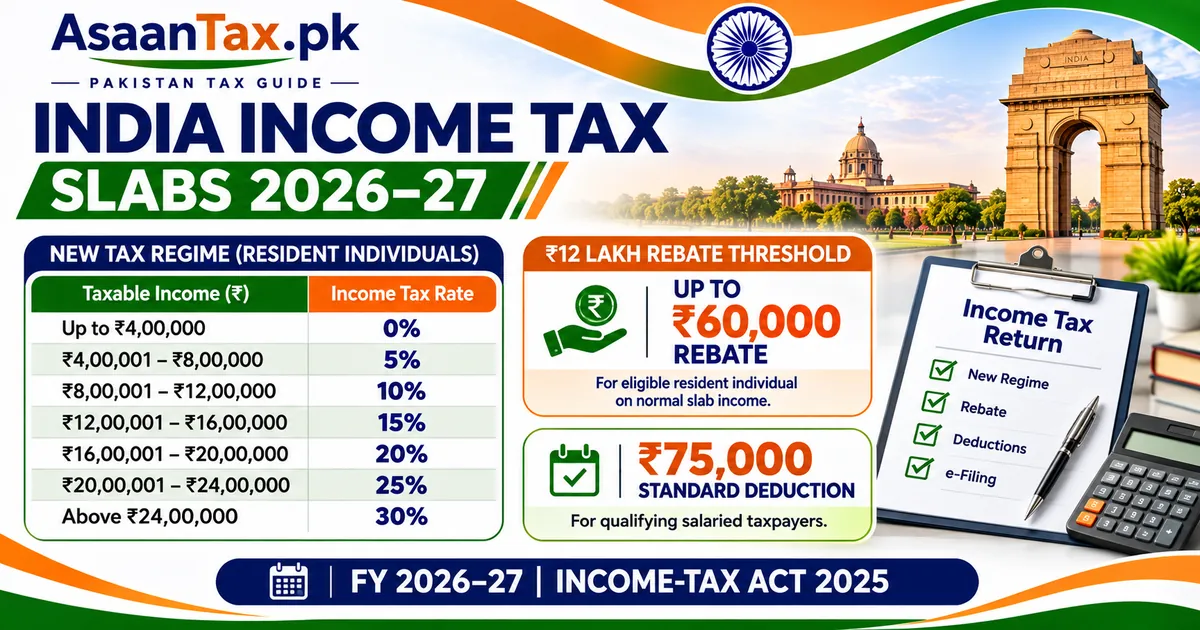
The most important benefits include a basic zero-rate slab up to ₹4 lakh, a rebate of up to ₹60,000 for qualifying resident individuals with total income up to ₹12 lakh, and a standard deduction of up to ₹75,000 for eligible salaried taxpayers.
For qualifying salary-only cases, these provisions can result in no income tax on gross salary up to ₹12.75 lakh.
However, the rebate is not available against every kind of income, and taxpayers should distinguish ordinary slab-rate income from income taxed at special rates.
This guide explains the new income tax slabs, rebate eligibility, marginal relief, standard deduction, old versus new tax regimes, calculation examples, Income Tax Return filing, deadlines and important considerations for Tax Year 2026–27.
1. India Income Tax Slabs for FY 2026–27 Under the New Regime
Under Section 202 of the Income-tax Act, 2025, the new regime provides the following rates.
| Annual Taxable Income | Income Tax Rate |
|---|---|
| Up to ₹4,00,000 | Nil |
| ₹4,00,001–₹8,00,000 | 5% |
| ₹8,00,001–₹12,00,000 | 10% |
| ₹12,00,001–₹16,00,000 | 15% |
| ₹16,00,001–₹20,00,000 | 20% |
| ₹20,00,001–₹24,00,000 | 25% |
| Above ₹24,00,000 | 30% |
These are progressive tax rates.
For example, someone with taxable income of ₹18 lakh does not pay 20% on the entire ₹18 lakh.
Only the portion falling within the relevant bracket is taxed at that bracket's rate.
Important: Tax may also include the applicable Health and Education Cess and surcharge, where relevant.
2. Did Budget 2026 Change India's Income Tax Slabs?
The Union Budget 2026 did not change the main new-regime income tax slabs for Tax Year 2026–27.
The government retained the seven income bands introduced under the preceding framework.
However, a major legal change took effect on April 1, 2026.
The Income-tax Act, 2025 replaced the earlier Income-tax Act, 1961 for the new tax-year framework, subject to transition and savings provisions.
Important Terminology Change
Under the previous framework, taxpayers commonly used:
- Financial Year (FY).
- Assessment Year (AY).
Under the new framework, the term Tax Year is used for the income period itself.
For example:
Tax Year 2026–27: April 1, 2026 to March 31, 2027.
The return for this tax year is generally filed after March 31, 2027.
Taxpayers should not confuse Tax Year 2026–27 with the earlier Assessment Year 2026–27, which concerns income earned during FY 2025–26.
3. What Is the Section 87A Tax Rebate in 2026–27?
Section 87A of the former Income-tax Act, 1961 provided a rebate for eligible resident individuals.
The corresponding rebate framework is contained in Section 156 of the Income-tax Act, 2025.
Under the new-regime rules, eligible resident individuals with total income not exceeding ₹12 lakh may receive a tax rebate of up to ₹60,000.
Rebate Summary
| Requirement | General Rule |
|---|---|
| Maximum Rebate | ₹60,000 |
| Total Income Limit | ₹12,00,000 |
| Eligible Taxpayers | Qualifying resident individuals |
| Relevant Regime | New income tax regime |
| Special-Rate Income | Rebate generally unavailable against tax on specified special-rate income |
| Marginal Relief | May apply slightly above ₹12 lakh |
The rebate reduces eligible income tax liability rather than reducing taxable income itself.
Example: Income of ₹12 Lakh
Assume an eligible resident individual has ₹12 lakh of ordinary taxable income.
The income tax calculation is:
- First ₹4 lakh: Nil.
- Next ₹4 lakh at 5%: ₹20,000.
- Next ₹4 lakh at 10%: ₹40,000.
Tax before rebate: ₹60,000.
Eligible rebate: ₹60,000.
Income tax after rebate: ₹0.
No Health and Education Cess arises on this zero tax amount in the simplified example.
4. Does Every Person Earning ₹12 Lakh Pay Zero Income Tax?
No.
The zero-tax outcome depends on the applicable conditions.
The ₹60,000 rebate is generally available to eligible resident individuals under the new regime.
It should not be treated as a universal exemption for every person or every kind of income.
Cases Requiring Special Attention
- Non-resident individuals.
- Income taxed at special rates.
- Certain capital gains.
- Lottery and specified winnings.
- Virtual digital asset income.
- Other income subject to special provisions.
Example: Capital Gains
A person may have total income below ₹12 lakh but also earn capital gains subject to a special tax rate.
The rebate generally cannot be used to eliminate the tax attributable to income that is specifically excluded from the rebate calculation.
Therefore, a taxpayer should classify income correctly before applying the rebate.
5. Is Salary Up to ₹12.75 Lakh Tax-Free?
For qualifying resident salaried taxpayers under the new regime, gross salary of ₹12.75 lakh can result in zero ordinary income tax because of the standard deduction and the rebate.
Example
| Description | Amount |
|---|---|
| Annual Gross Salary | ₹12,75,000 |
| Eligible Standard Deduction | ₹75,000 |
| Taxable Salary | ₹12,00,000 |
| Slab-Rate Income Tax | ₹60,000 |
| Eligible Rebate | ₹60,000 |
| Income Tax After Rebate | ₹0 |
This assumes:
- The person is an eligible resident individual.
- The income qualifies for the ordinary slab-rate calculation.
- The full salary standard deduction is available.
- There is no other income altering the total income or tax outcome.
Important: ₹12.75 lakh is not the basic exemption limit. It is a potential zero-tax result based on a combination of the standard deduction and rebate.
6. Standard Deduction for Salaried Employees in 2026–27
The new income tax regime generally allows an eligible standard deduction of up to ₹75,000 against salary income.
The old regime generally provides a standard deduction of up to ₹50,000.
| Regime | Standard Salary Deduction |
|---|---|
| New Regime | Up to ₹75,000 |
| Old Regime | Up to ₹50,000 |
The standard deduction is generally available for eligible salary and pension income, subject to the relevant legal provisions.
However, a self-employed freelancer cannot automatically claim the salary standard deduction against independent business profits.
Example
An employee earns ₹15 lakh in gross annual salary.
Under the new regime:
₹15,00,000 − ₹75,000 = ₹14,25,000.
The taxpayer's simplified taxable salary is ₹14.25 lakh before considering any other relevant adjustments.
The income tax slabs are then applied to the applicable taxable income.
7. How to Calculate Income Tax on ₹15 Lakh Salary
Assume the taxpayer is an individual with:
- Annual gross salary: ₹15,00,000.
- Standard deduction: ₹75,000.
- No other taxable income.
- No additional deductions or adjustments.
- New tax regime.
Step 1: Determine Taxable Income
₹15,00,000 − ₹75,000 = ₹14,25,000.
Step 2: Calculate Slab Tax
| Income Portion | Rate | Tax |
|---|---|---|
| First ₹4,00,000 | 0% | ₹0 |
| Next ₹4,00,000 | 5% | ₹20,000 |
| Next ₹4,00,000 | 10% | ₹40,000 |
| Remaining ₹2,25,000 | 15% | ₹33,750 |
| Total Before Cess | ₹93,750 |
The regular ₹12 lakh rebate is not available because total income exceeds ₹12 lakh.
The calculated tax exceeds the income above ₹12 lakh, so the specific marginal-relief condition does not reduce tax in this example.
Health and Education Cess at 4%:
₹93,750 × 4% = ₹3,750.
Estimated Income Tax Including Cess: ₹97,500.
This is a simplified illustration, excluding additional tax credits and special circumstances.
8. Income Tax on ₹20 Lakh Under the New Regime
Assume an individual has ₹20 lakh of ordinary taxable income after all applicable deductions.
Calculation
| Taxable Portion | Rate | Tax |
|---|---|---|
| ₹0–₹4 lakh | 0% | ₹0 |
| ₹4–₹8 lakh | 5% | ₹20,000 |
| ₹8–₹12 lakh | 10% | ₹40,000 |
| ₹12–₹16 lakh | 15% | ₹60,000 |
| ₹16–₹20 lakh | 20% | ₹80,000 |
| Total | ₹2,00,000 |
Health and Education Cess at 4%:
₹8,000.
Estimated total Income Tax: ₹2,08,000.
This example assumes no surcharge and no other special adjustments.
9. What Is Marginal Relief Above ₹12 Lakh?
Marginal relief protects eligible resident individuals whose income slightly exceeds the ₹12 lakh rebate threshold.
Without marginal relief, a small increase in income above ₹12 lakh could result in a disproportionately large tax liability.
Example
Suppose ordinary taxable income is ₹12,10,000.
Tax under the slabs:
- First ₹4 lakh: Nil.
- Next ₹4 lakh: ₹20,000.
- Next ₹4 lakh: ₹40,000.
- Remaining ₹10,000 at 15%: ₹1,500.
Total before relief: ₹61,500.
Income exceeding ₹12 lakh: ₹10,000.
The relevant marginal relief may reduce the eligible pre-cess tax to ₹10,000.
After applying 4% cess, the illustrative tax becomes ₹10,400.
Important: Marginal relief has specific conditions and is not available on every type of tax liability. A correct calculation must consider the nature of the income.
10. Old Tax Regime vs New Tax Regime in India
India continues to provide an old-regime option for eligible taxpayers.
The old regime permits various deductions and exemptions that are restricted or unavailable under the new regime.
Old Regime Slabs for Individuals Below Age 60
| Taxable Income | Tax Rate |
|---|---|
| Up to ₹2,50,000 | Nil |
| ₹2,50,001–₹5,00,000 | 5% |
| ₹5,00,001–₹10,00,000 | 20% |
| Above ₹10,00,000 | 30% |
Higher basic exemption limits may apply to eligible senior and super-senior resident individuals under the old regime.
Comparison
| Feature | Old Regime | New Regime |
|---|---|---|
| Basic Zero-Rate Slab for Younger Individual | ₹2.5 lakh | ₹4 lakh |
| Maximum Ordinary Resident Rebate | ₹12,500 | ₹60,000 |
| Rebate Income Threshold | ₹5 lakh | ₹12 lakh |
| Salary Standard Deduction | ₹50,000 | ₹75,000 |
| HRA Exemption | Potentially available | Generally unavailable |
| Common Investment Deductions | Potentially available | Restricted |
| Default Regime | No | Yes |
The best regime depends on individual income, deductions, exemptions and eligible reliefs.
A taxpayer with significant qualifying old-regime deductions may benefit from comparing both calculations.
11. Which Deductions Are Available Under the New Tax Regime?
The new regime generally provides lower slab rates but restricts many exemptions and deductions.
However, certain deductions remain available when the relevant conditions are satisfied.
Examples include:
- Eligible salary standard deduction.
- Specified employer contributions to recognized pension arrangements.
- Certain permitted allowances and deductions.
- Other deductions expressly allowed under the new legislation.
Common deductions associated with the old regime, such as several investment-based deductions, are generally restricted under the new regime.
Taxpayers should not assume that every expense or investment is deductible.
12. How to Select the Old or New Tax Regime
The new regime is the default for eligible taxpayers.
However, an eligible person may be permitted to opt for the old regime under the relevant conditions.
Individuals Without Business or Professional Income
An eligible salaried individual may generally choose the appropriate regime while filing the tax return, subject to applicable rules and deadlines.
Individuals With Business or Professional Income
Taxpayers with business or professional income face more restrictive switching rules.
They must follow the prescribed procedure and relevant election requirements under the applicable legislation.
An election should not be made solely by comparing slab rates.
The taxpayer must compare the complete tax result after allowable deductions, rebate eligibility, surcharge and other relevant provisions.
13. Do Freelancers Pay Tax Under the Same Slabs?
Freelancers and self-employed professionals may be subject to the relevant individual tax rates.
However, independent business income differs from salary income.
A freelancer should calculate income using the applicable business or professional income provisions, including eligible expenses or a lawful presumptive taxation option where available.
Example
A freelance consultant earns:
- Gross business receipts: ₹18 lakh.
- Eligible business expenses: ₹5 lakh.
Simplified business profit:
₹18 lakh − ₹5 lakh = ₹13 lakh.
The relevant tax is then calculated according to the applicable income tax regime, after determining any additional income or adjustments.
The ₹75,000 salary standard deduction does not automatically apply to independent professional profits.
14. Does the ₹12 Lakh Rebate Apply to Non-Resident Indians?
The enhanced resident-individual rebate generally does not apply to non-resident individuals.
A non-resident may still be subject to the applicable tax slabs on relevant Indian taxable income.
However, the person's residency status and the nature of their income are essential.
Example
A non-resident individual has ₹10 lakh in Indian income taxable at ordinary slab rates.
The person cannot automatically claim the ₹60,000 resident-individual rebate merely because taxable income is below ₹12 lakh.
Applicable tax liability must be determined under the non-resident rules.
15. What Is the Health and Education Cess?
India generally charges a 4% Health and Education Cess on income tax, including applicable surcharge where relevant.
Example
Income tax before cess: ₹50,000.
Cess:
₹50,000 × 4% = ₹2,000.
Total:
₹52,000.
If an eligible rebate reduces the applicable income tax to zero, cess does not arise on that zero amount.
High-income taxpayers may also be subject to surcharge under the relevant provisions.
16. Which Income May Be Taxed at Special Rates?
Not all income is taxed using ordinary slab rates.
Certain income categories are subject to special provisions.
Examples may include:
- Specified short-term capital gains.
- Certain long-term capital gains.
- Lottery winnings.
- Winnings from online games.
- Virtual digital asset income.
- Other income subject to special tax rates.
The applicable rates and deductions must be determined separately.
The ₹60,000 ordinary income rebate should not automatically be applied against such specially taxed income.
17. Who Must File an Income Tax Return in India?
Income tax return filing obligations depend on taxable income and other statutory requirements.
A person may be required to file because of:
- Income exceeding the relevant exemption threshold.
- Specified high-value transactions.
- Certain foreign assets or financial interests.
- Relevant business turnover or professional receipts.
- Particular tax compliance conditions.
- Other requirements under the Income-tax Act.
Important: Zero final income tax after a rebate does not automatically mean a person has no filing obligation.
Taxpayers should review the applicable filing requirements before deciding not to file.
18. India Income Tax Return Filing Deadlines for Tax Year 2026–27
Tax Year 2026–27 ends on March 31, 2027.
The ordinary filing deadlines under the updated framework depend on taxpayer classification.
| Taxpayer Category | Ordinary Filing Due Date |
|---|---|
| Eligible salary / ITR-1 and ITR-2 cases | July 31, 2027 |
| Relevant non-audit business or professional cases | August 31, 2027 |
| Certain audit cases | October 31, 2027 |
| Relevant transfer-pricing cases | November 30, 2027 |
These are standard dates under the provisions reviewed in November 2026. An applicable legal extension or subsequent amendment may change the deadline.
Important Distinction
Tax Year 2026–27 relates to income earned between April 2026 and March 2027.
Assessment Year 2026–27 under the earlier law relates to income earned between April 2025 and March 2026.
Confusing these periods can lead to filing under the wrong statutory framework.
19. How to File an Income Tax Return Online in India
The official income tax e-filing portal is:
Step 1: Log In
Access your account using the appropriate PAN and authentication details.
Step 2: Select the Correct Tax Year
Choose the relevant period under the applicable e-filing system.
Step 3: Select the Correct Return Form
Identify the form suitable for your income sources and legal status.
Step 4: Review Personal Information
Confirm PAN, identity, address and relevant bank details.
Step 5: Review Income Information
Check salary, house property, business income, capital gains and other relevant income sources.
Step 6: Check TDS and Tax Credits
Reconcile the relevant tax deduction records and annual information.
Step 7: Select the Tax Regime
Verify whether the new or old regime is applicable and whether a valid election is required.
Step 8: Apply Eligible Deductions and Rebate
Check the standard deduction, applicable rebate and other statutory reliefs.
Step 9: Calculate Final Tax Liability
Review tax, surcharge, cess and tax already paid.
Step 10: Submit and Verify
File the return and complete the required verification process.
A saved draft should not be treated as a completed and verified return.
20. Documents Required for Income Tax Filing
Depending on the taxpayer's circumstances, useful records include:
- PAN and relevant identification.
- Salary and employer tax documents.
- Bank statements.
- Tax deduction records.
- Annual Information Statement details.
- Interest income certificates.
- Business income and expense records.
- Investment and capital gain statements.
- House property documents.
- Eligible deduction records.
- Advance tax and self-assessment payment receipts.
- Foreign income and asset information where relevant.
Keeping accurate records helps reduce reporting mistakes and possible tax notices.
21. Income Tax for Overseas Pakistanis Working in India
Pakistani nationals earning income in India should determine their tax residency and applicable Indian income tax obligations.
Nationality alone does not determine whether the person is treated as an Indian tax resident.
The treatment depends on factors including:
- Actual days of residence.
- Employment and business activities.
- Source of income.
- Indian tax residency classification.
- Taxable assets and investments.
- Applicable international tax provisions.
Cross-border taxation can be complex, and the availability of any treaty benefit must be checked against the relevant legal conditions.
22. Common Income Tax Mistakes to Avoid
- Confusing Tax Year 2026–27 with Assessment Year 2026–27.
- Applying old slab rates to the new tax year.
- Treating the ₹12 lakh rebate threshold as the basic exemption limit.
- Assuming every taxpayer receives the ₹60,000 rebate.
- Claiming the rebate against ineligible special-rate income.
- Ignoring the ₹75,000 salary standard deduction.
- Applying the salary deduction to freelance business profits.
- Applying one tax rate to the entire income.
- Forgetting the 4% Health and Education Cess.
- Using the wrong filing category or return form.
- Selecting the old regime without evaluating its conditions.
- Ignoring capital gains and other non-salary income.
- Assuming zero tax means no return is required.
- Forgetting tax deduction credits.
- Failing to verify the submitted return.
23. Income Tax Checklist for 2026–27
Before submitting the return, check the following:
- Confirm Tax Year 2026–27.
- Determine residential status.
- Identify all income sources.
- Compare old and new regimes.
- Calculate taxable income.
- Apply correct tax brackets.
- Check eligibility for the ₹60,000 rebate.
- Review any marginal relief.
- Apply the ₹75,000 salary deduction where eligible.
- Separate special-rate income.
- Calculate the applicable cess.
- Review any surcharge.
- Reconcile withholding tax and advance tax.
- Select the correct return form.
- Confirm the applicable due date.
- Submit and verify the income tax return.
- Save filing acknowledgments and records.
24. Watch Tax With Naeem — Related Income Tax Education
For general guidance on income tax return preparation, salary, rental income, capital gains and dividends, watch this related video from the Tax With Naeem YouTube channel.
Video Title: Income Tax Return Filing in Pakistan — Salary, Rental Income, Capital Gain and Dividend Explained
https://www.youtube.com/watch?v=VX88o1N1AfA
This is a Pakistan income tax tutorial, not an India-specific income tax filing video.
It provides general educational context about different categories of income. Indian taxpayers must use the official Income Tax Department rules and the applicable Income-tax Act when calculating and filing Indian taxes.
25. Official Sources and References
1. Income Tax Department — Official Portal
2. Income Tax Department — Tax Rates and Computation
https://wm.incometaxindia.gov.in/w/tax-rates-and-computation
3. Income Tax Department — Section 156, Income-tax Act, 2025
https://www.incometaxindia.gov.in/
4. Government of India — Union Budget 2026
https://www.indiabudget.gov.in/
5. Income Tax Department — Income from Salary and Standard Deduction
https://www.incometaxindia.gov.in/income-from-salary
6. Income Tax Department — Filing Services
https://www.incometax.gov.in/iec/foportal/
7. AsaanTax.pk — International Taxation Guides
8. Tax With Naeem — Related Income Tax Tutorial
https://www.youtube.com/watch?v=VX88o1N1AfA
26. Conclusion: What Are India's Income Tax Slabs for 2026–27?
For Tax Year 2026–27, India's new income tax regime retains seven tax bands, ranging from 0% on the first ₹4 lakh to 30% on taxable income exceeding ₹24 lakh.
Eligible resident individuals can receive a rebate of up to ₹60,000 when qualifying total income does not exceed ₹12 lakh.
Salaried taxpayers may also benefit from the ₹75,000 standard deduction, producing a possible zero-tax result for qualifying gross salary up to ₹12.75 lakh.
However, eligibility depends on residency, income classification, tax regime choice and the applicable statutory conditions.
The Income-tax Act, 2025 also introduces updated tax-year terminology and return filing provisions.
The most important distinction is between the basic exemption slab, the rebate threshold and the final tax liability after deductions and relief.
For professional tax education covering India, Pakistan, the UAE, Saudi Arabia, the UK and the United States, visit AsaanTax.pk.
Editorial Note: This article reflects the Income-tax Act, 2025, Finance Act 2026 and official guidance available as of November 10, 2026.
Disclaimer: This article is for general educational information and does not constitute personalized tax advice. Actual liability depends on tax residence, total income, deductions, special tax provisions and current legislation. Readers should verify their situation through the Income Tax Department or a qualified Indian tax professional.