Canada Income Tax Brackets 2026: Federal Rates, Credits and Filing Deadlines
Published: November 10, 2026
Country: Canada
Tax Year: January 1 – December 31, 2026
Tax Authority: Canada Revenue Agency (CRA)
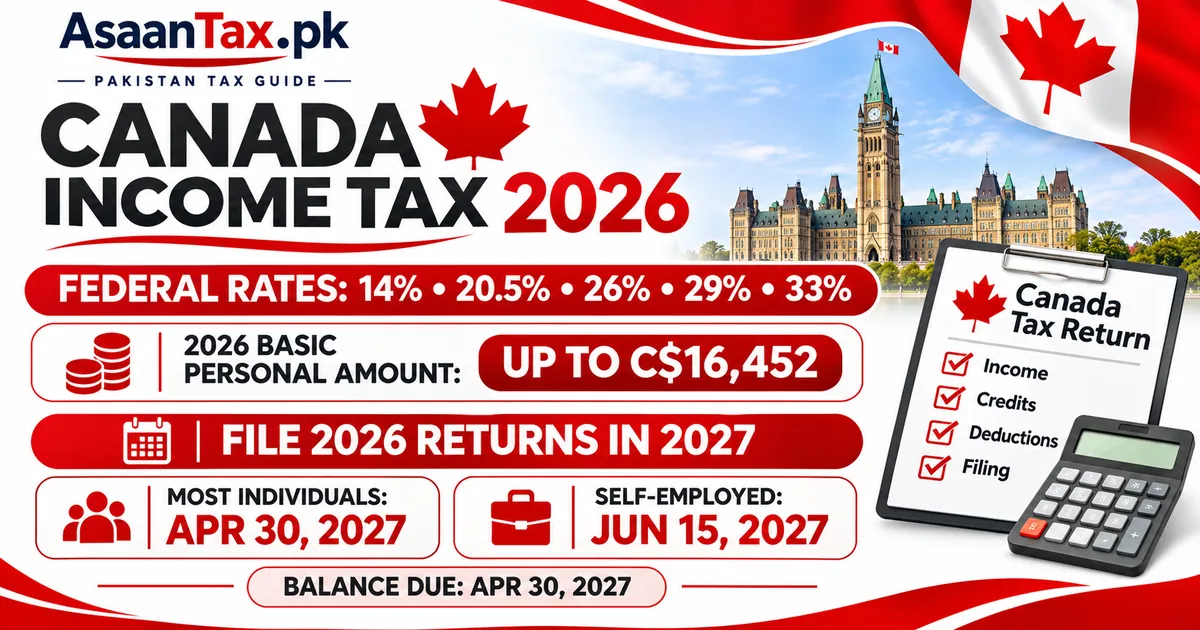
Standard Filing Deadline: April 30, 2027
Self-Employed Filing Deadline: June 15, 2027
Understanding Canada's latest income tax brackets is essential for employees, freelancers, self-employed individuals, business owners, families and newcomers to Canada.
For Tax Year 2026, Canada applies five federal personal income tax rates: 14%, 20.5%, 26%, 29% and 33%.
The lowest federal tax rate is 14%, applying to the first C$58,523 of taxable income. The highest rate of 33% applies to the portion exceeding C$258,482.
The maximum federal Basic Personal Amount for 2026 is C$16,452, although this amount is reduced for higher-income individuals.
Canadian taxpayers must also consider provincial or territorial income tax, federal and provincial tax credits, Canada Pension Plan (CPP) contributions, Employment Insurance (EI) premiums and other applicable obligations.
This comprehensive guide explains the 2026 federal tax brackets, Basic Personal Amount, non-refundable and refundable credits, salary examples, provincial tax rates, Self Assessment-style return preparation, CRA filing deadlines and tax considerations for overseas Pakistanis.
1. Canada Federal Income Tax Brackets for 2026
Canada operates a progressive income tax system.
This means each portion of taxable income is taxed at the rate assigned to its bracket.
Official CRA Federal Tax Rates
| Federal Taxable Income | Tax Rate |
|---|---|
| C$0 – C$58,523 | 14% |
| Over C$58,523 – C$117,045 | 20.5% |
| Over C$117,045 – C$181,440 | 26% |
| Over C$181,440 – C$258,482 | 29% |
| Over C$258,482 | 33% |
These rates apply to federal taxable income for the calendar year 2026.
They do not include provincial or territorial income tax.
Important Clarification
A taxpayer earning C$100,000 does not pay 20.5% on the entire amount.
Instead:
- The first C$58,523 is subject to 14%.
- The next portion is subject to 20.5%.
This is how progressive taxation works.
2. What Changed in Canada's Federal Income Tax Rates for 2026?
One of the most important changes is the reduction of the lowest federal marginal income tax rate.
In 2025, the lowest rate was reduced during the year, resulting in a blended annual rate of 14.5%.
For 2026, the lowest federal income tax rate is 14% for the full year.
Canada also increased the federal bracket thresholds through inflation indexation.
The CRA's published 2026 indexing factor is 2%.
Why Does Indexation Matter?
Indexation adjusts certain tax thresholds to reflect changes in consumer prices.
It can reduce the impact of inflation pushing taxpayers into higher tax brackets even when their purchasing power has not improved.
However, not all credits and provincial tax thresholds follow identical indexing rules.
3. Canada Basic Personal Amount for 2026
The Basic Personal Amount (BPA) is an important federal non-refundable income tax credit.
For 2026, the maximum federal BPA is C$16,452.
The minimum federal BPA for higher-income taxpayers is C$14,829.
| Federal Basic Personal Amount | 2026 Amount |
|---|---|
| Maximum BPA | C$16,452 |
| Minimum BPA | C$14,829 |
| Lowest Federal Credit Rate | 14% |
The maximum BPA generally applies to taxpayers whose net income does not exceed the relevant threshold at which the BPA phaseout begins.
For higher-income taxpayers, the BPA is gradually reduced until the minimum amount applies.
Is the BPA the Same as a Standard Deduction?
No.
Canada's BPA operates as a non-refundable tax credit rather than the same type of standard deduction used in the United States.
A tax deduction reduces taxable income.
A non-refundable tax credit generally reduces calculated income tax, subject to the credit rules.
Example
Assume an eligible taxpayer qualifies for the maximum BPA.
C$16,452 × 14% = C$2,303.28.
The illustrative federal tax credit associated with the maximum BPA is C$2,303.28.
This is not a guaranteed cash payment or refundable benefit.
4. How Does the Federal Basic Personal Amount Phase Out?
The maximum BPA is reduced for higher-income individuals.
For 2026, the federal brackets relevant to the phaseout are:
- Phaseout begins above C$181,440 of net income.
- Minimum BPA applies at C$258,482 or more of net income.
Between those amounts, the maximum BPA is progressively reduced.
The calculation uses the applicable statutory formula.
Important: The phaseout is based on the relevant net income measure and should not automatically be calculated from gross salary alone.
5. How to Calculate Federal Income Tax in Canada
Federal income tax is generally calculated by applying each marginal rate to the corresponding portion of taxable income.
Eligible tax credits are then considered.
Example: C$60,000 Taxable Income
Assume an individual has:
- Federal taxable income: C$60,000.
- Maximum federal BPA: C$16,452.
- No additional deductions or credits.
Step 1: Calculate tax within the first bracket.
C$58,523 × 14% = C$8,193.22.
Step 2: Apply the second bracket.
C$60,000 − C$58,523 = C$1,477.
C$1,477 × 20.5% = C$302.79.
Step 3: Calculate federal tax before credits.
C$8,193.22 + C$302.79 = approximately C$8,496.01.
Step 4: Apply the maximum federal BPA credit.
C$16,452 × 14% = C$2,303.28.
Illustrative federal income tax after the BPA credit: approximately C$6,192.73.
This example excludes other federal credits, provincial tax, CPP, EI and additional adjustments.
The actual return may produce a different amount.
6. Canada Income Tax Example: C$100,000
Assume a taxpayer has C$100,000 in federal taxable income.
The person qualifies for the maximum federal BPA and has no other adjustments for this simplified example.
Federal Tax Calculation
| Income Portion | Rate | Tax |
|---|---|---|
| First C$58,523 | 14% | C$8,193.22 |
| Remaining C$41,477 | 20.5% | C$8,502.79 |
| Federal Tax Before Credits | C$16,696.01 | |
| Maximum BPA Credit | −C$2,303.28 | |
| Illustrative Federal Tax | C$14,392.73 |
Estimated federal income tax after the BPA credit: approximately C$14,392.73.
This is not the total income tax bill because provincial or territorial tax must also be considered.
Other credits can change the final amount.
7. Canada Federal Income Tax vs Provincial Income Tax
Canada has both federal and provincial or territorial income taxation.
An individual's income tax liability generally includes:
Federal Income Tax + Applicable Provincial or Territorial Income Tax − Eligible Credits and Adjustments
The correct provincial or territorial rate structure normally depends on the individual's province or territory of residence on December 31 of the tax year.
Example: Ontario Resident
An Ontario resident calculates federal income tax using the federal brackets.
The taxpayer must also calculate Ontario income tax using the relevant Ontario brackets and credits.
Example: Alberta Resident
An Alberta resident uses the federal income tax structure together with Alberta's separate rates.
The final income tax result may differ from a person with identical income living in Ontario.
8. Provincial Income Tax Rates in Canada for 2026
Different Canadian provinces have their own tax brackets.
The following table shows the lowest ordinary provincial rates for 2026.
| Province | Lowest Provincial Rate |
|---|---|
| Alberta | 8% |
| British Columbia | 5.6% |
| Manitoba | 10.8% |
| New Brunswick | 9.4% |
| Newfoundland and Labrador | 8.7% |
| Nova Scotia | 8.79% |
| Ontario | 5.05% |
| Prince Edward Island | 9.5% |
| Saskatchewan | 10.5% |
Quebec administers its own provincial income tax system through Revenu Québec.
The territories also have distinct tax brackets.
Important: These figures are the lowest provincial rates, not the total tax rates or complete provincial schedules. Provincial surtaxes, credits, and higher brackets may affect the final calculation.
9. Ontario Income Tax Brackets for 2026
Ontario uses the following ordinary provincial income tax brackets:
| Taxable Income | Ontario Rate |
|---|---|
| Up to C$53,891 | 5.05% |
| Over C$53,891 – C$107,785 | 9.15% |
| Over C$107,785 – C$150,000 | 11.16% |
| Over C$150,000 – C$220,000 | 12.16% |
| Above C$220,000 | 13.16% |
Ontario residents must also consider relevant provincial credits, surtaxes and the Ontario Health Premium where applicable.
Therefore, adding the lowest Ontario rate to the federal rate does not always provide the final tax amount.
10. Alberta Income Tax Brackets for 2026
For 2026, Alberta's ordinary provincial income tax brackets are:
| Taxable Income | Alberta Rate |
|---|---|
| Up to C$61,200 | 8% |
| Over C$61,200 – C$154,259 | 10% |
| Over C$154,259 – C$185,111 | 12% |
| Over C$185,111 – C$246,813 | 13% |
| Over C$246,813 – C$370,220 | 14% |
| Above C$370,220 | 15% |
Alberta also provides its own provincial tax credits and Basic Personal Amount rules.
Taxpayers should use the CRA's current provincial tables rather than assuming all provinces have the same tax treatment.
11. Canada Employment Amount for 2026
The Canada Employment Amount is a federal non-refundable tax credit for eligible employment income.
The maximum employment amount for 2026 is C$1,501.
The amount claimed is generally limited to the lesser of:
- C$1,501; or
- The individual's qualifying employment income for the year.
At the lowest federal rate of 14%, the maximum corresponding federal credit is approximately C$210.14.
This credit may reduce federal income tax for eligible employees.
Pension income does not automatically qualify as employment income for this credit.
12. Major Federal Tax Credits in Canada
Tax credits can reduce an individual's calculated federal tax or provide benefits depending on the specific program.
Basic Personal Amount
Available to eligible individuals, subject to the income-dependent amount.
Canada Employment Amount
Available to eligible employees with qualifying employment income.
Age Amount
Certain taxpayers aged 65 or older may qualify for an age-related non-refundable credit, subject to applicable income limits.
Disability Tax Credit
Eligible individuals with qualifying impairments may receive tax relief under the relevant certification and eligibility rules.
Eligible Medical Expenses
Taxpayers may claim qualifying medical expenses according to statutory rules and thresholds.
Charitable Donations
Eligible donations to qualified recipients may generate tax credits.
Eligible Dependants and Caregivers
Certain family circumstances may qualify for additional non-refundable credits.
These credits have different requirements and should not be treated as automatic deductions for every taxpayer.
13. Refundable Credits vs Non-Refundable Credits
Canada distinguishes between refundable and non-refundable tax credits.
Non-Refundable Tax Credit
A non-refundable credit can reduce the amount of income tax payable, generally only to zero.
It does not ordinarily create a refund beyond the relevant tax liability.
Refundable Credit or Benefit
A refundable credit or benefit can potentially produce a payment even when little or no income tax is payable, subject to eligibility.
Examples of Federal Benefits and Credits
Depending on current program rules, eligible Canadians may qualify for:
- Canada Child Benefit.
- Canada Workers Benefit.
- Relevant GST/HST-related benefit programs.
- Other refundable federal or provincial programs.
Program names, amounts and eligibility conditions may change.
The applicable rules should be checked for the specific benefit year.
14. RRSP Contributions and Income Tax Deductions
A Registered Retirement Savings Plan (RRSP) can provide eligible Canadian taxpayers with income tax deductions.
Contributions may reduce taxable income, subject to available deduction room and other requirements.
Example
Assume a taxpayer has:
- Income before RRSP deduction: C$80,000.
- Eligible RRSP deduction: C$5,000.
The simplified taxable income may decrease to C$75,000, assuming no other adjustments.
This can reduce income subject to the relevant marginal tax rates.
However, the contribution itself is not automatically an allowable deduction if it exceeds the individual's permitted room or fails other legal requirements.
Taxpayers should review their available RRSP deduction limit in CRA records.
15. TFSA vs RRSP: Important Tax Differences
A Tax-Free Savings Account (TFSA) and an RRSP have different tax consequences.
| Feature | TFSA | RRSP |
|---|---|---|
| Contributions | Generally not deductible | May be deductible |
| Eligible Investment Growth | Generally tax-free | Generally tax-deferred |
| Withdrawals | Generally tax-free | Generally taxable |
| Contribution Limits | Applicable TFSA room | Applicable RRSP deduction room |
Investment income earned in eligible accounts can receive different treatment from ordinary taxable investment income.
Taxpayers should check contribution limits and avoid excess contributions.
16. Are Capital Gains Taxed at the Same Rates as Salary?
Capital gains are not necessarily included in taxable income in the same manner as salary.
Canada's capital gains rules determine how much of a realized gain is included in taxable income.
The applicable inclusion rate and specific exemptions depend on current legislation and the type of transaction.
Example
Suppose an investor sells an eligible capital asset for more than its adjusted cost base.
The investor must calculate the realized capital gain and apply the relevant inclusion rules.
Only the applicable taxable portion is included in income.
It is then subject to the relevant tax calculation, unless a specific exemption or other provision applies.
Capital gains, employment income and dividends should not be treated as identical categories.
17. How Are Canadian Dividends Taxed?
Canadian dividends can receive different tax treatment depending on whether they qualify as eligible or non-eligible dividends.
The Canadian system generally uses dividend gross-up and dividend tax credit mechanisms.
The calculation may involve both federal and provincial dividend tax credits.
Foreign dividends generally follow different rules.
Important
A taxpayer should not simply apply the 14% federal bracket rate directly to the cash amount of every dividend without considering the applicable rules.
Tax slips and the correct dividend classification are important.
18. CPP and EI Are Separate From Federal Income Tax
Employees may have payroll deductions for the Canada Pension Plan and Employment Insurance.
Canada Pension Plan
CPP contributions support qualifying pension and related benefits.
Depending on the taxpayer's employment and province, CPP or the Quebec Pension Plan may apply.
Employment Insurance
EI premiums fund eligible employment insurance benefits.
These payroll deductions are separate from federal and provincial income tax.
Therefore, a federal income tax estimate alone does not determine the employee's final take-home salary.
Self-employed individuals may have different CPP obligations from employees.
19. Do Freelancers Pay Canadian Income Tax?
Self-employed individuals generally report taxable business income and calculate income tax using the applicable federal and provincial rules.
Freelancers may include:
- Software developers.
- Graphic designers.
- Consultants.
- Marketing professionals.
- Writers.
- Independent contractors.
- E-commerce operators.
- Other qualifying self-employed workers.
Example
A freelancer earns:
- Annual business revenue: C$90,000.
- Eligible business expenses: C$25,000.
Simplified net business income:
C$90,000 − C$25,000 = C$65,000.
The taxpayer must then determine the relevant taxable income and apply the income tax rules.
Self-employed CPP contributions and other obligations may also arise.
GST/HST Considerations
GST/HST registration is separate from personal income tax.
Depending on taxable supplies and the applicable small-supplier rules, a freelancer may also need to register for GST/HST.
20. When Must Canadian Income Tax Returns Be Filed for 2026?
Canadian personal income tax returns normally cover the calendar year.
For income earned between January 1 and December 31, 2026, the return is generally filed in 2027.
CRA Filing Deadlines for 2026 Income
| Requirement | Standard Deadline |
|---|---|
| Tax Year Ends | December 31, 2026 |
| Most Individuals — Filing | April 30, 2027 |
| Self-Employed Individuals — Filing | June 15, 2027 |
| Balance Owing — Payment | April 30, 2027 |
The self-employed filing deadline generally also applies where a spouse or common-law partner carried on a business, subject to specific exceptions.
Important
The extended self-employed filing deadline does not automatically extend the payment deadline.
A self-employed taxpayer may need to pay any balance owing by April 30, 2027, even where the return is due June 15.
Special rules can apply to deceased taxpayers, some non-residents and other circumstances.
21. How to File a Canadian Income Tax Return Online
The CRA provides electronic filing services for eligible taxpayers.
Step 1: Open the CRA Website
Visit:
https://www.canada.ca/en/revenue-agency.html
Step 2: Access Your CRA Account
Review available account information, tax slips and relevant details.
Step 3: Collect Tax Documents
Gather T4 slips, investment statements, self-employment records and other relevant documents.
Step 4: Determine Tax Residency
Confirm whether the individual is resident or non-resident for Canadian tax purposes.
Step 5: Report All Required Income
Include employment, self-employment, rental, investment and other reportable income.
Step 6: Claim Eligible Deductions
Review RRSP deductions, eligible expenses and other statutory deductions.
Step 7: Claim Tax Credits
Apply the relevant federal and provincial tax credits.
Step 8: Calculate Taxes
Calculate federal and provincial or territorial tax.
Step 9: Submit Through a Supported Method
Eligible taxpayers can use NETFILE-certified software to file electronically.
Step 10: Save the Confirmation
Retain the filing confirmation and supporting documents.
Taxpayers should verify the submission rather than assuming a saved draft has been filed.
22. Documents Needed for Canada Tax Filing
Common supporting documents include:
- Social Insurance Number and relevant identification.
- T4 employment slips.
- T4A and other applicable information slips.
- T5 investment income slips.
- Relevant T3 slips.
- RRSP contribution receipts.
- Business income and expense records.
- Rental income statements.
- Charitable donation receipts.
- Eligible medical expense records.
- Tuition and education documentation.
- Capital gain transaction statements.
- Foreign income records where required.
- Previous CRA Notices of Assessment.
Not every document applies to every taxpayer.
23. Do Newcomers to Canada Pay Tax on Worldwide Income?
A person who becomes a Canadian tax resident may generally become taxable on worldwide income for the relevant period of residence, subject to applicable rules.
Canadian residency for tax purposes is not determined solely by nationality, immigration status or possession of a Canadian passport.
The CRA considers residential ties and other relevant circumstances.
Important Factors
- Residential ties in Canada.
- Presence in Canada.
- Family relationships and residential arrangements.
- Provincial residence.
- Residence in another country.
- Applicable tax treaty provisions.
A newcomer may have special first-year reporting considerations.
Income earned before becoming resident may receive different treatment from income earned after Canadian tax residency begins.
24. Income Tax for Overseas Pakistanis in Canada
Pakistani citizens living in Canada may be required to pay Canadian income tax if they are Canadian tax residents or earn taxable Canadian-source income.
The correct treatment depends on residency and source of income.
Potential situations include:
- Employment in Canada.
- Canadian business income.
- Rental property in Pakistan.
- Foreign bank interest.
- Pakistani dividends.
- Capital gains from overseas investments.
- Other international income sources.
Canada–Pakistan Tax Treaty
Canada and Pakistan have a tax treaty intended to address certain double-taxation issues.
The availability of treaty benefits depends on the type of income, residence and specific treaty provisions.
A taxpayer should not assume that paying tax in Pakistan automatically removes all Canadian reporting requirements.
Foreign tax credits may be available where the statutory conditions are satisfied.
25. Foreign Assets and Reporting Requirements
Certain Canadian tax residents with specified foreign property may need to file Form T1135.
Generally, the foreign property reporting threshold considers whether the total cost amount of specified foreign property exceeded C$100,000 at any time during the year.
This is a reporting threshold rather than a blanket tax-free limit.
Important
The T1135 rules contain exclusions and detailed requirements.
Not every foreign asset is reportable, and reporting does not mean the full value of the foreign asset is taxed.
Canadian residents should also consider their ordinary foreign income reporting obligations.
26. What Happens If You File Your Canadian Tax Return Late?
Late filing may result in penalties when tax remains owing.
For a typical late-filed return with a balance owing, the CRA's general late-filing penalty is:
5% of the balance owing, plus 1% for each full month late, up to 12 months.
Different and more severe penalties may apply to repeat late filing under the relevant conditions.
Interest can also apply to unpaid balances.
Example
Assume:
- Tax owing: C$2,000.
- Return filed two full months late.
- General late-filing penalty applies.
Initial 5%:
C$100.
Additional 2%:
C$40.
Illustrative late-filing penalty:
C$140, excluding applicable interest.
A taxpayer who expects a balance owing should avoid missing the filing and payment deadlines.
27. Common Canada Income Tax Mistakes
- Using outdated 2025 brackets for the 2026 tax year.
- Applying 14% to all income regardless of higher brackets.
- Ignoring provincial or territorial income tax.
- Treating the BPA as a refundable cash payment.
- Assuming the maximum BPA applies at every income level.
- Forgetting employment-related tax credits.
- Confusing CPP and EI with income tax.
- Applying US federal tax rules to Canadian income.
- Treating all dividends and capital gains like salary income.
- Claiming unsupported deductions.
- Ignoring foreign income reporting.
- Failing to report relevant foreign assets.
- Missing CRA filing deadlines.
- Assuming self-employed taxpayers can delay payment until June 15.
- Failing to retain tax documents and receipts.
28. Final Canada Income Tax Checklist for 2026
Before filing, verify:
- Tax Year 2026 is selected.
- Correct federal income tax brackets.
- Correct province or territory of residence.
- Relevant taxable income.
- Basic Personal Amount eligibility.
- Canada Employment Amount.
- CPP and EI contributions.
- Eligible deductions and tax credits.
- RRSP deduction room.
- Employment and self-employment income.
- Investment and rental income.
- Capital gains and dividend treatment.
- Foreign income.
- T1135 reporting requirements, where applicable.
- Tax already deducted or paid.
- April 30, 2027 filing or payment deadline.
- June 15, 2027 self-employed filing deadline, where applicable.
- Return submission confirmation.
29. Watch Tax With Naeem — Income Tax Return Education
For general educational guidance on income tax return filing, salary income, rental income, capital gains and dividends, watch the following related video from Tax With Naeem.
Related Video: Income Tax Return Filing in Pakistan — Salary, Rental Income, Capital Gains and Dividends Explained
https://www.youtube.com/watch?v=VX88o1N1AfA
This video explains Pakistan's income tax system rather than the Canadian CRA system.
It is included as supplementary tax education. Canadian taxpayers should rely on official CRA guidance and the relevant Canadian tax legislation for calculations and return filing.
30. Official CRA Sources and References
1. Canada Revenue Agency — Current Federal and Provincial Tax Brackets
2. CRA — Personal Income Tax Rates and Brackets
https://www.canada.ca/en/revenue-agency/services/tax/individuals/tax-rates-brackets.html
3. CRA — 2026 Payroll Deductions Tables and Personal Amounts
4. CRA — Personal Income Tax Due Dates
5. CRA — 2027 Deadlines for Canadian Businesses and Self-Employed Taxpayers
6. CRA — Filing an Individual Income Tax Return
https://www.canada.ca/en/services/taxes/income-tax/personal-income-tax.html
7. CRA — NETFILE
8. CRA — Foreign Income and Form T1135
https://www.canada.ca/en/revenue-agency/services/forms-publications/forms/t1135.html
9. AsaanTax.pk — International Taxation Guides
10. Tax With Naeem — Related Tax Tutorial
https://www.youtube.com/watch?v=VX88o1N1AfA
31. Conclusion: What Are Canada's Income Tax Brackets for 2026?
Canada's federal income tax system uses five progressive rates for 2026: 14%, 20.5%, 26%, 29% and 33%.
The lowest rate of 14% applies to the first C$58,523 of federal taxable income, while the highest rate of 33% applies to the portion exceeding C$258,482.
The maximum federal Basic Personal Amount is C$16,452, with a reduced amount for higher-income taxpayers.
However, federal income tax is only part of the calculation. Provincial or territorial taxes, tax credits, CPP, EI and other obligations can significantly affect a taxpayer's final liability.
For most individuals, the 2026 income tax return must be filed by April 30, 2027. Eligible self-employed taxpayers generally have until June 15, 2027 to file, but the ordinary balance owing remains due April 30.
The most important rule is to calculate federal tax progressively, apply eligible credits, and include the correct provincial or territorial tax.
For more professional international tax guides covering Canada, the United States, the United Kingdom, the UAE, Saudi Arabia, India and Pakistan, visit AsaanTax.pk.
Editorial Note: This article reflects CRA information available as of November 10, 2026. The figures relate to income earned during calendar year 2026, with returns generally filed in 2027.
Disclaimer: This guide is for general educational purposes and does not constitute personalized Canadian tax advice. Tax obligations depend on residency, province, income type, eligible deductions, credits and applicable law. Readers should consult the CRA or a qualified Canadian tax professional for individual circumstances.