Brazil Tax Reform 2026: CBS and IBS Test Year, 11.3% CBS Reference Rate for 2027
Published: November 12, 2026
Country: Brazil
Tax Authorities: Receita Federal do Brasil (RFB), Federal Senate and IBS Management Committee
Key Legislation: Constitutional Amendment 132/2023; Complementary Laws 214/2025 and 227/2026
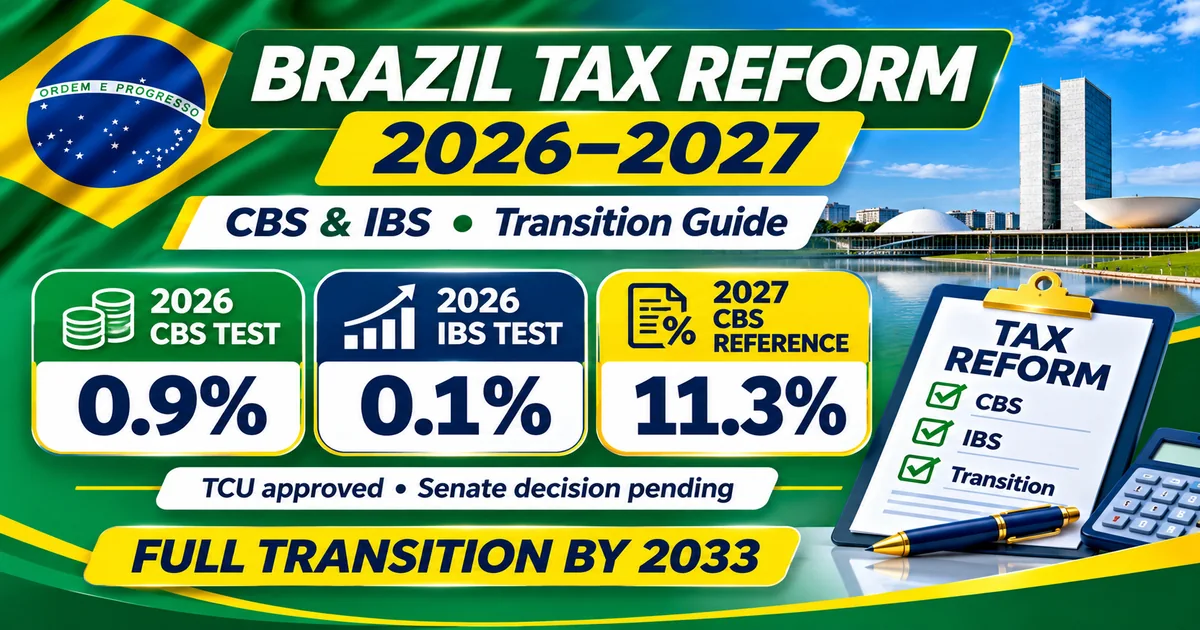
2026 Test Rates: CBS 0.9% and IBS 0.1%
2027 CBS Reference Rate: 11.3%, approved by the TCU and awaiting final Senate action
Full Transition: 2033
Introduction: Brazil's Major Consumption Tax Reform
Brazil is undergoing one of the most significant reforms of its consumption tax system in decades.
The reform replaces several complex federal, state and municipal taxes with a new dual Value Added Tax (VAT) framework designed to simplify compliance, improve transparency and reduce the cumulative taxation of business transactions.
The two main taxes are:
- CBS — Contribuição sobre Bens e Serviços: A federal contribution on goods and services.
- IBS — Imposto sobre Bens e Serviços: A tax on goods and services administered within the state and municipal framework.
Brazil also introduces a separate Selective Tax, known as Imposto Seletivo (IS), for specified goods and activities.
The year 2026 is the testing and adaptation phase.
During this period, the CBS test rate is 0.9%, while IBS is tested at 0.1%.
A significant development occurred on October 28, 2026, when Brazil's Federal Court of Accounts, the Tribunal de Contas da União (TCU), approved an 11.3% CBS reference rate for 2027.
The rate was calculated at 11.3468% before the statutory rounding.
However, the Federal Senate must still complete its role in formally establishing the reference rate.
This article explains what businesses need to know about Brazil's 2026 tax reform, the 11.3% reference rate, new invoicing obligations, the transition schedule, tax credits and how the changes may affect international businesses.
1. What Is Brazil's New CBS Tax?
CBS stands for Contribuição sobre Bens e Serviços, or Contribution on Goods and Services.
It is the new federal consumption tax created under Brazil's tax reform.
CBS is intended to replace the existing federal PIS/Pasep and Cofins contributions under the transition timetable.
The tax follows a VAT-style framework with rules for:
- Taxable supplies of goods and services.
- Input tax credits.
- Business-to-business transactions.
- Imports and exports.
- Special treatment for qualifying sectors.
- Electronic invoice reporting.
- Tax settlement and compliance.
The aim is to make taxation more transparent and reduce distortions caused by the previous system.
2. What Is IBS?
IBS stands for Imposto sobre Bens e Serviços, or Tax on Goods and Services.
It is the other major component of Brazil's dual VAT model.
IBS is intended to gradually replace:
- ICMS — the state-level tax on goods and certain services.
- ISS — the municipal tax on services.
IBS and CBS are designed to work under broadly coordinated consumption-tax principles, although they have separate administration and revenue allocation arrangements.
The reform uses a gradual transition so that state and municipal governments can adjust to the new system.
3. Brazil's CBS and IBS Test Rates for 2026
The official 2026 test rates are:
| Tax | 2026 Test Rate | Level |
|---|---|---|
| CBS | 0.9% | Federal |
| IBS | 0.1% | State and municipal framework |
| Combined Test Rates | 1.0% | Before special treatment |
These are transitional testing rates.
They are not the permanent combined VAT rate that will apply when the new tax system reaches full operation.
Important Clarification
During 2026, taxpayers complying with the applicable electronic invoice and other reporting obligations can qualify for relief from the actual collection of the CBS and IBS test amounts.
The official framework also addresses the offsetting of relevant amounts against existing federal taxes where applicable.
Therefore, it would be incorrect to tell every company that it must simply pay an additional 1% tax on all sales during 2026.
4. What Happened on October 28, 2026?
On October 28, 2026, the TCU approved the calculation of the proposed CBS reference rate for 2027.
Official Calculation
| Item | Figure |
|---|---|
| Technical Calculated Rate | 11.3468% |
| Rounded Reference Rate | 11.3% |
| TCU Decision Date | October 28, 2026 |
| Decision Number | Acórdão 2933/2026 |
| Formal Transmission to Senate | November 10, 2026 |
| Senate Deadline | December 15, 2026 |
| Planned CBS Full-Rate Start | January 1, 2027 |
The 11.3% figure reflects the reference-rate calculation required by the reform framework.
It is intended to support revenue neutrality as the existing federal consumption taxes are replaced.
The rate is not simply a discretionary increase announced without a calculation.
5. Is the 11.3% CBS Rate Finally Confirmed?
Not yet as a final Senate-established rate, as of November 12, 2026.
This distinction is essential.
The TCU has approved the technical reference calculation, and the Federal Senate has received the decision.
However, the Federal Senate is responsible for fixing the reference rate through the relevant resolution.
The Senate has until December 15, 2026.
If it does not issue the resolution by the deadline, the TCU-calculated rate applies provisionally under the applicable legal framework.
What Businesses Should Do
Companies should prepare their systems for an 11.3% reference scenario while monitoring the final Senate resolution and tax authority instructions.
They should not hard-code an unqualified statement that the final 2027 rate has already been conclusively enacted.
6. Why Is the 2027 CBS Reference Rate 11.3%?
Brazil's reform is designed to replace existing consumption taxes while broadly maintaining the intended level of public revenue.
The TCU reviewed the calculations and methodology prepared for the new federal tax.
The reference rate reflects revenue requirements under the statutory model, including the interaction of:
- The existing federal tax revenue base.
- The economic value of taxable consumption.
- Available deductions and credits.
- Special tax regimes.
- Reduced rates and exemptions.
- Tax administration considerations.
A single rate is not sufficient to determine the final tax burden of every business.
A company supplying products under a special reduced-rate regime may have different results from a company supplying fully standard-rated services.
7. How Does CBS Replace PIS and Cofins?
Under the reform timetable, the CBS begins operating at the full applicable framework in 2027.
The existing PIS/Pasep and Cofins contributions are scheduled to be extinguished as part of that transition.
Comparison
| Current Framework | Reform Framework |
|---|---|
| PIS/Pasep | Replaced by CBS |
| Cofins | Replaced by CBS |
| Multiple cumulative and non-cumulative arrangements | New VAT-style credit framework |
| Various reporting and calculation methods | Updated electronic documentation and reporting rules |
The purpose is to reduce complexity and provide greater consistency across the taxation of goods and services.
However, the implementation does not mean that every sector will automatically receive the same effective tax outcome.
8. What Happens to ICMS and ISS?
ICMS and ISS will be replaced gradually through the IBS transition.
Transition Schedule
| Year | Transition Arrangement |
|---|---|
| 2026 | CBS and IBS testing |
| 2027 | Full CBS implementation; transitional IBS |
| 2028 | Continuation of initial IBS transition |
| 2029 | IBS replaces 10% of the relevant ICMS/ISS component |
| 2030 | IBS replaces 20% |
| 2031 | IBS replaces 30% |
| 2032 | IBS replaces 40% |
| 2033 | Full IBS implementation; end of the old ICMS/ISS system |
These percentages describe the transition structure, not ordinary IBS tax rates charged directly to customers.
The objective is to avoid an immediate nationwide replacement of state and municipal tax systems.
9. What Is the IBS Rate in 2027 and 2028?
The transitional IBS rate for 2027 and 2028 is 0.1%, generally allocated between the state and municipal components under the relevant provisions.
| IBS Component | Transitional Rate |
|---|---|
| State Component | 0.05% |
| Municipal Component | 0.05% |
| Total IBS | 0.10% |
The reform contains an associated mechanism affecting the CBS rate during the transition.
Taxpayers should not simply assume that the final customer-facing rate for every transaction is 11.3% plus 0.1% without considering the legally prescribed rates, reductions, credits and transaction classification.
10. Brazil's Tax Reform Timeline: 2026 to 2033
2026 — Testing and Adaptation
CBS is tested at 0.9% and IBS at 0.1%.
Businesses adapt electronic invoices, accounting systems and tax reporting.
2027 — CBS Takes Effect
The new CBS becomes operational under the full-rate framework.
PIS/Pasep and Cofins are phased out under the legislated timetable.
The Selective Tax also begins applying to specified activities.
2028 — Continued Transitional Operation
CBS continues and IBS remains at the initial transitional level.
Businesses continue updating tax systems and compliance processes.
2029–2032 — Gradual IBS Implementation
IBS progressively replaces the existing ICMS and ISS components.
2033 — Full Reform
The dual VAT structure is intended to become fully implemented.
The transition represents a multi-year transformation rather than a single tax-rate change.
11. How Do Electronic Invoices Change?
One of the most immediate effects of the 2026 reform concerns electronic invoicing.
Brazil's tax authorities require relevant taxpayers to include CBS and IBS information in electronic tax documents, subject to applicable technical specifications and transition relief.
Depending on the business, relevant documents can include:
- NF-e — electronic goods invoices.
- NFC-e — electronic consumer invoices.
- NFS-e — electronic service invoices.
- Other relevant fiscal documents.
- Specific-regime reporting declarations where required.
The precise technical obligations depend on the document category and published layouts.
Important
Businesses should follow the latest Receita Federal, IBS Management Committee and electronic invoice technical notes.
The 2026 test year includes transitional relief provisions, but this should not be interpreted as permanent permission to ignore the new fields.
12. Can Businesses Avoid Paying the Test Taxes in 2026?
Brazil's official joint communication provides relief from collection of the CBS and IBS test amounts for taxpayers who comply with the applicable accessory obligations.
It also addresses situations where no relevant accessory obligation has yet been established.
Example
A company issues electronic invoices using the technical specifications required for its transactions.
Where the statutory conditions for the testing period are satisfied, the company may qualify for the dispensation of collecting CBS and IBS during 2026.
The existing taxes continue to operate under the applicable transition rules.
This is why the testing year must not be presented as a universal additional 1% tax burden.
13. CBS Calculation Example on BRL 100,000
The following is an illustrative calculation using the approved TCU reference rate.
Assume a fully taxable transaction with a simplified CBS tax base of BRL 100,000.
Illustrative CBS at 11.3%:
BRL 100,000 × 11.3% = BRL 11,300.
| Description | Amount |
|---|---|
| Assumed CBS Tax Base | BRL 100,000 |
| Illustrative Reference Rate | 11.3% |
| Gross Calculated CBS | BRL 11,300 |
Important: This is a reference-rate illustration, not a definitive invoice calculation for January 2027.
The final Senate rate, specific taxable base, credits, exemptions and other statutory adjustments can affect the amount actually due.
14. What Is the Difference Between Gross Tax and Net VAT Liability?
A VAT-style system generally permits eligible input tax credits.
This helps reduce cumulative tax on successive stages of production and distribution.
Simplified Example
Assume a business has:
- Output CBS before credits: BRL 11,300.
- Eligible input CBS credits: BRL 4,000.
Illustrative net liability:
BRL 11,300 − BRL 4,000 = BRL 7,300.
This is a simplified example and does not determine the legally available credit or final tax for an actual transaction.
Credit eligibility and timing depend on the applicable law.
The essential point is that gross CBS shown on sales is not necessarily identical to the business's final net CBS liability.
15. What Is Non-Cumulative VAT?
A non-cumulative VAT framework generally allows eligible taxes paid on business purchases to be credited against taxes charged on sales.
Simplified Business Chain
A manufacturer sells goods to a distributor.
The distributor sells the goods to a retailer.
The retailer sells to the final consumer.
Under a properly functioning credit system, eligible businesses may deduct relevant input taxes, helping prevent the same value added from being taxed repeatedly without relief.
However, the actual treatment depends on the transaction, the legal eligibility of credits and special regimes.
16. Will All Products and Services Pay the Same Rate?
No.
Brazil's new tax framework contains differentiated treatments for various goods, services and activities.
Depending on the legislation, certain sectors can qualify for:
- Reduced rates.
- Zero-rating.
- Specific tax regimes.
- Special credit mechanisms.
- Other statutory relief.
Businesses should therefore classify their goods and services carefully.
Examples of Areas Requiring Special Review
- Healthcare.
- Education.
- Essential food products.
- Agriculture and food supply.
- Financial services.
- Real estate.
- Fuel.
- International trade.
- Specially regulated services.
A headline CBS reference rate should not be treated as the effective rate on every sale.
17. What Is Brazil's Selective Tax?
Brazil's reform also creates the Imposto Seletivo, or Selective Tax.
It is a separate federal tax intended to discourage consumption of specified goods and services considered harmful to health or the environment.
The Selective Tax is scheduled to begin in 2027.
The precise taxable categories, rates and calculation rules are governed by the applicable legislation.
Important
The Selective Tax is not the same as CBS or IBS.
Businesses must determine separately whether a particular product or activity falls within its scope.
18. Does the Reform Change Corporate Income Tax?
CBS and IBS are primarily consumption taxes.
They should not be confused with ordinary corporate income taxes on business profits.
Brazil continues to have separate taxation of corporate income, including relevant IRPJ and CSLL rules.
Difference
Consumption Taxes: Generally concern taxable supplies of goods and services.
Corporate Income Taxes: Generally concern taxable business profits.
The introduction of CBS and IBS does not mean every Brazilian company's profits will automatically be taxed at 11.3%.
19. How Could the Reform Affect Small Businesses?
Small businesses may face different practical effects depending on their registration and tax regime.
For example, companies using Simples Nacional have particular rules that need to be reviewed separately.
The reform can affect:
- Electronic invoicing.
- Tax classifications.
- Customer invoicing.
- Purchase credits.
- Accounting software.
- Supplier contracts.
- Business pricing.
- Tax compliance documentation.
The appropriate treatment should be evaluated according to the company's actual tax regime.
20. How Could the Reform Affect Freelancers and Service Providers?
Independent professionals and service businesses may need to update their accounting and invoicing arrangements.
Examples include:
- Software developers.
- Marketing agencies.
- Consultants.
- Designers.
- IT service companies.
- Engineering businesses.
- Other service providers.
The result depends on the provider's legal structure, registration status, tax classification and eligibility for special regimes.
A freelancer should not assume the 11.3% reference rate is automatically a flat income tax on personal earnings.
CBS is a consumption-tax measure, not the ordinary progressive personal income tax.
21. What About Foreign Companies Selling to Brazil?
Foreign suppliers and international digital platforms should review whether transactions are within Brazil's new tax rules.
Potentially relevant activities include:
- Cross-border digital services.
- Software subscriptions.
- Online platforms.
- E-commerce.
- Imported goods.
- International professional services.
- Other supplies to Brazilian customers.
The applicable treatment can depend on the nature of the service, contractual parties, import rules and collection mechanisms.
Foreign businesses should obtain advice before treating every transaction as taxable under the same standard rate.
22. Will the Reform Affect Consumer Prices?
The effect on consumer prices is not determined simply by comparing the new CBS reference rate with a previously advertised tax percentage.
Final prices can depend on:
- Effective tax credits.
- Previous cumulative taxes.
- Sector-specific exemptions.
- Input costs.
- Competition.
- Supplier pricing decisions.
- Business margins.
- Other applicable taxes.
Some industries may experience lower effective tax costs, while others may experience increases.
The outcome will vary depending on the business model and applicable rates.
23. What Should Companies Do Before January 2027?
Businesses should prepare operationally rather than waiting until the final day.
Step 1: Review Tax Registration
Confirm the company's current Brazilian tax registrations and applicable tax regime.
Step 2: Update ERP and Accounting Systems
Ensure software can process CBS and IBS separately.
Step 3: Review Invoice Layouts
Use the latest electronic invoice technical specifications.
Step 4: Classify Products and Services
Identify applicable normal, reduced or special tax treatments.
Step 5: Review Input Credits
Determine eligible credit processes under the new law.
Step 6: Prepare for the Senate Decision
Monitor the final CBS reference-rate resolution.
Step 7: Review Contracts
Examine tax clauses, pricing provisions and long-term commercial agreements.
Step 8: Train Finance Teams
Ensure employees understand the transition between the old and new systems.
Step 9: Test Tax Calculations
Perform simulations before the new collection phase begins.
Step 10: Monitor Official Notices
Track Receita Federal, the Senate and IBS Management Committee announcements.
24. Common Brazil Tax Reform Mistakes to Avoid
- Treating the 11.3% TCU reference rate as a final Senate resolution.
- Assuming the 2026 test rates are permanent VAT rates.
- Believing every business must pay an additional 1% during 2026.
- Confusing CBS with corporate income tax.
- Confusing IBS with personal income tax.
- Assuming PIS and Cofins continue unchanged after the 2027 transition.
- Ignoring electronic invoice specifications.
- Using outdated invoicing software.
- Assuming every product is taxable at the headline rate.
- Forgetting the relevant input tax credit rules.
- Treating Simples Nacional businesses exactly like every other company.
- Confusing transitional IBS percentages with final tax rates.
- Assuming the reform is fully implemented in 2027.
- Ignoring the 2033 full-transition deadline.
- Using unverified rate announcements rather than official publications.
25. Brazil Tax Reform Compliance Checklist
Before January 2027, review:
- CBS and IBS registration requirements.
- 2026 testing rules.
- Electronic invoice compliance.
- Current technical notes.
- Relevant business tax regime.
- Product and service classifications.
- Potential reduced-rate treatment.
- Input tax credit eligibility.
- Existing PIS/Cofins obligations.
- Current ICMS/ISS obligations.
- TCU-approved CBS reference rate.
- Final Senate resolution when issued.
- ERP tax configuration.
- Customer contract tax clauses.
- Supplier invoice details.
- Accounting staff training.
- 2027 operational readiness.
- Full transition timetable through 2033.
26. Watch Tax With Naeem — Related Tax Education
For general educational guidance about taxation, business income, salary, rental income and income tax return filing, watch the following related tutorial from Tax With Naeem.
Related Video: Income Tax Return Filing in Pakistan — Salary, Rental Income, Capital Gains and Dividends Explained
https://www.youtube.com/watch?v=VX88o1N1AfA
This video explains Pakistan's income tax filing system. It is included as supplementary tax education.
Important: It does not explain the Brazilian CBS or IBS legislation.
For Brazil's consumption tax reform, businesses should rely on official Receita Federal, TCU and Senate guidance.
27. Official Sources and References
1. Receita Federal — Understanding Brazil's Consumption Tax Reform
2. Receita Federal — Reform Legislation
3. TCU — 11.3% CBS Reference Rate Approved on October 28, 2026
4. TCU — Reference-Rate Decision Delivered to the Senate on November 10, 2026
5. Brazilian Senate — CBS 2027 Rate and Legislative Procedure
6. Receita Federal and IBS Management Committee — Joint Guidance
https://www.gov.br/receitafederal/pt-br/assuntos/noticias/2025/dezembro/comunicado-conjunto
7. Brazilian Ministry of Finance — Tax Reform Questions and Answers
8. TCU — Technical CBS Rate Calculation
https://sites.tcu.gov.br/reforma-tributaria/visao-cbs-2027.html
9. AsaanTax.pk — International Tax Guides
10. Tax With Naeem — Related Educational Video
https://www.youtube.com/watch?v=VX88o1N1AfA
28. Conclusion: What Will Brazil's 2026 Tax Reform Mean for 2027?
Brazil's tax reform represents a significant change in the way goods and services are taxed.
During 2026, the country is testing CBS at 0.9% and IBS at 0.1%, supported by specific electronic reporting requirements and transitional relief.
From January 1, 2027, the new federal CBS system is scheduled to replace PIS/Pasep and Cofins under the reform timetable.
On October 28, 2026, the TCU approved an 11.3% reference rate for CBS.
The decision was delivered to the Federal Senate on November 10, 2026.
The Senate is expected to establish the 2027 reference rate by December 15, with a statutory provisional mechanism if the deadline is missed.
Meanwhile, IBS will continue through a gradual transition until full implementation in 2033.
For businesses, the key tasks are updating invoices, reviewing tax classifications, testing software, preparing credit calculations and monitoring official rate decisions.
The most important distinction is that the 11.3% CBS reference rate has been approved technically by the TCU, but the final Senate rate-setting process remains pending as of November 12, 2026.
For more international tax guides covering Brazil, the USA, Canada, France, Germany, Singapore, the UAE and Pakistan, visit:
AsaanTax.pk: https://www.asaantax.pk/
Editorial Note: This article is based on official Brazilian tax authority, TCU and Senate publications available as of November 12, 2026. It will need to be updated after the Senate's final CBS rate decision or the statutory deadline of December 15, 2026.
Disclaimer: This content provides general educational information and is not personalized Brazilian tax or legal advice. Actual tax obligations depend on business classification, specific taxable supplies, credits, special regimes, effective legislation and official regulatory guidance. Businesses should consult Receita Federal or a qualified Brazilian tax professional before implementing changes.