South Korea Corporate Tax 2026: Rates Rise to 10–25% and the New Global Minimum Top-Up Tax
Published: November 12, 2026
Country: Republic of Korea (South Korea)
Tax Authority: National Tax Service (NTS)
Tax Year: Business years beginning on or after January 1, 2026
Corporate Income Tax Rates: 10%, 20%, 22% and 25%
Global Minimum Tax: 15% for qualifying multinational groups
Main Legislation: Corporate Tax Act and International Tax Coordination Law
Introduction
South Korea introduced important corporate taxation changes in 2026, affecting domestic businesses, foreign-invested companies and large multinational enterprise groups.
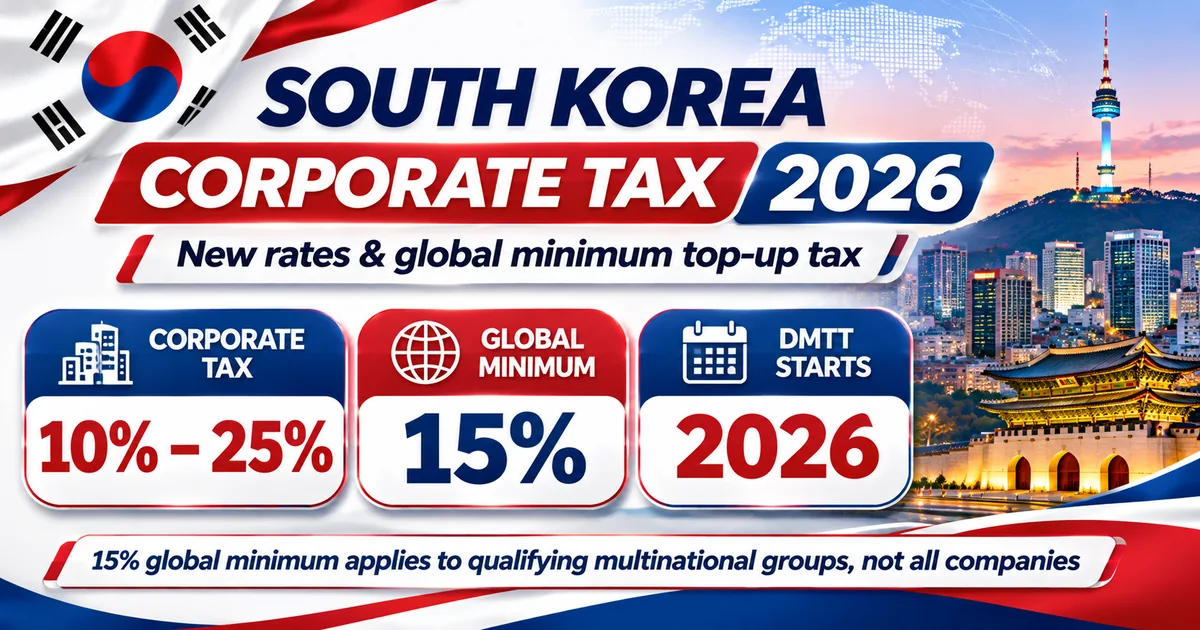
The 2026 tax reform increased ordinary national corporate income tax rates by one percentage point across all four brackets.
The revised rates are 10%, 20%, 22% and 25%, depending on taxable corporate income.
In addition to these national rates, companies generally face separate local corporate income tax.
Another major development is South Korea's implementation of a Domestic Minimum Top-Up Tax (DMTT) from January 1, 2026.
The new tax supports the OECD/G20 Pillar Two global minimum tax framework, which aims to ensure that large multinational enterprise groups are subject to a minimum effective tax rate of 15% in each relevant jurisdiction.
However, the 15% minimum does not apply automatically to every company in South Korea.
It generally concerns multinational groups with consolidated annual revenue of at least €750 million in at least two of the preceding four fiscal years.
This guide explains South Korea's 2026 corporate tax rates, taxable income brackets, local taxes, international minimum tax rules, top-up tax examples, filing deadlines and compliance requirements.
1. What Changed in South Korea's Corporate Tax Rates in 2026?
South Korea's National Assembly approved an increase in all four ordinary corporate income tax brackets.
The rates increased by one percentage point from January 1, 2026, for business years beginning on or after that date.
Corporate Tax Rate Comparison
| Taxable Corporate Income | Previous Rate | 2026 Rate |
|---|---|---|
| Up to KRW 200 million | 9% | 10% |
| Above KRW 200 million to KRW 20 billion | 19% | 20% |
| Above KRW 20 billion to KRW 300 billion | 21% | 22% |
| Above KRW 300 billion | 24% | 25% |
These are progressive national corporate income tax rates.
Each rate applies to the relevant portion of taxable income.
The new schedule restores the national rates to their earlier 2022 levels.
2. When Did the New Rates Become Effective?
The revised national corporate income tax rates apply to business years beginning on or after January 1, 2026.
Example
A company has a financial year beginning January 1, 2026 and ending December 31, 2026.
The revised 2026 brackets generally apply to that year.
However, a company with a business year that began before January 1, 2026 may be subject to the earlier rates for that particular year.
The start date of the business year is therefore important.
3. Official Corporate Income Tax Brackets for 2026
| Corporate Taxable Income | National Marginal Rate |
|---|---|
| First KRW 200 million | 10% |
| Next income up to KRW 20 billion | 20% |
| Next income up to KRW 300 billion | 22% |
| Income above KRW 300 billion | 25% |
The rates above generally concern ordinary profit-making corporations.
Certain qualifying small corporations with mainly real estate rental activities or other specified characteristics can be subject to different brackets.
Eligible cooperative corporations may also have special tax treatment.
Therefore, the standard first-bracket rate of 10% should not be presented as applying universally to every corporation.
4. How Is Corporate Income Tax Calculated?
South Korea applies the relevant progressive corporate tax rates to the company's taxable income.
Taxable income is not necessarily the same as revenue or accounting profit.
A corporation must generally determine:
- Total taxable income.
- Allowable business expenses.
- Tax depreciation.
- Tax adjustments.
- Loss relief where applicable.
- Relevant tax exemptions.
- Tax credits.
- Other statutory adjustments.
The applicable brackets are then used to calculate the national corporate tax before relevant credits and other adjustments.
5. Example: Company With KRW 100 Million Taxable Income
Assume a qualifying ordinary Korean company has taxable income of KRW 100 million.
The entire amount falls in the first national corporate tax bracket.
Calculation:
KRW 100,000,000 × 10% = KRW 10,000,000.
Illustrative national corporate income tax: KRW 10 million.
Under the previous 9% rate, the corresponding calculation would have produced KRW 9 million.
The increase is KRW 1 million before considering local tax, credits and other adjustments.
6. Example: Company With KRW 300 Million Taxable Income
Assume a company has KRW 300 million of taxable income.
New 2026 Calculation
First KRW 200 million at 10%:
KRW 20 million.
Remaining KRW 100 million at 20%:
KRW 20 million.
Total national corporate income tax: KRW 40 million.
Previous Calculation
First KRW 200 million at 9%:
KRW 18 million.
Remaining KRW 100 million at 19%:
KRW 19 million.
Previous national corporate tax:
KRW 37 million.
Difference
KRW 40 million − KRW 37 million = KRW 3 million.
The tax increase is approximately KRW 3 million before additional adjustments.
7. Example: Company With KRW 1 Billion Taxable Income
Assume an ordinary Korean corporation has KRW 1 billion in taxable income.
First KRW 200 million at 10%:
KRW 20 million.
Remaining KRW 800 million at 20%:
KRW 160 million.
Total national corporate tax:
KRW 180 million.
The simplified effective national tax rate is:
KRW 180 million ÷ KRW 1 billion = 18%.
The company's marginal rate is 20%, but the effective national rate in this example is 18%.
This figure excludes local income tax and available tax adjustments.
8. Does South Korea Charge Local Corporate Income Tax?
Yes.
South Korea generally imposes separate local corporate income tax.
The ordinary local rates correspond to approximately 10% of the national marginal corporate rates.
2026 National and Local Rate Comparison
| Taxable Income Bracket | National Rate | Local Rate | Combined Marginal Rate |
|---|---|---|---|
| Up to KRW 200 million | 10% | 1% | 11% |
| KRW 200 million–20 billion | 20% | 2% | 22% |
| KRW 20 billion–300 billion | 22% | 2.2% | 24.2% |
| Above KRW 300 billion | 25% | 2.5% | 27.5% |
These combined rates are indicative marginal rates for an ordinary corporation.
Local taxation has its own legal calculation, credits and possible adjustments.
Important: The 25% headline corporate tax rate excludes the separate local corporate income tax.
9. What Is the OECD Global Minimum Tax?
The Global Minimum Tax is part of the OECD/G20 Pillar Two framework.
It is designed to address international profit shifting and low taxation of large multinational groups.
Under the framework, qualifying multinational enterprise groups are generally subject to a minimum effective tax rate of 15% in each relevant jurisdiction.
Where the jurisdictional effective tax rate is below the minimum, additional tax may arise.
The system does not replace every country's ordinary domestic corporate income tax.
Instead, it creates additional calculations for qualifying multinational groups.
10. Which Companies Are Subject to the Global Minimum Tax?
The rules generally apply to multinational enterprise groups with consolidated revenue of at least:
€750 million.
The threshold must generally be met in at least two of the four fiscal years immediately preceding the relevant tested year.
Important
The test concerns consolidated group revenue, not merely the individual Korean subsidiary's revenue.
A relatively small Korean subsidiary may be within scope because it belongs to a qualifying international group.
Conversely, a large Korean company that does not belong to a qualifying multinational group may not automatically be subject to Pillar Two.
Certain entities are excluded under the statutory rules.
11. What Is the Domestic Minimum Top-Up Tax?
A Domestic Minimum Top-Up Tax allows South Korea to impose relevant additional tax on low-taxed Korean income of qualifying multinational groups.
The objective is to secure Korea's taxing rights over low-taxed profits that could otherwise create a top-up tax liability in another jurisdiction.
The Korean DMTT generally begins applying to business years starting on or after January 1, 2026.
Main Principle
If a qualifying multinational group's effective tax rate in South Korea is below 15%, a domestic top-up tax calculation may be required.
The final tax amount depends on GloBE income, covered taxes, substance-based exclusions, safe harbours and other applicable provisions.
12. Why Can a Top-Up Tax Apply When Corporate Rates Are Above 15%?
South Korea's headline national rates range from 10% to 25%.
However, the Pillar Two effective tax rate is not identical to the ordinary statutory tax rate.
The effective rate is generally calculated using adjusted covered taxes divided by relevant GloBE income for the jurisdiction.
Factors affecting the calculation may include:
- Tax incentives.
- Tax credits.
- Temporary differences.
- Deferred taxes.
- Exemptions.
- Differences between accounting and tax income.
- Special GloBE adjustments.
Therefore, a Korean entity may need a Pillar Two calculation even if its statutory marginal tax rate exceeds 15%.
13. Example: Global Minimum Tax Calculation
Assume a qualifying multinational group has the following simplified Korean jurisdictional results:
GloBE income: KRW 10 billion.
Adjusted covered taxes: KRW 1.2 billion.
Simplified effective tax rate:
KRW 1.2 billion ÷ KRW 10 billion = 12%.
Minimum required effective rate:
15%.
Indicative percentage difference:
15% − 12% = 3 percentage points.
Before applicable adjustments, the difference applied to KRW 10 billion would equal KRW 300 million.
Important: KRW 300 million is not necessarily the actual domestic top-up tax.
The final calculation can be reduced or changed by substance-based income exclusions, safe harbours, other taxes and detailed GloBE provisions.
14. Is the 15% Global Minimum Tax a Flat Tax on Sales?
No.
The 15% figure is a minimum effective tax rate on relevant GloBE income.
It is not:
- A 15% tax on annual company sales.
- A 15% VAT.
- A tax imposed automatically on every Korean corporation.
- An additional 15% charged on top of all existing corporate tax.
- A universal withholding tax.
The actual top-up calculation depends on the relevant jurisdictional income and covered taxes.
15. What Are the Three Main Pillar Two Tax Rules?
South Korea's implementation includes three major mechanisms.
| Rule | Main Purpose | Korean Effective Year |
|---|---|---|
| Income Inclusion Rule (IIR) | Parent-jurisdiction taxation of relevant low-taxed foreign group income | 2024 |
| Undertaxed Profits Rule (UTPR) | Residual top-up tax mechanism | 2025 |
| Domestic Minimum Top-Up Tax (DMTT) | Taxation of relevant low-taxed Korean group income | 2026 |
These provisions operate under a prescribed interaction and ordering framework.
16. What Is the Income Inclusion Rule?
The Income Inclusion Rule allows the jurisdiction of a qualifying parent company to impose relevant top-up tax relating to low-taxed subsidiaries or other constituent entities.
Example
A Korean parent company owns a subsidiary in another jurisdiction.
The multinational group meets the €750 million revenue test.
If the foreign jurisdiction's relevant effective tax rate is below 15%, the IIR may result in top-up tax being imposed in Korea.
The calculation is subject to the detailed GloBE rules.
17. What Is the Undertaxed Profits Rule?
The Undertaxed Profits Rule is designed to collect certain residual top-up tax amounts not collected through qualifying domestic minimum taxes or the IIR.
It can allocate additional tax obligations across jurisdictions where relevant group entities operate.
The Korean UTPR generally applies to fiscal years beginning on or after January 1, 2025.
It is a separate mechanism from the new domestic top-up tax introduced in 2026.
18. Which Rule Takes Priority?
In a simplified description, a qualifying domestic minimum top-up tax is generally considered first for the relevant low-taxed domestic jurisdiction.
The Income Inclusion Rule may then apply to relevant remaining top-up tax obligations.
The UTPR operates as a further mechanism for qualifying residual top-up tax.
This ordering helps reduce overlapping taxation of the same low-taxed income.
However, the actual calculation involves statutory crediting, allocation and other technical provisions.
19. Does Every Foreign-Owned Korean Company Pay DMTT?
No.
A Korean subsidiary with foreign shareholders does not automatically become subject to the global minimum tax.
Its group must generally satisfy the revenue and other applicable Pillar Two criteria.
Example
A Korean subsidiary belongs to a multinational group with qualifying consolidated revenue of €900 million.
The group may fall within the global minimum tax framework.
Another Korean subsidiary belongs to a small international group with consolidated revenue of €20 million.
The ordinary €750 million threshold would generally not be satisfied.
The second group would not normally fall within Pillar Two solely because it owns a Korean company.
20. What About Small and Medium-Sized Businesses?
Ordinary small and medium-sized Korean companies are generally governed by the applicable national and local corporate income tax rules.
The global minimum tax is primarily aimed at very large multinational enterprise groups.
Certain SMEs may qualify for domestic tax incentives or other statutory relief.
However, an SME should not automatically assume that every available deduction or credit applies without restrictions.
Special corporate categories may also have different rates.
21. Are Property Rental Corporations Treated Differently?
Yes, certain small corporations that mainly engage in real estate rental activities or satisfy other specified conditions can be subject to special national corporate rate provisions.
The NTS publishes a separate schedule for qualifying small corporations.
For 2026, a specified small corporation may face a 20% rate on taxable income up to KRW 20 billion rather than the ordinary 10% first bracket.
Higher income then falls within the applicable 22% and 25% bands.
The exact classification should be verified before applying ordinary corporate rates.
22. Do Korean Companies Pay VAT?
Yes.
South Korea generally applies a standard Value Added Tax rate of 10% to relevant taxable supplies.
VAT is separate from corporate income tax.
Example
A VAT-registered company sells standard-rated services for KRW 10 million before VAT.
VAT:
KRW 10 million × 10% = KRW 1 million.
Total invoice:
KRW 11 million.
The company's corporate income tax is calculated separately on relevant taxable profit.
23. How Are Foreign Companies Taxed in South Korea?
Tax treatment depends on whether the foreign company has a relevant taxable business presence in Korea and the nature of its Korean-source income.
A foreign corporation with a Korean permanent establishment may be subject to corporate taxation on relevant Korea-attributable income.
Other Korean-source income can be subject to withholding tax where applicable.
Tax treaties may modify the outcome.
International groups should also consider transfer pricing, beneficial ownership, permanent establishment and Pillar Two obligations.
24. How Does the Reform Affect Pakistani Companies Doing Business in Korea?
Pakistani businesses may have Korean tax obligations where they establish a Korean company, branch, permanent establishment or other relevant taxable activity.
Potential matters include:
- Korean corporate income tax.
- Local income tax.
- VAT registration.
- Withholding tax.
- Cross-border service payments.
- Transfer pricing.
- Relevant tax treaty provisions.
- Filing requirements.
- Global minimum tax exposure if part of a qualifying multinational group.
Pakistani ownership alone does not determine whether the Korean entity is subject to the global minimum tax.
The group's consolidated revenue and relevant entity classifications must also be reviewed.
25. South Korea Corporate Tax Filing Deadline
The Korean National Tax Service generally requires corporate income tax returns within three months after the last day of the month in which the business year ends.
Example
A company has a December 31, 2026 year-end.
The ordinary national corporate income tax filing deadline is:
March 31, 2027.
A separate local corporate income tax filing generally follows one month later.
For a December year-end company, the ordinary local filing deadline is generally April 30, 2027.
Special rules or extensions may apply in particular circumstances.
26. Global Minimum Tax Filing Deadlines
South Korea's Pillar Two reporting uses separate deadlines from ordinary corporate income tax returns.
The general global minimum tax reporting deadline is the later of:
- 15 months after the end of the relevant fiscal year; or
- June 30, 2026.
For a group's first in-scope year, an 18-month transitional period generally applies, subject to the relevant rules.
Illustrative December Year-End Schedule
| Pillar Two Measure | First Relevant Fiscal Year | Indicative Initial Filing Deadline |
|---|---|---|
| IIR | 2024 | June 30, 2026 |
| UTPR | 2025 | June 30, 2027 |
| DMTT | 2026 | June 30, 2028 |
These dates assume the typical calendar-year multinational group and the relevant first-year rules.
A company with a different fiscal year-end or specific reporting arrangements may have different obligations.
27. What Is the GloBE Information Return?
The GloBE Information Return is a specialized international tax information report.
It can include information about:
- Multinational group structure.
- Constituent entities.
- Jurisdictional income.
- Covered taxes.
- Effective tax rates.
- Top-up tax calculations.
- Applicable safe harbours.
- Other required disclosures.
Where a relevant group entity files the return in a jurisdiction with appropriate information exchange arrangements, Korean entities may qualify for alternative notification procedures.
However, exemptions from duplicate filing do not automatically remove every Korean reporting obligation.
28. How to File Corporate Tax in South Korea
Step 1: Determine the Financial Year
Confirm the company's accounting and tax period.
Step 2: Prepare Financial Statements
Gather the balance sheet, income statement and supporting accounting records.
Step 3: Calculate Taxable Income
Apply relevant tax adjustments and deductions.
Step 4: Determine the Applicable Company Category
Check ordinary corporate rates versus any special corporate schedule.
Step 5: Apply the 2026 Tax Brackets
Calculate national corporate tax using the relevant marginal rates.
Step 6: Review Tax Credits
Determine eligibility for statutory credits or other relief.
Step 7: Calculate Local Corporate Income Tax
Prepare the separate local tax calculation.
Step 8: Review International Taxation
Check permanent establishment, transfer pricing and foreign tax obligations.
Step 9: Determine Pillar Two Applicability
For multinational groups, assess the €750 million revenue test and relevant GloBE requirements.
Step 10: Submit the Tax Return
Use the official NTS filing arrangements, including Hometax where applicable.
Step 11: Pay Tax Due
Complete payments through approved channels.
Step 12: Preserve Records
Retain the submitted returns, financial calculations, payment evidence and relevant international tax documentation.
29. What Documents Should Companies Keep?
| Document | Purpose |
|---|---|
| Business Registration | Identifies the company |
| Financial Statements | Supports income calculation |
| General Ledger | Supports reported transactions |
| Corporate Tax Adjustments | Reconciles accounting and taxable profit |
| Expense Documentation | Supports deductible costs |
| Tax Credit Records | Supports claimed relief |
| VAT Records | Supports transaction taxation |
| Transfer Pricing Documentation | Supports related-party pricing |
| Consolidated Group Accounts | Supports Pillar Two revenue test |
| GloBE Calculations | Supports global minimum tax compliance |
| Tax Return Acknowledgments | Confirms filing |
| Tax Payment Receipts | Confirms payments |
Additional records may be required based on the company's activities and international structure.
30. Common Corporate Tax Mistakes to Avoid
- Using the old 9%, 19%, 21% and 24% rates for business years beginning in 2026.
- Applying 25% to every company's entire taxable profit.
- Confusing revenue with taxable income.
- Ignoring separate local corporate income tax.
- Assuming every small corporation qualifies for the first 10% bracket.
- Ignoring the special rules for certain property rental corporations.
- Treating the 15% global minimum as an additional flat tax on all companies.
- Applying the €750 million threshold to only the Korean subsidiary.
- Confusing a statutory tax rate with the GloBE effective tax rate.
- Ignoring qualifying domestic top-up tax requirements.
- Forgetting transfer pricing or foreign subsidiary disclosures.
- Using the ordinary corporate tax filing deadline for Pillar Two returns.
- Assuming a foreign-parented Korean entity cannot have global minimum tax reporting obligations.
- Treating VAT as the same tax as corporate income tax.
- Failing to retain adequate tax calculation records.
31. South Korea Corporate Tax 2026 Checklist
Before preparing your return, verify:
- Correct financial year start date.
- Corporate taxpayer classification.
- National corporate tax brackets.
- Local corporate tax calculations.
- Taxable income reconciliation.
- Relevant deductible expenses.
- Corporate tax credits and exemptions.
- Special company classification rules.
- Transfer pricing requirements.
- Korean-source and foreign-source income.
- Applicable tax treaties.
- Multinational group status.
- Consolidated revenue threshold.
- Jurisdictional GloBE income.
- Covered taxes and effective rates.
- Domestic top-up tax eligibility.
- Applicable safe harbours.
- GloBE Information Return requirements.
- Ordinary national corporate tax filing deadline.
- Local corporate filing deadline.
- International reporting deadlines.
- Supporting records and confirmations.
32. Watch Tax With Naeem — Related Tax Education
For general education on income taxation, business income and tax return preparation, watch the following related tutorial from Tax With Naeem.
Related Video: Income Tax Return Filing in Pakistan — Salary, Rental Income, Capital Gains and Dividends Explained
https://www.youtube.com/watch?v=VX88o1N1AfA
This is a Pakistan income tax tutorial.
It is included as supplementary educational material and does not explain South Korea's corporate income tax or OECD Pillar Two regulations.
For Korean corporate tax compliance, businesses should use the official National Tax Service instructions and relevant legal provisions.
33. Official Sources and References
1. National Tax Service — 2026 Corporate Tax Rates
https://t.nts.go.kr/nts/cm/cntnts/cntntsView.do?cntntsId=7746&mi=2372
2. National Tax Service — Global Minimum Tax Overview
https://www.nts.go.kr/gmt/cm/cntnts/cntntsView.do?cntntsId=239052&mi=41029
3. National Tax Service — Global Minimum Tax Filing and Payment Guidance
https://s.nts.go.kr/webtv/na/ntt/selectNttList.do?bbsId=50850&nttSn=1350915
4. Korean Corporate Tax Act — Official Legislation
5. Korean International Tax Coordination Law
https://www.law.go.kr/lsInfoP.do?lsiSeq=280389&urlMode=engLsInfoR&viewCls=engLsInfoR
6. National Tax Service — Corporate Tax Filing Deadlines
https://www.nts.go.kr/english/cm/cntnts/cntntsView.do?cntntsId=238886&mi=40008
7. OECD — Global Minimum Tax
https://www.oecd.org/en/topics/global-minimum-tax.html
8. OECD Economic Survey: Korea 2026
9. National Tax Service — Official Website
https://www.nts.go.kr/english/
10. AsaanTax.pk — International Tax Guides
11. Tax With Naeem — Related Educational Video
https://www.youtube.com/watch?v=VX88o1N1AfA
34. Conclusion: What Does South Korea's Corporate Tax Reform Mean in 2026?
South Korea's 2026 tax reform increases ordinary national corporate income tax rates to 10%, 20%, 22% and 25%.
The revised rates apply to business years beginning on or after January 1, 2026.
Companies generally must also calculate separate local corporate income tax, which increases the combined marginal rates.
The country has also introduced a Domestic Minimum Top-Up Tax under the OECD Pillar Two framework.
The domestic top-up tax generally concerns low-taxed Korean income of qualifying multinational enterprise groups that meet the €750 million consolidated revenue test.
It does not automatically impose a 15% additional tax on every Korean business.
For companies operating internationally, the most important tasks include determining applicable tax rates, monitoring group revenue thresholds, preparing effective tax rate calculations and meeting separate corporate and global minimum tax filing obligations.
The key takeaway is that South Korea's 2026 corporate tax increase and its 15% global minimum top-up tax are two distinct reforms with different calculations and eligibility requirements.
For more international tax guides covering South Korea, Japan, Singapore, Malaysia, the UAE, the UK, USA and Pakistan, visit:
AsaanTax.pk: https://www.asaantax.pk/
Editorial Note: This article was prepared on November 12, 2026, using South Korea's National Tax Service, enacted Corporate Tax Act and international tax guidance.
Disclaimer: This content is for general educational purposes and does not constitute personalized Korean corporate tax or legal advice. Actual liabilities depend on taxable income, corporate classification, available tax credits, local taxes, group structure and relevant international tax rules. Businesses should consult the National Tax Service or a qualified Korean tax professional for their circumstances.