Italy Income Tax 2026: IRPEF Middle Rate Cut to 33% — Who Saves €440 and Who Does Not
Published: November 12, 2026
Country: Italy
Tax Year: January 1 – December 31, 2026
Tax Authority: Agenzia delle Entrate (Italian Revenue Agency)
Legal Basis: Budget Law 2026 — Law No. 199 of December 30, 2025
Main Change: Middle IRPEF rate reduced from 35% to 33%
Introduction
Italy has introduced a personal income tax reduction for 2026 aimed primarily at easing the burden on middle-income taxpayers.
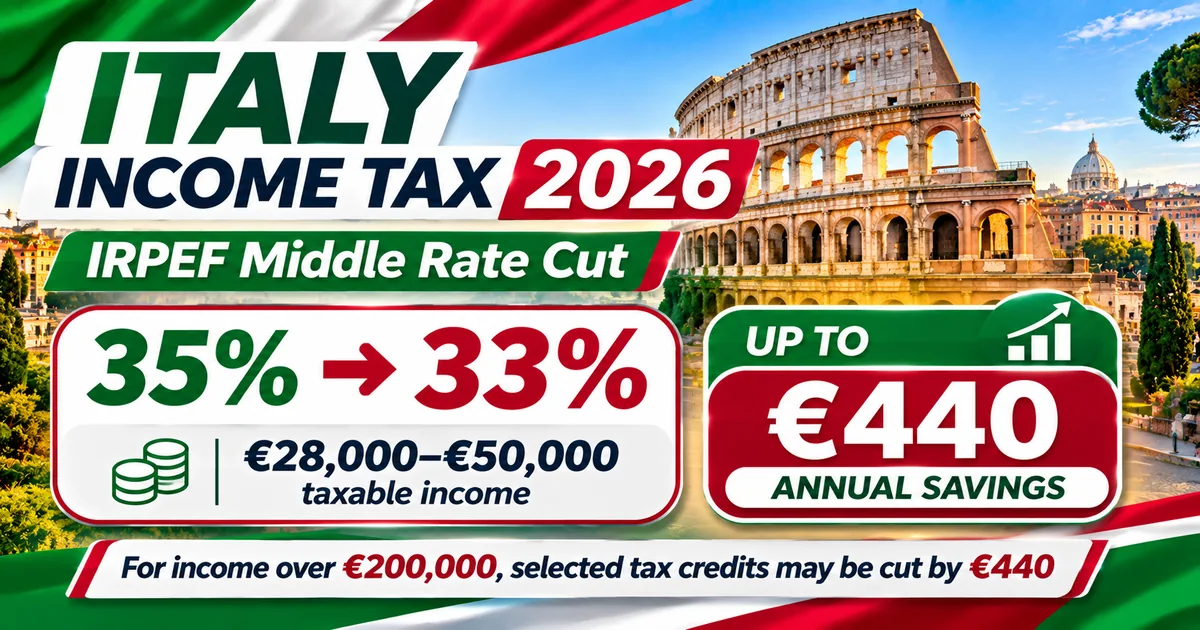
Under the 2026 Budget Law, the middle bracket of the Italian Personal Income Tax, known as IRPEF (Imposta sul Reddito delle Persone Fisiche), has been reduced from 35% to 33%.
The change applies to taxable income above €28,000 and up to €50,000.
As a result, qualifying taxpayers can save up to €440 annually in gross national income tax.
However, the saving is not the same for everyone.
A taxpayer earning €30,000 in taxable income receives a much smaller reduction than a person earning €50,000.
Individuals whose taxable income does not exceed €28,000 do not benefit directly from this particular rate change.
Furthermore, a separate restriction applies to taxpayers whose total income exceeds €200,000. Their available tax credits for specified expenses can be reduced by €440, potentially cancelling the benefit from the lower middle rate.
This article explains Italy's official 2026 income tax brackets, calculations at different salary levels, high-income restrictions, employee withholding, freelancers, expatriates, and income tax return filing requirements.
1. What Changed in Italy's Income Tax Rates for 2026?
Italy's 2026 Budget Law, Law No. 199/2025, amended Article 11 of the Consolidated Income Tax Act (TUIR).
The most important change is a reduction in the second IRPEF rate from 35% to 33%.
The first and highest ordinary national IRPEF rates remain 23% and 43%, respectively.
Italy IRPEF Rates — 2025 vs 2026
| Annual Taxable Income | 2025 Rate | 2026 Rate |
|---|---|---|
| Up to €28,000 | 23% | 23% |
| Above €28,000 to €50,000 | 35% | 33% |
| Above €50,000 | 43% | 43% |
The reform reduces the tax rate by two percentage points on the relevant middle bracket.
Important: These are marginal rates. They are not applied as a single percentage to a person's entire income.
2. When Did Italy's New 33% IRPEF Rate Start?
The new rate took effect on January 1, 2026.
It applies to the 2026 tax period.
Employees may see the benefit through payroll withholding calculations and any necessary adjustments.
Pensioners may also benefit where their taxable pension income falls within the relevant bracket.
Italy's social security institution, INPS, confirmed that it began applying the updated rate to relevant pension payments in March 2026, including adjustments for January and February.
For annual returns, the changes will generally appear in the 2027 filing campaign for income earned during 2026.
3. What Is IRPEF in Italy?
IRPEF is Italy's progressive national personal income tax.
It can apply to several categories of income, depending on the taxpayer's residency, income classification and applicable tax regime.
Examples include:
- Employment salary.
- Pension income.
- Certain self-employment income.
- Business income.
- Rental income subject to ordinary IRPEF.
- Other qualifying personal income.
However, some income is subject to substitute or separate taxation.
For example, qualifying rental income under the Cedolare Secca regime or income under certain preferential self-employment regimes may not be subject to ordinary IRPEF brackets in the same way.
4. How Much Can Taxpayers Save From the 33% Rate?
The maximum saving is calculated using the full width of the middle bracket.
Middle bracket:
€50,000 − €28,000 = €22,000.
Rate reduction:
35% − 33% = 2 percentage points.
Maximum gross saving:
€22,000 × 2% = €440 per year.
The full reduction is reached once the relevant taxable income reaches €50,000.
The benefit does not continue growing on income above €50,000 because the top 43% marginal rate remains unchanged.
5. Italy Income Tax Savings Table for 2026
The following table shows the reduction in gross national IRPEF attributable solely to the middle-bracket rate change.
| Annual Taxable Income | Maximum Rate-Cut Saving |
|---|---|
| €20,000 | €0 |
| €28,000 | €0 |
| €30,000 | €40 |
| €35,000 | €140 |
| €40,000 | €240 |
| €45,000 | €340 |
| €50,000 | €440 |
| €60,000 | €440 |
| €80,000 | €440 |
| €150,000 | €440 |
These figures assume the individual has sufficient ordinary IRPEF liability and do not include changes to tax credits, deductions or other tax provisions.
For total income exceeding €200,000, the separate tax-credit restriction must also be considered.
6. Example: Income of €25,000
Assume a taxpayer has €25,000 of annual taxable income under the ordinary IRPEF regime.
All income falls within the first bracket.
The rate remains 23%.
Therefore, the new middle-bracket reduction does not apply.
Gross tax saving from the 2026 middle-rate cut: €0.
The taxpayer may receive other tax reliefs, but those benefits are separate from the 35% to 33% reform.
7. Example: Income of €30,000
Assume a taxpayer has €30,000 of taxable income.
Only €2,000 falls within the affected bracket.
Calculation:
€30,000 − €28,000 = €2,000.
Tax saving:
€2,000 × 2% = €40.
Annual gross saving: €40.
This illustrates why taxpayers only slightly above €28,000 do not receive the maximum benefit.
8. Example: Income of €40,000
Assume a taxpayer has €40,000 of taxable income.
Under the Previous 2025 Rates
First €28,000 at 23%:
€6,440.
Next €12,000 at 35%:
€4,200.
Total gross national IRPEF:
€10,640.
Under the New 2026 Rates
First €28,000 at 23%:
€6,440.
Next €12,000 at 33%:
€3,960.
Total gross national IRPEF:
€10,400.
Tax Saving
€10,640 − €10,400 = €240 annually.
This calculation excludes available deductions, tax credits, regional and municipal surtaxes and social insurance contributions.
9. Example: Income of €50,000
A taxpayer has annual taxable income of €50,000.
2025 Calculation
First €28,000 at 23%:
€6,440.
Next €22,000 at 35%:
€7,700.
Total:
€14,140.
2026 Calculation
First €28,000 at 23%:
€6,440.
Next €22,000 at 33%:
€7,260.
Total:
€13,700.
Annual Reduction
€14,140 − €13,700 = €440.
The taxpayer receives the maximum gross rate-cut benefit.
10. Example: Income of €60,000
A taxpayer has €60,000 of taxable income.
2026 Gross Tax Calculation
First €28,000 at 23%:
€6,440.
Next €22,000 at 33%:
€7,260.
Remaining €10,000 at 43%:
€4,300.
Total:
€18,000 gross national IRPEF.
Under the previous middle rate of 35%, the corresponding gross tax would have been €18,440.
Therefore:
Annual gross saving: €440.
The amount above €50,000 remains taxed at the 43% marginal rate.
11. Why Do Higher Earners Not Always Keep the €440 Saving?
Italy's Budget Law 2026 introduced an additional restriction for taxpayers with total income exceeding €200,000.
Article 1, paragraph 4, modifies Article 16-ter of TUIR.
For affected taxpayers, the available tax-credit amount relating to specified expenses is reduced by €440.
The measure is intended to neutralize the benefit of the lower middle IRPEF rate for sufficiently high-income individuals.
Important Distinction
The legislation reduces qualifying available tax credits.
It does not create a separate universal €440 tax charge on every taxpayer earning more than €200,000.
The actual offset depends on the taxpayer's eligible expenses and tax credits.
12. Which Tax Credits Are Affected Above €200,000?
The high-income restriction covers specified categories, including:
- Certain expenses eligible for 19% tax credits.
- Qualifying donations to political parties.
- Specified insurance premiums against catastrophic events.
However, the legislation contains exceptions.
For example, qualifying medical expenses under Article 15(1)(c) are excluded from this particular €440 reduction.
Why This Matters
A high-income taxpayer with sufficient credits in the affected categories may lose the entire €440 IRPEF saving.
A taxpayer without sufficient affected credits may have a different net result.
Therefore, the headline statement that every person earning over €200,000 receives no tax benefit would be too broad.
13. Example: High Earner With €220,000 Income
Assume a taxpayer has total income of €220,000 and sufficient qualifying tax credits affected by the restriction.
Gross IRPEF benefit from the new middle rate:
€440.
Reduction in relevant tax credits:
€440.
Net change attributable to these two measures:
€440 − €440 = €0.
Illustrative net benefit: €0.
This example assumes the relevant credits are sufficient and the statutory conditions apply.
Actual outcomes depend on the taxpayer's available credits, total income and applicable deductions.
14. What if a High Earner Has No Affected Credits?
The restriction operates through a reduction of available credits for specified expenses.
Accordingly, the absence of sufficient eligible credits can affect the practical outcome.
It should not be assumed that a taxpayer with no relevant credits automatically pays an additional €440 merely because total income exceeds €200,000.
A full tax calculation is required.
This is why high-income taxpayers should review their deductions and credits rather than relying only on a tax-bracket comparison.
15. Is the €440 Saving Based on Gross Salary?
No.
The IRPEF brackets generally apply to the relevant taxable income after legally permitted deductions.
Gross salary and taxable income are not identical.
For example, an employee may receive gross annual compensation of €50,000, but the actual IRPEF taxable income may be lower after relevant social security contributions or other deductible amounts.
Therefore, the full €440 gross tax saving does not automatically apply to everyone whose employment contract states a €50,000 gross annual salary.
Taxpayers should use their actual taxable income to determine the rate-cut benefit.
16. Do Pensioners Benefit From the IRPEF Reduction?
Yes, qualifying pension income subject to ordinary progressive IRPEF can benefit from the lower middle rate.
INPS confirmed implementation of the new second bracket from March 2026 for affected pensions, including relevant adjustments for January and February.
However, the benefit depends on taxable pension income.
Pensioners whose taxable income does not exceed €28,000 do not receive a direct gross tax saving from this particular middle-rate reduction.
Separate pension-related reliefs may also apply.
17. Do Self-Employed Workers and Freelancers Benefit?
Potentially, yes.
A self-employed individual whose relevant income is taxed under the ordinary progressive IRPEF system may benefit.
However, many freelancers in Italy use special tax regimes.
The most important example is the Regime Forfettario, where eligible self-employed income is generally subject to a substitute tax rather than the ordinary IRPEF brackets.
Example
Freelancer A is taxed under ordinary IRPEF.
Their income may benefit from the 33% middle bracket.
Freelancer B is eligible for the Regime Forfettario and pays the applicable substitute tax on relevant income.
The ordinary IRPEF rate reduction may not directly reduce the tax payable under that separate regime.
Freelancers should confirm their tax classification before claiming the saving.
18. What Is the Regime Forfettario?
Italy's Regime Forfettario is a simplified tax system for qualifying small self-employed businesses and professionals.
Under the general framework, eligible taxpayers can be subject to a 15% substitute income tax.
Certain qualifying new activities may receive a reduced 5% rate for a limited initial period.
Eligibility depends on statutory turnover, employment and other conditions.
Important
The 15% and 5% substitute rates are not part of the ordinary 23%, 33% and 43% IRPEF brackets.
A person using the simplified regime should not calculate business income tax by automatically applying the middle IRPEF rate.
19. What About Italy's Regional and Municipal Income Taxes?
Ordinary IRPEF is a national personal income tax.
Italy also imposes regional and municipal income tax surcharges, known as addizionali.
The applicable rates depend on the region and municipality, as well as the relevant legal requirements.
The national 35% to 33% reduction does not mean all regional and municipal rates have been reduced by two percentage points.
A complete personal tax calculation must include these separate amounts where applicable.
20. Does the IRPEF Rate Cut Reduce Social Security Contributions?
No.
Italian social security contributions are separate from ordinary income tax.
Employees and self-employed persons may pay relevant contributions to INPS or applicable professional pension schemes.
The 2026 IRPEF reduction does not automatically reduce those contribution rates.
Therefore, the change in a worker's net pay may differ from the gross tax saving shown in the tax-bracket examples.
21. Does the Reduction Apply to Foreign Workers in Italy?
Foreign nationals can benefit where their income is subject to ordinary Italian IRPEF and the relevant conditions are satisfied.
The treatment depends on tax residence, income source and any special regime.
For example, a Pakistani, Indian or British professional employed in Italy may benefit from the middle-rate reduction where the income is subject to the standard IRPEF schedule.
However, immigration status alone does not determine tax treatment.
An expatriate using a separate preferential tax regime should calculate the effect of the law under that regime.
22. How Is Italian Tax Residence Determined?
Italy generally distinguishes between tax residents and non-residents.
Residents can be subject to tax on worldwide income, with relevant treaty relief.
Non-residents are generally subject to tax on qualifying Italian-source income.
Tax residence is determined under Italian domestic law, taking account of relevant residence, domicile and physical-presence rules.
An applicable double taxation treaty may also affect residence and taxing rights.
A passport or work visa does not, by itself, establish the final tax residency position.
23. What About Pakistani Professionals Living in Italy?
Pakistani nationals living or working in Italy should consider both countries' applicable tax rules.
Important matters include:
- Italian tax residence.
- Employment or freelance income.
- Overseas rental income.
- Foreign savings and investments.
- Applicable foreign asset declarations.
- Pakistan tax residency.
- Double taxation relief.
- Any relevant tax treaty provisions.
Example
A Pakistani professional working in Milan earns qualifying employment income taxable under ordinary IRPEF.
The person may benefit from the new 33% middle bracket.
If the employee also owns property in Pakistan, separate tax and reporting rules may apply to that foreign property.
The employee should review both domestic rules and the applicable treaty before claiming a credit or exemption.
24. Is Italy's 2026 Rate Reduction Permanent?
The 2026 Budget Law amended the ordinary IRPEF rate under TUIR rather than presenting it as a single payroll bonus.
The reduced rate applies from the 2026 tax year.
However, future legislation can change tax rates or thresholds.
Taxpayers preparing future returns should always use the law applicable to the relevant year.
25. How Does the Tax Cut Affect Monthly Salary?
The maximum annual gross saving is €440.
Dividing that amount by 12 months gives:
Approximately €36.67 per month.
This is a convenient monthly equivalent, not a guaranteed monthly pay increase.
Actual payroll results depend on:
- Taxable salary.
- Number of pay periods.
- Tax credits.
- Withholding calculations.
- Social security contributions.
- Year-end adjustments.
- Other employment-related payments.
For a taxpayer with €40,000 of taxable income, the €240 annual gross saving corresponds to approximately €20 per month.
26. When Will the 2026 Tax Cut Appear in Tax Returns?
Italy generally reports income earned during a calendar year in the following year's tax declaration.
Therefore:
| Tax Period | Filing Campaign |
|---|---|
| Income earned in 2025 | Generally filed in 2026 |
| Income earned in 2026 | Generally filed in 2027 |
The reduced 33% middle rate applies to income earned during 2026.
For relevant taxpayers, this change will be reflected in the 2027 Model 730 or Redditi Persone Fisiche declaration.
The official 2027 filing deadlines should be confirmed when published by the Italian Revenue Agency.
27. What Is Italy's Model 730?
Model 730 is an income tax declaration commonly used by qualifying employees and pensioners.
It allows relevant income, deductions, tax credits and withholding to be reconciled.
Taxpayers may file through the Italian Revenue Agency's available pre-filled return service or other approved channels.
Some individuals, including those with more complex income, may need to use Model Redditi Persone Fisiche instead.
28. How to File an Italian Income Tax Return
Step 1: Access the Official Tax Portal
Visit https://www.agenziaentrate.gov.it/.
Step 2: Sign In
Use the appropriate supported digital identity method.
Step 3: Select the Relevant Return
Choose Model 730 or Redditi PF as applicable.
Step 4: Confirm the Tax Year
For the 2026 IRPEF rate change, review the 2026 income period during the 2027 filing process.
Step 5: Review Income Information
Check employment, pensions and additional taxable income.
Step 6: Verify Withholding
Review employer or pension withholding records.
Step 7: Check Deductions
Enter or verify deductible expenses.
Step 8: Check Tax Credits
Review eligible credits, particularly the restriction for total income exceeding €200,000.
Step 9: Review Foreign Income
Disclose relevant overseas income or assets where required.
Step 10: Complete and Submit
Submit the return and retain confirmation.
29. Documents Needed for Italy Income Tax Filing
Depending on the taxpayer's circumstances, relevant documents may include:
- Codice Fiscale.
- Employment income certification (Certificazione Unica).
- Pension income documents.
- Tax withholding records.
- Business or freelance income records.
- Deductible expense receipts.
- Medical expense records.
- Insurance premium documentation.
- Rental income statements.
- Foreign income certificates.
- Overseas tax payment evidence.
- Relevant family information.
- Foreign asset reporting documents.
- Previous tax assessments.
These records help ensure accurate tax calculations and valid deductions.
30. Common Italy Income Tax Mistakes to Avoid
- Using the old 35% middle rate for 2026 income.
- Applying 33% to the entire annual income.
- Assuming every taxpayer saves €440.
- Expecting the €440 saving below €28,000 of taxable income.
- Confusing gross salary with taxable income.
- Assuming the saving grows beyond €440 on income above €50,000.
- Ignoring the high-income credit restriction above €200,000.
- Assuming all taxpayers above €200,000 automatically receive no benefit regardless of their credits.
- Ignoring regional and municipal income tax surcharges.
- Confusing IRPEF with social security contributions.
- Applying ordinary IRPEF rates to separate substitute-tax regimes.
- Assuming foreign nationality excludes a person from the reform.
- Using 2026 filing deadlines for 2027 without verification.
- Omitting relevant foreign income.
- Claiming unsupported tax credits.
- Failing to verify payroll withholding adjustments.
31. Italy Income Tax 2026 Checklist
Before preparing the annual return:
- Confirm Tax Year 2026.
- Determine Italian tax residency.
- Verify total and taxable income.
- Use the new 33% middle rate.
- Apply the correct progressive calculation.
- Calculate the gross rate-cut benefit.
- Review employment or pension records.
- Consider regional and municipal surtaxes.
- Verify social security contributions separately.
- Determine whether income uses a substitute tax regime.
- Check tax credits.
- Review the €200,000 high-income restriction.
- Preserve eligible expense receipts.
- Check any foreign income.
- Review applicable treaty relief.
- Select Model 730 or Redditi PF.
- Confirm the official filing deadline.
- Save the submitted tax return and acknowledgment.
32. Watch Tax With Naeem — Related Income Tax Education
For general educational guidance on salary income, rental income, capital gains, dividends and income tax return filing, watch the following video from Tax With Naeem.
Related Video: Income Tax Return Filing in Pakistan — Salary, Rental Income, Capital Gains and Dividends Explained
https://www.youtube.com/watch?v=VX88o1N1AfA
This video was published on October 2, 2025.
It explains Pakistan's income tax system and is provided as supplementary educational content.
Important: It is not an Italian IRPEF tax-filing tutorial.
For Italian tax calculations and return preparation, readers should follow the official Italian Revenue Agency and current legislation.
33. Official Sources and References
1. Italian Ministry of Labour — Budget Law 2026
2. Italian Chamber of Deputies — Personal Income Tax and IRPEF Rates
https://temi.camera.it/leg19/temi/19_tl18_irpef.html
3. Italian Government — Budget Law 2026, Law No. 199/2025
4. Italian Finance Department — Official Tax Legislation Database
5. INPS — IRPEF Rate Reduction Implementation
6. Italian Revenue Agency — Official Tax Portal
https://www.agenziaentrate.gov.it/
7. Italian Revenue Agency — Pre-Filled Income Tax Return
https://infoprecompilata.agenziaentrate.gov.it/
8. Italian Ministry of Economy and Finance
9. AsaanTax.pk — International Taxation Guides
10. Tax With Naeem — Related Income Tax Tutorial
https://www.youtube.com/watch?v=VX88o1N1AfA
34. Conclusion: Who Really Benefits From Italy's 2026 IRPEF Cut?
Italy's 2026 tax reform provides a targeted reduction in the middle personal income tax bracket.
The IRPEF rate for taxable income between €28,000 and €50,000 decreased from 35% to 33%.
This provides a maximum annual gross saving of €440.
However, the actual benefit varies according to income and available tax credits.
Taxpayers with taxable income at or below €28,000 do not benefit directly from this particular rate reduction.
Those earning between €28,000 and €50,000 can receive progressively larger gross savings.
Taxpayers with taxable income at or above €50,000 may receive the full €440 gross reduction.
For taxpayers whose total income exceeds €200,000, the separate reduction in certain eligible tax credits may offset the benefit.
Employees, pensioners, self-employed professionals and expatriates should review their tax regime, taxable income, credits and payroll records before estimating the final result.
The key message is that Italy's 2026 IRPEF reform lowers the middle marginal tax rate by two percentage points, but €440 is the maximum gross tax reduction—not a guaranteed payment to every taxpayer.
For more international tax guides covering Italy, France, Germany, Spain, the Netherlands, the UK, USA, UAE and Pakistan, visit:
AsaanTax.pk: https://www.asaantax.pk/
Editorial Note: Prepared on November 12, 2026, using Italian Budget Law 2026, official parliamentary analysis, Ministry of Labour guidance and INPS publications.
Disclaimer: This article provides general educational information and does not constitute personalized Italian tax or legal advice. Actual liabilities depend on taxable income, personal deductions, credits, special tax regimes, tax residency and relevant regional and municipal provisions. Readers should consult Agenzia delle Entrate or a qualified Italian tax professional for individual circumstances.