New Zealand Tax 2026–27: Income Tax Brackets, ACC Levy and KiwiSaver Changes Explained
Published: November 12, 2026
Country: New Zealand
Tax Year: April 1, 2026 – March 31, 2027
Tax Authority: Inland Revenue Department (IRD)
ACC Authority: Accident Compensation Corporation
Currency: New Zealand Dollar (NZD)
Introduction
New Zealand's 2026–27 tax year brings important changes for employees, employers, self-employed professionals, small businesses and eligible KiwiSaver members.
Although the ordinary personal income tax brackets remain unchanged from the rates introduced on April 1, 2025, the 2026–27 financial year includes increases to the ACC earners' levy and minimum KiwiSaver contributions.
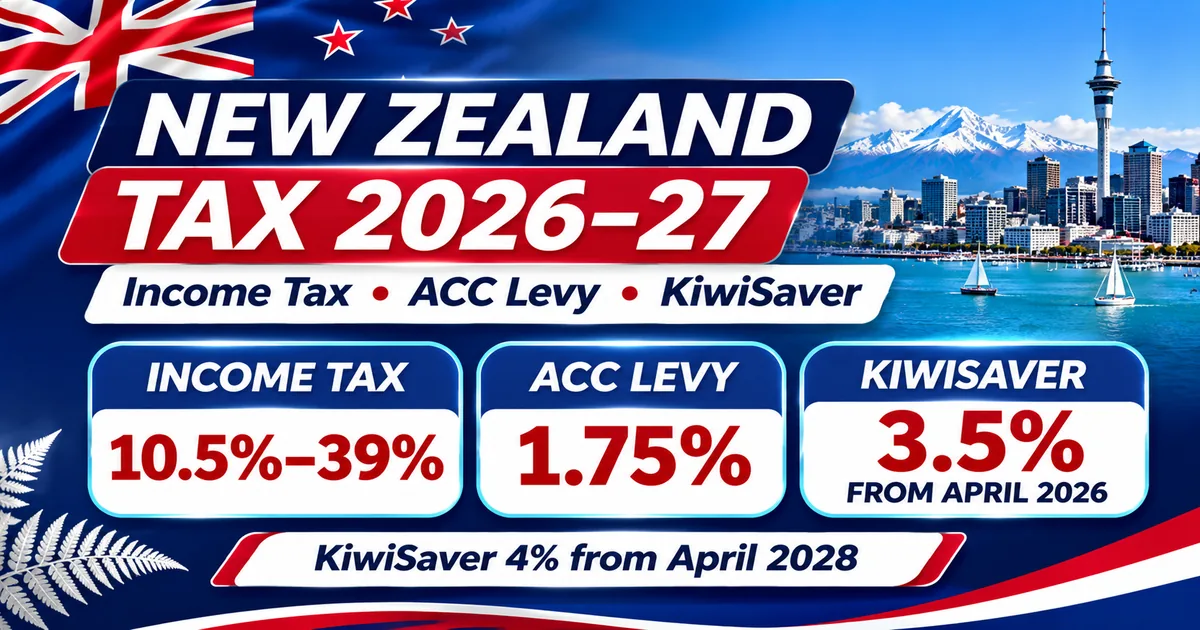
New Zealand continues to apply progressive personal income tax rates ranging from 10.5% to 39%.
From April 1, 2026, the ACC earners' levy increased to 1.75%, applying to eligible earnings up to an annual maximum of NZ$156,641.
Meanwhile, the default KiwiSaver contribution rate increased from 3% to 3.5% for employees and employers, subject to applicable eligibility and temporary reduction provisions.
A further increase to 4% is scheduled for April 1, 2028.
These changes can affect employees' take-home pay, retirement savings, employers' payroll costs and the tax calculations used by businesses.
This guide explains New Zealand's official income tax brackets, PAYE calculations, ACC levy, KiwiSaver changes, government contributions, tax residency, filing deadlines and practical examples for the 2026–27 tax year.
1. What Are New Zealand's Income Tax Rates for 2026–27?
New Zealand has a progressive personal income tax system.
Different portions of taxable income are taxed at different rates.
Official Income Tax Brackets
| Annual Taxable Income | Marginal Income Tax Rate |
|---|---|
| NZ$0–NZ$15,600 | 10.5% |
| NZ$15,601–NZ$53,500 | 17.5% |
| NZ$53,501–NZ$78,100 | 30% |
| NZ$78,101–NZ$180,000 | 33% |
| Above NZ$180,000 | 39% |
These rates apply during the income tax year ending March 31, 2027.
Important: The highest marginal tax rate does not apply to the taxpayer's entire income.
For example, someone earning NZ$100,000 does not pay 33% on all NZ$100,000.
Only the portion falling within the relevant 33% bracket is taxed at that rate.
2. Did New Zealand Change Its Income Tax Brackets in 2026?
The income tax bracket thresholds currently applicable in 2026–27 were introduced on April 1, 2025.
There was no further general bracket increase on April 1, 2026.
Therefore, a taxpayer comparing the 2025–26 and 2026–27 schedules will find the same main personal income tax thresholds.
However, take-home pay may still change because the ACC levy and KiwiSaver contributions increased.
It is important to separate:
- Changes to income tax brackets.
- Changes to ACC deductions.
- Changes to KiwiSaver savings contributions.
- Other payroll deductions.
These do not all represent income tax increases.
3. How Does Progressive Income Tax Work?
Under a progressive tax system, tax is calculated separately on each layer of taxable income.
Example
An employee has annual taxable income of NZ$60,000.
The first NZ$15,600 is taxed at 10.5%.
The next NZ$37,900 is taxed at 17.5%.
The remaining NZ$6,500 is taxed at 30%.
The final income tax is the sum of these calculations.
The taxpayer's marginal income tax rate is 30%, but the effective tax rate on the full NZ$60,000 is considerably lower.
4. Income Tax Calculation on NZ$60,000
Assume an employee earns NZ$60,000 during the 2026–27 tax year.
| Income Portion | Tax Rate | Income Tax |
|---|---|---|
| First NZ$15,600 | 10.5% | NZ$1,638.00 |
| Next NZ$37,900 | 17.5% | NZ$6,632.50 |
| Remaining NZ$6,500 | 30% | NZ$1,950.00 |
| Total | NZ$10,220.50 |
Illustrative annual personal income tax: NZ$10,220.50.
This amount excludes ACC earners' levy, KiwiSaver contributions and other deductions or tax credits.
5. Income Tax Calculation on NZ$100,000
Assume a taxpayer earns NZ$100,000 in taxable employment income.
Calculation
First NZ$15,600 at 10.5%:
NZ$1,638.00.
Next NZ$37,900 at 17.5%:
NZ$6,632.50.
Next NZ$24,600 at 30%:
NZ$7,380.00.
Remaining NZ$21,900 at 33%:
NZ$7,227.00.
Total
NZ$22,877.50 in ordinary income tax.
The effective income tax rate on this simplified example is approximately 22.88%.
The employee may also pay ACC and KiwiSaver deductions.
6. What Is the ACC Earners' Levy?
The ACC earners' levy helps fund New Zealand's accident compensation system for covered non-work injuries.
It is collected from eligible employment earnings through the PAYE system.
ACC is separate from ordinary personal income tax.
For 2026–27, the rate is:
1.75% of eligible earnings, subject to the annual maximum.
This is equivalent to NZ$1.75 for every NZ$100 of relevant earnings.
The previous 2025–26 rate was 1.67%.
7. ACC Earners' Levy Rates and Limits
| Tax Year | ACC Earners' Levy | Maximum Liable Earnings |
|---|---|---|
| 2025–26 | 1.67% | NZ$152,790 |
| 2026–27 | 1.75% | NZ$156,641 |
| 2027–28 | 1.83% | NZ$160,244 |
For 2026–27, the maximum ACC earners' levy is approximately:
NZ$2,741.22.
The earnings ceiling means that relevant employee income above NZ$156,641 is not charged an additional ACC earners' levy under the ordinary annual cap.
However, different ACC levy rules apply to self-employed people and businesses.
8. ACC Levy Calculation on NZ$60,000
Assume a worker earns NZ$60,000 of ACC-liable earnings.
ACC levy:
NZ$60,000 × 1.75% = NZ$1,050.
Annual ACC earners' levy: NZ$1,050.
This amount is separate from the ordinary NZ$10,220.50 income tax calculated earlier.
Combined Illustration
| Deduction | Amount |
|---|---|
| Ordinary Income Tax | NZ$10,220.50 |
| ACC Earners' Levy | NZ$1,050.00 |
| Total | NZ$11,270.50 |
KiwiSaver and other deductions are not included in this combined amount.
9. Does the ACC Levy Apply Above NZ$156,641?
The standard 2026–27 earners' levy is capped using maximum liable annual earnings of NZ$156,641.
For example, a taxpayer earning NZ$200,000 does not calculate the normal annual ACC earners' levy on the entire NZ$200,000.
Instead, the ACC cap is applied.
The ordinary personal income tax calculation still uses the relevant full taxable income, including amounts above the ACC ceiling.
Important
The ACC cap does not mean income above NZ$156,641 becomes exempt from ordinary income tax.
10. What Is KiwiSaver?
KiwiSaver is New Zealand's voluntary, work-based savings initiative designed primarily to support retirement savings and, in qualifying cases, first-home withdrawals.
Eligible members can receive:
- Employee contributions.
- Employer contributions.
- Government contributions where eligible.
- Investment returns.
- Other benefits allowed under the scheme.
KiwiSaver contributions are not the same as income tax.
Employee contributions are generally deducted from pay and credited to the member's savings account.
The individual's investment remains subject to the scheme's relevant withdrawal rules.
11. What Changed to KiwiSaver on April 1, 2026?
The default contribution rate increased from 3% to 3.5%.
This change applies to both eligible employees and the ordinary minimum employer contribution.
KiwiSaver Rate Comparison
| Contribution Category | Before April 2026 | From April 2026 | Scheduled April 2028 |
|---|---|---|---|
| Default Employee Rate | 3% | 3.5% | 4% |
| Standard Minimum Employer Rate | 3% | 3.5% | 4% |
Employees already contributing at a higher chosen rate generally continue using that rate.
Eligible temporary contribution reductions may also apply.
12. What Are the Available Employee KiwiSaver Rates?
For 2026–27, eligible employees can generally choose the following contribution rates:
- 3.5%.
- 4%.
- 6%.
- 8%.
- 10%.
The default rate is 3.5%.
A qualifying employee who wishes to contribute only 3% temporarily must use the approved temporary rate reduction process.
An employee cannot simply instruct payroll to ignore the new minimum without the appropriate legal arrangement.
13. How Much KiwiSaver Is Deducted From NZ$60,000?
Assume an eligible employee earns NZ$60,000 annually and contributes at the default 3.5% rate.
Employee KiwiSaver contribution:
NZ$60,000 × 3.5% = NZ$2,100.
Comparison
At the former 3% rate:
NZ$1,800 per year.
At the new 3.5% rate:
NZ$2,100 per year.
Additional employee savings contribution: NZ$300 annually.
This is extra money directed into KiwiSaver, not an additional NZ$300 income tax.
14. Employee Take-Home Pay Example for 2026–27
Assume an employee earns NZ$60,000, has a main employment tax code, contributes to KiwiSaver at 3.5%, and has no student loan or other special deductions.
| Description | Annual Amount |
|---|---|
| Gross Salary | NZ$60,000.00 |
| Ordinary Income Tax | −NZ$10,220.50 |
| ACC Earners' Levy | −NZ$1,050.00 |
| Employee KiwiSaver Contribution | −NZ$2,100.00 |
| Illustrative Take-Home Pay | NZ$46,629.50 |
This is a simplified annual estimate, not an exact payslip calculation.
Actual withholding may differ because of payroll frequency, rounding, tax codes and other circumstances.
15. Does the Employer Also Pay 3.5% KiwiSaver?
Generally, eligible employers must contribute at least 3.5% of relevant gross pay for qualifying employees.
However, employer contributions are subject to Employer Superannuation Contribution Tax (ESCT).
Example
Employee gross salary:
NZ$60,000.
Employer gross KiwiSaver contribution at 3.5%:
NZ$2,100.
The actual amount reaching the employee's KiwiSaver account from the employer can be lower because ESCT is deducted.
Important
The employer's gross 3.5% contribution should not automatically be treated as a 3.5% net deposit into the member's account.
Employment agreements and statutory requirements must also be considered.
16. What Happens to KiwiSaver in 2028?
The scheduled next increase is:
April 1, 2028: Default employee and employer rates increase to 4%.
Example on NZ$60,000 Salary
At 3.5%:
NZ$2,100 annually.
At 4%:
NZ$2,400 annually.
Difference:
NZ$300 additional annual employee contribution.
The employer's required gross contribution would generally increase under the corresponding rule, subject to exceptions and any future legislation.
17. Can Employees Temporarily Continue at 3%?
Yes.
IRD provides a temporary contribution rate reduction mechanism.
Eligible members can apply to continue contributing at 3% for a temporary period of between three and twelve months.
The arrangement can be renewed through another qualifying application.
An employer may choose to match the reduced 3% rate during the permitted period.
How to Apply
- Log in to myIR.
- Find the KiwiSaver temporary rate reduction service.
- Submit the application.
- Obtain the relevant approval or certificate.
- Provide the certificate to the employer where required.
- Review the date the temporary arrangement ends.
A temporary rate reduction is different from permanently changing the default statutory rate.
18. Are 16- and 17-Year-Olds Eligible for Employer KiwiSaver Contributions?
From April 1, 2026, the compulsory employer contribution requirement extends to eligible KiwiSaver members aged 16 and 17.
This is a notable change for younger workers.
The employee must meet the applicable KiwiSaver and employment conditions.
Eligible younger workers may also qualify for government contributions under the rules introduced from July 1, 2025.
Not every young worker is automatically enrolled or eligible for every benefit.
19. What Is the KiwiSaver Government Contribution?
The government contribution arrangements changed from July 1, 2025.
For eligible members, the government generally contributes:
25 cents for each NZ$1 contributed by the member.
The maximum government contribution is:
NZ$260.72 per qualifying contribution year.
To receive the maximum, a member generally needs to contribute at least NZ$1,042.86 during the relevant July 1 to June 30 government contribution year.
Important Income Restriction
Individuals earning more than NZ$180,000 in annual taxable income are generally ineligible for the government contribution under the current rules.
Other age, residence and membership conditions must also be satisfied.
20. Does KiwiSaver Reduce Income Tax?
Ordinary employee KiwiSaver contributions are generally deducted from pay after calculating the relevant PAYE income tax.
They do not automatically reduce the employee's taxable salary dollar for dollar.
Example
A person earns NZ$60,000.
The employee contributes NZ$2,100 to KiwiSaver.
The NZ$2,100 is not ordinarily deducted from the NZ$60,000 before applying the personal income tax brackets.
Therefore, taxpayers should not treat KiwiSaver contributions as equivalent to an ordinary income tax deduction.
21. What Is PAYE in New Zealand?
PAYE stands for Pay As You Earn.
Employers generally deduct relevant income tax and ACC earners' levy from eligible employees' pay.
Other payroll deductions can include:
- KiwiSaver contributions.
- Student loan repayments.
- Child support.
- Other legally required deductions.
The amount withheld depends on the employee's tax code, income and relevant circumstances.
22. What Are New Zealand's Tax Codes?
Employees generally provide a tax code declaration, known as IR330, to their employer.
Common tax codes include:
- M — a standard main employment code in relevant situations.
- ME — a main employment code where the applicable independent earner tax credit conditions are met.
- SB — secondary income within the lowest band.
- S — secondary income.
- SH — secondary income within a higher band.
- ST — secondary income within the 33% band.
- SA — secondary income within the top 39% band.
Student loan obligations can add another designation to relevant tax codes.
Taxpayers should use the correct tax code to avoid underpayment or overpayment.
23. What Is Secondary Tax?
An employee receiving income from more than one source may need to use a secondary tax code.
The purpose is to improve withholding accuracy based on the person's estimated total income.
Secondary tax is not necessarily a separate additional final tax on top of the ordinary income tax liability.
Final income tax is generally determined using the relevant total taxable income and applicable progressive rates.
A person using an incorrect secondary tax code may have a refund or additional amount to pay after assessment.
24. What About Student Loan Repayments?
Employees with qualifying New Zealand student loans may have additional deductions.
For 2026–27, IRD payroll guidance identifies an annual repayment threshold of NZ$24,128 for relevant main employment income.
The general student loan repayment rate is 12% on the amount above the applicable threshold.
Separate rules apply to secondary employment and overseas-based borrowers.
Student loan deductions are not the same as income tax, ACC or KiwiSaver.
25. How Are Freelancers and Self-Employed Workers Taxed?
Self-employed individuals generally pay income tax on relevant net taxable profits.
Example
A consultant receives:
Annual business revenue: NZ$100,000.
Eligible business expenses: NZ$30,000.
Simplified business profit:
NZ$70,000.
The taxpayer calculates income tax on the relevant taxable income using the progressive tax brackets, after applying any additional statutory rules.
Important
Self-employed taxpayers may also have ACC levies.
ACC CoverPlus and Work Account levies can depend on business classification, liable income and other factors.
A self-employed person's ACC invoice should not automatically be calculated using only the standard employee earners' levy.
26. Does New Zealand Have GST?
Yes.
New Zealand's general Goods and Services Tax rate is 15% on relevant taxable supplies.
Businesses generally must register for GST when taxable activity turnover reaches or is expected to reach NZ$60,000 within a relevant 12-month period, subject to the statutory tests.
Example
A GST-registered business sells a standard-rated service for NZ$1,000 before GST.
GST:
NZ$1,000 × 15% = NZ$150.
Total invoice:
NZ$1,150.
GST is separate from personal income tax, ACC and KiwiSaver.
27. What Is New Zealand's Tax Residency Rule?
New Zealand tax residency affects whether an individual must declare worldwide income or only specified New Zealand-source income.
Under IRD's general rules, a person can become a New Zealand tax resident when:
- They are present in New Zealand for more than 183 days during a relevant 12-month period; or
- They have a permanent place of abode in New Zealand.
The actual outcome depends on the applicable legal tests.
Tax residency is not identical to immigration residency or citizenship.
28. Does New Zealand Tax Foreign Income?
New Zealand tax residents generally have obligations concerning worldwide income.
Potentially relevant foreign income includes:
- Overseas salary.
- Foreign rental income.
- Dividends.
- Interest.
- Business income.
- Certain investment income.
- Other taxable receipts.
However, foreign tax credits, transitional residence exemptions and double taxation treaties can affect the final position.
Foreign income should not be omitted simply because it is received into an overseas bank account.
29. Tax Guide for Pakistani Professionals in New Zealand
Pakistani professionals living or working in New Zealand should review:
- New Zealand tax residency.
- Employment income.
- PAYE tax code.
- ACC earners' levy.
- KiwiSaver eligibility.
- Foreign income from Pakistan.
- Applicable foreign tax credits.
- Relevant double taxation treaty provisions.
- Remaining Pakistan tax obligations.
Example
A Pakistani software engineer works in Auckland and receives a salary from a New Zealand employer.
The salary is generally subject to the relevant New Zealand payroll rules.
If the person also earns rental income from property in Pakistan, separate foreign income reporting and treaty considerations may arise.
Pakistani nationality alone does not determine the individual's New Zealand tax treatment.
Similarly, KiwiSaver eligibility depends on the scheme's statutory immigration and residence conditions, not simply the presence of a work visa.
30. When Does New Zealand's 2026–27 Tax Year End?
New Zealand's ordinary individual tax year runs from April 1 to March 31.
| Event | Date |
|---|---|
| 2026–27 Tax Year Begins | April 1, 2026 |
| 2026–27 Tax Year Ends | March 31, 2027 |
| Standard IR3 Return Deadline | July 7, 2027 |
| Return Filing With Approved Extension | According to applicable extension arrangements |
Not everyone must file an IR3 return.
IRD automatically assesses many salary and wage earners.
A return can be required where a taxpayer has self-employment, rental, relevant overseas or other income requiring individual reporting.
31. How to File a New Zealand Income Tax Return
Step 1: Visit Inland Revenue
Open https://www.ird.govt.nz/.
Step 2: Log In to myIR
Use your registered account.
Step 3: Review Your Tax Position
Check whether IRD has issued an automatic assessment or requires an IR3 return.
Step 4: Select the Correct Tax Year
Choose the year ending March 31, 2027.
Step 5: Review Employment Income
Confirm employer-reported salary and PAYE information.
Step 6: Enter Additional Income
Report relevant business, rental, investment and foreign income.
Step 7: Review Allowable Expenses
Claim qualifying deductions with supporting documents.
Step 8: Review Tax Credits
Check entitlement to available tax credits and foreign tax relief.
Step 9: Review the Tax Calculation
Check amounts withheld, additional tax and potential refunds.
Step 10: Submit
Complete the return through myIR.
Step 11: Save the Confirmation
Retain the acknowledgment and assessment.
32. Documents Needed for New Zealand Tax Filing
Depending on circumstances, useful records can include:
- IRD number.
- Employment salary information.
- PAYE records.
- ACC levy information.
- KiwiSaver contribution statements.
- Student loan records.
- Business income and expense statements.
- Rental property information.
- Bank interest statements.
- Dividend records.
- Foreign income details.
- Foreign tax payment evidence.
- Relevant tax credit documentation.
- Other supporting tax records.
Accurate records help taxpayers avoid errors and respond to IRD queries.
33. Common New Zealand Tax Mistakes
- Assuming the income tax brackets changed again in April 2026.
- Applying 39% to all income earned by a higher-rate taxpayer.
- Confusing the ACC levy with ordinary income tax.
- Applying ACC to income above the prescribed annual cap without checking the rules.
- Using the old 1.67% ACC levy for 2026–27.
- Continuing to apply the default 3% KiwiSaver rate without an approved reduction.
- Assuming employer KiwiSaver contributions are entirely free of tax.
- Treating KiwiSaver contributions as automatic deductions from taxable income.
- Assuming the government KiwiSaver contribution remains at its older maximum.
- Ignoring the NZ$180,000 government contribution income restriction.
- Confusing the 2026–27 tax year with the calendar year.
- Using an incorrect secondary tax code.
- Ignoring student loan repayments.
- Applying employee ACC rules directly to every self-employed business.
- Forgetting relevant overseas income.
- Assuming everyone must file an IR3 return.
- Missing the filing deadline without a valid extension.
34. New Zealand Tax Compliance Checklist
Before preparing the return or reviewing payroll:
- Confirm the April 2026 to March 2027 tax year.
- Use the correct 10.5% to 39% income tax brackets.
- Confirm employee tax code.
- Review total employment income.
- Apply the 1.75% ACC levy where relevant.
- Use the NZ$156,641 ACC earnings cap.
- Confirm KiwiSaver eligibility.
- Check the 3.5% default contribution.
- Review any temporary reduction certificate.
- Confirm employer contributions and ESCT.
- Review student loan deductions.
- Identify self-employment income.
- Review GST registration if relevant.
- Determine tax residency.
- Check foreign income and credits.
- Confirm IR3 filing requirements.
- Check the July 7, 2027 standard deadline.
- Preserve supporting documents.
35. Watch Tax With Naeem — Related Income Tax Education
For general tax education about salary income, rental income, capital gains, dividends and filing an income tax return, watch the following related tutorial from Tax With Naeem.
Related Video: Income Tax Return Filing in Pakistan — Salary, Rental Income, Capital Gains and Dividends Explained
https://www.youtube.com/watch?v=VX88o1N1AfA
This video explains Pakistan's income tax filing system and is included as supplementary educational material.
Important: It is not a New Zealand IRD, ACC or KiwiSaver tutorial.
For New Zealand-specific rules, readers should use the official Inland Revenue and ACC resources.
36. Official Government Sources and References
1. Inland Revenue — Income Tax Rates for Individuals
2. Inland Revenue — Tax Codes and PAYE
3. Inland Revenue — ACC Earners' Levy Rates
4. ACC — Calculating Business Levies
https://www.acc.co.nz/for-business/received-an-invoice/calculate-your-levies
5. Inland Revenue — KiwiSaver Changes
https://www.ird.govt.nz/kiwisaver-changes
6. Inland Revenue — Employee KiwiSaver Contributions
https://www.ird.govt.nz/kiwisaver/kiwisaver-individuals/employee-contributions
7. Inland Revenue — Employer KiwiSaver Contributions
8. Inland Revenue — KiwiSaver Benefits
https://www.ird.govt.nz/kiwisaver/kiwisaver-for-individuals/kiwisaver-benefits
9. Inland Revenue — Individual Tax Residency
https://www.ird.govt.nz/international-tax/individuals/tax-residency-status-for-individuals
10. Inland Revenue — Overseas Income
11. Inland Revenue — New Zealand Tax Residents and DTAs
https://www.ird.govt.nz/international-tax/double-tax-agreements/new-zealand-tax-residents
12. Inland Revenue — myIR Portal
13. AsaanTax.pk — International Tax Guides
14. Tax With Naeem — Related Educational Video
https://www.youtube.com/watch?v=VX88o1N1AfA
37. Conclusion: What Changed in New Zealand Tax for 2026–27?
New Zealand's 2026–27 financial year includes important changes to payroll deductions and retirement savings.
The progressive income tax rates continue to range from 10.5% to 39%.
The ACC earners' levy increased to 1.75%, with a maximum liable earnings level of NZ$156,641.
The default employee KiwiSaver contribution rate also increased to 3.5% from April 1, 2026, alongside the standard minimum employer contribution.
A further increase to 4% is scheduled for April 2028.
The KiwiSaver government contribution is generally limited to NZ$260.72 annually for eligible members, subject to income, age and other qualifying conditions.
For taxpayers, the most important consideration is to understand how ordinary income tax, ACC deductions, KiwiSaver contributions and other payroll obligations interact.
The key takeaway is that New Zealand's personal income tax brackets remained unchanged in 2026–27, but ACC and KiwiSaver changes can affect take-home pay and employer costs.
For more international tax guides covering New Zealand, Australia, Singapore, Malaysia, Canada, the UK, USA, UAE and Pakistan, visit:
AsaanTax.pk: https://www.asaantax.pk/
Editorial Note: Prepared on November 12, 2026, using official Inland Revenue and ACC publications for the 2026–27 tax year.
Disclaimer: This article provides general educational information and does not constitute personalized New Zealand tax, employment, investment or legal advice. Actual payroll deductions, ACC liability, KiwiSaver eligibility and tax filing requirements depend on individual circumstances and applicable legislation. Readers should consult Inland Revenue, ACC or a qualified professional for specific matters.