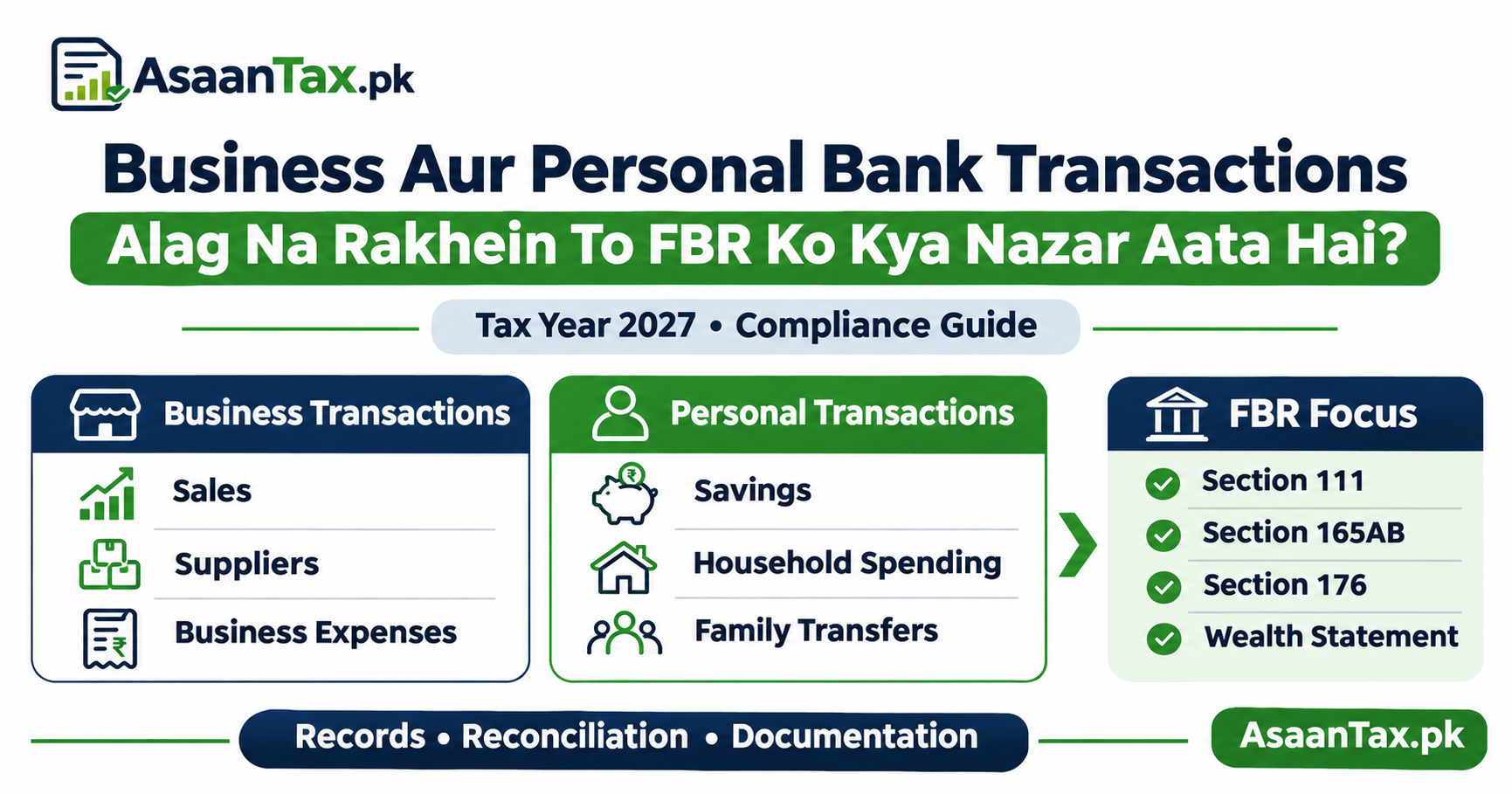
Many business owners, freelancers, consultants, online sellers and sole proprietors in Pakistan use the same bank account for business payments and personal spending.
They receive customer payments, transfer money to family members, pay household bills, purchase business equipment, receive loans and sometimes transfer money between their own bank accounts.
Although this may seem convenient, mixing business and personal bank transactions can create serious accounting, tax return and FBR reconciliation problems.
The biggest issue is not simply using one bank account. The issue arises when business revenue, personal transfers, loans and expenses cannot be clearly identified or supported by genuine financial records.
For Tax Year 2027, the importance of maintaining accurate transaction records has increased, particularly following new Finance Act 2026 provisions regarding financial data reporting and automated cross-matching.
This AsaanTax.pk guide explains what FBR may identify through legally available information, why large bank credits are not automatically taxable income, how Sections 111, 165A, 165AB, 174 and 176 apply, and how to separate and reconcile business and personal transactions.
Why Should Business and Personal Bank Transactions Be Kept Separate?
Business and personal finances serve different purposes.
Business transactions generally include customer receipts, supplier payments, salaries, business expenses, investments and financing transactions.
Personal transactions may include household spending, family transfers, gifts, personal savings, personal loans and other non-business financial activities.
When these transactions are mixed together, accurately identifying business turnover and profit becomes more difficult.
Example
A sole proprietor receives the following deposits during a tax year:
| Transaction | Amount |
|---|---|
| Customer payments | Rs. 3,000,000 |
| Transfer from own savings account | Rs. 1,000,000 |
| Documented bank loan | Rs. 800,000 |
| Genuine personal gift | Rs. 200,000 |
| Total bank credits | Rs. 5,000,000 |
The bank statement shows Rs. 5 million in total credits.
However, only Rs. 3 million represents customer receipts in this example.
The other transactions require proper classification and supporting evidence.
Total bank deposits are not automatically equal to business turnover or taxable profit.
What Can FBR See About Bank Transactions?
FBR may receive and examine relevant financial information through statutory reporting, third-party data, taxpayer declarations and legally authorized information requests.
Potential information can include:
- Relevant bank deposits and withdrawals.
- Certain reported banking transactions.
- Profit-on-debt payments.
- Withholding tax information.
- Account and transaction information required under applicable provisions.
- Declared business turnover.
- Assets and liabilities reported in Wealth Statements.
- Property and vehicle information.
- Other financial records lawfully obtained during proceedings.
FBR operates the Maloomat facility, which provides taxpayers access to certain third-party financial and asset information held in its systems.
Does FBR Have Live Access to Every Bank Account?
It is incorrect to assume that every FBR officer has unrestricted real-time access to all transactions in every bank account.
The law provides different mechanisms for information reporting, digital matching and authorized information requests.
The information available through each mechanism depends on its statutory scope.
However, taxpayers should also not assume that their bank transactions are invisible merely because the account is personal.
New Section 165AB – Bank Reporting Rules for Tax Year 2027
Finance Act 2026 introduced Section 165AB into the Income Tax Ordinance, 2001.
The provision establishes a framework for electronic reporting of specified banking information to a Central Data Hub.
It covers banks and Electronic Money Institutions under the relevant statutory conditions.
Rs. 100 Million Reporting Threshold
The framework refers to account holders whose deposits or withdrawals exceed Rs. 100 million (Rs. 10 crore) during the prescribed reporting period.
Relevant financial information can include:
- Opening and closing balances.
- Total credits.
- Peak credits.
- Deposit and withdrawal particulars.
- Other prescribed information.
The legislation provides for automated cross-matching with relevant tax information.
A gross mismatch may result in the relevant information being directed into FBR's compliance risk management process for further examination.
Important Clarification
The Rs. 100 million threshold is specific to this reporting mechanism.
It is not a general income tax exemption or a guarantee that smaller transactions cannot be reviewed by FBR.
Other statutory information-gathering provisions continue to exist.
Section 165A – Banking Information and FBR
Section 165A provides a separate legal mechanism concerning information from banking companies.
FBR has previously announced information-sharing arrangements involving data on relevant deposits, cash withdrawals, credit card payments and profit on debt.
The exact information supplied is governed by the applicable statutory provisions and reporting requirements.
For a taxpayer, the practical lesson is straightforward:
Maintain accurate records of the nature and source of substantial financial transactions.
Section 111 – Unexplained Income and Bank Deposits
Section 111 of the Income Tax Ordinance concerns unexplained income, assets, investments and certain expenditure.
The provision can become relevant when an amount or financial asset has no satisfactory explanation supported by the relevant facts.
For example, FBR may question the source of a bank deposit or investment if it appears inconsistent with the taxpayer's declared income and financial records.
However, not every unexplained-looking deposit is automatically concealed taxable income.
The taxpayer must have an appropriate opportunity to provide the correct factual and legal explanation under the applicable proceedings.
Example
A person has a bank deposit of Rs. 2 million.
The deposit represents the documented proceeds from selling a previously owned vehicle.
The taxpayer should retain the sale agreement, ownership transfer records and banking trail.
The relevant tax consequences of the underlying vehicle sale must be evaluated separately.
The banking credit should not automatically be described as new business revenue merely because funds entered the account.
Section 176 – FBR Request for Bank Statements
Section 176 allows the relevant tax authority to request prescribed information and evidence within the scope of the law.
Depending on the case, a taxpayer may be asked for:
- Bank statements.
- Details of deposits.
- Business invoices.
- Expense vouchers.
- Loan agreements.
- Property sale documents.
- Financial statements.
- Other relevant supporting records.
The taxpayer should review the exact notice, time period and legal requirements.
A response should address the specific questions and include genuine documentary evidence.
Ignoring a valid notice may result in additional legal consequences.
Section 174 – Business Record-Keeping Requirements
Section 174 provides record-maintenance requirements for taxpayers.
Income Tax Rules, 2002 contain more detailed rules governing books and records of business income.
Records may include:
- Money received and spent.
- Sales and purchases.
- Services provided and obtained.
- Business assets.
- Business liabilities.
- Supporting invoices.
- Other prescribed accounting documents.
FBR generally requires income tax records to be retained for six years, with additional retention potentially required where legal proceedings remain pending.
Keeping one mixed bank account does not eliminate record-keeping obligations.
Is It Illegal to Use a Personal Bank Account for Business?
The answer depends on the business structure, banking rules and applicable legal obligations.
Sole Proprietorship
A sole proprietor and the owner are not separate corporate legal persons.
However, banking terms, business registration, accounting and tax reporting requirements may still affect how an account should be used.
Using one account does not automatically prove tax evasion, but a separate designated business account is generally more practical.
Private Limited Company
A registered company is a separate legal entity from its shareholders and directors.
Company funds should not be freely mixed with shareholders' personal funds.
Personal payments from a company may need to be classified as remuneration, dividends, genuine loans, reimbursements or other legally appropriate transactions.
Improper mixing can create corporate accounting, tax and governance problems.
Freelancers and Consultants
Independent freelancers may receive customer payments into their personal banking arrangements where permitted by the bank and applicable regulations.
However, clear invoices, client records and business expense documentation remain essential.
Business Turnover vs Bank Credits vs Taxable Profit
These three amounts are not necessarily the same.
Bank Credits
Total deposits recorded in an account.
Business Turnover
Revenue earned from business activities according to the applicable accounting and tax rules.
Taxable Profit
Relevant business income after permitted deductions and adjustments.
Example
| Description | Amount |
|---|---|
| Total bank credits | Rs. 8,000,000 |
| Own-account transfers | Rs. 2,000,000 |
| Genuine bank loan proceeds | Rs. 1,000,000 |
| Customer receipts | Rs. 5,000,000 |
| Legitimate deductible business expenses | Rs. 3,500,000 |
| Illustrative business profit | Rs. 1,500,000 |
This is a simplified cash-receipts illustration.
Actual tax reporting can also involve receivables, liabilities, timing differences, inventory, capital expenditure and other tax adjustments.
FBR tax liability should not be calculated by automatically applying an income tax slab to every bank credit.
What Happens When Personal Expenses Are Paid From a Business Account?
Suppose a shop owner pays the following expenses from the same account used to collect business revenue.
| Payment | Amount | General Classification |
|---|---|---|
| Inventory purchase | Rs. 500,000 | Business purchase |
| Shop electricity | Rs. 40,000 | Business expense |
| Family groceries | Rs. 60,000 | Personal expense |
| Children's education | Rs. 80,000 | Personal expense |
| Business advertising | Rs. 30,000 | Business expense |
| Personal holiday | Rs. 100,000 | Personal expense |
Only legally allowable business expenditure should be claimed as a business deduction.
Personal spending cannot normally be converted into a deductible business expense merely because it was paid using a business bank account.
For a sole proprietor, personal withdrawals should be reflected appropriately as owner drawings or other relevant movements.
For a company, the legal classification of payments to directors or shareholders must be reviewed separately.
Transfers Between Your Own Bank Accounts
A transfer between two accounts belonging to the same person is generally a movement of existing funds rather than new income.
Example
A taxpayer transfers Rs. 500,000 from Bank A to Bank B.
Bank A records a debit.
Bank B records a credit.
The person has not necessarily earned another Rs. 500,000.
The transfer should be reconciled using both statements.
Documents to Maintain
- Bank A statement.
- Bank B statement.
- Transaction reference.
- Matching dates and amounts.
- Explanation of the movement.
The same transfer should not be counted twice as customer revenue.
What If a Family Member Transfers Money to Your Business Account?
Family transfers require correct classification.
The payment might be:
- A genuine gift.
- A loan.
- Repayment of money previously lent.
- Payment for goods or services.
- A capital contribution.
- Another transaction.
Each category has different financial and possible tax consequences.
A transfer from a relative is not automatically exempt income.
Supporting evidence should reflect the true legal and financial nature of the transaction.
Example
A relative transfers Rs. 1,000,000 as a genuine documented loan.
If the amount is legally repayable, it may be treated as a liability rather than business revenue.
The documentation should support the loan and relevant banking transactions.
Do not manufacture loan agreements after receiving an FBR inquiry to conceal actual income.
Are Cash Deposits Automatically Taxable?
No.
Cash deposits are banking transactions, not automatically taxable income.
However, cash deposits can require explanation where their source is unclear.
Possible sources may include:
- Cash business receipts.
- Previously withdrawn funds.
- Documented asset sale proceeds.
- Genuine loans.
- Gifts.
- Other lawful financial transactions.
The correct tax treatment depends on the actual source.
Cash business sales may still be taxable business receipts.
Depositing existing cash does not by itself generate new earnings.
What Happens When Freelancers Receive Client Payments?
Freelancers should maintain separate records for:
- Local client receipts.
- Foreign client receipts.
- Platform fees.
- Refunds.
- Transfers from payment platforms.
- Business expenses.
- Personal withdrawals.
- Withholding tax.
- Foreign remittance evidence.
For qualifying IT and IT-enabled service exporters, Section 154A can provide a special tax regime subject to conditions.
However, the mere receipt of foreign money does not establish eligibility for a reduced rate.
Example
A freelancer receives Rs. 2 million from overseas clients.
The taxpayer should identify:
- Actual gross export proceeds.
- Nature of the exported services.
- Banking and realization documentation.
- Registration status where required.
- Applicable tax regime.
- Any allowable expenses or other reporting requirements.
The account's label as personal or business does not by itself determine the income tax rate.
How to Separate Business and Personal Transactions
The following process can help maintain accurate records.
Step 1: Identify Your Business Structure
Determine whether you operate as a sole proprietor, partnership, AOP or company.
Step 2: Use a Dedicated Business Bank Account
Open an appropriate account for business activity, subject to the bank's requirements.
Step 3: Receive Customer Payments Through the Business Account
Where practical, direct customer receipts to the dedicated account.
Step 4: Pay Genuine Business Expenses From the Business Account
Maintain invoices, bills and payment evidence.
Step 5: Record Personal Withdrawals Separately
For a sole proprietor, track drawings taken for personal use.
For a company, use the legally appropriate accounting and payment procedure.
Step 6: Label Transfers Correctly
Distinguish between:
- Sales.
- Loan receipts.
- Owner capital contributions.
- Own-account transfers.
- Reimbursements.
- Gifts.
- Refunds.
- Other non-revenue amounts.
Step 7: Reconcile Bank Statements Monthly
Match every significant transaction with the relevant accounting records.
Step 8: Prepare Annual Tax Records
Reconcile turnover, business profit, financial assets and liabilities before filing the income tax return.
Practical Bank Reconciliation Example
Suppose a business owner has the following annual cash inflows and outflows.
Money Received
| Receipt | Amount |
|---|---|
| Customer receipts | Rs. 4,000,000 |
| Owner's own savings transfer | Rs. 800,000 |
| Documented loan | Rs. 700,000 |
| Total money received | Rs. 5,500,000 |
Money Paid
| Payment | Amount |
|---|---|
| Suppliers and business operating expenses | Rs. 2,500,000 |
| Personal household spending | Rs. 900,000 |
| Business equipment purchase | Rs. 400,000 |
| Closing balance increase, assuming zero opening cash balance and no other movements | Rs. 1,700,000 |
The records should separately show:
- Business revenue.
- Business expenses.
- Personal spending.
- Capital transactions.
- Loan liability.
- Equipment asset.
- Closing cash or bank balance.
Taxable profit is determined after applying the appropriate accounting and income tax rules.
Capital equipment purchases are not necessarily immediately deductible as ordinary business expenses; depreciation provisions may apply.
How to Report Business and Personal Transactions in an FBR Return
Step 1: Collect Complete Bank Statements
Obtain records for every relevant account and period.
Step 2: Prepare Business Accounts
Calculate actual revenue, allowable expenses and business profit.
Step 3: Identify Personal Transactions
Separate personal spending, savings transfers, gifts and loans.
Step 4: Report Income Under the Correct Head
Use the appropriate FBR return categories for business income, salary, property income, capital gains or other sources.
Step 5: Reconcile Relevant Withholding Tax
Match tax deduction certificates and FBR records.
Step 6: Complete the Wealth Statement
Where required under Section 116, report relevant bank balances, assets, liabilities and personal expenses.
Step 7: Check the Reconciliation
The change in net wealth should reconcile with relevant financial inflows and outflows.
Step 8: Submit Through IRIS
File the applicable return and statement through the official portal.
Wealth Statement Problems Caused by Mixed Bank Transactions
When business and personal transactions are not clearly classified, the taxpayer may face difficulty explaining changes in net wealth.
Common problems include:
- Duplicate recording of own-account transfers.
- Missing bank balances.
- Personal expenses claimed as business costs.
- Missing loan liabilities.
- Undeclared business assets.
- Incorrect business capital balances.
- Cash movements counted as income.
- Missing records of asset sales.
FBR's reconciliation guidance requires the difference between current-year and previous-year wealth to agree with the difference between relevant receipts and expenses.
The Unreconciled Amount should be zero before successful submission.
However, achieving zero by inserting fabricated cash, gifts or loans does not make a declaration legally accurate.
What If FBR Sends a Notice About Bank Deposits?
If FBR issues a notice requesting an explanation of bank credits:
First: Verify the Notice
Check its authenticity through the relevant official FBR facility.
Second: Identify the Section
The notice may relate to Section 176, Section 111, Section 122 or another provision.
Third: Review the Period
Check the exact tax year and bank transactions concerned.
Fourth: Prepare a Transaction Reconciliation
Explain each disputed amount using accurate records.
Fifth: Attach Genuine Supporting Evidence
Include bank statements, invoices, loan records and other relevant documents.
Sixth: Submit Within the Applicable Deadline
Follow the notice-linked procedure and retain the acknowledgment.
A notice is not automatically proof of tax evasion or an immediately enforceable tax demand.
Can FBR Treat All Bank Deposits as Business Turnover?
Not automatically.
Business turnover must be determined from the actual nature of the transactions and applicable law.
For example, a documented transfer from a person's own account ordinarily does not constitute an additional sale.
Similarly, genuine loan proceeds are not automatically business revenue.
However, amounts that represent customer sales or other taxable receipts cannot be excluded simply by describing them as personal transfers.
Where a taxpayer fails to provide a satisfactory explanation under relevant legal proceedings, adverse tax adjustments may arise.
What Penalties Can Apply to Incorrect Reporting?
Consequences depend on the actual default and applicable section.
Potential issues include:
- Amendment of assessment.
- Penalties for specified tax defaults.
- Default surcharge where applicable.
- Additional tax demands.
- Audit or information requests.
- Other proceedings authorized by law.
There is no single automatic penalty that applies every time someone uses a personal account for business transactions.
Penalties require a relevant legal basis and applicable statutory conditions.
Best Practices for Small Businesses and Freelancers
To improve tax compliance:
- Use a designated business account where practical.
- Keep clear invoices for customer payments.
- Reconcile bank accounts monthly.
- Record personal drawings separately.
- Maintain supporting records for loans and gifts.
- Avoid mixing company and shareholder funds.
- Categorize foreign receipts accurately.
- Keep complete withholding tax records.
- Reconcile closing assets and liabilities.
- Retain required records for the statutory period.
- Review IRIS and Maloomat information.
- Respond promptly to valid FBR correspondence.
Watch Tax with Naeem – Income Tax and Bank Profit Reporting
For Urdu-language guidance on declaring different sources of income in an FBR return, see this related tutorial from Tax with Naeem:
Income Tax Return Filing in Pakistan | Salary | Rental | Capital Gain | Dividend Explained
https://www.youtube.com/watch?v=VX88o1N1AfA
This video explains income classification and annual tax-return reporting, including financial income sources.
Important: It is a related income-tax tutorial, not a specific Section 165AB or business/personal bank reconciliation tutorial.
For additional related videos, search:
https://www.youtube.com/results?search_query=Tax+with+Naeem+bank+transactions+FBR
How AsaanTax.pk Can Help
AsaanTax.pk provides tax compliance assistance to individuals, freelancers, sole proprietors and registered businesses.
Relevant services include:
- Business income tax return preparation.
- Bank transaction reconciliation guidance.
- FBR notice review.
- Wealth Statement preparation.
- Sole proprietorship NTN registration.
- Freelance income tax guidance.
- Business and personal transaction classification.
- Withholding tax reconciliation.
- FBR IRIS filing assistance.
- General income tax compliance.
Need Help Understanding FBR Bank Transaction Rules?
Visit AsaanTax.pk for income tax filing guidance, business documentation assistance and FBR compliance information.
Website: https://www.asaantax.pk/
AsaanTax.pk is an independent tax services platform and is not affiliated with the Federal Board of Revenue or the Government of Pakistan.
Official Sources and References
- FBR – Income Tax Ordinance, 2001
- FBR – Finance Act 2026
- FBR – Income Tax Rules, 2002
- FBR – Maloomat Third-Party Financial Information
- FBR – Banking Information Sharing
- FBR – File Income Tax Return and Wealth Statement
- FBR – IRIS Portal
- Tax with Naeem – Income Tax Return Tutorial
Last updated: November 4, 2026.
Disclaimer: This article is general educational information. FBR's access to bank data, the scope of financial reporting, business-income classification and tax obligations depend on the law and circumstances of each case. The Section 165AB threshold is not a tax-free allowance or a safe limit for avoiding scrutiny. Never create false financial documents or divide transactions to conceal income. For significant discrepancies or disputed notices, consult a qualified tax professional.