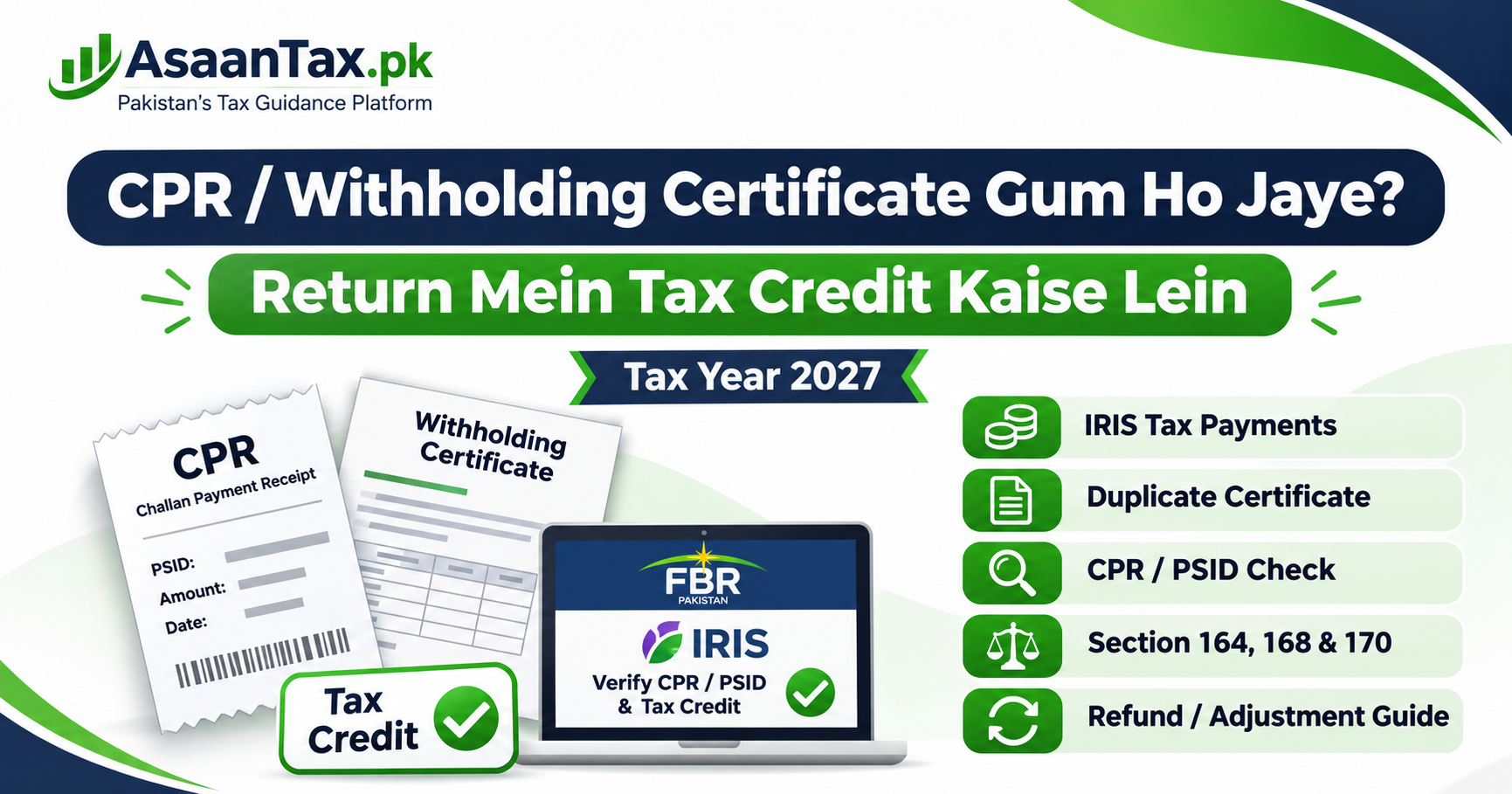
Have you lost your FBR Computerized Payment Receipt (CPR), withholding tax certificate or proof of advance income tax payment?
Perhaps your employer deducted salary tax, a bank deducted tax from savings profit, or you paid advance income tax while purchasing property or registering a motor vehicle.
When preparing your annual income tax return, you discover that the original certificate or receipt is missing.
A common question is:
"If my withholding tax certificate or CPR is lost, can I still claim tax credit in my FBR income tax return?"
In many cases, a missing document can be recovered, replaced or supported with verified records. However, claiming a tax credit depends on the actual tax deduction, payment, classification and relevant legal requirements.
For Tax Year 2027, Sections 164, 168 and 170 of the Income Tax Ordinance, 2001 are especially important.
This AsaanTax.pk guide explains how to locate missing CPR records, request a duplicate withholding certificate, check tax payments in IRIS, deal with missing withholding entries, claim eligible tax credits and apply for refunds where legally permitted.
What Is a Computerized Payment Receipt (CPR)?
A Computerized Payment Receipt, commonly called CPR, is an official payment record generated after a tax payment has been successfully deposited through the applicable FBR payment system.
The receipt may contain information such as:
- CPR number.
- Taxpayer identification.
- Payment date.
- Tax type.
- Amount paid.
- Relevant payment particulars.
- Other transaction information.
According to FBR's payment guidance, a CPR is generated after successful payment and generally becomes reflected in IRIS within 24 hours.
A CPR is important supporting evidence when reconciling income tax payments.
What Is a PSID?
PSID stands for Payment Slip ID.
It is generated through the applicable tax payment system before completing the payment.
The PSID identifies a payment transaction so that the relevant amount can be deposited through an authorized payment channel.
CPR vs PSID
| PSID | CPR |
|---|---|
| Generated for payment | Generated after successful payment |
| Identifies payment slip | Evidence of completed payment |
| May remain unpaid | Relates to recorded paid transaction |
| Not sufficient alone to prove tax deposit | Used to verify completed tax payment |
Important: A PSID without a corresponding successful payment record does not prove that tax has been deposited.
What Is a Withholding Tax Certificate?
A withholding tax certificate is evidence of tax collected or deducted by a prescribed withholding agent.
The withholding agent may be:
- Employer.
- Bank.
- Customer or company.
- Property transfer authority.
- Motor vehicle registering authority.
- Government department.
- Another person required by law to deduct or collect tax.
Section 164 of the Income Tax Ordinance provides the framework for withholding tax certificates and related payment documentation.
Example
A company pays a consultant Rs. 500,000.
Assume the applicable withholding tax for the transaction is Rs. 30,000.
The company deducts Rs. 30,000 and pays Rs. 470,000 to the consultant.
The consultant should obtain proper withholding documentation showing the deduction and relevant details.
Whether the Rs. 30,000 can be adjusted against the consultant's annual income tax liability depends on the applicable legal tax treatment.
Can You Claim Tax Credit If the CPR Is Lost?
Potentially, yes.
Losing a physical or digital copy of a CPR does not necessarily mean that the underlying government payment no longer exists.
The key questions are:
- Was tax actually deducted or collected?
- Was the relevant payment made or reported correctly?
- Can the payment be verified?
- Does the amount belong to the correct taxpayer?
- Does it relate to the correct tax year?
- Is the tax legally adjustable?
- Has the same credit already been claimed?
Where the required legal conditions and evidence are satisfied, a lost document can often be replaced or the relevant payment verified through official records.
However, an unsupported deduction cannot automatically be claimed merely because a taxpayer believes tax was withheld.
Section 164 – Right to Withholding Documentation
Section 164 establishes requirements for persons who deduct or collect tax to provide the applicable certificate and prescribed payment particulars.
The recipient should retain the certificate and payment evidence.
What If the Certificate Is Lost?
The taxpayer should contact the withholding agent and request a duplicate or replacement certificate.
For example:
- An employee can contact the employer's payroll or accounts department.
- A saver can contact the bank.
- A contractor can contact the client who deducted tax.
- A property buyer or seller can contact the relevant collection authority.
- A vehicle purchaser can contact the relevant collecting authority.
The replacement document should identify the actual transaction and tax deduction accurately.
Never prepare a fake certificate or alter the original tax figures.
How to Recover a Lost CPR Through FBR IRIS
FBR provides online payment and verification services through IRIS.
Step 1: Open the Official Portal
Visit:
Step 2: Sign In
Use your registered CNIC or NTN and password.
Step 3: Review Tax Payment Records
Navigate to the available tax payments or payment history sections.
FBR also provides a separate public CPR verification service.
Step 4: Search the Relevant Payment
Use available identifying information such as:
- CPR number.
- PSID.
- Taxpayer registration details.
- Payment date.
- Payment amount.
- Relevant tax year.
The exact search options depend on the available IRIS interface.
Step 5: Verify the Record
Confirm that the payment belongs to the correct taxpayer and relevant period.
Step 6: Retrieve the Available Evidence
Download, print or save the available official payment record.
Step 7: Preserve a Backup
Keep electronic copies securely with your tax records.
Important: An online CPR verification facility may require an existing CPR or PSID number. If the identification is missing, use your authenticated payment history or request the particulars from the original payment channel.
How to Check Withholding Tax in IRIS MIS
FBR specifically identifies the following facility for reviewing many withholding payment records:
IRIS → MIS → Tax Payments
Step 1
Log in to IRIS.
Step 2
Open the MIS section, where available.
Step 3
Select Tax Payments.
Step 4
Review the available withholding tax entries.
Step 5
Identify the relevant tax year, section, withholding agent and amount.
Step 6
Compare the entries with supporting documents.
Step 7
Record or download the available information for reconciliation.
Some data may also be accessible through FBR Maloomat.
What If a Payment Is Missing?
A missing IRIS entry does not automatically prove that the withholding agent never deducted tax.
It may indicate a reporting delay, identification error or other reconciliation issue.
The payment should be investigated using reliable supporting evidence.
What Is FBR Maloomat?
FBR Maloomat is a facility through which taxpayers may access specified third-party information held by FBR.
Depending on available records, it may include withholding and other financial information.
Use the official facility available through FBR.
For withholding claims, compare Maloomat information with IRIS, payment receipts and actual transaction records.
Not every payment or withholding entry is guaranteed to appear in the same way across all facilities.
How to Get a Duplicate Salary Withholding Certificate
If you are a salaried employee and your certificate has been lost:
Step 1: Contact Your Employer
Request the annual salary and withholding tax certificate.
Step 2: Mention the Tax Year
Clearly identify the required tax period.
For Tax Year 2027, the ordinary period is July 1, 2026 to June 30, 2027.
Step 3: Request Relevant Details
The certificate should contain the applicable salary and withholding details.
Step 4: Check Payroll Records
Compare the certificate with monthly payslips.
Step 5: Check IRIS
Verify the available withholding information.
Step 6: Resolve Any Discrepancy
If the amounts differ, request clarification or correction from the employer.
Important
Tax deducted from salary under Section 149 is generally relevant to the employee's annual tax calculation.
However, the actual tax credit must reflect accurate, legally eligible amounts.
How to Get a Duplicate Bank Withholding Tax Certificate
Banks may deduct tax from specified profit-on-debt payments under Section 151.
If your certificate is missing:
- Contact the bank.
- Request a withholding tax certificate for the relevant year.
- Obtain the relevant account statement.
- Check gross profit credited.
- Check tax deducted.
- Verify the bank's records against available FBR information.
- Confirm whether the tax belongs to an adjustable, separate or final regime.
Important
Not every withholding amount deducted from bank profit is freely adjustable against unrelated salary or business tax.
The income and withholding must be classified under the applicable law before determining the correct credit or refund treatment.
What If Property Tax CPR Is Missing?
Advance income tax can be collected during property transactions under provisions including:
- Section 236C: Relevant property sale or transfer.
- Section 236K: Relevant property purchase or transfer.
- Section 236A: Qualifying property auctions.
If the relevant receipt is lost:
Step 1: Locate the Property Transaction
Identify the property, date and transaction reference.
Step 2: Contact the Collecting Authority
This may be a registrar, development authority, housing society or other prescribed entity.
Step 3: Request CPR or PSID Details
Obtain the relevant payment reference and supporting confirmation.
Step 4: Verify With FBR
Use the official payment verification or IRIS facility.
Step 5: Check Tax Treatment
Determine whether the tax is legally adjustable, minimum or otherwise subject to a special regime.
Step 6: Preserve Supporting Documents
Keep property transfer records, receipts and tax payment evidence.
Do not automatically assume every amount paid during property registration is an adjustable income tax credit.
Stamp duty, registration fees and other charges are not the same as federal advance income tax.
What If Vehicle Purchase Tax CPR Is Lost?
Section 231B concerns specified advance income tax on motor vehicle transactions.
A person who lost the relevant receipt should contact the manufacturer, dealer, registering authority or collecting person, as applicable.
Useful records include:
- Vehicle invoice.
- Registration record.
- Vehicle particulars.
- CNIC or NTN.
- Purchase or registration date.
- Tax payment reference.
Check the actual applicable transaction and tax year before claiming the amount.
Tax paid under Section 231B may generally be adjustable subject to the relevant statutory provisions.
What If Your Client Deducted Tax but Gave No Certificate?
This is a common issue for consultants, freelancers, contractors and businesses.
For example, a customer may pay an invoice after withholding tax under Section 153.
The recipient receives a reduced amount but no withholding certificate.
Recommended Action
- Contact the client's accounts department.
- Ask which legal section was used.
- Confirm the gross invoice amount.
- Confirm the withholding amount.
- Request the tax deduction certificate.
- Request the corresponding payment or reporting evidence.
- Compare the records with IRIS.
- Resolve any discrepancy before claiming an unsupported amount.
Important
A reduced client payment does not by itself establish that the deducted amount was correctly deposited and is available as an adjustable tax credit.
The applicable tax regime may also classify certain deductions as minimum or final tax.
Section 168 – How Tax Credit Works
Section 168 provides credit rules for tax collected or deducted under the relevant provisions.
The credit is subject to statutory limitations and the nature of the deduction.
Example 1: Adjustable Withholding Tax
Suppose an individual has:
| Description | Amount |
|---|---|
| Annual income tax liability | Rs. 150,000 |
| Eligible salary withholding | Rs. 100,000 |
| Eligible additional withholding | Rs. 30,000 |
| Remaining tax payable | Rs. 20,000 |
Calculation:
Rs. 150,000 − Rs. 100,000 − Rs. 30,000 = Rs. 20,000.
The relevant records must support the Rs. 130,000 total credit.
Example 2: Excess Tax Paid
Suppose another taxpayer has:
| Description | Amount |
|---|---|
| Final annual income tax liability | Rs. 100,000 |
| Eligible adjustable income tax paid | Rs. 140,000 |
| Illustrative excess tax | Rs. 40,000 |
Where all legal conditions are satisfied, the Rs. 40,000 excess may be eligible for refund treatment.
The existence of excess tax in a calculation does not automatically establish an approved cash refund.
Adjustable Tax vs Final Tax vs Minimum Tax
The legal classification of withholding tax is extremely important.
| Tax Type | General Treatment |
|---|---|
| Adjustable tax | Eligible credit against the relevant annual tax liability |
| Final tax | Settles tax under the applicable final-tax regime |
| Minimum tax | Subject to the applicable minimum-liability rules |
| Exempt or non-creditable payment | No automatic ordinary income tax credit |
Adjustable Tax
May be credited according to Section 168 and other applicable provisions.
Final Tax
Should not automatically be entered as an ordinary adjustable credit against unrelated income.
Minimum Tax
The deduction may establish a minimum tax liability that limits an ordinary adjustment or refund.
A lost certificate does not change the original legal character of the tax.
What If Withholding Tax Is Not Showing in IRIS?
There can be several reasons:
- Withholding agent used the wrong CNIC or NTN.
- Incorrect tax year was selected.
- Payment is not reflected yet.
- Wrong tax section was selected.
- Withholding statement contains an error.
- Tax was deducted but not deposited correctly.
- Payment classification does not match the taxpayer.
- Available data is incomplete.
How to Resolve the Problem
First, obtain evidence from the withholding agent.
Second, compare the taxpayer identification details.
Third, confirm the relevant tax year and section.
Fourth, obtain available CPR, SPR or equivalent payment information.
Fifth, request correction of the withholding agent's reporting where necessary.
Sixth, review the updated record through FBR's official systems.
If the matter remains unresolved, approach FBR using an appropriate complaint, facilitation or legal procedure.
What If Tax Was Deducted but Not Deposited?
This is a more serious issue than merely losing a certificate.
A withholding agent generally has obligations to deduct, deposit and report tax correctly.
Sections 160 and 161 are relevant to payment and failure-to-pay obligations.
However, the legal consequences for the withholding agent and the taxpayer claiming credit depend on the actual facts and applicable law.
Recommended Procedure
- Obtain proof of deduction.
- Ask the withholding agent for deposit details.
- Request the withholding certificate.
- Compare the amount with FBR records.
- Seek correction or official determination where required.
- Do not fabricate a CPR or claim that payment has been verified when it has not.
How to Claim Withholding Tax Credit in Tax Year 2027 Return
Step 1: Gather Supporting Records
Collect all available documents, including duplicates and transaction evidence.
Step 2: Log In to IRIS
Visit https://iris.fbr.gov.pk/.
Step 3: Select Tax Year 2027
Choose the relevant income tax return when the filing form is available.
Step 4: Declare Income Correctly
Enter salary, business income, property income and other reportable income in their appropriate categories.
Step 5: Review Withholding Tax
Locate the applicable tax deduction or payment section.
Step 6: Match Your Records
Confirm the taxpayer, legal provision, payment period and amount.
Step 7: Enter Eligible Adjustable Tax
Record only the amount that is legally creditable and properly supported.
Step 8: Separate Final and Minimum Tax
Use their proper return schedules and do not duplicate the same payment.
Step 9: Review the Tax Calculation
Check the final liability after applicable deductions and credits.
Step 10: Submit the Return
Submit the return and legally required supporting statements.
Step 11: Preserve All Documentation
Keep copies of relevant certificates, payment records and submission acknowledgments.
The precise names of Tax Year 2027 IRIS fields should be checked when the relevant form becomes available.
What If the CPR Belongs to the Wrong Tax Year?
An incorrect tax period can create a mismatch in the annual return.
For example, a payment made in July 2027 may relate to a different obligation from an amount deducted during the tax year ending June 30, 2027.
The correct year depends on the transaction, deduction date, payment and relevant statutory provision.
Do not simply move the amount into a different year's credit field without confirming its legal treatment.
If a classification error exists, request correction through the prescribed procedure.
What If the CPR Contains the Wrong CNIC or NTN?
This can prevent payment records from matching the intended taxpayer.
Step 1
Obtain the original payment details.
Step 2
Identify the incorrect registration number.
Step 3
Contact the relevant withholding agent or payment authority.
Step 4
Request the appropriate official correction.
Step 5
Preserve the payment and correction evidence.
Step 6
Reconcile the corrected record with IRIS before making the final claim.
Never use a CPR belonging to another taxpayer merely because it shows the same tax amount.
How to Claim a Refund of Excess Withholding Tax
Section 170 provides the statutory framework for refunds of excess income tax.
A taxpayer should determine whether:
- The amount was legally paid or credited.
- The amount is adjustable or refundable.
- The relevant return has been filed.
- Supporting records are available.
- The refund amount is correctly calculated.
- Statutory time limits and procedures are satisfied.
Step 1: Submit the Income Tax Return
File the applicable return using accurate income and payment information.
Step 2: Reconcile Eligible Tax Credits
Verify amounts claimed under the relevant provisions.
Step 3: Determine the Actual Excess
Compare legally creditable payments with the final tax liability.
Step 4: Apply for Refund
Use the prescribed Section 170 process where applicable.
Step 5: Respond to Verification Requests
Provide genuine supporting records.
Step 6: Monitor the Refund Status
Follow the relevant FBR process.
Important: Missing CPR documentation may delay verification, but it does not automatically mean every genuine payment is lost or that every claimed amount must be refunded.
Can You File Your Return Without the Original Paper CPR?
An income tax return can be prepared using genuine electronic and documentary records, subject to the current legal and system requirements.
However, Section 164 contains documentation requirements for withholding payments.
Therefore, the safest procedure is to recover the original record, obtain a duplicate or secure legally acceptable supporting evidence before finalizing a credit claim.
A taxpayer should not assume that a screenshot of an unrelated payment is sufficient.
Sample Withholding Tax Reconciliation Table
Prepare a table before filing:
| Tax Source | Gross Amount | Tax Deducted | Evidence | Status |
|---|---|---|---|---|
| Employer salary | Rs. 1,800,000 | Rs. 72,000 | Salary certificate | Verified |
| Bank profit | Rs. 200,000 | Rs. 40,000 | Bank certificate | Verify regime |
| Client services | Rs. 500,000 | Rs. 30,000 | Duplicate requested | Pending |
| Vehicle purchase | As per invoice | Rs. 60,000 | CPR | Verified |
How to Use This Table
The taxpayer should verify each payment separately.
Do not add all four entries automatically as adjustable credits.
For example, the bank-profit tax may fall under a separate legal regime.
Client withholding may be adjustable, minimum or final depending on the actual transaction.
The verified vehicle tax should be classified under the applicable Section 231B rules.
How to Prevent CPR and Certificate Loss
Follow these practices:
- Save CPR documents in PDF format.
- Keep a secure backup of payment records.
- Maintain a tax-year-wise folder.
- Save salary and bank withholding certificates.
- Keep original invoices.
- Record the PSID and CPR numbers.
- Match payments with IRIS.
- Use clear document filenames.
- Reconcile withholding tax quarterly.
- Maintain records for the required statutory period.
Suggested File Naming Format
TY2027_Section149_SalaryTax.pdf
TY2027_Section231B_VehicleCPR.pdf
TY2027_Section153_ClientCertificate.pdf
This makes annual return preparation and future FBR correspondence easier.
Common Mistakes When Claiming Lost CPR Tax Credit
Avoid these mistakes:
- Treating an unpaid PSID as proof of tax payment.
- Claiming estimated withholding amounts without evidence.
- Using another taxpayer's CPR.
- Selecting the wrong tax year.
- Claiming final tax as ordinary adjustable tax.
- Ignoring minimum-tax provisions.
- Claiming the same payment twice.
- Failing to request a duplicate certificate.
- Assuming a missing IRIS entry proves no deduction occurred.
- Ignoring differences between withholding agent and taxpayer records.
- Treating sales tax as income tax credit.
- Assuming every credit creates an automatic refund.
- Submitting false or altered certificates.
- Ignoring notices requesting payment verification.
Watch Tax with Naeem – Income Tax Return and Withholding Tax
For a related Urdu tutorial about income tax return preparation and tax already deducted from different sources, watch:
Tax with Naeem – Income Tax Return Filing in Pakistan | Salary | Rental | Capital Gain | Dividend Explained
https://www.youtube.com/watch?v=VX88o1N1AfA
This is a related tax-return tutorial, not a dedicated lost-CPR recovery video.
For CPR-specific videos, search the Tax with Naeem channel:
https://www.youtube.com/results?search_query=Tax+with+Naeem+CPR+Withholding+Tax+Certificate
Always follow the official FBR payment verification and documentation rules.
How AsaanTax.pk Can Help
AsaanTax.pk provides guidance and assistance with:
- Income tax return preparation.
- Withholding tax reconciliation.
- Missing CPR and payment record guidance.
- Income tax credit verification.
- Salaried-person tax filing.
- Business withholding tax documentation.
- Property and vehicle tax records.
- FBR IRIS payment verification.
- Income tax refund application guidance.
- FBR notice and record reconciliation.
Need Help With a Missing CPR or Withholding Certificate?
Visit AsaanTax.pk for guidance on reconciling income tax records and preparing an accurate return.
Website: https://www.asaantax.pk/
AsaanTax.pk is an independent tax services website and is not affiliated with the Federal Board of Revenue or the Government of Pakistan.
Official Sources and References
- FBR – Income Tax Ordinance, 2001
- FBR – Withholding Taxes
- FBR – Income Tax Payment and CPR Guide
- FBR – IRIS Online Portal and CPR Verification
- FBR – IRIS Help and User Guides
- Tax with Naeem – Income Tax Return Tutorial
Last updated: November 4, 2026.
Disclaimer: This article provides general educational information. Credit eligibility depends on the actual tax deduction, payment, relevant tax year, statutory classification and supporting records. Sections 164, 168 and 170 must be applied according to the current law and individual circumstances. A missing document is not proof that a payment was made or that a refund is automatically due. Seek qualified assistance for disputed payments or tax notices.