Every year, millions of people in Pakistan pay Zakat, Sadaqah and charitable donations to support families, hospitals, educational institutions, disaster relief funds and welfare organizations.
Many taxpayers also ask an important question:
Can Zakat or charitable donations reduce income tax in Pakistan?
The answer is yes in qualifying circumstances, but the applicable tax treatment depends on the nature of the payment, the recipient organization and the relevant provisions of the Income Tax Ordinance, 2001.
For Tax Year 2027 (July 1, 2026 to June 30, 2027), two sections are particularly important:
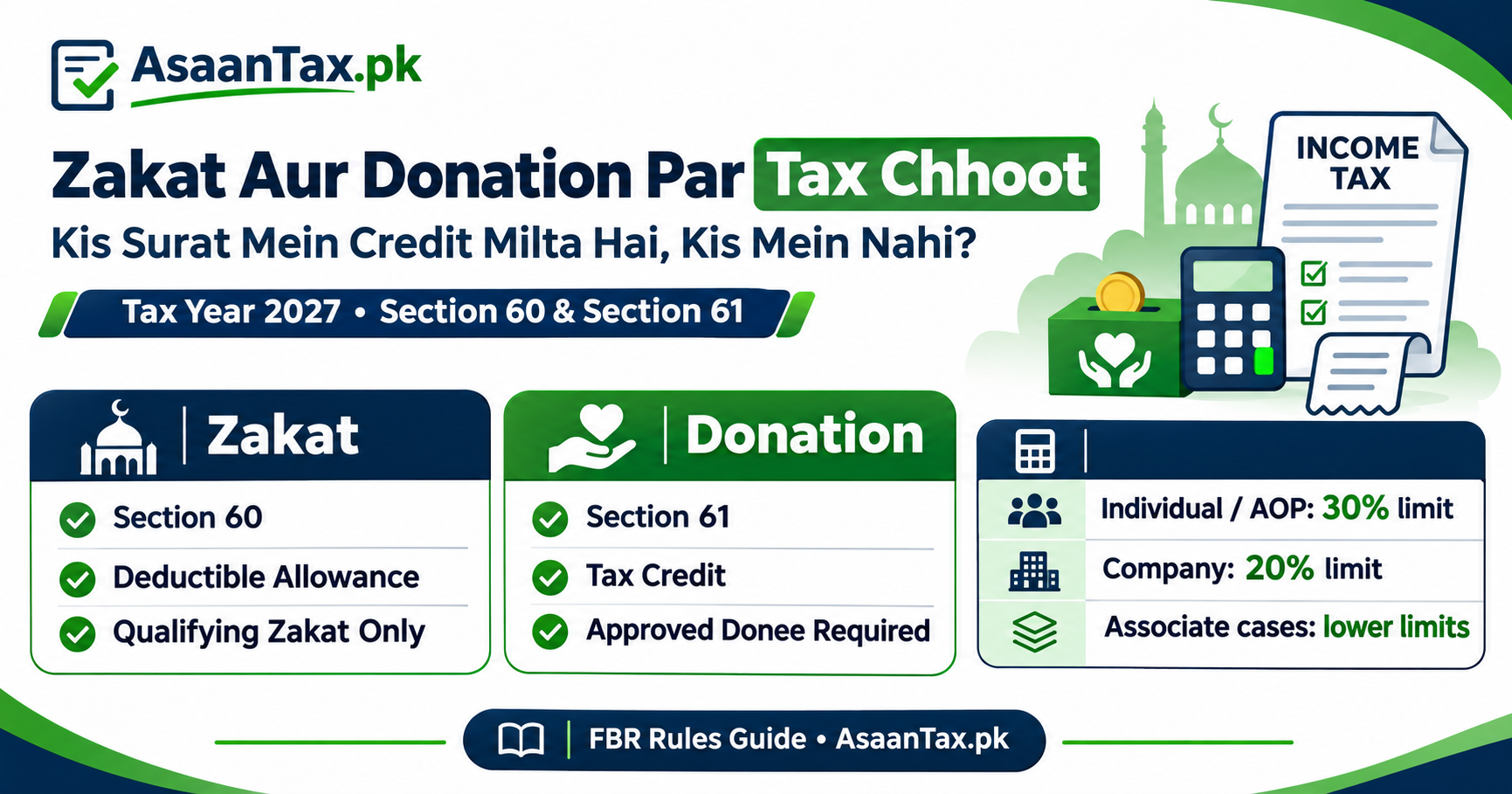
- Section 60 – Deductible allowance for qualifying Zakat.
- Section 61 – Tax credit for eligible charitable donations.
These provisions operate differently.
Zakat qualifying under Section 60 may reduce taxable income through a deductible allowance, whereas qualifying charitable donations under Section 61 may reduce calculated income tax through a statutory tax credit.
This complete AsaanTax.pk guide explains the latest FBR rules, donation tax credit limits, eligible charities, Zakat deductions, required receipts, calculation examples and income tax return filing procedures.
What Is the Difference Between Zakat and Charitable Donations for Income Tax?
Although Zakat and charitable donations both involve giving money or property for beneficial purposes, their tax treatment is not automatically the same.
| Feature | Zakat | Charitable Donation |
|---|---|---|
| Main tax section | Section 60 | Section 61 |
| Nature of relief | Deductible allowance | Tax credit |
| Main eligibility | Payment under Zakat and Ushr Ordinance | Donation to qualifying recipient |
| Calculation | Relevant allowable deduction | Formula-based tax credit |
| Key documents | Zakat deduction or payment evidence | Valid donation and eligibility evidence |
| Automatic refund | No | No |
| Can every payment qualify? | No | No |
The legal classification of the payment is essential.
A person cannot simply describe every voluntary contribution as Zakat or every family transfer as a qualifying charitable donation to obtain tax relief.
Section 60 – Zakat Deduction in Pakistan
Section 60 of the Income Tax Ordinance provides a deductible allowance for qualifying Zakat paid under the Zakat and Ushr Ordinance, 1980.
This is a deduction-related provision rather than an ordinary tax credit.
Which Zakat Payments May Qualify?
A taxpayer may be entitled to an allowance for Zakat paid in accordance with the relevant statutory framework.
For example, Zakat deducted through the prescribed banking mechanism may be supported by the relevant official deduction certificate.
The taxpayer must establish that the payment meets Section 60.
Important Conditions
Section 60 does not allow the same Zakat amount to be deducted twice where it has already been taken into account under Section 40(2).
An unused allowance cannot ordinarily be refunded, carried forward to a future tax year or carried back to an earlier year.
Example: Zakat Deduction From Taxable Income
Suppose an individual has the following:
Taxable income before Section 60 allowance: Rs. 2,000,000.
Qualifying Zakat under the applicable statutory conditions: Rs. 50,000.
Assuming the full allowance is available against the relevant taxable-income calculation:
Adjusted illustrative taxable-income amount:
Rs. 2,000,000 − Rs. 50,000 = Rs. 1,950,000.
Income tax is then calculated using the appropriate provisions and tax schedule.
Important: The income tax saving is not necessarily Rs. 50,000.
The actual tax saving depends on the applicable marginal tax rate and the person's overall tax position.
Does Voluntary Zakat Given Directly to a Poor Person Qualify?
A person may voluntarily give Zakat directly to a deserving recipient for religious purposes.
However, whether that payment qualifies for a Section 60 income tax allowance is a separate legal question.
Section 60 specifically refers to Zakat paid under the Zakat and Ushr Ordinance, 1980.
Therefore, taxpayers should not automatically claim every privately distributed Zakat payment as a Section 60 deduction.
A direct payment to an individual also does not automatically qualify for the Section 61 charitable donation tax credit.
For return filing, distinguish religious Zakat obligations from legally recognized income tax deductions.
What Is Section 61 – Charitable Donations?
Section 61 provides a tax credit for qualifying charitable donations, voluntary contributions or subscriptions made during the relevant tax year.
The donation must be made to a recipient covered by the statutory provision.
These can include:
- Educational boards or universities in Pakistan established under relevant federal or provincial law.
- Educational institutions, hospitals or relief funds established or run by federal, provincial or local government.
- Qualifying nonprofit organizations.
- Persons eligible for the relevant Section 100C tax credit.
- Entities, organizations and funds included in the Thirteenth Schedule.
Important: Simply calling an organization a charity or NGO does not automatically establish Section 61 eligibility.
The organization must satisfy the applicable legal conditions.
Which Organizations Qualify for Donation Tax Credit?
Eligibility should be established using the current statutory provisions and appropriate supporting evidence.
Examples of potentially qualifying recipients include:
Government Educational Institutions
Qualifying public educational institutions established or administered under the applicable law.
Government Hospitals
Eligible hospitals established or run by the relevant government.
Approved Nonprofit Organizations
Organizations meeting the applicable legal nonprofit or tax-credit requirements.
Disaster Relief Funds
Qualifying relief funds within the legal categories described by Section 61.
Thirteenth Schedule Entities
Organizations and funds expressly specified in the Thirteenth Schedule to the Income Tax Ordinance.
A taxpayer must verify the recipient's status for the relevant tax year.
What Is the Donation Tax Credit Limit for Individuals?
Section 61 generally limits the eligible donation amount used in the tax credit formula to the lower of:
- The actual qualifying donation.
- Thirty percent of the individual's taxable income.
Example
Taxable income: Rs. 2,000,000.
Thirty percent of taxable income: Rs. 600,000.
Qualifying donation: Rs. 200,000.
The amount used as component C in the formula is Rs. 200,000.
The full donation is within the permitted ceiling, but the tax credit is calculated separately.
Donation Tax Credit Limit for Companies
For companies, the normal statutory ceiling is twenty percent of taxable income.
Example
Company taxable income: Rs. 10,000,000.
Twenty percent ceiling: Rs. 2,000,000.
Qualifying donation: Rs. 1,000,000.
The amount used in the credit formula is Rs. 1,000,000, assuming all Section 61 conditions are satisfied.
The company does not receive an automatic Rs. 1 million reduction in tax payable.
Lower Limits for Donations to Associates
Section 61 includes a lower ceiling where a donor gives a qualifying donation to an associate.
The limits are:
| Taxpayer | Ordinary Limit | Associate Limit |
|---|---|---|
| Individual | 30% | 15% |
| AOP | 30% | 15% |
| Company | 20% | 10% |
The existence of an associate relationship must be determined according to the Income Tax Ordinance.
The reduced limit is not a substitute for determining whether the recipient is legally eligible.
How Is Donation Tax Credit Calculated?
The formula under Section 61 is:
Tax Credit = (A ÷ B) × C
Where:
A = Assessed tax before the relevant tax credits.
B = Taxable income.
C = The lower of actual qualifying donations and the applicable statutory ceiling.
Example 1: Salaried Individual
Annual taxable income: Rs. 2,000,000.
Income tax before tax credits: Rs. 200,000.
Eligible charitable donation: Rs. 100,000.
Applicable normal donation ceiling:
30% × Rs. 2,000,000 = Rs. 600,000.
Because the donation is below the ceiling, component C is Rs. 100,000.
Tax credit:
(Rs. 200,000 ÷ Rs. 2,000,000) × Rs. 100,000.
Tax credit = Rs. 10,000.
Tax after this illustrative credit:
Rs. 200,000 − Rs. 10,000 = Rs. 190,000.
This is a formula illustration using an assumed assessed-tax amount, not a separate calculation of the Tax Year 2027 salary slabs.
Example 2: Donation Exceeding the Allowed Limit
Suppose an individual has:
Taxable income: Rs. 1,000,000.
Assessed tax before credits: Rs. 80,000.
Qualifying donation: Rs. 500,000.
Normal ceiling:
30% × Rs. 1,000,000 = Rs. 300,000.
Component C is limited to Rs. 300,000.
Tax credit:
(Rs. 80,000 ÷ Rs. 1,000,000) × Rs. 300,000.
Tax credit = Rs. 24,000.
Even though the individual donated Rs. 500,000, the statutory formula does not provide a Rs. 500,000 tax refund.
Example 3: Company Donation Credit
Taxable income: Rs. 10,000,000.
Assessed income tax before credits: Rs. 2,900,000.
Qualifying donation: Rs. 1,000,000.
Normal company ceiling:
20% × Rs. 10,000,000 = Rs. 2,000,000.
Component C = Rs. 1,000,000.
Tax credit:
(Rs. 2,900,000 ÷ Rs. 10,000,000) × Rs. 1,000,000.
Tax credit = Rs. 290,000.
Tax after the illustrative credit:
Rs. 2,610,000.
This example excludes special corporate tax regimes, other credits, minimum tax and surcharge effects.
Donation Tax Credit Calculation Table
The table below assumes qualifying donations, ordinary non-associate limits and hypothetical assessed-tax amounts.
| Taxpayer | Taxable Income | Tax Before Credit | Donation | Illustrative Credit |
|---|---|---|---|---|
| Individual | Rs. 1,000,000 | Rs. 80,000 | Rs. 50,000 | Rs. 4,000 |
| Individual | Rs. 2,000,000 | Rs. 200,000 | Rs. 100,000 | Rs. 10,000 |
| Individual | Rs. 3,000,000 | Rs. 400,000 | Rs. 150,000 | Rs. 20,000 |
| Company | Rs. 5,000,000 | Rs. 1,450,000 | Rs. 500,000 | Rs. 145,000 |
| Company | Rs. 10,000,000 | Rs. 2,900,000 | Rs. 1,000,000 | Rs. 290,000 |
These are examples, not guaranteed tax savings for particular salary levels or businesses.
Are Cash Donations Eligible for Tax Credit?
Section 61(4) specifies an important condition for monetary donations.
The law requires a cash amount paid as a donation to be paid through a crossed cheque drawn on a bank to qualify under the relevant donation-credit calculation.
Example
A person makes a donation of Rs. 100,000 to an eligible organization.
If the payment and documentation satisfy the Section 61 conditions, the donor may claim the relevant calculated tax credit.
However, an unsupported cash payment should not automatically be treated as qualifying for that credit.
What About Online Bank Transfers?
Electronic bank transfers provide useful financial evidence, but taxpayers should not simply assume that every digital payment satisfies the exact statutory wording concerning crossed cheques.
Confirm the current legally accepted payment procedure before claiming a Section 61 credit based solely on an electronic transfer.
Can Donations to a Mosque Qualify for Tax Credit?
A contribution to a mosque does not automatically qualify for a Section 61 credit merely because it is made for religious purposes.
Eligibility depends on the legal status of the recipient and whether it falls within the permitted categories.
A donation to a qualifying approved organization may be treated differently from a payment made to an informal collection box.
Always verify the legal status and payment documentation.
Can Donations to a Hospital Qualify?
A donation to a hospital may qualify where the institution falls within the relevant Section 61 category.
For example, a qualifying government-run hospital may satisfy the statutory requirements.
A private hospital should not automatically be assumed eligible without checking its nonprofit or other qualifying legal status.
Can Donations to a School or University Qualify?
Yes, certain educational institutions qualify.
However, a government-established university, an approved nonprofit educational organization and an ordinary commercial school are not automatically treated alike.
The institution must meet the relevant legal conditions.
Ordinary school tuition fees should not be described as Section 61 charitable donations.
Does a Donation to a Family Member Qualify?
A personal payment to a relative or friend is not automatically a Section 61 charitable donation.
For example:
- Giving money to a brother for household expenses.
- Paying a relative's rent.
- Helping a friend with hospital bills.
- Sending personal financial support to parents.
These may be genuine and worthwhile payments, but they do not automatically create a donation tax credit.
The donor should separately determine any reporting requirements relating to gifts, loans or personal expenses.
Can Donation of Property Qualify for Tax Credit?
Section 61 also covers qualifying property given as a donation.
Under Section 61(3), the fair market value of the donated property is determined at the time of the gift for the relevant component of the credit calculation.
However, donating property can involve additional legal questions concerning:
- Asset ownership.
- Valid transfer.
- Valuation.
- Recipient eligibility.
- Capital Gains Tax.
- Property transfer documentation.
- Other applicable duties.
The tax credit calculation should not be treated as proof that every other tax consequence is exempt.
Does Every Registered NGO Qualify?
No.
An organization may be registered under a society, trust, company or welfare law without automatically satisfying all tax-credit conditions.
For income tax purposes, taxpayers should establish whether the recipient is:
- A qualifying nonprofit organization.
- Eligible under Section 100C.
- Expressly listed in the relevant statutory schedule.
- Otherwise included in Section 61.
Ask the organization for its NTN, applicable approval or eligibility records and proper donation receipt.
How to Verify an Approved Charity Before Donating
Before claiming a tax credit:
- Obtain the organization's full legal name.
- Request its NTN or other relevant tax registration information.
- Ask for evidence of current Section 61 eligibility.
- Verify whether the recipient qualifies as an approved nonprofit organization, Section 100C eligible person or scheduled entity.
- Confirm the legally acceptable payment method.
- Make the donation through a traceable and legally compliant process.
- Obtain an official receipt.
- Preserve supporting documents.
- Report the donation using the applicable FBR return fields.
A charity's website or promotional advertisement alone is not conclusive proof of income tax eligibility.
What Documents Are Required for Zakat and Donation Tax Relief?
| Document | Purpose |
|---|---|
| Zakat deduction certificate | Evidence of qualifying Zakat |
| Official donation receipt | Confirm donation particulars |
| Crossed cheque and bank evidence | Support monetary donation method |
| NGO or charity NTN | Identify recipient |
| Approval or statutory eligibility evidence | Establish Section 61 qualification |
| Property gift records, if applicable | Support non-cash donation |
| Tax Year 2027 income details | Calculate the allowance or credit |
| FBR return and tax calculation | Support claim in IRIS |
Records must relate to the correct tax year and actual donor.
How to Claim Zakat Deduction in FBR IRIS
Step 1: Collect Zakat Records
Obtain the appropriate certificate or other legally acceptable proof.
Step 2: Log In to FBR IRIS
Visit:
Step 3: Select the Correct Tax Year
For Tax Year 2027, the relevant period is July 1, 2026 to June 30, 2027.
Step 4: Locate the Deductible Allowances Section
Find the relevant Zakat allowance category in the available return form.
Step 5: Enter the Eligible Amount
Report only Zakat that qualifies under Section 60.
Step 6: Review the Tax Calculation
Check the effect of the allowance on taxable income.
Step 7: Complete Submission
Submit the return and required accompanying statements.
The exact IRIS field layout may differ when the Tax Year 2027 filing form becomes available.
How to Claim Donation Tax Credit in FBR IRIS
Step 1: Verify the Recipient
Confirm that the organization falls within the applicable Section 61 categories.
Step 2: Confirm Payment Compliance
Verify the monetary or property donation and applicable legal payment requirements.
Step 3: Obtain an Official Receipt
Keep details of the organization, amount, date and purpose.
Step 4: Open the Tax Credits Section
In the applicable FBR return, locate the Section 61 charitable donation category.
Step 5: Enter the Eligible Donation
Enter the relevant amount and details required by IRIS.
Step 6: Apply the Statutory Ceiling
Determine the applicable percentage for an individual, AOP, company or associate donation.
Step 7: Review the Formula-Based Credit
Check that the return applies the relevant assessed-tax, taxable-income and eligible-donation components.
Step 8: Reconcile the Annual Tax Liability
Include applicable withholding tax and other eligible payments separately.
Step 9: Submit and Preserve Records
Retain supporting documentation with the tax return acknowledgment.
Can a Salaried Person Claim Donation Tax Credit?
Yes, if the salaried individual makes an eligible donation and satisfies the statutory requirements.
Example
A salaried person earns taxable income during Tax Year 2027.
The employer has already deducted tax under Section 149.
The employee makes a qualifying donation to an eligible institution.
The taxpayer may claim the legally calculated Section 61 tax credit through the applicable income tax return.
Any resulting excess adjustable tax is subject to the usual legal refund rules.
A donation does not automatically require the employer or the government to refund the full donation amount.
Can a Business Owner Claim Donation Tax Credit?
An individual business owner or AOP may qualify under Section 61, subject to applicable limits.
The business owner should distinguish:
- Personal donations.
- Business expenses.
- Company donations.
- Payments made to associates.
- Donations made by a separate legal entity.
A sole proprietorship and a company have different legal and tax identities.
Do not claim one payment twice under different taxpayers.
Can Freelancers Claim Donation Tax Credit?
Freelancers may qualify when they are subject to the relevant income tax regime and have made qualifying donations.
However, freelancers whose income is taxed under a separate final-tax regime may face different practical calculations and restrictions.
A freelancer should review the actual taxable income and assessed tax used in the Section 61 formula.
Not every foreign-client receipt or final-tax payment automatically creates an equivalent donation-credit entitlement.
What If the Taxpayer Has No Income Tax Liability?
A charitable donation does not automatically result in a cash refund.
For example, a person with no relevant assessed income tax liability may have no usable Section 61 credit under the ordinary statutory formula.
Likewise, an unused Section 60 Zakat allowance cannot ordinarily be carried forward or converted into a direct refund.
Tax relief should not be confused with government reimbursement of charitable giving.
Can Both Zakat and Donation Relief Be Claimed?
Potentially yes, where a taxpayer has separate qualifying payments that independently satisfy the relevant sections.
However, the same expenditure should not be counted twice merely by changing its label.
For example:
- A qualifying statutory Zakat payment may be considered under Section 60.
- A separate qualifying donation to an eligible institution may be considered under Section 61.
The taxpayer must establish the correct category and complete the calculations according to the law.
What Happens If FBR Questions a Donation Credit?
FBR may seek appropriate documentation through the applicable legal process.
A taxpayer may be asked to explain:
- Who received the donation?
- Was the recipient eligible?
- Was the donation actually made?
- Was the payment method compliant?
- Did the amount belong to the relevant tax year?
- Is the claimed valuation correct?
- Has the statutory ceiling been applied?
- Is the donation to an associate?
False receipts or fabricated donations can create serious compliance problems.
Common Mistakes in Zakat and Donation Tax Claims
Avoid these mistakes:
- Claiming every voluntary Zakat payment under Section 60.
- Assuming all charities qualify under Section 61.
- Treating the 30% limit as a 30% tax refund.
- Claiming the entire donation as a direct reduction in tax.
- Ignoring the lower limits for associates.
- Claiming unsupported cash donations.
- Assuming every online transfer satisfies the statutory crossed-cheque condition.
- Losing donation receipts.
- Claiming personal family support as an approved charity donation.
- Reporting the same amount twice.
- Using an incorrect tax year.
- Claiming credits without checking the recipient's eligibility.
- Confusing Zakat deductions with charitable donation tax credits.
- Assuming donation relief automatically produces a cash refund.
Watch Tax with Naeem – Income Tax Return and Tax Credits
For Urdu-language guidance about income tax return calculations and tax reporting, watch the related video from Tax with Naeem:
Income Tax Return Filing in Pakistan | Salary | Rental | Capital Gain | Dividend Explained
https://www.youtube.com/watch?v=VX88o1N1AfA
This video provides background on income tax return preparation, different income categories and taxation.
It is not a dedicated Section 60 Zakat or Section 61 Donation Tax Credit tutorial.
For Zakat and donation-related videos from Tax with Naeem, search:
https://www.youtube.com/results?search_query=Tax+with+Naeem+Zakat+Donation+Tax+Credit
Always verify tax relief rules from the applicable official legislation rather than relying on older videos.
How AsaanTax.pk Can Help
AsaanTax.pk provides guidance and assistance with income tax filing and related compliance.
Relevant services include:
- Salaried-person income tax returns.
- Business and freelancer return preparation.
- Zakat deductible allowance guidance.
- Section 61 charitable donation credit calculations.
- Verification of tax documentation requirements.
- Income tax return filing through IRIS.
- Withholding tax reconciliation.
- Income tax refund guidance.
- Wealth Statement preparation.
- General FBR compliance.
Need Help Understanding Zakat and Donation Tax Relief?
Visit AsaanTax.pk for guidance on Pakistani income tax returns, legally available deductions and charitable donation credits.
Website: https://www.asaantax.pk/
AsaanTax.pk is an independent tax services platform and is not affiliated with the Federal Board of Revenue or the Government of Pakistan.
Official Sources and References
- FBR – Income Tax Ordinance, 2001, amended up to June 30, 2026
- FBR – Finance Acts
- FBR – Income Tax Rules, 2002
- Pakistan Centre for Philanthropy
- FBR – IRIS Online Tax Filing
- Tax with Naeem – Income Tax Return Tutorial
Last updated: November 4, 2026.
Disclaimer: This article provides general educational information. Zakat allowances and charitable donation tax credits depend on statutory eligibility, the recipient, payment method, taxable income, assessed tax and other applicable conditions. Examples using assumed tax liabilities are illustrations, not guaranteed refunds. Verify all relevant circumstances against current FBR law or consult a qualified tax professional before filing an income tax return.