YouTube, Facebook, Instagram and TikTok have become important sources of income for thousands of Pakistani content creators, vloggers, influencers and digital publishers.
Many creators earn money through Google AdSense, Facebook monetization, brand sponsorships, affiliate marketing, video promotions and digital advertising.
However, one important question remains:
How much income tax must a Pakistani YouTuber or social media creator pay in Tax Year 2027?
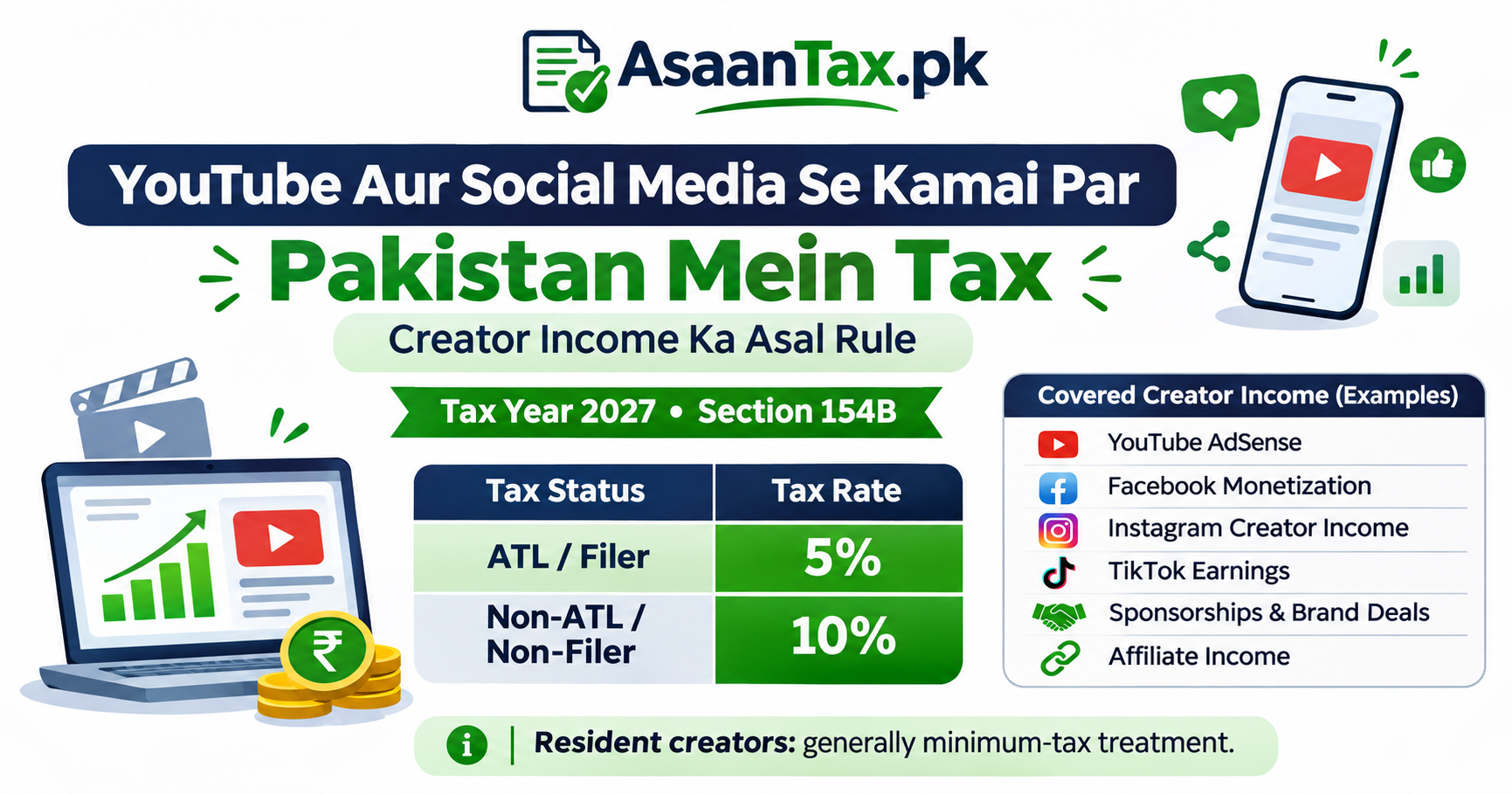
Finance Act 2026 introduced a new withholding tax provision, Section 154B, specifically covering revenues received from social media platforms.
The ordinary withholding rate is 5% for persons appearing on the FBR Active Taxpayers List (ATL), while the applicable enhanced non-ATL rate is generally 10%.
For resident creators, this deduction is generally treated as minimum tax rather than a final settlement of the annual income tax liability.
In addition, FBR issued special social media income computation rules under Section 99C in September 2026.
This complete AsaanTax.pk guide explains the tax on YouTube AdSense earnings, Facebook and TikTok monetization, foreign platform payments, sponsorship income, business expenses, tax return filing and Wealth Statement requirements.
Is YouTube Income Taxable in Pakistan?
Yes.
Income earned from monetized YouTube activity can be taxable in Pakistan under the applicable provisions of the Income Tax Ordinance, 2001.
Examples include:
- YouTube advertising revenue.
- Google AdSense payments.
- YouTube Premium revenue shares.
- Channel memberships.
- Super Chat and other monetization receipts.
- Paid video sponsorships.
- Brand promotions.
- Affiliate commissions.
- Other commercial content revenue.
However, different revenue streams can have different legal classifications.
A payment received directly from a social media platform is not necessarily taxed in exactly the same way as a payment received from a local business for a sponsorship campaign.
The actual agreement, source of payment and nature of the service determine the correct treatment.
What Is Section 154B of the Income Tax Ordinance?
Section 154B was introduced through Finance Act 2026.
It governs withholding tax on revenues received from social media platforms.
Under the provision, banks and non-banking financial institutions must deduct the prescribed tax when applicable social media platform revenue is credited to or received in a person's account.
The provision expressly recognizes digital content creators and social media influencers earning through platforms including:
- YouTube.
- Facebook.
- Instagram.
- TikTok.
- Other similar digital platforms.
It also covers relevant receipts routed through online payment service providers and digital financial platforms.
Important
The legal classification depends on whether the payment actually represents revenue from social media platforms.
Merely receiving foreign currency or using a payment intermediary does not by itself establish the correct tax category.
Latest Social Media Income Tax Rates – Tax Year 2027
| Taxpayer Classification | Section 154B Withholding |
|---|---|
| ATL / Filer | 5% |
| Non-ATL / Non-Filer | 10% |
| Resident creator on ATL | 5% — minimum-tax treatment |
| Resident creator not on ATL | 10% — minimum-tax treatment |
| Qualifying non-resident without Pakistan PE | Final-tax treatment under the relevant provisions |
Applicable tax year: July 1, 2026 to June 30, 2027.
Legal references: Section 154B, Division IIIAB of Part III of the First Schedule, Tenth Schedule and Section 169.
The non-resident rate must be determined according to the applicable ATL classification and statutory conditions.
Who Deducts Tax From YouTube Earnings?
For Section 154B, the relevant withholding obligation is placed on banks and non-banking financial institutions receiving or crediting qualifying platform revenue.
Example
A Pakistani YouTuber receives Rs. 200,000 in qualifying platform revenue through the banking system.
If the creator is on ATL:
Tax at 5% = Rs. 10,000.
Amount after this withholding = Rs. 190,000.
If the creator is not on ATL:
Tax at 10% = Rs. 20,000.
Amount after this withholding = Rs. 180,000.
These figures assume the entire Rs. 200,000 is the relevant Section 154B withholding base.
Actual bank charges, foreign currency conversion and foreign-platform deductions may affect the amount ultimately received.
YouTube and Social Media Tax Calculation Table
The following table assumes qualifying gross social media platform receipts.
| Platform Revenue | Filer Tax 5% | Non-Filer Tax 10% |
|---|---|---|
| Rs. 50,000 | Rs. 2,500 | Rs. 5,000 |
| Rs. 100,000 | Rs. 5,000 | Rs. 10,000 |
| Rs. 200,000 | Rs. 10,000 | Rs. 20,000 |
| Rs. 500,000 | Rs. 25,000 | Rs. 50,000 |
| Rs. 1,000,000 | Rs. 50,000 | Rs. 100,000 |
| Rs. 2,000,000 | Rs. 100,000 | Rs. 200,000 |
| Rs. 5,000,000 | Rs. 250,000 | Rs. 500,000 |
| Rs. 10,000,000 | Rs. 500,000 | Rs. 1,000,000 |
Important: The table calculates withholding tax, not necessarily the creator's complete annual income tax liability.
For resident creators, minimum-tax treatment can affect the final calculation.
Is the 5% YouTube Tax Final or Adjustable?
This is one of the most important questions for Pakistani content creators.
Resident Creator
Under Section 154B, tax deducted from a resident person is treated as minimum tax.
This means the deduction generally forms part of the applicable tax calculation while establishing a statutory minimum liability.
A resident creator cannot assume that paying 5% automatically settles all income tax on their creator earnings.
Non-Resident Creator
Where a non-resident person has no permanent establishment in Pakistan and meets the applicable statutory requirements, Section 154B provides final-tax treatment.
Tax residency must be determined under the actual legal rules.
Example
A resident YouTuber receives Rs. 3,000,000 in qualifying platform revenue.
Section 154B withholding at 5%:
Rs. 150,000.
The creator may need to calculate annual taxable business income under the applicable legal provisions.
The relationship between the ordinary tax liability, special income-computation rules and the Section 154B minimum tax determines the final position.
A simple 5% bank deduction should not be presented as the universal final liability for every resident creator.
What Is the Difference Between YouTube Income and Freelancing Income?
A common mistake is treating every international internet payment as an IT export eligible for reduced Section 154A tax.
However, the Income Tax Ordinance distinguishes between different types of income.
| Income Source | Relevant Tax Provision |
|---|---|
| YouTube monetization | Section 154B |
| Facebook platform monetization | Section 154B |
| TikTok platform revenue | Section 154B where applicable |
| Qualifying exported IT/ITeS services | Section 154A |
| Other qualifying exported services | Section 154A |
| Local brand sponsorship | Relevant business and withholding provisions |
| Local video production service | Relevant business/service provisions |
| Affiliate commission | Relevant contract and income provisions |
Can a YouTuber Use the PSEB 0.25% Rate?
Not automatically.
The 0.25% concession is associated with qualifying IT and IT-enabled export services under Section 154A and the relevant registration conditions.
YouTube advertising monetization covered by Section 154B should not simply be reclassified as an IT export because the platform pays from outside Pakistan.
If a person earns both YouTube revenue and genuine qualifying software development export income, the two income streams should be recorded separately.
What Is the Tax on Facebook Monetization in Pakistan?
Qualifying revenue received from Facebook monetization can fall under Section 154B.
Examples may include eligible:
- Facebook video advertising revenue.
- Monetized Reels.
- Platform creator revenue programs.
- Other payments representing social media monetization.
The ordinary Section 154B rate is 5%, subject to applicable enhanced non-ATL rates.
However, payment structures and eligibility must be reviewed individually.
A direct payment from a Pakistani advertiser for a Facebook promotional campaign is not necessarily the same as Facebook platform monetization.
What Is the Tax on TikTok Earnings?
TikTok creators may earn income from:
- Platform monetization programs.
- Qualifying live-stream gifts.
- Creator reward programs.
- Sponsorships.
- Brand promotions.
- Affiliate commissions.
Where a receipt represents qualifying revenue from a social media platform and is received through the prescribed channels, Section 154B may apply.
The ordinary tax rate is 5%, with applicable higher withholding for non-ATL taxpayers.
A separate direct sponsorship or merchandise sale must be classified according to its actual legal nature.
Does Instagram Income Have the Same Tax?
Revenue from qualifying Instagram platform monetization can fall within Section 154B.
However, Instagram sponsorships and direct brand partnerships require attention to the paying party and underlying agreement.
For example:
A platform payment for monetized content may fall under Section 154B.
A payment from a Pakistani clothing company for promotional posts may instead be treated as ordinary business/service income with applicable withholding obligations.
Do not apply one flat rate to every Instagram-related receipt without examining the transaction.
How Is Brand Sponsorship Income Taxed?
Brand sponsorships are a major source of income for influencers.
A creator may receive payment to promote:
- Clothing brands.
- Restaurants.
- Mobile phones.
- Cars.
- Online applications.
- Financial services.
- Consumer products.
Example
A Pakistani influencer receives Rs. 300,000 from a local company for a promotional video campaign.
The payment must be classified according to the actual agreement and relevant income tax provisions.
The paying company may have a withholding obligation under an applicable section such as Section 153.
The amount and tax treatment depend on the nature of services, tax status, company classification and statutory rules.
Do not automatically apply the Section 154B 5% rate to every local brand sponsorship.
What About Sponsorship Payments From Foreign Brands?
A creator may receive a sponsorship directly from an overseas business.
For example, an international company pays a Pakistani YouTuber to review a product.
The payment requires a separate review of:
- The contractual service.
- Location and nature of the activity.
- Source of income.
- Taxpayer residency.
- Whether any special export-of-services regime applies.
- Relevant withholding tax.
- Foreign exchange documentation.
The fact that payment comes from abroad does not automatically mean it qualifies for the 0.25% IT export rate.
What Is Section 99C – Special Social Media Income Rules?
Section 99C authorizes special procedures for specified sectors.
In September 2026, FBR issued rules concerning income from remunerative social media content.
The relevant notifications include:
- SRO 1640(I)/2026.
- SRO 1641(I)/2026.
- SRO 1642(I)/2026.
These rules address prescribed income computation and reporting for relevant resident and non-resident persons.
They are particularly important for creators whose earnings depend on user engagement and monetized content.
FBR Rs. 195 Per 1,000 YouTube Views Rule
The special social media procedure uses a prescribed revenue-per-mille benchmark.
The benchmark is:
Rs. 195 per 1,000 YouTube views.
However, this should not be misunderstood as a universal fixed tax charged for every 1,000 views.
It is an income-estimation benchmark used under the relevant special procedure.
The statutory calculation also refers to average views per content item, the number of posts and actual remuneration.
Simplified Illustration
Suppose a qualifying creator has:
Average views per video: 100,000.
Number of relevant videos: 20.
Illustrative total views: 2,000,000.
Estimated benchmark remuneration:
2,000,000 ÷ 1,000 × Rs. 195.
Benchmark remuneration = Rs. 390,000.
The relevant procedure requires comparison with actual remuneration according to the rules.
This example is not a statement that every creator with 2 million views automatically owes 5% of Rs. 390,000.
The special procedure's applicability, income base, expense treatment and taxpayer classification must be determined first.
Can Content Creators Deduct Business Expenses?
Ordinary business income is generally subject to statutory expense deduction rules, including Section 20 and relevant limitations.
Potential business expenditure may involve:
- Video production equipment.
- Editing software.
- Camera equipment.
- Microphones.
- Video production services.
- Professional editing.
- Internet services used for business.
- Studio costs.
- Website hosting.
- Advertising.
- Other legitimate business expenditure.
However, capital equipment may need depreciation treatment rather than immediate deduction.
Personal or household expenses should not automatically be claimed as business expenses.
Special Social Media Procedure
The 2026 special social media income-computation rules prescribe an expense calculation subject to a maximum of 30% of relevant remuneration.
This is a special-rule calculation, not a blanket statement that every type of content creator can always deduct exactly 30% without considering the law.
Taxpayers must distinguish ordinary business deductions from the special procedure's prescribed formula.
Example: YouTuber With Revenue and Expenses
Suppose a resident creator has:
| Description | Amount |
|---|---|
| Actual platform revenue | Rs. 2,000,000 |
| Documented production expenses | Rs. 400,000 |
| Illustrative ordinary business profit | Rs. 1,600,000 |
| Section 154B tax withheld at 5% | Rs. 100,000 |
The ordinary profit calculation alone does not establish the final income tax liability.
The creator must review whether the special Section 99C procedure applies, whether its minimum income computation changes the relevant amount, and how Section 154B minimum tax interacts with the annual calculation.
Is Google AdSense Income Tax-Free Because It Comes From Abroad?
No.
Foreign payment by itself does not create an automatic exemption from Pakistani income tax.
Where qualifying AdSense revenue represents social media platform monetization, Section 154B can apply.
The creator should retain:
- AdSense payment statements.
- YouTube monetization reports.
- Bank credit records.
- Withholding tax records.
- Foreign currency conversion details.
- Relevant contracts or payment information.
A separate website advertising business may require examination of its exact activities and income classification rather than an automatic assumption that every AdSense payment is identical.
Does Foreign Tax Deducted by Google Reduce Pakistani Tax?
A platform may withhold foreign tax under another country's laws.
For example, certain US-source YouTube income can be subject to US withholding, depending on the creator's tax information and applicable rules.
However, foreign tax withheld does not automatically become a Pakistani tax credit.
Any foreign tax credit or other relief depends on the applicable Pakistani law, double taxation agreement and relevant requirements.
Keep foreign withholding and Pakistani Section 154B withholding as separate records.
How to Declare YouTube Income in FBR IRIS – Tax Year 2027
Step 1: Collect Revenue Records
Download annual statements from YouTube, Google AdSense and other relevant platforms.
Step 2: Separate Income Sources
Maintain separate figures for:
- Platform monetization.
- Brand sponsorships.
- Affiliate commissions.
- Other business services.
- Other income.
Step 3: Obtain Banking Records
Download bank statements and relevant remittance evidence.
Step 4: Verify Section 154B Tax
Obtain or reconcile the relevant withholding information.
Step 5: Log In to IRIS
Visit:
Step 6: Select Tax Year 2027
Tax Year 2027 generally covers July 1, 2026 to June 30, 2027.
Step 7: Declare Relevant Business Income
Use the correct categories and tax computation rules.
Step 8: Complete the Special Social Media Schedule Where Applicable
Apply any relevant prescribed Section 99C declaration requirements.
Step 9: Report Withholding Tax
Enter eligible Section 154B withholding according to the required return treatment.
Step 10: Add Other Income
Declare salary, property income, other business income and other reportable receipts where applicable.
Step 11: Complete the Wealth Statement
Where required, record assets, liabilities, bank balances and financial changes.
Step 12: Reconcile and Submit
Review the annual calculation, documentation and applicable tax rules before final submission.
The precise Tax Year 2027 IRIS screens and schedules should be checked when the relevant return forms become available.
Documents Required for YouTubers and Influencers
| Document | Purpose |
|---|---|
| AdSense annual statements | Platform income evidence |
| YouTube revenue reports | Monetization details |
| Facebook/TikTok payout history | Other platform receipts |
| Bank statements | Payment verification |
| Section 154B withholding records | Pakistani tax deduction |
| Sponsorship invoices | Direct brand income |
| Affiliate statements | Commission income |
| Business expense records | Eligible costs |
| Foreign tax documents | Overseas withholding records |
| Previous income tax return | Tax history |
| Wealth Statement | Financial reconciliation |
Maintain the records for the applicable statutory period.
Can a Salaried Person Also Earn YouTube Income?
Yes.
An employee may legally earn salary and operate a monetized YouTube channel, subject to employment restrictions and other applicable laws.
However, the tax return should correctly classify both income sources.
For example:
- Salary is generally reported under Salary.
- Content creator business income is reported according to the applicable business and special provisions.
- Section 154B withholding is dealt with according to its minimum-tax treatment.
- Other income may require separate reporting.
The presence of salary does not automatically make platform revenue tax-free.
What If You Receive YouTube Revenue Through Payoneer or Another Payment Service?
Section 154B expressly contemplates payments received through banking channels, including online payment service providers and digital financial platforms.
Therefore, a creator should not assume that routing money through an intermediary automatically removes Section 154B applicability.
Maintain a complete record of:
- Original platform revenue.
- Intermediary fees.
- Currency conversion.
- Transfer to the Pakistani account.
- Withholding tax.
- Actual amount received.
Where the same earnings move through multiple accounts or intermediaries, reconcile them properly to avoid duplicate revenue reporting.
Do Small YouTubers Also Have Tax Obligations?
A creator should not assume exemption merely because a channel has relatively few subscribers.
The applicability of Section 154B depends on qualifying platform revenue and the relevant legal conditions.
The special Section 99C procedures may have additional scope and threshold rules, particularly for certain non-resident cases.
A person with low earnings may still have reporting obligations under the applicable income tax provisions.
Do not confuse YouTube monetization eligibility requirements with FBR income tax thresholds.
Are YouTube Gifts and Donations Tax-Free?
Not automatically.
Payments described as gifts, tips, Super Chats or viewer support may be remuneration for monetized digital content.
The actual source and nature of the payment matter.
For example, a platform-processed Super Chat payment is not automatically the same as a genuine personal family gift.
Similarly, voluntary audience contributions can have commercial characteristics.
The receipt should be classified using the applicable tax law.
Can Creators Claim Back the 5% Tax?
Not automatically.
For resident creators, Section 154B characterizes the tax as minimum tax.
Minimum tax is not the same as an ordinary fully refundable advance payment.
The taxpayer must review the annual liability and legal restrictions applicable to the minimum-tax amount.
A person should not assume that a lower ordinary income tax calculation automatically entitles them to a refund of all Section 154B withholding.
What Happens If Social Media Income Is Not Declared?
Failure to correctly report taxable income may create compliance risks.
Depending on the facts, these can include:
- Tax assessment amendments.
- FBR notices.
- Requests for bank information.
- Withholding tax discrepancies.
- Penalties under applicable provisions.
- Default surcharge.
- Other proceedings authorized by law.
FBR may compare legally available financial information with the taxpayer's declared income.
Creators should maintain accurate platform statements and banking records.
Common Tax Mistakes Made by Pakistani YouTubers
Avoid these mistakes:
- Treating all AdSense income as automatically tax-free.
- Applying the 0.25% IT export rate to ordinary YouTube monetization.
- Ignoring Section 154B.
- Assuming 5% withholding is final for every resident creator.
- Confusing filer and non-filer withholding rates.
- Reporting platform revenue and local sponsorship income as identical transactions.
- Omitting foreign-platform earnings from required records.
- Claiming unrelated household expenses as creator business costs.
- Ignoring the special Section 99C rules.
- Assuming Rs. 195 per 1,000 views is a universal fixed tax.
- Confusing foreign platform withholding with Pakistani withholding.
- Claiming minimum tax as automatically refundable.
- Using inaccurate bank conversion figures.
- Ignoring Wealth Statement reconciliation.
- Filing the return under an incorrect tax year.
Watch Tax with Naeem – Income Tax Return and Creator Earnings
For Urdu-language guidance on income classification, return filing and withholding tax, watch this related tutorial from Tax with Naeem:
Income Tax Return Filing in Pakistan | Salary | Rental | Capital Gain | Dividend Explained
https://www.youtube.com/watch?v=VX88o1N1AfA
The video explains how different income categories are treated in an annual FBR return.
Important: It is a general income tax tutorial published before the Section 154B regime. It should not be treated as a dedicated Tax Year 2027 social media creator tax tutorial.
For a video specifically addressing YouTube and social media income, search the channel:
https://www.youtube.com/results?search_query=Tax+with+Naeem+YouTube+Income+Tax+Pakistan
How AsaanTax.pk Can Help YouTubers and Social Media Creators
AsaanTax.pk provides tax compliance assistance to Pakistani content creators, YouTubers, freelancers and online businesses.
Relevant services include:
- NTN registration guidance.
- YouTube income tax return preparation.
- Social media monetization tax guidance.
- Section 154B withholding reconciliation.
- Local sponsorship income reporting.
- Foreign payment documentation.
- Freelance and creator business income classification.
- Income tax return filing.
- Wealth Statement reconciliation.
- General FBR compliance assistance.
Need Help Filing Your Creator Income Tax Return?
Visit AsaanTax.pk for guidance on Tax Year 2027 income tax rules, social media earnings, FBR withholding and accurate return preparation.
Website: https://www.asaantax.pk/
AsaanTax.pk is an independent tax services website and is not affiliated with the Federal Board of Revenue or the Government of Pakistan.
Official Sources and References
- FBR – Finance Act 2026 and Finance Acts
- FBR – Income Tax Ordinance, 2001
- FBR – Withholding Tax Rate Card
- FBR – Income Tax Rules, 2002
- FBR – IRIS Tax Filing Portal
- Tax with Naeem – Income Tax Return Tutorial
Last updated: November 4, 2026.
Disclaimer: This article provides general educational information. Tax liability depends on the type of creator income, residency status, ATL position, banking arrangements, deductions, special social media computation rules and applicable legislation. Section 154B withholding and Section 99C income-computation requirements must be considered separately. Verify significant tax positions with a qualified professional before filing.