Saudi Arabia VAT and ZATCA E-Invoicing (Fatoorah) 2026: Complete Guide for Businesses
Published: November 10, 2026
Country: Kingdom of Saudi Arabia
Tax Authority: Zakat, Tax and Customs Authority (ZATCA)
Standard VAT Rate: 15%
Major Update: Fatoorah Phase 2 integration continues in 2026, with Wave 25 scheduled for February 1, 2027.
Saudi Arabia continues to modernize its tax system through Value Added Tax (VAT) and the Fatoorah electronic invoicing initiative.
Businesses operating in Riyadh, Jeddah, Dammam, Makkah and other Saudi cities must understand VAT registration, tax invoicing, return filing and electronic reporting requirements.
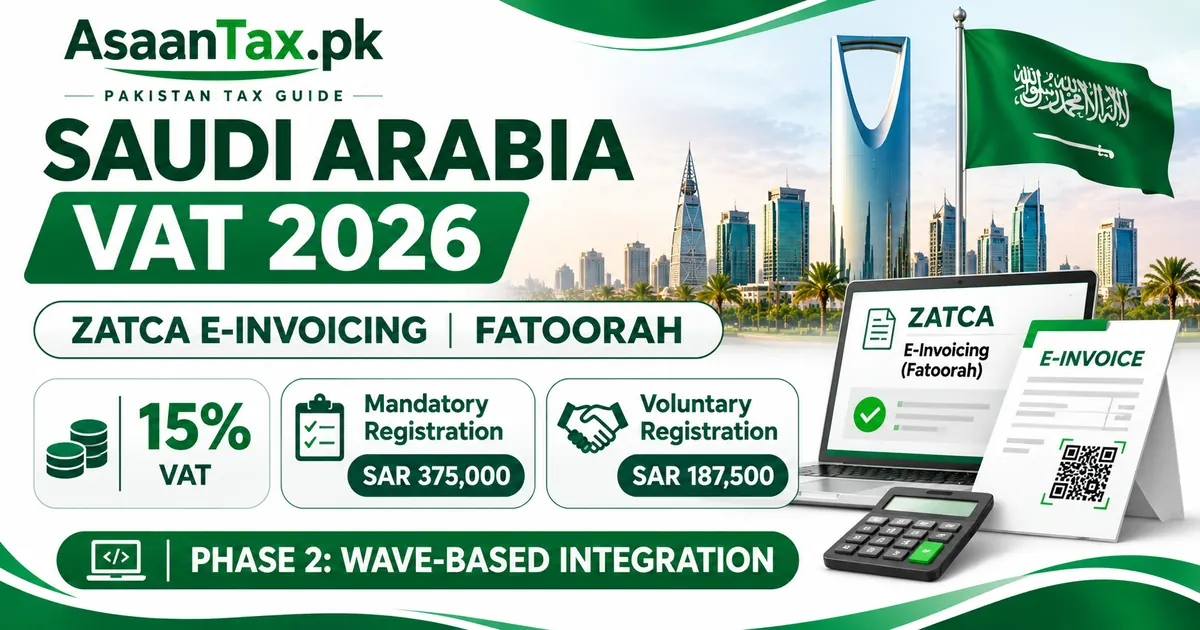
The standard Saudi Arabia VAT rate in 2026 is 15%, with mandatory VAT registration generally applicable to resident businesses whose annual taxable supplies exceed SAR 375,000.
Eligible businesses may register voluntarily when their relevant taxable supplies or taxable expenses exceed SAR 187,500.
Alongside VAT, ZATCA is implementing the Fatoorah electronic invoicing system. Phase 1 requires compliant electronic invoice generation, while Phase 2 adds integration with ZATCA's platform and additional technical requirements.
This guide explains Saudi VAT, Fatoorah Phase 1 and Phase 2, the latest integration waves, QR codes, invoice formats, monthly and quarterly returns, tax calculations, penalties and practical compliance steps.
1. What Is VAT in Saudi Arabia?
Value Added Tax is an indirect tax imposed on taxable supplies of goods and services.
Saudi Arabia introduced VAT on January 1, 2018, initially at 5%.
The standard VAT rate increased to 15% on July 1, 2020.
For 2026, the standard VAT rate remains 15%.
VAT-registered businesses generally collect output VAT on standard-rated sales and may recover qualifying input VAT paid on business purchases.
The net VAT liability is determined according to the applicable VAT rules.
Saudi VAT 2026 — Key Rules
| Requirement | General Rule |
|---|---|
| Standard VAT Rate | 15% |
| Mandatory Registration Threshold | SAR 375,000 |
| Voluntary Registration Threshold | SAR 187,500 |
| Monthly VAT Returns | Generally for annual revenues exceeding SAR 40 million |
| Quarterly VAT Returns | Generally for other registered taxpayers |
| Filing Deadline | Last day of the month following the tax period |
| E-Invoicing System | Fatoorah |
| Phase 1 Start | December 4, 2021 |
| Phase 2 Start | January 1, 2023, in waves |
Certain supplies may qualify for zero-rating, exemption or another specific treatment.
2. Who Must Register for VAT in Saudi Arabia?
VAT registration generally applies to persons conducting economic activities in Saudi Arabia who meet the relevant statutory requirements.
Potentially affected businesses include:
- Trading companies.
- Retail stores.
- Restaurants and cafés.
- Construction businesses.
- Manufacturers.
- E-commerce businesses.
- Professional service providers.
- IT and software businesses.
- Consultants.
- Importers and distributors.
- Other businesses making taxable supplies.
Registration is based on the applicable taxable supply thresholds, rather than simply whether the business is large or small.
Mandatory Registration — SAR 375,000
Resident businesses must generally register when taxable supplies exceed SAR 375,000 during the relevant previous 12-month period or are expected to exceed the threshold during the next 12 months, subject to the applicable registration rules.
Example
A business records SAR 420,000 in qualifying annual taxable supplies.
Since the value exceeds SAR 375,000, the business generally falls within mandatory registration requirements.
The threshold concerns taxable supplies, not net profit.
3. Voluntary VAT Registration — SAR 187,500
A resident business may qualify for voluntary registration if its relevant taxable supplies or taxable expenses exceed SAR 187,500 under the statutory tests.
Example
A business has annual taxable supplies of SAR 250,000.
Although this is below the mandatory threshold, the business may qualify to register voluntarily.
Potential Benefits
- Recovery of eligible input VAT.
- Better VAT record management.
- Ability to issue compliant VAT invoices.
- Preparation for business growth.
However, registration also creates obligations to file returns, maintain records and comply with applicable invoicing rules.
4. How Is Saudi Arabia VAT Calculated?
For a standard-rated supply:
VAT = Price Excluding VAT × 15%
Example 1: VAT-Exclusive Price
A business sells equipment for SAR 10,000 before VAT.
VAT:
SAR 10,000 × 15% = SAR 1,500.
Total invoice:
SAR 10,000 + SAR 1,500 = SAR 11,500.
| Description | Amount |
|---|---|
| Sale Value Before VAT | SAR 10,000 |
| VAT at 15% | SAR 1,500 |
| Total Including VAT | SAR 11,500 |
Example 2: VAT-Inclusive Price
If the final selling price is SAR 11,500 including VAT:
VAT = VAT-Inclusive Price × 15 ÷ 115
VAT = SAR 1,500.
Net selling price = SAR 10,000.
Businesses should distinguish VAT-inclusive from VAT-exclusive prices.
5. What Is Fatoorah E-Invoicing in Saudi Arabia?
Fatoorah is ZATCA's electronic invoicing framework.
It requires covered businesses to generate and maintain compliant electronic invoices through approved technical processes and standards.
An electronic invoice is not merely a photograph, scanned document or ordinary PDF created from a manual invoice.
ZATCA defines electronic invoices as invoices generated in a structured electronic format through an appropriate electronic solution.
The system aims to improve:
- Tax transparency.
- Invoice accuracy.
- Business documentation.
- Electronic tax compliance.
- Integration between business systems and ZATCA.
- Prevention and detection of fraudulent invoicing.
Fatoorah applies to persons covered by the e-invoicing regulations and relevant parties issuing invoices on their behalf.
Non-resident taxable persons are excluded from the e-invoicing regulations under ZATCA's published scope rules.
6. Fatoorah Phase 1 — Generation Phase
Phase 1 became effective on December 4, 2021.
Covered taxpayers must issue and store invoices electronically using a compliant invoicing solution.
Phase 1 Requirements
- Use a compliant electronic invoicing system.
- Stop issuing handwritten invoices as the tax invoice method.
- Do not rely on ordinary word-processing or spreadsheet documents as compliant invoice-generation systems.
- Include the required invoice information.
- Generate QR codes for simplified invoices.
- Maintain appropriate invoice records.
- Prevent unauthorized alteration and prohibited invoicing functionalities.
Phase 1 generally does not require every invoice to be transmitted to ZATCA in real time.
That integration requirement arises under Phase 2 for taxpayers selected into an applicable wave.
7. Fatoorah Phase 2 — Integration Phase
Phase 2 began on January 1, 2023, and continues through staggered implementation waves.
Businesses included in a notified wave must integrate their electronic invoicing solution with ZATCA's Fatoora platform by the applicable deadline.
Additional Phase 2 Requirements
- Integration with ZATCA's electronic platform.
- Invoices in the required structured electronic format.
- Additional mandatory invoice fields.
- Compliant QR code information.
- Cryptographic security controls.
- Appropriate digital identifiers.
- Clearance or reporting processes, depending on invoice type.
- Compliance with relevant XML implementation and security standards.
Businesses should test their systems before the specified integration deadline.
Phase 1 vs Phase 2
| Feature | Phase 1 | Phase 2 |
|---|---|---|
| Electronic Invoice Generation | Required | Required |
| Compliant Electronic Solution | Required | Required |
| Structured Integration Format | Basic requirements | Additional technical requirements |
| ZATCA Platform Integration | Not generally required | Required for notified taxpayers |
| QR Code | Required for simplified invoices | Expanded requirements |
| Invoice Clearance or Reporting | Not the general Phase 1 mechanism | Required as applicable |
| Cryptographic Controls | Initial controls | Additional security requirements |
8. Latest ZATCA Phase 2 Wave Update in 2026
ZATCA announced the selection criteria for Wave 25 on July 24, 2026.
The announcement covers taxpayers whose VAT-taxable revenues exceeded SAR 187,500 in any of the years 2022, 2023, 2024 or 2025.
The announced deadline for notified Wave 25 taxpayers to integrate with Fatoora is February 1, 2027.
Important Wave 25 Details
| Requirement | Wave 25 Announcement |
|---|---|
| Announcement Date | July 24, 2026 |
| Revenue Threshold | Exceeded SAR 187,500 |
| Relevant Historical Years | 2022, 2023, 2024 or 2025 |
| Integration Deadline | February 1, 2027 |
| Platform | ZATCA Fatoora |
| Implementation | For targeted, notified taxpayers |
The integration waves are not the same as the ordinary VAT registration requirements.
Businesses must review their own ZATCA notices and confirm whether an earlier or later integration deadline applies.
Important: The Wave 25 revenue-selection criterion does not mean that every unregistered business with SAR 187,500 revenue must immediately charge VAT.
The rules for VAT registration and e-invoicing integration must be considered separately.
9. Standard Tax Invoice vs Simplified Tax Invoice
ZATCA distinguishes between standard tax invoices and simplified tax invoices.
Standard Tax Invoice
Generally used for business-to-business (B2B) transactions.
It contains the required supplier and buyer information, tax details and other mandatory fields.
Simplified Tax Invoice
Generally used for business-to-consumer (B2C) transactions.
It contains the specified simplified invoice information and mandatory QR code.
Comparison
| Feature | Standard Tax Invoice | Simplified Tax Invoice |
|---|---|---|
| Common Use | B2B | B2C |
| Buyer VAT Details | Required where applicable | Different requirements |
| QR Code | Subject to applicable phase requirements | Mandatory |
| Phase 2 Process | Clearance | Reporting |
| ZATCA Integration | Before issue, where applicable | Report after issue |
Businesses should follow the applicable invoice standards rather than assuming that every electronic invoice has identical data requirements.
10. What Is Invoice Clearance Under Phase 2?
For standard electronic tax invoices subject to Phase 2, the clearance process generally requires submission to ZATCA before the invoice is issued to the buyer.
The Fatoora platform checks the invoice against the relevant requirements.
If the invoice meets the applicable requirements, the platform provides the clearance result.
The business then provides the cleared invoice to the buyer through the permitted method.
Simplified Invoice Reporting
Simplified electronic tax invoices generally follow a different process.
A compliant simplified invoice is generated and issued to the consumer.
The business must then report the relevant invoice data to Fatoora within 24 hours of issuance, using the required technical process.
Critical Difference
Standard B2B invoice: Clearance generally occurs before issuance.
Simplified B2C invoice: The invoice is generally issued first and reported within 24 hours.
Businesses should configure their software to distinguish the two processes correctly.
11. Are QR Codes Mandatory on Saudi E-Invoices?
QR codes are mandatory for simplified electronic tax invoices under ZATCA's requirements.
The information encoded in the QR code depends on the applicable implementation phase.
Phase 2 introduced expanded technical and security-related requirements.
A QR code placed on an ordinary invoice does not automatically make the invoice compliant.
The underlying document, structured data, security features and system must also satisfy the relevant standards.
12. Can Businesses Issue Fatoorah Invoices in English?
ZATCA states that the mandatory visible invoice information must be available in Arabic.
Invoices can also be bilingual, containing English alongside Arabic.
Businesses operating internationally may therefore use an Arabic-English format where the mandatory Arabic requirements are satisfied.
An English-only invoice should not be assumed compliant merely because the customer is a foreign business.
13. What Software Is Required for ZATCA E-Invoicing?
Businesses need an invoicing solution that satisfies the requirements applicable to their implementation phase.
Potential solutions include:
- Compliant POS systems.
- Accounting software.
- ERP platforms.
- Cloud invoicing software.
- Custom-built compliant invoicing systems.
- Integrated retail and business management systems.
For Phase 2, the solution must support the required Fatoora integration process.
Technical Features to Review
- XML invoice generation.
- Required invoice fields.
- Compatible QR codes.
- Cryptographic controls.
- Appropriate device or solution identification.
- Clearance and reporting workflows.
- Secure record storage.
- Credit and debit note processing.
- Handling of API responses and validation errors.
- Reporting and audit trails.
Businesses should use ZATCA's published technical specifications and developer guidance.
14. How to Prepare for Fatoorah Phase 2 Integration
Step 1: Check Your Assigned Wave
Review official communications from ZATCA.
Step 2: Confirm Your Integration Deadline
Do not assume the Wave 25 date applies if your business was assigned to an earlier wave.
Step 3: Review Existing Accounting Software
Identify whether the software supports the relevant technical requirements.
Step 4: Upgrade or Replace the Solution
Work with your software provider or technical team as necessary.
Step 5: Prepare Invoice Data
Verify VAT registration numbers, invoice fields, customer information and applicable transaction classifications.
Step 6: Complete Technical Onboarding
Follow the official Fatoora platform onboarding process.
Step 7: Test the System
Use the appropriate testing and validation tools.
Step 8: Resolve Errors
Review XML validation problems, rejected invoices and missing fields.
Step 9: Train Employees
Ensure staff understand B2B clearance and B2C reporting.
Step 10: Go Live Before the Deadline
Complete the integration before the applicable enforcement date.
15. How Often Are VAT Returns Filed in Saudi Arabia?
ZATCA generally assigns monthly or quarterly VAT filing periods based on the registered business's annual revenue.
Monthly VAT Returns
Businesses whose annual revenues exceed SAR 40 million are generally required to file monthly VAT returns.
Quarterly VAT Returns
Businesses below the relevant SAR 40 million threshold generally follow quarterly VAT filing periods unless another arrangement applies.
VAT Return Deadlines
Returns and applicable VAT payments are generally due by the last day of the month following the relevant tax period.
| Example Tax Period | Standard Deadline |
|---|---|
| September 2026 | October 31, 2026 |
| July–September 2026 | October 31, 2026 |
| October 2026 | November 30, 2026 |
| October–December 2026 | January 31, 2027 |
Businesses should confirm their assigned filing periods and any specific official deadline adjustments.
16. How to Submit a Saudi VAT Return Through ZATCA
Step 1: Log In
Visit https://zatca.gov.sa/ and access the taxpayer services portal.
Step 2: Open the VAT Services
Select the applicable VAT return service.
Step 3: Choose the Tax Period
Confirm whether the return is monthly or quarterly.
Step 4: Review Taxable Sales
Enter the relevant standard-rated, zero-rated and exempt supplies correctly.
Step 5: Review Purchases
Calculate eligible recoverable input VAT.
Step 6: Check Imports and Adjustments
Complete applicable reverse-charge, import and other adjustments.
Step 7: Reconcile Invoice Records
Check consistency between accounting records, Fatoorah invoices and reported VAT amounts.
Step 8: Calculate Net VAT
Review the resulting amount payable or credit balance.
Step 9: Submit the Return
Complete the electronic return declaration.
Step 10: Pay and Save Records
Pay the applicable liability using an authorized payment method and retain the confirmation.
17. Saudi VAT Example: Output VAT and Input VAT
Assume a registered trading business reports:
| Description | Amount |
|---|---|
| Standard-Rated Sales Before VAT | SAR 200,000 |
| Output VAT at 15% | SAR 30,000 |
| Eligible Input VAT | SAR 12,000 |
| Net VAT Payable | SAR 18,000 |
Net VAT = Output VAT − Recoverable Input VAT
SAR 30,000 − SAR 12,000 = SAR 18,000.
The simplified amount payable is SAR 18,000.
Actual returns may include other categories, adjustments and restrictions.
18. Saudi VAT Penalties in 2026
ZATCA publishes penalties for relevant VAT violations.
General VAT Penalty Overview
| Violation | Published General Penalty |
|---|---|
| Failure to register for VAT | SAR 10,000 |
| Failure to file a VAT return | 5%–25% of tax required to be declared |
| Late VAT payment | 5% of unpaid tax for each month or part thereof |
| Issuing a tax invoice without registration | Up to SAR 100,000 |
| Failure to maintain required records | Up to SAR 50,000 |
| General VAT regulatory violation | Up to SAR 50,000 |
| Obstructing authorized ZATCA officials | Up to SAR 50,000 |
Other violations, including tax evasion and incorrect returns, may have separate penalties.
Important: Published penalty figures do not automatically determine the amount assessed in every individual case.
Relevant statutory provisions, administrative decisions, relief initiatives and the circumstances of the violation must be considered.
19. What Happens if a Business Fails to File Its VAT Return?
Failure to submit a required VAT return within the applicable deadline can attract a penalty ranging from 5% to 25% of the tax that should have been declared.
Late filing and late tax payment are separate compliance issues.
A business should not assume that filing late eliminates liability for unpaid VAT.
Example
Suppose a business fails to file a VAT return and has SAR 20,000 of tax that should have been declared.
The applicable late-filing penalty may depend on the statutory percentage assessed.
A 5% illustrative penalty would be SAR 1,000.
A 25% illustrative penalty would be SAR 5,000.
This is an illustration of the published range, not a determination of the actual assessed penalty.
20. Are Any Saudi VAT Penalty Waivers Available?
ZATCA introduced initiatives to cancel or exempt certain financial penalties where specified conditions were met.
One such initiative was extended through June 30, 2026.
It included certain late-registration, late-payment, late-filing and e-invoicing-related violations, subject to its conditions and exclusions.
However, a previous waiver should not be assumed to remain available after its stated expiry.
Taxpayers should verify whether a new official initiative or extension applies before relying on penalty relief.
21. Is Fatoorah Compliance Required for Small Businesses?
Fatoorah requirements are not limited to large multinational companies.
Covered small businesses must meet the requirements applicable to them.
Phase 1 generally applies to covered VAT taxpayers.
Phase 2 depends on selection into the relevant integration wave.
Businesses with lower revenue should not assume that they will never be included.
The Wave 25 selection criterion shows the expanding scope of Phase 2.
However, a business must still confirm its individual notification and the applicable legal requirements.
22. Does Fatoorah Replace VAT Return Filing?
No.
Fatoorah and VAT return filing serve related but separate purposes.
Fatoorah concerns the generation, storage, clearance and reporting of electronic invoices.
VAT returns concern periodic reporting of taxable supplies, input tax, adjustments and tax payable.
A business using compliant e-invoicing software may still need to submit periodic VAT returns.
Similarly, filing a VAT return does not replace the obligation to generate compliant invoices.
23. Saudi VAT vs Zakat and Corporate Income Tax
Businesses should distinguish VAT from other Saudi tax obligations.
| Tax | General Purpose |
|---|---|
| VAT | Indirect tax on taxable supplies |
| Zakat | Applies under the relevant Zakat rules to qualifying persons and entities |
| Corporate Income Tax | Applies to relevant taxable income under Saudi income tax legislation |
| Withholding Tax | May apply to specified payments to non-residents |
The application of these obligations depends on business ownership, residence, income classification and other legal factors.
Registering for VAT does not automatically settle Zakat or income tax obligations.
24. Common VAT and Fatoorah Mistakes to Avoid
- Charging 5% instead of the current standard 15% VAT rate.
- Using net profit instead of taxable supplies for registration.
- Failing to register after exceeding the mandatory threshold.
- Generating manual invoices through ordinary word processors.
- Omitting required QR codes on simplified invoices.
- Assuming a scanned invoice qualifies as a structured electronic invoice.
- Confusing Phase 1 with Phase 2 requirements.
- Ignoring a ZATCA integration-wave notification.
- Treating all invoices as B2C simplified invoices.
- Failing to obtain clearance for standard invoices where applicable.
- Failing to report simplified invoices within 24 hours.
- Assuming an English-only invoice always meets the requirements.
- Using non-compliant software.
- Failing to reconcile invoices with VAT returns.
- Missing monthly or quarterly VAT deadlines.
- Applying outdated penalty waiver announcements.
- Failing to retain electronic records.
25. Final Saudi VAT and Fatoorah Compliance Checklist
Before submitting a return or completing system integration, verify:
- Applicable VAT registration status.
- Correct 15% standard VAT rate.
- Relevant VAT registration thresholds.
- Appropriate invoicing system.
- Mandatory Arabic invoice information.
- Correct standard and simplified invoice formats.
- Required QR code.
- Relevant Phase 1 compliance.
- Assigned Phase 2 integration wave.
- Integration deadline.
- XML and security requirements.
- B2B invoice clearance.
- B2C invoice reporting within 24 hours.
- Proper accounting integration.
- Output VAT reconciliation.
- Eligible input VAT.
- Monthly or quarterly return deadline.
- Applicable VAT payment.
- Required electronic records.
- Updated staff training.
- Official ZATCA notices and guidance.
26. Watch Tax With Naeem — Related Tax Compliance Guidance
For general educational information on taxation, filing requirements and income reporting, watch the Tax With Naeem YouTube channel.
Related Video: Income Tax Return Filing in Pakistan — Salary, Rental Income, Capital Gains and Dividends Explained
https://www.youtube.com/watch?v=VX88o1N1AfA
This video covers Pakistan income tax filing, not Saudi VAT or ZATCA's Fatoorah system.
The video is included as supplementary tax education. Businesses should follow Saudi ZATCA regulations for actual Saudi VAT and e-invoicing compliance.
27. Official Sources and References
1. ZATCA — Official Website
2. ZATCA — VAT Rules and Regulations
https://www.zatca.gov.sa/en/RulesRegulations/VAT/Pages/default.aspx
3. ZATCA — VAT Registration for Businesses
https://zatca.gov.sa/en/eServices/Pages/eServices-001.aspx
4. ZATCA — What Is E-Invoicing?
https://www.zatca.gov.sa/en/E-Invoicing/Introduction/Pages/What-is-e-invoicing.aspx
5. ZATCA — E-Invoicing Implementation Phases
https://zatca.gov.sa/en/E-Invoicing/Introduction/Pages/Roll-out-phases.aspx
6. ZATCA — Wave 25 Announcement, July 24, 2026
https://zatca.gov.sa/en/MediaCenter/News/Pages/Wave25-E-invoicing.aspx
7. ZATCA — E-Invoicing Guidelines
https://zatca.gov.sa/en/E-Invoicing/Introduction/Guidelines/Pages/default.aspx
8. ZATCA — VAT Penalties
https://zatca.gov.sa/en/RulesRegulations/VAT/Pages/Penalties.aspx
9. ZATCA — VAT Return Filing Update, October 20, 2026
https://zatca.gov.sa/en/MediaCenter/News/Pages/Submit-VAT-Return-for-Oct-andQ3-2026.aspx
10. Tax With Naeem — Related Income Tax Tutorial
https://www.youtube.com/watch?v=VX88o1N1AfA
11. AsaanTax.pk — International Taxation
28. Conclusion: How Can Saudi Businesses Stay VAT and Fatoorah Compliant in 2026?
Saudi Arabia's standard VAT rate remains 15%, with mandatory registration generally required above SAR 375,000 in annual taxable supplies.
Eligible businesses may register voluntarily when relevant supplies or expenses exceed SAR 187,500.
Alongside regular VAT reporting, Fatoorah has established a structured electronic invoicing system.
Phase 1 requires compliant invoice generation, while Phase 2 introduces integration with ZATCA through staggered implementation waves.
The July 2026 Wave 25 announcement is particularly relevant to businesses preparing for the February 1, 2027 integration deadline.
Businesses must verify their assigned wave, use compliant software, distinguish clearance from reporting, file VAT returns within the prescribed period and retain accurate financial records.
The most important principle is that VAT registration, Fatoorah e-invoicing and VAT return filing are three connected but distinct compliance obligations.
For more international tax guides covering Saudi Arabia, UAE Corporate Tax, UAE VAT, UK Income Tax, US federal taxation and Pakistan's FBR system, visit AsaanTax.pk.
Editorial Note: This article reflects ZATCA guidance available as of November 10, 2026. The latest independently verified integration-wave announcement for this guide is Wave 25, dated July 24, 2026.
Disclaimer: This article is for general educational purposes. Saudi VAT liabilities, electronic invoicing deadlines and penalties depend on the taxpayer's circumstances, applicable rules and official ZATCA notifications. Businesses should obtain professional advice for complex or high-value transactions.