Buying a new or used car in Pakistan involves more than paying the vehicle's showroom price. Depending on the engine capacity, taxable vehicle value and buyer's Active Taxpayer List (ATL) status, the Federal Board of Revenue (FBR) collects advance income tax under Section 231B of the Income Tax Ordinance, 2001.
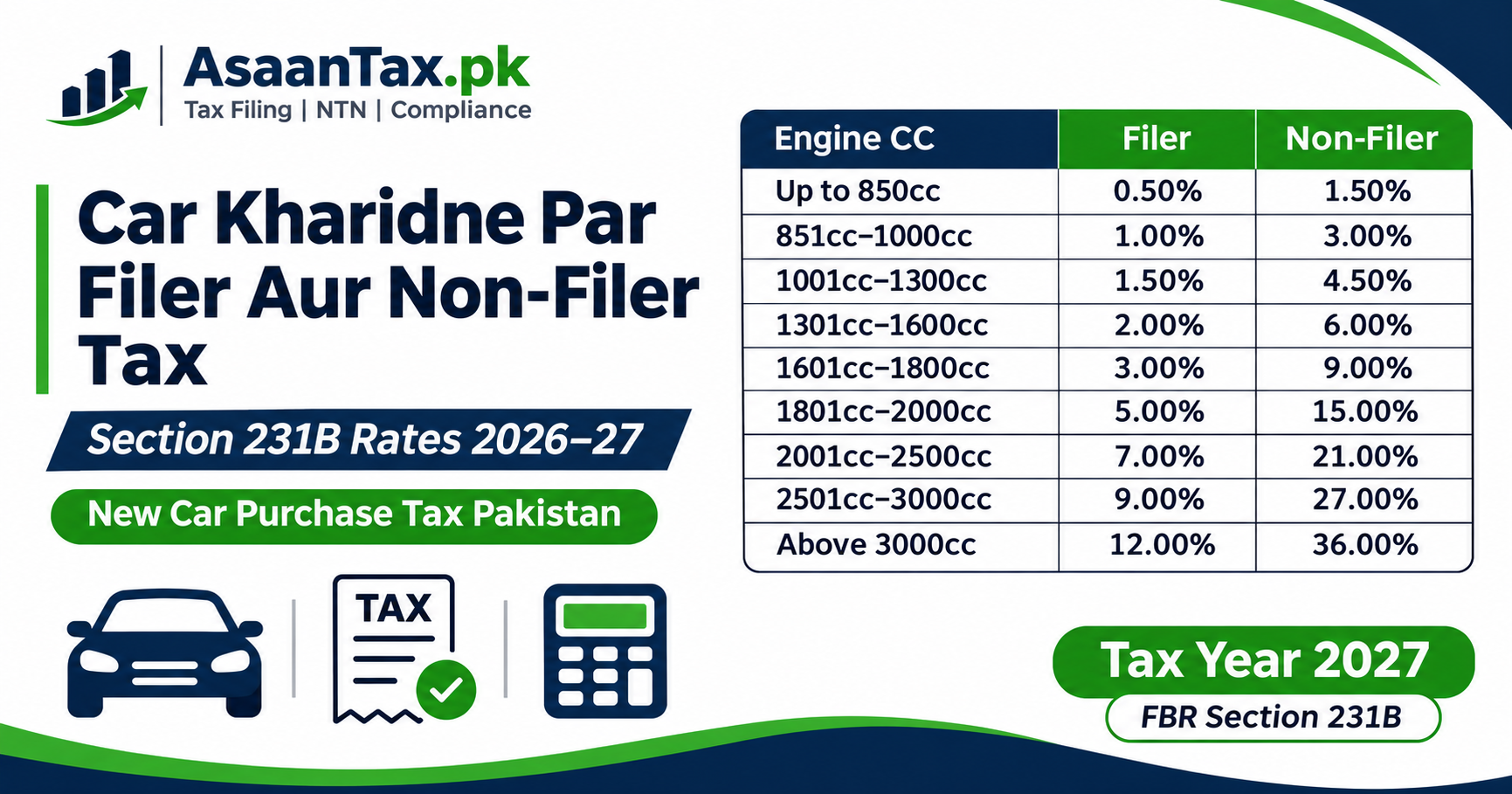
For Tax Year 2027 (July 1, 2026 to June 30, 2027), the withholding tax on new car registration ranges from 0.5% to 12% for filers and 1.5% to 36% for non-filers, depending on engine capacity.
This means a non-filer can generally pay three times the advance income tax charged to a filer when purchasing or registering the same qualifying vehicle.
Whether you are purchasing a Suzuki Alto, Suzuki Swift, Toyota Yaris, Toyota Corolla, Honda City, Honda Civic, Hyundai Tucson, Kia Sportage, Toyota Fortuner or another vehicle, understanding the relevant FBR tax rate is essential.
In this complete guide, AsaanTax.pk explains the latest Section 231B car tax rates, filer and non-filer differences, vehicle tax calculations, used car transfer taxes, imported car valuation, ATL verification and tax return reporting.
What Is Section 231B of the Income Tax Ordinance?
Section 231B governs the collection of advance income tax on specified motor vehicle transactions in Pakistan.
It includes provisions dealing with:
- Registration of motor vehicles.
- Purchase of vehicles from manufacturers.
- Transfer of registration or ownership.
- Certain sales of locally manufactured vehicles before first registration.
- Leasing or financing transactions covered by the relevant provisions.
The tax is generally collected through the prescribed authority or institution at the applicable transaction stage.
The amount depends on the statutory category, engine capacity, taxable value and taxpayer status.
Important: Section 231B advance income tax is separate from provincial vehicle registration charges, annual token tax, General Sales Tax (GST), customs duty and other applicable levies.
Latest FBR Car Tax Rates in Pakistan 2026–27
For Tax Year 2027, the following advance income tax percentages apply to qualifying new vehicle registration or purchase transactions under Sections 231B(1) and 231B(3).
| Engine Capacity | Filer (ATL) | Non-Filer |
|---|---|---|
| Up to 850cc | 0.50% | 1.50% |
| 851cc–1000cc | 1.00% | 3.00% |
| 1001cc–1300cc | 1.50% | 4.50% |
| 1301cc–1600cc | 2.00% | 6.00% |
| 1601cc–1800cc | 3.00% | 9.00% |
| 1801cc–2000cc | 5.00% | 15.00% |
| 2001cc–2500cc | 7.00% | 21.00% |
| 2501cc–3000cc | 9.00% | 27.00% |
| Above 3000cc | 12.00% | 36.00% |
Applicable period: Financial Year 2026–27 / Tax Year 2027.
Legal reference: Section 231B, Division VII of Part IV of the First Schedule, read with the relevant Tenth Schedule provisions.
These rates are calculated using the applicable statutory vehicle value rather than a fixed rupee amount for every car.
What Is the Difference Between a Filer and Non-Filer?
A filer generally refers to a taxpayer whose name appears on the FBR Active Taxpayers List.
A non-filer, for the purposes of these withholding rate comparisons, generally refers to a person who does not appear on the relevant ATL.
For qualifying new car purchase and registration transactions, the ordinary non-ATL rate is three times the ATL rate.
Example
A 1500cc car has an applicable taxable invoice value of Rs. 6,000,000.
Filer rate: 2%
Filer tax: Rs. 120,000.
Non-filer rate: 6%
Non-filer tax: Rs. 360,000.
Additional advance income tax for non-filer: Rs. 240,000.
This is why checking your ATL status before purchasing a vehicle is financially important.
Car Purchase Tax Calculation Formula
The basic calculation is:
Advance Income Tax = Applicable Vehicle Value × Section 231B Tax Rate
For example:
Vehicle value = Rs. 5,000,000.
Engine capacity = 1300cc.
Filer rate = 1.5%.
Calculation:
Rs. 5,000,000 × 1.5% = Rs. 75,000.
For a non-filer:
Rs. 5,000,000 × 4.5% = Rs. 225,000.
Difference = Rs. 150,000.
The taxable value must be determined according to the applicable statutory rules.
Complete Car Tax Calculation Examples by CC
The following table compares filer and non-filer advance income tax for hypothetical vehicle values.
| Engine CC | Assumed Vehicle Value | Filer Tax | Non-Filer Tax |
|---|---|---|---|
| 660cc | Rs. 2,500,000 | Rs. 12,500 | Rs. 37,500 |
| 1000cc | Rs. 3,500,000 | Rs. 35,000 | Rs. 105,000 |
| 1200cc | Rs. 4,500,000 | Rs. 67,500 | Rs. 202,500 |
| 1300cc | Rs. 5,000,000 | Rs. 75,000 | Rs. 225,000 |
| 1500cc | Rs. 6,000,000 | Rs. 120,000 | Rs. 360,000 |
| 1800cc | Rs. 8,000,000 | Rs. 240,000 | Rs. 720,000 |
| 2000cc | Rs. 10,000,000 | Rs. 500,000 | Rs. 1,500,000 |
| 2500cc | Rs. 15,000,000 | Rs. 1,050,000 | Rs. 3,150,000 |
| 3000cc | Rs. 20,000,000 | Rs. 1,800,000 | Rs. 5,400,000 |
| 3500cc | Rs. 25,000,000 | Rs. 3,000,000 | Rs. 9,000,000 |
These vehicle prices are illustrative and do not represent actual current showroom prices.
The calculations exclude provincial registration fees, annual token tax, insurance and other charges.
Suzuki Alto 660cc Filer and Non-Filer Tax
The Suzuki Alto is commonly equipped with a 660cc engine.
A qualifying 660cc vehicle falls in the up-to-850cc category.
| Taxpayer Status | Section 231B Rate |
|---|---|
| Filer | 0.5% |
| Non-Filer | 1.5% |
Example
Assumed taxable vehicle value: Rs. 3,000,000.
Filer tax = Rs. 15,000.
Non-filer tax = Rs. 45,000.
Difference = Rs. 30,000.
The actual amount depends on the taxable invoice value applicable to the vehicle.
Tax on a 1000cc Car in Pakistan
For vehicles with engine capacities from 851cc to 1000cc, the Section 231B rates are:
- Filer: 1%.
- Non-Filer: 3%.
Suppose the vehicle value is Rs. 3,500,000.
Filer tax = Rs. 35,000.
Non-filer tax = Rs. 105,000.
Difference = Rs. 70,000.
Note that an exactly 1000cc car falls in this category, while a vehicle exceeding 1000cc falls in the next relevant category.
Toyota Yaris, Honda City and 1300cc Car Tax
A 1300cc vehicle generally falls in the 1001cc–1300cc category.
The applicable rates are:
- Filer: 1.5%.
- Non-Filer: 4.5%.
A vehicle with a taxable value of Rs. 5,000,000 would attract:
Filer tax = Rs. 75,000.
Non-filer tax = Rs. 225,000.
Different variants of Toyota Yaris, Honda City and other models may have different engine capacities.
Always confirm the exact engine size of the variant being purchased.
Tax on 1500cc and 1600cc Cars
Vehicles between 1301cc and 1600cc generally fall within the following Section 231B rate category:
| Status | Tax Rate |
|---|---|
| Filer | 2% |
| Non-Filer | 6% |
For an assumed taxable value of Rs. 6,000,000:
Filer advance tax = Rs. 120,000.
Non-filer advance tax = Rs. 360,000.
These percentages are not the vehicle's total sales tax rate.
Honda Civic, Toyota Corolla and 1800cc Car Tax
For a qualifying vehicle with engine capacity from 1601cc to 1800cc:
Filer rate = 3%.
Non-filer rate = 9%.
Suppose the car's relevant taxable value is Rs. 8,000,000.
Filer tax = Rs. 240,000.
Non-filer tax = Rs. 720,000.
Additional amount for non-filer = Rs. 480,000.
The final figure must be calculated from the actual invoice or statutory valuation.
Tax on SUVs and Vehicles Above 2000cc
Higher engine-capacity vehicles can attract significantly larger advance income tax amounts.
| Engine Capacity | Filer | Non-Filer |
|---|---|---|
| 2001cc–2500cc | 7% | 21% |
| 2501cc–3000cc | 9% | 27% |
| Above 3000cc | 12% | 36% |
For example, a qualifying 2500cc vehicle valued at Rs. 15 million would attract:
Filer tax = Rs. 1,050,000.
Non-filer tax = Rs. 3,150,000.
Different SUV models, including Toyota Fortuner, Hyundai Tucson and Kia Sportage variants, may have different engines or powertrains.
The exact variant and legal classification must be confirmed.
How Is Vehicle Value Calculated Under Section 231B?
Section 231B uses specific valuation rules for calculating advance tax.
Locally Manufactured or Assembled Vehicles
For a qualifying locally manufactured or assembled vehicle, the relevant value is generally the invoice value inclusive of applicable duties and taxes.
Imported Vehicles
For imported vehicles, the applicable value generally involves the customs-assessed import value increased by relevant customs duty, Federal Excise Duty and sales tax payable at import stage.
Auctioned Vehicles
For auctioned vehicles, the relevant auction value inclusive of applicable duties and taxes may be used.
Important: The percentage should not automatically be applied to an informal market estimate or an arbitrary ex-showroom figure.
Does Finance Act 2026 Change Car Registration Tax Rates?
For Tax Year 2027, FBR's withholding tax rate card retains the engine-capacity-based percentage schedule shown above.
Finance Act 2026 introduced changes in several other areas of vehicle taxation and administrative provisions.
However, changes relating to customs duty, GST or provincial token tax should not be confused with the Section 231B advance income tax percentage schedule.
Car buyers should verify the type of tax being quoted by the dealer or registration authority.
Used Car Transfer Tax Under Section 231B(2)
Buying a previously registered car involves different tax provisions from registering a brand-new vehicle.
Section 231B(2) covers advance tax collected at the time of transfer of registration or ownership.
The published base rates for the relevant vehicle categories are:
| Engine Capacity | Filer Base Tax | Non-Filer Base Tax |
|---|---|---|
| Up to 850cc | Nil | Nil |
| 851cc–1000cc | Rs. 5,000 | Rs. 15,000 |
| 1001cc–1300cc | Rs. 7,500 | Rs. 22,500 |
| 1301cc–1600cc | Rs. 12,500 | Rs. 37,500 |
| 1601cc–1800cc | Rs. 18,750 | Rs. 56,250 |
| 1801cc–2000cc | Rs. 25,000 | Rs. 75,000 |
| 2001cc–2500cc | Rs. 37,500 | Rs. 112,500 |
| 2501cc–3000cc | Rs. 50,000 | Rs. 150,000 |
| Above 3000cc | Rs. 62,500 | Rs. 187,500 |
These are base amounts before the applicable reduction for vehicle age.
Age-Based Transfer Tax Reduction
The statutory rate is reduced by 10% for each year from the date of first registration in Pakistan, subject to the relevant rules.
Section 231B also provides that the transfer-related advance tax is not collected after five years from first registration in Pakistan.
Example
A 1500cc qualifying vehicle has a base filer transfer tax of Rs. 12,500.
After two applicable annual reductions of 10% each, the illustrative amount would be:
Rs. 12,500 × 80% = Rs. 10,000.
Actual collection depends on the legally relevant first-registration date and transaction details.
Important
Provincial transfer fees, token tax arrears and other registration charges may still apply even if federal transfer advance tax is no longer collected.
Is There a Special Tax on Selling an Unregistered New Car?
Yes.
Section 231B(2A) contains a separate provision for specified locally manufactured vehicles sold before registration by the original purchaser.
This is different from ordinary purchase/registration tax and from transfer tax on an already registered used vehicle.
The relevant base advance income tax amounts are:
| Engine Capacity | Filer | Non-Filer |
|---|---|---|
| Up to 1000cc | Rs. 100,000 | Rs. 300,000 |
| 1001cc–2000cc | Rs. 200,000 | Rs. 600,000 |
| Above 2000cc | Rs. 400,000 | Rs. 1,200,000 |
The provision applies only where its statutory conditions are satisfied.
This additional tax is intended to address the specified pre-registration sale transaction and should not be charged automatically on every used or new vehicle purchase.
Is Car Sales Tax Different From Section 231B Tax?
Yes.
General Sales Tax on vehicles is governed by the Sales Tax Act, 1990 and applicable notifications.
Section 231B is an advance income tax collected under the Income Tax Ordinance, 2001.
Other vehicle costs can include:
- GST.
- Customs duty on imports.
- Federal Excise Duty where applicable.
- Provincial registration fees.
- Annual token tax.
- Number plate and smart card fees.
- Insurance and other transaction-related expenses.
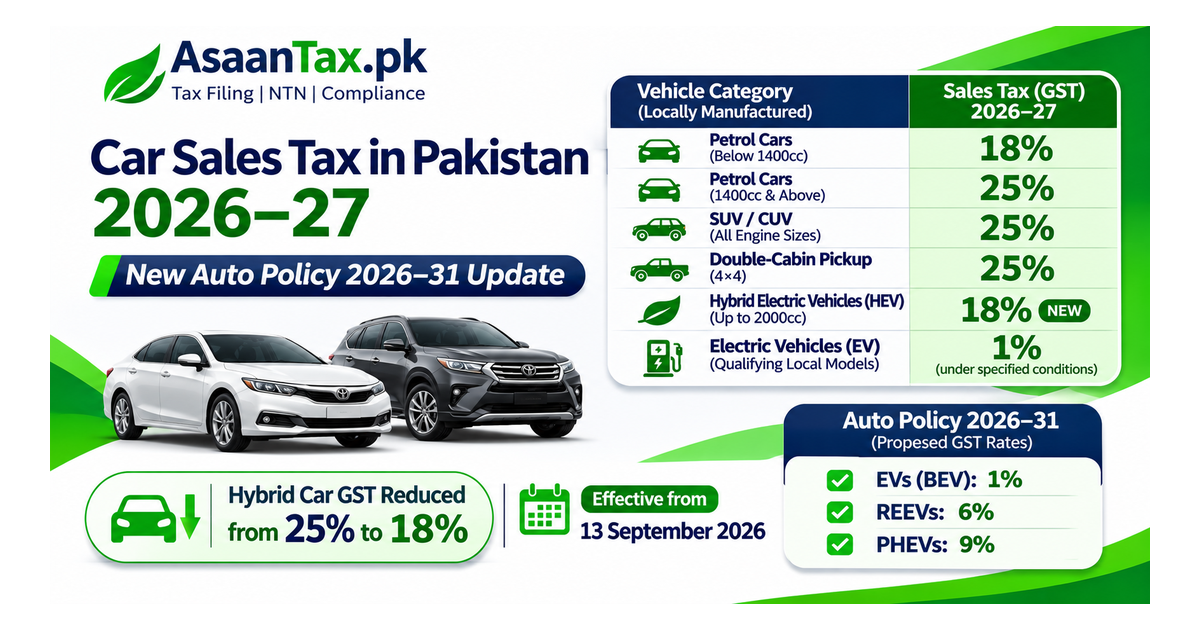
An 18% or 25% GST rate is not a replacement for the applicable Section 231B withholding rate.
Does Section 231B Apply to Electric Vehicles?
Electric vehicles and vehicles without a conventional engine-capacity classification may be subject to specific statutory valuation and tax provisions.
The relevant rules can depend on vehicle value, classification and the subsection involved.
Where engine capacity is not applicable and the vehicle's relevant value is Rs. 5 million or more, special Section 231B rates may apply.
For an eligible new vehicle in that category, the published rate is 3% of the applicable value for ATL taxpayers and 9% for non-ATL taxpayers.
The exact treatment should be checked against the vehicle's official classification and current FBR rate card.
Do not automatically apply the petrol-engine CC table to every electric vehicle.
Car Registration Tax vs Annual Token Tax
Advance income tax on a new vehicle and annual motor vehicle token tax are different liabilities.
Section 231B Advance Income Tax
Collected in connection with specified purchase, registration or transfer events.
Annual Token Tax
Generally collected through the relevant provincial or territorial motor vehicle taxation authority.
Section 234 Income Tax
Separate advance income tax may be collected with motor vehicle tax under Section 234, subject to the relevant legal provisions.
Token tax rates can differ in Punjab, Sindh, Khyber Pakhtunkhwa, Balochistan and Islamabad Capital Territory.
Therefore, a taxpayer should not calculate the total cost of registering a vehicle using Section 231B alone.
Can Section 231B Advance Income Tax Be Adjusted in an FBR Return?
Section 231B advance income tax is generally adjustable against the taxpayer's income tax liability, subject to the applicable law and individual circumstances.
For example, a taxpayer who paid Rs. 120,000 in qualifying vehicle advance income tax may be able to claim the relevant amount in their annual income tax return.
The taxpayer should retain:
- Vehicle purchase invoice.
- Registration documents.
- Relevant withholding tax receipt.
- CPR or other official payment evidence.
- Details linking the transaction to their tax registration.
Important: Adjustable tax does not automatically mean the full amount is immediately refundable.
The actual adjustment or refund depends on the person's total tax position, applicable rules and proper reporting.
How to Report Car Advance Tax in Tax Year 2027 Return
When preparing the Tax Year 2027 return, follow the relevant IRIS requirements.
Step 1: Collect Vehicle Documents
Keep the car invoice and proof of advance tax collection.
Step 2: Log In to FBR IRIS
Visit https://iris.fbr.gov.pk/.
Step 3: Select Tax Year 2027
Tax Year 2027 generally covers July 1, 2026 to June 30, 2027.
Step 4: Report Relevant Income
Enter salary, business and other chargeable income under the appropriate categories.
Step 5: Enter Advance Tax
Report eligible Section 231B tax under the correct tax payment or withholding category.
Step 6: Complete the Wealth Statement
Where required, report the vehicle as an asset and reconcile its acquisition using actual savings, bank payments, financing or other lawful sources.
Step 7: Review the Tax Calculation
Check the adjustment and any remaining payable tax or eligible refund.
Step 8: Submit and Retain Records
File the return and keep the acknowledgment.
The actual IRIS interface and field names may differ when the Tax Year 2027 return form becomes available.
What If a Car Is Purchased Through Bank Financing?
Vehicles financed through banks or leasing companies may involve additional legal requirements.
Section 231B includes a provision under which qualifying financial institutions collect advance tax at 4% of the value when leasing a motor vehicle to a person not appearing on ATL.
The exact treatment depends on the legal form of the transaction, the person acquiring the vehicle and the applicable subsection.
Do not assume that every financed car is subject to an additional 4% tax regardless of taxpayer status.
Request a complete tax breakdown from the bank or financing institution.
Does Every Vehicle Owner Have to File an Income Tax Return?
Section 114 includes a filing test relating to ownership of motor vehicles having engine capacity above 1000cc.
However, the exact filing obligation depends on other applicable conditions and exceptions under Section 115.
For example:
- A qualifying 1500cc vehicle may trigger the vehicle-ownership filing test.
- An exactly 1000cc vehicle does not automatically satisfy the wording “above 1000cc.”
- A 660cc vehicle owner may still be required to file for income, NTN or other reasons.
Owning a car is only one factor in determining whether a return is compulsory.
How to Check Your Filer Status Before Buying a Car
Before placing a booking or registering a vehicle, check your current ATL status.
Method 1: Online
Visit the official FBR IRIS website:
Open the Active Taxpayer List (Income Tax) verification facility.
Enter your CNIC or NTN and complete the verification.
Method 2: SMS
For an individual, send:
ATL 1234567890123
to 9966, replacing the example with your actual 13-digit CNIC without dashes.
For a company or AOP, use the prescribed NTN-based format.
Important
Simply having an NTN does not automatically mean you currently appear on ATL.
If your status is inactive, review your filing obligations and any applicable late-filing rules before making a vehicle purchase.
Can Overseas Pakistanis Purchase Cars at Filer Rates?
Overseas Pakistanis may have special tax residency and compliance circumstances.
However, being overseas does not automatically establish eligibility for every ATL rate on a motor vehicle transaction.
The applicable withholding treatment must be determined from the buyer's current ATL status, the specific statutory provisions and any available exemption or exception.
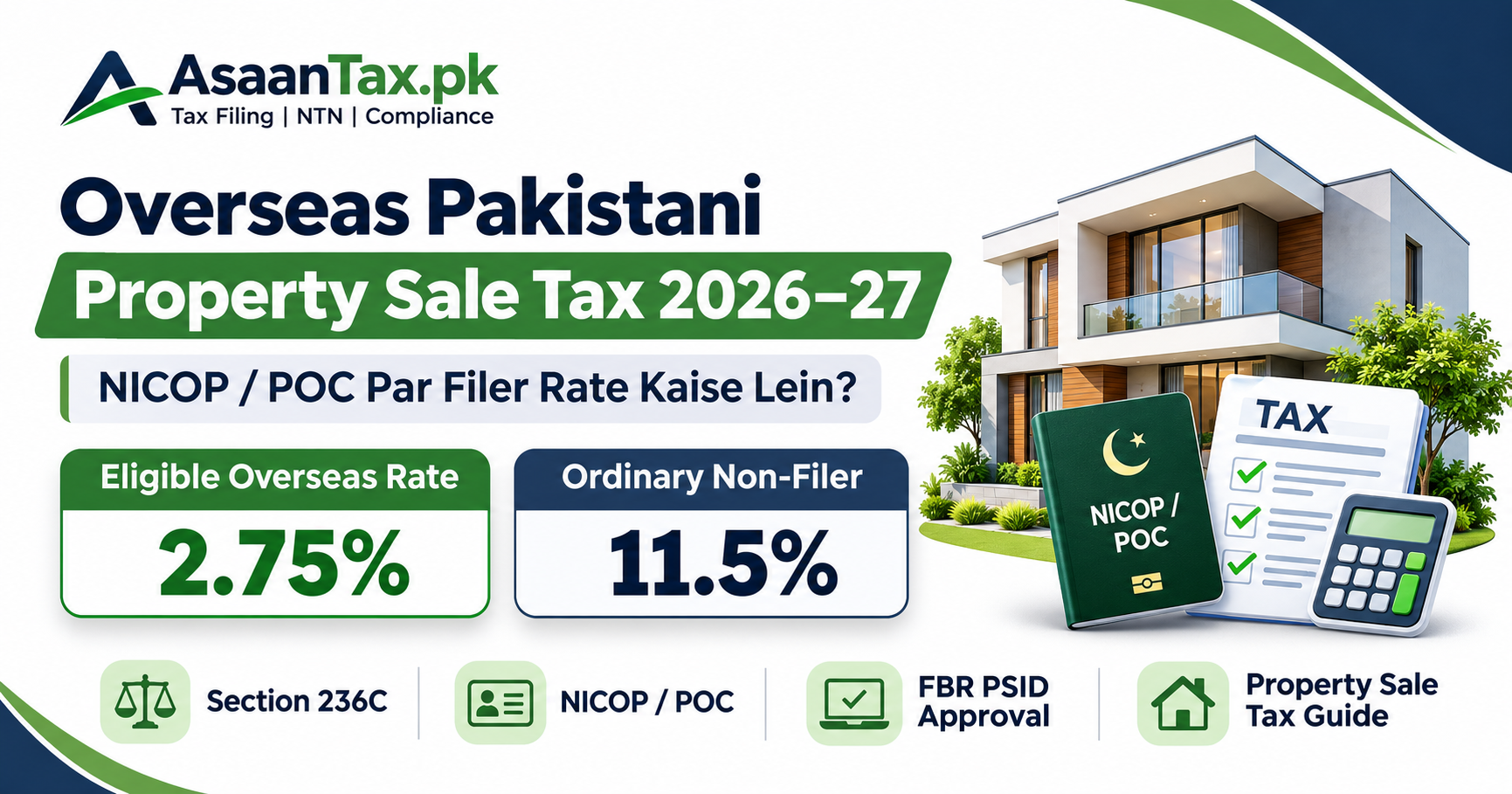
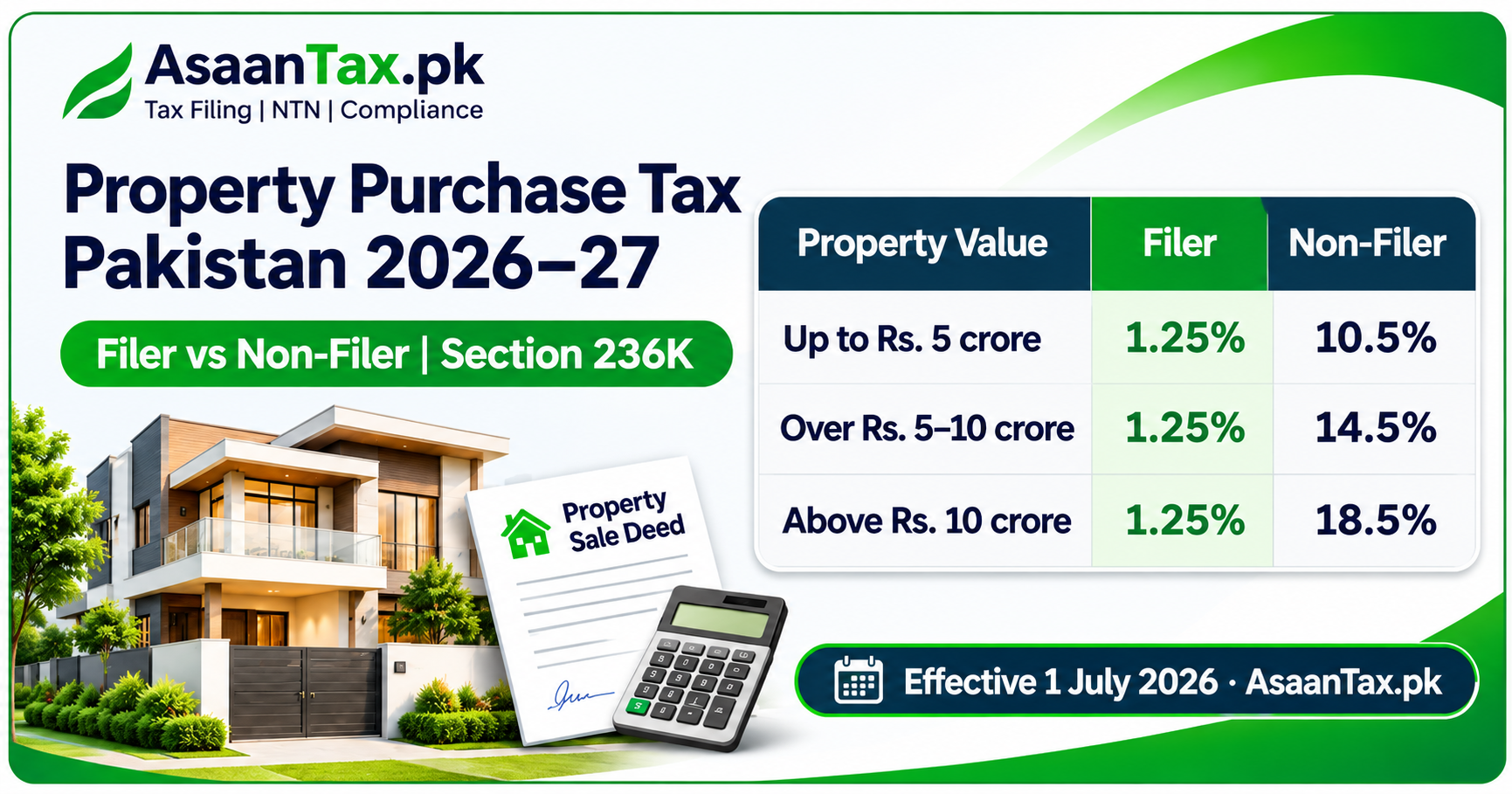
Do not automatically apply rules designed for overseas Pakistani property transactions under Section 236K to a vehicle purchase under Section 231B.
Documents Required Before Car Registration
Useful documents may include:
- CNIC or relevant identification.
- NTN, where applicable.
- Current ATL status confirmation.
- Vehicle invoice.
- Vehicle model and engine capacity.
- Manufacturer or importer details.
- Chassis and engine information.
- Bank financing documents, if applicable.
- Relevant tax payment evidence.
- Provincial registration documentation.
Imported vehicles may require additional customs and import records.
Common Car Tax Calculation Mistakes
Car buyers should avoid:
- Using outdated fixed rupee tax amounts for new vehicle registration.
- Applying the new car percentage table to a used car transfer.
- Forgetting the non-filer rate difference.
- Using the wrong engine-capacity category.
- Applying the tax rate to an incorrect vehicle value.
- Confusing GST with advance income tax.
- Ignoring provincial registration fees and token tax.
- Treating the unregistered vehicle resale tax as an ordinary transfer charge.
- Assuming an adjustable tax amount is automatically refundable.
- Purchasing without verifying current ATL status.
- Recording the vehicle incorrectly in the Wealth Statement.
- Using rates from an earlier Finance Act without checking the current tax year.
Watch Car Tax Tutorials – Tax with Naeem
For Urdu-language guidance about FBR income tax, car registration, filer status and the difference between filer and non-filer taxation, explore the YouTube channel Tax with Naeem.
Find relevant videos here:
https://www.youtube.com/results?search_query=Tax+with+Naeem+Car+Tax+Filer+Non+Filer
Relevant topics include:
- Section 231B car registration tax.
- Filer and non-filer tax comparison.
- Used car transfer tax.
- FBR ATL status verification.
- Vehicle purchase reporting in income tax returns.
- Wealth Statement and vehicle asset disclosure.
For the most accurate guidance, use videos discussing the Finance Act 2026 and Tax Year 2027. Older tutorials may refer to superseded rates.
How AsaanTax.pk Helps With Car Tax and FBR Compliance
Planning to purchase a car but unsure whether the filer or non-filer rate applies?
AsaanTax.pk provides professional guidance on income tax registration, filing and relevant vehicle taxation requirements.
Our services include:
- NTN registration assistance.
- Income tax return filing.
- FBR ATL status guidance.
- Section 231B advance income tax calculation assistance.
- Filer and non-filer vehicle tax comparison.
- Withholding tax documentation guidance.
- Wealth Statement reporting.
- Car purchase tax adjustment guidance.
- General FBR compliance assistance.
Need Help Understanding Car Purchase Tax?
Visit AsaanTax.pk for tax filing guidance, FBR compliance information and assistance with applicable advance income tax requirements.
Website: https://www.asaantax.pk/
AsaanTax.pk is an independent tax services platform and is not affiliated with the Federal Board of Revenue or the Government of Pakistan.
Official Sources and References
- FBR – Withholding Tax Rate Cards
- FBR – Income Tax Ordinance, 2001
- FBR – Finance Act 2026
- FBR – IRIS Online Filing
- FBR – Active Taxpayer List Verification
- Punjab Excise – Motor Vehicle Tax
Last updated: November 3, 2026.
Disclaimer: This article provides general information about vehicle-related advance income tax in Pakistan. Actual liability depends on the vehicle's engine capacity, statutory taxable value, transaction type, ATL status, applicable exemptions and current law. New vehicle purchase, used vehicle transfer, pre-registration resale, leasing, provincial registration and annual token tax can be subject to different rules. Verify the actual tax with FBR and the relevant registration authority before making payment.