Buying a plot, house, apartment or commercial property in Pakistan? Before purchasing real estate, you should understand how much advance income tax you may have to pay to the Federal Board of Revenue (FBR).
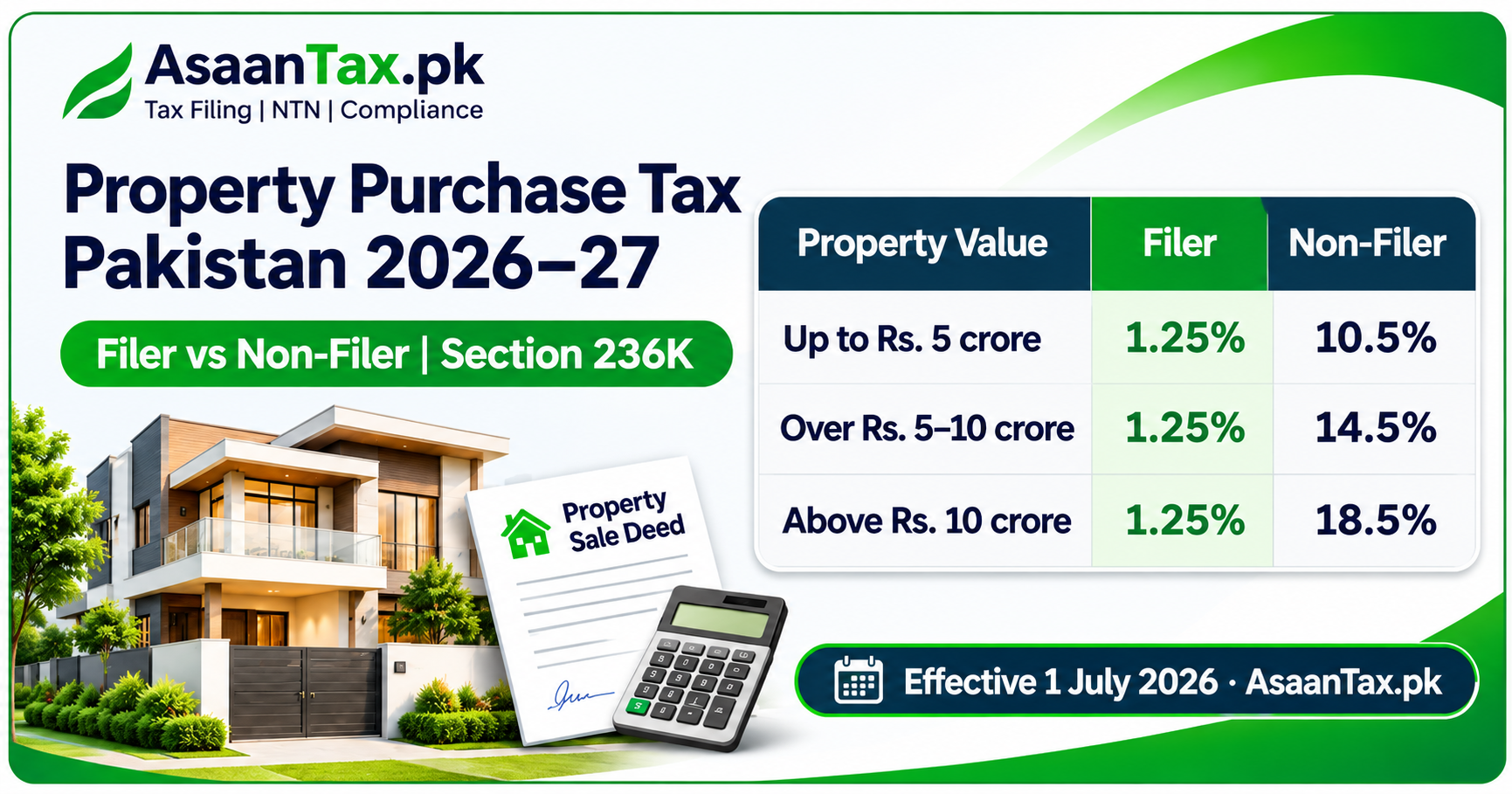
Under the Finance Act 2026, property buyers appearing on the Active Taxpayers List (ATL) generally pay 1.25% advance tax under Section 236K, while non-filers may pay 10.5%, 14.5% or 18.5%, depending on the property's fair market value.
The updated rates apply from July 1, 2026, for the financial year 2026–27 (Tax Year 2027).
In this guide, AsaanTax.pk explains the latest property purchase tax rates in Pakistan, compares filer and non-filer liabilities, provides practical calculations and discusses how buyers can check their FBR status before purchasing property.
Latest Property Purchase Tax Rates in Pakistan 2026–27
The following table compares advance income tax rates for filers and non-filers purchasing immovable property under Section 236K.
| Fair Market Value of Property | Filer (ATL) | Non-Filer (Non-ATL) |
|---|---|---|
| Up to Rs. 50 million (5 crore) | 1.25% | 10.5% |
| Above Rs. 50 million up to Rs. 100 million (5–10 crore) | 1.25% | 14.5% |
| Above Rs. 100 million (10 crore) | 1.25% | 18.5% |
Effective date: July 1, 2026.
Applicable law: Section 236K of the Income Tax Ordinance, 2001, read with the relevant provisions of the First and Tenth Schedules, as amended through the Finance Act 2026.
The listed rates relate to advance income tax collected from the property purchaser. Provincial stamp duties, registration fees and other transfer expenses are separate.
What Is Section 236K Property Purchase Tax?
Section 236K governs the collection of advance income tax from a purchaser or transferee of immovable property in Pakistan.
This tax is generally collected when a property transaction is registered, recorded or attested by the relevant authority.
The collecting authority may include a registrar, housing authority, housing society or another legally authorized entity responsible for recording the property transfer.
The amount is calculated using the property's applicable fair market value, subject to statutory valuation requirements.
It is important to distinguish this tax from annual property tax, capital gains tax and provincial transfer charges.
Property Purchase Tax for Filers in Pakistan
A filer generally means a taxpayer whose name appears on the FBR Active Taxpayers List.
For Tax Year 2027, the ordinary advance tax rate under Section 236K for a buyer on the ATL is:
1.25% of the property's applicable fair market value.
This is a flat rate across the property value categories described above.
For example, if the taxable fair market value of a property is Rs. 10 million (1 crore):
Property purchase tax = Rs. 10,000,000 × 1.25%
Total advance tax = Rs. 125,000 (1.25 lakh).
Appearing on the Active Taxpayers List can therefore make a substantial difference to the cost of purchasing property.
Property Purchase Tax for Non-Filers in Pakistan
A non-filer, in the context of these withholding tax rates, generally refers to a person whose name does not appear on the relevant FBR Active Taxpayers List.
Under the applicable rules, higher rates are collected from buyers not appearing on the ATL.
For property worth up to Rs. 50 million, the non-filer advance tax rate is 10.5%.
For property worth more than Rs. 50 million but not exceeding Rs. 100 million, the rate is 14.5%.
For property worth more than Rs. 100 million, the rate is 18.5%.
These rates apply to the relevant taxable property value and should not be confused with a progressive income tax calculation in which each portion of value is charged at a different slab rate.
Example: Non-Filer Buying Property Worth Rs. 10 Million
Property value: Rs. 10,000,000
Non-filer advance tax rate: 10.5%
Tax = Rs. 10,000,000 × 10.5%
Total advance tax = Rs. 1,050,000 (10.5 lakh).
A filer buying property of the same taxable value would ordinarily pay Rs. 125,000 under Section 236K.
The difference in advance tax collected at the time of purchase would be Rs. 925,000.
Filer vs Non-Filer Property Tax Comparison With Examples
The following examples illustrate how filer status affects the advance tax collected from property buyers.
| Property Value | Filer Tax | Non-Filer Tax | Difference |
|---|---|---|---|
| Rs. 5 million (50 lakh) | Rs. 62,500 | Rs. 525,000 | Rs. 462,500 |
| Rs. 10 million (1 crore) | Rs. 125,000 | Rs. 1,050,000 | Rs. 925,000 |
| Rs. 20 million (2 crore) | Rs. 250,000 | Rs. 2,100,000 | Rs. 1,850,000 |
| Rs. 50 million (5 crore) | Rs. 625,000 | Rs. 5,250,000 | Rs. 4,625,000 |
| Rs. 75 million (7.5 crore) | Rs. 937,500 | Rs. 10,875,000 | Rs. 9,937,500 |
| Rs. 120 million (12 crore) | Rs. 1,500,000 | Rs. 22,200,000 | Rs. 20,700,000 |
These calculations are illustrative and assume that the stated property value is the value used for Section 236K.
Actual payments should be verified with FBR and the relevant property registration or transfer authority.
Why Is Becoming a Filer Important Before Buying Property?
The advance tax difference between a filer and non-filer can be substantial.
For example, on a property valued at Rs. 20 million, the difference under Section 236K is Rs. 1,850,000.
A person planning to purchase property should therefore verify their ATL status before completing the transaction.
However, being registered for an NTN or submitting an income tax return does not necessarily mean a person's ATL status has immediately become active.
Late return filing may involve separate ATL inclusion requirements, including an applicable surcharge or statutory exception.
Taxpayers should complete the relevant legal requirements and confirm their status through FBR before relying on filer rates.
How to Check Your Filer or Non-Filer Status Before Property Purchase
You can verify your taxpayer status through official FBR facilities.
Step 1: Visit FBR
Open the official FBR IRIS portal at https://iris.fbr.gov.pk/ or access FBR's online verification services.
Step 2: Select Active Taxpayer Verification
Choose the relevant Active Taxpayer List (Income Tax) verification service.
Step 3: Enter Your Identification Details
Provide your CNIC or NTN and other requested verification information.
Step 4: Check Your ATL Status
Review whether your name appears on the applicable Active Taxpayers List.
Step 5: Confirm Before Transfer
If you are buying property, confirm your status again before the transfer or registration process.
Your applicable withholding tax treatment is determined according to the relevant legal rules at the time of the transaction.
What About Late Filers in 2026–27?
Taxpayers often ask whether a person who submits an income tax return after the deadline must pay a separate property purchase withholding tax rate.
The Finance Act 2026 omitted Rule 1A of the Tenth Schedule, which previously prescribed separate higher withholding tax rates for certain late filers.
Accordingly, the earlier separate property purchase late-filer rates should not be presented as current rates for transactions governed by the 2026 amendments.
However, a late-filing taxpayer must still satisfy the conditions for inclusion in the ATL.
A person whose name does not appear on the relevant Active Taxpayers List may continue to face non-ATL rates.
Late filing may also have separate implications under Sections 182 and 182A.
Always verify the current ATL status and applicable requirements before proceeding with a property transaction.
Property Purchase Tax for Overseas Pakistanis
Certain overseas Pakistanis may qualify for favorable tax treatment when purchasing property in Pakistan.
FBR provides a facility for eligible non-resident individuals holding a Pakistan Origin Card (POC) or National Identity Card for Overseas Pakistanis (NICOP).
Under the applicable requirements, qualifying individuals may obtain filer-rate treatment under Sections 236C and 236K even if they do not appear on the ATL.
The procedure involves identity and non-resident status verification through the relevant FBR system.
Eligibility is not automatic merely because a person lives abroad. Supporting documents and approval through the prescribed process may be required.
Overseas Pakistanis should confirm eligibility and the required PSID process before paying advance tax.
Is Property Purchase Tax the Only Tax on Buying a House or Plot?
No.
Section 236K relates to federal advance income tax collected from the buyer.
Other costs may include:
- Provincial stamp duty.
- Property registration fees.
- Applicable provincial taxes or charges.
- Housing society transfer charges.
- Development authority fees.
- Legal and documentation expenses.
These additional costs depend on the property's location, applicable provincial law, transfer authority and type of transaction.
For example, costs associated with property transfers in Punjab may differ from those in Sindh, Islamabad, Khyber Pakhtunkhwa or Balochistan.
Always request a complete breakdown of applicable taxes and transfer costs before purchasing property.
What Is the Difference Between Property Purchase Tax and Property Sale Tax?
Property purchase and property sale involve different withholding tax sections.
Section 236K – Tax on Property Purchase
Section 236K generally applies to the purchaser or transferee.
For the current tax period, the ordinary filer rate is 1.25%, while non-filer rates depend on property value.
Section 236C – Tax on Property Sale
Section 236C generally applies to the seller or transferor.
For the 2026–27 period, the advance withholding tax rate for an ATL seller is 2.75%, while the general non-ATL seller rate is 11.5%.
The seller's capital gains tax liability, where applicable, is a separate matter.
A buyer should not confuse the seller's Section 236C payment with the buyer's Section 236K payment.
Can You Legally Reduce Property Purchase Tax?
Buyers can benefit from the lower applicable withholding tax rate by meeting the legal requirements for active taxpayer treatment.
Before purchasing property:
- Determine whether you are required to file an income tax return.
- Ensure your FBR registration and information are accurate.
- File any legally required outstanding returns.
- Complete applicable ATL inclusion requirements.
- Verify your status directly through FBR.
- Confirm the correct property valuation and tax calculation.
- Retain all official challans, payment records and transfer documents.
Do not understate property values, conceal the source of funds or provide inaccurate information to avoid tax.
Tax compliance should be completed lawfully and accurately.
Documents Commonly Required for Property Tax Assistance
Depending on the transaction, buyers may need:
- CNIC, NTN or relevant overseas identification.
- FBR registration and ATL status details.
- Property location and identification information.
- Sale agreement or transfer documents.
- Relevant property valuation details.
- Source of funds and payment information.
- Applicable PSID or tax payment records.
- Supporting documents required by the registrar or housing authority.
Requirements may vary by transaction and authority.
Get Professional Property Tax Assistance From AsaanTax.pk
Planning to purchase a plot, house, apartment, shop or commercial property in Pakistan?
Not sure whether you will be charged the filer or non-filer rate?
AsaanTax.pk provides professional assistance with FBR registration, income tax return filing, ATL verification and property tax compliance.
Our services include:
- NTN registration assistance.
- Income tax return preparation and filing.
- Late tax return filing guidance.
- Active Taxpayer List verification.
- Property purchase withholding tax guidance.
- Section 236K tax calculation assistance.
- Documentation and compliance support.
- General assistance with tax payment procedures.
Understanding your tax obligations before purchasing property can help prevent unexpected financial costs and compliance problems.
Contact AsaanTax.pk Today
Get guidance before completing your next property purchase.
Website: https://www.asaantax.pk/
Call or WhatsApp: 0308-4781532
AsaanTax.pk is an independent tax services provider and is not an official FBR or Government of Pakistan website.
Official Sources and References
For further verification, consult:
- FBR – Withholding Tax Rate Cards
- FBR – Income Tax Ordinance
- FBR – Overseas Pakistanis Property Tax FAQs
- FBR – IRIS Portal
Last updated: November 2, 2026.
Disclaimer: This article provides general information about advance withholding tax on immovable property purchases in Pakistan. Actual tax obligations depend on the law applicable at the time of transfer, property valuation, ATL status, exemptions and transaction-specific circumstances. Confirm the latest requirements with FBR or a qualified tax professional before completing a transaction.