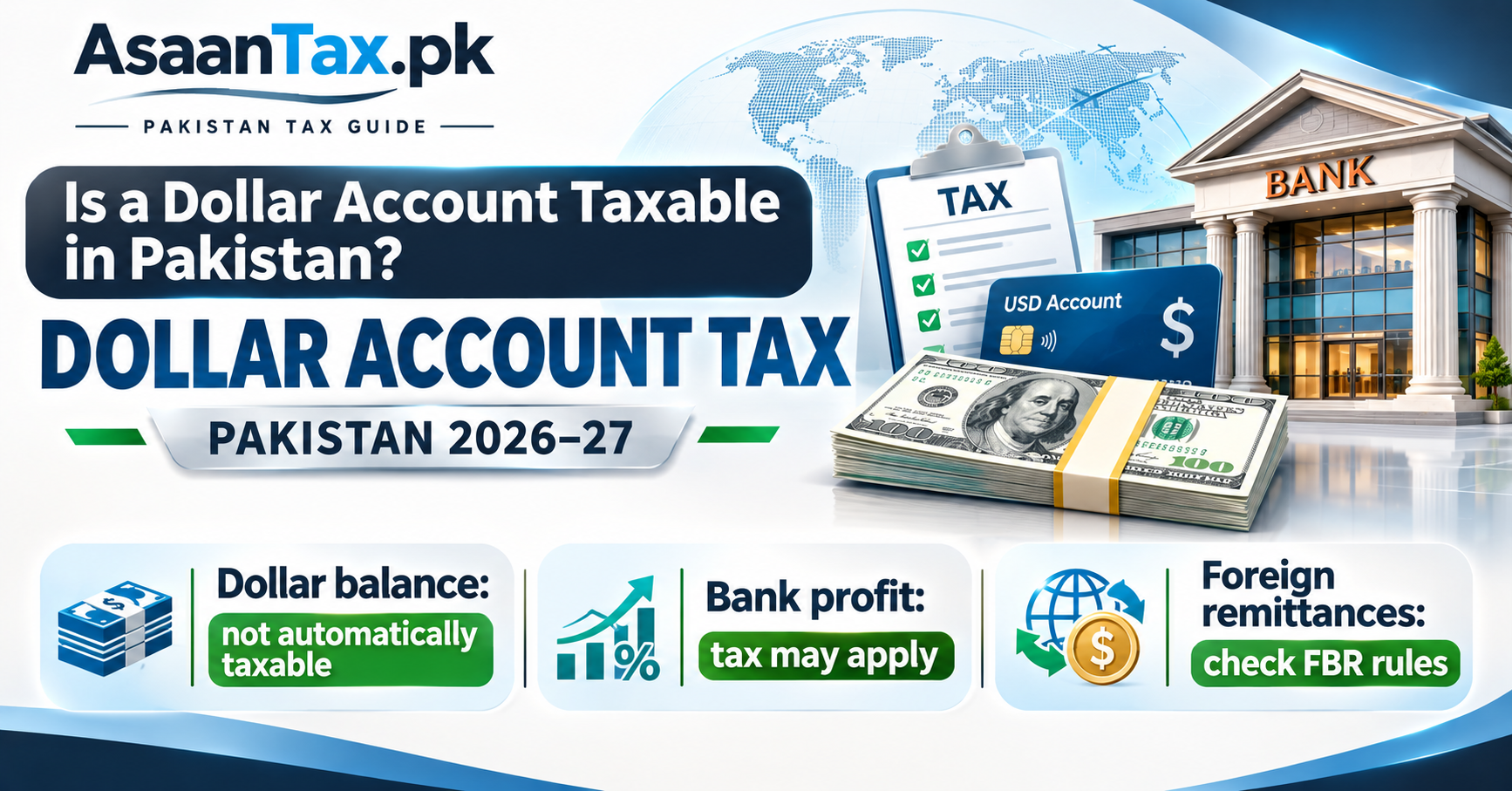
Is a Dollar Account Taxable in Pakistan? Complete Foreign Currency Account Tax Guide 2026–27
Published: November 9, 2026
Applicable Tax Year: 2027
Financial Year: 2026–27
Relevant Authorities: Federal Board of Revenue (FBR) and State Bank of Pakistan (SBP)
Many Pakistanis maintain US dollar accounts, foreign currency savings accounts and international banking arrangements to protect their savings, receive overseas remittances or manage international business payments.
However, an important question arises: Does FBR charge tax on money kept in a dollar account in Pakistan?
The answer depends on several factors.
Simply keeping dollars in a legitimate bank account does not automatically make the entire balance taxable income. However, profit earned on deposits, taxable business receipts, unexplained funds and foreign assets may create different tax obligations.
Some foreign-currency accounts also receive specific statutory exemptions, particularly under arrangements for eligible non-residents.
The Federal Board of Revenue regulates the income tax consequences, while the State Bank of Pakistan determines many banking and foreign exchange requirements.
This guide explains dollar account taxation in Pakistan for Tax Year 2027, including bank profit, foreign remittances, resident and non-resident accounts, Roshan Digital Accounts, FBR Wealth Statements and reporting requirements.
1. Is Keeping Dollars in a Bank Account Taxable in Pakistan?
No separate federal income tax is automatically charged merely because someone holds US dollars in a bank account.
For income tax purposes, it is important to distinguish between the principal amount deposited and the income generated from it.
For example, an individual may deposit USD 10,000 in a foreign currency account using previously declared savings.
The fact that those savings remain in a dollar account does not, by itself, mean the entire deposit becomes taxable income again.
However, if the same account earns interest or bank profit, that income may be subject to income tax unless a relevant exemption applies.
Similarly, if the account receives payments for taxable professional services or business activities, those receipts must be examined according to their actual nature.
Quick Tax Comparison
| Transaction | General FBR Treatment |
|---|---|
| Holding previously declared dollars | No automatic tax on the principal |
| Depositing legitimate savings | Not automatically new taxable income |
| Earning bank interest or profit | May be taxable unless exempt |
| Receiving family remittances | Depends on their nature and evidence |
| Receiving foreign freelance income | May be taxable under relevant provisions |
| Converting USD into PKR | No automatic tax solely on conversion |
| Maintaining an overseas bank account | Foreign asset reporting may apply |
| Holding an eligible exempt non-resident account | Specific exemption provisions may apply |
Taxpayers should not assume that every foreign currency transaction is either fully taxable or completely exempt.
2. What Is a Foreign Currency Account in Pakistan?
A foreign currency account is a bank account that allows eligible customers to hold money in a foreign currency rather than Pakistani rupees.
Common currencies include:
- United States Dollar (USD).
- Euro (EUR).
- British Pound Sterling (GBP).
- Other currencies supported by an authorized bank.
Foreign currency accounts are regulated by the State Bank of Pakistan through the Foreign Exchange Manual, relevant circulars and applicable legislation.
Account facilities and eligibility requirements depend on the type of account and the bank's authorization.
Common Types of Foreign Currency Accounts
Personal Foreign Currency Account
A personal account used by an eligible individual to hold foreign currency.
Foreign Currency Savings Account
An account that may pay profit or interest on an eligible foreign currency balance.
Foreign Currency Current Account
An account generally used for transactions without necessarily paying regular deposit profit.
Foreign Currency Value Account (FCVA)
A special account category available to eligible persons under SBP rules.
Roshan Digital Account
A banking facility designed primarily for eligible non-residents and certain other qualifying customers.
Business Foreign Currency Account
An account used for permitted commercial transactions, subject to applicable foreign exchange and banking regulations.
The account's legal classification is important because tax exemptions and banking permissions may differ.
3. What Does Pakistan's Foreign Currency Accounts Protection Law Say?
The Foreign Currency Accounts (Protection) Ordinance, 2001, protects certain rights of persons holding foreign currency accounts with authorized dealers.
It provides protections concerning the holding, withdrawal, use and transfer of foreign currency, subject to the relevant legal framework.
Another important law is the Protection of Economic Reforms Act, 1992.
Section 5 contains provisions concerning foreign currency account protections and certain exemptions.
However, significant restrictions apply to some exemptions for Pakistani residents and domestic entities in respect of accounts or deposits created on or after December 16, 1999.
Important Tax Clarification
A foreign currency account being legally protected does not automatically mean that every resident account is exempt from income tax.
Taxpayers must check whether the specific account and income qualify for the applicable exemption.
4. Is Profit Earned on a Dollar Account Taxable?
Profit or interest earned on a foreign currency deposit may be taxable as profit on debt.
For ordinary taxable accounts, the relevant provisions may include Sections 7B and 151 of the Income Tax Ordinance, 2001.
The applicable treatment depends on the account holder's residency, the nature of the deposit, the relevant income tax provisions and any statutory exemptions.
Example: Dollar Savings Account
Assume the following hypothetical situation:
| Description | Amount |
|---|---|
| Dollar Deposit | USD 20,000 |
| Annual Profit Rate | 3% |
| Annual Profit | USD 600 |
Annual profit:
USD 20,000 × 3% = USD 600
The USD 600 represents the gross profit earned during the year.
Where the profit is taxable, the taxpayer must determine its relevant Pakistani rupee value and apply the appropriate tax provisions.
The tax is not automatically calculated as a percentage of the entire USD 20,000 principal.
Important: This is an educational example and does not prescribe a bank deposit profit rate or a universal FBR tax percentage.
5. Is There Withholding Tax on Foreign Currency Account Profit?
Where applicable, banks may be required to deduct income tax from profit on debt under Section 151.
However, the correct withholding treatment depends on the taxpayer and the account.
Some accounts or specified banking arrangements may qualify for statutory exemptions.
Therefore, account holders should check:
- The legal type of account.
- Whether the account earns profit.
- The account holder's tax residency.
- Whether a statutory tax exemption applies.
- The latest withholding tax provisions.
- The bank's tax deduction certificate.
Important Distinction
Tax deducted from deposit profit is not necessarily an additional tax on the money originally deposited.
The distinction between principal and profit must be maintained when preparing an income tax return.
6. What Is the Tax Treatment of Roshan Digital Accounts?
Roshan Digital Accounts provide eligible customers with banking and investment facilities in Pakistan.
The tax treatment of income arising from these accounts depends on the specific account product, investment and relevant statutory provision.
Certain qualifying non-resident arrangements and investments may receive specific exemptions or final-tax treatment.
For example, profit from an ordinary foreign currency savings account should not automatically be treated in the same way as income from an eligible government security or Naya Pakistan Certificate.
Important Considerations
- Confirm whether the account holder qualifies as a non-resident.
- Verify the exact bank account product.
- Check whether the funds were received through permitted channels.
- Identify whether the income is bank profit or investment income.
- Review applicable exemptions and tax deduction provisions.
- Maintain supporting bank documentation.
2026 SBP Update
On March 24, 2026, SBP broadened eligibility for several special foreign currency and non-resident rupee account categories.
The update included Foreign Currency Value Accounts, Foreign Currency Business Value Accounts and relevant non-resident rupee accounts.
These banking changes should be considered when selecting an account.
However, broader account eligibility does not automatically create a blanket income tax exemption.
7. Can a Resident Pakistani Open a Dollar Account?
Eligible Pakistani residents can generally open foreign currency accounts with authorized banks, subject to SBP regulations, identity verification and other applicable requirements.
The bank may request information concerning the source of funds and the intended nature of transactions.
Can a Resident Deposit Cash Dollars?
SBP's relevant instructions state that a Pakistani citizen resident in Pakistan may deposit cash foreign currency into the specified account arrangements only where the relevant filer condition is satisfied.
The rules concerning non-residents are different.
Therefore, an account holder should confirm the permissible funding methods before depositing foreign currency notes.
Required Documents May Include
- CNIC or another accepted identification document.
- Bank account opening application.
- Income or employment information.
- Source-of-funds documentation.
- Taxpayer information where required.
- Other documents requested under banking regulations.
Exact requirements may vary between banks and account categories.
8. Are Overseas Remittances Tax-Free in Pakistan?
Many overseas Pakistanis send money to their families through authorized banking and remittance channels.
Receiving a genuine family remittance does not automatically mean that the recipient has earned taxable business or salary income.
However, an important distinction exists between the tax treatment of the underlying money and the legal protection available when explaining its source.
Section 111(4) of the Income Tax Ordinance provides a specific protection for qualifying foreign remittances, subject to statutory conditions.
Section 111(4): Rs 5 Million Protection
Under the relevant provision, qualifying foreign exchange remittances of up to Rs 5 million in a tax year may benefit from protection against treatment as unexplained income where the statutory requirements are fulfilled.
These include receiving funds through recognized channels, encashment into Pakistani rupees by a scheduled bank and the required bank certificate.
Is Rs 5 Million a Tax-Free Remittance Limit?
Not exactly.
The Rs 5 million amount is a threshold associated with the specific Section 111(4) protection against unexplained-income treatment.
It is not a universal rule that every foreign remittance below Rs 5 million is exempt and every amount above Rs 5 million becomes taxable.
Larger genuine remittances may still be explainable with appropriate evidence.
Similarly, payments received for taxable business services do not automatically become tax-free merely because they arrive from overseas.
9. Can FBR Ask About Money Received in a Dollar Account?
Yes. FBR can examine the tax treatment and source of funds where permitted under applicable legislation.
Section 111 addresses certain unexplained income, investments, assets and expenditures.
A taxpayer receiving substantial foreign currency deposits may need to explain:
- The identity of the sender.
- The purpose of the transfer.
- Whether the money represents income, savings, a loan, gift or remittance.
- Whether the underlying income has been declared.
- Whether the transfer occurred through authorized channels.
- Whether the taxpayer maintained supporting documents.
A legitimate bank transaction is not automatically taxable simply because it is large.
However, a bank deposit alone is not always sufficient proof that the underlying income is exempt.
10. Do You Have to Declare a Dollar Account in an FBR Wealth Statement?
Where an individual is required to submit a Wealth Statement under Section 116, relevant bank balances should be reported accurately.
This can include foreign currency accounts maintained in Pakistan.
Example
Suppose a resident individual holds USD 15,000 in a Pakistani bank account on the last day of the tax year.
If a Wealth Statement is required, the foreign currency balance should be reflected using the relevant reporting method and applicable valuation basis.
Information to Maintain
- Bank name.
- Account type.
- Account ownership.
- Currency.
- Foreign currency balance.
- Appropriate PKR reporting value.
- Supporting bank statements.
- Source of funds.
- Profit or interest received during the year.
Do not omit a material bank balance merely because the account is denominated in US dollars.
11. What If the Dollar Account Is Outside Pakistan?
A foreign currency account maintained at a bank outside Pakistan is different from a foreign currency account held with a Pakistani bank.
Tax residency and foreign asset reporting requirements become especially important.
For resident individuals, Section 116A provides additional reporting requirements where certain foreign income or asset thresholds are met.
Section 116A Reporting Thresholds
| Category | Threshold |
|---|---|
| Foreign income | USD 10,000 or more |
| Foreign assets | USD 100,000 or more |
These thresholds concern the specified foreign income and assets statement for qualifying resident individuals.
They do not mean that foreign income below USD 10,000 is automatically tax-exempt.
They also do not mean that every foreign bank account below USD 100,000 can be omitted from other applicable disclosures.
Important
A person should correctly determine tax residency before applying resident or non-resident reporting rules.
12. Are Foreign Currency Accounts Taxable for Non-Resident Pakistanis?
A non-resident Pakistani may have different income tax obligations from a resident Pakistani.
Under Section 11, the scope of taxable income differs according to residency.
Non-residents are generally taxable in Pakistan on relevant Pakistan-source income, subject to the applicable law and treaty provisions.
However, a non-resident's account may also qualify for special statutory relief.
The exact treatment depends on:
- Residence status under the Income Tax Ordinance.
- Type of foreign currency account.
- Source of deposit profit.
- Applicable exemptions.
- Investment type.
- Relevant tax treaty, where applicable.
Holding a NICOP does not automatically prove non-resident tax status.
The person's actual tax residency must be determined according to the law.
13. Do Freelancers Pay Tax on Dollars Received From Foreign Clients?
Freelancers receiving foreign payments must distinguish bank account balances from taxable professional income.
For example, a Pakistani resident providing software development, consulting, graphic design or marketing services to foreign clients may receive payments in US dollars.
Those receipts may be taxable according to the applicable business income or special export-of-services provisions.
Example
A freelancer receives USD 12,000 during the year from overseas clients.
The income tax treatment depends on factors including:
- The nature of the services.
- Tax residency.
- Relevant foreign-source or Pakistan-source classification.
- Applicable export-of-services provisions.
- PSEB registration where relevant.
- Available banking documentation.
- The applicable tax regime for Tax Year 2027.
Keeping the payment in a dollar account does not automatically make taxable professional income exempt.
14. Does Converting Dollars Into Rupees Create Income Tax?
Simply converting money from USD into PKR does not automatically make the entire converted amount taxable.
For example, assume a person has legitimate, previously declared savings of USD 5,000.
The person converts the money into Pakistani rupees through an authorized bank.
The conversion represents an exchange of currencies rather than necessarily a new income receipt.
However, where an exchange gain arises, its tax treatment may require separate consideration under the applicable income tax rules.
Important Exchange Rate Considerations
- Personal savings may be treated differently from business foreign currency balances.
- Foreign exchange gains arising in business accounts may have income tax consequences.
- The applicable accounting and tax recognition rules must be considered.
- The original source and cost of the currency should be documented.
Do not assume that all exchange rate gains are taxable or that all such gains are exempt.
15. Can a Dollar Account Be Used to Receive Family Gifts?
Eligible account holders may receive permissible funds from family members through authorized banking channels.
However, the income tax treatment of the underlying gift depends on the applicable law.
Section 39 contains provisions concerning gifts and income from other sources.
A genuine gift from a qualifying relative may receive different treatment from a payment made by an unrelated person.
For substantial gifts, retain supporting evidence such as:
- Sender's identity.
- Family relationship.
- Transfer receipt.
- Bank confirmation.
- Gift declaration where appropriate.
- Source-of-funds documents where available.
The word "gift" written in a transaction description is not by itself sufficient to establish an exemption.
16. What Documents Should Dollar Account Holders Keep?
Maintaining complete records can reduce future tax compliance difficulties.
Recommended documents include:
- Bank account opening records.
- Foreign currency bank statements.
- Deposit and withdrawal receipts.
- Foreign remittance confirmations.
- Encashment certificates where required.
- Salary or business income records.
- Foreign client invoices.
- Bank profit certificates.
- Tax deduction certificates.
- Relevant foreign asset statements.
- Gift or inheritance documents where applicable.
- Previous FBR income tax returns and Wealth Statements.
Account holders should preserve records for the applicable statutory retention periods.
17. Example: Dollar Account With Foreign Remittances and Bank Profit
Suppose a Pakistani resident receives legitimate family support through authorized banking channels.
During the tax year:
| Description | Amount |
|---|---|
| Opening Dollar Balance | USD 5,000 |
| Family Remittance Received | USD 8,000 |
| Bank Profit Received | USD 200 |
| Closing Balance Before Withdrawals | USD 13,200 |
For illustrative purposes, the taxpayer must distinguish:
Opening balance: Previously owned funds.
Family remittance: A transfer requiring classification and supporting evidence.
Bank profit: Potentially taxable income unless an applicable exemption exists.
Closing balance: A reportable asset where relevant.
These items should not automatically be combined and treated as one taxable income amount.
The actual tax outcome depends on the source of funds, taxpayer status and legal provisions.
18. Common FBR Mistakes Related to Dollar Accounts
Taxpayers should avoid the following mistakes:
- Assuming the full dollar account balance is taxable income.
- Assuming every foreign currency account is tax-exempt.
- Failing to declare taxable bank profit.
- Treating freelance earnings as tax-free family remittances.
- Ignoring foreign asset reporting requirements.
- Applying non-resident exemptions without verifying tax residency.
- Confusing a Roshan Digital Account with an ordinary dollar savings account.
- Ignoring Section 111 documentation requirements.
- Using inconsistent currency conversion values in tax records.
- Failing to reconcile foreign currency bank balances.
- Assuming remittances above Rs 5 million are automatically taxable.
- Claiming foreign exchange exemptions without checking account eligibility.
- Depositing cash foreign currency without following SBP requirements.
- Failing to retain bank certificates and transaction evidence.
19. Final Compliance Checklist for Dollar Account Holders
Before filing an income tax return or Wealth Statement, review the following:
- Identify the exact type of foreign currency account.
- Confirm resident or non-resident tax status.
- Obtain annual account statements.
- Reconcile deposits and withdrawals.
- Identify any taxable business or professional receipts.
- Identify deposit profit or interest.
- Check applicable tax exemptions.
- Obtain withholding tax certificates.
- Verify remittance documentation.
- Review Section 111 requirements.
- Declare relevant bank balances in the Wealth Statement.
- Check Section 116A if foreign assets or income are held abroad.
- Review exchange rate differences.
- Retain the appropriate supporting records.
20. Watch Tax With Naeem — Income Tax Return Guidance
For educational guidance on Pakistan's income tax return filing system, income reporting and tax documentation, visit the Tax With Naeem YouTube content.
Related Video: Income Tax Return Filing in Pakistan — Salary, Rental Income, Capital Gains and Dividends Explained
YouTube:
https://www.youtube.com/watch?v=VX88o1N1AfA
This is a general income tax filing tutorial, not a dedicated foreign currency account tax video.
Viewers should use the latest FBR legislation and SBP instructions when determining the correct treatment of dollar deposits, bank profit and foreign remittances.
21. Official Sources and References
1. Federal Board of Revenue — Income Tax Ordinance, 2001
https://www.fbr.gov.pk/Categ/Income-Tax-Ordinance/326/1000
Relevant provisions include:
- Section 11 — Income of resident and non-resident persons.
- Section 39 — Income from Other Sources.
- Section 111 — Unexplained income or assets.
- Section 116 — Wealth Statement.
- Section 116A — Foreign income and assets statement.
- Section 151 — Tax withholding on profit on debt.
2. State Bank of Pakistan — Foreign Exchange Manual
https://www.sbp.org.pk/laws-regulations/foreign-exchange-manual
3. SBP — Foreign Currency and Non-Resident Account Update, March 24, 2026
https://www.sbp.org.pk/circulars/epd-circular-letter-no-05-of-2026
4. State Bank — Resident Foreign Currency Cash Deposit Instructions
https://www.sbp.org.pk/circulars/epd-circular-letter-no-05-of-2018
5. Pakistan Code — Foreign Currency Accounts (Protection) Ordinance, 2001
https://www.pakistancode.gov.pk/
6. FBR — IRIS Tax Filing Portal
7. AsaanTax.pk — Pakistan Income Tax Guides
8. Tax With Naeem — Income Tax Return Tutorial
https://www.youtube.com/watch?v=VX88o1N1AfA
22. Conclusion: Is a Dollar Account Tax-Free in Pakistan?
A dollar account in Pakistan is not automatically taxable merely because it contains foreign currency.
However, the source of deposits and income generated from the account must be considered separately.
Ordinary bank deposit profit may be taxable unless the relevant account or income qualifies for a statutory exemption.
Foreign remittances, freelance income, overseas assets and foreign exchange gains may involve different tax provisions.
For resident taxpayers, accurate Wealth Statement reporting is particularly important. Overseas Pakistanis should also verify whether they qualify for non-resident account exemptions or special banking arrangements.
The most important principle is that holding foreign currency, earning bank profit, receiving overseas remittances and operating an international business are different activities with different tax consequences.
For more detailed guides on foreign remittances, bank profit, overseas Pakistani taxation, Wealth Statements and FBR compliance, visit AsaanTax.pk.
Editorial Note: This guide is based on the Income Tax Ordinance updated through June 30, 2026, and relevant SBP foreign exchange regulations, including the March 24, 2026 update.
Disclaimer: This article provides general educational information. The actual tax treatment depends on the person's tax residency, account category, income source, statutory exemptions and supporting records. Professional advice should be obtained for substantial foreign currency transactions or complex cross-border tax matters.