Is Selling or Gifting Gold Taxable in Pakistan? Complete FBR Guide 2026–27
Published: November 9, 2026
Applicable Tax Year: 2027
Financial Year: 2026–27
Relevant Legislation: Income Tax Ordinance, 2001, as amended through June 30, 2026
Gold is one of the most popular forms of savings and family wealth in Pakistan. People frequently buy gold jewellery, gold biscuits, coins and ornaments for weddings, investments, financial security and family gifts.
However, many taxpayers have an important question: Does FBR charge income tax when someone sells gold or gifts jewellery to a family member?
The answer depends on the nature of the transaction.
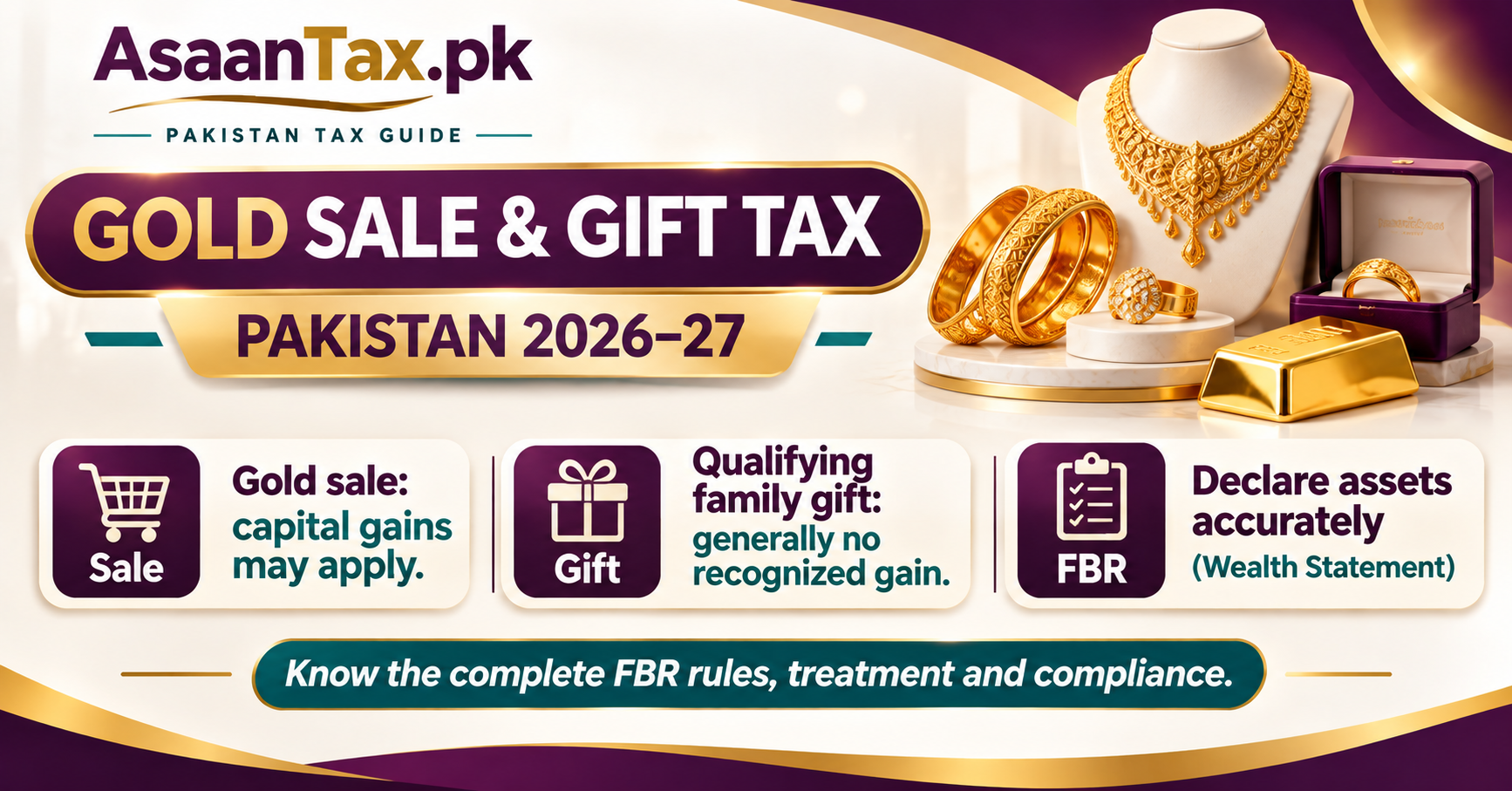
Selling gold at a profit may create a taxable capital gain under Section 37 of the Income Tax Ordinance, 2001. Giving gold to a qualifying relative may receive non-recognition treatment under Section 79, while gifts received from other persons require examination under Section 39.
Gold ownership may also need to be declared in an FBR Wealth Statement under Section 116.
This guide explains the tax treatment of gold sales, family gifts, wedding jewellery, inherited gold, business transactions and Wealth Statement reporting for Tax Year 2027.
1. Is Selling Gold Taxable in Pakistan?
Selling gold in Pakistan does not automatically mean that income tax is payable on the entire amount received.
The first question is whether the transaction generates a taxable gain or represents business income.
For investment gold or jewellery held as a capital asset, Section 37 may apply when the asset is sold for more than its legally allowable cost.
Example: Selling Gold for a Profit
Suppose an individual purchases investment gold for Rs 1,000,000.
Later, the gold is sold for Rs 1,400,000.
| Description | Amount |
|---|---|
| Original Purchase Cost | Rs 1,000,000 |
| Selling Price | Rs 1,400,000 |
| Potential Capital Gain | Rs 400,000 |
Capital Gain = Selling Price − Allowable Cost
Rs 1,400,000 − Rs 1,000,000 = Rs 400,000.
In this simplified example, Rs 400,000 is the potential capital gain, not the income tax itself.
The actual liability depends on the taxpayer's circumstances, the applicable tax rules, and whether the asset is held as an investment or as business stock.
2. Is Personal Gold Jewellery Exempt From Capital Gains Tax?
A common misconception is that every item of personal jewellery is automatically exempt because it is used for personal purposes.
Section 37(5) generally excludes certain movable property held for personal use from the definition of a capital asset.
However, that exclusion contains an exception referring to the categories of assets listed in Section 38(5).
These categories include jewellery.
Therefore, personal-use jewellery should not automatically be treated as exempt from capital gains tax.
The tax treatment of a particular sale depends on ownership, acquisition cost, sale proceeds and the applicable provisions.
Keeping gold jewellery at home is not itself a sale or realization of a capital gain.
The relevant tax question arises when a transaction takes place or a separate taxable event occurs.
3. Is There a Fixed 15% Tax on Every Gold Sale?
No. Taxpayers should not assume that every gold sale in Pakistan is subject to a universal flat 15% income tax.
Tax rates depend on how the relevant income is classified and the provisions applicable to the taxpayer.
A capital gain on privately held gold jewellery should not automatically be treated in the same way as a capital gain on listed securities, property or business trading income.
Similarly, a jeweller's business profit is different from an individual's gain on selling an investment asset.
Main Factors Affecting Tax
- Whether gold is a personal capital asset or business inventory.
- The legally allowable acquisition cost.
- The sale consideration.
- The taxpayer's other taxable income.
- The applicable tax slabs or special provisions.
- Whether the relevant transaction is exempt or eligible for non-recognition treatment.
For Tax Year 2027, taxpayers should consult the current Income Tax Ordinance and relevant rate schedules before calculating their actual income tax.
4. What Happens If Gold Is Sold at a Loss?
Section 38(5) contains an important restriction concerning jewellery.
It generally does not recognize capital losses on the disposal of jewellery and certain other specified assets.
Example
Suppose jewellery was purchased for Rs 800,000 but later sold for Rs 650,000.
The mathematical loss would be:
Rs 800,000 − Rs 650,000 = Rs 150,000.
However, that does not mean the taxpayer can automatically deduct Rs 150,000 from other taxable income.
Where Section 38(5) applies, the capital loss on jewellery is not recognized for the relevant deduction.
This rule is especially important when comparing investment profits and losses.
5. Is Gifting Gold to Family Members Tax-Free?
Genuine gifts of gold between qualifying relatives can receive favourable income tax treatment.
Section 79(1)(c) generally provides non-recognition treatment for a gift of an asset to a relative defined under Section 85(5).
Section 39 also contains an exclusion for qualifying gifts received from such relatives.
Examples of Family Gifts
A parent may give gold jewellery to a daughter.
A husband may gift a gold necklace to his wife.
A mother may give gold ornaments to her son.
A sibling may transfer gold to another sibling.
These arrangements can qualify for the relevant family gift treatment where the statutory definition of relative and other legal requirements are satisfied.
Important: The existence of a family relationship does not remove the need to prove that a significant gift was genuine.
6. Who Qualifies as a Relative Under Section 85?
The Income Tax Ordinance provides a defined meaning of a relative.
Section 85(5) includes specified ancestral, descendant, adopted-child and spousal relationships.
The definition is broader than only parents, children and spouses, but it must be applied according to its exact wording.
A taxpayer should not assume that every friend, distant acquaintance, business partner or unrelated person qualifies as a relative.
For substantial gold gifts, the parties should document their relationship and retain appropriate supporting evidence.
7. Is Gold Received as a Wedding Gift Taxable?
Gold is commonly given at weddings in Pakistan.
The tax treatment depends on who gives the gold, whether the gift is genuine and which provisions apply.
Gold Gifted by Parents
Gold jewellery genuinely gifted by parents generally falls within the qualifying family gift framework.
Gold Gifted by a Spouse
A genuine gift between spouses can also qualify for the applicable relative-gift treatment.
Gold Gifted by Other Relatives
The relationship must be checked against the statutory definition in Section 85(5).
Gold Gifted by an Unrelated Person
A significant gift from a person outside the statutory relative definition may be taxable as Income from Other Sources under Section 39.
The relevant circumstances, documentation and applicable provisions must be reviewed before deciding the tax treatment.
8. What Does Section 39 Say About Gold Gifts?
Section 39 deals with Income from Other Sources.
Under Section 39(1)(la), the amount or fair market value of property received without consideration or as a gift may be chargeable to tax, subject to the applicable provisions.
However, the clause excludes qualifying gifts received from a relative as defined in Section 85(5).
Section 39(3) also contains rules concerning certain loans, advances, deposits and gifts received outside specified banking or digital channels.
The relationship between those rules, the statutory exceptions and the nature of the property must be examined carefully.
Important Documentation Advice
For a substantial gold gift, retain:
- A written gift declaration where appropriate.
- Donor and recipient identification.
- Evidence of the family relationship.
- Description and weight of the gold.
- Available purchase receipts.
- Date of transfer.
- Available valuation evidence.
- Details of how and when possession was transferred.
A genuine physical jewellery gift should not automatically be described as unlawful simply because it was physically handed over.
Nevertheless, poor documentation can create difficulties if FBR later asks the taxpayer to explain the source of the asset.
9. Do You Have to Declare Gold in an FBR Wealth Statement?
Where an individual is required to submit a Wealth Statement under Section 116, material gold holdings should be reported accurately in the appropriate asset category.
Gold jewellery, gold bars and other valuable gold holdings can form part of a taxpayer's wealth.
Depending on the applicable form and facts, the asset may be reported under jewellery, precious metals, personal assets or another suitable category.
Information to Maintain
- Quantity or weight of gold.
- Nature of the asset.
- Purchase or acquisition date.
- Acquisition cost or legally relevant reporting value.
- Whether the gold was purchased, gifted or inherited.
- Supporting evidence of ownership.
- Any subsequent disposal.
Important Distinction
The value reported in a Wealth Statement is not necessarily the current market value of gold.
Follow the applicable reporting requirements and maintain consistency with previous statements.
Do not arbitrarily revalue gold each year solely because market prices have increased.
10. How Should a Gold Gift Be Reported in a Wealth Statement?
When a taxpayer genuinely receives gold as a gift, the reporting should reflect the actual transaction.
For example, suppose a mother gifts gold jewellery to her daughter during the financial year.
Where the daughter is required to submit a Wealth Statement, she should consider recording the gold as an asset and correctly identifying the acquisition as a gift.
If the mother also files a Wealth Statement, her records should reflect the corresponding disposal or reduction in gold holdings where required.
Both parties should use supportable figures and maintain consistent records.
A gift should not be invented merely to remove an unreconciled amount from a Wealth Statement.
11. Can FBR Ask About Undeclared Gold?
Yes. FBR may investigate unexplained assets under applicable provisions, including Section 111.
A person claiming ownership of substantial gold may be asked to explain its source.
Potential questions include:
- When was the gold purchased or received?
- Was it purchased from declared savings?
- Was it received as a genuine family gift?
- Was it inherited?
- Is the gold held personally or for a business?
- Was the asset previously declared?
- Are supporting documents available?
For significant amounts, accurate historical records are especially important.
A genuine gift or inheritance may provide a legitimate explanation, but the taxpayer should be able to substantiate that explanation.
12. Is Inherited Gold Taxable in Pakistan?
Gold jewellery, coins and other valuables may pass to legal heirs following the death of an owner.
Section 79 generally provides non-recognition treatment for the transmission of an asset to a beneficiary or executor on death.
Therefore, simply inheriting gold does not ordinarily create a recognized capital gain on the transmission itself.
However, the subsequent sale of inherited gold is a separate matter.
The beneficiary may need to consider the applicable acquisition cost, disposal consideration, Section 37 and Section 79 cost provisions.
For relevant inherited movable assets, the general cost carryover rule in Section 79(3) may be important.
Do not assume that the special inherited immovable property rule in Section 76(8A) automatically applies to gold.
13. Is Selling Gold Biscuits or Gold Bars Taxable?
Gold bars and biscuits are commonly purchased for investment rather than personal ornamentation.
When an individual sells such gold for a profit, the transaction may create a taxable capital gain under Section 37.
Where gold is regularly bought and sold as a commercial activity, the profit may instead fall under business income rules.
Investment Example
| Description | Amount |
|---|---|
| Gold Biscuit Purchase | Rs 2,000,000 |
| Gold Biscuit Sale | Rs 2,600,000 |
| Potential Gain | Rs 600,000 |
The Rs 600,000 difference represents the mathematical gain before applying the legally relevant tax treatment.
The actual tax is not calculated by automatically applying a universal flat percentage to the full Rs 2.6 million received.
14. What If Someone Regularly Trades Gold?
A professional gold trader or jeweller is treated differently from a person occasionally selling personal gold.
Gold held for sale in an ordinary business may constitute stock-in-trade.
Section 37 excludes qualifying stock-in-trade from its general capital asset definition.
Profits from commercial gold trading may instead be taxed under the business income provisions.
Businesses may also have registration, sales tax, invoice, withholding and reporting obligations depending on the applicable law and their activities.
A shopkeeper should not calculate business tax using only the rules applicable to personal jewellery.
15. Does Sales Tax Apply When Buying or Selling Gold Jewellery?
Sales tax and income tax are two different taxes.
Sales tax may be relevant to taxable supplies of gold, jewellery or related products by registered businesses.
The correct treatment depends on the applicable Sales Tax Act, schedules, notifications, exemptions and any special rules for the jewellery trade.
A private individual selling an old necklace is not automatically treated in the same way as a registered jewellery business making taxable supplies.
The jeweller's applicable sales tax obligations should be verified separately.
This article does not apply one universal sales tax percentage to all gold transactions because different transaction types may have different treatment.
16. Is Cash Payment for Gold Automatically Taxable?
The use of cash does not, by itself, establish that the entire transaction value is taxable income.
However, cash transactions can create documentation and source-of-funds issues.
For valuable gold purchases or sales, bank transfers and proper receipts may provide a clearer audit trail.
Important records may include:
- Seller or buyer identification.
- Invoice or transaction receipt.
- Gold weight and purity.
- Purchase or sale price.
- Payment evidence.
- Relevant correspondence.
- Previous ownership documentation.
Applicable anti-money-laundering, documentation and transaction-specific rules may impose additional obligations.
Taxpayers should not attempt to disguise business receipts or unexplained funds as personal gold sales or family gifts.
17. What If Gold Is Sold to Pay Household Expenses?
A person may sell gold to finance medical expenses, education, weddings or other personal needs.
The purpose for which sale proceeds are spent does not automatically determine whether a capital gain is taxable.
For example, if gold is sold for Rs 1.5 million and its legally allowable cost is Rs 1.1 million, the potential gain is Rs 400,000.
Using the proceeds for household expenses does not automatically exempt that gain.
However, the correct tax treatment must still be calculated under applicable law.
Where a Wealth Statement is required, the sale, reduction in gold holdings, receipt of cash and related expenditure should be reconciled accurately.
18. What If Gold Was Purchased Many Years Ago?
Older gold purchases can create documentation difficulties.
A taxpayer may no longer have the original purchase invoice, particularly if jewellery was purchased decades earlier.
In such circumstances, the taxpayer should gather available supporting evidence, including:
- Old receipts or jeweller records.
- Family gift documents.
- Inheritance records.
- Previous Wealth Statements.
- Available photographs or inventories.
- Bank records.
- Other reliable evidence of acquisition.
However, photographs alone may not conclusively establish an acquisition cost.
A taxpayer should not invent a purchase price merely to reduce a taxable gain.
Where the evidence is incomplete, professional advice is advisable.
19. Can a Husband Gift Gold to His Wife Without Income Tax?
A genuine gift of gold from a husband to his wife can fall within the relative-gift non-recognition provisions.
The gift should reflect an actual transfer of ownership.
For significant gold holdings, maintaining a gift declaration and related records can help establish the transaction.
If the wife later sells the gold, that later disposal requires separate tax analysis.
The original gift treatment does not guarantee that every future sale will be tax-free.
20. Can Parents Gift Gold to Their Children?
Yes. Parents commonly give gold jewellery to their children for weddings and other family occasions.
Genuine qualifying gifts between parents and children generally benefit from the relevant family gift provisions.
The asset should be properly documented and reflected in relevant tax records where required.
If an adult child later sells gifted jewellery, the sale may be subject to applicable capital gains rules.
For capital gains purposes, the cost carryover provisions under Section 79 may be important.
21. Does Zakat on Gold Replace Income Tax?
No. Zakat and income tax are separate legal and religious obligations.
A person may have Zakat obligations on qualifying gold holdings under the applicable framework.
That does not automatically eliminate income tax consequences when gold is sold for a taxable gain.
Similarly, paying income tax does not automatically settle a person's Zakat obligations.
The two should be evaluated separately.
22. Practical Example: Gold Gift Followed by a Sale
Assume a mother purchased gold jewellery for Rs 900,000.
She later makes a genuine qualifying gift of that jewellery to her daughter.
Under the relevant non-recognition provisions, the gift itself generally does not trigger a recognized capital gain.
Suppose the daughter later sells the jewellery for Rs 1,500,000.
For illustration, assume the legally relevant carried-over cost is Rs 900,000.
| Description | Amount |
|---|---|
| Original Relevant Cost | Rs 900,000 |
| Later Sale Proceeds | Rs 1,500,000 |
| Illustrative Capital Gain | Rs 600,000 |
The potential gain is Rs 600,000.
The actual taxable amount and income tax depend on the complete facts and applicable law.
This example demonstrates why a tax-favoured family gift does not necessarily eliminate tax on a later commercial sale.
23. Common Mistakes Taxpayers Should Avoid
- Assuming all personal jewellery sales are automatically exempt.
- Treating the full sale proceeds as taxable profit.
- Applying a universal 15% rate to every gold transaction.
- Claiming a prohibited capital loss on jewellery.
- Treating every unrelated gift as exempt.
- Failing to document valuable family gifts.
- Ignoring gold holdings in a required Wealth Statement.
- Inventing gifts to explain unexplained wealth.
- Confusing inherited gold with inherited immovable property.
- Using an unsupported acquisition cost.
- Treating a professional gold business as an occasional personal transaction.
- Ignoring applicable business sales tax obligations.
- Failing to reconcile gold sales with bank balances and expenditures.
- Assuming Zakat replaces income tax.
- Relying on outdated tax rates or unverified social media claims.
24. Final Gold Tax Compliance Checklist
Before selling or gifting valuable gold, taxpayers should:
- Identify whether the gold is jewellery, bullion or business inventory.
- Determine the date and method of acquisition.
- Locate supporting purchase or ownership documents.
- Verify the legally allowable cost.
- Calculate any potential gain on sale.
- Review whether Section 37 applies.
- Check whether Section 38 restricts a capital loss claim.
- Confirm whether a gift qualifies under Sections 39, 79 and 85.
- Prepare appropriate family gift documentation.
- Review the relevant Wealth Statement disclosures.
- Reconcile the transfer with cash, bank and asset records.
- Preserve the sale invoice and payment evidence.
- Consult current FBR law before filing.
25. Watch Tax With Naeem — Income Tax and Capital Gains Guide
For educational guidance on income tax returns, capital gains and tax reporting in Pakistan, watch the following video from the Tax With Naeem YouTube channel.
Video Title: Income Tax Return Filing in Pakistan | Salary | Rental | Capital Gain | Dividend Explained
YouTube Link:
https://www.youtube.com/watch?v=VX88o1N1AfA
This video explains general income tax return preparation and capital gains concepts.
It is not a dedicated tutorial on gold sales or family jewellery gifts. Taxpayers should use the current Income Tax Ordinance for the specific treatment of gold transactions.
26. Official Sources and References
1. Federal Board of Revenue — Income Tax Ordinance, 2001
Official legislation updated through June 30, 2026.
https://www.fbr.gov.pk/Categ/Income-Tax-Ordinance/326/1000
Relevant provisions:
- Section 37 — Capital Gains.
- Section 38 — Deduction of Capital Losses.
- Section 39 — Income from Other Sources.
- Section 75 — Disposal and Acquisition of Assets.
- Section 76 — Cost.
- Section 79 — Non-Recognition Rules.
- Section 85 — Associates and Relatives.
- Section 111 — Unexplained Income or Assets.
- Section 116 — Wealth Statement.
2. FBR — Sales Tax Act, 1990
3. FBR IRIS Portal
4. AsaanTax.pk — Wealth Statement Reconciliation Guide
https://www.asaantax.pk/blog/wealth-statement-reconciliation-unreconciled-amount-zero
5. AsaanTax.pk — Pakistan Tax Guides
6. Tax With Naeem — Income Tax Return Tutorial
https://www.youtube.com/watch?v=VX88o1N1AfA
27. Conclusion: Is Gold Sale or Gift Taxable in Pakistan?
Gold taxation in Pakistan depends on the nature of the transaction.
A sale of gold held as a capital asset may result in a taxable capital gain under Section 37.
A genuine gift to a qualifying relative can benefit from non-recognition treatment under Section 79 and the relevant exclusion under Section 39.
However, gifts from persons outside the statutory definition of relatives may require separate income tax treatment.
Gold received through inheritance generally benefits from non-recognition treatment on transmission, but its later sale can have separate tax implications.
Taxpayers who are required to file Wealth Statements should ensure valuable gold holdings and related transactions are properly documented and reported.
The key principle is that owning gold, selling gold, gifting gold and trading gold as a business are four different situations with potentially different tax consequences.
For more professional tax guidance on FBR income tax returns, Wealth Statements, gifts, inherited assets and capital gains tax, visit www.asaantax.pk.
Editorial Note: This article is based on the Income Tax Ordinance, 2001, updated through June 30, 2026, including the relevant Finance Act 2026 amendments.
Disclaimer: This guide is intended for general education. The actual tax treatment of gold transactions depends on the taxpayer's circumstances, the nature of the asset, the applicable law and supporting documentation. Readers should seek qualified tax advice for substantial transactions or unresolved valuation matters.