Double Taxation Avoidance Agreements (DTAA): How Tax Treaties Save You From Double Tax
Published: November 11, 2026
Coverage: International Taxation, Pakistan and Overseas Income
Relevant Authorities: FBR, OECD, IRS, HMRC and National Tax Authorities
Main Pakistani Law: Income Tax Ordinance, 2001, Sections 102, 103 and 107
Introduction: Why Double Taxation Matters
International employment, overseas investments, freelancing, property ownership and cross-border business activities are increasingly common.
However, earning income from more than one country can create complicated tax obligations.
For example, an individual living in Pakistan may receive income from a company in the United Kingdom. The United Kingdom may have taxation rights over certain income, while Pakistan may also impose tax based on the individual's tax residency.
Without appropriate relief, the same income could be taxed twice.
Double Taxation Avoidance Agreements (DTAAs) help address this problem.
These bilateral tax treaties establish rules for allocating taxing rights and providing relief from international double taxation.
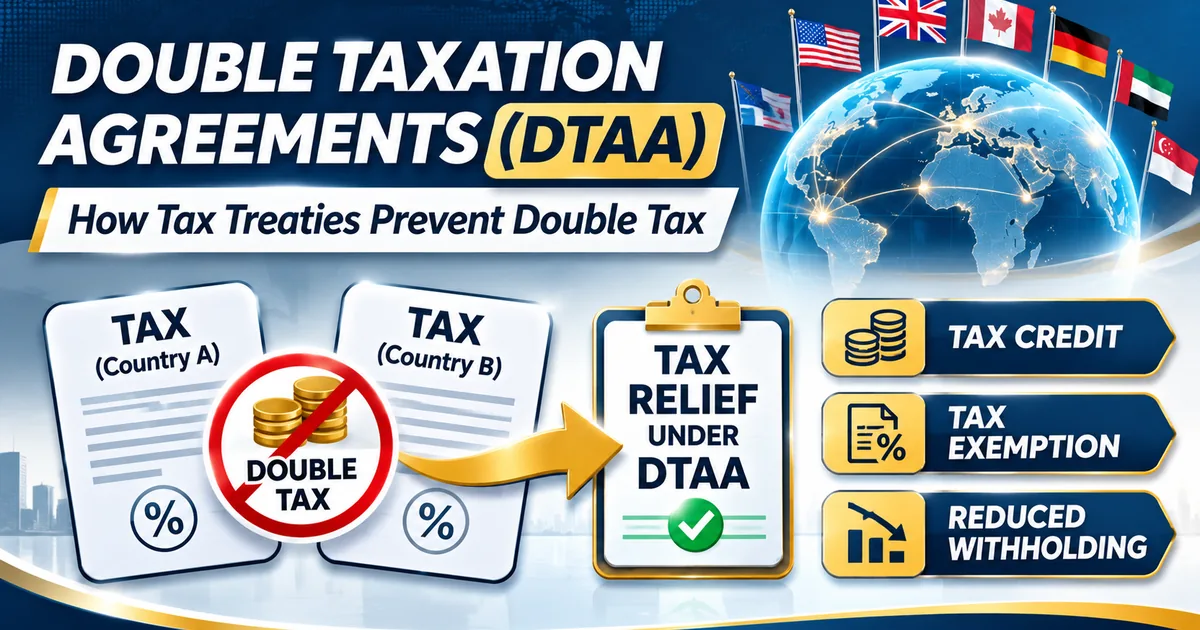
Depending on the treaty and domestic law, relief may take the form of a tax exemption, foreign tax credit or reduced withholding tax.
However, a DTAA does not automatically make all foreign income tax-free.
This guide explains how DTAAs work, why tax residency matters, which income categories are covered, how foreign tax credits are calculated, how to obtain a Tax Residency Certificate and how overseas Pakistanis can benefit from international tax treaties.
1. What Is a Double Taxation Avoidance Agreement?
A Double Taxation Avoidance Agreement is an agreement between two countries intended to address overlapping tax claims on relevant income or capital.
It can establish:
- Which country has primary taxing rights.
- Whether the other country may also impose tax.
- Whether withholding tax is limited.
- How foreign tax credits are calculated.
- Which income is exempt under the treaty.
- How tax residency conflicts are resolved.
- How disputes between tax authorities can be addressed.
- How tax information may be exchanged.
Most income tax treaties are influenced by international model conventions developed by the Organisation for Economic Co-operation and Development (OECD) or the United Nations.
Each signed treaty contains its own provisions.
Important: The actual treaty text, protocols, effective dates and applicable amendments must be checked before claiming relief.
2. What Is Double Taxation?
International double taxation can arise when two countries tax the same taxpayer on the same income for the same period.
Example
An individual is resident in Country A but receives income from Country B.
Country B imposes tax because the income arises within its jurisdiction.
Country A also taxes the income because its resident taxpayers are generally subject to worldwide taxation.
Without a credit, exemption or other relief, overlapping taxation may arise.
Two Common Forms
Juridical double taxation: Comparable taxes imposed by two countries on the same taxpayer and income.
Economic double taxation: Related income taxed in the hands of different taxpayers, such as certain corporate profit and shareholder dividend arrangements.
Tax treaties primarily address juridical double taxation, although some provisions can also help with related-party and economic double taxation issues.
3. How Do Tax Treaties Prevent Double Taxation?
Treaties commonly use three important mechanisms.
| Relief Mechanism | How It Works |
|---|---|
| Foreign Tax Credit | Eligible tax paid abroad reduces domestic tax on the relevant income |
| Exemption Method | One country exempts qualifying income under the applicable rules |
| Reduced Withholding Tax | The source country limits tax on specified payments |
A treaty can also allocate exclusive taxing rights over certain types of income.
The precise method depends on the relevant treaty article.
4. Foreign Tax Credit Explained
A foreign tax credit helps prevent excessive overlapping taxation where both countries may lawfully tax the same income.
The country of residence may permit a credit for qualifying income tax already paid in the other country.
Example: Foreign Tax Credit
Assume a taxpayer has foreign-source income of PKR 1,000,000.
For illustration:
- Eligible foreign income tax paid: PKR 150,000.
- Pakistan tax attributable to the same income: PKR 200,000.
If Section 103 applies without other adjustments:
Allowable foreign tax credit = PKR 150,000.
Remaining Pakistan tax attributable to that income:
PKR 200,000 − PKR 150,000 = PKR 50,000.
| Description | Amount |
|---|---|
| Foreign-Source Income | PKR 1,000,000 |
| Foreign Tax Paid | PKR 150,000 |
| Pakistan Tax Attributable to Income | PKR 200,000 |
| Allowable Foreign Tax Credit | PKR 150,000 |
| Remaining Pakistan Tax | PKR 50,000 |
The example illustrates how a credit can prevent full taxation twice.
Actual calculations depend on the person's other income, applicable tax rates, foreign tax classification and statutory limitations.
5. What Happens if Foreign Tax Is Higher?
A foreign tax credit generally does not create an unlimited refund.
Example
Suppose:
- Foreign tax paid: PKR 250,000.
- Pakistan tax attributable to the same foreign-source income: PKR 180,000.
Under the general limitation in Section 103:
Allowable credit = PKR 180,000.
The credit reduces the relevant Pakistan income tax to zero.
The additional PKR 70,000 foreign tax is not automatically refunded by Pakistan.
The taxpayer must review whether separate foreign-country refund or treaty mechanisms are available.
6. Exemption Method Explained
Under the exemption method, one country may exempt relevant foreign income where the treaty or domestic legislation provides for it.
For example, an employment income article might allocate taxing rights to one country under specified conditions.
The other country may provide an exemption, sometimes with progression.
What Is Exemption With Progression?
A country may exempt certain foreign income but still take that income into account when calculating the rate applied to other taxable income.
This depends on the domestic law and treaty provisions.
An exemption does not always mean the income disappears from all reporting or tax calculations.
7. Reduced Withholding Tax Under a DTAA
Cross-border payments may be subject to withholding tax in the country where the payment originates.
Tax treaties sometimes limit that withholding.
Common categories include:
- Dividends.
- Interest.
- Royalties.
- Certain technical or service fees, depending on the treaty.
Illustrative Withholding Example
A foreign company pays a qualifying royalty of $10,000.
Assume, purely for illustration:
- Domestic withholding rate: 20%.
- Applicable treaty limit: 10%.
| Calculation | Amount |
|---|---|
| Royalty Payment | $10,000 |
| Domestic Withholding at 20% | $2,000 |
| Illustrative Treaty Withholding at 10% | $1,000 |
| Potential Withholding Reduction | $1,000 |
Important: The 10% figure is hypothetical. It is not a universal treaty withholding rate.
The actual rate depends on the two countries, the income category, beneficial ownership and relevant treaty eligibility conditions.
8. What Income Is Commonly Covered by Tax Treaties?
The scope differs by treaty.
| Income Category | Common Treaty Consideration |
|---|---|
| Employment Salary | Where work is exercised and residence conditions |
| Business Profits | Whether a permanent establishment exists |
| Dividends | Source-country withholding limitations |
| Interest | Treaty withholding rules and exemptions |
| Royalties | Source taxation and treaty limits |
| Rental Income | Location of immovable property |
| Capital Gains | Asset type and applicable taxing rights |
| Pensions | Type of pension and relevant treaty article |
| Independent Services | Business presence and specific treaty wording |
| Government Service | Special employment and pension rules |
Tax treaties generally concern specified income or capital taxes.
They do not automatically remove VAT, GST, customs duties, social security contributions or unrelated statutory charges.
9. Why Tax Residency Is Important
Tax residency is often the starting point for determining treaty entitlement.
A taxpayer may qualify as resident under one country's domestic law, both countries' laws or neither, depending on the circumstances.
Relevant tests can include:
- Number of days physically present.
- Permanent home.
- Centre of vital interests.
- Habitual abode.
- Nationality, where relevant under the treaty.
- Other domestic residence requirements.
An immigration visa, residence permit or nationality alone does not always determine tax residence.
10. What Happens If Someone Is Resident in Two Countries?
A person may be considered a tax resident under both countries' domestic laws.
This is known as dual tax residence.
Many treaties contain tie-breaker provisions.
For individuals, these commonly consider:
- Permanent home.
- Centre of vital interests.
- Habitual abode.
- Nationality.
- Mutual agreement between the competent authorities.
The order and availability of these tests depend on the treaty.
For companies, dual-residence issues can involve different rules, including competent-authority determinations under applicable treaty amendments.
11. What Is a Tax Residency Certificate?
A Tax Residency Certificate (TRC) is an official document confirming a person's tax residence for a relevant period.
It may be required to support a claim for treaty benefits.
Common Uses
- Claiming reduced withholding tax.
- Applying for exemption under a treaty.
- Supporting a refund application.
- Demonstrating treaty residence.
- Completing foreign tax authority documentation.
A TRC is important evidence, but it does not automatically prove entitlement to every treaty benefit.
Other treaty requirements must still be satisfied.
12. How to Obtain a Tax Residency Certificate in Pakistan
Pakistan's FBR provides a procedure under Rule 19A.
A Pakistan-resident person seeking treaty relief in another country may apply to the competent authority for a Certificate of Residence.
The application generally includes relevant information concerning:
- Taxpayer identity.
- Basis of Pakistan tax residence.
- Applicable tax year.
- Foreign country involved.
- Type of income.
- Relevant period.
- Income declared and tax paid.
- Supporting information required by FBR.
Rule 19A provides for a separate application and certificate for each relevant tax year.
The application should follow the official prescribed process.
Official Reference
FBR Rule 19A:
https://www.fbr.gov.pk/rule-19A/152738
13. Foreign Tax Credit Under Pakistan Section 103
Section 103 of the Income Tax Ordinance, 2001 provides foreign tax credit relief for qualifying Pakistan-resident taxpayers.
Under the general rule, the credit is limited to the lower of:
- Qualifying foreign income tax paid; or
- Pakistan income tax attributable to the foreign-source income.
The law contains additional rules for different income heads and the relevant computation.
Important
The credit concerns qualifying foreign income taxes, not every levy or fee paid abroad.
Evidence of the foreign tax payment is essential.
14. Foreign-Source Salary Under Pakistan Section 102
Pakistan also has a specific statutory provision concerning foreign-source employment salary.
Under Section 102, qualifying foreign-source salary received by a resident individual is exempt from Pakistan income tax where foreign income tax has been paid on that salary under the applicable conditions.
Salary tax withheld by the employer and paid to the relevant foreign tax authority can satisfy the statutory foreign-tax-paid condition.
Example
A Pakistan tax resident receives salary for employment duties performed abroad.
The foreign employer deducts relevant income tax and remits it to the foreign tax authority.
The individual may qualify for the Section 102 exemption, depending on the statutory requirements.
This provision should not be confused with the general foreign tax credit under Section 103.
Important Distinction
Section 102 concerns specific qualifying foreign-source salary.
Section 103 concerns foreign-source income chargeable to Pakistan tax and qualifying foreign tax credits.
The correct provision depends on the nature of the income.
15. Pakistan's Double Taxation Agreements
Pakistan has signed numerous tax treaties with foreign countries.
Examples appearing in FBR's official treaty records include:
- United Kingdom.
- United Arab Emirates.
- Saudi Arabia.
- Qatar.
- Oman.
- Canada.
- Germany.
- France.
- China.
- Singapore.
- Malaysia.
- Ireland.
- Other treaty partners.
However, a treaty's existence alone does not determine the tax rate or relief for every payment.
The applicable treaty must be read together with any protocol, amendment or Multilateral Instrument changes.
Official Treaty Directory
https://www.fbr.gov.pk/dtaa/132245/132249
16. Pakistan–UAE Double Taxation Agreement
Pakistan and the UAE have a tax treaty relationship.
This may be relevant to:
- Employment income.
- Business profits.
- Dividends.
- Interest.
- Royalties.
- Other covered income.
Important for UAE Workers
Ordinary UAE employment salary is generally not subject to UAE personal income tax.
However, this does not automatically mean Pakistan must exempt every UAE salary received by a person who remains a Pakistan tax resident.
The result depends on residence, source rules, Section 102, applicable domestic exemptions and the treaty.
A tax treaty does not automatically create a foreign tax credit where no qualifying foreign tax was paid.
17. Pakistan–UK Double Taxation Agreement
The Pakistan–UK treaty is particularly relevant to people receiving cross-border employment, pension, investment and business income.
The UK and Pakistan have a Double Taxation Convention that must be considered together with relevant subsequent modifications.
The UK Government published updated treaty materials in May 2026.
Possible Situations
- A Pakistan resident receiving UK-source income.
- A UK resident earning rental income from Pakistan.
- A business receiving cross-border service payments.
- A shareholder receiving certain investment income.
The actual treaty article and withholding treatment must be checked for each case.
Official UK Treaty Reference
https://www.gov.uk/government/publications/pakistan-tax-treaties
18. Pakistan–Canada Double Taxation Agreement
Canada and Pakistan also have an income tax treaty.
It addresses relevant categories of income and tax residence.
For example, a Canadian tax resident may earn rental or investment income from Pakistan.
Both countries' tax rules may be relevant, and the treaty can help determine how double taxation relief is provided.
However, Canadian residents should still consider CRA reporting requirements for foreign income and assets.
A treaty generally does not eliminate all filing obligations.
19. How Tax Treaties Apply to Freelancers
Freelancers can encounter double taxation where they perform services for foreign clients.
However, payment from an overseas customer does not automatically mean the payment is foreign-source for every tax purpose.
Example
A Pakistan-based freelance software developer provides services remotely to a client in the UK.
The client pays the developer from a UK bank account.
The developer must determine:
- Where the services are performed.
- Whether Pakistan treats the income as Pakistan-source or foreign-source.
- Whether the UK has taxing rights.
- Whether any UK withholding is legally required.
- Whether the applicable treaty provides relief.
- Whether Pakistan's domestic provisions apply.
Important: A foreign customer or foreign currency payment does not, by itself, establish eligibility for a foreign tax credit.
20. How Tax Treaties Apply to Companies
International companies can be taxed in more than one country.
Treaties commonly address business profits through rules concerning permanent establishments.
What Is a Permanent Establishment?
A permanent establishment (PE) is a taxable business presence defined under the relevant treaty.
It can arise in situations involving:
- A qualifying fixed place of business.
- Certain offices or branches.
- Relevant construction projects.
- Dependent agents under applicable treaty rules.
- Other activities meeting the treaty definition.
A treaty may limit the source country's ability to tax a foreign enterprise's business profits where no relevant PE exists.
However, the actual outcome depends on treaty wording and domestic law.
21. Can Someone Claim Treaty Benefits Without Paying Tax Abroad?
Sometimes, depending on the type of benefit.
For example, a treaty might give exclusive taxing rights over a particular category of income to the country of residence.
However, a foreign tax credit generally requires qualifying foreign tax actually paid or accrued under the applicable law.
These are separate forms of relief.
Tax treaty exemption and foreign tax credit should not be treated as interchangeable.
22. How to Claim DTAA Benefits: Step-by-Step
Step 1: Determine Tax Residency
Establish the country of residence under domestic law and the relevant treaty.
Step 2: Identify the Income Source
Determine the legal source of the income.
Step 3: Locate the Relevant Treaty
Use the official treaty records of the two countries.
Step 4: Read the Applicable Income Article
Review the provision for employment, dividends, interest, royalties, business profits or other relevant income.
Step 5: Confirm Treaty Eligibility
Check residence, beneficial ownership and applicable anti-abuse requirements.
Step 6: Obtain a Tax Residency Certificate
Apply through the appropriate tax authority if required.
Step 7: Calculate the Domestic and Treaty Rates
Determine whether the treaty reduces withholding or provides another exemption.
Step 8: Provide Supporting Documentation
Submit the TRC, declarations and other prescribed records to the payer or authority.
Step 9: Apply for Relief or Refund
Follow the applicable foreign-country procedure.
Step 10: Claim Foreign Tax Credit Where Relevant
Use the appropriate domestic return, schedules and supporting evidence.
Step 11: Maintain Records
Keep certificates, tax statements, payment receipts and treaty claim confirmations.
Step 12: Review Annual Changes
Treaties, implementation rules and taxpayer circumstances may change.
23. What Documents Are Usually Required?
| Document | Purpose |
|---|---|
| Tax Residency Certificate | Supports treaty residence |
| Tax Identification Details | Identifies the taxpayer |
| Employment or Service Contract | Establishes payment arrangements |
| Income Statement | Supports amount and classification |
| Foreign Tax Withholding Certificate | Demonstrates tax deducted |
| Foreign Tax Payment Receipt | Supports foreign tax credit |
| Bank Statement | Supports receipt and payment records |
| Tax Return | Reports relevant income and claims |
| Beneficial Ownership Declaration | Supports relevant treaty benefits |
| Other Prescribed Treaty Forms | Satisfies local claim requirements |
Requirements depend on the relevant country and treaty.
24. Can Treaty Benefits Be Denied?
Yes.
Treaty benefits are subject to legal eligibility and anti-abuse provisions.
Certain tax treaties include a Principal Purpose Test (PPT), limitation-on-benefits provisions or other restrictions.
Examples of Potential Problems
- Incorrect tax residency claims.
- Artificial company arrangements.
- Conduit structures.
- Inaccurate beneficial ownership declarations.
- Ineligible income classifications.
- Missing supporting documents.
- Treaty-shopping arrangements.
The OECD's Multilateral Instrument can modify particular treaties to strengthen anti-abuse measures.
A treaty should not be used to justify artificial transactions whose principal purpose is improperly obtaining tax relief.
25. Does a DTAA Eliminate VAT, GST or Customs Duty?
Generally, no.
Ordinary income tax treaties primarily cover taxes specifically identified in the treaty.
VAT, GST, customs duties and social security contributions may be governed by separate domestic laws or international agreements.
Example
A company qualifies for reduced income tax withholding under a treaty.
That does not automatically remove applicable VAT or GST obligations.
Businesses must evaluate the different taxes separately.
26. What If Both Countries Still Demand Tax?
A taxpayer should first verify the legal basis of each country's assessment.
If both countries' positions appear inconsistent with the applicable treaty, the taxpayer may consider the Mutual Agreement Procedure (MAP), where available.
What Is MAP?
MAP is a treaty dispute-resolution mechanism through which the competent authorities of the participating countries may attempt to resolve taxation not in accordance with the treaty.
MAP has its own eligibility conditions, deadlines and procedures.
A taxpayer should not assume that an ordinary refund request automatically begins a MAP case.
27. Common DTAA Mistakes to Avoid
- Assuming every foreign payment qualifies for tax relief.
- Treating nationality as the same as tax residency.
- Using a treaty rate without checking the actual agreement.
- Claiming a foreign tax credit without qualifying foreign tax.
- Confusing foreign-source income with foreign bank receipts.
- Ignoring beneficial ownership conditions.
- Applying a treaty withholding rate to unrelated income categories.
- Ignoring permanent establishment rules.
- Claiming both exemption and credit incorrectly on the same income.
- Assuming DTAAs eliminate all taxes.
- Failing to obtain a Tax Residency Certificate when required.
- Using outdated treaty provisions.
- Ignoring treaty changes made through the MLI.
- Claiming undocumented foreign tax payments.
- Failing to report income because treaty relief is expected.
- Assuming tax treaty relief eliminates domestic return filing obligations.
28. Final DTAA Compliance Checklist
Before claiming treaty relief, verify:
- Both countries have an applicable treaty.
- Relevant treaty provisions are in force.
- Tax residency has been determined correctly.
- The income source is correctly classified.
- The correct treaty article has been identified.
- The relevant income is covered by the treaty.
- Beneficial ownership conditions are met.
- Anti-abuse restrictions have been reviewed.
- Foreign withholding tax is calculated correctly.
- A Tax Residency Certificate is available if required.
- Foreign tax payment evidence is available.
- Applicable foreign tax credit limits are calculated.
- Section 102 or 103 is considered where relevant.
- Any foreign refund claim is submitted properly.
- Required income tax returns are filed.
- Relevant records are retained.
29. Watch Tax With Naeem — Related Tax Education
For general educational guidance about income tax filing, overseas income, salary, rental income, capital gains and dividends, watch content from Tax With Naeem.
Related Video: Income Tax Return Filing in Pakistan — Salary, Rental Income, Capital Gains and Dividends Explained
https://www.youtube.com/watch?v=VX88o1N1AfA
This is a Pakistan income tax filing tutorial, not a dedicated DTAA tutorial.
It is provided as supplementary education about income classification and return filing.
For international tax treaty claims, readers should consult the relevant FBR provisions, official tax treaty texts and applicable foreign tax authority guidance.
30. Official Sources and References
1. Federal Board of Revenue — Double Taxation Agreements
https://www.fbr.gov.pk/dtaa/132245/132249
2. FBR — Section 107, Double Taxation Agreements
https://www.fbr.gov.pk/section-107/152714
3. FBR — Section 103, Foreign Tax Credit
https://www.fbr.gov.pk/x/152709
4. FBR — Section 102, Foreign-Source Salary
https://www.fbr.gov.pk/section-102/152708
5. FBR — Rule 19A, Tax Residency Certificate
https://www.fbr.gov.pk/rule-19A/152738
6. FBR — Rule 16, Foreign Tax Credit Documentation
https://www.fbr.gov.pk/rule-16/152734
7. OECD — Model Tax Convention
https://www.oecd.org/en/topics/oecd-model-tax-convention-on-income-and-on-capital.html
8. OECD — Preventing Tax Treaty Abuse
https://www.oecd.org/en/topics/preventing-tax-treaty-abuse.html
9. Internal Revenue Service — Tax Treaties
https://www.irs.gov/individuals/international-taxpayers/tax-treaties
10. HMRC — Relief From Double Taxation
https://www.gov.uk/tax-foreign-income/taxed-twice
11. UK–Pakistan Tax Treaty Information
https://www.gov.uk/government/publications/pakistan-tax-treaties
12. AsaanTax.pk — International Tax Guides
13. Tax With Naeem — Related Tax Tutorial
https://www.youtube.com/watch?v=VX88o1N1AfA
31. Conclusion: How Do Tax Treaties Help Avoid Double Tax?
Double Taxation Avoidance Agreements are essential instruments for international taxpayers, overseas professionals, investors and companies.
They help countries determine how income should be taxed and provide mechanisms to reduce overlapping taxation.
Depending on the applicable agreement and domestic law, a taxpayer may receive:
- A foreign income tax credit.
- An income tax exemption.
- A reduced withholding tax rate.
- Relief from conflicting residence-based tax claims.
- Access to dispute-resolution procedures.
For Pakistani taxpayers, Sections 102, 103 and 107 of the Income Tax Ordinance, 2001 provide important domestic rules relevant to foreign-source income and international taxation.
However, relief is never determined solely by the name of the treaty or the countries involved.
The income category, tax residency, beneficial ownership, treaty conditions and actual foreign tax paid must all be considered.
The most important principle is that a DTAA prevents or relieves double taxation according to specific legal rules—it does not automatically make international income tax-free.
For professional international tax articles covering Pakistan, UAE, Saudi Arabia, the UK, USA, Canada, Germany and other countries, visit:
AsaanTax.pk: https://www.asaantax.pk/
Editorial Note: This article reflects official treaty and domestic-law guidance reviewed as of November 11, 2026. Readers should verify the text and current status of the specific treaty applicable to their circumstances.
Disclaimer: This article is for general educational purposes and is not individualized tax or legal advice. Eligibility for treaty relief depends on tax residency, income source, applicable treaties, domestic law and supporting documentation. Taxpayers should consult the relevant authority or a qualified international tax professional before making substantial treaty claims.