Germany Income Tax 2026: Tax Brackets, Solidarity Surcharge and Complete Filing Guide
Published: November 11, 2026
Country: Germany
Tax Year: January 1 – December 31, 2026
Tax Authority: German Federal and State Tax Authorities (Finanzamt)
Applicable Law: German Income Tax Act (Einkommensteuergesetz — EStG)
Main Reference: Section 32a EStG
Germany operates a progressive income tax system that affects employees, freelancers, self-employed professionals, investors, business owners and international workers.
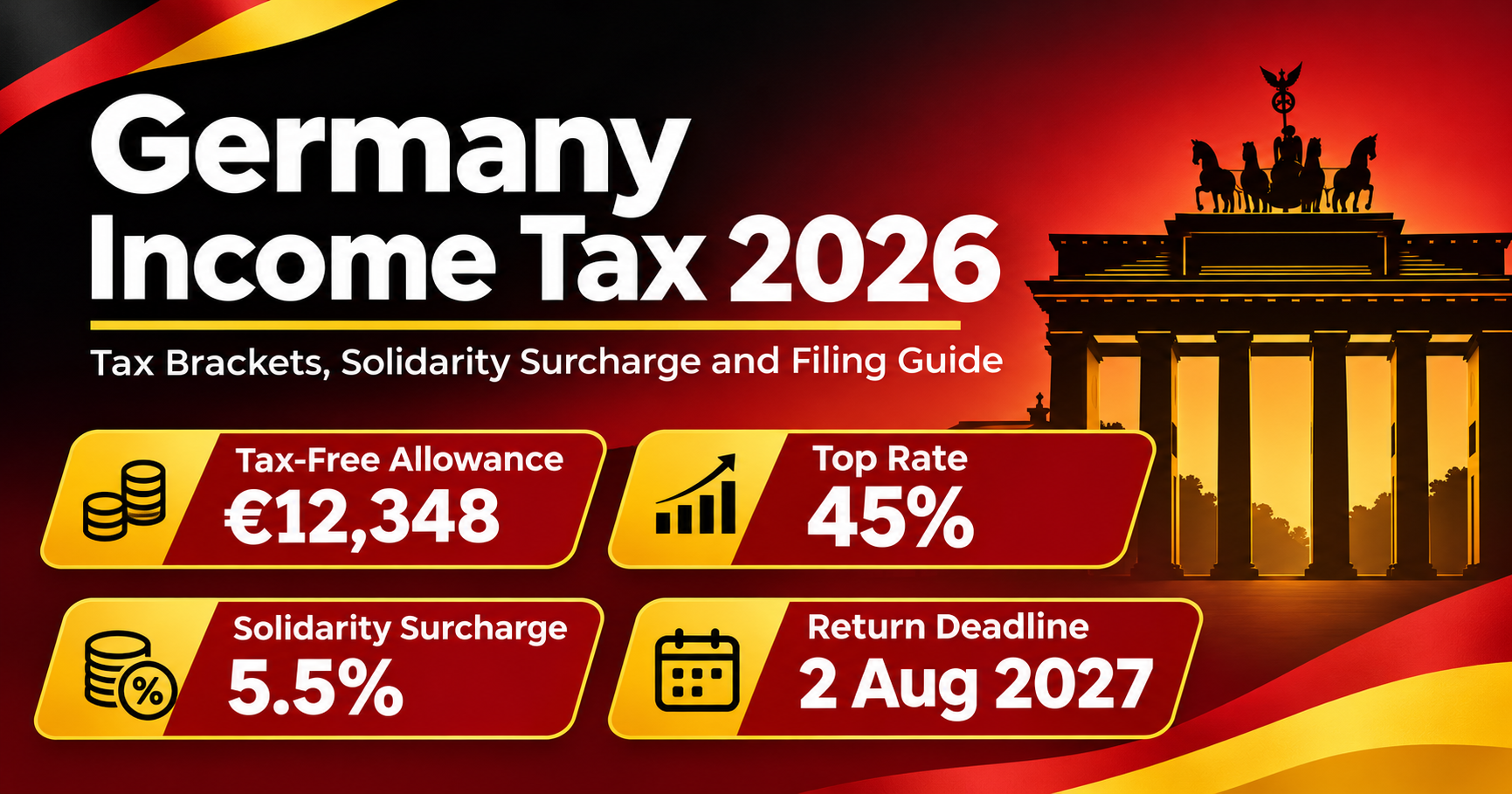
For Tax Year 2026, Germany increased its basic tax-free allowance to €12,348 for an individual taxpayer.
The personal income tax rate begins at approximately 14% above the tax-free allowance and increases progressively to 42%, with a top rate of 45% on sufficiently high taxable income.
However, German tax obligations extend beyond ordinary income tax.
Depending on their circumstances, individuals may also have to pay the Solidarity Surcharge (Solidaritätszuschlag), Church Tax (Kirchensteuer) and social insurance contributions.
Germany also provides deductions and allowances for eligible employees, families, freelancers and other taxpayers.
This complete guide explains the official 2026 income tax brackets, tax-free allowance, solidarity surcharge thresholds, married-couple taxation, church tax, salary calculations, deductions, tax residency and electronic return filing through ELSTER.
1. Germany Income Tax Brackets for 2026
Germany applies a progressive individual income tax system.
For the 2026 tax year, Section 32a of the German Income Tax Act establishes the following taxable income ranges.
| Annual Taxable Income | Income Tax Treatment |
|---|---|
| Up to €12,348 | 0% — Basic tax-free allowance |
| €12,349–€17,799 | Progressive marginal rates beginning at 14% |
| €17,800–€69,878 | Progressively increasing marginal rates |
| €69,879–€277,825 | 42% marginal rate |
| Above €277,825 | 45% marginal rate |
Important: Germany does not calculate tax by simply applying a single fixed percentage to the entire income within each progressive band.
The legislation uses mathematical formulas for the middle brackets.
Consequently, a person earning €50,000 does not pay 42% income tax on that amount.
The 42% marginal rate begins at a much higher taxable income threshold.
These figures are based on taxable income after the applicable deductions and adjustments, not necessarily gross annual salary.
2. What Changed in Germany's Income Tax Rates for 2026?
Germany's Federal Ministry of Finance introduced inflation-related adjustments to the personal income tax schedule for 2026.
The purpose includes reducing the effects of inflation-driven bracket increases, sometimes referred to as bracket creep.
Basic Allowance Comparison
| Tax Year | Basic Tax-Free Allowance |
|---|---|
| 2025 | €12,096 |
| 2026 | €12,348 |
| Increase | €252 |
The increase means eligible taxpayers can earn an additional €252 within the basic tax-free amount.
Other relevant income tax thresholds have also been adjusted.
However, the income threshold for the 45% highest marginal tax rate remains unchanged at €277,826.
3. What Is the Basic Tax-Free Allowance in Germany?
The German basic tax-free allowance is called the Grundfreibetrag.
It represents the amount of taxable income exempt from ordinary income tax under the general progressive schedule.
For 2026:
Single taxpayer: €12,348.
Under qualifying joint assessment and income splitting, the combined basic allowance for a married couple can effectively be €24,696.
Example
An eligible individual has annual taxable income of €12,000.
Because this is below €12,348:
Ordinary income tax: €0.
However, this does not automatically mean the person has no other contributions, taxes or reporting obligations.
The basic allowance applies to taxable income, not simply the gross amount received from an employer.
4. How Does Progressive Taxation Work in Germany?
Germany's progressive tax system applies increasing marginal rates as taxable income rises.
For example:
An individual earns €80,000 in taxable income.
The first €12,348 is within the tax-free allowance.
Income above that threshold is calculated using the statutory progressive formulas.
The 42% rate applies to the relevant higher portion of taxable income.
The resulting tax is substantially less than 42% of the entire €80,000.
Marginal Rate vs Effective Rate
Marginal tax rate: The rate applicable to the next relevant euro of taxable income.
Effective tax rate: Total income tax divided by the income measure being compared.
A taxpayer may have a 42% marginal rate while paying a significantly lower effective rate across total taxable income.
5. Germany Income Tax Calculation on €80,000
Assume an individual has:
- Tax Year: 2026.
- Filing basis: Individual.
- Annual taxable income: €80,000.
- No special tax calculation adjustments.
Under Section 32a EStG, the statutory formula for this range is:
Income Tax = 42% × Taxable Income − €11,135.63
Calculation:
€80,000 × 42% = €33,600.
€33,600 − €11,135.63 = €22,464.37.
The applicable statutory rounding gives:
Illustrative annual income tax: €22,464.
This amount is ordinary income tax before any relevant Solidarity Surcharge, Church Tax or additional personal circumstances.
It also excludes social insurance contributions.
6. Germany Income Tax on €100,000
Assume a single taxpayer has €100,000 of taxable income.
Calculation:
€100,000 × 42% = €42,000.
€42,000 − €11,135.63 = €30,864.37.
After statutory rounding:
Illustrative ordinary income tax: €30,864.
The taxpayer's marginal rate is 42%.
However, the ordinary income tax of €30,864 represents approximately 30.86% of the €100,000 taxable income.
A separate calculation is required to determine whether the Solidarity Surcharge applies.
7. What Is the Solidarity Surcharge in Germany?
The Solidarity Surcharge is known as Solidaritätszuschlag, commonly shortened to Soli.
It is a separate federal surcharge calculated by reference to the relevant income tax liability.
The standard surcharge rate is:
5.5% of the relevant assessed income tax.
However, it is incorrect to assume that every person paying income tax must also pay the full surcharge.
Since major reforms effective from 2021, most ordinary income-tax payers have been relieved from this charge.
Exemption thresholds and a mitigation zone apply.
8. Solidarity Surcharge Exemption Thresholds for 2026
For 2026, the relevant basic exemption thresholds are:
| Assessment Category | Relevant Income Tax Threshold |
|---|---|
| Individual Assessment | €20,350 |
| Qualifying Joint Assessment | €40,700 |
These figures relate to the relevant income tax assessment base, not gross annual salary.
Example
An individual's relevant income tax liability is €15,000.
Because the amount is below the €20,350 threshold, no ordinary Solidarity Surcharge is due under the general rule.
Higher-Income Example
Suppose a taxpayer's income tax is sufficiently high for the surcharge to apply.
The maximum ordinary surcharge rate is 5.5% of the relevant tax base, subject to the mitigation-zone calculation.
The statutory mitigation zone prevents the full surcharge from applying immediately once the exemption threshold is crossed.
Important: Separate rules can apply to certain capital income subject to withholding tax.
9. Is the Solidarity Surcharge 5.5% of Salary?
No.
The Solidarity Surcharge is generally calculated using the relevant income tax amount.
It is not an additional flat 5.5% tax on gross employment salary.
Incorrect Example
Gross salary × 5.5%.
This is not the ordinary Solidarity Surcharge calculation.
Correct Approach
- Determine relevant taxable income.
- Calculate ordinary income tax.
- Determine the surcharge assessment base.
- Apply the exemption threshold.
- Apply the mitigation-zone calculation if required.
- Calculate the applicable surcharge.
This distinction is especially important when comparing salary tax deductions in Germany.
10. What Is Church Tax in Germany?
Germany also operates a Church Tax system.
It applies to members of relevant religious communities that are legally entitled to collect Church Tax.
The standard rate is generally:
- 8% of the relevant income tax in Bavaria and Baden-Württemberg.
- 9% of the relevant income tax in most other German federal states.
Church Tax is not a universal tax on all German residents.
Whether it applies depends on recognised membership and the relevant legal rules.
Example
A qualifying taxpayer has a relevant income tax liability of €10,000.
If the applicable Church Tax rate is 9%:
€10,000 × 9% = €900.
This is an illustrative calculation; specific statutory adjustments may apply.
11. Germany Income Tax for Married Couples in 2026
Germany permits qualifying married couples and registered partners to use joint assessment and the income-splitting method.
The German term is Ehegattensplitting.
How Income Splitting Works
Under the general calculation:
- Combine the relevant taxable incomes.
- Divide the combined amount by two.
- Calculate income tax on half.
- Multiply the resulting income tax by two.
Example
A qualifying married couple has combined taxable income of €100,000.
Using income splitting, the tax is calculated by applying the relevant statutory formula to €50,000 and multiplying the result by two.
This method can be particularly beneficial where one spouse earns much more than the other.
However, the result depends on the couple's actual income and eligibility.
Tax classes used for payroll withholding do not by themselves determine the final annual joint tax liability.
12. What Are Germany's Tax Classes?
Germany uses tax classes, known as Steuerklassen, primarily for wage tax withholding.
The general classes are:
| Tax Class | Typical Situation |
|---|---|
| Class I | Many single or divorced employees |
| Class II | Qualifying single parents |
| Class III | Certain married employees under eligible arrangements |
| Class IV | Married employees, commonly with similar earnings |
| Class V | Certain married employees paired with Class III |
| Class VI | Additional employment relationships |
The appropriate class depends on legal status and circumstances.
Important
Tax class affects how much wage tax the employer deducts during the year.
The final annual income tax is determined through the applicable assessment rules.
A tax class is not the same as an income tax bracket.
13. Does Germany Tax Gross Salary or Taxable Income?
German income tax is ultimately determined using taxable income after the relevant statutory adjustments.
Gross employment salary and taxable income can differ because of:
- Eligible work-related deductions.
- Certain social insurance contributions.
- Relevant pension contributions.
- Special expenses.
- Other allowable deductions.
- Tax relief provisions.
Therefore, applying the annual tax bracket directly to gross salary can overstate or miscalculate the actual income tax amount.
For precise results, taxpayers should use the applicable official calculation system.
14. Employee Standard Expense Allowance in 2026
Germany generally provides an employee-related work expense allowance known as the Arbeitnehmer-Pauschbetrag.
For 2026, the general amount remains:
€1,230.
This is a deduction, not a direct €1,230 reduction in tax payable.
Employees with qualifying work-related expenses exceeding the allowance may potentially claim the higher substantiated amount, subject to the applicable rules.
Examples of relevant expenses can include qualifying:
- Commuting costs.
- Professional equipment.
- Work-related education.
- Certain business travel expenses.
- Other eligible employment expenses.
Taxpayers should preserve records where necessary.
15. Commuting Allowance Changes in 2026
The German government increased the commuter distance allowance to €0.38 per qualifying kilometre from the first kilometre beginning in 2026.
The relevant tax deduction is generally based on the one-way distance between home and the first workplace, subject to the applicable rules.
Example
An employee's qualifying one-way commuting distance is 20 kilometres.
The person travels to the eligible workplace on 200 qualifying days.
Illustrative commuting deduction:
20 × 200 × €0.38 = €1,520.
This is a potential deduction amount, not a €1,520 cash refund.
The resulting tax savings depend on the individual's actual tax circumstances.
16. Child Benefit in Germany for 2026
Germany provides child benefit, known as Kindergeld, for eligible families.
The amount increased to:
€259 per eligible child per month in 2026.
Annual Equivalent
€259 × 12 = €3,108 per child.
The actual entitlement depends on the child, family and eligibility requirements.
Germany also has child-related tax allowances and assessment rules that interact with family benefits.
Taxpayers should not assume they can receive every benefit and deduction simultaneously without adjustments.
17. Social Insurance Contributions in Germany
German employees can have several mandatory social insurance deductions in addition to income tax.
The main categories generally include:
- Statutory pension insurance.
- Health insurance.
- Long-term care insurance.
- Unemployment insurance.
Contribution rates and income ceilings vary by category and may change annually.
Employer and employee contributions may be shared according to the relevant rules.
Important
An employee's final take-home pay cannot be calculated by subtracting income tax alone.
A complete payroll calculation must also consider social insurance, Church Tax where relevant, and any applicable Solidarity Surcharge.
18. Income Tax for Freelancers and Self-Employed Individuals
Self-employed taxpayers generally calculate income tax based on taxable business or professional profits rather than gross receipts.
Example
A freelance consultant reports:
Annual business revenue: €90,000.
Eligible business expenses: €30,000.
Simplified profit:
€90,000 − €30,000 = €60,000.
The relevant profit may form part of taxable income after further legal adjustments.
The freelancer then uses the applicable progressive personal income tax calculation.
Important
Freelancers and sole proprietors should separately consider:
- VAT registration.
- Income tax advance payments.
- Accounting obligations.
- Social insurance.
- Business classification.
- Trade Tax where applicable.
Certain liberal professions can receive different Trade Tax treatment from ordinary commercial businesses.
19. Germany VAT for Freelancers and Businesses
Germany's standard VAT rate is generally 19%.
A reduced rate of 7% applies to qualifying supplies.
Certain supplies may be exempt or receive other treatment.
Small Business Regulation
Germany's small-business VAT rules, known as the Kleinunternehmerregelung, can exempt eligible businesses from charging VAT under the relevant turnover conditions.
The current framework generally involves a preceding-year turnover limit of €25,000 and a current-year limit of €100,000, subject to the statutory requirements.
Small-business VAT treatment does not automatically exempt business profits from personal income tax.
20. Investment Income and Capital Gains
Certain German investment income is taxed under a special withholding tax framework.
Qualifying investment income may be subject to a flat 25% withholding tax, commonly known as Abgeltungsteuer, plus applicable surcharge and Church Tax.
Different rules may apply to:
- Dividends.
- Interest.
- Capital gains from shares.
- Certain investment funds.
- Cryptocurrency.
- Business-held investments.
- Real estate disposals.
The German progressive income tax brackets should not automatically be applied to every type of investment income.
Specific exemptions and elections may also be available.
21. Do Foreign Workers Pay Income Tax in Germany?
Foreign employees can be subject to German income tax depending on tax residence and the source of income.
Germany generally taxes residents on worldwide income, subject to relevant exemptions, reliefs and international tax treaties.
Non-residents are generally subject to German taxation on specified German-source income.
Important Factors
- Availability of a home or domicile in Germany.
- Habitual abode.
- Employment location.
- Duration of stay.
- Income source.
- Applicable tax treaties.
Nationality does not automatically determine whether someone is treated as a German tax resident.
22. Germany Income Tax for Overseas Pakistanis
Pakistani nationals working or living in Germany may have German income tax obligations.
Possible sources of income include:
- German salary income.
- Freelance and consulting income.
- Rental income.
- Overseas bank interest.
- Dividends.
- Relevant capital gains.
- Other foreign income.
Example
A Pakistani software engineer relocates to Berlin and becomes a German tax resident.
The engineer earns salary income in Germany and also receives rental income from Pakistan.
The German tax treatment depends on the applicable domestic income tax rules and the Germany–Pakistan double taxation agreement.
Foreign income reporting may be required even where treaty relief applies.
Similarly, obligations in Pakistan depend on the individual's Pakistani tax residence and relevant domestic law.
23. What Is the Germany–Pakistan Double Taxation Agreement?
Germany and Pakistan have a double taxation agreement covering relevant types of income.
A treaty can allocate taxing rights between jurisdictions and provide mechanisms to reduce or avoid certain cases of double taxation.
However, treaty relief is not automatic.
Relevant considerations include:
- Tax residence.
- Employment income.
- Business profits.
- Permanent establishments.
- Rental income.
- Interest and dividends.
- Other treaty provisions.
Taxpayers should not assume that receiving income abroad or paying foreign tax eliminates German reporting obligations.
24. Who Must File an Income Tax Return in Germany?
Not every employee must submit an annual tax return.
However, filing can become mandatory in various circumstances.
Examples may include:
- Self-employment income.
- Certain untaxed additional income.
- Specified combinations of employment and tax classes.
- Receipt of certain income-replacement benefits.
- Multiple employment relationships.
- Other circumstances identified by German tax law.
Some employees file voluntarily to seek refunds or claim eligible expenses.
The legal obligation must be assessed individually.
25. Germany 2026 Income Tax Filing Deadlines
Germany generally uses the calendar year for individual income taxation.
For Tax Year 2026:
| Requirement | Deadline |
|---|---|
| Tax Year Begins | January 1, 2026 |
| Tax Year Ends | December 31, 2026 |
| Statutory Self-Filing Date | July 31, 2027 |
| Adjusted Self-Filing Deadline | August 2, 2027 |
| Standard Tax-Adviser Deadline | February 29, 2028 |
| Ordinary Voluntary Filing Time Limit | December 31, 2030 |
The July 31, 2027 date falls on a Saturday, so the normal legal deadline moves to Monday, August 2, 2027.
The adviser-assisted deadline assumes no earlier request by the tax office or other special exception.
The voluntary filing time limit generally applies to qualifying voluntary returns, not every tax case.
26. How to File a German Income Tax Return Through ELSTER
Germany provides an official electronic tax portal known as Mein ELSTER.
Website:
Step 1: Register for ELSTER
Create an account through the official portal.
Step 2: Complete Identity Verification
Follow the relevant authentication process.
Step 3: Select Income Tax
Choose the appropriate income tax return service.
Step 4: Select Tax Year 2026
Make sure the correct assessment period is selected.
Step 5: Review Personal Information
Confirm identity, tax identification details and relevant address information.
Step 6: Enter Employment Income
Review salary and payroll information.
Step 7: Report Additional Income
Include business, rental, investment or foreign income where required.
Step 8: Claim Eligible Expenses
Review work-related deductions, special expenses and other qualifying reliefs.
Step 9: Review Income Tax Calculation
Check any Solidarity Surcharge or Church Tax position.
Step 10: Submit the Return
Send the completed tax return electronically.
Step 11: Review the Assessment
The Finanzamt issues a tax assessment notice, known as a Steuerbescheid.
Taxpayers should compare the assessment with their submitted information and review any errors.
27. Documents Required for Germany Tax Filing
Depending on the circumstances, useful documents include:
- German tax identification number.
- Employment income statements.
- Annual wage tax certificate.
- Tax class information.
- Insurance contribution records.
- Pension contribution statements.
- Business income and expense statements.
- Rental property information.
- Investment income statements.
- Commuting and work-related expense records.
- Relevant family and childcare expense records.
- Foreign income statements.
- Foreign tax payment certificates.
- Tax payment receipts.
Documents should be retained according to the applicable rules.
28. How Can Taxpayers Reduce German Income Tax Legally?
Possible lawful ways to reduce taxable income or tax payable can include:
Work-Related Expenses
Eligible employment expenses can reduce taxable income.
Pension Contributions
Qualifying retirement contributions may receive tax relief.
Insurance Contributions
Relevant health, care and other qualifying contributions may be deductible.
Family Benefits
Applicable child-related allowances and tax relief may benefit qualifying families.
Charitable Contributions
Eligible donations may provide tax deductions.
Business Expenses
Self-employed individuals can deduct qualifying expenses incurred for business purposes.
Double Taxation Relief
Certain foreign income may qualify for relief under German law or relevant treaties.
The actual result depends on statutory limits, supporting records and taxpayer eligibility.
29. Common Germany Income Tax Mistakes to Avoid
- Using the 2025 basic allowance instead of the 2026 amount.
- Treating €12,348 as a guaranteed tax refund.
- Applying 42% to an entire salary.
- Confusing gross salary with taxable income.
- Assuming everyone pays the Solidarity Surcharge.
- Calculating the surcharge as 5.5% of gross salary.
- Ignoring the surcharge exemption thresholds.
- Confusing tax class with the final income tax rate.
- Ignoring Church Tax where legally applicable.
- Forgetting social insurance deductions.
- Claiming unsupported work expenses.
- Assuming all investment income uses ordinary income tax bands.
- Applying employee tax rules to business profits without adjustments.
- Forgetting foreign rental or investment income.
- Using the wrong return filing deadline.
- Assuming every employee is required to file.
- Assuming a saved ELSTER draft is a submitted return.
- Ignoring the tax assessment notice.
30. Final Germany Income Tax Checklist for 2026
Before preparing the return, verify:
- Correct Tax Year 2026.
- German tax residence.
- Correct income tax brackets.
- €12,348 basic allowance.
- Gross salary and taxable income.
- Relevant tax class.
- Employer wage tax withholding.
- Social insurance contributions.
- Eligible work expenses.
- Commuting allowance.
- Pension and insurance deductions.
- Family benefits.
- Relevant investment income.
- Rental income.
- Business or freelance income.
- Foreign income.
- Potential double taxation relief.
- Solidarity Surcharge applicability.
- Church Tax position.
- Correct filing deadline.
- ELSTER submission confirmation.
- Final Finanzamt assessment notice.
31. Watch Tax With Naeem — Related Income Tax Education
For general educational guidance on income tax return filing, salary income, rental income, capital gains and dividends, watch this related video from the Tax With Naeem YouTube channel.
Related Video: Income Tax Return Filing in Pakistan — Salary, Rental Income, Capital Gains and Dividends Explained
https://www.youtube.com/watch?v=VX88o1N1AfA
This is a Pakistan income tax tutorial, not a Germany-specific Finanzamt or ELSTER tax filing tutorial.
It is included as supplementary income tax education.
For German tax calculations, readers should use official German tax legislation and Finanzamt guidance.
32. Official Government Sources and References
1. Federal Ministry of Finance — 2026 Tax Changes
2. German Income Tax Act — Section 32a
https://www.gesetze-im-internet.de/estg/__32a.html
3. Federal Ministry of Finance — 2026 Income Tax Tariff
4. Solidarity Surcharge — 2026 Official Guidance
https://lsth.bundesfinanzministerium.de/lsth/2026/B-Anhaenge/Anhang-27/I/inhalt.html
5. Employee Expense Allowance — 2026
https://esth.bundesfinanzministerium.de/lsth/2026/tabellarische-Uebersicht/9a.html
6. Official ELSTER Tax Portal
7. German State Tax Authority — Filing Deadlines
https://finanzamt-bw.fv-bwl.de/
8. German Income Tax Act — Complete Legislation
https://www.gesetze-im-internet.de/estg/
9. AsaanTax.pk — International Tax Guides
10. Tax With Naeem — Related Tax Tutorial
https://www.youtube.com/watch?v=VX88o1N1AfA
33. Conclusion: What Are Germany's Income Tax Rates for 2026?
Germany's personal income tax system continues to use progressive rates in 2026.
The basic tax-free allowance increased to €12,348 for individual taxpayers.
The ordinary income tax rate increases progressively from approximately 14% to 42%, while the highest marginal rate of 45% applies to taxable income above €277,825.
However, ordinary income tax is only one part of Germany's overall tax and payroll system.
Employees may also have social insurance contributions, Church Tax and, in applicable higher-income circumstances, the Solidarity Surcharge.
The 2026 surcharge exemption thresholds are €20,350 for individual assessments and €40,700 for qualifying joint assessments, measured by the relevant income tax amount.
Taxpayers should distinguish taxable income from gross salary, use the correct statutory calculation, claim legitimate deductions and submit returns by the applicable deadline.
The most important principle is that Germany's tax system uses progressive rates and specific income tax formulas, so a taxpayer's highest marginal rate is not the percentage paid on their entire salary.
For additional international tax guides covering Germany, Spain, Ireland, the UK, USA, UAE, Canada, Australia and Pakistan, visit:
AsaanTax.pk: https://www.asaantax.pk/
Editorial Note: This article reflects German tax law and Federal Ministry of Finance guidance reviewed as of November 11, 2026.
Disclaimer: This article is provided for general educational purposes and is not personalized German tax advice. Actual income tax, surcharge, payroll contributions, tax residency and return obligations depend on individual circumstances and applicable legislation. Readers should consult the Finanzamt or a qualified German tax adviser for complex cases.