US Expat Tax 2026: FATCA, FBAR and Filing Obligations for Americans Abroad
Published: November 11, 2026
Country: United States of America
Tax Year: January 1 – December 31, 2026
Tax Authorities: Internal Revenue Service (IRS), Financial Crimes Enforcement Network (FinCEN)
Standard Filing Deadline: April 15, 2027
Qualifying Expat Filing Extension: June 15, 2027
Millions of American citizens and US taxpayers live, work, invest or operate businesses outside the United States.
Many believe that leaving the country automatically ends their American income tax obligations.
However, US citizens and resident aliens generally remain subject to US federal income tax rules on worldwide income, even when they permanently live abroad.
The rules apply to Americans living in countries such as the United Kingdom, United Arab Emirates, Canada, Germany, Australia, Saudi Arabia, Pakistan and Singapore.
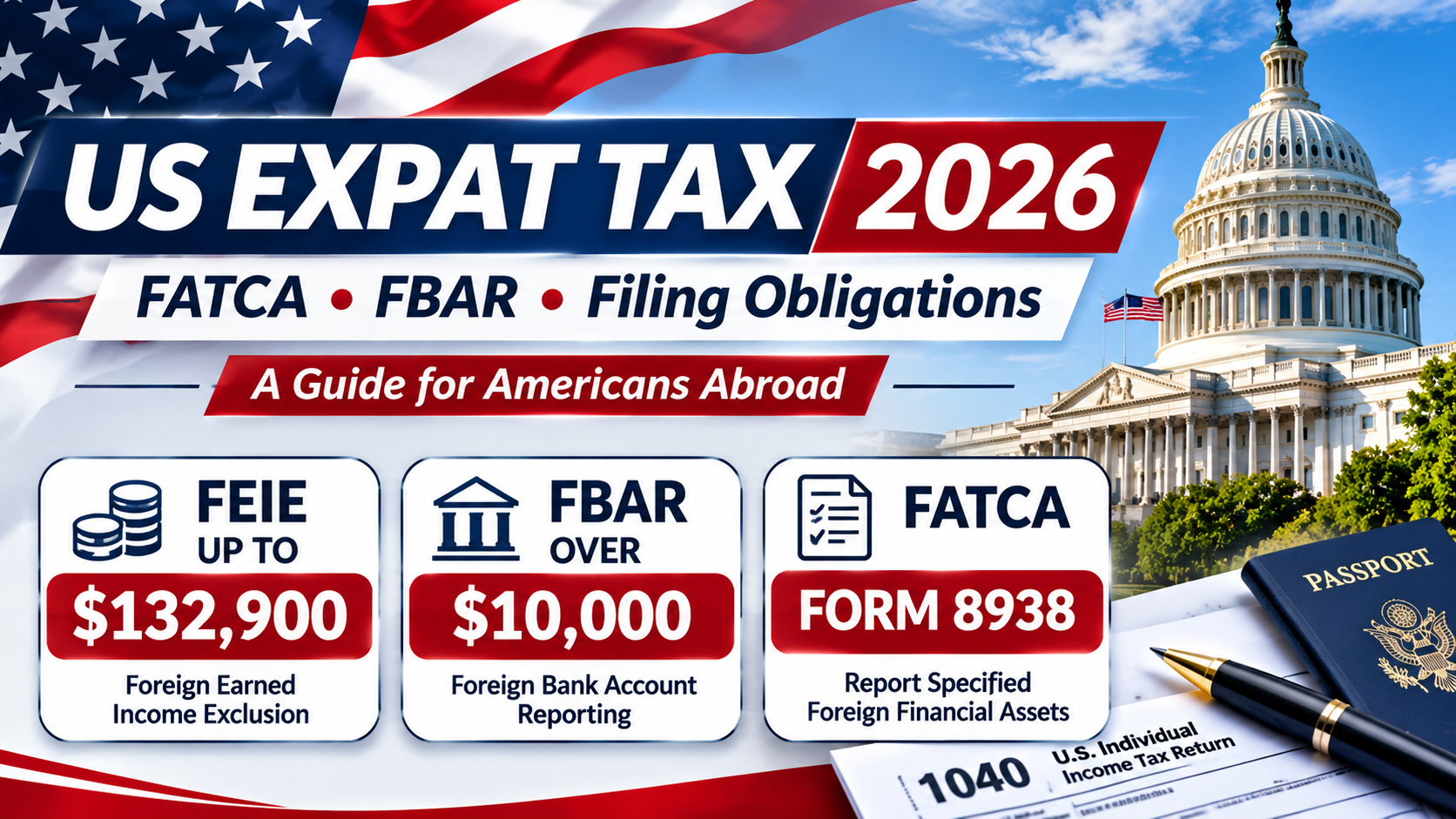
For 2026, qualifying Americans abroad may claim a Foreign Earned Income Exclusion (FEIE) of up to $132,900.
Americans may also have separate foreign financial account reporting obligations under the Bank Secrecy Act and FATCA.
The most important reports include:
- Form 1040: Federal individual income tax return.
- FinCEN Form 114 (FBAR): Foreign financial account reporting.
- IRS Form 8938: Specified foreign financial asset reporting under FATCA.
- Form 2555: Foreign Earned Income Exclusion.
- Form 1116: Foreign Tax Credit.
This guide explains US expat tax rules, the differences between FATCA and FBAR, reporting thresholds, tax exclusions, credits, filing deadlines, penalties and practical compliance steps.
1. Do Americans Living Abroad Have to Pay US Income Tax?
US citizens and resident aliens generally remain subject to US federal income taxation on worldwide income.
This means income earned outside the United States can still be relevant to an American tax return.
Potential income sources include:
- Foreign employment salary.
- Freelance and consulting income.
- Business profits.
- Overseas property rental income.
- Bank interest.
- Dividends.
- Capital gains.
- Cryptocurrency transactions.
- Other taxable income.
However, having a US filing obligation does not automatically mean additional US tax must be paid.
Various exclusions, credits and deductions may reduce or eliminate the resulting US federal income tax.
Important: Reporting income and actually owing income tax are two different issues.
2. Who Must File a US Federal Tax Return While Abroad?
US filing obligations depend on filing status, age, gross income, employment classification and other conditions.
Americans abroad generally follow the same federal income tax return filing thresholds as taxpayers living in the United States.
However, special filing requirements can arise.
For example, an individual with net earnings from self-employment of at least $400 generally has a federal return filing obligation, subject to the applicable rules.
A person claiming the Foreign Earned Income Exclusion also generally must file a federal return to make the election.
Important
Income eligible for exclusion under the FEIE is still considered in determining whether a federal tax return must be filed.
Americans should not simply ignore foreign salary when testing filing requirements.
3. What Is FATCA?
FATCA stands for the Foreign Account Tax Compliance Act.
It was introduced to improve US tax compliance concerning offshore financial accounts and specified foreign assets.
FATCA includes two important reporting areas.
Reporting by Foreign Financial Institutions
Certain foreign financial institutions must identify and report specified accounts held by US persons under applicable agreements and rules.
Reporting by US Taxpayers
Specified US taxpayers may need to file Form 8938 when the total value of relevant foreign financial assets exceeds the applicable threshold.
FATCA is not a separate annual tax charged automatically on the value of an overseas bank account.
It is primarily a tax compliance and information-reporting framework.
4. What Is IRS Form 8938?
Form 8938 is called:
Statement of Specified Foreign Financial Assets.
It is generally attached to the taxpayer's federal income tax return when the relevant reporting conditions are met.
Specified foreign financial assets can include certain:
- Foreign bank accounts.
- Foreign brokerage accounts.
- Interests in foreign financial institutions.
- Foreign securities held outside financial accounts.
- Certain foreign entity interests.
- Other reportable financial contracts and instruments.
The exact treatment depends on ownership, account structure and applicable reporting exceptions.
5. FATCA Form 8938 Thresholds for Americans Living Abroad
Americans who satisfy the applicable living-abroad criteria can qualify for substantially higher Form 8938 thresholds than taxpayers residing in the United States.
Form 8938 Thresholds — Living Abroad
| Filing Status | Year-End Asset Value | At Any Time During Year |
|---|---|---|
| Single | More than $200,000 | More than $300,000 |
| Married Filing Separately | More than $200,000 | More than $300,000 |
| Married Filing Jointly | More than $400,000 | More than $600,000 |
The threshold is met if either relevant value test is exceeded.
Important
Living outside the United States does not automatically establish eligibility for these higher thresholds.
The taxpayer must meet the IRS rules for being treated as living abroad for Form 8938 purposes.
6. FATCA Reporting Thresholds for Taxpayers Living in the USA
For comparison, the relevant domestic thresholds are lower.
| Filing Status | Year-End Value | At Any Time |
|---|---|---|
| Single | More than $50,000 | More than $75,000 |
| Married Filing Separately | More than $50,000 | More than $75,000 |
| Married Filing Jointly | More than $100,000 | More than $150,000 |
Taxpayers should use the threshold appropriate to their residence and filing circumstances.
Note: Form 8938 reporting generally requires the taxpayer to have an income tax return filing obligation. Different rules can apply to specified domestic entities.
7. What Is FBAR?
FBAR stands for:
Report of Foreign Bank and Financial Accounts.
The report is submitted using FinCEN Form 114.
FBAR is separate from the federal income tax return and is filed electronically through the US Treasury's BSA E-Filing System.
It reports qualifying foreign financial accounts when the total account balances exceed the relevant threshold.
8. What Is the FBAR Reporting Threshold for 2026?
The general FBAR threshold is:
More than $10,000 in aggregate foreign financial accounts at any time during the calendar year.
The threshold applies to combined account values.
It is not a separate $10,000 threshold for each individual account.
Example
An American living abroad has:
| Foreign Financial Account | Highest Relevant Balance |
|---|---|
| Bank Account A | $6,000 |
| Bank Account B | $4,500 |
| Total | $10,500 |
If the applicable combined account value exceeds $10,000 at any time, FBAR filing is generally required.
The taxpayer may have to report the relevant accounts even where neither individual account exceeds $10,000.
Important
For precise FBAR reporting, the maximum value of each account and the aggregate value rules must be determined under FinCEN instructions.
The report is about account balances and reporting—not a tax on the full balance.
9. FATCA vs FBAR: What Is the Difference?
FATCA Form 8938 and FBAR have different legal bases, filing methods and thresholds.
| Feature | FATCA Form 8938 | FBAR / FinCEN Form 114 |
|---|---|---|
| Primary Authority | IRS | FinCEN |
| Purpose | Specified foreign asset reporting | Foreign financial account reporting |
| Filing Location | With federal tax return | BSA E-Filing System |
| General Minimum Trigger | Varies by filing status and location | More than $10,000 aggregate |
| Reporting Scope | Certain financial accounts and other assets | Relevant foreign financial accounts |
| Filing Requirement | Depends on return filing and assets | Can apply without an income tax return |
| Due Date | Generally follows income tax return | April 15, automatic extension to October 15 |
Do Taxpayers Sometimes Need Both?
Yes.
An American may need to file both Form 8938 and FBAR when separate statutory conditions are met.
Filing one form does not automatically replace the other.
10. Does Every Foreign Bank Account Need to Be Reported?
Not necessarily.
The reporting obligation depends on the relevant threshold, account ownership and other legal conditions.
Accounts that may be relevant include:
- Foreign savings accounts.
- Foreign current accounts.
- Certain foreign securities accounts.
- Joint foreign bank accounts.
- Foreign accounts over which a US person has signature authority.
Important
An account does not have to generate interest or taxable income to become reportable.
A foreign account containing only savings may still require FBAR reporting if the conditions are satisfied.
11. Foreign Earned Income Exclusion for 2026
The Foreign Earned Income Exclusion allows qualifying taxpayers to exclude certain foreign earned income from US federal taxable income.
For Tax Year 2026, the maximum FEIE is:
$132,900 per qualifying individual.
For 2025, the maximum was $130,000.
Comparison
| Tax Year | Maximum FEIE |
|---|---|
| 2025 | $130,000 |
| 2026 | $132,900 |
| Increase | $2,900 |
The exclusion is not automatic.
It is generally claimed by completing Form 2555 with the federal income tax return.
12. Who Qualifies for the Foreign Earned Income Exclusion?
To qualify, an individual generally needs:
- Qualifying foreign earned income.
- A tax home in a foreign country.
- Satisfaction of the bona fide residence test or physical presence test.
- A valid election.
Bona Fide Residence Test
Qualifying taxpayers may satisfy this test by establishing bona fide residence in a foreign country for an uninterrupted period that includes an entire tax year.
Physical Presence Test
This generally requires at least 330 full days of physical presence in foreign countries during a period of 12 consecutive months.
Important
A person working remotely from a foreign country does not automatically qualify without satisfying all applicable conditions.
13. Is All Foreign Income Eligible for the FEIE?
No.
The FEIE principally concerns qualifying income from personal services performed abroad.
Examples can include:
- Foreign wages.
- Salaries.
- Professional fees.
- Qualifying self-employment earnings.
Income generally not eligible for the FEIE includes:
- Bank interest.
- Dividends.
- Most capital gains.
- Pension income.
- Rental income not representing qualifying compensation for personal services.
Investment income requires separate tax treatment.
14. FEIE Calculation Example: $100,000 Foreign Salary
Assume an American citizen earns $100,000 in eligible foreign employment income during 2026.
The person has a foreign tax home, satisfies the applicable qualification test, and qualifies for the full-year exclusion.
Foreign salary:
$100,000.
Maximum FEIE:
$132,900.
Because the foreign earned salary is below the limit, the entire qualifying $100,000 may potentially be excluded from regular federal taxable income.
Illustrative foreign earned income remaining after exclusion: $0.
This does not eliminate FBAR, FATCA or other reporting requirements.
Any other income, taxes or deductions must be assessed separately.
15. FEIE Calculation Example: $160,000 Foreign Salary
Assume a qualifying American earns $160,000 of foreign employment income in 2026.
Maximum FEIE:
$132,900.
Income remaining before other adjustments:
$160,000 − $132,900 = $27,100.
Illustrative remaining foreign earned income: $27,100.
Important Tax Calculation Rule
The remaining $27,100 should not simply be taxed as if it were the taxpayer's only income starting in the lowest tax bracket.
The IRS requires the relevant Foreign Earned Income Tax Worksheet to determine the rates applicable to income not excluded.
Other deductions and credits may also affect the result.
16. Foreign Housing Exclusion and Deduction for 2026
Qualifying Americans abroad may also benefit from the foreign housing provisions.
For 2026, the standard general limits include:
| Item | Amount |
|---|---|
| Maximum FEIE | $132,900 |
| General Housing Expense Limit | $39,870 |
| Full-Year Base Housing Amount | $21,264 |
Higher housing expense limits may apply to certain designated high-cost locations.
Important
The foreign housing amount is not automatically equal to the full annual rent paid.
The applicable calculation considers qualifying housing expenses, the base housing amount, location-based limits and other requirements.
The exclusion and deduction also operate differently depending on whether the expenses are associated with employer-provided amounts or self-employment earnings.
17. What Is the Foreign Tax Credit?
The Foreign Tax Credit (FTC) can provide relief where qualifying foreign income taxes have been paid or accrued on income also subject to US taxation.
It is generally claimed using Form 1116, subject to available exceptions.
Example
An American living in Germany earns salary income that is taxable in both Germany and the United States.
The individual pays qualifying German income tax.
A Foreign Tax Credit may reduce the relevant US federal income tax liability, subject to the statutory credit limitations.
Important
Foreign taxes paid do not always translate into an identical dollar-for-dollar reduction in total US tax.
Credit categories, income sourcing, deductions and other limitations must be considered.
18. FEIE vs Foreign Tax Credit: Which Is Better?
Both options can reduce double taxation, but they work differently.
| Feature | FEIE | Foreign Tax Credit |
|---|---|---|
| Main Purpose | Excludes eligible foreign earned income | Credits eligible foreign income tax |
| Primary Form | Form 2555 | Form 1116 |
| Annual 2026 Limit | $132,900 maximum per qualifying person | Subject to credit calculation limits |
| Income Type | Qualifying foreign earned income | Relevant income subject to qualifying foreign tax |
| Foreign Tax Payment Required | Not necessarily | Generally yes |
| Treatment of Excluded Income | Excluded under Section 911 | No FTC for taxes on excluded income |
Important Anti-Double-Benefit Rule
A taxpayer cannot claim a Foreign Tax Credit for foreign taxes attributable to income excluded under the FEIE.
Some taxpayers may use both provisions for different portions of income where permitted.
The most suitable approach depends on the person's complete tax circumstances.
19. Do American Freelancers Abroad Pay Self-Employment Tax?
Potentially, yes.
An American operating a self-employed business abroad may owe US self-employment tax even when qualifying foreign business earnings are excluded from regular income tax using Form 2555.
Example
An American freelance consultant works abroad.
Net business income:
$70,000.
The person qualifies for the FEIE.
Although eligible foreign earned income may be excluded from ordinary federal income taxation, the exclusion does not automatically remove US self-employment tax.
A Social Security totalization agreement or another applicable provision may affect the result.
Freelancers should therefore assess income tax and self-employment tax separately.
20. What About Americans Living in the UAE or Saudi Arabia?
An American citizen living in Dubai, Abu Dhabi, Riyadh or Jeddah generally remains subject to US federal worldwide-income reporting rules.
Even where their foreign country does not charge ordinary personal income tax on employment salary, US obligations can continue.
Example
An American employee lives in Dubai and earns $120,000 of qualifying salary.
The person may be eligible for the FEIE, subject to the relevant requirements.
However, the person may also need to disclose qualifying UAE accounts through FBAR or Form 8938.
Important: No local income tax does not mean no US reporting requirement.
21. Do Americans Living in Pakistan Have US Tax Obligations?
Yes, American citizens and relevant US taxpayers living in Pakistan may still be required to file US income tax returns and foreign financial account reports.
Potential income includes:
- Employment income in Pakistan.
- Consulting income.
- Pakistani rental income.
- Foreign bank interest.
- Dividends.
- Business profits.
- Capital gains.
Relevant Pakistani taxes may affect Foreign Tax Credit calculations, subject to the applicable requirements.
Pakistani bank accounts may also fall within FBAR or Form 8938 reporting.
The exact result depends on ownership, account values, tax residence and applicable law.
22. US Filing Deadlines for Americans Abroad in 2027
Tax Year 2026 generally covers January 1 through December 31, 2026.
For most calendar-year taxpayers:
| Requirement | Date |
|---|---|
| Tax Year Ends | December 31, 2026 |
| Regular Federal Filing Deadline | April 15, 2027 |
| Qualifying Automatic Expat Filing Extension | June 15, 2027 |
| Further Extended Filing Deadline | Generally October 15, 2027, where validly extended |
| FBAR Standard Deadline | April 15, 2027 |
| FBAR Automatic Extended Deadline | October 15, 2027 |
Important Payment Rule
The automatic two-month overseas extension generally gives qualifying taxpayers additional time to file without a late-filing penalty.
However, interest on unpaid federal tax generally begins from the regular April deadline.
Additional rules can apply to extensions, disasters, military service and other circumstances.
23. How to File FBAR Electronically
FBAR is submitted through FinCEN's BSA E-Filing System.
Step 1
Identify all relevant foreign financial accounts.
Step 2
Determine the highest value of each account during 2026.
Step 3
Convert reportable amounts into US dollars using the appropriate reporting conversion rules.
Step 4
Determine whether the combined account reporting threshold is exceeded.
Step 5
Gather account names, numbers, financial institution information and relevant ownership details.
Step 6
Access the official BSA E-Filing System.
Step 7
Complete FinCEN Form 114.
Step 8
Submit electronically.
Step 9
Save the filing acknowledgment.
Step 10
Retain supporting records.
Official FBAR filing portal: https://bsaefiling.fincen.treas.gov/
24. How to File a US Expat Income Tax Return
Step 1: Determine Filing Requirements
Review filing status, gross income and other relevant conditions.
Step 2: Collect Worldwide Income Records
Gather foreign salary, business income and investment information.
Step 3: Convert Amounts to US Dollars
Use appropriate currency conversion methods.
Step 4: Complete Form 1040
Report income under the applicable federal rules.
Step 5: Review FEIE Eligibility
Use Form 2555 where applicable.
Step 6: Review Foreign Tax Credits
Prepare Form 1116 if required.
Step 7: Evaluate FATCA Reporting
Determine whether Form 8938 must be attached.
Step 8: Review Other International Forms
Certain foreign corporations, partnerships, trusts, gifts and investments can trigger additional information reporting.
Step 9: Calculate Tax Due
Consider income tax, self-employment tax, deductions and credits.
Step 10: Submit the Return
File by the applicable due date, using a valid extension where necessary.
Step 11: File FBAR Separately
Submit FinCEN Form 114 if required.
Step 12: Preserve Documentation
Retain tax returns, financial account records and acknowledgments.
25. What Penalties Can Apply for Missing FATCA or FBAR?
FATCA and FBAR rules include potentially significant penalties.
Form 8938
Failure to file Form 8938 can trigger an initial penalty generally starting at $10,000.
Additional penalties can arise in certain cases of continuing non-compliance after IRS notification.
FBAR
FBAR penalties depend on the applicable law and the circumstances, including whether a violation is non-willful or willful.
Civil penalties can be substantial.
Certain intentional violations may also carry criminal consequences.
Important
Penalty amounts and inflation adjustments can change.
Taxpayers should not rely on a single historical penalty figure for every violation.
26. What if an American Has Never Filed US Taxes Abroad?
The IRS provides certain compliance procedures for eligible taxpayers whose prior reporting failures were non-willful.
These include the Streamlined Filing Compliance Procedures.
For qualifying taxpayers living outside the United States, the streamlined foreign offshore procedures generally involve:
- Three relevant years of delinquent or amended federal income tax returns.
- Six relevant years of delinquent FBARs.
- Required additional international information returns.
- Payment of applicable tax and interest.
- Certification of non-willful conduct.
Important
These procedures have specific eligibility restrictions.
Taxpayers under IRS examination or criminal investigation may be ineligible.
A person should obtain qualified US international tax advice before submitting past-due foreign reporting forms.
27. Does Renouncing US Citizenship End Expat Tax Obligations?
Renouncing US citizenship can have serious immigration, nationality and tax consequences.
The US expatriation tax rules may apply to certain covered expatriates.
Potential considerations include:
- Prior tax compliance.
- Net worth.
- Average annual income tax liability.
- Exit tax rules.
- Form 8854.
- Relevant asset valuations.
Renunciation is not a simple alternative to filing annual US returns.
Anyone considering this step should obtain specialized legal and tax advice.
28. Common US Expat Tax Mistakes to Avoid
- Assuming US citizenship stops creating tax obligations after relocation.
- Ignoring worldwide income.
- Believing the FEIE applies automatically.
- Using the 2025 exclusion amount for 2026.
- Assuming FEIE eliminates FBAR reporting.
- Treating the $10,000 FBAR threshold as applying separately to each account.
- Confusing FATCA Form 8938 with FBAR.
- Assuming foreign accounts without interest never require reporting.
- Claiming foreign tax credits on excluded income.
- Ignoring US self-employment tax.
- Missing the June overseas filing extension conditions.
- Assuming the June extension eliminates April interest.
- Ignoring foreign business ownership reporting.
- Reporting foreign currency amounts without proper conversion.
- Failing to maintain bank account balances and records.
- Assuming no US tax due means no US forms are required.
- Submitting delinquent filings without reviewing appropriate compliance procedures.
29. Final US Expat Tax Compliance Checklist for 2026
Before filing, confirm:
- US citizenship or tax residency status.
- Filing status and income thresholds.
- Worldwide employment income.
- Business and freelance income.
- Foreign rental income.
- Interest and dividends.
- Capital gains and digital assets.
- FEIE eligibility.
- $132,900 maximum exclusion.
- Foreign housing expenses.
- Foreign Tax Credit eligibility.
- Self-employment tax.
- Foreign bank account values.
- FBAR $10,000 aggregate threshold.
- Form 8938 reporting thresholds.
- Foreign business ownership.
- Foreign trusts and gifts.
- Correct currency conversion.
- April 15, 2027 federal tax payment deadline.
- Applicable June 15 overseas extension.
- October 15 FBAR automatic extension.
- Return and reporting confirmations.
30. Watch Tax With Naeem — Related Income Tax Education
For general educational guidance on income tax returns, salary, rental income, capital gains and dividends, watch the following related tutorial from Tax With Naeem.
Video: Income Tax Return Filing in Pakistan | Salary | Rental | Capital Gain | Dividend Explained | FBR
https://www.youtube.com/watch?v=VX88o1N1AfA
This video was published by Tax With Naeem on October 2, 2025.
It explains Pakistan's income tax return system, not US expat tax or IRS foreign account reporting.
It is included as supplementary education concerning income classification and tax filing.
For US expat tax obligations, readers should use the official IRS and FinCEN instructions.
31. Official IRS and FinCEN Sources
1. IRS — US Citizens and Resident Aliens Abroad
https://www.irs.gov/individuals/international-taxpayers/us-citizens-and-resident-aliens-abroad
2. IRS — Foreign Earned Income Exclusion
https://www.irs.gov/individuals/international-taxpayers/foreign-earned-income-exclusion
3. IRS — Form 2555 Instructions for 2026
https://www.irs.gov/instructions/i2555
4. IRS — FATCA Reporting for US Taxpayers
https://www.irs.gov/businesses/corporations/summary-of-fatca-reporting-for-us-taxpayers
5. IRS — Comparison of Form 8938 and FBAR
https://www.irs.gov/businesses/comparison-of-form-8938-and-fbar-requirements
6. IRS — Foreign Tax Credit
https://www.irs.gov/individuals/international-taxpayers/foreign-tax-credit
7. IRS — US Citizens Abroad: Filing and Payment Deadlines
8. FinCEN — BSA E-Filing System
https://bsaefiling.fincen.treas.gov/
9. IRS — Streamlined Filing Compliance Procedures
https://www.irs.gov/individuals/international-taxpayers/streamlined-filing-compliance-procedures
10. IRS — Foreign Housing Exclusion and Deduction
https://www.irs.gov/individuals/international-taxpayers/foreign-housing-exclusion-or-deduction
11. AsaanTax.pk — International Taxation Guides
12. Tax With Naeem — Related Tutorial
https://www.youtube.com/watch?v=VX88o1N1AfA
32. Conclusion: What Must Americans Abroad Report in 2026?
Americans living abroad remain subject to important US federal income tax and financial-account reporting obligations.
For Tax Year 2026, qualifying taxpayers may exclude up to $132,900 of eligible foreign earned income through Form 2555.
However, the exclusion does not automatically eliminate federal return filing, self-employment tax or foreign account reporting.
FBAR generally applies where aggregate relevant foreign financial accounts exceed $10,000 at any time during the calendar year.
FATCA Form 8938 has separate asset thresholds based on filing status and whether the taxpayer qualifies as living abroad.
Many expatriates can reduce double taxation through the Foreign Earned Income Exclusion, Foreign Tax Credit and other relief provisions.
The ordinary federal tax filing deadline is April 15, 2027, with an automatic filing extension to June 15 for qualifying individuals abroad.
The most important rule is that owing no additional US federal income tax does not automatically eliminate US reporting obligations.
Americans abroad should review both their tax return requirements and their separate foreign financial account reporting obligations.
For additional international tax guides covering the USA, UK, UAE, Canada, Germany, Australia and Pakistan, visit:
AsaanTax.pk: https://www.asaantax.pk/
Editorial Note: This guide reflects IRS and FinCEN guidance reviewed as of November 11, 2026. Figures relate to Tax Year 2026, generally filed in 2027.
Disclaimer: This content is intended for general educational purposes and does not constitute personalized US tax, financial reporting or legal advice. Filing obligations depend on citizenship, residency, income, account ownership, asset values and other applicable legal conditions. Consult the IRS, FinCEN or a qualified US international tax professional for specific circumstances.