Singapore Income Tax 2026: Rates for Residents, Non-Residents and Companies
Published: November 11, 2026
Country: Republic of Singapore
Year of Assessment: 2026
Individual Income Basis Period: January 1 – December 31, 2025
Tax Authority: Inland Revenue Authority of Singapore (IRAS)
Currency: Singapore Dollar (SGD or S$)
Singapore is internationally recognized for its competitive tax framework, established financial sector, business-friendly environment and efficient tax administration.
The country attracts professionals, technology companies, investors, international entrepreneurs and multinational businesses.
However, Singapore is not an income-tax-free country.
Individual tax residents pay progressive personal income tax, while non-residents may face different rates depending on their activities and the nature of their income.
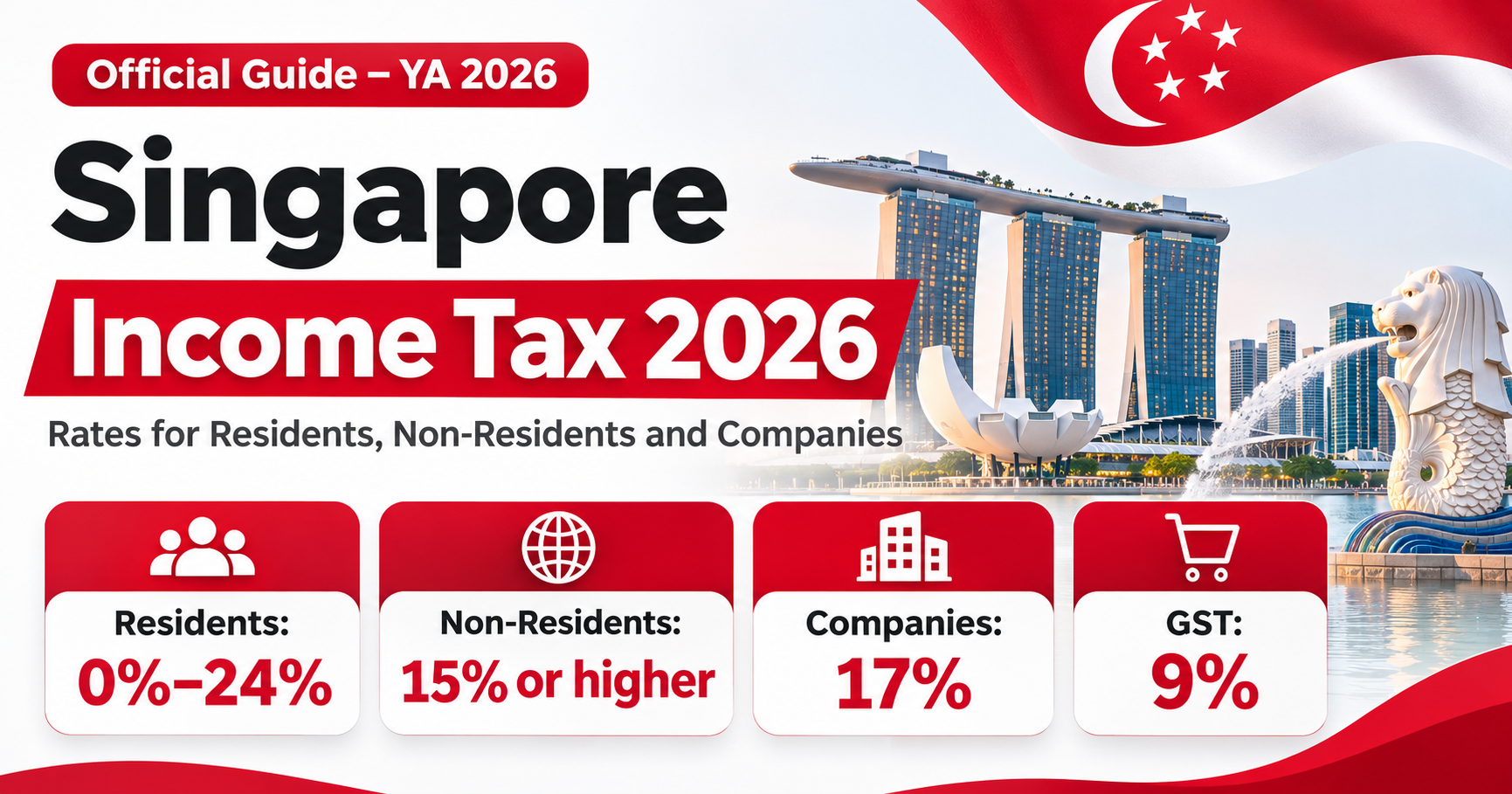
Companies generally pay a 17% corporate income tax rate on chargeable income, subject to applicable exemptions, rebates and other tax provisions.
For Year of Assessment (YA) 2026, Singapore's personal income tax rates range from 0% to 24%.
Non-resident employment income is generally taxed at 15% or the resident progressive rates, whichever results in a higher tax amount.
Singapore also provides a major corporate tax measure for YA 2026: an enhanced 50% Corporate Income Tax rebate, with a maximum combined benefit of S$40,000 under the applicable conditions.
This guide explains Singapore's 2026 income tax brackets, resident and non-resident taxation, company income tax, startup exemptions, tax reliefs, GST, filing procedures and important IRAS deadlines.
1. Singapore Personal Income Tax Rates for Residents in 2026
Singapore uses a progressive personal income tax system for individuals who qualify as tax residents.
For YA 2026, the rates range from 0% to 24%.
Official Resident Income Tax Brackets
| Annual Chargeable Income | Marginal Tax Rate |
|---|---|
| First S$20,000 | 0% |
| Next S$10,000 (up to S$30,000) | 2% |
| Next S$10,000 (up to S$40,000) | 3.5% |
| Next S$40,000 (up to S$80,000) | 7% |
| Next S$40,000 (up to S$120,000) | 11.5% |
| Next S$40,000 (up to S$160,000) | 15% |
| Next S$40,000 (up to S$200,000) | 18% |
| Next S$40,000 (up to S$240,000) | 19% |
| Next S$40,000 (up to S$280,000) | 19.5% |
| Next S$40,000 (up to S$320,000) | 20% |
| Next S$180,000 (up to S$500,000) | 22% |
| Next S$500,000 (up to S$1 million) | 23% |
| Above S$1 million | 24% |
These are marginal rates, not flat rates imposed on the taxpayer's entire income.
The brackets apply to chargeable income after relevant allowable deductions and reliefs.
2. What Is the Tax-Free Income Threshold in Singapore?
For Singapore tax residents, the first S$20,000 of chargeable income is subject to a 0% income tax rate.
Example
An eligible tax resident has chargeable income of S$18,000.
The entire amount falls within the zero-rate bracket.
Income tax: S$0.
However, zero income tax does not necessarily mean the person has no tax filing obligation.
IRAS filing requirements depend on income levels, employment arrangements, tax notices and other circumstances.
3. How Does Progressive Income Tax Work?
Singapore does not apply one tax rate to an individual's entire chargeable income.
Instead, each portion is taxed at its relevant marginal rate.
For example, a person with chargeable income of S$100,000 does not pay 11.5% on the entire S$100,000.
Only the portion between S$80,000 and S$120,000 is taxed at 11.5%.
The lower portions are taxed at their respective rates.
This produces an effective tax rate that is generally lower than the highest marginal rate reached.
4. Income Tax Calculation on S$60,000
Assume an individual qualifies as a Singapore tax resident and has S$60,000 of chargeable income.
| Income Portion | Rate | Tax |
|---|---|---|
| First S$20,000 | 0% | S$0 |
| Next S$10,000 | 2% | S$200 |
| Next S$10,000 | 3.5% | S$350 |
| Remaining S$20,000 | 7% | S$1,400 |
| Total | S$1,950 |
Illustrative income tax: S$1,950.
This example assumes S$60,000 is already the taxpayer's chargeable income, not gross salary.
Additional rebates or other adjustments may affect the final amount.
5. Income Tax Calculation on S$100,000
Assume a qualifying tax resident has S$100,000 of chargeable income.
The accumulated tax on the first S$80,000 is S$3,350.
Income above S$80,000:
S$100,000 − S$80,000 = S$20,000.
Tax on the additional amount:
S$20,000 × 11.5% = S$2,300.
Total:
S$3,350 + S$2,300 = S$5,650.
Illustrative resident income tax: S$5,650.
The taxpayer's highest marginal rate is 11.5%, but the effective tax rate on chargeable income is 5.65%.
6. Who Is a Singapore Tax Resident?
Tax residency is important because it determines the relevant income tax rates and relief eligibility.
A person may be treated as a Singapore tax resident if they satisfy the applicable statutory conditions.
Singapore Citizens and Permanent Residents
Singapore citizens and permanent residents who normally reside in Singapore are generally treated as tax residents, subject to the relevant rules.
Foreign Employees
Foreigners can qualify as tax residents through specific residence or employment tests.
An important general test is:
At least 183 days of stay or work in Singapore during the relevant calendar year.
Additional rules can apply where employment extends across two or three calendar years.
Important
Singapore nationality, permanent residence status, employment passes and actual tax residency are not always interchangeable.
The individual's circumstances must be checked under IRAS rules.
7. Singapore Non-Resident Income Tax Rates in 2026
Non-residents are generally taxed differently from residents.
The applicable rate depends on the type of income.
Non-Resident Tax Comparison
| Type of Income | General Tax Treatment |
|---|---|
| Employment income | 15% or resident progressive rates, whichever produces higher tax |
| Director's fees | Generally 24% |
| Relevant rental income | Generally 24% |
| Other non-employment taxable income | Generally 24%, subject to exceptions |
| Certain non-resident professional income | 15% on gross or 24% on net income under applicable rules |
| Specified withholding income | Relevant withholding rates and treaty rules |
Non-residents generally cannot claim the same personal reliefs as qualifying resident individuals.
However, deductions and special exemptions may apply in certain circumstances.
8. Non-Resident Employment Income: 15% or Higher
The general non-resident employment income rule is frequently misunderstood.
It is not always a flat 15% final rate.
IRAS generally compares:
- A 15% tax calculation on relevant employment income; and
- A calculation using resident progressive rates.
The higher tax amount applies.
Example: S$40,000 Employment Income
Assume a non-resident employee earns S$40,000 in taxable employment income.
15% calculation:
S$40,000 × 15% = S$6,000.
Resident progressive calculation, for comparison:
S$550.
The higher amount is S$6,000.
Illustrative non-resident employment tax: S$6,000.
This assumes the standard non-resident employment rules apply and no special exemption or treaty relief changes the result.
9. Are Short-Term Foreign Employees Exempt?
Certain non-resident employees working in Singapore for 60 days or less during a year may qualify for the short-term employment income exemption.
However, exclusions and special provisions apply.
For example, the concession generally does not apply in the same manner to non-resident company directors, public entertainers and certain professionals.
Taxpayers should not assume that all short assignments are automatically tax-free.
The nature of the duties, length of stay and applicable treaty rules must be examined.
10. Singapore Tax on Non-Resident Directors
Remuneration and director's fees received by non-resident directors are generally subject to a 24% withholding tax rate under the current rules.
Example
A non-resident director receives S$50,000 in relevant director's fees.
Illustrative withholding tax:
S$50,000 × 24% = S$12,000.
Tax: S$12,000.
The treatment can depend on the legal classification of the payment and relevant tax agreements.
Ordinary non-resident employment income and non-resident director's fees should not be calculated using the same rate automatically.
11. Singapore Personal Income Tax Reliefs
Eligible Singapore tax residents can claim specified personal reliefs.
These can include:
- Earned Income Relief.
- Employee CPF Relief.
- Self-Employed CPF Relief.
- Qualifying Child Relief.
- Parent Relief.
- Spouse Relief.
- Certain disability-related reliefs.
- Supplementary Retirement Scheme Relief.
- Other applicable statutory reliefs.
Personal Relief Cap
Singapore generally imposes an overall personal income tax relief cap of:
S$80,000 per Year of Assessment.
The cap concerns total relevant personal relief claims.
A taxpayer cannot automatically deduct S$80,000 without satisfying the separate eligibility conditions for each relief.
12. Are There Personal Income Tax Rebates for YA 2026?
Personal income tax rebates must be distinguished from corporate tax rebates.
Singapore granted a 60% personal income tax rebate, capped at S$200, for eligible tax residents in YA 2025.
That YA 2025 rebate should not automatically be carried forward into YA 2026.
Taxpayers should only claim a personal rebate where it is specifically provided for the applicable Year of Assessment.
The enhanced 50% tax rebate announced for YA 2026 concerns Corporate Income Tax, not an automatic 50% rebate for every individual.
13. Singapore Corporate Income Tax Rate in 2026
Singapore's standard Corporate Income Tax rate is:
17% of chargeable income.
It generally applies to local and foreign companies subject to Singapore Corporation Tax.
Example: S$200,000 Chargeable Income
A company has S$200,000 of taxable income before applying any available tax exemption or rebate.
At 17%:
S$200,000 × 17% = S$34,000.
The initial corporate tax is S$34,000.
However, the company may qualify for partial tax exemptions, startup exemptions or a YA 2026 corporate tax rebate.
The actual tax payable can therefore be substantially lower.
14. Singapore Corporate Income Tax Rebate for YA 2026
The Singapore Government enhanced the Corporate Income Tax rebate for YA 2026.
The updated measure provides:
- A 50% rebate on relevant corporate income tax payable.
- A minimum cash-grant benefit of S$2,000 for eligible active companies satisfying the local employee condition.
- A maximum combined rebate and cash-grant benefit of S$40,000 per company.
Important
The original Budget 2026 proposal was 40%, with a S$1,500 cash-grant benefit and S$30,000 combined cap.
These amounts were subsequently enhanced.
Businesses preparing YA 2026 returns should therefore use the updated 50%, S$2,000 and S$40,000 figures.
The cash grant is subject to specific eligibility conditions and should not automatically be added to every company's rebate calculation.
15. Corporate Tax Rebate Example
Assume a company has S$17,000 in corporate tax payable before the YA 2026 rebate.
Potential 50% rebate:
S$17,000 × 50% = S$8,500.
Illustrative amount after rebate:
S$17,000 − S$8,500 = S$8,500.
This assumes the company qualifies for the rebate and that the calculation is not affected by other provisions or the combined benefit cap.
Any cash grant must be considered separately under the applicable rules.
16. Startup Corporate Tax Exemption in Singapore
Singapore offers a tax exemption scheme for qualifying new startup companies.
For the first three consecutive Years of Assessment, eligible companies can benefit from:
| Chargeable Income Portion | Tax Exemption |
|---|---|
| First S$100,000 | 75% |
| Next S$100,000 | 50% |
The maximum amount of normal chargeable income exempted is S$125,000 per relevant YA.
Important Eligibility Rules
The startup exemption is not available automatically to every newly incorporated company.
Eligibility includes relevant incorporation, tax residency and shareholder conditions.
Investment holding companies and certain property development companies are excluded from the startup exemption scheme.
Companies must check the precise requirements.
17. Startup Tax Calculation Example
Assume an eligible startup has S$100,000 in normal chargeable income.
The startup exemption covers 75% of the first S$100,000.
Exempt amount:
S$75,000.
Remaining taxable amount:
S$25,000.
Corporate tax at 17%:
S$25,000 × 17% = S$4,250.
Illustrative corporate tax before the YA 2026 rebate: S$4,250.
A separate rebate calculation may further reduce the final tax if the company satisfies the applicable conditions.
18. Partial Tax Exemption for Other Companies
Singapore also provides a partial tax exemption scheme for qualifying companies.
Under the general scheme:
- 75% exemption on the first S$10,000 of normal chargeable income.
- 50% exemption on the next S$190,000.
The maximum exemption under these bands is S$102,500.
This scheme can benefit established companies that do not qualify for the enhanced new-startup exemption.
Important
A company should not claim the startup exemption and general partial exemption on the same chargeable income as if both apply cumulatively without regard to the statutory rules.
The applicable scheme must be determined first.
19. Singapore GST Rate in 2026
Goods and Services Tax (GST) is separate from personal and corporate income tax.
Singapore's standard GST rate is:
9%.
The rate increased to 9% from January 1, 2024.
GST Calculation Example
A GST-registered business sells a standard-rated service for S$1,000 before GST.
GST:
S$1,000 × 9% = S$90.
Total invoice:
S$1,090.
Qualifying supplies may be zero-rated or exempt under the relevant rules.
20. When Must Businesses Register for GST?
A business generally must register for GST when its taxable turnover exceeds the relevant S$1 million threshold under the applicable retrospective or prospective tests.
Important
The GST registration threshold is based on relevant taxable turnover, not corporate taxable profit.
A company may have substantial revenue but comparatively low accounting or taxable profits.
The GST and Corporate Income Tax obligations must therefore be evaluated separately.
21. How Are Freelancers Taxed in Singapore?
Freelancers and sole proprietors generally report relevant taxable business or professional income under the individual income tax system.
Their taxable business income is normally calculated after allowable business expenses.
Example
A freelance consultant earns:
Annual business revenue: S$90,000.
Allowable business expenses: S$20,000.
Simplified net profit:
S$70,000.
The individual must determine their tax residency, applicable reliefs and other income before calculating final income tax.
GST registration may also become necessary where the relevant turnover tests are satisfied.
A sole proprietor should not automatically apply the 17% company rate to personal business income.
22. Singapore Tax on Foreign Income
Singapore generally operates a territorial-based tax system with specific statutory provisions concerning foreign-source income.
For resident individuals, foreign-sourced income received in Singapore is generally exempt, subject to important exceptions, including certain income received through partnerships.
Employment income derived from work performed in Singapore does not automatically become foreign-source simply because a foreign company pays it.
Example
A foreign employee works physically in Singapore and receives salary into an overseas bank account.
The foreign bank account does not by itself exempt the salary from Singapore income tax.
Taxpayers should determine where services were performed and whether relevant exemptions or treaty rules apply.
23. What About Capital Gains and Dividends?
Singapore generally does not impose a broad capital gains tax on genuine capital investment gains.
However, gains from trading activities may be taxable as income depending on the facts.
Relevant factors can include:
- Nature of the asset.
- Holding period.
- Frequency of transactions.
- Commercial intention.
- Financing arrangements.
- Nature of the taxpayer's business.
Certain dividends received under Singapore's one-tier corporate tax system are generally exempt in shareholders' hands.
Foreign dividends can have different statutory treatment.
Investors should not assume that every asset sale or investment receipt is automatically tax-free.
24. Singapore Personal Income Tax Filing Deadline for YA 2026
The official IRAS individual income tax e-filing period for YA 2026 ran from:
March 1 to April 18, 2026.
| Event | Date |
|---|---|
| Income Basis Period | January 1 – December 31, 2025 |
| Filing Opens | March 1, 2026 |
| Individual e-Filing Deadline | April 18, 2026 |
| Corporate Form C-S / C Deadline | November 30, 2026 |
As of November 11, 2026, the individual YA 2026 filing deadline has passed.
Taxpayers with outstanding returns should check their obligations and available filing options directly with IRAS.
25. Singapore Corporate Tax Filing Deadlines
Companies generally have two main Corporate Income Tax filing obligations.
Estimated Chargeable Income (ECI)
ECI is generally due within three months after the financial year ends, unless a relevant filing waiver or exception applies.
Corporate Income Tax Return
The standard electronic deadline for Form C-S, Form C-S (Lite) or Form C is:
November 30 of the relevant Year of Assessment.
For YA 2026, the standard filing deadline is November 30, 2026.
Companies should not assume that a zero-profit position automatically eliminates all filing obligations.
26. How to File an Individual Tax Return Through IRAS
Step 1: Visit IRAS
Open https://www.iras.gov.sg/.
Step 2: Access myTax Portal
Sign in using the applicable secure authentication method.
Step 3: Review Filing Status
Check whether a return is required.
Step 4: Select the Correct Year of Assessment
For income earned in 2025, select YA 2026.
Step 5: Review Employment Income
Check pre-filled data provided under the Auto-Inclusion Scheme.
Step 6: Report Additional Income
Enter business, rental or other taxable income that is not already correctly included.
Step 7: Review Personal Reliefs
Claim only reliefs for which the taxpayer qualifies.
Step 8: Check Tax Residency
Confirm the relevant resident or non-resident treatment.
Step 9: Submit the Return
Complete electronic filing where required.
Step 10: Review the Tax Bill
Check the Notice of Assessment and make any permitted amendments within the relevant timeline.
27. Do All Employees Need to File a Tax Return?
No.
IRAS offers a No-Filing Service and Direct Notice of Assessment arrangements for eligible individuals.
Some taxpayers may not need to submit a separate return if their income and tax relief information are correctly available to IRAS.
However, individuals required to file must do so even if certain income information has been pre-filled.
Taxpayers should check their actual filing notification and myTax Portal status rather than assuming that every employee is exempt from filing.
28. What About Pakistani Professionals Living in Singapore?
Pakistani nationals employed or operating businesses in Singapore may have tax obligations depending on:
- Singapore tax residency.
- Employment income.
- Duration of work in Singapore.
- Freelance or business activities.
- Income received from overseas.
- Relevant tax agreements.
- Pakistani tax residency.
- Other applicable reporting rules.
Example
A Pakistani software engineer works in Singapore and earns S$100,000 of annual employment income.
The applicable tax depends on whether the professional qualifies as a Singapore tax resident, the relevant chargeable income and eligible reliefs.
Pakistani nationality alone does not establish the appropriate tax rate.
The individual's Pakistani tax obligations must also be reviewed separately.
29. Common Singapore Income Tax Mistakes
- Treating Singapore as a completely tax-free country.
- Assuming all foreign employees pay exactly 15%.
- Ignoring the higher-of-two-calculations rule for non-resident employment.
- Applying the 15% employment rate to non-resident director's fees.
- Confusing gross salary with chargeable income.
- Treating the S$20,000 zero-rate bracket as a universal filing exemption.
- Assuming the YA 2025 personal tax rebate applies to YA 2026.
- Using the original 40% corporate rebate instead of the enhanced 50%.
- Treating the S$40,000 combined rebate cap as a direct cash payment.
- Applying 17% Corporate Tax to a sole proprietor's personal profit.
- Assuming every new company qualifies for startup tax exemption.
- Confusing the GST turnover threshold with the Corporate Tax profit base.
- Ignoring the 9% GST rate.
- Reporting income in the wrong Year of Assessment.
- Missing IRAS filing deadlines.
- Assuming overseas salary payments are automatically tax-exempt.
30. Singapore Tax Compliance Checklist for 2026
Before filing, verify:
- Correct Year of Assessment.
- Income basis period.
- Individual tax residency.
- Correct progressive resident brackets.
- Non-resident employment calculation.
- Director's fee treatment.
- Applicable personal reliefs.
- S$80,000 relief cap.
- Freelance or business income.
- Rental income.
- Foreign-source income treatment.
- Corporate taxable income.
- Applicable startup or partial exemption.
- Updated 50% YA 2026 corporate rebate.
- Relevant S$2,000 cash-grant conditions.
- Maximum S$40,000 combined corporate benefit.
- GST registration status.
- 9% GST where relevant.
- Individual filing obligations.
- ECI filing obligations.
- November 30 corporate filing deadline.
- Supporting documents and records.
31. Watch Tax With Naeem — Related Income Tax Education
For general educational guidance on income tax filing, salary, rental income, capital gains and dividends, watch content from Tax With Naeem.
Related Video: Income Tax Return Filing in Pakistan — Salary, Rental Income, Capital Gains and Dividends Explained
https://www.youtube.com/watch?v=VX88o1N1AfA
This video is about Pakistan income tax filing, not Singapore's IRAS income tax return process.
It is included as supplementary educational material.
Readers should use official IRAS guidance for actual Singapore income tax calculations and filing.
32. Official IRAS and Singapore Government Sources
1. IRAS — Individual Income Tax Rates
2. IRAS — Working Out Tax Residency
3. IRAS — Individual Income Tax Filing Season 2026
4. IRAS — Corporate Income Tax Rates and Rebates
https://www.iras.gov.sg/quick-links/tax-rates/corporate-income-tax-rates
5. IRAS — Corporate Income Tax Filing Guide
6. IRAS — Personal Tax Reliefs
7. IRAS — GST Rates
https://www.iras.gov.sg/taxes/goods-services-tax-(gst)/basics-of-gst/current-gst-rates
8. Singapore Ministry of Finance — Finance (Income Taxes) Bill 2026
9. IRAS — Official Website
10. AsaanTax.pk — International Tax Guides
11. Tax With Naeem — Related Video
https://www.youtube.com/watch?v=VX88o1N1AfA
33. Conclusion: What Are Singapore's Income Tax Rates in 2026?
Singapore maintains a competitive but structured tax system.
For YA 2026, resident individuals pay progressive income tax ranging from 0% to 24%.
Non-resident employment income is generally taxed at 15% or the resident progressive rates, whichever produces the higher amount.
Non-resident director's fees and certain other income categories generally face a 24% rate, subject to relevant rules.
Companies generally pay 17% corporate income tax on chargeable income, with potential benefits from startup exemptions, partial exemptions and the enhanced 50% Corporate Income Tax rebate for YA 2026.
Singapore also charges 9% GST on relevant standard-rated taxable supplies.
The individual YA 2026 filing deadline was April 18, 2026, while the general corporate income tax return deadline is November 30, 2026.
The most important rule is to determine tax residency, income classification and the correct Year of Assessment before applying any Singapore income tax rate.
For more professional international taxation guides covering Singapore, Malaysia, the UAE, Saudi Arabia, the UK, USA, Canada, Germany and Pakistan, visit:
AsaanTax.pk: https://www.asaantax.pk/
Editorial Note: This article reflects official IRAS and Singapore Ministry of Finance guidance reviewed as of November 11, 2026, including the enhanced YA 2026 Corporate Income Tax rebate.
Disclaimer: This guide provides general educational information and is not individualized Singapore tax, legal or financial advice. Tax obligations depend on residency, income classification, applicable reliefs, business structure and statutory provisions. Readers should consult IRAS or a qualified Singapore tax professional for their circumstances.