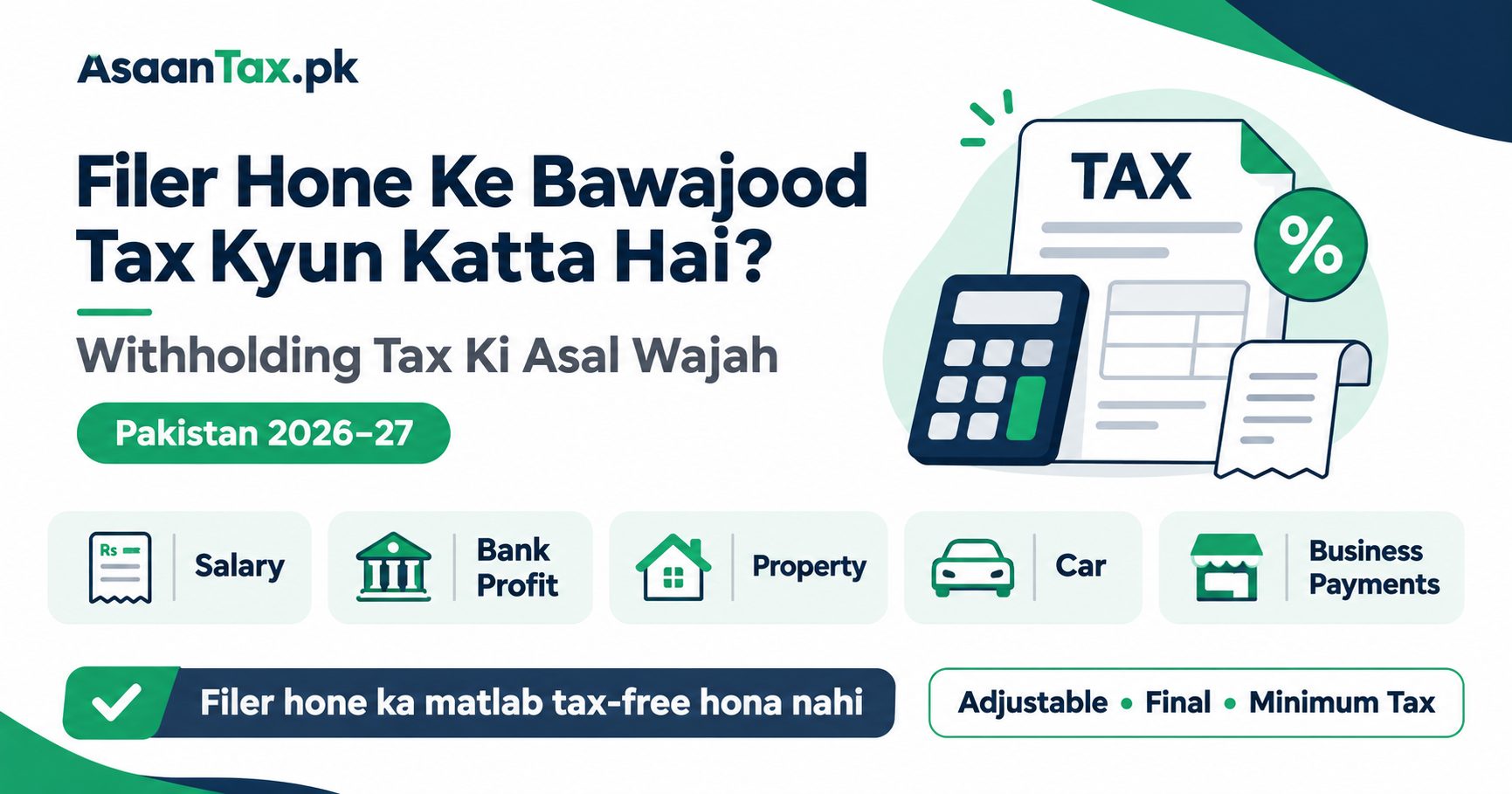
Many taxpayers in Pakistan ask the same question:
"I am already an FBR filer. Why is tax still deducted from my salary, bank account, property transaction, car purchase or business payments?"
Some people believe that once they file their income tax return and become active on the Federal Board of Revenue's Active Taxpayer List (ATL), no further income tax should be deducted.
This is a misunderstanding.
Being a filer does not mean being exempt from income tax.
Filer status generally helps a taxpayer qualify for the withholding tax treatment available to active taxpayers. It does not automatically remove the legal obligation to deduct or collect tax on a particular transaction.
Pakistan's Income Tax Ordinance, 2001 contains several withholding tax provisions. Some taxes are adjustable against the final annual liability, some are final, and others can be subject to minimum-tax treatment.
In this comprehensive AsaanTax.pk guide, we explain why tax is deducted even from filers, how withholding tax works, the differences between adjustable, final and minimum tax, how to check tax deductions through FBR IRIS, and how to claim an eligible refund for Tax Year 2027.
What Is Withholding Tax in Pakistan?
Withholding tax is an income tax collection mechanism through which a prescribed person deducts or collects tax when making or receiving specified payments.
For example:
- An employer deducts income tax from an employee's salary.
- A bank deducts applicable tax from savings account profit.
- A company may deduct tax when paying a contractor.
- A property registration authority collects advance tax during a property transaction.
- A vehicle manufacturer or registering authority may collect advance income tax during vehicle purchase or registration.
The person responsible for deduction or collection is known as a withholding agent.
The tax is collected under the applicable legal section and deposited through the prescribed government payment process.
FBR explains that some withholding taxes constitute advance payments, while others settle the relevant income tax liability under a final-tax regime.
Does Becoming a Filer Mean You Do Not Have to Pay Tax?
No.
A filer is generally a person who satisfies the conditions for appearing on FBR's Active Taxpayers List.
Filer status is not the same as a tax exemption.
An active taxpayer may qualify for lower rates on selected transactions, but where the applicable law requires withholding tax, the deduction can still apply.
Example
Suppose a person appears on ATL and purchases a qualifying new motor vehicle.
The applicable Section 231B advance income tax may still be collected.
However, the filer may qualify for a lower rate than someone who does not appear on ATL.
This means being a filer can reduce the amount collected at source without eliminating the tax altogether.
Filer vs Non-Filer – What Is the Real Difference?
The main distinction for withholding tax purposes is that the law applies different rates to certain transactions depending on the taxpayer's ATL status.
| Matter | Filer / ATL | Non-Filer / Non-ATL |
|---|---|---|
| Relevant withholding tax | Applicable filer rate | Applicable non-ATL rate |
| Salary income tax | Charged under salary rules | Charged under salary rules |
| New vehicle advance tax | Lower ATL rate where prescribed | Higher rate where prescribed |
| Property advance tax | ATL rate where applicable | Non-ATL rate where applicable |
| Bank profit tax | Applicable legal rate | Higher rate where prescribed |
| Final tax | May still apply | May still apply |
| Annual return filing | Required where law applies | Required where law applies |
The exact treatment depends on the relevant section.
A person who is not on ATL may also be subject to special classifications or exemptions in particular circumstances.
Why Does Tax Get Deducted From a Filer's Salary?
Section 149 of the Income Tax Ordinance governs withholding of income tax from salary.
Employers are generally required to calculate and deduct applicable salary tax during the tax year.
Example
Suppose an employee earns a taxable annual salary of Rs. 1,800,000.
The employer calculates income tax according to the applicable salaried-person slabs and deductions.
The employer may then deduct the tax through monthly payroll.
The employee's ATL status does not remove the employer's Section 149 withholding obligation.
Important
The salary tax deduction should correspond to the applicable estimated annual taxable salary and available adjustments.
An employee should request a salary certificate or annual withholding statement to verify deductions.
Why Does a Bank Deduct Tax From a Filer's Profit?
Section 151 governs withholding on specified profit-on-debt payments.
For example, a bank may deduct income tax when crediting taxable savings account profit.
Example
A bank pays Rs. 100,000 in taxable profit.
Suppose the legally applicable withholding rate for that account and taxpayer is 20%.
Withholding tax:
Rs. 100,000 × 20% = Rs. 20,000.
Net amount after this deduction:
Rs. 80,000.
This is a hypothetical calculation using an assumed applicable rate.
The actual treatment depends on the account, taxpayer category, current law and any relevant exemptions.
Important
Not every bank account or savings instrument is taxed identically.
Special regimes may apply to certain government certificates, qualifying Roshan Digital Account deposits and other investments.
Why Does Tax Get Deducted When a Filer Buys Property?
Section 236K governs advance income tax collection from purchasers of qualifying immovable property.
The purchaser may have to pay the prescribed advance tax during registration or transfer.
Being on ATL may allow the buyer to benefit from the applicable filer rate.
However, the ordinary filer rate is not necessarily zero.
Example
A filer purchases property with an applicable taxable value of Rs. 10,000,000.
Assume the relevant Section 236K filer rate is 1.5%.
Advance tax:
Rs. 10,000,000 × 1.5% = Rs. 150,000.
The example is illustrative and depends on the current statutory rate and valuation basis for the specific transaction.
Why Does Tax Get Deducted When a Filer Sells Property?
Section 236C provides for advance tax collection from sellers of qualifying immovable property.
The applicable amount is generally based on the gross sale consideration and relevant tax rules.
Example
Suppose an ATL taxpayer sells property for Rs. 20,000,000.
Using the Tax Year 2027 ordinary filer withholding rate of 2.75% for an applicable transaction:
Rs. 20,000,000 × 2.75% = Rs. 550,000.
This tax may be collected even though the seller is an active filer.
Section 236C advance tax is different from Capital Gains Tax on the actual taxable profit from the sale.
Other provisions concerning adjustments, minimum tax and special property circumstances must be checked separately.
Why Does Tax Get Deducted When a Filer Buys a Car?
Section 231B governs advance income tax on specified motor vehicle transactions.
For qualifying new vehicle purchases or registration, the applicable tax depends on the vehicle's engine capacity, statutory value and taxpayer status.
Example
A qualifying 1500cc vehicle has an applicable taxable value of Rs. 6,000,000.
Assume the Tax Year 2027 filer rate for the relevant category is 2%.
Advance tax:
Rs. 6,000,000 × 2% = Rs. 120,000.
Although the buyer is a filer, the applicable advance income tax still has to be collected.
The tax may generally be adjustable in the person's income tax return, subject to the statutory provisions.
Why Does a Filer's Business Payment Have Tax Deducted?
Section 153 applies to specified payments for goods, services and contracts made by prescribed withholding agents.
Example
A registered business provides professional services to a client.
The client may be legally required to deduct withholding tax when paying the invoice.
Whether the deduction applies and its rate depend on:
- Type of service or supply.
- Taxpayer classification.
- Whether the recipient appears on ATL.
- Status of the payer as a withholding agent.
- Applicable exemptions.
- Relevant special taxation provisions.
Not every payment to a business is subject to exactly the same withholding tax rate.
Important
The tax treatment can be adjustable, minimum or final depending on the actual statutory provision.
Do not assume that all Section 153 deductions automatically create a refundable credit.
Why Does a Filer Pay Tax on Rental Income?
Section 155 applies to specified payments of rent for immovable property.
A prescribed withholding agent may be required to deduct tax from rent paid to a landlord.
The deduction can apply even if the landlord is on ATL.
The actual rate depends on the taxpayer category, rent amount and current statutory rules.
Example
A landlord receives annual rent of Rs. 1,200,000.
If the tenant is a prescribed withholding agent, tax may need to be deducted under the applicable Section 155 rules.
The landlord must determine how the withheld amount is treated in the annual tax calculation.
The final liability can depend on the landlord's other income, permitted deductions and applicable taxation regime.
What Is Adjustable Withholding Tax?
Adjustable withholding tax can generally be credited against a taxpayer's final income tax liability, where the law permits.
This means the tax deducted during the year is taken into account while calculating the final amount payable.
Example
| Description | Amount |
|---|---|
| Final annual income tax liability | Rs. 250,000 |
| Eligible advance/withholding tax paid | Rs. 180,000 |
| Remaining tax payable | Rs. 70,000 |
Calculation:
Rs. 250,000 − Rs. 180,000 = Rs. 70,000.
The taxpayer generally pays the remaining Rs. 70,000, subject to other applicable adjustments.
Example: Excess Adjustable Tax
| Description | Amount |
|---|---|
| Final annual income tax liability | Rs. 150,000 |
| Eligible adjustable tax paid | Rs. 200,000 |
| Potential excess tax | Rs. 50,000 |
An eligible excess payment may give rise to a refund claim under the relevant rules.
However, not every withholding tax deduction is adjustable or refundable.
What Is Final Withholding Tax?
Final withholding tax settles the relevant income tax liability for a specified category of income or transaction according to the applicable regime.
The amount deducted generally cannot simply be applied against unrelated ordinary income tax liabilities.
Examples may include:
- Certain dividends.
- Specified export income.
- Qualifying Naya Pakistan Certificate profit.
- Other income expressly covered by final-tax provisions.
The applicable section, taxpayer classification and statutory conditions determine whether a payment is final.
Example
An eligible investor earns Rs. 100,000 in profit on qualifying Naya Pakistan Certificates.
If the special 10% final-tax regime applies:
Tax deducted = Rs. 10,000.
The relevant tax treatment is final under that regime.
The same amount should not automatically be claimed as ordinary adjustable tax against unrelated salary income.
What Is Minimum Withholding Tax?
Minimum tax treatment means that tax collected under a specified provision can operate as a minimum liability for the relevant income or transaction.
This can affect whether the taxpayer is able to recover the amount when the normal tax calculation is lower.
Example
A business earns income from a transaction subject to a legally prescribed minimum-tax regime.
Suppose the minimum tax attributable to that transaction is Rs. 100,000 while the ordinary calculated liability is Rs. 70,000.
Subject to the relevant statutory rules, the minimum liability may remain Rs. 100,000.
The exact application depends on the section and applicable rules.
Adjustable Tax vs Final Tax vs Minimum Tax
| Feature | Adjustable | Final | Minimum |
|---|---|---|---|
| Deducted at source | Yes, where prescribed | Yes, where prescribed | Yes, where prescribed |
| Credit against normal tax | Generally available | Not generally available against unrelated tax | Limited by applicable law |
| Refund potential | Possible | Generally not for valid final tax | Subject to minimum-tax rules |
| Annual tax treatment | Credited in calculation | Settles relevant tax | Minimum liability may apply |
| Legal classification | Section-specific | Section-specific | Section-specific |
A taxpayer must correctly identify the category before preparing the income tax return.
How to Check Withholding Tax Deducted in FBR IRIS
FBR provides digital records of many withholding tax deductions.
Step 1: Log In to FBR IRIS
Visit:
Step 2: Open the Relevant Tax Records
Check the MIS or available tax-payment information sections.
Step 3: Select Tax Payments
FBR identifies the MIS → Tax Payments facility as a place where taxpayers can view relevant withholding information.
Step 4: Select the Relevant Tax Year
Choose the tax period for which you want to check deductions.
Step 5: Review Available Records
Compare the available entries with:
- Salary certificates.
- Bank withholding certificates.
- Vehicle tax receipts.
- Property tax payment records.
- Business withholding certificates.
- Other official deduction evidence.
Step 6: Investigate Missing or Incorrect Entries
If a legally deducted amount does not appear, contact the withholding agent and request the correct reporting or payment evidence.
Do not claim fabricated or unsupported tax payments.
Why Is My Withholding Tax Not Showing in IRIS?
Possible reasons include:
- Wrong CNIC or NTN used by the withholding agent.
- Incorrect tax year.
- Delay in reporting or reconciliation.
- Incorrect payment classification.
- Payment not yet deposited or reflected.
- Errors in the withholding statement.
- Missing supporting documentation.
Ask the withholding agent to verify their submitted records.
FBR's official systems can also be used to investigate the payment status.
How to Adjust Withholding Tax in an Income Tax Return
When preparing a return:
- Collect all official withholding tax records.
- Separate adjustable, final and minimum-tax amounts.
- Confirm the correct tax year.
- Declare the relevant income in its proper category.
- Enter eligible adjustable withholding tax in the applicable IRIS field.
- Reconcile with available FBR records.
- Review the final tax calculation.
- Complete the return and wealth statement, where required.
- Submit the return.
- Preserve the acknowledgment and supporting certificates.
Never enter final-tax payments as ordinary adjustable credits without a legal basis.
How to Claim an Income Tax Refund in Pakistan
Section 170 deals with refunds of excess income tax.
FBR states that taxpayers seeking an income tax refund generally need to have filed their return electronically.
The refund amount should appear in their IRIS return records.
Step 1: File Your Income Tax Return
Ensure that the tax return has been properly submitted.
Step 2: Identify Excess Eligible Tax
Compare your final income tax liability with legally creditable tax payments.
Step 3: Check the Refund Amount
Verify the refundable amount appearing in IRIS.
Step 4: Submit the Relevant Refund Application
Use the applicable Section 170 refund application facility.
Step 5: Provide Supporting Information
Submit the tax documents or additional evidence lawfully required.
Step 6: Monitor Application Status
Follow the official FBR refund process and respond to any further lawful requests.
Important
A tax deduction does not automatically create a refund entitlement.
Final tax, minimum-tax rules, outstanding liabilities, late filing restrictions and other legal conditions may affect the result.
Can a Salaried Filer Claim a Tax Refund?
Yes, where excess legally adjustable tax has been deducted and the taxpayer meets the relevant refund conditions.
For example, payroll tax estimates may differ from the taxpayer's actual annual taxable salary after a job change or other qualifying adjustment.
If the final liability is less than eligible tax paid, an excess may arise.
The taxpayer should first verify the salary certificate and income tax calculation.
Why Does Being on ATL Reduce Tax but Not Eliminate It?
The law uses ATL status to determine applicable withholding rates on specified transactions.
It does not provide a blanket exemption from income tax.
For example:
- A filer may pay a lower vehicle advance tax rate.
- A filer may pay a lower property withholding tax rate.
- A filer may still pay normal salary income tax.
- A filer may still be subject to final dividend tax.
- A filer may still owe income tax after adjusting advance payments.
The tax system considers both the taxpayer's filing status and the legal nature of the transaction.
Is Withholding Tax the Same as Sales Tax?
No.
Withholding income tax and sales tax are different legal concepts.
Withholding Income Tax
Collected under the Income Tax Ordinance, 2001.
It may be deductible or collectible on salary, payments, investments, property transactions and other specified activities.
Sales Tax
Generally governed by the Sales Tax Act, 1990 or applicable provincial sales tax laws.
It can apply to taxable supplies of goods and services.
A person being an income tax filer does not automatically make goods or services sales-tax-free.
What If a Withholding Agent Deducts the Wrong Rate?
If tax has been deducted incorrectly:
- Verify your ATL status on the relevant transaction date.
- Identify the applicable legal section.
- Check the rate prescribed for that transaction.
- Examine any applicable exemptions.
- Request an explanation and correction from the withholding agent.
- Obtain revised withholding documentation where appropriate.
- Review the available statutory adjustment or refund mechanism.
Do not assume that an excess deduction can always be refunded instantly by the bank, employer or payer.
The correction process depends on the legal category and stage of payment.
Common Mistakes About Filer and Withholding Tax
Taxpayers frequently make these mistakes:
- Assuming filer status means zero income tax.
- Confusing NTN registration with ATL status.
- Treating all withholding taxes as adjustable.
- Attempting to claim final tax as ordinary refundable tax.
- Ignoring the correct transaction-specific rate.
- Using old Finance Act rates.
- Failing to collect withholding certificates.
- Claiming the same payment twice.
- Reporting deductions in the wrong tax year.
- Assuming a bank deduction means all tax obligations are settled.
- Failing to reconcile tax records with IRIS.
- Not reviewing whether a refund application is legally available.
Watch Tax with Naeem – Withholding Tax and Income Tax Explained
For a practical explanation of why tax is still deducted when filing an income tax return, watch this relevant video from Tax with Naeem:
Income Tax Return Filing in Pakistan | Salary | Rental | Capital Gain | Dividend Explained | FBR
https://www.youtube.com/watch?v=VX88o1N1AfA
The video explains:
- Salary tax treatment.
- Rental income.
- Profit on bank deposits.
- Dividend income.
- Capital gains.
- Normal tax and final tax.
- Why tax may already have been deducted when an annual return is filed.
This video was published on October 2, 2025. The concepts remain useful, but viewers should use current Tax Year 2027 law for applicable rates.
How AsaanTax.pk Can Help With Withholding Tax
Are you an FBR filer but unsure why tax has been deducted from your payment?
AsaanTax.pk provides income tax compliance guidance, including:
- FBR income tax return filing.
- Salaried individual tax returns.
- Withholding tax reconciliation.
- Review of eligible adjustable tax.
- Income tax refund application guidance.
- FBR ATL status verification.
- Property and vehicle advance tax guidance.
- Bank profit and investment income reporting.
- Business withholding tax guidance.
- Wealth statement preparation.
Need Help Understanding Your Tax Deductions?
Visit AsaanTax.pk for professional guidance on income tax filing, FBR withholding tax and tax compliance procedures.
Website: https://www.asaantax.pk/
AsaanTax.pk is an independent tax service provider and is not affiliated with the Federal Board of Revenue or the Government of Pakistan.
Official Sources and References
- FBR – Withholding Taxes in Pakistan
- FBR – Withholding Tax Rate Card, Tax Year 2027
- FBR – Income Tax Ordinance, 2001
- FBR – Income Tax Refund Guide
- FBR – IRIS Portal
- Tax with Naeem – Salary, Rental, Capital Gain and Dividend Video
Last updated: November 4, 2026.
Disclaimer: This article is intended for general educational purposes. Withholding tax rates, exemptions, tax credits, final-tax treatment and refund eligibility depend on the applicable legal section, taxpayer classification, transaction and tax year. Some examples use assumed amounts for explanation. Verify your individual tax treatment using the current FBR legislation or a qualified tax professional before filing or claiming a refund.