France Income Tax 2026: New Brackets, 0–45% Rates and the Higher 31.4% Flat Tax on Capital Income
Published: November 12, 2026
Country: France
Tax Authority: Direction Générale des Finances Publiques (DGFiP)
Assessment Year: 2026, generally covering income earned in 2025
Capital Income Update: New standard 31.4% flat tax from January 1, 2026
France has introduced important income tax developments in 2026, affecting employees, self-employed professionals, investors, company shareholders, property owners and international residents.
Under the French Finance Act for 2026, the progressive personal income tax brackets were increased by 0.9% to reflect inflation.
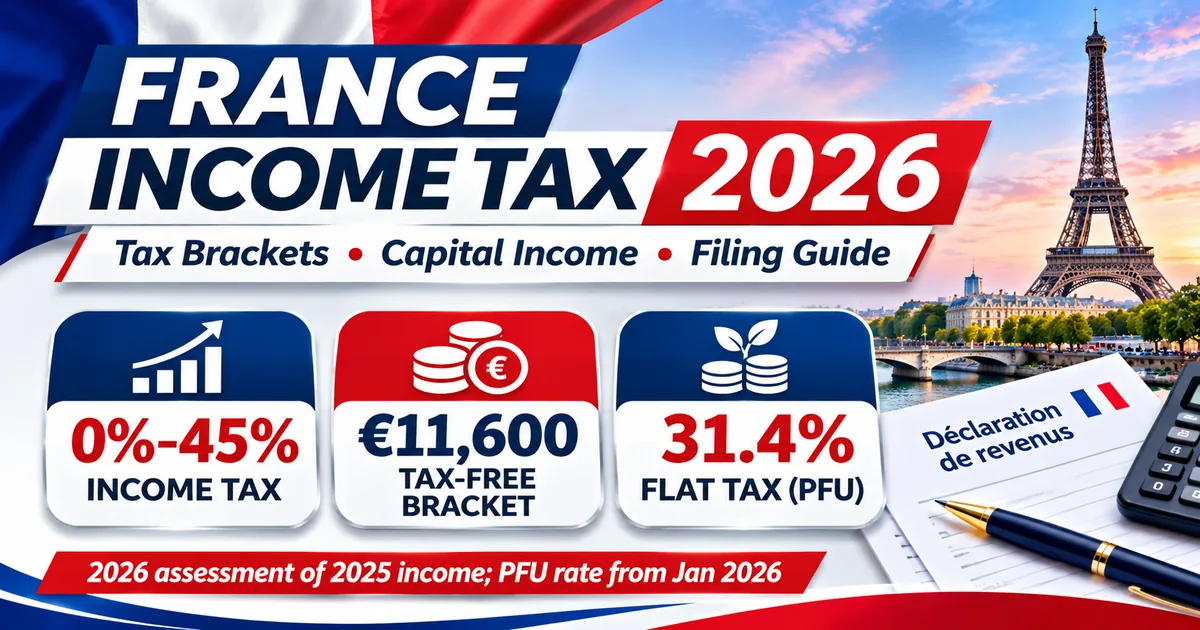
The revised income tax scale begins at 0% on the first €11,600 of taxable income per household share and progressively increases to a maximum ordinary marginal rate of 45%.
Another important development concerns capital income.
From January 1, 2026, the standard French flat tax on qualifying dividends, interest and other relevant investment income increased from 30% to 31.4%.
The new rate consists of 12.8% income tax and 18.6% social contributions.
However, France's income tax system contains important distinctions between employment income, investment income, rental income, business profits and capital gains.
This guide explains the new tax brackets, the higher flat tax, the family quotient system, withholding tax, non-resident rules, filing deadlines and tax considerations for expatriates.
1. What Are France's Income Tax Brackets for 2026?
France applies progressive personal income tax rates.
The 2026 tax assessment schedule, applicable to income received during 2025, contains five brackets.
Official France Income Tax Brackets — 2026 Assessment
| Taxable Income Per Household Share | Tax Rate |
|---|---|
| Up to €11,600 | 0% |
| Above €11,600 to €29,579 | 11% |
| Above €29,579 to €84,577 | 30% |
| Above €84,577 to €181,917 | 41% |
| Above €181,917 | 45% |
These rates apply progressively.
A person whose taxable income falls within the 30% marginal bracket does not pay 30% tax on their entire income.
Only the portion falling within that bracket is taxed at 30%.
The brackets apply after taking into account the relevant household tax-share calculation and eligible adjustments.
2. What Changed in France's Income Tax Rules for 2026?
The Finance Act for 2026 increased the progressive income tax band thresholds by 0.9%.
This adjustment was intended to reduce the effect of inflation pushing taxpayers into higher marginal brackets.
Main Changes
- The zero-rate bracket now extends to €11,600 per household share.
- The 11% bracket extends to €29,579.
- The 30% bracket extends to €84,577.
- The 41% bracket extends to €181,917.
- The highest ordinary marginal rate remains 45%.
- The standard PFU on relevant capital income increased to 31.4% from January 1, 2026.
The progressive income tax changes and capital-income flat-tax changes have different effective periods.
The new progressive brackets concern the 2026 assessment of 2025 income.
The increased PFU concerns relevant income from 2026, subject to the specific rules for each investment.
3. What Is the €11,600 Tax-Free Bracket?
France's first personal income tax bracket is taxed at 0%.
For the 2026 assessment, the zero-rate bracket extends to €11,600 of taxable income per household share.
Example
A single taxpayer with one household share has €10,000 of taxable income.
The amount falls within the zero-rate bracket.
Ordinary income tax before other considerations: €0.
However, the zero-rate threshold is not the same as a universal gross salary exemption.
Gross wages, taxable income, deductions, household structure and other reliefs can change the calculation.
A person may also have social insurance or other obligations despite owing no ordinary income tax.
4. How Does Progressive Income Tax Work in France?
France calculates income tax using successive marginal tax brackets.
For example, a single individual with €40,000 of taxable income generally has:
- The first €11,600 taxed at 0%.
- The next €17,979 taxed at 11%.
- The remaining €10,421 taxed at 30%.
The entire €40,000 is not taxed at 30%.
This system distinguishes between the marginal tax rate and the average effective tax rate.
Marginal tax rate: The rate applying to the highest relevant portion of income.
Average income tax rate: Total calculated income tax divided by the relevant taxable income.
5. France Income Tax Calculation on €30,000
Assume a single taxpayer has:
- One household tax share.
- €30,000 of net taxable income.
- No additional tax credits or reductions.
Calculation
| Income Portion | Rate | Tax |
|---|---|---|
| First €11,600 | 0% | €0 |
| Next €17,979 | 11% | €1,977.69 |
| Remaining €421 | 30% | €126.30 |
| Total Gross Income Tax | €2,103.99 |
Illustrative gross income tax: €2,103.99.
This is the progressive calculation before any applicable décote, reductions, tax credits or other adjustments.
The final income tax assessed can therefore be lower.
6. France Income Tax Calculation on €50,000
Assume a single taxpayer has €50,000 of net taxable income and one tax share.
First €11,600:
€0.
Next €17,979 at 11%:
€1,977.69.
Remaining €20,421 at 30%:
€6,126.30.
Total:
€8,103.99.
This is the illustrative gross progressive income tax before other applicable adjustments.
The marginal rate is 30%, but the gross effective rate on €50,000 is approximately 16.21%.
7. France Income Tax Calculation on €100,000
Assume a single taxpayer has €100,000 of net taxable income.
| Income Portion | Rate | Tax |
|---|---|---|
| First €11,600 | 0% | €0 |
| Next €17,979 | 11% | €1,977.69 |
| Next €54,998 | 30% | €16,499.40 |
| Remaining €15,423 | 41% | €6,323.43 |
| Total Gross Income Tax | €24,800.52 |
Illustrative gross progressive tax: €24,800.52.
The taxpayer's highest marginal income tax rate is 41%.
However, the effective rate on the illustrated taxable income is approximately 24.80%.
Actual assessed tax may differ after relevant adjustments.
8. What Is the Family Quotient in France?
France uses a family-based income tax calculation known as the quotient familial.
It divides a tax household's taxable income into a number of tax shares, called parts.
The number of shares depends on the household's composition and qualifying dependants.
General Examples
| Household | Typical Tax Shares |
|---|---|
| Single individual without dependants | 1 |
| Married or PACS couple under joint taxation | 2 |
| Married couple with one qualifying child | 2.5 |
| Married couple with two qualifying children | 3 |
Special custody, disability and family circumstances can affect the calculation.
How It Works
The household's taxable income is divided by the number of shares.
The progressive tax schedule is applied to the resulting amount.
The calculated tax is then multiplied by the number of shares.
Tax savings from additional dependent-related shares can be subject to statutory limits.
9. What Is the 31.4% Flat Tax on Capital Income?
The French flat tax is known as the Prélèvement Forfaitaire Unique (PFU).
It generally applies to qualifying savings and investment income.
Before 2026, the standard combined rate was 30%.
From January 1, 2026, the standard combined rate increased to 31.4%.
PFU Rate Breakdown
| Component | 2025 | 2026 |
|---|---|---|
| Income Tax Component | 12.8% | 12.8% |
| Social Contributions | 17.2% | 18.6% |
| Total Standard PFU | 30% | 31.4% |
The increase arose from changes to the relevant social contribution rates.
The ordinary income tax component remains 12.8%.
Important: The 31.4% rate is not a universal tax on every type of capital income. Certain savings products and investments have special rules.
10. Which Investments Are Generally Subject to PFU?
Depending on their legal classification, relevant investments can include:
- Ordinary bank interest.
- Taxable dividends.
- Bond interest.
- Certain securities gains.
- Certain other investment returns.
However, important exclusions and different rules can apply.
For example:
- Certain regulated savings accounts can be tax-exempt.
- Life insurance may receive special treatment.
- Real estate capital gains follow separate rules.
- Some long-term investment plans have specific exemptions.
- Non-resident investors can face different withholding and social contribution treatment.
Investors should establish the applicable tax regime before applying 31.4%.
11. Example: Flat Tax on €10,000 of Investment Income
Assume an investor receives €10,000 of income fully subject to the standard 31.4% PFU in 2026.
Income tax component:
€10,000 × 12.8% = €1,280.
Social contributions:
€10,000 × 18.6% = €1,860.
Total standard PFU:
€3,140.
Net amount after the illustrated tax:
€6,860.
Comparison With the Former 30% Rate
| Calculation | Amount |
|---|---|
| Tax at 30% | €3,000 |
| Tax at 31.4% | €3,140 |
| Additional Tax | €140 |
The additional charge on €10,000 of fully affected income is €140.
This illustration excludes special exemptions, credits and taxpayer-specific provisions.
12. Can Investors Choose Progressive Income Tax Instead?
Yes.
Under applicable conditions, an individual can opt to have relevant investment income taxed using the progressive personal income tax schedule instead of the 12.8% flat income tax component.
This choice is commonly made through the relevant income tax return election.
When Might Progressive Tax Be Better?
It can be advantageous for some taxpayers whose marginal income tax rate is 0% or 11%.
Depending on the investment and eligibility conditions, benefits may include:
- A 40% dividend allowance for qualifying dividends.
- Certain deductible costs.
- Partial deductibility of qualifying CSG.
- Application of the taxpayer's progressive income tax rates.
Important
The election generally applies to all income and gains within the relevant scope, rather than allowing arbitrary transaction-by-transaction selection.
Taxpayers should compare both methods before making an election.
13. Are All Dividends Taxed at 31.4%?
No.
The standard PFU can apply to ordinary taxable dividends received by an eligible resident taxpayer.
However, not every dividend receives identical treatment.
Factors include:
- Whether the dividend qualifies for the relevant regime.
- Whether a progressive tax election is made.
- The shareholder's tax residence.
- Applicable treaty provisions.
- Corporate or personal ownership.
- Exemptions and specific tax rules.
Foreign dividends may also involve foreign withholding tax and double taxation relief.
14. Does the 31.4% Rate Apply to Life Insurance?
Not necessarily.
France provides special rules for certain life insurance investment returns.
The applicable treatment can depend on:
- Contract date.
- Premium payment date.
- Contract duration.
- Amount invested.
- Nature of the withdrawal.
- Relevant allowances.
Official 2026 guidance continues to show specific social contribution treatment for qualifying life insurance income, which can differ from the general 18.6% rate.
Therefore, it would be incorrect to apply the new 31.4% PFU automatically to every life insurance gain.
15. Is Real Estate Capital Gains Tax Also 31.4%?
Not generally.
Gains from the disposal of French real estate are subject to a separate legal regime.
The result can depend on:
- Whether the property qualifies as the principal residence.
- Ownership duration.
- Purchase and sale values.
- Eligible acquisition or improvement costs.
- Available exemptions.
- Applicable social contributions.
- Additional taxes on certain large gains.
Principal residence exemptions can be significant.
Do not use the standard securities PFU formula for every property sale.
16. How Are Salaries Taxed in France?
Employment income generally forms part of the household's progressive personal income tax calculation.
However, gross salary and taxable salary are not the same.
Employee social contributions and applicable deductions can affect the taxable amount.
France also generally provides a 10% professional expense deduction for qualifying employment income, subject to minimum and maximum limits.
Some employees may choose to claim qualifying actual professional expenses instead, where the law permits.
Example
A person earns €45,000 in gross annual salary.
It would be incorrect to assume that the full €45,000 must automatically be inserted into the progressive table without adjustments.
The taxpayer must determine the correct net taxable employment amount.
17. What Is Withholding at Source in France?
France operates a withholding system known as prélèvement à la source.
Employers generally deduct relevant income tax from salaries using the withholding rate communicated under the applicable tax administration process.
For some self-employed and rental income, tax instalments may be collected through a separate mechanism.
Important
Withholding at source is generally a method of paying income tax.
It does not replace the annual income tax declaration or assessment process.
The final annual calculation can produce:
- A tax refund.
- No additional balance.
- Additional tax to pay.
18. France Income Tax for Married Couples and Families
France generally uses joint taxation for eligible married couples and PACS partners, subject to certain exceptions.
The household tax shares can reduce progressive tax exposure compared with taxing all household income as if it belonged to one single individual.
However, the family quotient benefit is subject to statutory limits.
Child-related credits, childcare costs, and other family deductions or reliefs may also be relevant.
The tax advantages depend on the household's circumstances.
19. Do Foreign Workers Pay French Income Tax?
Yes, where the applicable French tax rules establish a tax liability.
The result depends on whether the person is a French tax resident and the source of the income.
France generally taxes resident individuals on worldwide income, subject to domestic rules and tax treaties.
Non-residents generally pay French tax on relevant French-source income where France has taxing rights.
Important factors can include:
- Permanent home.
- Main place of stay.
- Principal professional activity.
- Centre of economic interests.
- Tax treaty residence.
- Location where employment duties are performed.
Holding a French visa does not automatically determine the final income tax treatment.
20. France Income Tax for Non-Residents
Non-residents can be subject to special minimum income tax rules on relevant French-source income.
For the 2026 assessment of 2025 income, the ordinary minimum-rate framework generally provides:
| Relevant French-Source Taxable Income | Minimum Rate |
|---|---|
| Up to €29,579 | 20% |
| Above €29,579 | 30% on the relevant portion |
Special lower rates can apply to qualifying income from certain French overseas departments.
A taxpayer may also be able to request the application of a lower average tax rate calculated by reference to worldwide income, where statutory conditions are met.
Tax treaties and other rules can modify the result.
These non-resident minimum rates must not be confused with the resident progressive tax brackets.
21. France Income Tax for Freelancers
Freelancers, consultants and independent professionals may pay tax on relevant business or professional income.
Income classification matters.
Possible categories include:
- Bénéfices Non Commerciaux (BNC).
- Bénéfices Industriels et Commerciaux (BIC).
- Other relevant income categories.
A freelancer's taxable profit may differ from gross receipts.
Under applicable business tax rules, eligible expenses or statutory allowances can affect the calculation.
Social contributions are also separate from ordinary personal income tax.
22. What Is the Micro-Entrepreneur Tax Regime?
France provides simplified arrangements for qualifying small businesses and self-employed individuals.
For 2026–2028, the relevant micro-enterprise turnover thresholds generally include:
| Activity | Turnover Threshold |
|---|---|
| Qualifying goods sales and similar activities | €203,100 |
| Qualifying services and professional activities | €83,600 |
Other activities can have different limits.
For example, certain non-classified furnished tourist accommodation activities have a separate threshold.
These limits concern eligibility for the relevant simplified tax regime and must not be confused with a universal tax-free income allowance.
VAT thresholds are a separate matter.
23. Does France Tax Foreign Income?
French tax residents generally have worldwide income reporting responsibilities, subject to treaty relief and statutory exemptions.
Relevant foreign income can include:
- Foreign employment salary.
- Overseas rental income.
- Foreign bank interest.
- Dividends from overseas companies.
- Business income.
- Relevant capital gains.
Foreign assets and financial accounts may also create separate reporting obligations.
The applicable tax treaty can help address double taxation.
24. French Tax Rules for Pakistani Residents and Expats
Pakistani nationals living and working in France should determine their French tax residency and income classification.
For example, a Pakistani software engineer living in Paris may have:
- French employment income.
- Rental income from Pakistan.
- Foreign savings or investment income.
- Other overseas receipts.
If the person qualifies as French tax resident, foreign income may need to be declared under the relevant rules.
Tax relief may be available under domestic law or applicable treaty arrangements.
Pakistani citizenship alone does not determine French tax residency.
Similarly, moving abroad does not automatically resolve any continuing Pakistani tax obligations.
25. France Income Tax Filing Deadlines in 2026
France's 2026 income tax filing campaign concerned income earned in 2025.
The official online filing deadlines were:
| Taxpayer Location | Online Deadline |
|---|---|
| Departments 01–19 and qualifying non-residents | May 21, 2026 |
| Departments 20–54 | May 28, 2026 |
| Departments 55–974 and 976 | June 4, 2026 |
| General paper filing deadline | May 19, 2026 |
Special deadlines applied to some territories and circumstances.
Filing Income Earned in 2026
Income earned during calendar year 2026 will generally be declared in 2027.
The official 2027 return deadlines should be confirmed once published by the French tax administration.
Do not automatically reuse the 2026 dates for the 2027 filing campaign.
26. How to File a French Income Tax Return Online
Step 1: Visit the Official Website
Open:
Step 2: Access Your Personal Tax Account
Sign in using the relevant tax identification and authentication details.
Step 3: Select the Annual Declaration
Open the income tax declaration service for the appropriate year.
Step 4: Verify Personal Details
Check residence, marital status, household composition and dependent information.
Step 5: Review Pre-Filled Income
Confirm salary, pensions and other information already provided to the tax administration.
Step 6: Add Missing Income
Declare relevant additional income, including business, rental and foreign income.
Step 7: Review Investment Income
Check interest, dividends and any relevant PFU or progressive tax election.
Step 8: Claim Eligible Deductions
Enter applicable expenses, allowances and tax credits.
Step 9: Review Foreign Tax Relief
Determine whether any double taxation treaty or foreign tax credit applies.
Step 10: Submit the Declaration
Review all entries and submit electronically.
Step 11: Save the Acknowledgment
Retain your filing confirmation and final tax assessment notice.
27. Documents Needed for French Tax Filing
Depending on individual circumstances, relevant documents can include:
- French tax identification number.
- Salary certificates.
- Employer withholding records.
- Pension statements.
- Bank interest certificates.
- Dividend statements.
- Investment gain and loss calculations.
- Rental property income records.
- Freelance business records.
- Qualifying work expense receipts.
- Family and dependent information.
- Foreign bank and income statements.
- Foreign tax payment documents.
- Relevant tax residency certificates.
Taxpayers should also retain documentation supporting any special exemptions or elections.
28. Common France Income Tax Mistakes to Avoid
- Applying the 2026 progressive table to 2026 income without confirming the 2027 assessment schedule.
- Assuming everyone pays a flat 45% rate.
- Confusing gross salary with taxable income.
- Ignoring the family quotient.
- Assuming the €11,600 zero-rate bracket is a universal salary exemption.
- Using the old 30% PFU where 31.4% applies.
- Assuming all savings products are subject to 31.4%.
- Applying securities flat-tax rules to every property sale.
- Forgetting qualifying foreign investment income.
- Applying resident brackets to non-residents without checking special rules.
- Ignoring the annual declaration after payroll withholding.
- Assuming micro-entrepreneur turnover thresholds are tax-free allowances.
- Claiming unsupported deductions.
- Missing foreign account reporting obligations.
- Confusing income tax with social contributions.
- Using expired filing deadlines.
29. France Income Tax 2026 Checklist
Before preparing a return or calculating tax:
- Confirm the income year and assessment year.
- Determine French tax residency.
- Use the correct progressive brackets.
- Check the number of family quotient shares.
- Calculate net taxable salary.
- Review any professional expense deduction.
- Identify taxable rental income.
- Identify interest and dividends.
- Apply the correct PFU rate where relevant.
- Review special savings product rules.
- Compare progressive taxation and PFU where permitted.
- Review business or freelance income.
- Check social contribution obligations.
- Declare relevant foreign income.
- Review double taxation treaty relief.
- Claim eligible tax credits.
- Confirm the current filing deadline.
- Submit the annual declaration.
- Save the filing acknowledgment.
30. Watch Tax With Naeem — Related Income Tax Education
For general educational guidance on salary income, rental income, capital gains, dividends and income tax return filing, watch the following related tutorial from Tax With Naeem.
Related Video: Income Tax Return Filing in Pakistan — Salary, Rental Income, Capital Gains and Dividends Explained
https://www.youtube.com/watch?v=VX88o1N1AfA
This is a Pakistan income tax educational video, not a French tax filing tutorial.
It is included as supplementary education concerning income classification and tax return preparation.
For French income tax calculations and filing, readers should rely on official French tax administration guidance.
31. Official French Tax Sources and References
1. French Public Service — Income Tax Brackets 2026
https://www.service-public.gouv.fr/particuliers/vosdroits/F1419
2. French Ministry of Economy — Finance Act 2026 Changes
3. French Ministry of Economy — PFU Flat Tax Rules
4. French Public Service — New PFU Rate
https://entreprendre.service-public.gouv.fr/actualites/A18796
5. French Public Service — Social Contributions
https://www.service-public.gouv.fr/particuliers/vosdroits/F2329
6. French Tax Administration — Official Portal
7. French Public Service — Tax Return Filing
https://www.service-public.gouv.fr/particuliers/vosdroits/F358
8. French Tax Administration — Non-Resident Rules
https://www.impots.gouv.fr/international-particulier/dois-je-declarer-mes-revenus-en-france
9. French Tax Administration — Micro-Entrepreneur Rules
10. AsaanTax.pk — International Taxation
11. Tax With Naeem — Related Tutorial
https://www.youtube.com/watch?v=VX88o1N1AfA
32. Conclusion: What Are France's Income Tax Rates in 2026?
France continues to operate a progressive personal income tax system, with marginal rates ranging from 0% to 45%.
The 2026 assessment schedule, applicable to income earned in 2025, begins with a 0% rate on the first €11,600 of taxable income per household share.
The following marginal rates are 11%, 30%, 41% and 45%.
A separate major change occurred on January 1, 2026, when the standard flat tax on qualifying capital income increased from 30% to 31.4%.
The new PFU combines 12.8% income tax and 18.6% social contributions.
However, some investments, including certain life insurance products, have different tax treatment.
For employees, freelancers, investors and expatriates, accurate French tax calculations require an understanding of tax residency, income categories, family quotient rules, eligible deductions and filing obligations.
The most important distinction is between progressive personal income tax and the separate flat-tax framework for qualifying investment income.
For more international tax guides covering France, Germany, Spain, Ireland, the UK, USA, UAE and Pakistan, visit:
AsaanTax.pk: https://www.asaantax.pk/
Editorial Note: This guide reflects official French government and tax administration information available as of November 12, 2026. The 2026 progressive assessment rates relate to 2025 income, while the updated standard PFU applies from January 2026 under the relevant provisions.
Disclaimer: This article is intended for general educational purposes and does not constitute personalized French tax, investment or legal advice. Actual tax liabilities depend on residence, household composition, income source, eligible allowances, applicable social contributions and treaty rules. Readers should consult the French tax administration or a qualified professional for individual circumstances.