Pakistan's freelance economy continues to grow as professionals earn income through international clients, online platforms and remote work. If you earn money through Fiverr, Upwork, Freelancer.com, software development, graphic design, digital marketing or other online services, understanding your income tax obligations is essential.
Under the Finance Act 2026, Pakistan has retained concessional withholding tax treatment for eligible IT and IT-enabled services exports, with the 0.25% rate extended through Tax Year 2029.
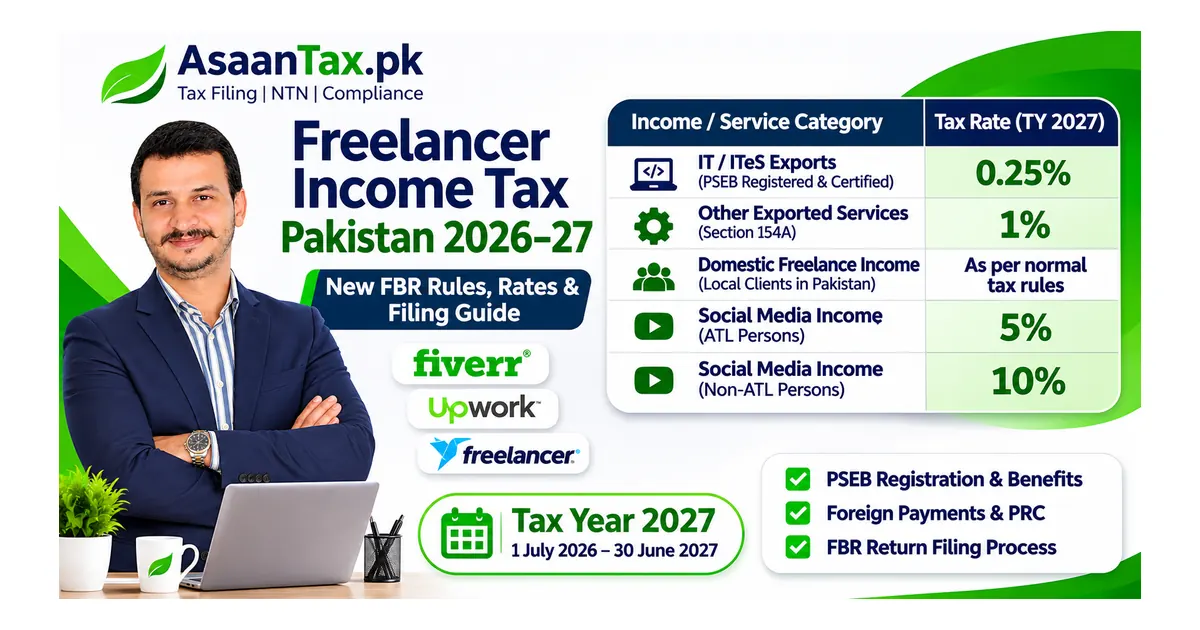
For Tax Year 2027 (July 1, 2026 to June 30, 2027), qualifying PSEB-registered IT exporters may benefit from a 0.25% tax deduction on export proceeds, while other qualifying services exported under Section 154A generally attract a 1% deduction.
However, every freelancer does not automatically qualify for these reduced rates. Your actual tax treatment depends on the services provided, PSEB registration, foreign remittance documentation, filing compliance and other statutory conditions.
In this comprehensive guide, AsaanTax.pk explains the latest freelancer tax rates, PSEB registration benefits, foreign payment rules, FBR IRIS filing procedures, required documents and important considerations for Tax Year 2027.
Latest Freelancer Income Tax Rates in Pakistan 2026–27
The tax treatment of freelance income depends on the nature of the services and the source of payment.
| Income or Service Category | Tax Treatment for TY 2027 |
|---|---|
| Qualifying IT and IT-enabled services exports by PSEB-registered and duly certified exporters | 0.25% withholding on qualifying export proceeds |
| Other qualifying exported services under Section 154A | 1% withholding on qualifying export proceeds |
| Freelance services provided to Pakistani clients | Applicable domestic business income and withholding provisions |
| Revenue received from social media platforms by persons on ATL | 5% withholding under Section 154B, where applicable |
| Revenue received from social media platforms by non-ATL persons | 10% withholding under Section 154B, where applicable |
Applicable period: July 1, 2026 to June 30, 2027.
Important: A withholding tax rate is not necessarily the taxpayer's final overall income tax liability. The treatment depends on the relevant statutory provisions.
What Is the 0.25% Freelancer Tax in Pakistan?
Section 154A of the Income Tax Ordinance, 2001 provides special treatment for eligible receipts from exports of computer software, IT services and IT-enabled services.
Under the applicable provisions, exporters registered with and duly certified by the Pakistan Software Export Board (PSEB) may qualify for a concessional deduction of 0.25% on eligible export proceeds.
The Finance Act 2026 extended this concessional rate through Tax Year 2029.
Example: Freelancer Earning Rs. 1 Million From IT Exports
Assume a software developer receives Rs. 1,000,000 in qualifying IT export proceeds during the tax year.
If the freelancer meets the requirements for the 0.25% rate:
Tax deduction = Rs. 1,000,000 × 0.25%
Tax deducted = Rs. 2,500
This is an illustration of the export withholding tax. The taxpayer must still meet applicable filing and other legal requirements.
What Is the 1% Tax on Freelance Export Income?
Section 154A also provides for a 1% withholding tax on other qualifying export-of-services receipts.
This can be relevant where a service export falls within Section 154A but does not qualify for the concessional PSEB-registered IT export rate.
Example: Freelancer Receiving Rs. 1 Million
Assume a freelancer earns Rs. 1,000,000 from qualifying exported services subject to the 1% rate.
Tax deduction = Rs. 1,000,000 × 1%
Tax deducted = Rs. 10,000
The difference between 0.25% and 1% on Rs. 1 million is Rs. 7,500.
However, the 1% rate should not be assumed to apply to all foreign payments. The transaction must actually qualify under Section 154A.
Freelancer Tax Calculation Table — 0.25% vs 1%
The following examples compare withholding tax on qualifying export proceeds.
| Annual Export Receipts | 0.25% Tax | 1% Tax |
|---|---|---|
| Rs. 500,000 | Rs. 1,250 | Rs. 5,000 |
| Rs. 1,000,000 | Rs. 2,500 | Rs. 10,000 |
| Rs. 1,500,000 | Rs. 3,750 | Rs. 15,000 |
| Rs. 2,000,000 | Rs. 5,000 | Rs. 20,000 |
| Rs. 3,000,000 | Rs. 7,500 | Rs. 30,000 |
| Rs. 5,000,000 | Rs. 12,500 | Rs. 50,000 |
| Rs. 10,000,000 | Rs. 25,000 | Rs. 100,000 |
| Rs. 20,000,000 | Rs. 50,000 | Rs. 200,000 |
These calculations assume that the entire amount qualifies as export proceeds under Section 154A and that the relevant rate applies.
They do not include bank charges, other taxes, additional income or liabilities arising from non-compliance.
Does Every Fiverr and Upwork Freelancer Qualify for 0.25% Tax?
No.
Fiverr and Upwork are online platforms connecting freelancers with clients. Simply receiving payments through these platforms does not automatically establish eligibility for the 0.25% rate.
A freelancer's services and registration status must satisfy the legal requirements.
For example, the following activities may fall within IT or IT-enabled services, depending on their actual nature and applicable definitions:
- Software development and programming.
- Website and application development.
- Graphic design and certain digital design services.
- Data processing and data entry.
- IT support and technical services.
- Digital marketing and related IT-enabled activities.
- Certain accounting, HR or business process outsourcing services.
The precise classification must be assessed under the definitions in the Income Tax Ordinance and relevant PSEB requirements.
A freelancer providing a service that does not qualify as an IT or IT-enabled export should not automatically use the 0.25% rate.
Is PSEB Registration Mandatory for Freelancers?
PSEB registration is particularly important for freelancers seeking the concessional 0.25% rate on qualifying IT and IT-enabled services exports.
Under Section 154A, the relevant category refers to exporters registered with and duly certified by PSEB.
Therefore, a freelancer wishing to use the concessional rate should verify that the necessary registration and certification requirements are satisfied.
PSEB registration is not automatically a universal legal requirement for every freelancer in Pakistan.
Why Is PSEB Registration Important?
Depending on eligibility and the services provided, PSEB registration can help establish the freelancer's IT export status and support access to the applicable concessional tax framework.
It may also help with documentation required by banks and relevant authorities.
Taxpayers should verify the current PSEB application process, eligibility criteria and required supporting documents before applying.
How Is Foreign Freelance Income Taxed in Pakistan?
Foreign clients may pay Pakistani freelancers through direct bank transfers, international payment platforms or other authorized channels.
Examples include payments received from clients in:
- United States.
- United Kingdom.
- United Arab Emirates.
- Saudi Arabia.
- Canada.
- Australia.
- European countries.
The country from which the payment originates does not, by itself, determine the applicable income tax rate.
The important considerations include the nature of services, the legal classification of receipts, the taxpayer's tax residence and the applicable requirements for export-of-services taxation.
Where income qualifies under Section 154A, the authorized foreign exchange dealer may deduct tax on the proceeds at the applicable rate.
Freelancers should maintain proper records to demonstrate that the income arose from qualifying services provided to overseas clients.
What Is a PRC and Why Is It Important for Freelancers?
A Proceeds Realization Certificate (PRC) or equivalent bank-issued remittance documentation can help establish the amount and nature of foreign funds received.
Banks may also classify transactions using relevant purpose codes.
Freelancers should retain:
- Foreign remittance certificates or equivalent supporting documentation.
- Bank statements.
- Client invoices.
- Contracts or work agreements.
- Platform earnings statements.
- Payment transaction records.
- Tax deduction certificates, where available.
These records may help support claims relating to exported services, the applicable withholding tax rate and the preparation of an accurate income tax return.
A bank transfer or PRC alone does not automatically establish eligibility for the 0.25% tax rate.
Is Freelancer Export Tax Final or Adjustable?
Section 154A contains provisions under which tax deducted on eligible export-of-services receipts may be treated as final tax, subject to specific legal conditions.
Among the relevant matters are return filing, required statements, registration or tax documentation obligations, and applicable sales tax compliance.
The Ordinance also provides mechanisms relating to the taxpayer's tax treatment under Section 154A.
Therefore, freelancers should not assume that a 0.25% or 1% bank deduction automatically completes every tax obligation.
If the necessary conditions are not met, the relevant income may be subject to a different tax treatment.
What If a Freelancer Works for Pakistani Clients?
Income earned from services supplied to clients within Pakistan is not automatically treated as an export of services.
For example, consider a web developer who designs a website for a Pakistani business and receives payment from a local company.
That income may fall under ordinary business income rules, with applicable withholding tax and other obligations depending on the transaction.
The 0.25% export rate cannot simply be applied because the person works online or describes themselves as a freelancer.
Domestic Freelance Income
Domestic freelance income may be subject to:
- The applicable income tax rules for individuals or businesses.
- Relevant withholding tax provisions.
- Business expense documentation requirements.
- Sales tax on services obligations, where applicable.
- Income tax return and wealth statement filing requirements.
The final calculation depends on taxable profit, legal classification, applicable rates and any eligible adjustments.
Can a Freelancer Have Both Local and Foreign Income?
Yes.
A freelancer may earn income from several sources during the same tax year.
For example:
- Rs. 1,500,000 from overseas software clients.
- Rs. 600,000 from Pakistani website development clients.
- Rs. 200,000 from another business activity.
These receipts should not automatically be combined and taxed entirely at 0.25%.
The freelancer must identify the correct tax treatment for each income stream.
Qualifying exported services may fall under Section 154A, while domestic income may be taxed under the applicable business income rules.
Appropriate classification is essential when completing the FBR income tax return.
New Tax Rules for YouTubers and Social Media Creators in 2026–27
The Finance Act 2026 introduced Section 154B, covering withholding tax on certain revenues received from social media platforms.
This can affect persons earning money from platforms such as:
- YouTube.
- Facebook.
- Instagram.
- TikTok.
- Similar digital content monetization platforms.
For Tax Year 2027, the relevant withholding tax treatment includes:
| Social Media Income Category | Withholding Rate |
|---|---|
| Person appearing on ATL | 5% |
| Person not appearing on ATL | 10% |
Section 154B distinguishes between the nature of tax for residents and certain non-residents.
For resident taxpayers, the relevant withholding is treated as minimum tax under the statutory provision.
For qualifying non-residents without a permanent establishment in Pakistan, different final-tax rules may apply.
Example: YouTube Revenue of Rs. 500,000
If Section 154B applies:
At 5%, the withholding would be Rs. 25,000.
At 10%, the withholding would be Rs. 50,000.
This example illustrates withholding rather than the taxpayer's complete final annual tax position.
Important: Paid services provided to a foreign client through an online platform are not automatically the same as revenue earned from social media content monetization.
Freelancers and content creators must identify the correct legal category before applying a rate.
Do Freelancers Need an NTN in Pakistan?
A freelancer who is required to register for income tax should obtain or maintain the applicable FBR registration.
For individuals, the CNIC generally serves as the identification number associated with their income tax registration.
Having an NTN or being registered with FBR does not, by itself, mean that every annual income tax return has been submitted.
Registration, return filing and ATL status are separate compliance matters.
Do Freelancers Have to File an Income Tax Return for Tax Year 2027?
Freelancers who meet the applicable statutory filing requirements must submit an income tax return.
Even if withholding tax has already been deducted from export receipts, return filing m