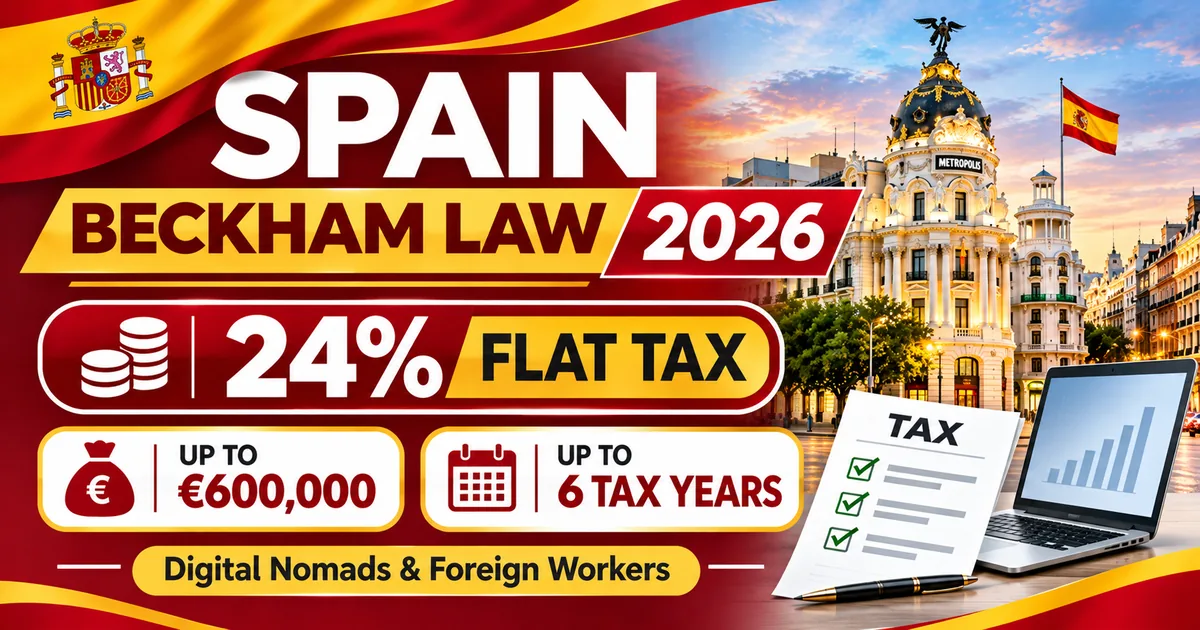
Spain Beckham Law 2026: 24% Flat Tax for Digital Nomads and Foreign Workers
Published: November 11, 2026
Country: Spain
Tax Year: January 1 – December 31, 2026
Tax Authority: Agencia Estatal de Administración Tributaria (AEAT)
Legal Basis: Article 93 of Spain's Personal Income Tax Law (Law 35/2006), as amended
Special Tax Rate: 24% up to €600,000; 47% on the excess
Spain is an increasingly popular destination for international professionals, remote employees, technology specialists, entrepreneurs and foreign workers.
Cities such as Madrid, Barcelona, Valencia and Málaga attract people seeking employment opportunities, business connections and the ability to work remotely.
However, Spain's ordinary personal income tax system can impose comparatively high progressive rates on individuals with substantial earnings.
The Spain Beckham Law, formally known as the special tax regime for workers and certain other qualifying individuals relocating to Spain, offers an alternative.
For eligible taxpayers, the regime generally applies a 24% rate to qualifying employment and other relevant general-base income up to €600,000 annually, with a 47% marginal rate on the excess.
The regime can apply for the tax year in which Spanish tax residence is acquired and the following five tax years.
Since reforms introduced under Spain's Startup Law, eligibility has expanded to include certain international remote employees, entrepreneurs and highly qualified professionals.
However, a digital nomad visa does not automatically guarantee eligibility, and ordinary self-employed freelancers do not necessarily qualify.
This guide explains the Beckham Law tax rates, digital nomad eligibility, five-year non-residence requirement, foreign income treatment, application deadlines, tax calculations and annual filing obligations for 2026.
1. What Is the Spain Beckham Law?
The Beckham Law is a special Spanish tax regime under Article 93 of the Personal Income Tax Law.
It allows eligible individuals who become Spanish tax residents after relocating for specified qualifying reasons to use special taxation rules broadly based on Spain's Non-Resident Income Tax framework.
The taxpayer remains a Spanish Personal Income Tax taxpayer but calculates relevant tax under the special regime.
The name comes from the regime's association with international footballer David Beckham, although the law itself is not limited to sportspeople.
In fact, certain professional athletes are excluded under the current statutory rules.
Beckham Law 2026 — Main Features
| Requirement | Rule |
|---|---|
| General special rate | 24% |
| Annual general-base threshold | €600,000 |
| Rate above €600,000 | 47% |
| Maximum duration | Six tax years |
| Previous Spanish non-residence | Five preceding tax years |
| Application form | Modelo 149 |
| Annual tax return | Modelo 151 |
| General application deadline | Six months from the relevant qualifying activity start date |
| Digital nomads | Certain qualifying remote employees |
| Family members | May qualify under separate conditions |
The regime does not automatically apply to every foreign national living in Spain.
2. What Are the Beckham Law Tax Rates in 2026?
Under the special regime, the ordinary rate schedule for relevant general-base income is:
| Relevant Taxable Income | Tax Rate |
|---|---|
| Up to €600,000 | 24% |
| Above €600,000 | 47% on the excess |
The higher rate applies only to the income portion above €600,000.
Example: €100,000 Annual Salary
Assume a qualifying employee has €100,000 of taxable employment income and no relevant adjustments.
Tax:
€100,000 × 24% = €24,000.
Illustrative annual income tax: €24,000.
This does not include any separate social security contributions or other applicable obligations.
Example: €700,000 Annual Salary
First €600,000 at 24%:
€144,000.
Remaining €100,000 at 47%:
€47,000.
Illustrative total tax: €191,000.
The entire €700,000 is not taxed at 47%.
3. Who Qualifies for the Spain Beckham Law?
The law establishes several eligibility requirements.
A qualifying applicant generally must:
- Become a Spanish tax resident because of a qualifying relocation.
- Not have been a Spanish tax resident during the five preceding tax years.
- Move for one of the permitted employment, remote-work, entrepreneurial or professional reasons.
- Meet the relevant conditions concerning business activities and permanent establishments.
- Submit the required election on time.
- Continue satisfying the applicable conditions.
The applicable requirements depend on the reason for relocation.
Examples of Potentially Eligible Applicants
- Foreign employees hired by Spanish companies.
- Employees relocated to Spain by an overseas employer.
- Certain international remote employees.
- Qualifying company directors.
- Qualifying entrepreneurs.
- Certain highly qualified professionals.
- Certain individuals carrying out qualifying research, development or innovation activities.
Being a foreign national or holding a residence permit does not automatically establish eligibility.
4. What Is the Five-Year Non-Residence Requirement?
A person generally must not have been tax resident in Spain during the five tax years preceding the year of relocation.
This requirement was reduced from ten years to five years under the Startup Law reforms applicable from 2023.
Example
A professional becomes a Spanish tax resident in 2026.
The five preceding years are:
If the professional was not Spanish tax resident in these five years and meets the other requirements, the previous residence condition may be satisfied.
However, maintaining a foreign address or passport does not by itself establish non-residence.
Spanish residence must be determined under the applicable domestic law and, where relevant, tax treaty provisions.
5. Can Digital Nomads Use the Beckham Law?
Yes, some digital nomads can qualify.
Spain expanded the special regime to include employees who relocate to Spain and perform their employment duties remotely using information and telecommunications technology.
This can include certain employees working from Spain for an employer established outside Spain.
The legislation specifically recognizes qualifying international teleworkers.
Example
A Pakistani IT professional works as an employee for an international company.
The employer authorizes the professional to relocate to Spain and perform employment duties remotely.
If the professional acquires Spanish tax residence, satisfies the five-year non-residence requirement, qualifies under the employment conditions and submits Modelo 149 on time, the special regime may be available.
Important Distinction
A digital nomad visa and Beckham Law eligibility are two separate legal matters.
A person may be permitted to live and work remotely in Spain without automatically qualifying for the special tax regime.
Immigration authorization, tax residence and tax-regime eligibility must each be checked independently.
6. Do Freelancers Automatically Qualify?
No.
This is one of the most important areas of misunderstanding.
An ordinary independent freelancer does not automatically qualify simply because their work is performed online or because they hold a digital nomad residence authorization.
Eligibility under Article 93 depends on the exact qualifying category.
Certain entrepreneurs and highly qualified professionals can qualify under expanded provisions.
However, regular self-employment activities may fall outside the permitted conditions, particularly where income is attributable to an ordinary permanent establishment in Spain.
Example: Independent Graphic Designer
A self-employed designer moves to Barcelona and continues serving international clients.
The designer has no qualifying employment relationship or approved entrepreneurial or professional basis under the special-regime rules.
The designer cannot assume that the 24% regime applies.
A tax professional should review the person's activities, contracts, business structure and legal eligibility before an election is attempted.
7. How Long Does the Beckham Law Last?
The special regime generally lasts for:
The tax year in which Spanish residence is acquired, plus the five following tax years.
Example: Relocation in 2026
| Tax Year | Special-Regime Year |
|---|---|
| 2026 | Year 1 |
| 2027 | Year 2 |
| 2028 | Year 3 |
| 2029 | Year 4 |
| 2030 | Year 5 |
| 2031 | Year 6 |
If the taxpayer remains resident after the eligible period, the normal Spanish personal income tax rules generally apply, unless another lawful treatment is available.
Important
The regime covers six tax years, not necessarily six complete 12-month periods.
A person relocating near the end of a calendar year can use part of their first tax year.
8. What Is the Difference Between Beckham Law and Ordinary Spanish Income Tax?
Spain's ordinary personal income tax regime uses progressive rates, combining state and regional components.
The exact ordinary rates and deductions depend partly on the autonomous community in which the individual resides.
Higher earners can face substantially higher marginal rates than the 24% special rate.
However, the ordinary system also provides personal allowances and various deductions or reliefs that may not be available in the same way under Beckham Law.
General Comparison
| Feature | Ordinary IRPF | Beckham Law |
|---|---|---|
| Employment tax structure | Progressive | 24% / 47% special schedule |
| Regional differences | Relevant | Special nationwide rate schedule |
| Personal allowances | May apply | Generally unavailable in the ordinary manner |
| Foreign income | Worldwide-income rules generally apply | Special source and employment income rules |
| Maximum duration | No special six-year limit | Up to six tax years |
| Annual return | Generally Modelo 100 | Modelo 151 |
Which Is Better?
The special regime may provide substantial savings for high-income qualifying employees.
However, at lower salaries, the ordinary Spanish income tax system may be more favorable after allowances, family circumstances and regional rates are considered.
The 24% rate is not automatically the best option for every applicant.
9. How Much Tax Could a Foreign Worker Save?
Consider an employee earning €120,000 annually.
Under the Beckham Law, assuming the full relevant amount is taxable at 24%:
€120,000 × 24% = €28,800.
Under ordinary Spanish IRPF, the calculation is progressive and depends on the employee's region, deductions and personal circumstances.
A direct savings figure cannot be stated reliably without calculating the ordinary tax liability for the particular region and individual.
Tax Comparison Method
Step 1: Determine annual taxable employment income.
Step 2: Calculate the Beckham Law tax liability.
Step 3: Calculate ordinary Spanish national and regional income tax.
Step 4: Include relevant deductions and allowances.
Step 5: Consider social security separately.
Step 6: Compare the overall results before electing the special regime.
10. Is Foreign Employment Income Exempt Under Beckham Law?
Not generally.
A major distinction exists between foreign employment earnings and certain foreign investment income.
Under the special regime, employment income obtained during the period can be treated as arising in Spain for the relevant tax calculation.
Therefore, salary paid by a foreign employer is not automatically exempt simply because the employer is located outside Spain or payment is deposited into a foreign bank account.
Example
A qualifying international remote employee works from Madrid for an overseas employer.
The employee receives €90,000 annually into a foreign bank account.
If the amount is taxable employment income under the special regime, it can be subject to the applicable Beckham Law rates.
The foreign location of the bank account does not, by itself, remove the income from Spanish taxation.
11. Are Foreign Dividends and Capital Gains Taxable?
Certain genuinely foreign-source investment income and foreign capital gains may fall outside the Spanish income tax charge under the Beckham Law's special source rules.
Examples can include qualifying:
- Dividends from foreign companies.
- Interest from foreign accounts.
- Capital gains from foreign assets.
However, the correct treatment depends on the legal source of the income, asset classification and specific exceptions.
A taxpayer should not assume that all amounts described as foreign income are automatically exempt.
Important
Foreign countries may continue to impose withholding or other applicable taxes on investment income.
The Beckham Law does not eliminate tax obligations in other countries.
12. How Are Spanish Dividends and Investment Gains Taxed?
Spanish-source dividends, interest and relevant capital gains can fall under the special savings-income tax schedule.
For 2026, the relevant rates are generally:
| Taxable Savings-Income Portion | Rate |
|---|---|
| First €6,000 | 19% |
| €6,000.01–€50,000 | 21% |
| €50,000.01–€200,000 | 23% |
| €200,000.01–€300,000 | 27% |
| Above €300,000 | 30% |
These are progressive bands, not a single flat percentage applied to the entire investment return.
Income source, withholding and special provisions must be reviewed before calculating tax.
13. Is Foreign Property Income Tax-Free?
Qualifying income from property located outside Spain may receive different treatment from Spanish-source rental income under the special regime.
However, not all property transactions are treated identically.
Important questions include:
- Where the property is situated.
- Whether the income is genuinely foreign-source.
- Whether the property is personally or commercially held.
- Whether the activity constitutes a taxable business.
- Whether another country taxes the property income.
- Whether any treaty provision applies.
A person receiving rental income from property in Pakistan, the UAE or another country should review the exact rules rather than relying on a blanket statement that all foreign assets are tax-free.
14. What About Spanish Wealth Tax and Foreign Assets?
Under the special regime, relevant Wealth Tax treatment is generally based on Spanish assets rather than worldwide assets.
This can be an important consideration for individuals relocating with substantial overseas assets.
However, other taxes and reporting requirements may have different rules.
The regime does not automatically eliminate every Spanish tax or disclosure obligation connected with an individual's wealth.
Form 720
Qualifying taxpayers under the special regime are generally not required to file Modelo 720 solely for assets abroad under the ordinary foreign-asset reporting regime.
However, taxpayers should separately check any other applicable reporting obligations.
15. Can Family Members Apply?
Yes, qualifying family members may also elect the special regime where the statutory conditions are met.
Potentially eligible family members include:
- A spouse.
- Children below the relevant age limit.
- Children with qualifying disabilities.
- In certain circumstances, the parent of the taxpayer's children where there is no marital relationship.
The family-related provisions contain residence, timing and income requirements.
Family members must generally submit their own Modelo 149 elections.
Important
The principal applicant's approval does not automatically place every accompanying family member under the regime.
Each associated taxpayer must meet the relevant conditions.
16. How to Apply for the Beckham Law in 2026
The election is made through the Spanish Tax Agency's Modelo 149.
Step 1: Confirm Spanish Tax Residence
Review whether the relocation results in Spanish tax residence under the applicable rules.
Step 2: Verify Five Years of Non-Residence
Document the prior five tax years.
Step 3: Confirm a Qualifying Relocation
Identify whether the person qualifies through employment, remote employment, entrepreneurship or another eligible category.
Step 4: Obtain Required Identification
Ensure the taxpayer has the appropriate Spanish tax identification and appears in the relevant taxpayer census.
Step 5: Prepare Supporting Documents
Collect the employment agreement, assignment letter, activity records or documents required for the qualifying category.
Step 6: Identify the Activity Start Date
Determine the legally relevant start date shown in the Social Security registration or applicable alternative documentation.
Step 7: Complete Modelo 149
Enter the taxpayer's personal, employment and qualifying regime information.
Step 8: Submit Electronically
Use the official AEAT electronic system.
Step 9: Retain the Filing Confirmation
Keep proof of submission and any tax authority communication.
Step 10: File Annual Returns
Use Modelo 151 for the relevant tax years under the special regime.
17. What Is the Six-Month Application Deadline?
This is a critical requirement.
The principal applicant generally must submit Modelo 149 within six months of the relevant qualifying activity start date.
The date is normally established by the Spanish Social Security registration or acceptable alternative documentation.
It is not necessarily six months from the visa approval or arrival date.
Example
An employee's qualifying activity begins on March 1, 2026.
The applicant should determine the six-month period from the legally relevant activity start date and file before the resulting deadline.
Applicants should avoid waiting until the final day.
Important for Family Members
Associated family members can have different timing rules, which may take into account their own arrival date and the principal applicant's activity start date.
18. What Is Modelo 151?
Modelo 151 is the annual income tax return used by qualifying taxpayers under Spain's special regime.
It is different from the ordinary resident income tax return, Modelo 100.
Modelo 149 vs Modelo 151
| Form | Purpose |
|---|---|
| Modelo 149 | Apply for, renounce or report exclusion from the special regime |
| Modelo 151 | Submit the annual tax return under the special regime |
| Modelo 100 | Ordinary Spanish resident personal income tax return |
Taxpayers should use the correct form rather than automatically filing an ordinary resident return.
19. When Is the Spain Beckham Law Tax Return Due?
Spain's income tax returns are generally filed in the following calendar year.
For the 2025 tax year, AEAT's official filing calendar specified June 30, 2026 as the ordinary deadline for Modelo 151.
For income earned during 2026, the return is generally expected to be filed during the 2027 annual filing campaign.
Important: The final 2027 filing dates should be confirmed through AEAT's official 2027 taxpayer calendar.
Taxpayers should not assume that the application deadline for Modelo 149 and the annual filing deadline for Modelo 151 are the same.
20. Does Beckham Law Exempt Social Security Contributions?
No.
Personal income tax and social security contributions are separate obligations.
An employee qualifying for the Beckham Law can still be subject to relevant Spanish Social Security contributions.
The applicable treatment depends on the employment arrangement, contribution rules and any international social security agreement.
Example
A remote employee receives €100,000 annually.
The Beckham Law may determine the income tax calculation.
However, the employer and employee must separately determine social security obligations.
The 24% special income tax rate should not be treated as the employee's complete payroll deduction rate.
21. Can Company Directors Qualify?
Certain company directors can qualify under the expanded special regime.
However, additional restrictions can apply, particularly where a company is treated as an asset-holding entity and the director has a related-party participation.
The person's ownership percentage, company classification and relationship with the company may affect eligibility.
Establishing a Spanish company does not automatically qualify its shareholder or director for Beckham Law treatment.
A detailed eligibility review is recommended.
22. Can Startup Founders and Entrepreneurs Qualify?
Certain entrepreneurs relocating to Spain may qualify under the expanded Article 93 provisions.
However, the qualifying entrepreneurial activity must satisfy the relevant requirements of Spain's applicable startup and immigration legislation.
Merely describing a business as a startup does not establish eligibility.
The activities, certifications and supporting documentation should be evaluated before applying.
Highly qualified professionals conducting specified activities may also qualify under separate statutory conditions.
23. What Are the Main Advantages of Beckham Law?
Potential advantages include:
- A predictable 24% rate on qualifying general-base income up to €600,000.
- Up to six tax years under the regime.
- Potential savings compared with ordinary progressive taxation for certain higher earners.
- Special treatment of qualifying foreign-source investment income.
- Relevant wealth tax treatment focusing on Spanish assets.
- Possible eligibility for qualifying accompanying family members.
- Availability to certain international remote employees.
These advantages depend on the individual's actual circumstances.
24. What Are the Disadvantages?
The regime is not automatically the best option.
Possible disadvantages include:
- Loss of ordinary personal and family allowances.
- Restrictions on ordinary deductions.
- Taxation of employment income paid by foreign employers.
- A strict application deadline.
- Limited duration.
- Complex treatment of international investments and business activities.
- Ineligibility for some self-employed freelancers.
- Continuing social security obligations.
- Potential tax obligations in other countries.
A person with lower income or substantial family-related reliefs may be better off under ordinary Spanish IRPF.
25. Beckham Law for Pakistani Professionals Moving to Spain
Pakistani software engineers, employees and entrepreneurs considering relocation to Spain should review both Spanish immigration and tax rules.
Example
A Pakistani software engineer accepts qualifying employment with a Spanish technology company.
The employee earns €85,000 annually.
If all Beckham Law conditions are satisfied, the simplified special-regime income tax at 24% would be:
€85,000 × 24% = €20,400.
This excludes social security and other adjustments.
The employee must also determine their Pakistani tax residence and any relevant continuing tax obligations.
Spanish tax residence does not automatically settle Pakistani reporting requirements.
Documents to Review
- Employment contract.
- Immigration authorization.
- Spanish tax identification.
- Social Security registration.
- Previous tax residency records.
- Salary and benefit details.
- Relevant foreign income.
- Tax treaty considerations.
26. Common Beckham Law Mistakes to Avoid
- Assuming every digital nomad visa holder qualifies.
- Treating ordinary freelance work as automatically eligible.
- Ignoring the five-year previous non-residence requirement.
- Missing the six-month Modelo 149 deadline.
- Assuming the six months begin from visa approval.
- Believing the regime lasts six complete years regardless of arrival date.
- Applying 24% to income above €600,000.
- Treating foreign employment income as automatically tax-free.
- Assuming Spanish-source investment gains are taxed at 24%.
- Confusing Modelo 149 with Modelo 151.
- Assuming family members qualify automatically.
- Ignoring Spanish Social Security contributions.
- Failing to compare ordinary IRPF against the special regime.
- Ignoring foreign-country tax liabilities.
- Assuming the regime eliminates all tax reporting duties.
27. Beckham Law 2026 Compliance Checklist
Before filing an application, confirm:
- Spanish tax residency position.
- Five preceding years of non-residence.
- Qualifying reason for relocation.
- Employment or remote-work documentation.
- Entrepreneurial or professional eligibility where relevant.
- Company director restrictions, if applicable.
- Whether the person conducts a permanent-establishment business.
- Correct activity start date.
- Six-month application deadline.
- Spanish tax identification.
- Modelo 149 supporting documents.
- Relevant salary and benefits.
- Foreign employment income.
- Spanish-source investment income.
- Foreign investment income classification.
- Family member eligibility.
- Social security obligations.
- Ordinary IRPF comparison.
- Annual Modelo 151 filing.
- Official AEAT notices and updates.
28. Watch Tax With Naeem — Related Income Tax Education
For general educational guidance on income tax returns, salary, rental income, capital gains and dividends, visit the Tax With Naeem YouTube channel.
Related Video: Income Tax Return Filing in Pakistan — Salary, Rental Income, Capital Gains and Dividends Explained
https://www.youtube.com/watch?v=VX88o1N1AfA
This is a Pakistan income tax tutorial, not a dedicated Spain Beckham Law guide.
It is included as supplementary educational material. Readers should follow Spain's official AEAT rules when determining eligibility, calculating taxes or preparing Modelo 149 and Modelo 151.
29. Official Sources and References
1. Spanish Tax Agency — Special Regime for Workers Relocating to Spain
2. Spanish Tax Agency — Article 93 Special Regime and Eligibility
3. Spanish Tax Agency — Modelo 149
https://sede.agenciatributaria.gob.es/Sede/procedimientos/G606.shtml
4. Spanish Tax Agency — Modelo 149 Instructions
5. Spanish Tax Agency — Special Regime Tax Rates
6. Spanish Tax Agency — Filing Calendar
7. Spanish Startup Law — Law 28/2022
https://www.boe.es/buscar/act.php?id=BOE-A-2022-21739
8. AsaanTax.pk — International Taxation Guides
9. Tax With Naeem — Related Tax Tutorial
https://www.youtube.com/watch?v=VX88o1N1AfA
30. Conclusion: Is Spain's Beckham Law Worth It in 2026?
Spain's Beckham Law offers an attractive alternative to ordinary progressive income taxation for qualifying foreign workers and certain international remote employees.
The special regime generally applies a 24% income tax rate to relevant general-base income up to €600,000 annually and a 47% marginal rate above that threshold.
Eligibility generally requires five preceding tax years of Spanish non-residence and relocation for a qualifying reason.
The benefit can last for the year of acquiring Spanish tax residence and five additional years.
However, applicants must submit Modelo 149 within the prescribed deadline, file the annual Modelo 151 return and comply with the detailed tax rules.
Not every digital nomad or freelancer qualifies, and foreign employment income is not automatically exempt.
The best decision is to establish eligibility first and then compare the actual tax outcome under Beckham Law with ordinary Spanish income tax before making the election.
For more international tax guides covering Spain, Ireland, the UK, UAE, USA, Canada and Pakistan, visit AsaanTax.pk:
Editorial Note: This article reflects Spanish Tax Agency guidance reviewed as of November 11, 2026. Application deadlines, annual return procedures and the classification of particular income sources should be verified against the relevant official rules.
Disclaimer: This article is provided for general educational purposes and is not individualized Spanish tax, immigration or legal advice. Eligibility depends on residence history, qualifying activity, income source, application timing and applicable legislation. Readers should consult AEAT or a qualified Spanish tax adviser for their specific circumstances.