Gulf Countries Tax Guide 2026: No Income Tax in UAE, Saudi Arabia, Qatar, Oman, Kuwait and Bahrain
Published: November 11, 2026
Region: Gulf Cooperation Council (GCC)
Countries: UAE, Saudi Arabia, Qatar, Oman, Kuwait and Bahrain
Applicable Year: 2026
Major Update: Oman introduces personal income tax from January 2028.
The Gulf countries have become popular destinations for international professionals, investors, entrepreneurs and expatriate workers seeking employment opportunities and attractive tax environments.
The six Gulf Cooperation Council countries—the United Arab Emirates, Saudi Arabia, Qatar, Oman, Kuwait and Bahrain—have historically maintained different tax systems from countries such as the United Kingdom, United States and Canada.
One of their most important advantages is the absence of general personal income tax on ordinary employment salaries.
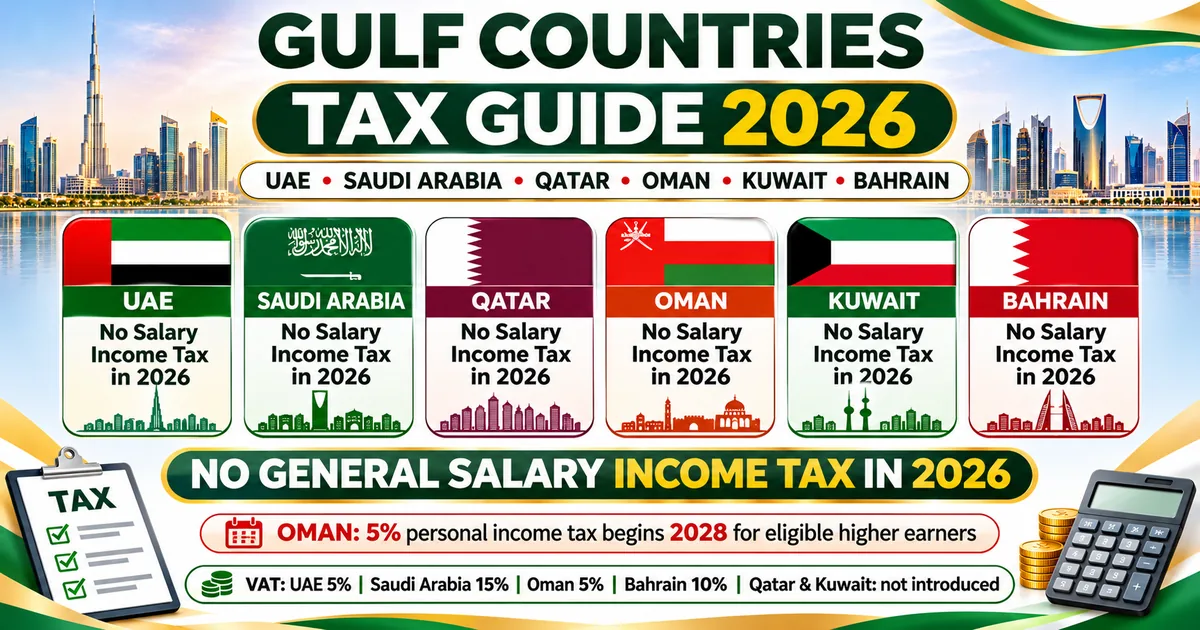
In 2026, all six GCC countries generally do not impose personal income tax on employment wages.
However, a tax-free salary does not mean that every financial activity is exempt from taxation.
Businesses may pay corporate income tax, consumers may pay Value Added Tax (VAT), and certain transactions may be subject to excise duties, withholding tax, social insurance or other charges.
Furthermore, Oman enacted a personal income tax law in 2025, with implementation scheduled for January 1, 2028.
This comprehensive guide compares personal income tax, corporate taxes, VAT, business obligations, expatriate taxation and major tax reforms across the six Gulf countries.
1. Which Gulf Countries Have No Personal Income Tax in 2026?
The six GCC countries generally do not impose ordinary personal income tax on employment salaries in 2026.
| Gulf Country | Ordinary Salary Income Tax in 2026 |
|---|---|
| United Arab Emirates | No general personal income tax |
| Saudi Arabia | No general tax on employment salaries |
| Qatar | No general tax on employment salaries |
| Oman | No general personal income tax in 2026 |
| Kuwait | No general personal income tax |
| Bahrain | No general personal income tax |
This is one reason Gulf countries remain attractive to employees receiving salaries from local employers.
However, the treatment of independent professional income, business profits, investments and foreign-source income may differ from ordinary employment salary.
Tax residency and obligations in other countries can also affect the individual.
2. Does No Income Tax Mean Everything Is Tax-Free?
No.
The term "tax-free country" is often used too broadly.
There are several important types of taxation:
- Personal income tax on salaries.
- Corporate income tax on company profits.
- Value Added Tax on taxable goods and services.
- Excise tax on specified products.
- Withholding tax on certain payments.
- Zakat or other religiously based statutory levies.
- Customs duties.
- Social insurance contributions.
- Property and real estate transaction charges.
For example, an employee in Saudi Arabia may not pay ordinary income tax on employment salary, but purchases of standard-rated goods and services are generally subject to 15% VAT.
Similarly, the UAE has no general federal personal income tax on salaries but imposes a standard 5% VAT and Corporate Tax on relevant business activities.
Therefore, salary taxation and business taxation must be considered separately.
3. UAE Income Tax Rules in 2026
The United Arab Emirates does not levy general federal personal income tax on individuals.
This means ordinary employment salaries received by employees in Dubai, Abu Dhabi, Sharjah and other emirates are generally not subject to UAE federal personal income tax.
Example: Dubai Employee
An employee receives a salary of AED 20,000 per month.
Annual salary:
AED 20,000 × 12 = AED 240,000.
Under the ordinary UAE personal income tax framework, the employee does not pay federal personal income tax on that salary.
However, other deductions or obligations may apply depending on nationality, employment and social insurance status.
Important UAE Taxes
| Tax | General Position |
|---|---|
| Personal Income Tax | No general federal tax |
| Standard VAT | 5% |
| Corporate Tax | 0% on first AED 375,000 of ordinary taxable income; 9% above |
| Minimum Tax for Large Groups | Special 15% minimum-tax framework may apply |
| Excise Tax | Applies to specified goods |
Is Freelance Income Automatically Tax-Free?
No.
Individuals conducting qualifying business activities in the UAE may come within Corporate Tax rules.
Under the natural-person business rules, relevant business turnover exceeding AED 1 million during a Gregorian calendar year can create Corporate Tax obligations.
Personal investment income and qualifying personal real estate investment income are generally treated differently from income from conducting a business.
Freelancers should therefore assess their actual activities rather than relying only on the absence of salary income tax.
4. Saudi Arabia Personal Income Tax in 2026
Saudi Arabia does not operate a general individual income tax system on employment earnings.
An employee receiving ordinary salary income from employment in Saudi Arabia is generally not subject to personal income tax on those earnings.
Example: Riyadh Employee
Monthly employment salary: SAR 15,000.
Annual salary:
SAR 15,000 × 12 = SAR 180,000.
General Saudi personal income tax on this employment salary: SAR 0.
However, employee or employer social insurance obligations may arise under the applicable rules.
Saudi Arabia's Other Taxes
Saudi Arabia imposes a standard VAT rate of 15%.
Certain business activities are subject to income tax, while eligible Saudi and GCC ownership interests may fall under Zakat rules.
The ordinary Saudi income tax rate on relevant non-Saudi ownership interests is generally 20%.
Different rules can apply to oil and gas activities, permanent establishments, withholding taxes and special sectors.
Is Zakat the Same as Personal Income Tax?
No.
Zakat and corporate income tax are separate legal obligations.
A company with mixed Saudi and non-Saudi ownership may need to determine the treatment of different ownership interests.
The absence of salary income tax does not remove corporate tax, Zakat, VAT or employer reporting obligations.
5. Qatar Income Tax Rules in 2026
Qatar generally does not impose personal income tax on ordinary salaries and wages.
Individuals working in Doha and other parts of Qatar can therefore receive employment income without general Qatar personal income tax.
Example: Doha Employee
Monthly salary: QAR 18,000.
Annual salary:
QAR 18,000 × 12 = QAR 216,000.
General Qatar personal income tax on employment salary: QAR 0.
However, other local employment and social insurance rules may apply.
Qatar Corporate Income Tax
Relevant taxable Qatar-source business income is generally subject to a standard corporate income tax rate of 10%, with exceptions and special rules.
The treatment can depend on foreign ownership, legal structure, source of income and available exemptions.
Qatar's Global Minimum Tax
Qatar has implemented rules concerning a 15% minimum effective tax rate for qualifying large multinational groups.
The framework applies to fiscal years commencing on or after January 1, 2025.
The legislation and related rules include measures governing the Domestic Minimum Top-up Tax and the Income Inclusion Rule.
The general threshold concerns multinational groups with consolidated annual revenue of at least €750 million in at least two of the four relevant preceding years.
This minimum-tax framework does not automatically apply to ordinary small businesses.
6. Does Qatar Charge VAT in 2026?
No general VAT system has entered into force in Qatar as of November 2026.
Although Qatar participates in the GCC's common VAT framework, the country has not yet implemented a general VAT through an operative domestic VAT law.
Important: Qatar should not be described as having a current 5% VAT rate.
A future VAT rate and implementation date must be based on official legislation and announcements.
Businesses in Qatar may still face other relevant taxes, including excise taxes, customs duties and business income taxes.
7. Oman Income Tax Rules in 2026
Oman does not impose general personal income tax during 2026.
Employees earning ordinary employment salaries are not yet subject to Oman's new personal income tax.
However, a major change is approaching.
Oman Personal Income Tax From January 2028
Royal Decree No. 56/2025 introduced the Personal Income Tax Law.
The law takes effect from January 1, 2028.
It provides for a 5% tax on taxable income for qualifying individuals whose total annual income exceeds OMR 42,000, subject to the specific statutory provisions.
Key Rules
| Item | Oman Personal Income Tax |
|---|---|
| Effective Date | January 1, 2028 |
| Annual Income Threshold | OMR 42,000 |
| Tax Rate | 5% |
| Relevant Taxpayers | Individuals meeting the statutory conditions |
| Applicable Income | Specified income categories |
| Relevant Authority | Oman Tax Authority |
Important Clarification
The OMR 42,000 threshold is associated with the statutory eligibility test.
It should not be assumed that every person's tax is simply 5% of all earnings above that amount.
The actual taxable income is determined using the provisions, exclusions and deductions specified in the law.
Example: Oman Employee in 2026
Monthly salary: OMR 2,000.
Annual salary:
OMR 2,000 × 12 = OMR 24,000.
General personal income tax in 2026: OMR 0.
For the period beginning in 2028, eligibility must be reassessed under the new law.
8. Oman Corporate Tax and VAT
Oman generally imposes a 15% income tax on relevant corporate taxable profits.
Certain qualifying small enterprises may benefit from a 3% rate where applicable conditions are satisfied.
The ordinary VAT rate is 5%.
| Tax | General Rate |
|---|---|
| Personal Income Tax in 2026 | Not in force |
| Future Personal Income Tax | 5% for qualifying individuals from 2028 |
| Standard Corporate Income Tax | 15% |
| Standard VAT | 5% |
| Certain Qualifying Small Enterprise Income | Special 3% treatment |
Businesses should check the relevant eligibility criteria and exclusions before applying special rates.
9. Kuwait Income Tax Rules in 2026
Kuwait generally does not impose personal income tax on employment salaries.
This makes it attractive to many expatriate employees.
Example: Kuwait Employee
Monthly employment salary: KWD 1,500.
Annual salary:
KWD 1,500 × 12 = KWD 18,000.
General personal income tax on the employment salary: KWD 0.
However, nationality-related social insurance requirements and other employment rules may apply.
Kuwait Corporate Income Tax
Kuwait generally imposes a 15% corporate income tax on relevant Kuwait-source profits attributable to foreign corporate entities.
The tax framework differs for Kuwaiti and qualifying GCC-owned companies.
Special rules apply to certain large multinational groups and other business structures.
Does Kuwait Have VAT?
Kuwait has not introduced general VAT as of November 2026.
Although it signed the GCC VAT framework, domestic implementation has not occurred.
Therefore, businesses should not apply a supposed current Kuwait VAT rate of 5%.
10. Bahrain Income Tax Rules in 2026
Bahrain generally does not impose personal income tax on ordinary employment salaries.
This applies to typical salaried employment income received by employees under its existing tax framework.
Example: Bahrain Employee
Monthly salary: BHD 1,200.
Annual salary:
BHD 1,200 × 12 = BHD 14,400.
General personal income tax: BHD 0.
However, social insurance obligations and other payroll-related requirements must be considered.
Bahrain VAT
Bahrain's standard VAT rate is 10%.
The rate increased from 5% to 10% effective January 1, 2022.
Businesses supplying standard-rated goods and services must comply with applicable VAT requirements.
Bahrain Corporate Tax
Bahrain generally does not impose a broad corporate income tax on ordinary non-oil companies in 2026.
However, there are important exceptions.
Certain companies operating in specified oil and gas activities can be subject to a 46% income tax.
Bahrain also introduced a 15% Domestic Minimum Top-up Tax for qualifying large multinational groups from January 2025.
Proposed Corporate Tax Reform
Bahrain proposed a wider 10% corporate income tax, potentially from 2027.
The proposal should not be treated as an already applicable 2026 general corporate tax.
Businesses should check the final legislation and effective dates before incorporating projected rates into tax calculations.
11. Gulf VAT Rates 2026 — Complete Comparison
VAT is one of the main taxes affecting consumers and businesses across the Gulf.
| Country | Standard VAT Rate in 2026 |
|---|---|
| UAE | 5% |
| Saudi Arabia | 15% |
| Qatar | Not introduced |
| Oman | 5% |
| Kuwait | Not introduced |
| Bahrain | 10% |
Example: Goods Worth 1,000 Local Currency Units
Assume a fully standard-rated sale with a pre-tax price of 1,000 units in the relevant country's local currency.
| Country | VAT Amount | Total Price |
|---|---|---|
| UAE | 50 AED | 1,050 AED |
| Saudi Arabia | 150 SAR | 1,150 SAR |
| Oman | 50 OMR | 1,050 OMR |
| Bahrain | 100 BHD | 1,100 BHD |
The values are examples in different currencies and are not comparable purchasing-power or currency-conversion figures.
Qatar and Kuwait do not have general VAT in force for 2026.
Special zero-rated or exempt supplies may receive different treatment in countries with VAT.
12. Gulf Corporate Tax Comparison in 2026
Although employment salaries are generally untaxed, companies can face significant tax obligations.
| Country | General Business Tax Position |
|---|---|
| UAE | 9% on ordinary taxable income exceeding AED 375,000 |
| Saudi Arabia | Generally 20% on relevant non-Saudi ownership interests; Zakat may apply |
| Qatar | Generally 10% on relevant taxable Qatar-source profits |
| Oman | Generally 15% |
| Kuwait | Generally 15% on relevant foreign corporate income |
| Bahrain | No broad corporate tax for ordinary businesses in 2026, with important exceptions |
Large multinational groups may also be affected by domestic minimum-tax rules.
A company should not choose a Gulf country solely based on the absence of individual salary tax.
13. What Is the 15% Global Minimum Tax in Gulf Countries?
Several GCC countries have introduced special rules related to the OECD Pillar Two global minimum-tax framework.
The framework generally seeks to ensure that qualifying multinational groups pay a minimum effective tax rate of 15%, subject to the relevant legal calculations.
The broad consolidated revenue threshold is €750 million in at least two of the preceding four years.
The implementation differs by country.
Important
This does not mean every company in the UAE, Qatar, Bahrain, Oman or Kuwait automatically pays 15% corporate income tax.
Only in-scope groups and entities are subject to the relevant Pillar Two provisions.
Different local rules govern the actual top-up calculation.
14. Is Freelance Income Tax-Free Across the Gulf?
Not automatically.
A freelance consultant, software developer or digital marketer may be conducting an independent business rather than earning ordinary employment salary.
Different rules may apply depending on the jurisdiction.
UAE
Business turnover can bring a natural person within the Corporate Tax system.
Saudi Arabia
Relevant non-employment and business income can be subject to different taxation arrangements.
Qatar
Qualifying business income may fall within income tax provisions.
Oman
Business activities may create income tax and VAT obligations under the relevant rules.
Kuwait
The legal entity and the nature of foreign business activity are important.
Bahrain
VAT and other commercial compliance requirements may apply, even without a broad general corporate income tax.
Key distinction: Being a salaried employee and independently operating a business are not the same legal activity.
15. Do Gulf Countries Tax Investments and Capital Gains?
Treatment depends on the asset, ownership structure and the nature of the transaction.
Many GCC countries do not impose a general personal capital gains tax on genuine private investment gains in the same manner as certain Western jurisdictions.
However, exemptions should not be assumed for all transactions.
Examples requiring separate review include:
- Sale of business shares.
- Commercial property transactions.
- Professionally conducted investment activities.
- Gains realized by companies.
- Investments connected with a taxable business.
- Foreign investment income taxable in another jurisdiction.
A personal investment exemption does not necessarily extend to profits generated through a company.
16. Are Foreign Bank Transfers Tax-Free in Gulf Countries?
Sending money from a Gulf bank to another country does not ordinarily create a Gulf personal income tax merely because money is remitted.
However, the tax treatment of the underlying funds is important.
For example, a Pakistani professional working in Dubai may remit salary savings to Pakistan.
The UAE generally does not impose personal income tax on ordinary employment salary.
However, the recipient's or sender's tax residency and obligations in Pakistan or another country may need to be considered.
A bank transfer should not be confused with a tax exemption for all underlying income.
17. Do Overseas Pakistanis Pay Tax in Pakistan on Gulf Salaries?
The answer depends on Pakistani tax residency, the income's source, treaty provisions and applicable Pakistan income tax law.
A person working in the Gulf may be a non-resident for Pakistani income tax purposes, but overseas employment alone does not automatically establish non-residence.
Important Considerations
- Number of days spent in Pakistan.
- Pakistani tax residency.
- Location where employment duties are performed.
- Whether income is Pakistan-source or foreign-source.
- Applicable tax treaty provisions.
- Asset and wealth reporting requirements.
- Bank documentation and remittance records.
Pakistani nationals working overseas should not automatically assume that foreign citizenship, a work visa or a foreign bank account determines their tax position.
18. Does a Tax-Free Salary Mean Higher Take-Home Pay?
A salary without personal income tax can improve disposable income.
However, employees should also consider:
- Housing and accommodation costs.
- Healthcare and insurance.
- School expenses.
- Transportation.
- Social insurance deductions where applicable.
- Living expenses.
- Employer-provided benefits.
- Currency exchange costs.
- Family residency expenses.
A country with no personal salary tax is not necessarily the cheapest or most financially suitable country for every employee.
Example
Employee A receives a salary of 12,000 local currency units in a country without salary income tax.
Employee B receives a lower gross salary but has subsidized housing and healthcare.
Their final financial position depends on total compensation and expenses, not only the income tax rate.
19. Which Gulf Country Is Best for Starting a Business?
Each country has different commercial advantages.
UAE
International business infrastructure, free zones, regional trade and diversified services.
Saudi Arabia
Large domestic market, major development projects and growing non-oil sectors.
Qatar
Business opportunities in services, infrastructure, energy-related activities and international investment.
Oman
Ports, logistics, industrial activity, manufacturing and diversified commercial opportunities.
Kuwait
Opportunities in local services, trading and selected investment sectors.
Bahrain
Financial services, international business operations and regional market access.
The best choice depends on company ownership rules, licensing, business activities, commercial costs and tax obligations.
20. Business Registration Does Not Automatically Create Tax Residence
Registering a company in a Gulf country does not automatically settle all personal or corporate tax obligations.
For example, a company incorporated in the UAE may be managed or conduct significant activities outside the UAE.
This can create additional tax considerations under the laws of other countries.
Relevant factors include:
- Place of management.
- Permanent establishment rules.
- Business substance.
- Employee location.
- Actual commercial activities.
- International tax treaties.
- Beneficial ownership.
- Shareholder residence.
International entrepreneurs should obtain advice before creating complex cross-border company structures.
21. Important Tax Reforms to Watch After 2026
Several Gulf tax systems continue to evolve.
Oman — Personal Income Tax in 2028
A 5% tax for qualifying higher-income individuals begins on January 1, 2028.
Qatar and Kuwait — Potential VAT Implementation
Both remain outside an operative general VAT system in 2026. Businesses should monitor official announcements rather than relying on anticipated implementation dates.
Bahrain — Proposed General Corporate Tax
A proposed 10% corporate income tax framework has been discussed for possible future implementation, subject to legislative developments.
GCC International Minimum Tax
Qualifying large multinational groups must consider country-specific Pillar Two implementation.
Saudi Arabia — Electronic Invoicing
ZATCA continues implementing Fatoorah Phase 2 integration through notified waves.
These changes demonstrate why companies and expatriates should regularly review current tax regulations.
22. Common Gulf Tax Mistakes to Avoid
- Assuming no personal income tax means no tax obligations.
- Treating employment income and business income identically.
- Assuming Qatar already charges VAT.
- Assuming Kuwait already charges VAT.
- Ignoring Oman's enacted 2028 personal income tax.
- Assuming every Gulf company is exempt from corporate tax.
- Applying Saudi Arabia's 15% VAT rate to other GCC countries.
- Treating Bahrain's proposed corporate tax as already in force for every company.
- Confusing Zakat with ordinary personal income tax.
- Ignoring large-group minimum-tax requirements.
- Assuming a work visa automatically determines tax residency.
- Ignoring payroll and social insurance requirements.
- Confusing VAT registration thresholds with income tax thresholds.
- Assuming all investment gains are exempt.
- Ignoring tax obligations in the person's home country.
- Treating bank transfers as proof of non-taxable income.
23. Gulf Tax Compliance Checklist for 2026
Before accepting employment or launching a business in a GCC country, check:
- Country of employment or business operations.
- Applicable personal salary tax treatment.
- Tax residency status.
- Employment or business income classification.
- Relevant corporate income tax rules.
- VAT rate and registration requirements.
- Payroll and social insurance obligations.
- Zakat or other statutory levies.
- Business licence requirements.
- Tax registration obligations.
- Applicable withholding taxes.
- Foreign-source income treatment.
- Relevant tax treaty provisions.
- Bank and remittance documentation.
- Accounting and record-keeping requirements.
- Filing and payment deadlines.
- Future tax law changes.
- Home-country tax obligations.
24. Watch Tax With Naeem — Related Income Tax Education
For general educational guidance on different categories of income, return filing, salary, rental income, capital gains and dividends, watch the following video from Tax With Naeem.
Related Video: Income Tax Return Filing in Pakistan | Salary | Rental | Capital Gain | Dividend Explained | FBR
https://www.youtube.com/watch?v=VX88o1N1AfA
The video was published by Tax With Naeem on October 2, 2025.
It explains Pakistan's income tax filing system and different income classifications.
Important: This is a Pakistan income tax tutorial, not a dedicated Gulf salary tax or GCC corporate tax video.
For Gulf taxation, readers should consult the official tax authority of the relevant country.
25. Official Government and Tax Authority Sources
United Arab Emirates
UAE Government — Taxation
https://u.ae/en/information-and-services/finance-and-investment/taxation
Federal Tax Authority
Saudi Arabia
Zakat, Tax and Customs Authority
Saudi VAT Guidelines and Tax Information
https://zatca.gov.sa/en/RulesRegulations/Taxes/Pages/default.aspx
Qatar
General Tax Authority
Qatar Global Minimum Tax
https://gta.gov.qa/en/global-minimum
Oman
Oman Tax Authority
https://tms.taxoman.gov.om/portal/
Oman Personal Income Tax Law
https://tms.taxoman.gov.om/portal/en/web/taxportal/w/issuance-of-personal-income-tax-pit-law
Oman Tax Rates
https://tms.taxoman.gov.om/portal/tax-rate
Kuwait
Kuwait Ministry of Finance
Bahrain
National Bureau for Revenue
International Tax References
World Bank — Gulf Economic Update
International Monetary Fund
Related Educational Resources
AsaanTax.pk — International Taxation Guides
Tax With Naeem — Income Tax Tutorial
https://www.youtube.com/watch?v=VX88o1N1AfA
26. Conclusion: Are Gulf Countries Really Tax-Free in 2026?
The six Gulf Cooperation Council countries continue to offer a major advantage to employees: ordinary employment salaries are generally not subject to personal income tax in 2026.
However, that advantage does not mean these countries have no taxation.
The UAE imposes Corporate Tax and 5% VAT. Saudi Arabia has 15% VAT and business taxation under its applicable income tax and Zakat rules.
Qatar generally taxes qualifying business profits but has not introduced VAT. Oman has a 15% standard corporate income tax and 5% VAT, with a new personal income tax scheduled to begin in 2028.
Kuwait generally taxes relevant foreign corporate activities but has not implemented VAT, while Bahrain has 10% VAT, special-sector business taxes and a minimum tax for qualifying multinational groups.
The key distinction is between tax-free employment salaries and the separate tax obligations of companies, freelancers, investors and consumers.
For individuals planning employment in the Gulf, it is important to review salary packages, residency, living costs and any continuing home-country tax obligations.
For business owners, corporate income tax, VAT, regulatory compliance and actual operations must all be considered.
For more professional international tax guides covering the Gulf, Europe, North America and Pakistan, visit AsaanTax.pk:
Editorial Note: This article reflects tax rules and government announcements reviewed as of November 11, 2026. Future measures, including Oman's personal income tax and proposed reforms in other GCC countries, are distinguished from rules currently in force.
Disclaimer: This article provides general educational information and does not constitute personalized tax, legal, employment or investment advice. Tax treatment depends on residency, the nature of income, business structure, statutory exemptions and applicable domestic law. Readers should verify their circumstances with the relevant tax authority or a qualified tax professional.