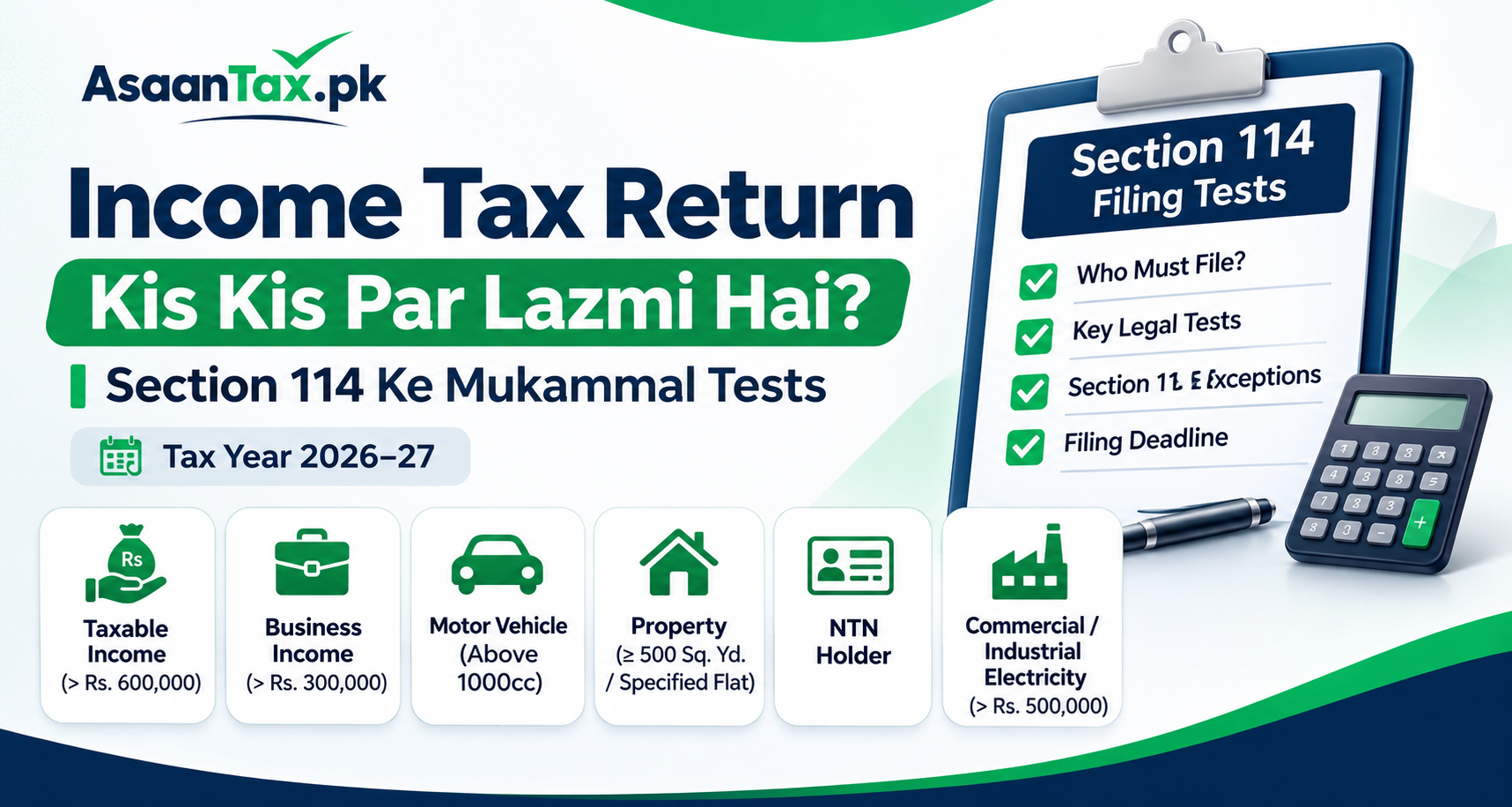
Many people in Pakistan believe that they are required to file an FBR income tax return only when their salary exceeds Rs. 50,000 per month or their annual income exceeds Rs. 600,000.
However, this is not the complete legal position.
Section 114 of the Income Tax Ordinance, 2001 requires several categories of individuals, companies, Associations of Persons (AOPs) and other taxpayers to file an income tax return.
Some filing obligations arise even when a person has little or no taxable income.
For example, owning certain immovable property, a motor vehicle with engine capacity above 1000cc, obtaining an NTN or meeting specified business and registration conditions may trigger an obligation to file.
In this complete guide, AsaanTax.pk explains who must file an income tax return in Pakistan, the important Section 114 tests, Section 115 exceptions, Tax Year 2026 and 2027 requirements, and the process of filing through FBR IRIS.
What Is Section 114 of the Income Tax Ordinance?
Section 114 of the Income Tax Ordinance, 2001 is the principal provision that identifies persons required to furnish an annual income tax return.
The section covers several different filing conditions, including:
- Taxable income.
- Company and non-profit organization status.
- Income subject to final taxation.
- Previous income tax assessments.
- Carried-forward losses.
- Ownership of specified immovable property.
- Ownership of motor vehicles above a particular engine capacity.
- NTN registration.
- Commercial or industrial electricity connections.
- Membership of specified professional or business organizations.
- Foreign income and assets reporting.
- Special requirements and notices under the law.
An individual may be required to file because of one qualifying condition even if another condition does not apply.
Who Must File an Income Tax Return in Pakistan?
The following is a practical summary of the major filing requirements under Section 114.
| Filing Test | Legal Reference |
|---|---|
| Every company | Section 114(1)(a) |
| Taxable income above the applicable tax-free threshold | Section 114(1)(ab) |
| Specified non-profit organization | Section 114(1)(ac) |
| Income subject to final taxation | Section 114(1)(ae) |
| Tax charged during either of two preceding tax years | Section 114(1)(b)(i) |
| Claiming carried-forward losses | Section 114(1)(b)(ii) |
| Certain property ownership | Section 114(1)(b)(iii)–(v) |
| Motor vehicle above 1000cc | Section 114(1)(b)(vi) |
| Obtained an NTN | Section 114(1)(b)(vii) |
| Specified commercial or industrial electricity connection | Section 114(1)(b)(viii) |
| Resident membership of specified associations or professional bodies | Section 114(1)(b)(ix) |
| Resident individual required to file foreign income and assets statement | Section 114(1)(b)(x) |
| Certain business income above Rs. 300,000 | Section 114(1A) |
Additional filing requirements may arise through other provisions, notifications or legally valid notices.
Test 1: Annual Taxable Income Above Rs. 600,000
For Tax Year 2027, the ordinary individual tax-free income threshold is Rs. 600,000 annually.
An individual whose annual taxable income exceeds the relevant maximum non-taxable amount may be required to submit an income tax return.
For a person earning a consistent taxable salary, Rs. 600,000 per year is equivalent to Rs. 50,000 per month.
Example
Monthly taxable salary: Rs. 80,000
Annual taxable salary: Rs. 960,000
Because the annual taxable salary exceeds Rs. 600,000, the individual meets the taxable-income filing test.
Important: Even if your taxable income is below Rs. 600,000, another Section 114 test may independently require you to file.
Test 2: Business Income Above Rs. 300,000
Section 114(1A) contains a special filing obligation for certain individuals earning business income.
An individual whose income under the head Income from Business exceeds Rs. 300,000 but does not exceed Rs. 400,000 during a tax year is also required to furnish a return.
For example:
Annual business income: Rs. 350,000
Even though this amount is below the ordinary Rs. 600,000 tax-free threshold, the individual may still be required to file under Section 114(1A).
This special provision should not be confused with annual sales turnover.
Business income must be determined according to the applicable income tax provisions.
Other Section 114 tests may also require a return at different income levels.
Test 3: Every Registered Company Must Generally File
Section 114(1)(a) requires every company to submit an income tax return.
This requirement is not limited to companies earning taxable profit.
For example:
- A company operating profitably.
- A company reporting an accounting loss.
- A newly incorporated company.
- A company that has not commenced active business.
- A company with no sales during the year.
These companies may still have filing obligations.
A company should not assume that having no business activity automatically eliminates its tax return requirement.
Its legal status, prescribed filing requirements and any applicable exemptions must be reviewed.
Test 4: Non-Profit Organizations
Section 114 also covers non-profit organizations as defined in the Income Tax Ordinance.
A non-profit organization may be required to furnish a return even where it qualifies for specified tax concessions or credits.
Being exempt from paying income tax on certain receipts is not necessarily the same as being exempt from submitting an annual tax return.
Organizations should review their approval, registration and reporting conditions.
Test 5: Income Subject to Final Taxation
Certain income categories are subject to special final-tax provisions.
Section 114(1)(ae) generally includes persons whose income is subject to final taxation under the Ordinance.
A taxpayer should not automatically assume that tax deducted at source removes every return filing obligation.
For example, qualifying service export receipts may fall under a special final-tax regime, but filing and other compliance conditions can still apply.
Applicable exceptions and special forms must be considered.
Test 6: Tax Charged in Either of the Previous Two Tax Years
Section 114(1)(b)(i) applies where a person was charged to tax in respect of either of the two preceding tax years.
This can create a filing requirement even where current-year income has fallen.
Example
A person was charged income tax in a previous year but has reduced earnings in the current year.
Their current income may be below the ordinary taxable threshold.
However, the previous-tax-year test may still apply.
The exact tax charging records and relevant years should be verified before determining the obligation.
Test 7: Claiming a Carried-Forward Loss
A taxpayer who claims a loss carried forward under the Income Tax Ordinance may be required to file an income tax return.
For example, a business owner may have a legally recognized loss from an earlier tax year that is eligible to be carried forward.
To claim the relevant relief, the taxpayer must meet the applicable return filing and loss-related conditions.
A business loss cannot automatically be claimed without the required records and legal compliance.
Test 8: Owning Property of 500 Square Yards or More
Section 114 contains specific tests based on immovable property ownership.
A person may become liable to file because of owning qualifying land or a flat in specified locations.
Property Within Specified Urban Areas
The law includes ownership of immovable property with land area of at least 500 square yards in specified municipal areas, cantonments or Islamabad Capital Territory.
It also includes ownership of any flat situated in the areas described by Section 114(1)(b)(iii).
Property in a Rating Area
There are separate tests concerning:
- Immovable property with land area of 500 square yards or more in a rating area.
- A flat with a covered area of at least 2,000 square feet situated in a rating area.
Important Property Distinction
The law does not simply say that every person owning any 5-marla or 10-marla house anywhere in Pakistan must file.
The applicable property test depends on size, classification and location.
Special exceptions under Section 115 must also be considered.
Test 9: Owning a Motor Vehicle Above 1000cc
Under Section 114(1)(b)(vi), ownership of a motor vehicle having engine capacity above 1000cc may trigger the filing requirement.
Examples include qualifying vehicles with:
- 1200cc engine capacity.
- 1300cc engine capacity.
- 1500cc engine capacity.
- 1600cc engine capacity.
- 1800cc engine capacity.
- 2000cc engine capacity.
What About a 660cc Car?
Owning a 660cc vehicle does not, by itself, satisfy the above-1000cc vehicle test.
However, the owner may still be required to file because of income, NTN registration, property ownership or another legal condition.
What About an Exactly 1000cc Car?
The statutory wording is “above 1000 CC.”
An exactly 1000cc vehicle should not automatically be treated as exceeding that threshold.
Verify the vehicle's legally recorded engine capacity rather than relying on its marketing name.
Important Exception
Section 115 provides certain exceptions from filing solely on specified property and vehicle ownership grounds for qualifying categories of persons.
Therefore, ownership of a vehicle above 1000cc is not the end of every taxpayer's legal analysis.
Test 10: Having Obtained an NTN
Section 114(1)(b)(vii) includes a person who has obtained a National Tax Number (NTN).
This is an important filing condition often overlooked by taxpayers.
A person may have registered with FBR to:
- Start a business.
- Open or operate a business account.
- Register a professional activity.
- Meet a commercial requirement.
- Complete an earlier tax registration process.
They should not assume that an unused NTN automatically removes all annual filing obligations.
Having an NTN and appearing on the Active Taxpayers List are also different matters.
NTN registration does not automatically establish current ATL status.
Test 11: Commercial or Industrial Electricity Bills Above Rs. 500,000
Section 114 includes the holder of a commercial or industrial electricity connection where the annual electricity bill exceeds Rs. 500,000.
Example
Annual commercial electricity bills: Rs. 620,000
The annual amount exceeds the specified Rs. 500,000 threshold.
The person holding the qualifying connection may therefore satisfy the relevant Section 114 filing test.
Important Note
This condition refers specifically to commercial or industrial electricity connections.
A normal domestic household electricity connection is not automatically covered by the same test.
Test 12: Membership of Certain Professional or Trade Organizations
Section 114 also contains a filing condition concerning resident persons registered with specified business or professional bodies.
Examples include:
- Chamber of Commerce and Industry.
- Trade or business associations.
- Market committees.
- Pakistan Engineering Council.
- Pakistan Medical and Dental Council or relevant successor regulatory arrangements.
- Pakistan Bar Council.
- Provincial Bar Councils.
- Institute of Chartered Accountants of Pakistan.
- Institute of Cost and Management Accountants of Pakistan.
The applicable test depends on the relevant legal status, registration and residency requirements.
Not every informal social club or membership automatically falls within this category.
Test 13: Foreign Income and Assets Statement Under Section 116A
Section 114 covers resident individuals required to submit a foreign income and assets statement under Section 116A.
Section 116A generally applies to a resident individual who has:
- Foreign income of at least USD 10,000; or
- Foreign assets valued at least USD 100,000.
The required statement contains information concerning foreign assets, liabilities, transfers and income.
Example
A Pakistan tax resident owns foreign financial assets worth USD 150,000.
The person may meet the foreign-assets statement requirement.
They should determine whether both the Section 116A statement and the relevant income tax return must be filed.
Important: The foreign income and assets statement is distinct from an ordinary wealth statement under Section 116.
Test 14: Filing Required by an FBR Notice
FBR may issue a legally valid notice requiring a person to furnish an income tax return.
Sections 114(3), 114(4) and related provisions govern certain circumstances in which the Commissioner can require filing.
A person receiving a notice should carefully review:
- The tax year involved.
- The statutory authority.
- The deadline specified.
- The requested documents.
- The appropriate response or legal remedy.
Do not ignore an official FBR notice merely because you believe your income is below the tax-free threshold.
The legality and scope of the notice should be evaluated according to the Ordinance.
Section 115 – Who May Not Be Required to File?
Section 115 provides exceptions for certain people who would otherwise be required to file solely because of specified property or vehicle ownership conditions.
Relevant categories include:
- A widow.
- An orphan below the age of 25.
- A disabled person.
- Certain non-residents in relation to property ownership.
Important Limitation
These exceptions do not provide a general exemption from every Section 114 filing test.
For example, a person who qualifies for a vehicle-ownership exception may still be required to file because of taxable income, obtaining an NTN or another independent condition.
The statutory basis for exemption must be checked carefully.
Do Salaried Persons Need to File Income Tax Returns?
Yes, salaried individuals who meet the applicable filing conditions must submit their annual income tax returns.
A person with annual taxable salary above Rs. 600,000 generally meets the taxable-income threshold.
However, even a lower-income salaried person may have an obligation because of another Section 114 test.
Example: Salary of Rs. 40,000 Per Month
Annual salary: Rs. 480,000.
The amount is below the ordinary Rs. 600,000 taxable-income threshold.
However, if the employee owns a qualifying vehicle, has obtained an NTN or meets another applicable Section 114 test, filing may still be required.
Example: Salary of Rs. 100,000 Per Month
Annual taxable salary: Rs. 1,200,000.
This exceeds the ordinary tax-free threshold and generally requires an income tax return.
The employee's employer deducting salary tax does not automatically replace the individual's own legal filing obligation.
Do Freelancers Need to File Income Tax Returns?
Freelancers may become liable to file because of:
- Their taxable business income.
- Special business-income filing requirements.
- NTN registration.
- Income subject to final taxation.
- Other Section 114 conditions.
Receiving payment through Fiverr, Upwork or another platform does not automatically determine whether a tax return is required.
The freelancer must identify the correct income classification and applicable filing conditions.
Where Section 154A applies to qualifying exported services, its separate return filing and final-tax conditions also need consideration.
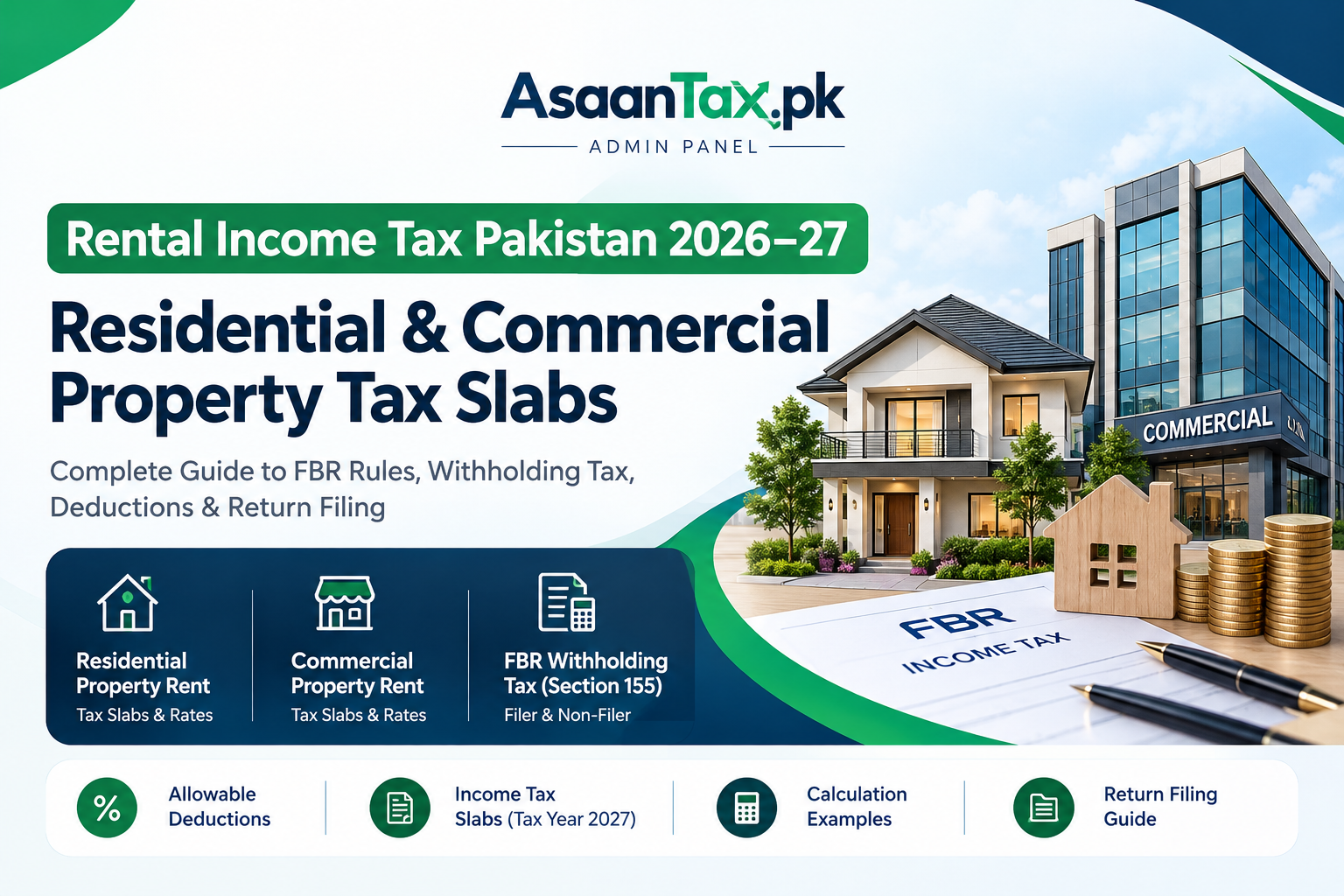
Do Rental Property Owners Have to File?
Rental income is generally taxable under the Income from Property provisions, subject to applicable deductions.
A landlord may need to file when taxable income exceeds the relevant threshold or another Section 114 test applies.
Owning a qualifying property may also create a filing obligation independently of how much rent is earned.
For example, a person receiving modest house rent may still need to file because they own property falling within the specific property-ownership tests.
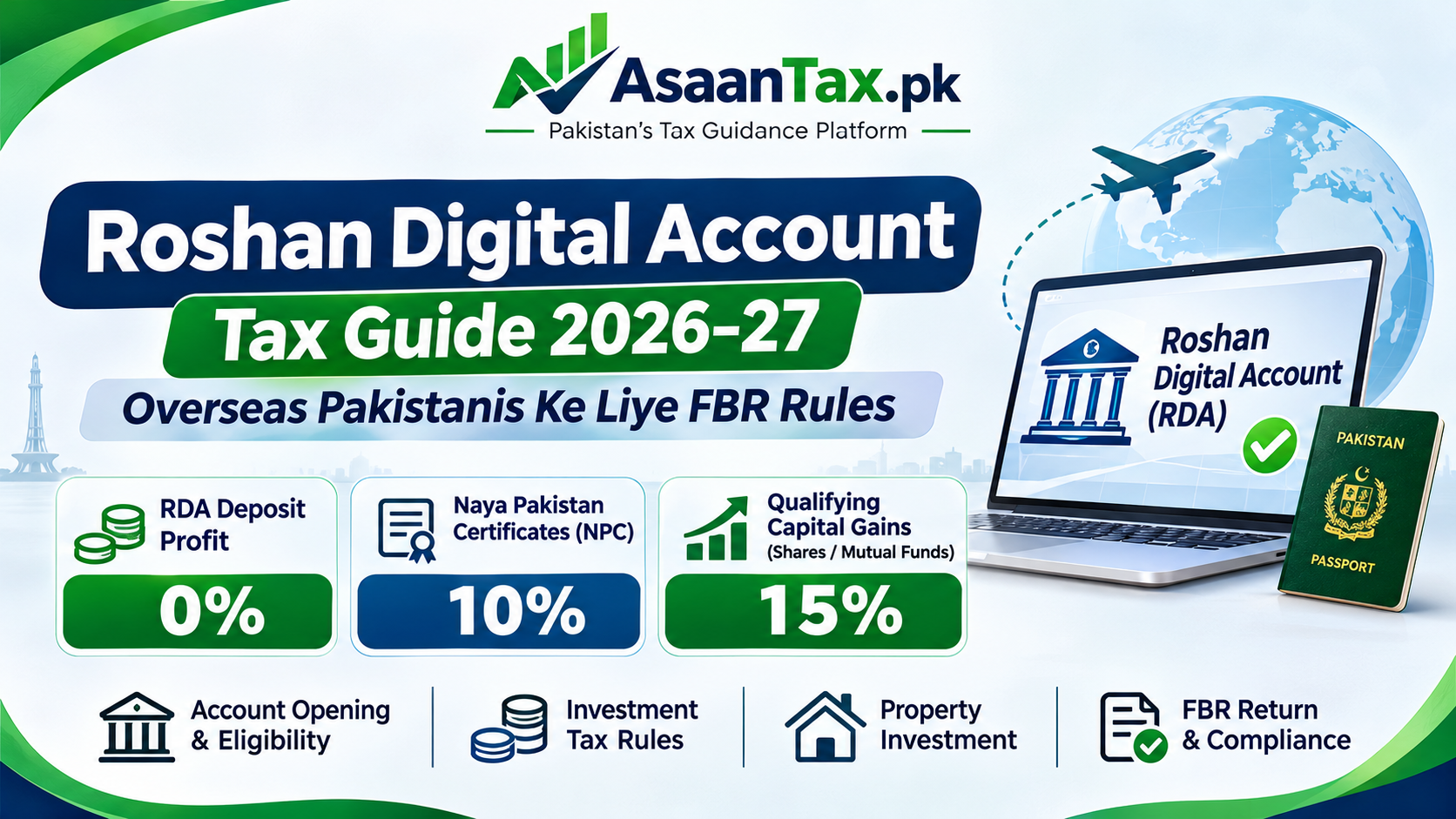
Do Overseas Pakistanis Have to File?
Not every overseas Pakistani is automatically required to file an income tax return simply because they hold a Pakistani passport or NICOP.
The filing obligation depends on factors such as:
- Tax residency.
- Pakistan-source income.
- NTN registration.
- Relevant property and vehicle tests.
- Section 115 exemptions.
- Other applicable statutory conditions.
A non-resident Pakistani with only foreign-source employment income may have a different filing position from a Pakistan resident earning worldwide income.
Overseas Pakistanis should not assume that remitting money to Pakistan creates an automatic tax return requirement.
Similarly, having no income tax payable does not necessarily mean there is no return filing requirement.
What If Your Income Is Below Rs. 600,000?
The income threshold is only one filing test.
Consider the following examples.
| Example | Possible Filing Position |
|---|---|
| Salary Rs. 450,000, no other trigger | May not be required |
| Salary Rs. 450,000, obtained NTN | Filing may be required |
| No income, owns qualifying 1500cc car | Vehicle test may apply; check Section 115 |
| No current income, company registered | Company generally must file |
| Business income Rs. 350,000 | Section 114(1A) applies |
| No income, owns qualifying urban property | Property test may apply; check Section 115 |
| Rental income plus salary above taxable threshold | Filing generally required |
This demonstrates why a person's return filing obligation cannot be determined solely by salary.
Tax Year 2026 vs Tax Year 2027 – What Is the Difference?
The relevant period depends on the tax year.
| Tax Year | Ordinary Income Period |
|---|---|
| Tax Year 2026 | July 1, 2025 – June 30, 2026 |
| Tax Year 2027 | July 1, 2026 – June 30, 2027 |
Tax Year 2026 relates to the financial period already completed on June 30, 2026.
Tax Year 2027 relates to the financial period ending June 30, 2027.
As of November 2026, Tax Year 2027 has not yet ended.
Different Finance Acts and FBR notifications may affect the tax calculations and administrative requirements of the two years.
Always select the correct tax year when filing.
When Is the Income Tax Return Due?
The ordinary statutory due dates under Section 118 generally include:
| Taxpayer | Ordinary Due Date |
|---|---|
| Individual | September 30 following the tax year |
| AOP | September 30 following the tax year |
| Company with normal June 30 year-end | December 31 following the tax year |
| Company with another qualifying special tax year | Relevant statutory deadline |
For Tax Year 2027, the usual individual and AOP filing deadline would be September 30, 2027, unless altered by a valid extension or notification.
A company with a June 30, 2027 year-end would ordinarily have a December 31, 2027 deadline.
Taxpayers should verify any official FBR extension rather than assuming that the original deadline will always remain unchanged.
How to File an Income Tax Return Under Section 114
Step 1: Confirm Your Filing Obligation
Review the applicable Section 114 tests and any Section 115 exceptions.
Step 2: Register With FBR
Ensure you have the relevant FBR registration and access to IRIS.
Step 3: Open the Official IRIS Portal
Visit:
Step 4: Select the Correct Tax Year
Choose the year for which you are required to file.
Step 5: Prepare Income Information
Organize income from the relevant categories:
- Salary.
- Business.
- Property.
- Capital gains.
- Other sources.
Step 6: Include Exempt or Final-Tax Income Where Required
Report such amounts according to the applicable return form and statutory requirements.
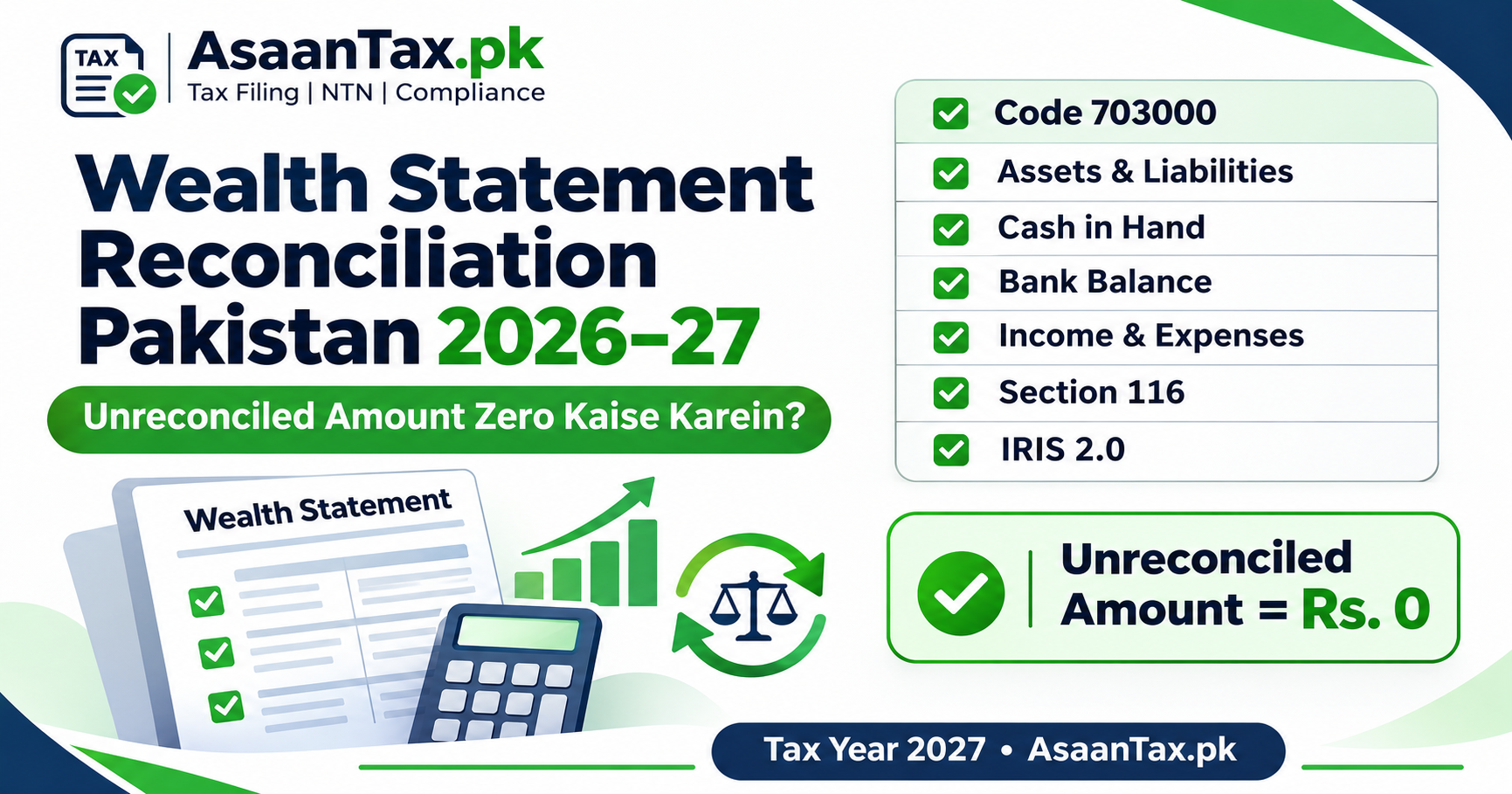
Step 7: Complete Your Wealth Statement
A resident individual must complete the applicable wealth statement where required under Section 116.
Reconcile opening assets, closing assets, liabilities, income and expenses.
Step 8: Enter Tax Payments and Withholding
Report eligible tax payments, deductions and credits supported by official records.
Step 9: Review and Submit
Check all entries before submitting the return electronically.
Step 10: Keep the Filing Acknowledgment
A successfully submitted return should appear in the completed tasks or relevant submission records.
Saving a draft is not the same as filing a return.
What Documents Are Needed for Return Filing?
The documents depend on the taxpayer's circumstances.
Common information includes:
- CNIC or NTN.
- FBR IRIS login details.
- Salary certificate.
- Business income and expense records.
- Bank statements.
- Property ownership details.
- Motor vehicle registration documents.
- Rental income information.
- Investment income and tax deduction records.
- Details of assets and liabilities.
- Previous income tax returns.
- Foreign assets or income details, if applicable.
Records should be accurate and consistent with the information reported to FBR.
What Happens If a Person Does Not File a Required Return?
A person who fails to file a legally required return may face consequences under the Income Tax Ordinance.
Depending on the situation, these may include:
- A filing notice from FBR.
- Penalties under Section 182.
- Additional compliance or enforcement procedures.
- Inactive ATL status.
- Higher withholding tax rates on certain transactions.
- Assessment or further inquiry under relevant statutory provisions.
The actual consequences depend on the legal provisions, facts and any available remedies.
An ATL surcharge under Section 182A is separate from a late-filing penalty under Section 182.
Paying one does not automatically discharge the other.
Does Filing an Income Tax Return Mean You Must Pay Tax?
No.
The obligation to file a return and the obligation to pay income tax are separate questions.
For example, a person may be required to file because they own a qualifying vehicle or have obtained an NTN, even if no income tax is ultimately payable.
A return may lawfully disclose zero taxable income, a loss, income subject to special treatment or an amount on which tax has already been deducted.
However, the return must accurately reflect the taxpayer's financial circumstances.
What Is the Difference Between NTN Registration and ATL Status?
An NTN or income tax registration record identifies the taxpayer in FBR's system.
ATL status refers to whether the taxpayer satisfies the applicable requirements for inclusion in the Active Taxpayer List.
A person can have an NTN and still appear inactive.
Similarly, a person filing after the deadline may need to complete additional requirements for ATL inclusion.
Taxpayers can verify ATL status through FBR's official online verification system.
Common Mistakes About Section 114
The following misunderstandings are common:
- Assuming only salaried people above Rs. 600,000 must file.
- Ignoring the business-income filing test.
- Assuming a company with zero income never files.
- Assuming every small house triggers the property test.
- Treating exactly 1000cc as automatically above 1000cc.
- Ignoring Section 115 exceptions.
- Assuming NTN registration means active filer status.
- Assuming tax deducted by an employer replaces return filing.
- Believing a zero-tax return is unnecessary.
- Filing the wrong tax year.
- Ignoring a valid FBR notice.
- Saving a draft without submitting the return.
Understanding these differences helps taxpayers meet their legal obligations more accurately.
How AsaanTax.pk Can Help With Section 114 Compliance
Are you unsure whether filing an income tax return is compulsory for you?
Do you own a car, property or business, or have an NTN but no taxable salary?
AsaanTax.pk provides assistance with income tax registration, filing requirements, wealth statements and FBR compliance.
Our services include:
- Section 114 return filing eligibility guidance.
- NTN registration assistance.
- Salaried person tax returns.
- Business and professional income tax returns.
- Freelancer income tax filing.
- Rental income reporting.
- Return filing for qualifying property and vehicle owners.
- Wealth statement preparation and reconciliation.
- Active Taxpayer List status guidance.
- General FBR compliance and notice assistance.
Need Help Determining Whether You Must File?
Visit AsaanTax.pk for guidance on your legal filing obligations and income tax return preparation.
Website: https://www.asaantax.pk/
AsaanTax.pk is an independent tax services provider and is not an official Federal Board of Revenue website.
Official Sources and Legal References
- FBR – Income Tax Ordinance, 2001
- FBR – Finance Act 2026
- FBR – File Income Tax Return
- FBR – Income Tax Due Dates
- FBR – IRIS Portal
- FBR – Section 116A Foreign Income and Assets Statement
Last updated: November 3, 2026.
Disclaimer: This article is for general educational information. Filing obligations depend on the taxpayer's circumstances, applicable tax year, statutory exemptions and current law. A person may meet more than one Section 114 test. Section 115 and other applicable provisions may provide exceptions in certain cases. Verify your legal position with FBR or a qualified tax professional before deciding not to file a return.