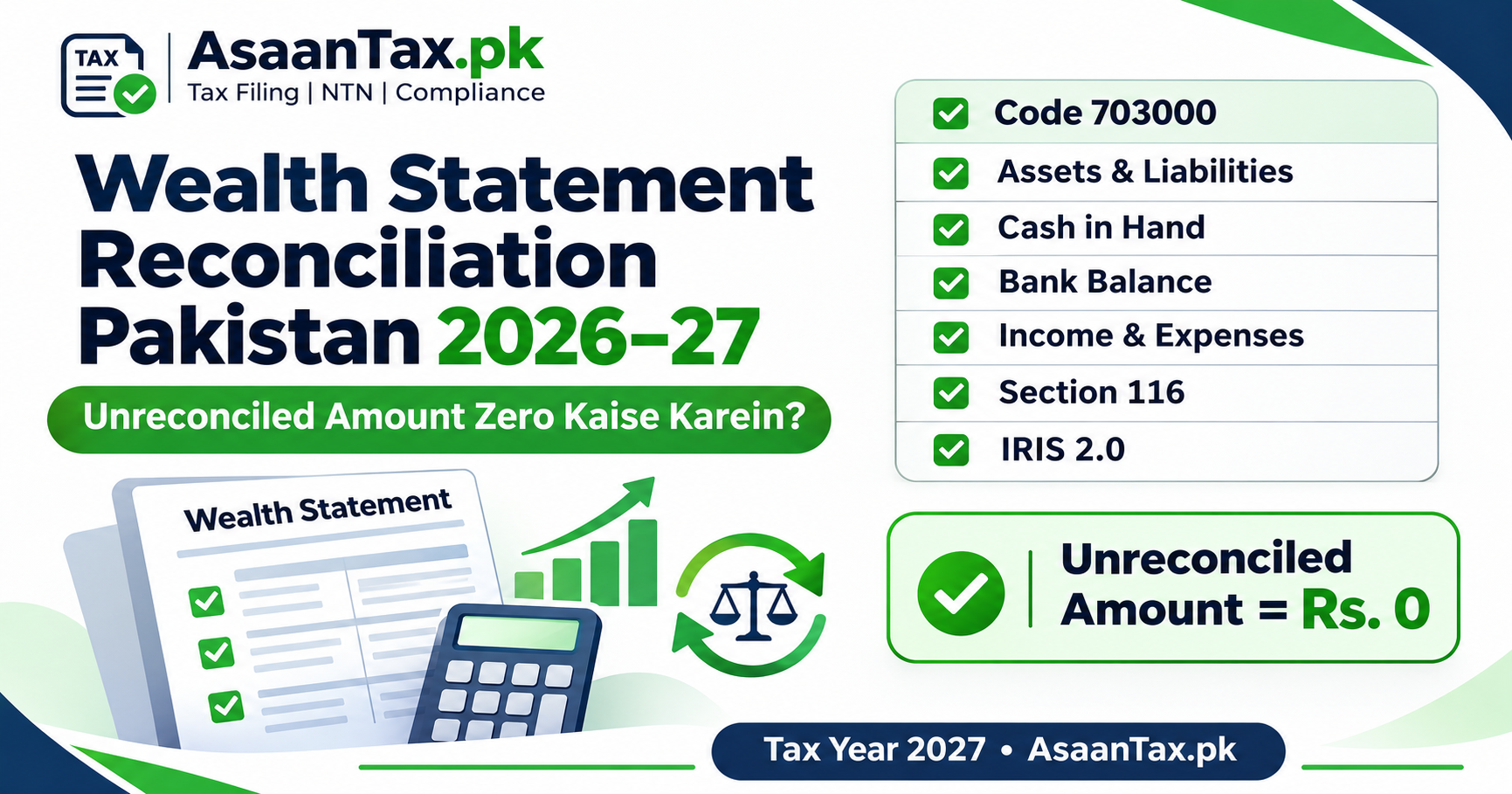
Are you filing your income tax return in Pakistan but receiving the error “Unreconciled Amount against Code 703000 must be zero before submission” in FBR IRIS?
This is one of the most common problems taxpayers face while preparing their annual Wealth Statement.
The error usually means that the change in your net assets and liabilities does not match the difference between your reported financial inflows and outflows.
The solution is not simply to enter a random amount in cash in hand or change your personal expenses until the difference disappears.
A properly reconciled Wealth Statement must accurately reflect your actual assets, liabilities, income, expenses and other legitimate financial transactions.
In this step-by-step guide, AsaanTax.pk explains the Wealth Statement reconciliation process under Section 116 of the Income Tax Ordinance, 2001, how to understand IRIS reconciliation codes, how to find missing entries and how to correct an Unreconciled Amount.
This guide is relevant to Tax Year 2026 and preparing for Tax Year 2027.
What Is an FBR Wealth Statement?
A Wealth Statement is a declaration of a taxpayer's assets, liabilities and financial position for the relevant tax year.
It is generally prepared along with the income tax return under Section 116 of the Income Tax Ordinance, 2001.
A Wealth Statement may include:
- Residential and commercial properties.
- Plots, agricultural land and other immovable assets.
- Motor vehicles.
- Bank accounts and closing balances.
- Cash in hand.
- Investments, shares and securities.
- Business capital or investment.
- Provident fund and other relevant balances.
- Loans and financial liabilities.
- Relevant assets or liabilities concerning dependents, as required by law.
- Personal and household expenses.
- Other reportable financial transactions.
The statement helps explain the taxpayer's financial position and changes in wealth from one year to the next.
What Is Wealth Statement Reconciliation?
Wealth Statement reconciliation is the process of matching the increase or decrease in net wealth with the taxpayer's genuine financial inflows and outflows during the year.
FBR's official guidance explains that a Wealth Statement must reconcile before successful submission.
In simple terms:
Change in Net Wealth = Net Financial Inflows
Where:
Change in Net Wealth = Current Year's Net Wealth − Previous Year's Net Wealth.
Net Financial Inflows = Relevant Inflows − Relevant Outflows.
Therefore:
Unreconciled Amount = Change in Net Wealth − Net Financial Inflows
If the figures are correctly reported, the difference should be zero.
Understanding FBR IRIS Reconciliation Codes
FBR's IRIS documentation identifies the following reconciliation codes.
| IRIS Code | Description |
|---|---|
| 703000 | Unreconciled Amount |
| 703001 | Net Assets – Current Year |
| 703002 | Net Assets – Previous Year |
| 703003 | Difference in Net Assets |
The reconciliation also uses relevant inflow and outflow information entered elsewhere in the Wealth Statement.
Older IRIS forms and guides use these codes. The current return form's displayed descriptions and available fields should always be checked because the user interface may change.
Why Does the Unreconciled Amount Appear?
An unreconciled amount generally arises when:
- Current-year assets are incomplete or incorrect.
- Previous-year wealth is entered incorrectly.
- Bank balances do not match supporting statements.
- Cash in hand is inaccurate.
- Personal expenses are omitted.
- Income or other inflows are missing.
- Loans are recorded incorrectly.
- A property or vehicle purchase is entered in the wrong way.
- Gifts or inheritance are misclassified.
- An asset sale or transfer is not properly reflected.
- Foreign remittance records are missing or misclassified.
- The same receipt or payment has been counted more than once.
The correct solution depends on identifying the actual difference.
Step-by-Step Guide to Fix Unreconciled Amount in IRIS 2.0
Step 1: Log In to FBR IRIS
Visit the official portal:
Enter your registered credentials.
Step 2: Open the Relevant Tax Return
Select the correct tax year.
For example:
Tax Year 2026 generally covers July 1, 2025 to June 30, 2026.
Tax Year 2027 generally covers July 1, 2026 to June 30, 2027.
The Tax Year 2027 period has not yet ended as of November 2026.
Step 3: Open the Wealth Statement
Navigate to the relevant Wealth Statement or Personal Assets/Liabilities section.
Depending on the IRIS interface, the reconciliation page may appear under:
Personal Assets / Liabilities / Receipts / Expenses → Reconciliation of Net Assets
Step 4: Check Previous Year's Wealth
Verify the brought-forward net assets from the previous Wealth Statement.
The previous year's closing financial position should normally agree with the current year's opening figures, subject to any legally valid corrections.
Step 5: Enter Current-Year Assets
Record all relevant assets and their correct amounts.
Step 6: Enter Current-Year Liabilities
Include genuine outstanding debts and obligations as of the reporting date.
Step 7: Review Inflows
Check taxable income, exempt income, genuine gifts, foreign transfers and other relevant inflows.
Step 8: Review Outflows
Check personal expenses, relevant taxes paid, gifts given and other genuine outflows.
Step 9: Click Calculate
Use the current form's calculation facility.
Step 10: Examine the Difference
If Code 703000 is not zero, compare the figures to your supporting records.
Step 11: Correct the Actual Error
Adjust the relevant entry only after finding a genuine omission, misclassification, duplication or calculation error.
Step 12: Recalculate and Submit
Once the statement is accurate and fully reconciled, complete the required IRIS submission and keep the acknowledgment.
Example 1: Correct Wealth Statement Reconciliation
Suppose a salaried individual has the following financial position.
| Description | Amount |
|---|---|
| Previous Net Wealth | Rs. 2,000,000 |
| Current Net Wealth | Rs. 2,800,000 |
| Increase in Wealth | Rs. 800,000 |
| Relevant Annual Inflows | Rs. 1,500,000 |
| Relevant Outflows | Rs. 700,000 |
| Net Financial Inflows | Rs. 800,000 |
| Unreconciled Amount | Rs. 0 |
Calculation:
Increase in Wealth = Rs. 2,800,000 − Rs. 2,000,000 = Rs. 800,000.
Net Inflows = Rs. 1,500,000 − Rs. 700,000 = Rs. 800,000.
Unreconciled Amount = Rs. 800,000 − Rs. 800,000.
Result: Rs. 0
The reconciliation balances.
Example 2: Unreconciled Amount of Rs. 200,000
Suppose IRIS displays:
| Description | Amount |
|---|---|
| Previous Net Wealth | Rs. 1,500,000 |
| Current Net Wealth | Rs. 2,300,000 |
| Increase in Wealth | Rs. 800,000 |
| Reported Inflows | Rs. 1,200,000 |
| Reported Outflows | Rs. 600,000 |
| Net Inflows | Rs. 600,000 |
| Unreconciled Amount | Rs. 200,000 |
The difference is Rs. 200,000.
The taxpayer should investigate the actual financial records.
For example, suppose a previously omitted, properly documented tax-exempt receipt of Rs. 200,000 is discovered.
If it legitimately belongs in the relevant inflow category and has not already been included elsewhere, recording it correctly may reconcile the statement.
However, if the discrepancy is actually caused by an overstated asset, the asset figure must be corrected instead.
Do not invent a receipt merely to eliminate the difference.
Positive vs Negative Unreconciled Amount
Positive Unreconciled Amount
Under the basic reconciliation formula, a positive difference indicates that the reported increase in wealth exceeds the recorded net inflows.
Possible explanations include:
- Missing income or other legitimate inflow.
- Overstated closing assets.
- Understated opening assets.
- Overstated expenses.
- Incorrect liability balances.
Negative Unreconciled Amount
A negative difference generally indicates that reported net inflows exceed the recorded increase in wealth.
Possible explanations include:
- Missing personal expenses.
- Understated closing assets.
- Overstated opening assets.
- Missing outflows.
- Incorrectly reported receipts.
- Incorrect loan or liability movements.
These are diagnostic examples, not automatic correction instructions.
The correct adjustment must be supported by evidence.
How to Enter Cash in Hand Correctly
Cash in hand refers to the taxpayer's genuine cash balance on the relevant reporting date.
For a normal June 30 tax year, this is usually the actual position as of June 30.
A taxpayer should not treat cash in hand as a convenient balancing figure.
Example
Opening cash in hand: Rs. 200,000.
Additional actual cash received during the year: Rs. 500,000.
Cash spent or deposited into bank accounts: Rs. 450,000.
Closing cash in hand: Rs. 250,000.
The closing amount should be recorded consistently with the other reported transactions.
Common Cash Mistakes
- Entering cash that does not actually exist.
- Forgetting cash withdrawn and spent.
- Counting a bank withdrawal as new income.
- Adding a large cash amount with no supporting source.
- Carrying forward an incorrect opening cash balance.
Cash in hand should be determined from real financial records.
How to Reconcile Bank Balances
Bank balances are another major cause of differences.
The closing balance in the Wealth Statement should agree with the relevant bank records for the reporting date.
Example
A person has two bank accounts:
| Bank Account | Closing Balance |
|---|---|
| Bank A | Rs. 350,000 |
| Bank B | Rs. 150,000 |
| Total | Rs. 500,000 |
The reported balances should collectively reflect the taxpayer's actual position.
Important: Bank Transfers Are Not Automatically Income
Suppose a taxpayer transfers Rs. 400,000 from Bank A to Bank B.
This is ordinarily an internal movement of funds, not an additional Rs. 400,000 of income.
If both accounts belong to the taxpayer, the transfer should not be counted twice as new financial resources.
Similarly, cash withdrawn from a bank account and held at home normally changes the form of the asset rather than creating new wealth.
How to Enter Property in a Wealth Statement
Property should be disclosed according to the relevant tax-year form, valuation instructions and supporting records.
Relevant details may include:
- Property type.
- Location.
- Ownership share.
- Acquisition date.
- Acquisition cost.
- Relevant additional costs.
- Current market value where required by the form.
Acquisition Cost vs Market Value
Acquisition cost and market value are not the same.
FBR's September 2025 clarification stated that the additional market-value field was not used in ordinary wealth reconciliation calculations.
Therefore, market-value disclosures should not be confused with the amount used in the reconciliation of net assets.
Always follow the current year's official form instructions.
Example
A person purchased a plot for Rs. 3,000,000 in an earlier year.
Its present estimated market value is Rs. 5,000,000.
The person should not automatically increase the reconciliation value by Rs. 2,000,000 merely because market prices have risen.
The actual reporting treatment depends on the prescribed asset fields and valuation rules.
How to Reconcile a New Property Purchase
Suppose a taxpayer purchases property for Rs. 5,000,000 during the year.
The taxpayer finances it through:
- Existing bank savings: Rs. 2,000,000.
- A genuine bank loan: Rs. 3,000,000.
The purchase does not automatically mean that the person's net wealth increased by Rs. 5,000,000.
The property becomes an asset, but the bank funds used decrease and the outstanding loan is a liability.
The taxpayer should accurately report the property, remaining bank balance and loan.
Important Principle
Buying an asset is not the same as earning income.
The reconciliation must correctly show how the acquisition was financed.
How to Report a Car Purchased During the Year
If a person purchases a vehicle, they should disclose the asset according to the relevant reporting rules.
Suppose a car costs Rs. 3,000,000.
If it is purchased using existing savings, the car increases one asset category while cash or bank deposits decrease.
If financed, the outstanding genuine liability must also be considered.
Do not treat the full vehicle purchase price as an ordinary personal expense while also declaring the vehicle as a closing asset unless the form and applicable rules specifically require separate entries for different components.
How to Enter Loans and Liabilities
Genuine loans can significantly affect the wealth calculation.
Examples include:
- Housing finance.
- Vehicle financing.
- Bank loans.
- Documented personal loans.
- Other genuine outstanding obligations.
Example
A person receives a genuine bank loan of Rs. 1,000,000.
If the entire amount remains in the bank at year-end, assets have increased by Rs. 1,000,000 and liabilities have also increased by Rs. 1,000,000.
The net wealth has not increased merely because the loan was received.
Documents to Keep
- Loan agreement.
- Bank statement.
- Disbursement confirmation.
- Repayment schedule.
- Outstanding balance certificate.
A fabricated loan must never be used to balance a Wealth Statement.
How to Report Gifts and Inheritance
Genuine gifts and inheritance may explain changes in financial position.
However, their tax treatment and documentation requirements depend on the actual transaction and relevant legislation.
For a genuine gift, supporting records may include:
- Donor's identity.
- Relationship.
- Gift documentation.
- Bank transfer evidence.
- Evidence of the donor's source of funds, where relevant.
For inheritance, useful records may include succession documents, transfer records and the underlying asset information.
A gift or inheritance should not be entered merely to offset an unexplained amount.
The transaction must genuinely have occurred.
How to Report Foreign Remittances
Money received from abroad requires correct classification.
Examples include:
- Transfer of a person's own overseas savings.
- Family maintenance.
- Genuine gift.
- Foreign salary income.
- Export-of-services receipts.
- Business income.
These categories may have different legal and tax treatment.
Where relevant, keep:
- Foreign bank records.
- Pakistani bank statements.
- Transfer confirmations.
- PRCs or equivalent banking documents.
- Supporting evidence of the source.
A foreign transfer does not become tax-free business income simply because it came through a banking channel.
Likewise, Section 111(4)'s conditions should not be confused with a general exemption for every foreign remittance.
How to Enter Personal and Household Expenses
Personal expenses are essential to wealth reconciliation.
Examples include:
- Food and groceries.
- Utility bills.
- House rent.
- Education expenses.
- Healthcare expenses.
- Travel expenses.
- Personal transport costs.
- Household maintenance.
- Other genuine family spending.
Example
| Personal Expense | Annual Amount |
|---|---|
| Groceries and food | Rs. 360,000 |
| Electricity, gas and internet | Rs. 180,000 |
| Education | Rs. 240,000 |
| Medical expenses | Rs. 60,000 |
| Transport and fuel | Rs. 120,000 |
| Other household expenses | Rs. 140,000 |
| Total | Rs. 1,100,000 |
These are illustrative figures only.
Report genuine expenditure consistent with your records.
Important Warning
Do not enter zero personal expenses when the taxpayer actually incurred household costs.
Similarly, do not create exaggerated personal expenses merely to clear a negative unreconciled balance.
How to Report Income Tax Paid
Income tax paid or withheld can be relevant to the wealth reconciliation depending on how the related income and taxes are reported.
Examples include:
- Salary tax deducted by an employer.
- Advance tax paid.
- Tax on relevant investments.
- Other applicable income tax payments.
Example
Gross salary: Rs. 2,000,000.
Income tax withheld: Rs. 150,000.
Net salary received: Rs. 1,850,000.
If gross income is recorded in the inflow calculation, the related tax deducted must be accounted for consistently under the applicable IRIS form.
Do not double-count salary tax as both an income reduction and a separate outflow.
Follow the tax year's instructions and reconcile with the employer's salary certificate.
How to Reconcile a Salaried Person's Wealth Statement
Suppose a salaried taxpayer has:
| Description | Amount |
|---|---|
| Opening Net Wealth | Rs. 1,500,000 |
| Annual Salary and Other Valid Inflows | Rs. 2,000,000 |
| Relevant Tax Payments | Rs. 150,000 |
| Household Expenses | Rs. 1,050,000 |
| Total Outflows | Rs. 1,200,000 |
| Increase in Net Wealth | Rs. 800,000 |
| Closing Net Wealth | Rs. 2,300,000 |
| Unreconciled Amount | Rs. 0 |
The example assumes no other changes, adjustments or reportable transactions.
This shows how annual income, taxes, expenses and net wealth can reconcile.
How to Reconcile a Business Owner's Wealth Statement
Business taxpayers may need to account for additional financial movements.
Examples include:
- Business capital introduced.
- Business drawings.
- Partnership capital.
- Loans given to or received from a business.
- Profit allocated to a taxpayer.
- Investments in business assets.
- Changes in business equity.
Business turnover is not the same as personal income.
Similarly, withdrawing money from a business may not create new income if the amount has already been recognized or represents withdrawal of existing capital.
Care should be taken to prevent double counting between the business records and the individual's personal Wealth Statement.
How to Handle Assets of Spouse and Dependents
Section 116 provides rules concerning disclosure of relevant family and dependent financial information.
The correct treatment depends on ownership, dependency and the applicable statutory provisions.
A taxpayer should not automatically declare all property owned independently by an earning spouse as the taxpayer's own asset.
However, assets funded or transferred by the taxpayer to dependents can require disclosure.
Identify legal ownership and the actual funding source before completing the form.
Can You Change Previous Year's Wealth Statement?
Sometimes the unreconciled amount arises because an earlier year's financial information was incorrect.
For example:
- A bank balance was entered incorrectly.
- A genuine asset was omitted.
- An outstanding liability was incorrectly recorded.
- A previous-year cash balance was overstated.
A taxpayer must not simply change the previous year's balance in the current year without considering the proper correction process.
Section 116(3) contains provisions governing revision of a Wealth Statement.
The law includes conditions regarding the nature of the correction, revised reconciliation, reasons for revision and the applicable time limit.
FBR also warned in September 2026 against improper revisions of historic wealth statements to introduce assets that were never genuinely declared or supported.
A previous-year correction must reflect a bona fide omission or error, not a fabricated explanation for unexplained assets.
Can a Wealth Statement Be Revised After Submission?
A Wealth Statement may be revised under the applicable Section 116 provisions.
However, the availability and procedure depend on factors including:
- The relevant tax year.
- The reason for revision.
- Whether the correction is genuine.
- Any applicable notice or proceeding.
- The statutory revision time limit.
- The required revised reconciliation and explanation.
A taxpayer should not assume that an unlimited number of changes can be made to historic records at any time.
For significant corrections, obtain qualified professional guidance before proceeding.
Does Zero Unreconciled Amount Mean FBR Has Approved Everything?
No.
A zero unreconciled amount shows that the figures entered into the reconciliation mathematically balance.
It does not automatically establish that:
- Every source of income is genuine.
- Every asset was reported correctly.
- Every loan is legally supportable.
- Every tax exemption was correctly claimed.
- All previous years are accurate.
- No further FBR inquiry can arise.
FBR may still examine underlying records under the applicable law.
Therefore, the goal should be accurate and documented reconciliation, not merely achieving zero through arbitrary entries.
Common Wealth Statement Reconciliation Mistakes
Taxpayers should avoid the following errors:
- Entering fictitious cash in hand.
- Using an incorrect previous-year net wealth figure.
- Forgetting bank accounts.
- Counting transfers between own accounts as new income.
- Declaring a financed car without its outstanding liability.
- Entering undocumented loans.
- Claiming fake gifts or remittances.
- Omitting household expenses.
- Double-counting tax deducted from salary.
- Confusing purchase cost with current market value.
- Treating business turnover as personal income.
- Incorrectly recording property sales.
- Changing historic statements without proper legal justification.
- Submitting the return without confirming that the Wealth Statement is complete.
Documents Needed for Wealth Statement Reconciliation
| Document | Purpose |
|---|---|
| Previous Wealth Statement | Verify opening assets and liabilities |
| Bank Statements | Confirm account balances and transfers |
| Salary Certificate | Reconcile salary and withholding |
| Business Records | Reconcile profit, capital and drawings |
| Property Documents | Verify acquisition and disposal |
| Vehicle Documents | Confirm vehicle cost and ownership |
| Loan Statements | Determine outstanding liabilities |
| Investment Records | Confirm investment balances |
| Remittance Documents | Support foreign transactions |
| Gift or Inheritance Records | Support genuine non-income receipts |
| Expense Records | Verify household and other spending |
| Previous Income Tax Return | Ensure reporting consistency |
Keep the records relevant to the tax year and the actual transactions.
What If Unreconciled Amount Still Does Not Become Zero?
If your Wealth Statement continues to show a difference:
First: Recheck Opening Wealth
Compare with the properly filed previous year's statement.
Second: Verify Closing Assets
Review property, vehicles, investments, cash and bank balances.
Third: Review Liabilities
Check bank loans and other legitimate outstanding obligations.
Fourth: Reconcile All Inflows
Identify income, savings movements, gifts, inheritance and other genuine transactions.
Fifth: Reconcile All Outflows
Check household expenses, taxes, transfers and other payments.
Sixth: Identify Duplicates
Remove duplicate entries only where they genuinely represent the same transaction.
Seventh: Review the Actual Records
If the difference cannot be explained, do not insert unsupported balancing amounts.
Seek professional help to reconstruct the correct transaction history.
Watch Wealth Statement Tutorials – Tax with Naeem
For practical tax education in Urdu, explore Tax with Naeem, a YouTube channel covering FBR income tax returns, IRIS, Wealth Statements, property declarations and tax compliance.
Find Wealth Statement and Reconciliation tutorials from Tax with Naeem:
https://www.youtube.com/results?search_query=Tax+with+Naeem+Wealth+Statement+Reconciliation
Topics to look for include:
- Wealth Statement filing in FBR IRIS.
- Cash in hand and bank balance reporting.
- Property and vehicle declarations.
- Personal expense reconciliation.
- Correcting the Unreconciled Amount.
- Section 116 and income tax return filing.
Use the latest relevant tutorial because IRIS screens and filing requirements can change.
How AsaanTax.pk Helps With Wealth Statement Reconciliation
Are you unable to submit your FBR income tax return because the Wealth Statement shows an unreconciled amount?
AsaanTax.pk provides guidance and assistance with:
- Income tax return preparation.
- Wealth Statement reconciliation.
- Review of cash and bank balances.
- Property and vehicle declarations.
- Loan and liability reporting.
- Income and household expense reconciliation.
- Foreign remittance reporting.
- Previous-year wealth review.
- Section 116 documentation guidance.
- General FBR compliance.
The purpose is to prepare an accurate and legally supported Wealth Statement.
Need Help With Wealth Statement Reconciliation?
Visit AsaanTax.pk for guidance on Wealth Statement preparation, income tax return filing and reconciliation procedures.
Website: https://www.asaantax.pk/
AsaanTax.pk is an independent tax services provider and is not affiliated with the Federal Board of Revenue or the Government of Pakistan.
Official Sources and References
- FBR – Income Tax Ordinance, 2001
- FBR – How to File Income Tax Return and Reconcile Wealth
- FBR – IRIS 2.0
- FBR – IRIS Help and User Guides
- FBR – IRIS FAQ: Code 703000
- FBR – Video Tutorials
- FBR – Wealth Statement Revision Guidance
- FBR – September 2026 Warning on Improper Wealth Statement Revisions
Last updated: November 3, 2026.
Disclaimer: This article provides general educational guidance. The appropriate wealth statement entries depend on actual financial records, legal ownership, transaction classification, tax residency and the requirements of the relevant tax year's IRIS form. Never create fictitious cash, loans, gifts or other entries to force reconciliation. Seek qualified advice where material discrepancies or prior-year corrections exist.