Ireland Corporate Tax 12.5% in 2026: Why Tech Giants Choose Dublin — And What Individuals Pay
Published: November 11, 2026
Country: Ireland
Corporate Tax Year: Company accounting period
Personal Tax Year: January 1 – December 31, 2026
Tax Authority: Irish Revenue Commissioners
Applicable Legislation: Taxes Consolidation Act 1997, as amended
Ireland is one of Europe's leading locations for multinational investment, technology operations, software development and international business.
Companies in sectors such as cloud computing, pharmaceuticals, financial services and digital technology have established significant operations in Dublin and other parts of Ireland.
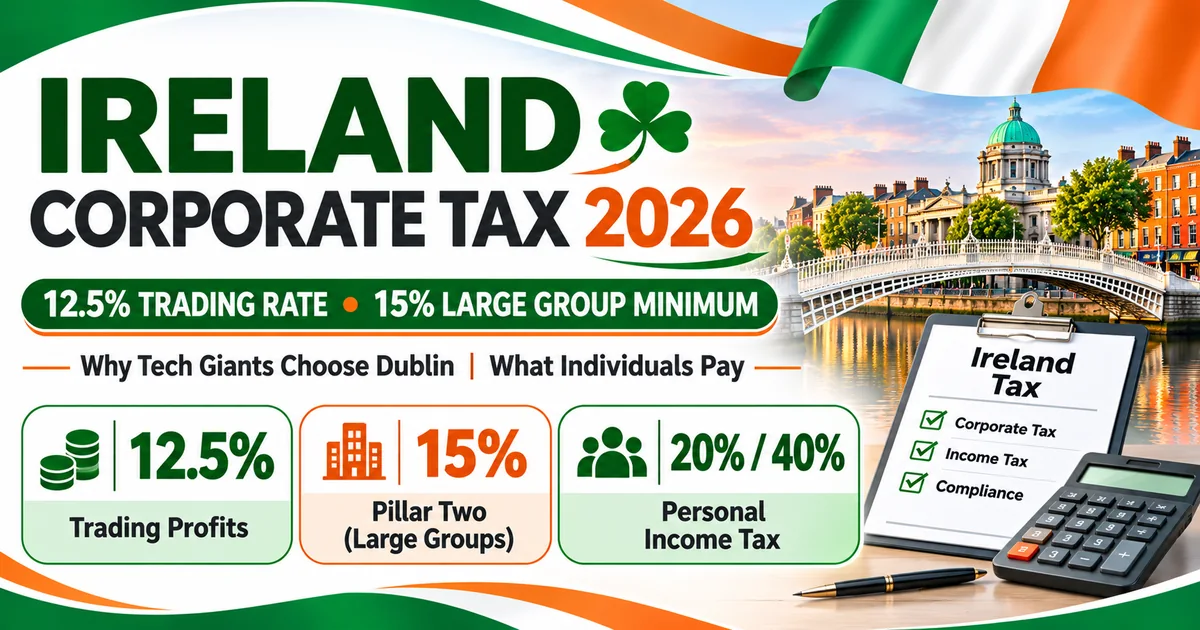
One important reason is Ireland's internationally competitive 12.5% Corporation Tax rate on qualifying trading profits.
However, this rate does not apply to every kind of company income.
Non-trading income, including certain rental and investment income, is generally taxed at 25%, while large multinational groups within the OECD Pillar Two framework are subject to a minimum effective tax rate of 15% under the relevant rules.
Individuals living and working in Ireland also face a separate tax system, including Income Tax at 20% and 40%, Universal Social Charge (USC) and Pay Related Social Insurance (PRSI).
This guide explains Ireland's 2026 Corporation Tax rates, why international technology businesses choose Dublin, the 15% minimum-tax rules, personal income taxes, salary calculations, business tax registration and filing deadlines.
1. What Is Ireland's Corporation Tax Rate in 2026?
Ireland generally applies two main Corporation Tax rates.
| Type of Company Income | Tax Rate |
|---|---|
| Qualifying Trading Income | 12.5% |
| Non-Trading Income | 25% |
| Certain Excepted Trading Income | 25% |
| Pillar Two Large-Group Minimum Effective Rate | 15% |
The 12.5% rate generally applies to qualifying profits from ordinary trading activities.
The 25% rate generally applies to specified non-trading income and excepted trades.
Pillar Two operates through a separate minimum-tax framework for qualifying large groups.
Important: Ireland has not replaced its general 12.5% trading rate with a universal 15% rate for every business.
2. How Does the 12.5% Corporate Tax Rate Work?
Corporation Tax is calculated on taxable profits rather than total turnover.
Example: Irish Software Company
Suppose a Dublin-based software company reports:
- Annual sales revenue: €1,000,000.
- Allowable business costs: €600,000.
- Taxable trading profits: €400,000.
Assuming the full profit qualifies for the 12.5% rate:
€400,000 × 12.5% = €50,000
The illustrative Corporation Tax is €50,000.
The calculation does not apply 12.5% to the company's total €1 million revenue.
The actual taxable profit must be determined after applicable tax adjustments, capital allowances and other relevant rules.
3. When Does Ireland Charge 25% Corporation Tax?
Ireland's 25% Corporation Tax rate applies to certain types of income.
Examples can include:
- Non-trading rental income.
- Certain investment income.
- Relevant passive income.
- Income from excepted trading activities.
Example: Company Rental Income
An Irish company earns €100,000 in taxable non-trading rental income.
Assuming the 25% rate applies:
€100,000 × 25% = €25,000.
The illustrative Corporation Tax is €25,000.
A company earning both trading and non-trading income may need to calculate the applicable amounts separately.
4. What Is Ireland's 15% Minimum Corporation Tax?
Ireland participates in the OECD Pillar Two international minimum-tax framework.
The rules are intended to ensure that qualifying large multinational enterprise groups and large-scale domestic groups pay a minimum effective tax rate of 15% on relevant profits in each jurisdiction, subject to the detailed rules.
Who Is Generally Covered?
The framework generally concerns groups with consolidated annual revenue of at least:
€750 million in at least two of the preceding four fiscal years.
Ireland implements relevant rules including:
- Income Inclusion Rule (IIR).
- Undertaxed Profits Rule (UTPR).
- Domestic top-up tax.
These rules can create additional tax where the group's relevant effective tax rate falls below the minimum.
Important Distinction
A small independent Irish technology company with ordinary taxable trading profits is not automatically subject to the Pillar Two minimum simply because the company operates internationally.
The €750 million group revenue test and other statutory conditions must be examined.
5. Does the 15% Minimum Tax Eliminate Ireland's 12.5% Rate?
No.
The ordinary 12.5% trading tax remains an important part of Ireland's Corporation Tax system.
Pillar Two introduces a separate minimum effective taxation framework for qualifying groups.
Comparison
| Business | General Tax Treatment |
|---|---|
| Small qualifying trading company | Generally 12.5% |
| Qualifying company with non-trading income | Generally 25% on that income |
| Large group within Pillar Two | 15% minimum effective framework |
| Company with qualifying R&D expenditure | Relevant credits may apply |
| Company earning chargeable capital gains | Separate chargeable-gains rules may apply |
The effective tax rate calculation for a Pillar Two group is not always equivalent to simply multiplying accounting profit by 15%.
Covered groups must follow detailed adjustments, top-up tax and reporting provisions.
6. Why Do Tech Giants Choose Dublin?
Ireland's corporate tax regime is one reason multinational technology companies establish operations in Dublin.
However, tax rates alone do not explain Ireland's position as a major technology and foreign investment location.
Several business advantages contribute to its attractiveness.
Access to the European Union
Ireland is a member of the European Union and the Eurozone.
This provides businesses with access to European markets and a euro-denominated operating environment.
English-Speaking Business Environment
English is widely used for business, technology and international commercial operations.
This can simplify communication for companies serving global markets.
Skilled International Workforce
Ireland attracts professionals in software engineering, finance, research, biotechnology and related industries.
Established Technology Ecosystem
Dublin has developed a substantial technology services and multinational business ecosystem.
Government Investment Support
IDA Ireland supports international businesses considering investment and expansion in Ireland.
Research and Development Incentives
Eligible companies may access Irish R&D-related tax relief under the relevant legislation.
Established International Tax Framework
Ireland's corporate taxation system and extensive network of tax treaties can support qualifying cross-border operations.
These advantages make Dublin commercially attractive, but companies must still satisfy applicable employment, tax, regulatory and economic-substance requirements.
7. Which Technology Companies Have Operations in Ireland?
Ireland has hosted major international technology and digital services operations.
Examples include companies such as:
- Google.
- Microsoft.
- Apple.
- Meta.
- Amazon.
- Salesforce.
The precise legal structure, office location, employment footprint and tax treatment of each company differ.
It would be misleading to assume that every international technology business pays exactly 12.5% on all worldwide profits.
Multinational groups may be subject to special tax rules, foreign tax liabilities, transfer-pricing requirements and Pillar Two top-up taxes.
8. Ireland's Research and Development Tax Credit in 2026
Ireland provides tax incentives for qualifying research and development expenditure.
For 2026, the R&D Corporation Tax Credit rate increased from 30% to 35% under the relevant legislation.
The increased rate is an important consideration for qualifying research-intensive businesses.
Example
Suppose a qualifying technology company incurs €200,000 in eligible R&D expenditure.
At an illustrative credit rate of 35%:
€200,000 × 35% = €70,000.
The potential R&D credit is €70,000, subject to the statutory conditions and applicable claim calculation.
Important
Not every software development cost automatically qualifies as R&D.
A company must meet the relevant requirements concerning qualifying scientific or technological advancement, activities, expenditure and documentation.
The R&D credit is separate from the ordinary Corporation Tax rate.
9. Ireland's Knowledge Development Box
Ireland also provides a Knowledge Development Box (KDB) regime for qualifying profits derived from relevant intellectual property.
The relief is subject to detailed conditions concerning eligible assets, qualifying expenditure and the development of intellectual property.
A company should not assume that all software revenue or licensing income automatically qualifies.
The KDB is intended to reward qualifying innovation-related activity rather than merely the ownership of intangible assets.
Businesses should review the legislation and Revenue guidance for the applicable accounting period and effective rate.
10. How to Register a Company for Tax in Ireland
A company operating in Ireland may need to register for several tax obligations.
These can include:
- Corporation Tax.
- Value Added Tax (VAT).
- Employer PAYE.
- Relevant withholding obligations.
- Other activity-specific taxes.
General Registration Steps
- Establish the appropriate legal business structure.
- Complete the relevant company registration process.
- Identify the company's Irish tax residence and taxable activities.
- Register for Corporation Tax with Revenue.
- Review VAT registration requirements.
- Register for employer PAYE where employees are engaged.
- Set up accounting and payroll records.
- Register for the Revenue Online Service (ROS).
- Prepare preliminary tax calculations.
- File the required returns by the relevant deadlines.
The detailed requirements depend on the legal structure, ownership, business activity and any non-resident characteristics.
11. Corporation Tax Filing Deadline in Ireland
Irish companies generally file their Corporation Tax return using Form CT1 through the Revenue Online Service.
The standard deadline is nine months after the end of the accounting period, no later than the 23rd day of that ninth month for electronic filing.
Example
A company has an accounting year ending December 31, 2026.
Its ordinary electronic Corporation Tax return and balance payment deadline is:
September 23, 2027.
The company may also have preliminary Corporation Tax payment obligations before the accounting period ends.
Important
Preliminary Corporation Tax rules differ between small and large companies.
Businesses should not assume they can wait until the CT1 filing deadline to make every tax payment.
12. Preliminary Corporation Tax for Small and Large Companies
The timing and amount of preliminary Corporation Tax depend on company size and other conditions.
Small Companies
A qualifying small company, generally determined by reference to the prior accounting period's Corporation Tax liability, normally pays preliminary tax in one instalment before the accounting period ends.
Large Companies
Large companies may be required to pay preliminary Corporation Tax in two instalments.
For accounting periods longer than seven months, the first instalment is generally due in the sixth month and the second in the eleventh month, according to the relevant provisions.
Large companies should check the exact percentages and available calculation methods.
13. What Income Tax Do Individuals Pay in Ireland in 2026?
Ireland's personal Income Tax system differs from the Corporation Tax system.
For individuals, ordinary Income Tax rates are:
20% and 40%.
The amount taxed at each rate depends on the taxpayer's personal circumstances.
Ireland Income Tax Bands — 2026
| Taxpayer Category | Standard 20% Band |
|---|---|
| Single individual | First €44,000 |
| Single Person Child Carer Credit qualifying individual | First €48,000 |
| Married / civil partnership, one income | First €53,000 |
| Married / civil partnership, two incomes | €53,000 plus qualifying increase up to €35,000 |
Income above the applicable standard rate band is generally taxed at 40%.
For married couples or civil partners with two incomes, the additional band depends on the lower earner's income and the applicable conditions.
14. Ireland Income Tax Calculation on €60,000 Salary
Assume a single PAYE employee earns €60,000 of taxable salary in 2026.
The employee qualifies for:
- Single Person Tax Credit: €2,000.
- Employee Tax Credit: €2,000.
Income Tax Calculation
| Description | Amount |
|---|---|
| First €44,000 at 20% | €8,800 |
| Remaining €16,000 at 40% | €6,400 |
| Tax Before Credits | €15,200 |
| Single Person Credit | −€2,000 |
| Employee Credit | −€2,000 |
| Income Tax After Credits | €11,200 |
Illustrative annual Income Tax: €11,200.
This calculation excludes USC, PRSI, pension deductions, other credits and additional circumstances.
The employee's actual take-home pay will therefore be different.
15. What Are Ireland's Personal Tax Credits in 2026?
Ireland provides tax credits that can reduce the amount of Income Tax payable.
Common Tax Credits
| Credit | 2026 Amount |
|---|---|
| Single Person Tax Credit | €2,000 |
| Married Person / Civil Partner Credit | €4,000 |
| Employee PAYE Tax Credit | €2,000 |
| Earned Income Tax Credit | Up to €2,000 |
| Single Person Child Carer Credit | €1,900 |
| Rent Tax Credit — Single | Up to €1,000 |
| Rent Tax Credit — Jointly Assessed Couple | Up to €2,000 |
Availability depends on statutory eligibility.
A taxpayer cannot assume that every listed credit applies to them.
The Earned Income Tax Credit and Employee Tax Credit also have rules preventing unrestricted duplication.
16. What Is Universal Social Charge (USC)?
Universal Social Charge is a separate charge on relevant income in Ireland.
It is calculated independently of ordinary Income Tax and PRSI.
For 2026, the standard USC rates and bands are:
| Annual Income Portion | USC Rate |
|---|---|
| First €12,012 | 0.5% |
| Next €16,688 | 2% |
| Next €41,344 | 3% |
| Balance | 8% |
The general annual USC exemption threshold is €13,000.
Where total income exceeds that threshold, USC may be calculated on the full relevant income rather than only the amount over €13,000.
Reduced rates and special rules may apply to qualifying individuals.
17. USC Example on €60,000 Annual Income
Assume a taxpayer has €60,000 of income fully subject to the standard USC rates.
| Income Portion | Rate | USC |
|---|---|---|
| €12,012 | 0.5% | €60.06 |
| €16,688 | 2% | €333.76 |
| €31,300 | 3% | €939.00 |
| Total | €1,332.82 |
Illustrative USC: €1,332.82.
Combined with the earlier Income Tax illustration:
Income Tax: €11,200.
USC: €1,332.82.
Combined Income Tax and USC: €12,532.82, before PRSI and any other adjustments.
18. What Is PRSI in Ireland?
Pay Related Social Insurance (PRSI) is another important payroll-related obligation.
PRSI helps finance relevant Irish social insurance benefits.
The amount depends on:
- Employment classification.
- Relevant PRSI class.
- Earnings.
- Applicable rate period.
- Relevant credits and exceptions.
October 2026 PRSI Change
For many employees under PRSI Class A, the employee contribution rate increased from 4.20% to 4.35% on October 1, 2026, subject to the relevant earnings bands and credits.
Employer PRSI rates were also adjusted.
Self-employed persons generally have different PRSI obligations, including Class S.
Important: PRSI is separate from Income Tax and USC.
Employees calculating take-home salary should account for all three.
19. What Is the Maximum Personal Income Tax Rate in Ireland?
Ireland's ordinary higher Income Tax rate is 40%.
However, a person's marginal deductions can be higher after accounting for USC and PRSI.
For example, a higher-income employee may be subject to:
- 40% Income Tax on the relevant portion.
- USC at the applicable marginal rate.
- Employee PRSI under the applicable class.
The combined marginal deduction rate can therefore exceed 40%.
The exact result depends on earnings, tax credits, employment status and other factors.
20. Do Freelancers and Sole Traders Pay 12.5% Tax?
No.
A common misconception is that every person running a business in Ireland pays 12.5%.
The 12.5% Corporation Tax rate generally concerns qualifying company trading profits.
An individual operating as a sole trader normally falls under the personal income tax framework.
Self-employed business profits may therefore be subject to:
- Personal Income Tax.
- Universal Social Charge.
- PRSI.
- VAT obligations where relevant.
Example
A freelance software developer operates as a sole trader in Dublin.
The person earns €90,000 in business revenue and has €30,000 in allowable business costs.
Simplified business profit:
€90,000 − €30,000 = €60,000.
The €60,000 generally forms part of the individual's relevant taxable income.
The person should not automatically multiply the profit by the 12.5% company rate.
21. Ireland VAT Rates in 2026
Value Added Tax is separate from Corporation Tax and personal Income Tax.
For 2026, Ireland's standard VAT rate is 23%.
Reduced rates can apply to qualifying supplies.
VAT Registration Thresholds
| Type of Business | General Threshold |
|---|---|
| Relevant Services-Only Business | €42,500 |
| Relevant Goods-Supply Business | €85,000 |
Other thresholds and special rules may apply.
VAT registration is based on qualifying turnover and other relevant conditions, not simply on the amount of Corporation Tax payable.
Businesses must review whether their goods and services are taxable, exempt or subject to a reduced rate.
22. Does Ireland Tax Capital Gains?
Yes.
Ireland generally taxes relevant chargeable capital gains under its Capital Gains Tax framework.
The standard CGT rate is generally 33%, subject to applicable exceptions, reliefs and special rates.
The tax treatment of investments, property disposals and company-held assets can differ.
For companies, certain chargeable gains are handled under special Corporation Tax calculation provisions designed to reflect relevant capital gains tax treatment.
Therefore, a company's capital gain should not automatically be taxed at 12.5%.
23. What Happens When an Irish Company Pays Dividends?
Corporation Tax on company profits and income taxation of dividends are separate matters.
A company may pay tax on its relevant profits.
When after-tax profits are distributed to shareholders, the dividend may have additional tax consequences.
Irish dividend withholding tax is generally 25%, subject to available exemptions, reliefs and applicable treaty conditions.
The shareholder's final tax treatment depends on residence, circumstances and the applicable law.
A business owner should not assume that paying 12.5% Corporation Tax means a dividend can then be withdrawn without personal tax consequences.
24. Ireland Income Tax Filing Deadlines for 2026 Income
Ireland's individual tax year normally runs from January 1 to December 31.
The ordinary self-assessment filing deadline is generally October 31 in the year after the income year.
Important Dates
| Event | Date |
|---|---|
| Personal Tax Year Begins | January 1, 2026 |
| Personal Tax Year Ends | December 31, 2026 |
| Standard Self-Assessment Filing Deadline | October 31, 2027, subject to applicable non-working-day rules |
| Possible ROS Extension | Confirm once Revenue announces it |
Taxpayers should not assume that a later ROS extension will be the same every year.
For example, Revenue announced an extension to November 18, 2026 for eligible online filing and payment concerning the earlier 2025 personal income tax return.
That specific date should not automatically be used for 2026 income returns filed in 2027.
25. How to File an Irish Self-Assessment Tax Return
Self-employed taxpayers and other relevant individuals generally use the Revenue Online Service.
Step 1: Access Revenue
Visit the official Irish Revenue website.
Step 2: Sign In to ROS
Use the appropriate authorized account.
Step 3: Select the Relevant Income Tax Year
Choose the correct tax year.
Step 4: Review Income Sources
Identify relevant employment, business, rental and investment income.
Step 5: Calculate Allowable Expenses
Review expenses and deductions under the applicable provisions.
Step 6: Apply Relevant Tax Credits
Use credits for which the taxpayer is legally eligible.
Step 7: Review USC and PRSI
Confirm applicable social charges and contribution liabilities.
Step 8: Complete Form 11
Enter the required self-assessment details.
Step 9: Pay Any Tax Due
Review preliminary tax and balancing payment obligations.
Step 10: Submit and Retain Confirmation
Save official filing acknowledgments and supporting records.
26. Can Overseas Pakistanis Start Businesses in Ireland?
Pakistani nationals and other foreign investors may be able to establish businesses in Ireland, subject to company law, immigration requirements and regulatory restrictions.
However, incorporation alone does not automatically grant:
- Irish immigration permission.
- The right to reside in Ireland.
- An employment permit.
- Irish tax residency.
- Access to every tax incentive.
- Eligibility for the 12.5% rate on all income.
Important Considerations
- Suitable business structure.
- Relevant company registration requirements.
- Actual business operations and management.
- Corporate tax residency.
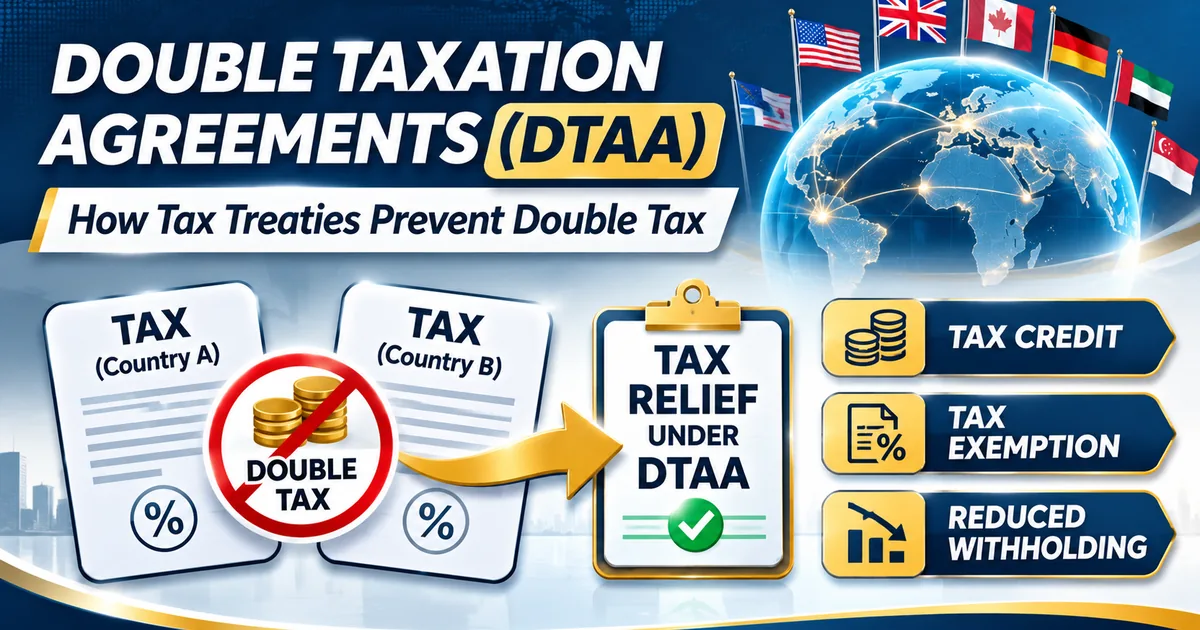
- International tax treaty considerations.
- Applicable visa and work-permit rules.
- VAT and payroll obligations.
- Proper accounting records.
A foreign entrepreneur should review both tax and immigration rules before launching operations.
27. Does Ireland Have a Double Taxation Treaty Network?
Ireland maintains an extensive international tax treaty network.
Treaties can help address certain cases of double taxation involving:
- Business profits.
- Employment income.
- Dividends.
- Interest.
- Royalties.
- Other qualifying income.
However, the availability of treaty benefits depends on the actual treaty, residence, beneficial ownership and relevant legal requirements.
A company cannot automatically obtain Irish treaty benefits merely by registering a corporate name or postal address.
Cross-border businesses should consider both Irish and foreign tax obligations.
28. Common Ireland Corporate Tax Mistakes to Avoid
- Assuming every Irish company pays 12.5% on all income.
- Applying the 12.5% rate to non-trading investment income.
- Believing every company is automatically subject to the 15% Pillar Two minimum.
- Confusing accounting profit with taxable trading profit.
- Assuming software development automatically qualifies for R&D credits.
- Overlooking preliminary Corporation Tax deadlines.
- Failing to file Form CT1 through the required system.
- Treating dividend withdrawals as automatically tax-free.
- Assuming the 12.5% company rate applies to sole traders.
- Ignoring USC when estimating personal income tax.
- Ignoring PRSI deductions.
- Applying a universal 20% personal Income Tax rate to all salary income.
- Forgetting available tax credits.
- Confusing VAT turnover with taxable profits.
- Ignoring international tax and transfer-pricing requirements.
- Assuming Ireland's corporate tax framework automatically creates immigration rights.
29. Ireland Tax Compliance Checklist for 2026
Before preparing a company or individual return:
- Identify the relevant legal structure.
- Determine corporate or individual tax residency.
- Separate trading and non-trading company income.
- Apply the correct Corporation Tax rate.
- Review whether Pillar Two applies.
- Identify qualifying R&D expenditure.
- Prepare accounting records.
- Review preliminary Corporation Tax obligations.
- Confirm the CT1 filing deadline.
- Review any VAT registration requirement.
- Determine applicable personal income tax bands.
- Apply relevant tax credits.
- Calculate Universal Social Charge.
- Review PRSI contributions.
- Reconcile payroll and tax payments.
- Check relevant foreign income.
- Verify applicable treaty benefits.
- Submit required returns on time.
- Retain supporting documentation.
30. Watch Tax With Naeem — Related Tax Education
For general educational guidance on business income, salary income, rental income, capital gains and return filing, watch the following video from the Tax With Naeem YouTube channel.
Related Video: Income Tax Return Filing in Pakistan — Salary, Rental Income, Capital Gains and Dividends Explained
https://www.youtube.com/watch?v=VX88o1N1AfA
This video is about Pakistan's income tax system, not Irish Corporation Tax or Irish Revenue filing.
It is included as supplementary education on income classification and return preparation.
For Irish tax calculations, readers should follow the official Irish Revenue rules.
31. Official Sources and References
1. Irish Revenue — Corporation Tax Rates
2. Irish Revenue — Pillar Two Rules
https://www.revenue.ie/en/companies-and-charities/pillar-two/what-is/pillar-two-rules.aspx
3. Irish Revenue — Corporation Tax Filing and Payment
4. Irish Revenue — Personal Income Tax Rates and Credits
https://www.revenue.ie/en/personal-tax-credits-reliefs-and-exemptions/tax-relief-charts/index.aspx
5. Irish Revenue — Universal Social Charge
https://www.revenue.ie/en/jobs-and-pensions/usc/standard-rates-thresholds.aspx
6. Ireland Department of Social Protection — PRSI Class A
https://www.gov.ie/en/department-of-social-protection/publications/prsi-class-a-rates/
7. Irish Revenue — Research and Development Tax Credit
8. Irish Revenue — VAT Rates
https://www.revenue.ie/en/vat/vat-rates/search-vat-rates/current-VAT-rates.aspx
9. Irish Revenue — Self-Assessment Filing
10. IDA Ireland — Foreign Direct Investment
11. AsaanTax.pk — International Tax Guides
12. Tax With Naeem — Related Tax Tutorial
https://www.youtube.com/watch?v=VX88o1N1AfA
32. Conclusion: Why Is Ireland Attractive to International Businesses?
Ireland continues to offer a competitive tax and business environment for qualifying companies.
The 12.5% Corporation Tax rate on trading profits remains an important feature of the Irish system.
However, the 25% rate on certain non-trading income and the 15% minimum effective tax rules for in-scope large groups show why Irish company taxation cannot be summarized using one rate alone.
Dublin's appeal also reflects EU market access, English-language business services, skilled workers, established technology infrastructure, foreign investment support and research incentives.
Individuals working in Ireland face a separate system involving 20% and 40% Income Tax rates, Universal Social Charge and PRSI contributions.
The most important distinction is that company trading profits, passive company income, large multinational group profits and personal salary income can all receive different tax treatment.
For more professional tax guides covering Ireland, the UK, USA, UAE, Canada, Australia, India, Saudi Arabia and Pakistan, visit AsaanTax.pk:
Editorial Note: This article reflects official Irish Revenue and government guidance reviewed as of November 11, 2026. Future filing deadlines and relief conditions should be checked against subsequent announcements.
Disclaimer: This content is provided for general educational purposes and does not constitute personalized tax, legal or investment advice. Individual obligations depend on tax residence, income classification, company structure, accounting periods and applicable legislation. Readers should consult Irish Revenue or a qualified Irish tax adviser before making material tax decisions.