IRS Tax Brackets 2026 USA: Federal Income Tax Rates and Standard Deduction
Published: November 10, 2026
Country: United States of America
Tax Year: January 1 – December 31, 2026
Tax Authority: Internal Revenue Service (IRS)
Standard Federal Filing Deadline: April 15, 2027
Official Reference: IRS Revenue Procedure 2025-32
Understanding the latest IRS tax brackets for 2026 is essential for employees, freelancers, self-employed individuals, married couples, small business owners and international taxpayers who have US federal income tax obligations.
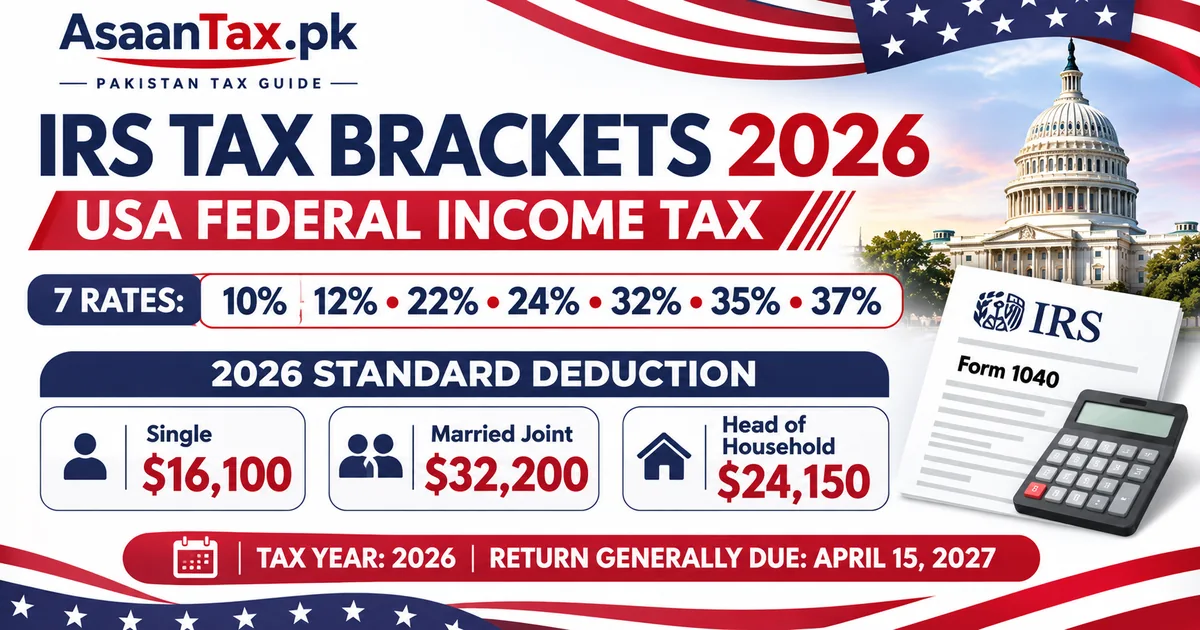
For Tax Year 2026, the United States retains seven federal individual income tax rates: 10%, 12%, 22%, 24%, 32%, 35% and 37%.
The IRS has also confirmed higher standard deduction amounts for 2026. The standard deduction is $16,100 for single filers, $32,200 for married couples filing jointly and $24,150 for heads of household.
These figures reflect inflation adjustments and federal tax law changes enacted under Public Law 119-21 in July 2025.
This guide explains the official 2026 tax brackets, deductions, filing statuses, marginal tax rates, tax calculations, new deductions for workers and seniors, estimated tax payments and IRS filing deadlines.
1. What Are the Federal Income Tax Rates for 2026?
The United States operates a progressive federal income tax system.
This means higher portions of taxable income are taxed at higher rates, rather than one rate applying to all earnings.
For 2026, the seven marginal rates are:
| Federal Tax Rate | Description |
|---|---|
| 10% | Lowest ordinary income tax bracket |
| 12% | Second bracket |
| 22% | Third bracket |
| 24% | Fourth bracket |
| 32% | Fifth bracket |
| 35% | Sixth bracket |
| 37% | Highest ordinary income tax bracket |
The income thresholds depend on filing status.
For example, a single taxpayer and a married couple filing jointly have different bracket limits.
Important: These are ordinary federal income tax rates. Special rates may apply to qualified dividends and long-term capital gains. State income taxes and payroll taxes are separate.
2. IRS Tax Brackets 2026 for Single Filers
The official 2026 brackets for single individuals are:
| Tax Rate | Taxable Income |
|---|---|
| 10% | $0–$12,400 |
| 12% | Over $12,400–$50,400 |
| 22% | Over $50,400–$105,700 |
| 24% | Over $105,700–$201,775 |
| 32% | Over $201,775–$256,225 |
| 35% | Over $256,225–$640,600 |
| 37% | Over $640,600 |
These thresholds apply to taxable income after relevant deductions, not necessarily gross salary.
Example
A single taxpayer has $80,000 in taxable income after deductions.
The first $12,400 is taxed at 10%.
The next $38,000 is taxed at 12%.
The remaining $29,600 is taxed at 22%.
Only the portion entering the 22% bracket is taxed at 22%.
3. IRS Tax Brackets 2026 for Married Filing Jointly
Married couples who qualify to file a joint federal income tax return generally use the following brackets:
| Tax Rate | Taxable Income |
|---|---|
| 10% | $0–$24,800 |
| 12% | Over $24,800–$100,800 |
| 22% | Over $100,800–$211,400 |
| 24% | Over $211,400–$403,550 |
| 32% | Over $403,550–$512,450 |
| 35% | Over $512,450–$768,700 |
| 37% | Over $768,700 |
Married filing jointly can provide different bracket thresholds and deduction opportunities compared with filing separately.
However, the appropriate filing status depends on individual circumstances and applicable legal requirements.
4. IRS Tax Brackets 2026 for Head of Household
Taxpayers who qualify for Head of Household filing status use the following brackets:
| Tax Rate | Taxable Income |
|---|---|
| 10% | $0–$17,700 |
| 12% | Over $17,700–$67,450 |
| 22% | Over $67,450–$105,700 |
| 24% | Over $105,700–$201,750 |
| 32% | Over $201,750–$256,200 |
| 35% | Over $256,200–$640,600 |
| 37% | Over $640,600 |
Head of Household status generally requires an eligible taxpayer to meet specific marital status, household-cost and qualifying-person tests.
Simply living with family members or paying household expenses does not automatically establish eligibility.
5. IRS Tax Brackets 2026 for Married Filing Separately
Married individuals filing separate federal income tax returns generally use these brackets:
| Tax Rate | Taxable Income |
|---|---|
| 10% | $0–$12,400 |
| 12% | Over $12,400–$50,400 |
| 22% | Over $50,400–$105,700 |
| 24% | Over $105,700–$201,775 |
| 32% | Over $201,775–$256,225 |
| 35% | Over $256,225–$384,350 |
| 37% | Over $384,350 |
Married filing separately can involve restrictions on deductions and credits.
Taxpayers should compare the legal consequences before selecting their filing status.
6. IRS Standard Deduction for Tax Year 2026
The standard deduction reduces the amount of income subject to federal income tax for eligible taxpayers.
For 2026, the IRS has confirmed the following amounts:
| Filing Status | Standard Deduction 2026 |
|---|---|
| Single | $16,100 |
| Married Filing Jointly | $32,200 |
| Married Filing Separately | $16,100 |
| Head of Household | $24,150 |
| Qualifying Surviving Spouse | $32,200 |
These are the basic standard deductions before applicable additional deductions for age or blindness.
What Does the Standard Deduction Mean?
Suppose an eligible single taxpayer earns $60,000 in wages.
If the taxpayer claims the basic standard deduction of $16,100:
$60,000 − $16,100 = $43,900.
The taxpayer's simplified taxable income is $43,900.
The relevant tax brackets are then applied to that taxable amount.
7. Standard Deduction 2025 vs 2026
The basic deduction amounts increased between the 2025 and 2026 tax years.
| Filing Status | 2025 | 2026 | Increase |
|---|---|---|---|
| Single | $15,750 | $16,100 | $350 |
| Married Filing Jointly | $31,500 | $32,200 | $700 |
| Married Filing Separately | $15,750 | $16,100 | $350 |
| Head of Household | $23,625 | $24,150 | $525 |
An increase in the standard deduction can reduce taxable income for eligible taxpayers.
However, the tax savings depend on the taxpayer's marginal rate, filing status and other tax circumstances.
8. How Does Progressive Federal Income Tax Work?
One of the most common mistakes is assuming that moving into a higher tax bracket causes all income to be taxed at the new rate.
That is not how the US progressive tax system works.
Example: Single Taxpayer With $60,000 Gross Salary
Assume:
- Annual wages: $60,000.
- Standard deduction: $16,100.
- No other income or adjustments.
- Filing status: Single.
Step 1: Calculate taxable income.
$60,000 − $16,100 = $43,900.
Step 2: Apply the first tax bracket.
$12,400 × 10% = $1,240.
Step 3: Apply the second tax bracket.
$43,900 − $12,400 = $31,500.
$31,500 × 12% = $3,780.
Step 4: Add the tax amounts.
$1,240 + $3,780 = $5,020.
Estimated federal income tax: $5,020.
The taxpayer is in the 12% marginal bracket but does not pay 12% on the entire $60,000 salary.
This simplified illustration excludes tax credits, payroll taxes, other deductions and additional income.
9. Federal Income Tax on a $100,000 Salary in 2026
Consider a single filer with:
- Gross annual salary: $100,000.
- Standard deduction: $16,100.
- No other adjustments.
Taxable income:
$100,000 − $16,100 = $83,900.
Calculation
| Taxable Income Portion | Rate | Tax |
|---|---|---|
| First $12,400 | 10% | $1,240 |
| Next $38,000 | 12% | $4,560 |
| Remaining $33,500 | 22% | $7,370 |
| Total | $13,170 |
Estimated federal income tax: $13,170.
Marginal Tax Rate vs Effective Tax Rate
Marginal rate: 22%.
Effective federal income tax rate measured against gross salary:
$13,170 ÷ $100,000 = 13.17%.
This demonstrates why a taxpayer's effective tax burden may be considerably lower than their highest marginal tax bracket.
10. Federal Income Tax Example for Married Filing Jointly
Assume a married couple filing jointly earns $100,000 in combined taxable wages before their standard deduction.
Standard deduction: $32,200.
Taxable income:
$100,000 − $32,200 = $67,800.
Calculation
First $24,800 taxed at 10%:
$2,480.
Remaining $43,000 taxed at 12%:
$5,160.
Total federal income tax:
$2,480 + $5,160 = $7,640.
Estimated federal income tax: $7,640.
This assumes the couple qualifies for the full basic standard deduction and has no other adjustments or credits.
11. Standard Deduction vs Itemized Deductions
Eligible taxpayers generally choose between the standard deduction and itemizing eligible expenses.
Common itemized deductions may include qualifying:
- Mortgage interest.
- State and local taxes, subject to applicable limitations.
- Charitable contributions.
- Medical expenses exceeding relevant thresholds.
- Other legally deductible expenses.
The most beneficial approach depends on the taxpayer's actual circumstances.
Taxpayers should compare the allowable itemized deduction total against the standard deduction.
Special rules apply to certain taxpayers, including some nonresident aliens and married individuals filing separately.
12. Additional Standard Deduction for Age 65 or Blindness
For Tax Year 2026, qualifying taxpayers who are age 65 or older or blind may receive an additional standard deduction.
The ordinary additional amount is:
| Eligible Category | Additional Amount |
|---|---|
| Married individual or qualifying surviving spouse | $1,650 per applicable condition |
| Unmarried individual who is not a qualifying surviving spouse | $2,050 per applicable condition |
A person who is both age 65 or older and blind may qualify for two additional amounts.
These ordinary additional standard deductions are separate from the newer senior deduction introduced under federal legislation.
13. Additional $6,000 Deduction for Eligible Seniors
Federal tax legislation provides a separate additional deduction of up to $6,000 for eligible individuals age 65 or older for tax years 2025 through 2028.
Eligible married couples may potentially claim up to $12,000 if both spouses qualify.
The deduction is subject to conditions, including income-based phaseouts.
The phaseout begins when modified adjusted gross income exceeds:
- $75,000 for relevant non-joint filers.
- $150,000 for married couples filing jointly.
Important: This enhanced senior deduction is not the same as the ordinary age-based additional standard deduction.
Eligible taxpayers may be able to benefit from both provisions.
14. Federal Tax Deductions for Tips and Overtime in 2026
Federal tax law introduced temporary deductions for certain qualified tips and overtime compensation.
Qualified Tips Deduction
Eligible taxpayers may deduct up to $25,000 of qualifying tips, subject to statutory conditions and income-based phaseouts.
Not every payment described as a tip qualifies.
Qualified Overtime Deduction
Eligible taxpayers may deduct up to:
- $12,500 for certain individual filers.
- $25,000 for married couples filing jointly.
The deduction generally concerns eligible overtime premium compensation, not automatically every dollar of overtime wages.
The relevant income limitations and reporting rules must be checked.
Important
The phrases "no tax on tips" and "no tax on overtime" should not be interpreted as universal exemptions from all federal and state taxes.
The applicable provisions are federal income tax deductions with eligibility limits and reporting requirements.
Payroll taxes may still apply.
15. Deduction for Qualified Car Loan Interest
Eligible taxpayers may deduct up to $10,000 of qualifying interest on certain loans used to purchase eligible new passenger vehicles for personal use.
The deduction is available for tax years 2025 through 2028 under the applicable legislation.
Eligibility depends on several factors, including:
- Vehicle eligibility.
- Final assembly requirements.
- Loan qualification.
- Personal-use conditions.
- Income limitations.
- Supporting documentation.
The deduction phases out above specified modified adjusted gross income thresholds.
It should not be assumed to cover every vehicle loan or lease payment.
16. Federal Income Tax vs State Income Tax
Federal income tax and state income tax are separate.
Some states impose individual income tax, while others do not impose a broad individual tax on wages.
Examples of states without a broad individual wage income tax include:
- Florida.
- Texas.
- Nevada.
- Washington.
- Wyoming.
However, specific taxes and state-level rules vary.
A person living in California or New York may face additional state income tax liabilities beyond federal tax.
State tax rules should therefore be evaluated separately.
17. What About Social Security and Medicare Taxes?
Federal income tax is not the same as payroll tax.
Employees may also be subject to Social Security and Medicare taxes.
The ordinary employee rates are generally:
- Social Security: 6.2%, subject to the annual wage base.
- Medicare: 1.45%, with additional Medicare tax potentially applicable at higher income levels.
Employers generally have separate matching obligations.
Self-employed individuals may have self-employment tax obligations.
As a result, calculating federal income tax alone does not determine a person's complete tax liability or take-home pay.
18. Do Freelancers and Self-Employed Individuals Use the Same IRS Brackets?
Sole proprietors and self-employed individuals generally use the applicable individual federal income tax brackets.
However, their taxable business income is normally determined after relevant allowable business expenses.
Example
A freelance consultant has:
- Annual business revenue: $90,000.
- Allowable business expenses: $20,000.
- Net business profit: $70,000.
The net business profit generally forms part of the federal income tax calculation, subject to adjustments and deductions.
The taxpayer may also owe self-employment tax.
The final taxable income and applicable tax will depend on the complete return.
A freelancer should not simply apply 22% or another bracket rate to gross business receipts.
19. IRS Estimated Tax Payments in 2026
Taxpayers who do not have enough federal income tax withheld may need to make estimated tax payments.
This can include:
- Freelancers.
- Sole proprietors.
- Independent contractors.
- Certain investors.
- Landlords.
- Other taxpayers with income not fully covered by withholding.
The general federal estimated tax deadlines for calendar-year 2026 are:
| Payment Period | Due Date |
|---|---|
| First Payment | April 15, 2026 |
| Second Payment | June 15, 2026 |
| Third Payment | September 15, 2026 |
| Fourth Payment | January 15, 2027 |
The actual obligation depends on expected tax liability, withholding, applicable safe harbors and other legal rules.
Some taxpayers may qualify for exceptions or different payment arrangements.
20. IRS Tax Filing Deadline for Tax Year 2026
For most calendar-year individual taxpayers, the federal income tax return for Tax Year 2026 is due:
April 15, 2027.
This return generally reports income earned from January 1 through December 31, 2026.
Important Filing Dates
| Requirement | Date |
|---|---|
| Tax Year Begins | January 1, 2026 |
| Tax Year Ends | December 31, 2026 |
| Standard Federal Return Deadline | April 15, 2027 |
| Standard Extended Filing Deadline | October 15, 2027 |
Extensions generally provide additional time to file, not additional time to pay tax already due.
Certain disaster-related or overseas filing relief provisions may apply.
21. How to File a US Federal Income Tax Return
The IRS offers several ways to file federal income tax returns.
Step 1: Determine Filing Status
Select the appropriate filing status under IRS requirements.
Step 2: Collect Income Documents
Gather available forms such as:
- Form W-2.
- Applicable Forms 1099.
- Investment statements.
- Self-employment records.
- Other taxable income documentation.
Step 3: Calculate Adjusted Gross Income
Include income and relevant adjustments.
Step 4: Determine Deductions
Compare the standard deduction with eligible itemized deductions.
Step 5: Calculate Taxable Income
Apply the appropriate deductions and tax rules.
Step 6: Apply Tax Brackets
Use the IRS tax rates for the relevant filing status.
Step 7: Review Tax Credits
Apply eligible tax credits where permitted.
Step 8: Account for Withholding
Subtract applicable tax already paid through withholding or estimated payments.
Step 9: File the Federal Return
Complete the applicable Form 1040 or other required return.
Step 10: Save the Confirmation
Retain the acknowledgment and supporting records.
Official IRS filing information: https://www.irs.gov/filing
22. Do Overseas Pakistanis in the United States Pay Federal Income Tax?
Pakistani citizens living or working in the United States may have federal tax obligations depending on their US tax residency, income sources and visa or immigration circumstances.
The rules differ for:
- US citizens.
- US tax residents.
- Green card holders.
- Certain nonresident aliens.
- Individuals with US-source income.
US citizens and resident aliens are generally subject to federal income tax rules on worldwide income, subject to applicable exclusions, deductions and tax credits.
Nonresident aliens have different sourcing, filing and deduction rules.
A person's Pakistani nationality alone does not determine whether US income tax applies.
Taxpayers with income in both Pakistan and the United States should also consider applicable double taxation rules.
23. Important Difference Between Tax Year 2026 and Tax Year 2027
Tax Year 2026 and Tax Year 2027 have different inflation-adjusted brackets and deductions.
Tax Year 2026: Income earned in 2026, generally filed in 2027.
Tax Year 2027: Income earned in 2027, generally filed in 2028.
The IRS announced separate inflation adjustments for Tax Year 2027 in November 2026.
Those newer amounts should not be used for a 2026 federal income tax return.
For example:
| Filing Status | 2026 Standard Deduction | 2027 Standard Deduction |
|---|---|---|
| Single | $16,100 | $16,600 |
| Married Filing Jointly | $32,200 | $33,200 |
| Head of Household | $24,150 | $24,925 |
Important: This article focuses on Tax Year 2026. Do not confuse the latest announcement date with the applicable tax year.
24. Common IRS Tax Calculation Mistakes
Taxpayers should avoid the following mistakes:
- Applying the highest marginal rate to all income.
- Using gross salary instead of taxable income.
- Using the wrong filing status.
- Applying 2025 brackets to Tax Year 2026.
- Confusing 2026 and 2027 standard deductions.
- Claiming an ineligible filing status.
- Ignoring income-based deduction phaseouts.
- Assuming all tips and overtime are universally tax-free.
- Confusing federal income tax with state income tax.
- Forgetting Social Security and Medicare taxes.
- Ignoring self-employment tax.
- Claiming unsupported business expenses.
- Failing to report relevant investment income.
- Missing estimated tax payments.
- Assuming a filing extension extends the payment deadline.
- Overlooking additional tax obligations connected with foreign income or assets.
25. Final IRS Tax Checklist for 2026
Before filing, confirm the following:
- Correct Tax Year 2026.
- Correct filing status.
- Total taxable income sources.
- Applicable standard deduction.
- Eligibility for itemized deductions.
- Additional deductions for age or blindness.
- Enhanced senior deduction where applicable.
- Qualified tips deduction, if eligible.
- Qualified overtime deduction, if eligible.
- Qualified car loan interest deduction, if eligible.
- Relevant tax credits.
- Federal income tax withholding.
- Estimated tax payments.
- Self-employment tax obligations.
- State income tax obligations.
- Foreign income or asset disclosures where applicable.
- April 15, 2027 filing and payment deadline.
- Supporting documents and records.
26. Watch Tax With Naeem — Income Tax Education
For general educational guidance on income tax return filing, income reporting and tax calculations, you can also watch content from Tax With Naeem.
Related Video: Income Tax Return Filing in Pakistan — Salary, Rental Income, Capital Gains and Dividends Explained
https://www.youtube.com/watch?v=VX88o1N1AfA
This video concerns Pakistan's income tax system, not the United States IRS system.
It is included as supplementary income tax education only.
For US federal income tax calculations, viewers should follow official IRS tax brackets, deductions and filing instructions.
27. Official IRS Sources and References
1. IRS — Revenue Procedure 2025-32, 2026 Tax Inflation Adjustments
https://www.irs.gov/irb/2025-45_IRB
2. IRS — Working Families Tax Cuts for Individuals
https://www.irs.gov/newsroom/working-families-tax-cuts-individuals-and-workers
3. IRS — Federal Income Tax Rates and Brackets
https://www.irs.gov/filing/federal-income-tax-rates-and-brackets
4. IRS — Publication 505, Tax Withholding and Estimated Tax
https://www.irs.gov/publications/p505
5. IRS — Federal Income Tax Return Filing
https://www.irs.gov/filing/individuals/how-to-file
6. IRS — Individual Tax Filing and Deadlines
https://www.irs.gov/individual-tax-filing
7. IRS — 2027 Inflation Adjustment Announcement
8. AsaanTax.pk — International Taxation Guides
9. Tax With Naeem — Related Tax Tutorial
https://www.youtube.com/watch?v=VX88o1N1AfA
28. Conclusion: What Are the IRS Tax Brackets and Standard Deduction for 2026?
The IRS has confirmed seven progressive federal individual income tax rates for Tax Year 2026, ranging from 10% to 37%.
The standard deduction is $16,100 for single filers, $32,200 for married couples filing jointly and $24,150 for eligible heads of household.
The actual federal income tax liability depends on taxable income, filing status, deductions, tax credits and other relevant provisions.
Higher earners do not pay their highest marginal rate on their entire income.
Taxpayers should also consider additional deductions introduced under recent federal legislation, including eligible relief for seniors, qualified tips, qualified overtime and certain vehicle loan interest.
The most important rule is to calculate taxable income first, select the correct filing status and then apply each tax bracket progressively.
For more professional guides on US federal taxes, UK Income Tax, UAE Corporate Tax, international taxation and Pakistan's FBR rules, visit AsaanTax.pk.
Editorial Note: Tax brackets and deduction amounts reflect official IRS guidance reviewed as of November 10, 2026. The figures apply to Tax Year 2026, generally filed in 2027.
Disclaimer: This article provides general educational information and does not constitute personalized tax advice. Individual liabilities may vary according to filing status, income, credits, deductions, residency and other circumstances. Consult official IRS guidance or a qualified US tax professional for specific situations.