Netherlands Box 3 Tax 2026: Why 36% Applies to Deemed Returns and the 30% Ruling Falls to 27% in 2027
Published: November 12, 2026
Country: Netherlands
Tax Year: 2026
Tax Authority: Belastingdienst (Dutch Tax Administration)
Major Changes: Box 3 taxation and the expatriate 30% ruling reduction in 2027
Introduction
The Netherlands has a distinctive personal income tax system that can affect residents, investors, property owners, foreign professionals and expatriate workers.
Two important tax topics deserve particular attention in 2026 and 2027.
The first is Box 3, the part of the Dutch income tax system that generally covers income from savings and investments.
The second is the 30% ruling, a special employment tax facility available to qualifying foreign employees recruited to work in the Netherlands.
A common misunderstanding is that the Netherlands directly charges 36% tax on the total value of a person's wealth.
That is incorrect.
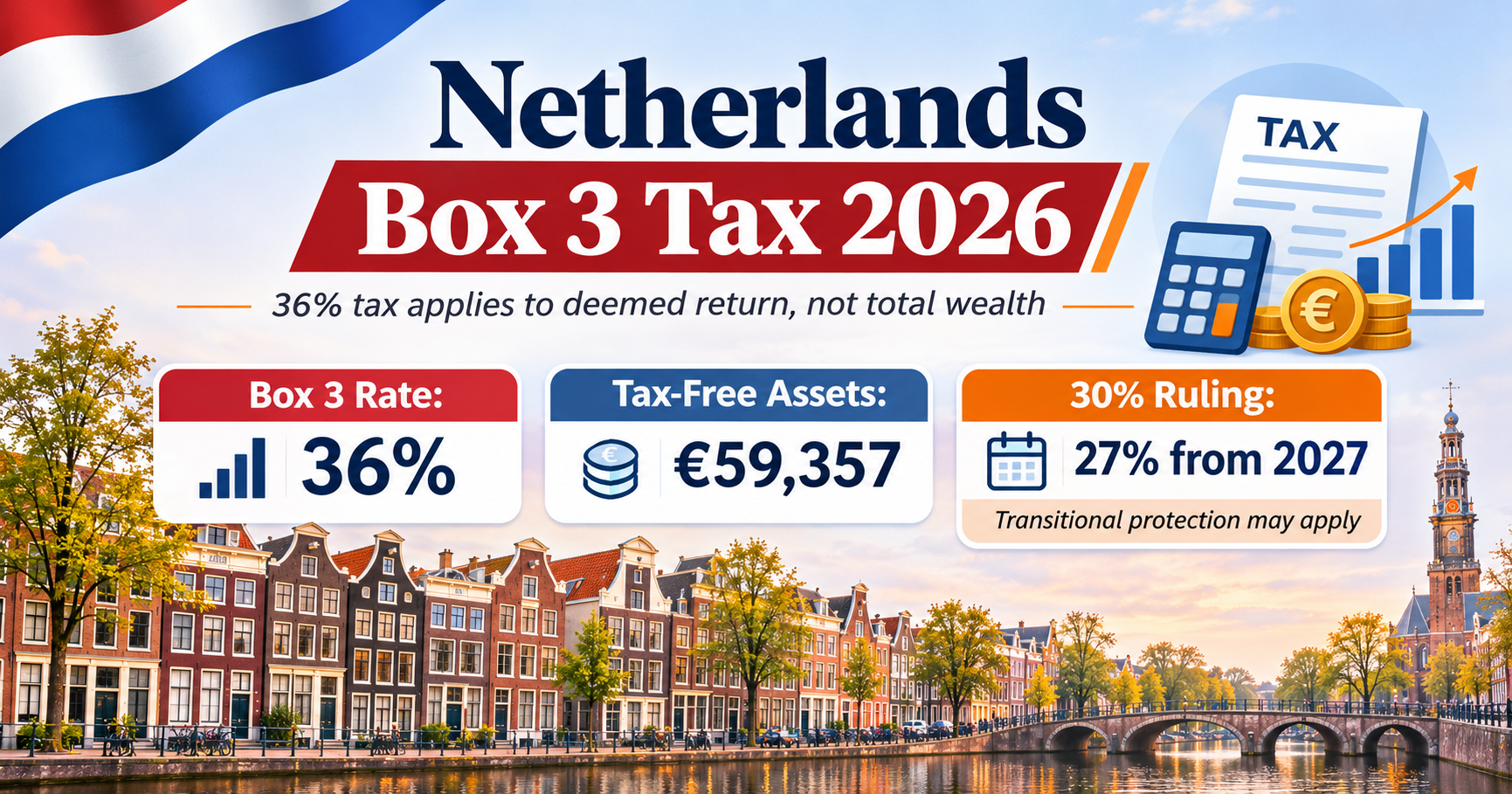
For 2026, the standard Box 3 rate is 36%, but it applies to calculated income from savings and investments, generally determined using assumed or deemed returns.
The tax-free asset allowance for 2026 is €59,357 per person, or €118,714 for qualifying fiscal partners.
Another significant change begins on January 1, 2027, when the maximum tax-free reimbursement under the expatriate 30% ruling generally decreases to 27%.
However, transitional rules protect some employees who began receiving the benefit before January 2024.
This guide explains the Dutch Box 3 calculation, savings and investment percentages, asset exemptions, actual-return relief, expatriate eligibility, salary thresholds, the 2027 reduction and the implications for international workers.
1. How Does the Netherlands Income Tax System Work?
The Netherlands divides relevant personal income into three principal categories called boxes.
| Tax Box | Main Income Category |
|---|---|
| Box 1 | Employment income, principal residence and certain other income |
| Box 2 | Income from substantial shareholdings |
| Box 3 | Savings and investment income |
Each box has a different tax calculation.
Box 1
Commonly includes salary, certain business income and relevant owner-occupied home income or deductions.
Box 2
Generally concerns income from a substantial interest in a company.
Box 3
Generally concerns the return from assets such as bank accounts, securities, investment property and certain other investments.
Important: The 36% Box 3 rate is not a universal rate applicable to salaries, business profits or all dividends.
2. What Is Box 3 Tax in the Netherlands?
Box 3 is part of the Dutch income tax system for savings and investments.
It is often informally called the Dutch wealth tax.
However, the 2026 calculation is more accurately described as taxation of a calculated return on relevant net assets.
The Dutch Tax Administration uses specified return percentages for different categories of assets and eligible debts.
These percentages are applied to the relevant values, and the resulting income is subject to a 36% Box 3 tax rate.
The system also includes a tax-free asset allowance.
Important Distinction
Incorrect: The Netherlands taxes all wealth at 36%.
Correct: The Netherlands generally taxes the relevant calculated Box 3 return at 36%, after applying the statutory calculation and tax-free allowance.
3. Netherlands Box 3 Tax Rate for 2026
The official Box 3 income tax rate is:
36% for Tax Year 2026.
The same tax percentage applied in 2024 and 2025.
The relevant calculations depend on the composition of the taxpayer's assets and debts.
A savings account is not necessarily treated in the same way as shares, cryptocurrency or a second property.
4. Netherlands Box 3 Deemed Return Percentages for 2026
For provisional 2026 assessments, the Dutch Tax Administration uses the following percentages:
| Asset Category | 2026 Deemed Return |
|---|---|
| Bank and Savings Balances | 1.28% |
| Investments and Other Assets | 6.00% |
| Eligible Debts | 2.70% |
The first two percentages represent assumed investment returns.
The debt percentage is used to determine the relevant deduction in the Box 3 return calculation, subject to applicable debt thresholds.
Important: These are the percentages used in 2026 provisional calculations. Final percentages for some categories can be determined later.
5. What Assets Fall Under Box 3?
Relevant assets can include:
- Bank savings.
- Current account balances.
- Foreign bank accounts.
- Shares and investment funds.
- Bonds and securities.
- Cryptocurrency.
- Second homes.
- Rental properties.
- Certain loans made to other persons.
- Other taxable investment assets.
Not every asset belongs in Box 3.
For example, a qualifying owner-occupied principal residence is generally dealt with under Box 1.
Substantial shareholdings can fall under Box 2.
Taxpayers should classify assets correctly rather than including every personal possession or investment in one category.
6. What Is the Box 3 Tax-Free Allowance for 2026?
The Netherlands provides a tax-free asset allowance known as heffingsvrij vermogen.
| Taxpayer Category | 2026 Allowance |
|---|---|
| Individual | €59,357 |
| Qualifying Fiscal Partners | €118,714 |
Example
An individual has €40,000 of relevant net Box 3 assets.
The amount is below the €59,357 tax-free allowance.
Under the standard deemed-return method, the individual generally has no taxable Box 3 income after the allowance.
Important
The allowance relates to qualifying net wealth under the deemed-return system.
It is not a €59,357 deduction directly against tax payable.
The separate actual-return calculation follows different rules and does not apply this tax-free asset allowance in the same way.
7. Example: Box 3 Tax on €100,000 in Savings
Assume a single Dutch tax resident has:
- €100,000 in savings.
- No other Box 3 assets.
- No relevant debts.
- A full 2026 individual tax-free allowance.
Step 1: Calculate the Deemed Savings Return
€100,000 × 1.28% = €1,280.
Step 2: Calculate Assets Above the Exemption
€100,000 − €59,357 = €40,643.
Step 3: Determine the Taxable Share
€40,643 ÷ €100,000 = 40.643%.
Step 4: Calculate Taxable Box 3 Income
€1,280 × 40.643% = approximately €520.23.
Step 5: Calculate Box 3 Tax
€520.23 × 36% = approximately €187.28.
Illustrative Box 3 tax: approximately €187.
The final assessed amount can differ because of statutory rounding, updated percentages and the actual-return relief rules.
8. Example: Box 3 Tax on €100,000 in Investments
Assume a single taxpayer holds:
- €100,000 in taxable investment assets.
- No savings or deductible debts.
- The full individual allowance.
Deemed investment return:
€100,000 × 6.00% = €6,000.
Assets above the allowance:
€40,643.
Taxable proportion:
40.643%.
Taxable deemed return:
€6,000 × 40.643% = approximately €2,438.58.
Box 3 tax at 36%:
Approximately €877.89.
Illustrative Box 3 tax: approximately €878.
This example demonstrates why the composition of a person's assets matters.
The same €100,000 asset value can produce different deemed-return calculations for bank deposits and other investments.
9. Does Box 3 Tax Apply When Investments Lose Money?
Potentially, but a taxpayer may be able to demonstrate that the actual return is lower than the calculated deemed return.
Dutch Supreme Court decisions led to an alternative actual-return relief mechanism.
The Dutch Tax Administration now permits qualifying taxpayers to report actual returns where these are lower than the deemed calculation.
Example
An investor has a deemed return of €6,000 under the provisional calculation.
However, the taxpayer's eligible actual return for the year is only €1,500.
Under the applicable actual-return relief rules, the lower return may be used.
This can reduce Box 3 tax.
The taxpayer must follow the prescribed calculation and reporting requirements.
10. What Is the Actual-Return Method?
The actual-return method is known as werkelijk rendement.
It can consider:
- Interest received.
- Dividends received.
- Certain rental income.
- Changes in investment values.
- Gains or losses in cryptocurrency values.
- Changes in the value of relevant property.
- Other items required by the actual-return rules.
Important
Actual return does not simply mean cash deposited into a bank account.
Unrealised increases or decreases in the value of investments can also matter.
The calculation generally considers the taxpayer's relevant assets and debts as a whole rather than selecting only individual investments that produced losses.
Additionally, the standard tax-free asset allowance is not deducted in the same way under the actual-return comparison.
11. What Happens if Actual Return Is Lower?
The Dutch Tax Administration states that taxpayers should not pay more Box 3 tax because they reported a lower actual return.
The legally permitted calculation that produces the lower relevant taxable return can provide relief.
For the 2026 provisional assessment, the full actual return is not yet known.
Therefore, the provisional assessment uses deemed returns.
The actual-return information can be taken into account through the relevant tax return and assessment procedures.
Taxpayers should retain their investment statements and valuation records.
12. What Is the Box 3 Valuation Date?
Under the standard deemed-return system, the relevant valuation date is generally:
January 1 of the tax year.
For Tax Year 2026, the principal valuation date is January 1, 2026.
Example
An individual has €80,000 in bank balances on January 1, 2026.
The person later spends or transfers some of the money.
The January 1 valuation remains important for the standard deemed-return calculation.
However, actual-return calculations and anti-abuse rules can require different information.
13. Does the Netherlands Tax Foreign Bank Accounts?
Dutch tax residents generally have worldwide income and asset reporting obligations, subject to relevant domestic exemptions and tax treaty rules.
Consequently, relevant foreign savings and investments may need to be included in Box 3.
Examples include:
- Bank deposits in Pakistan.
- Overseas brokerage accounts.
- Foreign investment portfolios.
- Relevant overseas property.
- Other qualifying foreign assets.
However, non-residents and individuals qualifying for specific transitional relief may face different rules.
Foreign assets should not be omitted simply because the financial institution is outside the Netherlands.
14. How Are Second Homes and Investment Properties Taxed?
A second residence, holiday property or investment property can fall within Box 3.
The value of such an asset may be included in the category for investments and other assets.
However, the actual tax position depends on property location, ownership, valuation, financing and potential treaty relief.
Important
The taxpayer's principal residence is generally treated differently.
Furthermore, actual-return relief can involve changes in the property's value, as well as relevant rental receipts.
Foreign property may require separate treaty analysis.
15. Are Cryptocurrency Investments Covered by Box 3?
Cryptocurrency holdings can fall within Box 3 when held as ordinary personal investments.
The 2026 provisional deemed return for investments and other assets is 6.00%.
However, cryptocurrency trading may have different tax treatment where it constitutes business or professional activity.
Example
A Dutch resident holds cryptocurrency valued at €50,000 on the relevant valuation date.
That holding may form part of the taxpayer's total Box 3 assets.
Whether tax is payable depends on the full Box 3 calculation, the allowance, debts and available actual-return relief.
16. What Is the Dutch 30% Ruling?
The 30% ruling, also called the Expat Scheme, is a special Dutch payroll tax facility for qualifying employees recruited from abroad.
It allows an employer to provide a portion of eligible remuneration as a tax-free allowance for relevant extraterritorial costs.
The facility is intended to compensate for additional costs associated with international relocation and employment.
The maximum tax-free reimbursement is generally 30% during 2026 for qualifying employees.
However, eligibility conditions and remuneration limits apply.
17. Who Qualifies for the 30% Ruling?
The main requirements can include:
- A qualifying employment relationship.
- Recruitment or transfer from abroad.
- Relevant specific expertise.
- Satisfaction of the applicable salary standard.
- Compliance with the recruitment-distance requirements.
- A valid application and tax authority decision.
- Other statutory requirements.
Certain academic researchers and physicians undergoing specialist training can qualify for exemptions from the ordinary salary threshold.
A residence permit or highly skilled migrant visa alone does not automatically grant the tax facility.
18. What Are the 2026 Salary Requirements?
The Dutch Tax Administration publishes annual salary standards for the Expat Scheme.
| Employee Category | 2026 Taxable Salary Requirement |
|---|---|
| General qualifying employee | More than €48,013 |
| Qualifying employee under 30 with relevant master's degree | More than €36,497 |
| Certain qualifying researchers and specialist trainees | Salary standard exception may apply |
The salary requirement relates to the taxable remuneration excluding the tax-free expat allowance.
The amount should not be confused with total gross compensation.
19. What Is the Maximum Salary for the 30% Ruling in 2026?
For 2026, the maximum remuneration base for the scheme is generally:
€262,000 annually.
The maximum tax-free allowance under a full-year 30% calculation can therefore reach:
€262,000 × 30% = €78,600.
The actual allowance can be lower due to the salary threshold, partial-year eligibility and other legal conditions.
The cap also affects certain employees who previously benefited from transitional protection.
20. What Changes From January 1, 2027?
The Dutch government has enacted a reduction in the tax-free reimbursement percentage.
From January 1, 2027, the maximum tax-free proportion generally falls from:
30% to 27%.
This change primarily affects employees who first qualified for the ruling on or after January 1, 2024.
However, employees with qualifying pre-2024 protection may continue using the 30% facility for their remaining eligible period.
Comparison
| Rule | 2026 | From 2027 |
|---|---|---|
| General tax-free expat allowance | Up to 30% | Up to 27% |
| Protected pre-2024 qualifying employees | Up to 30% | Up to 30% |
| Maximum ordinary duration | Generally 5 years | Generally 5 years |
| Salary requirements | 2026 indexed standards | Relevant higher or transitional standards |
Businesses should review the original date of the employee's ruling before applying the new percentage.
21. Example: Expat Earning €70,000
Assume an eligible employee has annual remuneration of €70,000 and qualifies for the relevant salary requirements.
During 2026
Maximum illustrative tax-free reimbursement:
€70,000 × 30% = €21,000.
Remaining taxable salary:
€49,000.
This exceeds the general 2026 salary threshold of €48,013.
From 2027
Assuming the employee is subject to the 27% limit:
Maximum illustrative tax-free reimbursement:
€70,000 × 27% = €18,900.
Remaining taxable salary:
€51,100.
Difference
€21,000 − €18,900 = €2,100.
This illustrates a reduction of €2,100 in the maximum tax-free remuneration amount, assuming identical total remuneration.
Important: The reduction in tax-free remuneration is not the same as an additional €2,100 tax bill. Actual net pay depends on payroll calculations, salary standards and individual circumstances.
22. Who Keeps the 30% Ruling After 2026?
Employees who first received the qualifying 30% ruling before January 1, 2024 may benefit from transitional protection.
This can allow the maximum 30% reimbursement to continue during the remaining permitted ruling period.
Employees who started using the ruling from January 2024 generally move to the 27% maximum in 2027.
Important
The employer must confirm the legally relevant effective date stated in the tax authority's decision.
The employee's arrival date or employment contract date does not necessarily determine every transitional right.
23. What Happens to the Expat Salary Threshold in 2027?
The 2027 changes also affect the expertise-related salary criteria.
Government guidance identifies higher reference requirements for new entrants, based on statutory amounts indexed from their 2024 baseline.
The reference amounts include:
- €50,436 for the general category before subsequent indexation.
- €38,388 for eligible younger master's degree holders before subsequent indexation.
The actual applicable amount depends on the employee's start date and the legally prescribed 2027 indexed threshold.
Employees already covered by transitional rules may have different requirements.
Employers should use the official 2027 payroll guidance rather than simply copying the 2026 salary test.
24. What Is Partial Non-Resident Taxpayer Status?
Previously, some employees benefiting from the 30% ruling could elect to be treated as partial non-resident taxpayers.
This could limit Dutch taxation of certain foreign Box 2 and Box 3 assets and income.
The general option was abolished from January 1, 2025.
However, a transitional arrangement allowed certain employees who were already using the ruling before 2024 to continue the treatment through December 31, 2026.
Important for 2027
From January 1, 2027, this transitional partial non-resident facility also ends.
Qualifying Dutch tax residents may therefore have broader reporting obligations involving worldwide Box 2 and Box 3 assets.
This is a separate development from the reduction of the reimbursement percentage from 30% to 27%.
25. What Does This Mean for Pakistani Expats in the Netherlands?
Pakistani professionals relocating to the Netherlands should consider the Dutch tax rules separately from their Pakistani obligations.
Potentially relevant issues include:
- Employment income taxable in Box 1.
- Eligibility for the expatriate ruling.
- Salary thresholds and employment contracts.
- Foreign bank accounts.
- Shares and investment portfolios.
- Rental property in Pakistan.
- Dutch tax residence.
- Pakistan tax residence.
- Applicable treaty relief.
Example
A Pakistani technology professional living in Amsterdam holds investments in Pakistan.
If the individual is a Dutch tax resident, the investments may be relevant to Dutch Box 3 reporting, subject to domestic and treaty rules.
Qualifying transitional partial non-resident treatment may affect some pre-2024 beneficiaries during 2026.
The employee should review the exact status before filing.
26. Does the 30% Ruling Automatically Exempt Foreign Wealth?
No.
The 30% ruling primarily concerns eligible employment-related tax-free reimbursement.
It is not a general exemption from Box 3.
For employees who started using the facility from 2024 onward, the former partial non-resident election generally does not apply.
This distinction is especially important for highly paid expatriates who hold substantial savings, securities or foreign property.
27. How to Apply for the Dutch 30% Ruling
The application generally involves the employer and employee.
Step 1: Confirm Employment Eligibility
Verify the qualifying employment relationship.
Step 2: Review Overseas Recruitment
Check the relevant recruitment and residence requirements.
Step 3: Confirm Specific Expertise
Review the applicable income threshold or qualifying exception.
Step 4: Gather Documents
Prepare identity, employment and supporting recruitment information.
Step 5: Submit the Application
Use the appropriate Dutch Tax Administration procedure.
Step 6: Observe the Four-Month Timing Rule
A timely application generally supports retrospective effect from the beginning of qualifying employment, where all requirements are met.
Step 7: Obtain the Tax Authority Decision
Retain the official approval.
Step 8: Update Payroll
Apply the facility according to the applicable decision and current year limits.
Step 9: Monitor the 2027 Rules
Confirm whether the employee retains 30% or moves to 27%.
28. Netherlands Income Tax Filing for 2026
The Dutch tax year generally follows the calendar year.
Income and assets relevant to 2026 will ordinarily be reported through the 2026 annual income tax return process in 2027.
Filing Steps
- Access the official Belastingdienst website.
- Sign in to the relevant personal tax service.
- Select the appropriate tax year.
- Review employment income.
- Check Box 1 income and deductions.
- Review any substantial shareholdings under Box 2.
- Verify savings and investments under Box 3.
- Confirm January 1 asset values.
- Consider actual-return relief.
- Review any relevant expat transitional status.
- Confirm foreign income and treaty relief.
- Submit and retain the acknowledgment.
The individual deadline should be confirmed from the official filing notice and any granted extension.
29. Documents to Prepare for Box 3 and Expat Tax Filing
Important records can include:
- Dutch tax identification information.
- Employment agreements.
- Expat ruling approval.
- Payslips and annual salary statements.
- Domestic bank balances.
- Foreign bank balances.
- Investment account statements.
- Cryptocurrency valuation records.
- Second-property valuations.
- Loan and debt information.
- Interest and dividend records.
- Evidence of investment gains or losses.
- Relevant foreign tax certificates.
- Supporting tax treaty documentation.
Accurate records are important where a person wishes to demonstrate actual investment returns lower than deemed returns.
30. Common Netherlands Tax Mistakes
- Saying that the government taxes all wealth at 36%.
- Confusing total assets with taxable Box 3 income.
- Applying the 6% deemed investment return to savings.
- Ignoring the €59,357 tax-free allowance.
- Forgetting the doubled allowance for qualifying fiscal partners.
- Treating the provisional deemed percentages as permanently final.
- Ignoring available actual-return relief.
- Using January 1 values without checking other reporting requirements.
- Omitting reportable foreign bank accounts.
- Assuming the 30% ruling applies to every expatriate.
- Treating the 30% ruling as a 30% income tax rate.
- Applying 27% to all pre-2024 beneficiaries without checking protection.
- Ignoring the salary threshold after the tax-free reimbursement.
- Forgetting the €262,000 remuneration cap for 2026.
- Assuming the expat ruling automatically removes Box 3 obligations.
- Ignoring the end of partial non-resident transitional treatment in 2026.
31. Netherlands Tax Compliance Checklist
Before filing or updating payroll, verify:
- Dutch tax residence.
- Correct 2026 tax year.
- Box 1 employment income.
- Box 2 relevant substantial interests.
- Box 3 assets.
- January 1 asset valuations.
- Savings balances.
- Investment portfolios.
- Foreign assets.
- Relevant debts.
- Tax-free asset allowance.
- Correct provisional deemed return percentages.
- Whether actual return is lower.
- Evidence for actual-return relief.
- Expat ruling eligibility.
- Original ruling start date.
- 2026 salary threshold.
- Remuneration cap.
- Applicable 2027 reimbursement percentage.
- Transitional protection.
- Partial non-resident status where relevant.
- Foreign tax treaty relief.
- Return filing and documentation.
32. Watch Tax With Naeem — Related Tax Education
For general educational guidance on salary income, rental income, capital gains, dividends and tax return filing, watch the following related tutorial from Tax With Naeem.
Related Video: Income Tax Return Filing in Pakistan — Salary, Rental Income, Capital Gains and Dividends Explained
https://www.youtube.com/watch?v=VX88o1N1AfA
This is a Pakistan income tax tutorial, not a dedicated Netherlands Box 3 or Dutch 30% ruling tutorial.
It is included as supplementary education concerning income classification and tax filing.
For Netherlands-specific tax calculations, taxpayers should use the Dutch Tax Administration's official instructions.
33. Official Sources and References
1. Dutch Tax Administration — Box 3 Calculation for 2026
2. Belastingdienst — Box 3 Tax Rates
3. Belastingdienst — Tax-Free Box 3 Allowance
https://www.belastingdienst.nl/wps/wcm/connect/nl/box-3/content/heffingsvrij-vermogen
4. Belastingdienst — Actual Investment Return
https://www.belastingdienst.nl/wps/wcm/connect/en/income-in-box-3/content/what-is-my-actual-return
5. Netherlands Government — Expat Ruling Reduction to 27%
https://business.gov.nl/amendments/30-percent-ruling-compensation-down-to-27-percent/
6. Netherlands Government — Expat Scheme and Transitional Rules
https://business.gov.nl/staff/employing-staff/the-expat-scheme-30-percent-ruling-in-the-netherlands/
7. Belastingdienst — Expertise and Salary Requirements
8. Netherlands Government — Income Tax Categories
https://www.rijksoverheid.nl/themas/werk/inkomstenbelasting/soorten-inkomstenbelasting
9. Official Dutch Tax Administration
https://www.belastingdienst.nl/
10. AsaanTax.pk — International Taxation Guides
11. Tax With Naeem — Related Educational Video
https://www.youtube.com/watch?v=VX88o1N1AfA
34. Conclusion: What Do the Box 3 and Expat Tax Changes Mean?
The Netherlands continues to apply a 36% tax rate to relevant calculated Box 3 income in 2026.
The rate does not apply directly to the entire value of a taxpayer's savings, investment portfolio or property.
For provisional 2026 assessments, the deemed return rates are 1.28% for bank balances, 6.00% for investments and other assets, and 2.70% for eligible debts.
The tax-free asset allowance is €59,357 per individual or €118,714 for qualifying fiscal partners.
Taxpayers may also be entitled to relief where their actual return is lower than the deemed return, subject to the applicable rules.
For expatriates, the maximum tax-free employment reimbursement generally reduces from 30% to 27% on January 1, 2027.
However, qualifying employees who first used the ruling before 2024 may retain the 30% maximum for their remaining eligible period.
A separate change ends the transitional partial non-resident taxation option after 2026, potentially affecting foreign asset reporting for some expatriates.
The essential distinction is that Box 3 concerns income calculated from assets, while the expatriate 30% ruling concerns employment-related tax-free reimbursement. They are separate parts of the Dutch tax system.
For more professional international tax articles about the Netherlands, Germany, France, Spain, the UK, UAE, USA and Pakistan, visit:
AsaanTax.pk: https://www.asaantax.pk/
Editorial Note: This article reflects official Dutch Tax Administration and Netherlands government guidance reviewed as of November 12, 2026. The 2026 Box 3 deemed percentages are provisional, and the 2027 expatriate ruling change is subject to the applicable transitional rules.
Disclaimer: This article provides general educational information and is not individualized Dutch tax, immigration or legal advice. Tax liability depends on tax residence, assets, debts, actual returns, treaty relief, payroll arrangements and statutory eligibility conditions. Readers should consult Belastingdienst or a qualified Dutch tax professional for individual circumstances.