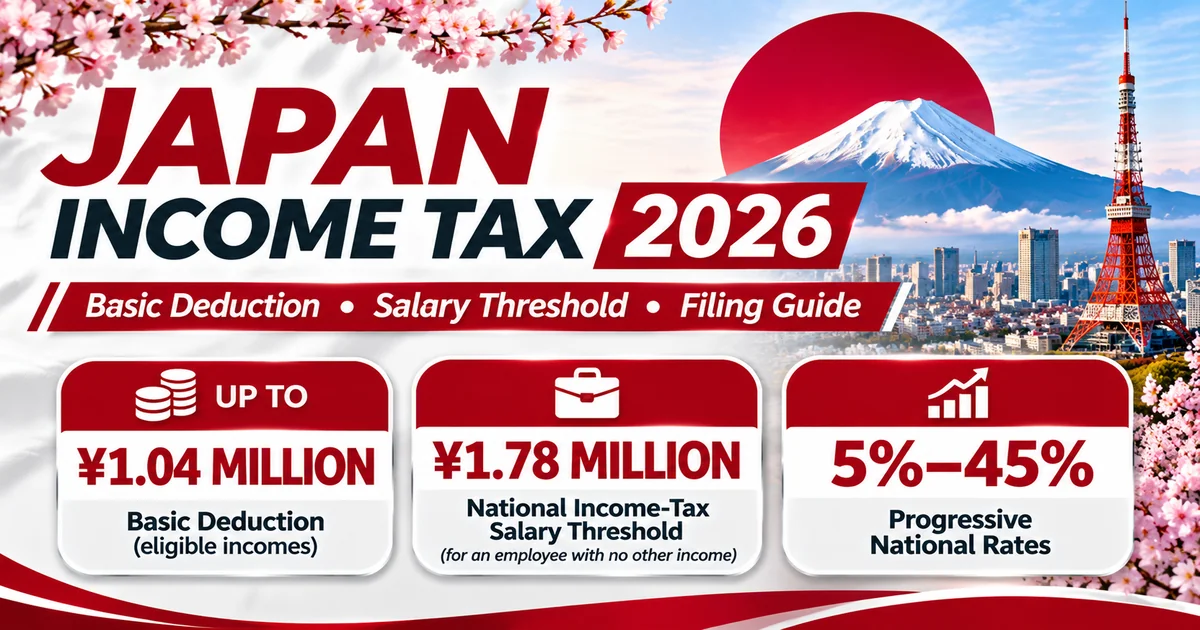
Japan Income Tax Cut 2026: Basic Deduction Up to ¥1.04 Million and the ¥1.78 Million Tax-Free Salary Threshold
Published: November 12, 2026
Country: Japan
Tax Year: January 1 – December 31, 2026
Tax Authority: National Tax Agency (NTA)
Main Reform: FY2026 Tax Reform
Implementation: Generally December 1, 2026, applying to 2026 national income tax
Japan has introduced important personal income tax changes for 2026 to help employees and families manage rising living costs.
The reform increases the maximum basic income tax deduction to ¥1.04 million and raises the national income tax-free annual salary threshold to ¥1.78 million for qualifying employees with no other income.
These changes are particularly relevant to part-time employees, lower-income salaried workers, students, spouses and families considering how much additional employment income can be earned.
However, the new ¥1.78 million threshold is not a universal exemption from every Japanese tax or social insurance contribution.
The actual income tax calculation depends on annual salary, other sources of income, qualifying deductions and the person's tax residency.
Japan also continues to impose progressive national income tax rates ranging from 5% to 45%, alongside the special reconstruction surtax and separate local inhabitant taxes.
This guide explains the 2026 tax reforms, new deduction amounts, salary calculations, tax brackets, employer year-end adjustments, foreign worker rules and filing obligations.
1. What Changed in Japan's Income Tax System in 2026?
Japan's FY2026 tax reform introduced adjustments designed to reduce the impact of inflation and the so-called annual income barrier.
The main changes include:
- Increasing the ordinary basic deduction from ¥580,000 to ¥620,000 for qualifying taxpayers.
- Providing additional basic deduction amounts for eligible lower- and middle-income individuals.
- Increasing the maximum basic deduction to ¥1,040,000.
- Increasing the minimum employment income deduction from ¥650,000 to ¥690,000.
- Providing an additional temporary ¥50,000 employment income deduction for qualifying salary income in 2026 and 2027.
- Raising the national income tax-free salary threshold to ¥1,780,000 for qualifying salary-only individuals.
- Making related changes to dependent and family income eligibility thresholds.
The new income tax deduction provisions generally take effect on December 1, 2026, while applying to the 2026 income tax year.
2. What Is Japan's New ¥1.04 Million Basic Deduction?
The basic deduction is known in Japanese as Kiso Kojo.
It reduces the income amount used to determine national income tax.
For 2026 and 2027, eligible resident individuals with total income of up to ¥4.89 million can receive a basic deduction of ¥1.04 million.
2026 Basic Deduction Table
| Total Income (After Relevant Income Calculations) | National Basic Deduction |
|---|---|
| Up to ¥4,890,000 | ¥1,040,000 |
| Above ¥4,890,000 to ¥6,550,000 | ¥670,000 |
| Above ¥6,550,000 to ¥23,500,000 | ¥620,000 |
| Above ¥23,500,000 to ¥24,000,000 | ¥480,000 |
| Above ¥24,000,000 to ¥24,500,000 | ¥320,000 |
| Above ¥24,500,000 to ¥25,000,000 | ¥160,000 |
| Above ¥25,000,000 | ¥0 |
Important: These are amounts of total income calculated under the tax law, not necessarily gross employment salary.
For non-residents, different basic deduction treatment can apply. The NTA states that the maximum 2026 basic deduction for non-residents is generally ¥620,000, not ¥1.04 million.
3. Is Every Japanese Taxpayer Eligible for the ¥1.04 Million Deduction?
No.
The ¥1.04 million deduction depends on total income and other applicable requirements.
For example, a taxpayer with qualifying total income of ¥3 million may fall within the maximum basic deduction category.
However, a taxpayer with total income of ¥8 million generally falls within the ¥620,000 basic deduction category.
An individual should therefore calculate their relevant total income before selecting the deduction.
Important Distinction
Gross Salary: Total employment payments before relevant adjustments.
Employment Income: Salary after the statutory employment income deduction.
Total Income: The total amount determined under the applicable tax rules across relevant income categories.
These amounts are not interchangeable.
4. What Is the ¥1.78 Million Tax-Free Salary Threshold?
For 2026, Japan raised the national income tax-free salary threshold to ¥1,780,000 for a qualifying employee with only salary income and no other relevant income.
The threshold is derived from two important deductions.
| Deduction | 2026 Amount |
|---|---|
| Maximum Basic Deduction for Eligible Income | ¥1,040,000 |
| Minimum Employment Income Deduction | ¥740,000 |
| Combined Amount | ¥1,780,000 |
Calculation
¥1,040,000 + ¥740,000 = ¥1,780,000.
A qualifying salary-only employee earning no more than ¥1.78 million generally has no taxable national employment income after these deductions.
Important
This is the threshold for the relevant national income tax calculation.
Local inhabitant tax, social insurance and dependent-status rules can have different thresholds.
5. How Does the New Threshold Compare With Previous Years?
Japan has increased the income tax-free salary threshold through successive reforms.
| Period | General Salary-Only National Income Tax Threshold |
|---|---|
| Earlier system | ¥1,030,000 |
| 2025 reform | Up to ¥1,600,000 for eligible salary-only taxpayers |
| 2026 reform | ¥1,780,000 for eligible salary-only taxpayers |
The new threshold represents a substantial increase from the older ¥1.03 million level.
However, comparisons must account for the legal conditions and different deduction arrangements for each year.
6. What Is the Employment Income Deduction?
The employment income deduction is known as Kyuyo Shotoku Kojo.
It represents a statutory deduction from salary receipts when calculating taxable employment income.
Japan uses a formula that depends on the employee's annual salary.
Employment Income Deduction for 2026
| Annual Gross Salary | Employment Income Deduction |
|---|---|
| Up to ¥2,200,000 | ¥740,000 |
| Above ¥2,200,000 to ¥3,600,000 | Salary × 30% + ¥80,000 |
| Above ¥3,600,000 to ¥6,600,000 | Salary × 20% + ¥440,000 |
| Above ¥6,600,000 to ¥8,500,000 | Salary × 10% + ¥1,100,000 |
| Above ¥8,500,000 | ¥1,950,000 maximum |
These amounts apply under the relevant 2026–2027 income tax rules, including specific statutory rounding and calculation tables.
The deduction reduces salary receipts when calculating employment income.
It is not a cash payment by the government.
7. Tax Calculation on ¥1.5 Million Annual Salary
Assume a qualifying resident employee earns ¥1,500,000 during 2026.
The individual has only salary income and satisfies the requirements for the applicable deductions.
Step 1: Gross Annual Salary
¥1,500,000.
Step 2: Employment Income Deduction
¥740,000.
Step 3: Employment Income
¥1,500,000 − ¥740,000 = ¥760,000.
Step 4: Basic Deduction
The taxpayer qualifies for a basic deduction of up to ¥1,040,000.
Because employment income is below this amount, the resulting taxable national income is zero.
Illustrative national income tax: ¥0.
This does not automatically eliminate other possible taxes or social insurance contributions.
8. Tax Calculation on ¥1.78 Million Annual Salary
Assume the employee has ¥1,780,000 of annual gross salary and no other income.
| Description | Amount |
|---|---|
| Gross Salary | ¥1,780,000 |
| Employment Income Deduction | −¥740,000 |
| Employment Income | ¥1,040,000 |
| Basic Deduction | −¥1,040,000 |
| Taxable National Income | ¥0 |
| Illustrative National Income Tax | ¥0 |
This example demonstrates the new threshold.
It assumes eligibility for the full basic deduction and the relevant salary deduction.
9. Tax Calculation on ¥2 Million Annual Salary
Assume an eligible resident employee has annual salary income of ¥2,000,000 and no other income.
Gross salary: ¥2,000,000.
Employment income deduction: ¥740,000.
Employment income:
¥2,000,000 − ¥740,000 = ¥1,260,000.
Basic deduction:
¥1,040,000.
Simplified taxable income:
¥1,260,000 − ¥1,040,000 = ¥220,000.
National income tax at the initial 5% marginal rate:
¥220,000 × 5% = ¥11,000.
The 2.1% Special Reconstruction Income Tax on this amount would be ¥231.
Illustrative combined national income tax and reconstruction tax: ¥11,231.
This example deliberately excludes social insurance deductions, additional personal deductions and credits that could reduce the amount.
Actual assessed tax may therefore be lower.
10. Japan's National Income Tax Rates for 2026
Japan continues to use seven progressive national income tax rates ranging from 5% to 45%.
Official National Income Tax Brackets
| Taxable Income | Marginal Rate | Quick Calculation Deduction |
|---|---|---|
| Up to ¥1,949,000 | 5% | ¥0 |
| ¥1,950,000–¥3,299,000 | 10% | ¥97,500 |
| ¥3,300,000–¥6,949,000 | 20% | ¥427,500 |
| ¥6,950,000–¥8,999,000 | 23% | ¥636,000 |
| ¥9,000,000–¥17,999,000 | 33% | ¥1,536,000 |
| ¥18,000,000–¥39,999,000 | 40% | ¥2,796,000 |
| ¥40,000,000 and above | 45% | ¥4,796,000 |
The taxable income amount is determined after applying relevant statutory deductions.
The figures exclude separate local inhabitant tax and the Special Reconstruction Income Tax.
Special taxation can apply to certain investment income and other categories.
11. How to Calculate Japan's Progressive Income Tax
Japan's NTA provides a quick calculation method.
National Income Tax = Taxable Income × Applicable Marginal Rate − Quick Calculation Deduction
For example, assume a taxpayer has ¥5,000,000 of taxable income after all relevant deductions.
Applicable bracket: 20%.
Quick calculation deduction: ¥427,500.
Calculation:
¥5,000,000 × 20% = ¥1,000,000.
¥1,000,000 − ¥427,500 = ¥572,500.
Illustrative ordinary national income tax: ¥572,500.
The Special Reconstruction Income Tax and any other applicable charges must be considered separately.
12. What Is the Special Reconstruction Income Tax?
Japan has a Special Reconstruction Income Tax associated with the recovery from the 2011 Great East Japan Earthquake.
For 2026, the surcharge is generally 2.1% of the relevant national income tax amount.
Example
Ordinary national income tax: ¥100,000.
Reconstruction surcharge:
¥100,000 × 2.1% = ¥2,100.
Illustrative combined amount:
¥102,100.
The surcharge is calculated on relevant national income tax, not as an additional 2.1% of the full gross salary.
13. Does the ¥1.78 Million Threshold Remove Local Inhabitant Tax?
No.
Local inhabitant tax is a separate tax imposed by relevant local governments.
It generally includes prefectural and municipal components.
The local tax calculation, deductions and exemptions differ from national income tax.
Therefore, a person whose salary does not generate national income tax under the ¥1.78 million threshold may still face local inhabitant tax.
Important: The national basic deduction of ¥1.04 million should not be automatically applied as the local inhabitant-tax basic deduction.
14. Does the New Threshold Remove Social Insurance Contributions?
No.
Japanese social insurance contributions are separate from national income tax.
Depending on employment circumstances, contributions may include:
- Employees' pension insurance.
- Health insurance.
- Employment insurance.
- Long-term care insurance where applicable.
Eligibility and contribution amounts depend on statutory conditions such as employment status, working hours, salary, employer size and other factors.
The 2026 income tax reform does not automatically raise every social insurance threshold to ¥1.78 million.
An employee should therefore evaluate tax and social insurance separately.
15. What Does the Reform Mean for Part-Time Workers?
The higher threshold can help qualifying part-time employees earn additional salary without immediately becoming subject to national income tax.
For example, a part-time worker previously concerned about exceeding a lower income tax threshold may have greater flexibility under the new national rules.
However, working additional hours may affect:
- Social insurance eligibility.
- Dependent-related arrangements.
- Employer family allowances.
- Local inhabitant tax.
- Spousal or dependent tax deductions.
A worker should not use the national income tax threshold as the only basis for determining working hours.
16. What Does the Reform Mean for Married Couples?
The revised income tax thresholds may affect families where one spouse works part-time.
Japan has separate rules for:
- Spouse deductions.
- Special spouse deductions.
- Dependent deductions.
- Social insurance dependent status.
- Household-related employment benefits.
A spouse's own national income tax threshold does not automatically determine whether the other spouse can claim a full spouse deduction.
The relevant annual income and eligibility conditions must be reviewed separately.
17. Does the Reform Benefit Higher-Income Employees?
Yes, some higher-income employees may benefit from the increased ordinary deduction amounts.
However, the maximum ¥1.04 million basic deduction is focused on qualifying lower- and middle-income individuals.
For taxpayers with higher total incomes, the basic deduction is reduced according to statutory bands.
For example, a taxpayer with relevant total income above ¥6.55 million but not exceeding ¥23.5 million generally falls into the ¥620,000 basic deduction band.
The tax-saving amount depends on the taxpayer's actual income, marginal tax rate and applicable deductions.
18. How Will Employers Apply the New Rules?
The NTA states that the 2026 changes generally take effect on December 1, 2026.
They affect the calculation of annual income tax through the year-end adjustment process.
Employer Responsibilities
Employers should review:
- Updated basic deduction declarations.
- Revised employment income deduction calculations.
- Employee estimated total income.
- Spouse and dependent declarations.
- Applicable annual withholding adjustments.
- Tax calculation tables.
- Employee payroll documentation.
- Required year-end reporting.
The NTA explains that ordinary withholding processes through November 2026 do not change solely because of this reform.
The updated rules are generally reflected in year-end adjustments from December 2026.
19. What Is Japan's Year-End Tax Adjustment?
Japan uses an employer-administered year-end income tax adjustment known as Nenmatsu Chosei.
Employers reconcile certain employees' annual income tax calculations with amounts withheld throughout the year.
This process can result in:
- A refund of excess income tax withheld.
- Additional withholding where insufficient tax was deducted.
- An adjustment reflecting updated deductions.
For 2026, employees should ensure their relevant declarations reflect the new basic deduction and dependent-related rules.
Failure to submit required information may affect the year-end calculation.
20. Do All Japanese Employees Need to File a Tax Return?
No.
Many salaried employees do not need to submit an individual final income tax return because their tax is settled through employer withholding and year-end adjustment.
However, a return may be required in certain circumstances.
Examples include:
- Employment income exceeding ¥20 million.
- Relevant additional income exceeding the applicable threshold.
- Certain multiple-employer arrangements.
- Business or self-employment income.
- Certain foreign income.
- Other circumstances requiring individual assessment.
Some taxpayers may voluntarily file to claim eligible refunds or deductions.
21. Japan Income Tax Filing Deadline for 2026 Income
Japan generally uses the calendar year for individual income tax.
For the 2026 tax year:
| Event | Date |
|---|---|
| Income Tax Year Begins | January 1, 2026 |
| Income Tax Year Ends | December 31, 2026 |
| Ordinary Return Filing Period Begins | February 16, 2027 |
| Standard Return Filing Deadline | March 15, 2027 |
The NTA generally requires qualifying final tax returns between February 16 and March 15 of the following year.
Different deadlines and procedures can apply when an individual departs Japan without appointing a tax agent.
Taxpayers should verify their particular filing requirements.
22. How to File an Income Tax Return in Japan
Step 1: Open the National Tax Agency Website
Visit https://www.nta.go.jp/english/.
Step 2: Access the Tax Return Preparation Service
Use the official tax return preparation system.
Step 3: Select Tax Year 2026
Choose the appropriate income tax year when filing services are available.
Step 4: Enter Personal Details
Include the required name, address and tax identification information.
Step 5: Review Salary Income
Use employer-issued wage and withholding records.
Step 6: Enter Other Income
Declare relevant business, rental, investment or foreign income.
Step 7: Apply Eligible Deductions
Check basic deduction eligibility, salary deductions and other relevant reliefs.
Step 8: Review Tax Withheld
Verify relevant amounts already deducted by employers or other payers.
Step 9: Complete the Tax Calculation
Review national tax, reconstruction surtax and other applicable items.
Step 10: Submit Through e-Tax Where Appropriate
Use the official electronic filing method and retain confirmation.
23. Do Foreign Workers Benefit From Japan's 2026 Tax Cuts?
Foreign employees may benefit where they are subject to the relevant Japanese tax rules and satisfy the applicable conditions.
For example, a foreign employee who is a Japanese tax resident may be entitled to resident-specific deductions.
However, the tax treatment depends on legal residency status and income classification.
An employment visa does not automatically establish the same tax treatment for every foreign national.
24. Japan Tax Residency Rules for Foreigners
Japan distinguishes between residents and non-residents for income tax purposes.
Resident individuals may be further classified under rules concerning permanent and non-permanent residents.
Relevant factors include:
- Domicile.
- Duration of residence.
- Nationality.
- Prior years of residence in Japan.
- Nature and source of income.
Permanent resident taxpayers are generally subject to Japanese taxation on worldwide income.
Non-permanent residents receive special foreign-source income treatment under applicable rules.
Non-residents are generally taxed on relevant Japan-source income.
Tax treaties may modify the outcome.
25. Non-Resident Income Tax in Japan
Non-residents are generally subject to different taxation arrangements from resident individuals.
Certain Japan-source employment and other income payments can be subject to withholding at 20.42%, depending on income classification and applicable provisions.
However, not all non-resident income is taxed identically.
Treaty relief, special elections and other statutory rules can apply.
The resident maximum basic deduction of ¥1.04 million should not automatically be used when calculating non-resident tax.
26. Does Japan Tax Foreign Income?
Japanese tax residents may need to report relevant foreign income.
Potential categories include:
- Overseas employment income.
- Foreign rental income.
- Overseas interest and dividends.
- Business income.
- Investment gains.
- Other foreign receipts.
However, the actual scope depends on whether the individual is a permanent resident, non-permanent resident or non-resident for Japanese tax purposes.
A non-permanent resident may receive different treatment for certain foreign-source income depending on whether it is paid in or remitted to Japan.
Tax treaty rules can also be relevant.
27. What About Pakistani Professionals Working in Japan?
Pakistani nationals living or working in Japan should determine their Japanese tax residency and income obligations.
For example, a Pakistani IT professional working in Tokyo may earn:
- Japanese employment salary.
- Consulting income.
- Income from property in Pakistan.
- Overseas interest or dividends.
The correct tax treatment depends on Japanese domestic law, the nature of the income and any relevant treaty provisions.
Pakistani citizenship alone does not determine Japanese tax residency.
A foreign employee should also assess any continuing obligations in Pakistan.
28. Can Freelancers Use the ¥1.78 Million Salary Threshold?
Not automatically.
The ¥1.78 million threshold is based on the combination of the maximum basic deduction and the employment income deduction.
Freelance or independent business receipts are not necessarily classified as employment salary.
For a sole proprietor, taxable business income is generally calculated under the relevant business income rules, including eligible expenses.
A freelancer should not automatically deduct the ¥740,000 employment income deduction from business revenue.
Other deductions and special business provisions may apply depending on eligibility.
29. Japan's Consumption Tax and Business Registration
Japan's national income tax system is separate from consumption tax.
The standard Japanese consumption tax rate is generally 10%, with a reduced 8% rate for qualifying supplies.
Businesses may face consumption tax registration and invoicing obligations depending on their activities and statutory thresholds.
The ¥1.78 million national salary income tax threshold does not replace the consumption tax rules.
Employees, freelancers and incorporated companies must consider the relevant tax systems separately.
30. Common Japan Income Tax Mistakes to Avoid
- Assuming the ¥1.04 million deduction applies to everyone.
- Treating gross salary and total income as identical.
- Assuming ¥1.78 million is a universal exemption from all taxes.
- Ignoring local inhabitant tax.
- Ignoring pension and health insurance contributions.
- Applying employment income deductions to ordinary freelance revenue.
- Using 2025 basic deduction figures for 2026.
- Assuming all higher-income employees qualify for the maximum deduction.
- Treating nationality alone as the tax residency test.
- Applying resident deduction rules automatically to non-residents.
- Ignoring year-end adjustment documents.
- Failing to declare relevant secondary income.
- Assuming everyone must file an individual final return.
- Ignoring tax treaty provisions.
- Failing to retain withholding certificates and income records.
31. Japan Income Tax 2026 Checklist
Before preparing your tax return or year-end adjustment:
- Confirm the 2026 income tax year.
- Determine Japanese tax residency.
- Calculate annual gross salary.
- Calculate the correct employment income deduction.
- Determine relevant total income.
- Identify the applicable basic deduction.
- Verify the ¥1.78 million salary threshold conditions.
- Review additional employment income.
- Check foreign-source income.
- Confirm spouse and dependent deduction eligibility.
- Check social insurance contributions.
- Review local inhabitant tax.
- Check applicable tax brackets.
- Calculate reconstruction surtax where relevant.
- Complete employee year-end declarations.
- Determine whether a final return is necessary.
- Verify the 2027 filing deadline.
- Retain income and withholding documentation.
32. Watch Tax With Naeem — Related Income Tax Education
For general educational guidance on salary income, rental income, capital gains, dividends and income tax return filing, watch the following related video from Tax With Naeem.
Related Video: Income Tax Return Filing in Pakistan — Salary, Rental Income, Capital Gains and Dividends Explained
https://www.youtube.com/watch?v=VX88o1N1AfA
This is a Pakistan income tax educational tutorial, not a Japan National Tax Agency filing tutorial.
It is provided as supplementary education about income classification and tax return preparation.
For Japanese income tax calculations and filing procedures, readers should follow official National Tax Agency guidance.
33. Official Japanese Government Sources
1. National Tax Agency — FY2026 Income Tax Reform
https://www.nta.go.jp/users/gensen/2026kiso/index.htm
2. NTA — Basic Deduction (No. 1199)
https://www.nta.go.jp/taxes/shiraberu/taxanswer/shotoku/1199.htm
3. NTA — Employment Income Deduction (No. 1410)
https://www.nta.go.jp/taxes/shiraberu/taxanswer/shotoku/1410.htm
4. NTA — Salary Income Tax-Free Threshold (No. 1800)
https://www.nta.go.jp/taxes/shiraberu/taxanswer/shotoku/1800.htm
5. NTA — National Income Tax Rates (No. 2260)
https://www.nta.go.jp/taxes/shiraberu/taxanswer/shotoku/2260.htm
6. NTA — 2026 Year-End Adjustment Guidance
https://www.nta.go.jp/users/gensen/nencho/index/shikata.htm
7. Ministry of Finance — FY2026 Tax Reform
https://www.mof.go.jp/tax_policy/tax_reform/outline/fy2026/08taikou_01.htm
8. NTA — Final Income Tax Return
https://www.nta.go.jp/english/taxes/individual/12011.htm
9. NTA — Wage Earners Required to File
https://www.nta.go.jp/english/taxes/individual/12018.htm
10. Japan National Tax Agency — Official Website
https://www.nta.go.jp/english/
11. AsaanTax.pk — International Taxation Guides
12. Tax With Naeem — Related Educational Video
https://www.youtube.com/watch?v=VX88o1N1AfA
34. Conclusion: What Does Japan's 2026 Income Tax Cut Mean?
Japan's 2026 tax reform provides important income tax relief for qualifying employees and lower- and middle-income households.
The maximum national income tax basic deduction increased to ¥1.04 million, while the minimum employment income deduction increased to ¥740,000 for qualifying salary levels.
Together, these deductions raise the national income tax-free salary threshold to ¥1.78 million for eligible employees with no other income.
However, the maximum basic deduction does not apply to all income levels.
Japan continues to apply progressive national income tax rates from 5% to 45%, alongside separate local taxes and social insurance contributions.
Employees should review the changes during the December 2026 year-end adjustment process, while individuals required to file a final income tax return should prepare for the 2027 filing period.
The most important distinction is that ¥1.78 million is a qualifying national income tax salary threshold, not a universal exemption from local taxes, pension contributions or healthcare insurance.
For additional international tax guides covering Japan, Singapore, Australia, France, Germany, the UK, USA, UAE and Pakistan, visit:
AsaanTax.pk: https://www.asaantax.pk/
Editorial Note: This article reflects National Tax Agency and Ministry of Finance rules available as of November 12, 2026. The revised deduction rules generally become effective on December 1, 2026, and apply to the 2026 national income tax year.
Disclaimer: This content is provided for general educational purposes and does not constitute personalized Japanese tax, employment or legal advice. Tax treatment depends on residency, income classification, deductions, other income, payroll arrangements and applicable legislation. Readers should consult the NTA or a qualified Japanese tax professional for individual circumstances.