Millions of Pakistanis use prepaid mobile SIMs, mobile internet packages, broadband connections and postpaid telephone services every day.
Whether you use Jazz, Zong, Telenor, Ufone or another telecom operator, you may notice that the amount paid for a recharge or internet package is not always equal to the usable balance or the basic advertised service price.
One reason is advance income tax under Section 236 of the Income Tax Ordinance, 2001. Sales tax and other applicable charges can also affect the final amount.
A common question is:
"If I am an FBR filer, why is 15% withholding tax still deducted from my mobile load?"
For Tax Year 2027, the ordinary Section 236 rate on mobile telephone and internet services is 15%, without a separate lower rate merely because a subscriber appears on the Active Taxpayers List (ATL).
However, a special 75% provision exists for specified persons covered by an Income Tax General Order under Section 114B. This is not the ordinary rate for every non-filer.
This comprehensive AsaanTax.pk guide explains current mobile tax rates, Section 236, prepaid and postpaid billing, internet package tax, the difference between income tax and sales tax, income tax return treatment, and SIM enforcement provisions.
What Is Mobile Withholding Tax in Pakistan?
Mobile withholding tax is an advance income tax collected under Section 236 on specified telephone and internet payments.
The law covers:
- Mobile telephone bills.
- Prepaid telephone cards.
- Electronic mobile recharge units.
- Internet subscriber bills.
- Prepaid internet cards.
- Other qualifying telephone and internet units sold through electronic methods.
The relevant service provider or prescribed person collects the tax according to the applicable provisions.
This is a federal income tax collection mechanism and is different from sales tax.
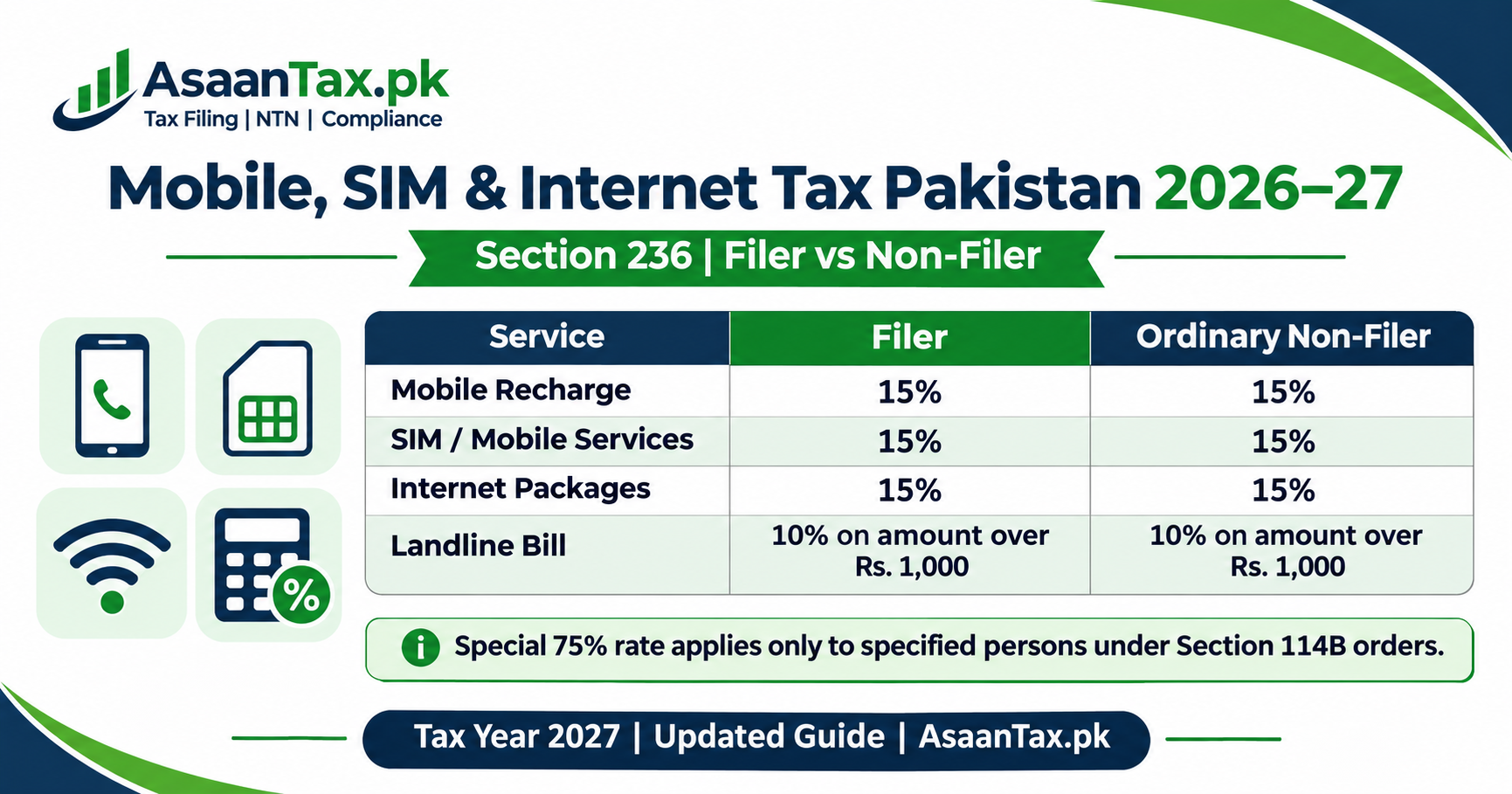
Latest Mobile and Internet Withholding Tax Rates – Tax Year 2027
The FBR Withholding Tax Rate Card updated through Finance Act 2026 provides the following ordinary rates.
| Service | Filer / ATL | Ordinary Non-Filer |
|---|---|---|
| Mobile prepaid recharge | 15% | 15% |
| Mobile postpaid bill | 15% | 15% |
| Mobile internet service | 15% | 15% |
| Prepaid internet card | 15% | 15% |
| Qualifying electronic recharge units | 15% | 15% |
| Landline bill above Rs. 1,000 | 10% on amount exceeding Rs. 1,000 | Same ordinary rate |
Applicable tax year: July 1, 2026 to June 30, 2027.
Relevant law: Section 236 and Division V of Part IV of the First Schedule.
The 75% special rate under Section 114B is discussed separately below.
Is Mobile Tax Lower for Filers Than Non-Filers?
For ordinary Section 236 mobile and internet transactions, the withholding income tax rate is the same for filers and ordinary non-filers.
Example
Two people purchase an otherwise identical qualifying mobile recharge.
Person A appears on ATL.
Person B does not appear on ATL and is not subject to a special Section 114B order.
Both are generally subject to the ordinary 15% Section 236 advance income tax rate.
This is different from certain other transactions such as property purchases, vehicle registration and bank profit, where the relevant withholding rate can vary significantly with ATL status.
Important: A person does not receive a zero mobile withholding rate merely by becoming a filer.
How Much Tax Is Deducted From Mobile Recharge?
For a simplified calculation, assume that the amount shown below is the taxable recharge value before other taxes or charges.
| Taxable Recharge Value | Section 236 Tax at 15% |
|---|---|
| Rs. 100 | Rs. 15 |
| Rs. 200 | Rs. 30 |
| Rs. 500 | Rs. 75 |
| Rs. 1,000 | Rs. 150 |
| Rs. 2,000 | Rs. 300 |
| Rs. 3,000 | Rs. 450 |
| Rs. 5,000 | Rs. 750 |
These figures show 15% of an assumed tax base.
They do not guarantee the actual usable balance from a top-up because telecom operators may calculate tax within a tax-inclusive recharge amount, and sales tax or other applicable charges can affect the transaction.
How Does a Rs. 100 Mobile Recharge Work?
There are two different ways a tax amount may be presented.
Example A: Rs. 100 Before Tax
If Rs. 100 is the taxable service or recharge value before Section 236 tax:
Advance income tax at 15% = Rs. 15.
The subtotal including this income tax alone would be Rs. 115, before any separate applicable charges.
Example B: Rs. 100 Inclusive of Section 236 Tax
If Rs. 100 is an amount that already includes 15% advance income tax, and no other tax is included:
Pre-tax base = Rs. 100 ÷ 1.15 = approximately Rs. 86.96.
Section 236 tax component = approximately Rs. 13.04.
These calculations are not a universal mobile balance conversion formula.
The actual recharge statement, relevant sales tax and operator billing method must be checked before determining usable balance.
Why Does a Filer Still Pay 15% Mobile Tax?
Filer status generally means that a taxpayer appears on FBR's Active Taxpayers List.
However, not every withholding tax provision provides a reduced ATL rate.
Section 236 has an ordinary rate for qualifying mobile and internet services.
Therefore:
- A filer may still pay 15%.
- An ordinary non-filer may also pay 15%.
- A person covered by the relevant Section 114B general order may face special consequences.
Filer status is not equivalent to a general exemption from all income tax.
What Is the Special 75% Mobile Tax Rule?
Finance Act 2024 introduced a special 75% rate for specified persons mentioned in an Income Tax General Order issued under Section 114B.
This provision targets cases where a person required to file an income tax return has not complied despite the relevant statutory notice and procedure.
Does Every Non-Filer Pay 75%?
No.
The ordinary non-ATL status alone should not be described as automatically triggering 75% tax on every mobile recharge.
The special provision requires the applicable legal conditions and a relevant FBR Income Tax General Order.
Example
Suppose a taxpayer falls within the specific group lawfully covered by an operative order.
For a hypothetical taxable prepaid recharge value of Rs. 1,000:
Special tax at 75% = Rs. 750.
This is a tax-base illustration only. The application of the special regime depends on the governing order and enforcement arrangements.
It is not an ordinary non-filer recharge calculation.
Section 114B – Can FBR Block a Mobile SIM?
Section 114B empowers FBR to take specified enforcement action against persons who meet the statutory conditions.
Potential measures include disabling SIMs or other legally authorized restrictions.
FBR previously issued Income Tax General Orders targeting identified non-compliant taxpayers.
Is Every Non-Filer SIM Automatically Blocked?
No.
A person should not assume that merely being absent from ATL means their SIM will automatically be blocked.
The statutory notice, identification, eligibility and order requirements must be considered.
What Should an Affected Person Do?
- Verify any official FBR order or communication.
- Determine whether an income tax return was legally required.
- Review any outstanding Section 114 notice.
- File the required return where applicable.
- Seek correction if the person was not legally required to file.
- Follow the official restoration procedure.
Always use official channels and avoid sharing tax credentials with unverified third parties.
Mobile Withholding Tax vs Sales Tax – What Is the Difference?
Two separate taxes can affect mobile and internet services.
1. Advance Income Tax
Collected under Section 236 of the Income Tax Ordinance, 2001.
The ordinary rate for mobile and internet services is 15%.
2. Sales Tax
Collected according to applicable federal, provincial or territorial sales tax legislation and notifications.
The actual sales tax treatment may depend on the service, location and current legal classification.
A telecom bill may therefore include both types of tax.
Example
An internet invoice may separately display:
- Service charges.
- Applicable sales tax.
- Advance income tax.
- Other lawful charges or adjustments.
Customers should not assume that every deduction shown on the bill represents Section 236 income tax.
Is Tax on Jazz, Zong, Ufone and Telenor Different?
The ordinary federal Section 236 rate is based on the legal category of the service rather than a special income tax percentage for each telecom brand.
For comparable qualifying mobile transactions, the ordinary Section 236 rate is 15%.
However, the total cost or usable balance can vary because of:
- Package pricing.
- Included services.
- Applicable sales tax.
- Discounts.
- Promotional offers.
- Billing methods.
- Other lawful charges.
For a precise comparison, examine the relevant operator's official recharge or invoice breakdown.
Is Internet Package Tax the Same as Mobile Load Tax?
For the ordinary Section 236 income tax schedule, both qualifying mobile and internet subscriber transactions generally fall within the 15% category.
However, internet products can differ in their commercial and sales tax treatment.
For example:
- Mobile internet purchased through recharge.
- Prepaid internet cards.
- Postpaid broadband bills.
- Home internet subscriptions.
Their actual invoice structure can vary.
The ordinary federal withholding percentage should not be confused with the complete tax-inclusive cost of an internet package.
What Is the Tax on Landline Telephone Bills?
Section 236 provides a different rate for telephone subscribers other than mobile phone subscribers where the monthly bill exceeds Rs. 1,000.
For this category, the rate is:
10% of the amount exceeding Rs. 1,000.
Example
Monthly qualifying landline bill: Rs. 2,000.
Excess over Rs. 1,000: Rs. 1,000.
Tax at 10% = Rs. 100.
Another Example
Monthly qualifying landline bill: Rs. 800.
Because the relevant bill does not exceed Rs. 1,000, the ordinary Section 236 landline collection threshold is not reached.
Other applicable charges may still be payable.
Can Mobile Withholding Tax Be Adjusted in an Income Tax Return?
Section 236 describes the tax as advance income tax.
Under the general provisions governing collection and credit for income tax, appropriately collected advance tax may be creditable against the taxpayer's income tax liability, subject to applicable rules.
The actual claim should be supported by genuine telecom tax records.
Example
A taxpayer has an annual income tax liability of Rs. 100,000.
Salary tax already withheld: Rs. 90,000.
Verified, legally eligible Section 236 tax credit: Rs. 2,000.
Assuming both amounts qualify for credit, the illustrative remaining tax liability would be Rs. 8,000.
However, not every amount shown on a mobile bill is income tax.
Sales tax and unrelated charges should not be entered as Section 236 income tax credits.
How to Obtain a Mobile Withholding Tax Certificate
Telecom operators may provide an annual or period-specific tax deduction certificate through official digital or customer service channels.
The availability and menu names vary by operator.
General Steps
- Open the telecom operator's official app or customer portal.
- Sign in to the relevant mobile account.
- Locate tax certificate, withholding tax or account statement services.
- Select the relevant period.
- Download or request the tax certificate.
- Verify the subscriber's information and tax amount.
- Preserve the certificate for the income tax return.
If no such option is available, contact the operator through its official customer support channel.
Do not use fabricated tax certificates or claim estimated amounts without suitable records.
How to Declare Mobile Withholding Tax in FBR IRIS
Where a taxpayer is legally entitled to claim the advance tax credit, follow the relevant IRIS procedure.
Step 1: Collect Records
Obtain genuine tax certificates or other accepted proof.
Step 2: Log In to IRIS
Visit https://iris.fbr.gov.pk/.
Step 3: Select the Correct Tax Year
For Tax Year 2027, the relevant period is July 1, 2026 to June 30, 2027.
Step 4: Review the Withholding Tax Information
Inspect the relevant tax payment and deduction records available through IRIS.
Step 5: Identify Section 236
Use the relevant telephone and internet advance tax category in the return where available.
Step 6: Record the Eligible Amount
Enter the supported legally creditable amount.
Step 7: Check the Final Calculation
Reconcile salary tax, business tax and other eligible payments.
Step 8: Submit the Applicable Return
Complete the income tax return and any legally required accompanying statement.
Important: The exact Tax Year 2027 IRIS form and fields should be confirmed when the filing form becomes available.
Can Non-Filers Claim a Mobile Tax Refund?
Refund entitlement is a separate question from withholding collection.
A taxpayer must consider:
- Whether the payment is legally creditable.
- Whether the person has an income tax filing obligation.
- Actual annual tax liability.
- Valid tax deduction records.
- Section 170 refund requirements.
- Other relevant limitations.
A person cannot automatically demand an immediate cash refund merely because a telecom operator deducted 15% during recharge.
Who Is Exempt From Section 236 Collection?
Section 236(4) provides specific exceptions, including:
- Government.
- Foreign diplomats.
- Diplomatic missions in Pakistan.
- Persons producing the relevant Commissioner certificate confirming tax-exempt income during the tax year.
These exceptions are statutory and conditional.
An ordinary citizen is not exempt merely because they have low income or appear on ATL.
Does Buying a New SIM Trigger 15% Withholding Tax?
Section 236 is primarily concerned with specified telephone and internet bills, prepaid cards and recharge units.
The tax should not automatically be described as a universal flat charge merely for acquiring or activating a SIM card.
A new SIM transaction may have activation, replacement or other charges governed by different rules.
Determine the actual nature of the payment before applying Section 236.
Common Mobile and Internet Tax Mistakes
Avoid these mistakes:
- Believing that filers never pay mobile withholding tax.
- Assuming every ordinary non-filer pays 75%.
- Confusing Section 236 income tax with sales tax.
- Using a tax-inclusive Rs. 100 recharge as though it were a Rs. 100 pre-tax amount.
- Assuming every telecom operator provides the same usable balance.
- Claiming sales tax as an income tax credit.
- Reporting unsupported tax deductions in IRIS.
- Entering an incorrect tax year.
- Treating an old telecom package advertisement as a current tax schedule.
- Ignoring the specific conditions of Section 114B.
- Assuming a mobile SIM is automatically blocked for every non-filer.
- Failing to preserve available withholding tax certificates.
Tax with Naeem – Filer and Withholding Tax Explained
For Urdu-language guidance about why withholding tax can still apply when a person is an FBR filer, watch the related Tax with Naeem video:
Income Tax Return Filing in Pakistan | Salary | Rental | Capital Gain | Dividend Explained
https://www.youtube.com/watch?v=VX88o1N1AfA
This video explains withholding tax, income classification and income tax return treatment.
It is a related income-tax tutorial, not a dedicated Section 236 mobile recharge tutorial.
For more videos on mobile load and internet withholding tax, search:
https://www.youtube.com/results?search_query=Tax+with+Naeem+Mobile+Load+Withholding+Tax
Always use the current FBR withholding rate card rather than relying on older tax-rate figures in historical videos.
How AsaanTax.pk Can Help
AsaanTax.pk provides assistance with Pakistan income tax compliance, including:
- NTN registration.
- Active Taxpayer List verification.
- Salaried-person income tax returns.
- Withholding tax reconciliation.
- Tax credit documentation.
- Income tax refund guidance.
- Freelance and business tax return filing.
- Wealth Statement preparation.
- General FBR compliance.
Need Help Understanding Mobile Withholding Tax?
Visit AsaanTax.pk for information on Tax Year 2027 income tax rates, FBR filing requirements and withholding tax treatment.
Website: https://www.asaantax.pk/
AsaanTax.pk is an independent tax services website and is not affiliated with the Federal Board of Revenue or the Government of Pakistan.
Official Sources and References
- FBR – Withholding Tax Rate Card, Tax Year 2027
- FBR – Income Tax Ordinance, 2001
- FBR – Withholding Tax Guidance
- FBR – Income Tax General Order under Section 114B
- FBR – IRIS Tax Filing Portal
- Tax with Naeem – Income Tax Return Tutorial
Last updated: November 4, 2026.
Disclaimer: This article provides general information. Tax rates and collection depend on the applicable law, transaction classification, statutory exceptions and any specific Income Tax General Order. Mobile recharge illustrations show simplified Section 236 tax calculations, not guaranteed usable balance. Sales tax and other charges can vary. Claim only verified and legally creditable withholding tax in a return.