Lowest Corporate Tax Countries in Europe 2026: Hungary, Bulgaria, Ireland and Cyprus Compared
Published: November 11, 2026
Coverage: Hungary, Bulgaria, Ireland and Cyprus
Tax Year: 2026
Category: International Taxation
Primary Sources: National tax authorities and European Commission
Europe offers several attractive destinations for entrepreneurs, startups, software companies, international investors and businesses considering expansion into the European Union.
However, corporate tax rates differ significantly between countries.
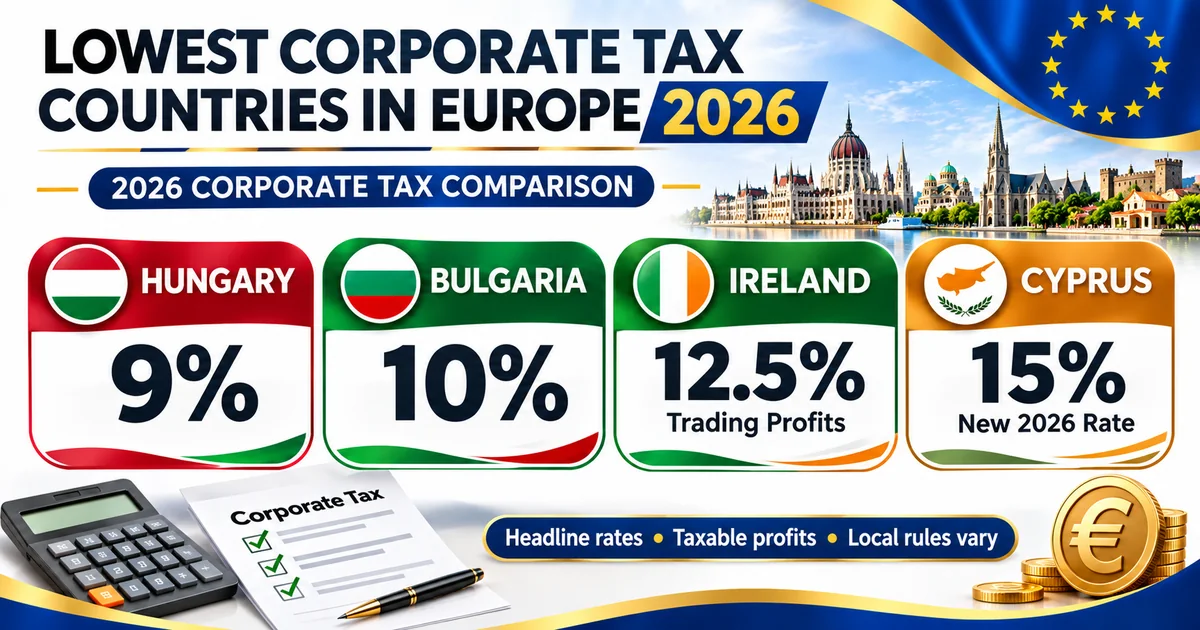
In 2026, Hungary applies a 9% standard corporate income tax rate, making it one of the lowest headline corporate tax jurisdictions within the European Union.
Bulgaria follows with a 10% flat corporate income tax rate, while Ireland maintains its internationally recognised 12.5% rate on qualifying trading profits.
Cyprus, previously known for its 12.5% corporate income tax rate, introduced a major reform effective January 1, 2026, increasing its standard rate to 15%.
This change is important because many older international tax articles still quote the previous Cyprus rate.
But the lowest headline corporate tax rate does not automatically mean the lowest total business tax burden.
Companies must also consider local business taxes, dividend withholding, payroll costs, VAT, legal substance, double-taxation agreements, accounting requirements and the European Union's 15% minimum-tax rules for qualifying large groups.
This complete guide compares Hungary, Bulgaria, Ireland and Cyprus in 2026 and explains what international entrepreneurs should consider before registering a business in Europe.
1. Which European Countries Have the Lowest Corporate Tax Rates in 2026?
The four countries covered in this comparison have the following standard or qualifying trading rates:
| Country | Corporate Tax Rate | Important Qualification |
|---|---|---|
| Hungary | 9% | Additional local business tax may apply |
| Bulgaria | 10% | General flat rate on taxable corporate profits |
| Ireland | 12.5% | Applies to qualifying trading income |
| Cyprus | 15% | Increased from 12.5% on January 1, 2026 |
These are headline corporate income tax rates.
They do not include every possible local tax, special industry charge, shareholder tax or additional international minimum-tax liability.
For qualifying large multinational and large domestic groups, the European Union's Pillar Two framework can create additional minimum-tax obligations.
2. Hungary Corporate Tax 2026 — 9% Rate
Hungary has one of the European Union's lowest standard corporate income tax rates.
The ordinary corporate tax rate is 9% of the relevant corporate tax base.
This rate has applied since January 1, 2017.
It can make Hungary attractive to companies operating in manufacturing, software development, shared services, logistics and other business activities.
Example: Hungarian Company With €100,000 Taxable Profit
Assume a Hungarian company has €100,000 of taxable profit, expressed in euros solely for comparison.
Corporate income tax:
€100,000 × 9% = €9,000.
Illustrative corporate income tax: €9,000.
In practice, the company must use the legally required tax accounting and currency reporting methods.
Hungary's Local Business Tax
One important consideration is the Hungarian local business tax, which can be levied at a rate of up to 2%, depending on the municipality.
However, the local business tax generally has a different calculation base from corporate income tax.
Therefore, it would be incorrect to assume every company simply pays 9% plus 2% on exactly the same taxable profit.
Other Potential Obligations
Hungarian businesses may also face:
- Standard VAT, generally 27%.
- Payroll taxes and contributions.
- Certain sector-specific taxes.
- Innovation contribution where applicable.
- Dividend-related taxes.
- Accounting and reporting obligations.
Hungary can be attractive, but companies should calculate the full operating tax burden rather than comparing only the 9% rate.
3. Bulgaria Corporate Tax 2026 — 10% Flat Rate
Bulgaria applies a general 10% corporate income tax rate on taxable corporate profits.
The rate is confirmed by the Bulgarian Ministry of Finance.
This relatively straightforward tax structure attracts interest from technology companies, service businesses, manufacturers and international entrepreneurs.
Example: Bulgarian Company With €100,000 Taxable Profit
Assume a Bulgarian company generates €100,000 in taxable profit.
Corporate tax:
€100,000 × 10% = €10,000.
Illustrative corporate income tax: €10,000.
The calculation assumes no special adjustments, exemptions or other tax provisions.
Why Bulgaria Attracts Businesses
Potential advantages include:
- A relatively low 10% headline corporate rate.
- European Union membership.
- Access to European markets.
- A developed technology and outsourcing sector.
- A comparatively straightforward corporate income tax structure.
- Potential cost advantages depending on the location and business model.
However, business incorporation must be accompanied by genuine legal and operational compliance.
4. Bulgaria's Dividend Tax and Other Business Obligations
Corporate income tax is only one component of the total tax cost.
Where profits are distributed to shareholders, dividend taxation may apply.
Bulgaria generally imposes a 5% final withholding tax on certain dividends, subject to relevant exemptions, shareholder status and treaty provisions.
For example, a dividend paid to a qualifying EU corporate shareholder may receive different treatment from a dividend paid to an individual shareholder.
Other considerations include:
- VAT registration.
- Payroll and social security obligations.
- Accounting and financial statements.
- Beneficial ownership reporting.
- Withholding tax on relevant cross-border payments.
- Permanent establishment and tax residence rules.
A business owner should not assume that paying 10% corporate tax means all company profits can be withdrawn personally without additional taxation.
5. Ireland Corporate Tax 2026 — 12.5% Trading Rate
Ireland retains its internationally recognised 12.5% Corporation Tax rate on qualifying trading profits.
The rate is particularly relevant to companies engaged in genuine commercial activities.
However, Ireland does not have one universal 12.5% rate for every category of income.
Ireland's Main Corporation Tax Rates
| Income Type | Rate |
|---|---|
| Qualifying Trading Income | 12.5% |
| Specified Non-Trading Income | 25% |
| Certain Excepted Trading Income | 25% |
| Pillar Two Minimum Effective Rate | 15% for in-scope groups |
Income classification is therefore critical.
Example: Irish Trading Company
A qualifying Irish trading company has €100,000 of taxable trading profit.
€100,000 × 12.5% = €12,500.
Illustrative Corporation Tax: €12,500.
If the same amount were taxable as non-trading income subject to the 25% rate, the calculation would be different.
6. Why Do Technology Companies Choose Ireland?
Ireland has become a significant European location for international technology and multinational business operations.
Its attractions extend beyond corporate tax rates.
Access to European Markets
Ireland is a member of the European Union and the Eurozone.
English-Speaking Business Environment
English is widely used in Ireland's commercial and technology sectors.
Skilled Workforce
Ireland has an established workforce in technology, finance, research and pharmaceutical activities.
Technology Ecosystem
Dublin and other Irish cities have substantial international business and technology operations.
Research and Development Incentives
Qualifying companies may access research and development tax credits under the applicable rules.
Established International Infrastructure
Ireland has an international business services industry, investment support institutions and a network of tax treaties.
However, operating in Ireland can involve higher commercial costs than some lower-cost European jurisdictions.
Tax efficiency should therefore be assessed alongside labour costs, location, infrastructure and access to customers.
7. Cyprus Corporate Tax 2026 — Increased to 15%
Cyprus has historically been regarded as an attractive international business and investment jurisdiction.
Until December 31, 2025, the standard corporate income tax rate was 12.5%.
However, the Cyprus tax reform increased the rate to 15% effective January 1, 2026.
Cyprus Tax Rate Comparison
| Period | Standard Corporate Tax |
|---|---|
| 2013–2025 | 12.5% |
| From January 1, 2026 | 15% |
The reform also introduced changes affecting dividend taxation, tax loss carryforwards, residence rules and certain other provisions.
Example: Cyprus Company With €100,000 Taxable Profit
€100,000 × 15% = €15,000.
Illustrative corporate income tax: €15,000.
The calculation assumes ordinary taxable income without special adjustments.
Important: Cyprus's 15% standard rate should not be confused with the separate 15% minimum effective tax under Pillar Two. They are different legal frameworks.
8. Why Might a Company Still Choose Cyprus?
Despite the increased corporate tax rate, Cyprus may remain attractive for some international business structures.
Potential considerations include:
- European Union membership.
- An established international professional services sector.
- Access to a tax treaty network.
- Certain participation and investment-income exemptions.
- Rules affecting intellectual property and financing activities.
- Geographic positioning in the Eastern Mediterranean.
- International business and holding company infrastructure.
Cyprus's 2026 reforms also extended the ordinary tax loss carryforward period from five years to seven years, subject to the relevant conditions.
A company considering Cyprus should review the full reform rather than selecting the jurisdiction based only on the historical 12.5% rate.
9. Corporate Tax Comparison on €100,000 Profit
The following example assumes an identical €100,000 taxable profit in each jurisdiction.
| Country | Headline Rate | Illustrative Corporate Tax |
|---|---|---|
| Hungary | 9% | €9,000 |
| Bulgaria | 10% | €10,000 |
| Ireland | 12.5% | €12,500 |
| Cyprus | 15% | €15,000 |
These are simplified headline-rate examples.
They exclude local taxes, shareholder taxes, special charges, foreign exchange effects and potential Pillar Two top-up taxes.
What Is the Difference Between Hungary and Cyprus?
At these headline rates, the tax difference on €100,000 of identical taxable profits is:
€15,000 − €9,000 = €6,000.
That does not necessarily mean the Hungarian company saves exactly €6,000 in total taxes.
The result depends on all relevant taxes and the company's actual circumstances.
10. Corporate Tax Comparison on €1 Million Profit
| Country | Illustrative Corporate Income Tax |
|---|---|
| Hungary | €90,000 |
| Bulgaria | €100,000 |
| Ireland | €125,000 |
| Cyprus | €150,000 |
This table illustrates the standard rates only.
It is not a calculation of the effective tax burden of a multinational group.
Companies must also account for their legally determined tax bases, financing structures, deductions, special taxes and other obligations.
11. What Is the EU's 15% Global Minimum Corporate Tax?
The European Union implemented the OECD/G20 Pillar Two minimum-tax framework for qualifying large multinational and large-scale domestic groups.
Broadly, the rules seek to ensure a minimum 15% effective tax rate in relevant jurisdictions for in-scope groups.
The framework generally concerns groups meeting a consolidated annual revenue threshold of €750 million under the relevant multi-year tests.
Does It Apply to Every Small Company?
No.
An ordinary independent small company with revenue far below the relevant group threshold is not automatically subject to Pillar Two merely because it is located in Hungary or Bulgaria.
How Does a Top-Up Tax Work?
If the legally calculated effective tax rate in a jurisdiction falls below 15%, the rules can require additional tax.
The calculation involves covered taxes, qualifying income and statutory adjustments.
A simple comparison of 9% and 15% is not sufficient to calculate a real Pillar Two liability.
12. Corporate Tax Rate vs Effective Tax Rate
A headline corporate income tax rate is the percentage stated in the relevant tax law.
An effective tax rate measures the actual tax burden relative to a defined income or profit measure.
The two can differ.
Reasons for Differences
- Allowable business expenses.
- Tax depreciation.
- Loss carryforwards.
- Research and development credits.
- Local business taxes.
- Industry-specific taxes.
- Non-deductible expenditures.
- Tax exemptions.
- Foreign tax credits.
- Pillar Two adjustments.
A country with a lower headline rate may not always produce a lower effective tax burden for a particular company.
13. VAT Rates in These European Countries
VAT is separate from corporate income tax.
| Country | Standard VAT Rate |
|---|---|
| Hungary | 27% |
| Bulgaria | 20% |
| Ireland | 23% |
| Cyprus | 19% |
VAT normally concerns taxable supplies rather than corporate profits.
Registration thresholds, cross-border services, EU VAT rules and reduced-rate supplies require separate analysis.
For a company selling goods or services to customers across the European Union, VAT compliance can be just as important as corporate tax planning.
14. Which Country Is Best for a Software Company?
The answer depends on the company's activities and operating model.
Hungary
May be attractive to businesses seeking a low headline corporate income tax rate and access to the Central European market.
However, local business tax and other business costs should be reviewed.
Bulgaria
May appeal to software development and service businesses seeking a 10% flat corporate tax rate and suitable operating costs.
Ireland
May suit technology businesses prioritising an English-speaking environment, international workforce, established technology infrastructure and access to the Eurozone.
Cyprus
May be suitable for certain international services, investment and holding structures where its updated tax rules and commercial environment fit the business.
No country is universally the best choice for every software company.
15. Which Country Is Best for Holding Companies?
Holding companies often require a different tax analysis from ordinary trading businesses.
Relevant considerations include:
- Taxation of dividend income.
- Capital gains exemptions.
- Participation exemptions.
- Withholding taxes.
- Beneficial ownership requirements.
- Tax treaties.
- Substance requirements.
- Anti-avoidance rules.
- Group taxation.
- Financing and interest deduction rules.
For example, the country with the lowest tax rate on trading profits may not necessarily have the most suitable holding-company rules for a particular investor.
A proper analysis should evaluate the nature of the company's investments and income.
16. Can Foreign Entrepreneurs Register Companies in These Countries?
Foreign investors may be able to establish companies in Hungary, Bulgaria, Ireland or Cyprus, subject to the applicable incorporation and ownership rules.
However, establishing a company does not automatically provide:
- Personal tax residence.
- Immigration permission.
- A work permit.
- A local bank account.
- Exemption from home-country taxation.
- Eligibility for every tax incentive.
- Protection from permanent establishment rules.
Company registration and individual immigration rights are separate matters.
Entrepreneurs should review the applicable legal, banking, tax and immigration requirements before incorporating.
17. Does an EU Company Automatically Pay Tax Only in Its Country of Registration?
No.
A company incorporated in one European country may have tax obligations in other countries.
Relevant factors include:
- Place of effective management.
- Permanent establishments.
- Actual employee and office locations.
- Where business activities are performed.
- Transfer-pricing arrangements.
- Cross-border tax treaties.
- Controlled foreign company rules.
- Beneficial ownership and economic substance.
For example, an entrepreneur living and managing a company from another country should not assume that foreign incorporation alone eliminates tax obligations in the country where management takes place.
This issue is particularly important for international freelancers and remote business owners.
18. What Are the Corporate Tax Filing Rules?
Filing and payment obligations differ by country.
Hungary
The ordinary corporate income tax return is generally due by the last day of the fifth month following the tax year.
For a calendar-year company, this is generally May 31 of the following year.
Bulgaria
Corporate income tax returns are generally filed between March 1 and June 30 of the following year, under the applicable rules.
Ireland
A company generally files its Corporation Tax return within nine months after the accounting period ends.
For electronic filing, the deadline is ordinarily no later than the 23rd day of the ninth month.
Cyprus
From tax year 2026 onward, corporate tax returns are to be submitted through the new Tax For All system.
The precise filing and payment dates should be checked against the Cyprus Tax Department's rules and current notices for the relevant tax year.
Important: Registration, preliminary tax, advance payments, VAT returns and annual financial statements may have different deadlines.
19. Dividend Tax Can Change the Total Tax Burden
A company may first pay corporate income tax on its taxable profits.
When profits are distributed to shareholders, additional tax can arise.
Simplified Example
A company earns €100,000 of taxable profit.
The company pays €10,000 corporate income tax.
After-tax profit is €90,000.
If the company distributes this amount, the shareholder's tax depends on applicable dividend rules.
The shareholder may owe tax in the country of residence, even where the distributing company is located in a low-tax jurisdiction.
Important
Avoid assuming that a 9%, 10%, 12.5% or 15% corporate tax payment is necessarily the final tax cost for a business owner.
The shareholder's position must be analysed separately.
20. Payroll Taxes and Employment Costs
Companies hiring staff must consider payroll obligations.
These may include:
- Employer social security contributions.
- Employee contributions.
- Wage withholding.
- Mandatory employment insurance.
- Pension-related obligations.
- Labour law compliance.
- Payroll reporting.
A country with a lower corporate tax rate may have higher employment costs in certain circumstances.
A business planning to hire developers or support staff should compare total employment costs, not simply the company income tax rate.
21. Business Substance and Anti-Avoidance Rules
European tax authorities and international frameworks require businesses to comply with applicable anti-avoidance and economic-substance rules.
A company should not rely on a foreign registered office address alone to establish its full tax position.
Relevant evidence may include:
- Real management and decision-making.
- Employees or contractors.
- Business premises.
- Commercial contracts.
- Accounting records.
- Local operational activities.
- Board decisions.
- Bank transactions.
- Actual customer and supplier relationships.
Tax structures should reflect legitimate commercial arrangements.
Artificial arrangements designed solely to shift profits may be challenged under relevant legislation.
22. Can Pakistani Entrepreneurs Benefit From European Corporate Tax Rates?
Pakistani entrepreneurs may consider establishing genuine businesses in European jurisdictions where the legal conditions allow.
Potential business activities include:
- Software development.
- IT consulting.
- E-commerce.
- International digital services.
- Export and distribution activities.
- Technology product development.
- Other lawful business operations.
However, a Pakistani resident who owns a European company must consider both local European taxation and any applicable Pakistani tax obligations.
Important questions include:
- Where is the company actually managed?
- Where are the services performed?
- Does the company have a taxable presence in Pakistan?
- Are dividends or salaries taxable in the shareholder's country?
- Are foreign assets and income reportable?
- Do double taxation agreements provide relevant relief?
Incorporating abroad is not a substitute for complying with the laws of the country where business operations and management take place.
23. Common Mistakes When Choosing a Low-Tax European Country
- Using Cyprus's outdated 12.5% corporate tax rate for 2026.
- Assuming Ireland's 12.5% rate covers all company income.
- Ignoring Hungary's local business tax.
- Applying the EU 15% minimum tax to every small company.
- Confusing revenue with taxable profit.
- Ignoring dividend withholding tax.
- Comparing VAT rates as if they were corporate income tax rates.
- Overlooking payroll taxes and employee costs.
- Assuming foreign incorporation creates immigration rights.
- Failing to consider the place of effective management.
- Ignoring permanent establishment obligations.
- Claiming tax treaty benefits without checking eligibility.
- Failing to maintain proper business records.
- Ignoring tax return and payment deadlines.
- Choosing a country based only on one advertised percentage.
24. Final Company Selection Checklist
Before deciding where to establish a European company:
- Identify the actual business activity.
- Determine the expected revenue and profit.
- Compare corporate income tax rates.
- Review local taxes.
- Check relevant VAT obligations.
- Examine employee payroll and social costs.
- Identify dividend and shareholder tax treatment.
- Assess whether Pillar Two applies.
- Review available research and investment incentives.
- Check incorporation and annual administration costs.
- Determine the company's tax residence.
- Evaluate permanent establishment risks.
- Confirm banking requirements.
- Check beneficial ownership rules.
- Review the local business environment.
- Check foreign shareholder tax obligations.
- Confirm filing and payment deadlines.
- Obtain advice concerning cross-border taxation.
25. Watch Tax With Naeem — Business and Income Tax Education
For general educational guidance on income tax filing, business income, capital gains, dividend income and taxation in Pakistan, watch the following related video from Tax With Naeem.
Video: Income Tax Return Filing in Pakistan | Salary | Rental | Capital Gain | Dividend Explained | FBR
https://www.youtube.com/watch?v=VX88o1N1AfA
This video was published by Tax With Naeem on October 2, 2025.
It explains different categories of income and the Pakistani income tax return system.
Important: This is not a dedicated European corporate tax tutorial.
Taxpayers should follow the laws and official tax authority guidance of Hungary, Bulgaria, Ireland or Cyprus when establishing or operating a business in those countries.
26. Official Sources and References
Hungary
National Tax and Customs Administration (NAV)
Business Taxation Guidance
Bulgaria
Ministry of Finance — Corporation Tax
Ireland
Irish Revenue — Corporation Tax Rates
Irish Revenue — Corporation Tax Payment and Filing
Cyprus
Cyprus Tax Department — Corporation Tax
Cyprus Tax Reform 2026
https://www.gov.cy/mof-tax/en/documents/forologiki-metarrythmisi-2026/
European Union
European Commission — Minimum Corporate Taxation
https://taxation-customs.ec.europa.eu/taxation/business-taxation/minimum-corporate-taxation_en
European Union — Company Tax
https://europa.eu/youreurope/business/finance-and-tax/business-tax/company-tax-eu/index_en.htm
Related Educational Resources
AsaanTax.pk — International Taxation
Tax With Naeem — Income Tax Tutorial
https://www.youtube.com/watch?v=VX88o1N1AfA
27. Conclusion: Which European Country Has the Lowest Corporate Tax in 2026?
Among Hungary, Bulgaria, Ireland and Cyprus, Hungary has the lowest standard headline corporate income tax rate at 9%, followed by Bulgaria at 10%.
Ireland retains a 12.5% rate on qualifying trading profits, making it attractive for many genuine commercial and international technology operations.
Cyprus increased its standard corporate income tax rate to 15% from January 1, 2026, although its international business environment and other tax provisions may remain relevant for specific structures.
For qualifying large corporate groups, the European Union's Pillar Two minimum tax can also affect the final effective tax rate.
However, a company's ideal location cannot be determined by corporate tax rates alone.
Entrepreneurs should evaluate the tax burden alongside operating costs, employee availability, market access, legal requirements, tax residency, shareholder taxation and administrative obligations.
The best country is not necessarily the one with the lowest headline rate, but the one offering the most suitable overall tax and commercial framework for a genuine business.
For more international corporate tax and business compliance guides, visit:
AsaanTax.pk: https://www.asaantax.pk/
Editorial Note: This guide reflects tax rules verified as of November 11, 2026, including Cyprus's 2026 tax reform and the European Union's Pillar Two framework.
Disclaimer: This article is intended for general educational information and does not constitute individualized tax, legal, business incorporation or immigration advice. Tax liabilities depend on actual business circumstances, local law, group structure, tax residence, income classification and applicable exemptions. Readers should obtain professional advice before implementing cross-border corporate structures.