Malaysia SST and E-Invoicing 2026: Rental Tax Cut to 6% and Business Compliance Guide
Published: November 12, 2026
Country: Malaysia
Tax Authorities: Royal Malaysian Customs Department (RMCD) and Inland Revenue Board of Malaysia (IRBM/LHDN)
Applicable Year: 2026
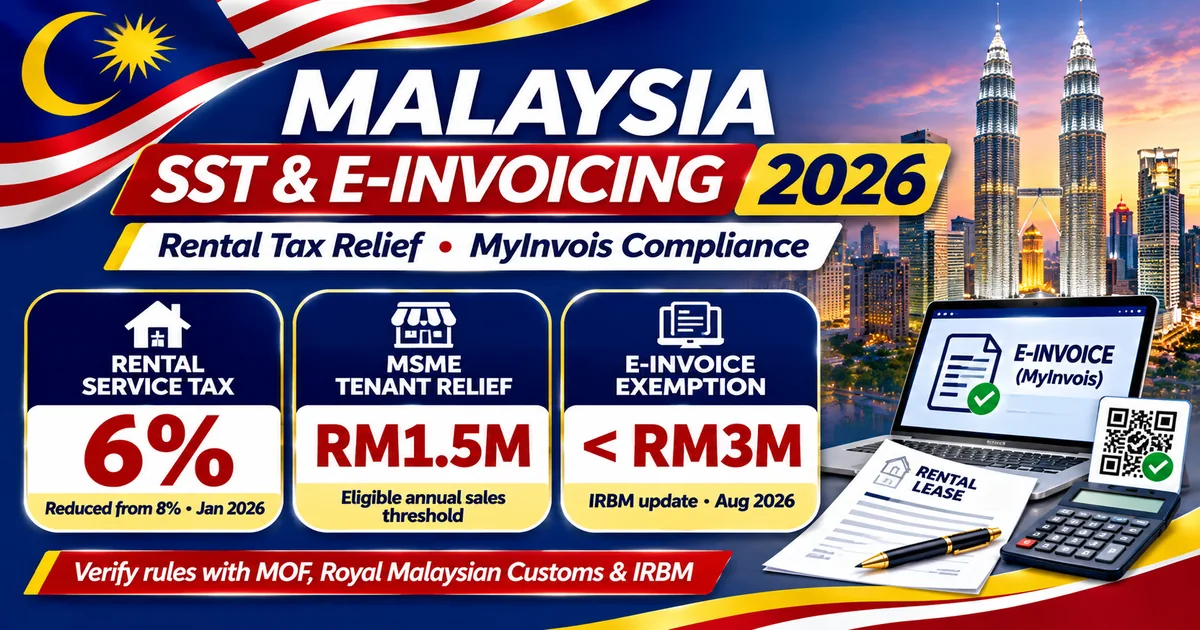
Major Changes: Rental service tax reduced to 6%; updated e-Invoice exemptions for businesses with annual turnover below RM3 million
Introduction
Malaysia has introduced important tax and digital compliance changes affecting landlords, commercial tenants, small and medium enterprises, service providers, retailers, consultants and other businesses.
One of the biggest developments is the reduction of service tax on qualifying rental and leasing services from 8% to 6%, effective January 1, 2026.
The government also expanded relief for eligible micro, small and medium enterprise (MSME) tenants.
At the same time, Malaysia continues implementing its nationwide electronic invoicing system, known as e-Invoicing, administered by the Inland Revenue Board of Malaysia (LHDN).
The 2026 e-Invoicing rollout initially covered smaller businesses, but the government subsequently increased the exemption threshold.
Under the updated August 30, 2026 implementation schedule, taxpayers with annual turnover or revenue below RM3 million are exempt from mandatory e-Invoice implementation, subject to the applicable eligibility rules.
This guide explains Malaysia's SST system, the rental tax reduction, business exemptions, e-Invoice registration, MyInvois procedures, reporting obligations, penalties and important compliance steps.
1. What Is Malaysia's Sales and Service Tax?
Malaysia operates a Sales and Service Tax system commonly known as SST.
SST contains two separate components:
Sales Tax: A tax on specified taxable goods manufactured in Malaysia or imported into Malaysia.
Service Tax: A tax on specified taxable services supplied by registered taxable persons under the applicable legislation.
Unlike a broad Value Added Tax system, Malaysia's SST does not operate as a universal tax on every transaction.
The treatment depends on the type of goods or services, the supplier's registration status and applicable exemptions.
2. Malaysia SST Rates in 2026
Malaysia has different tax rates for different goods and services.
| Tax Category | General Position in 2026 |
|---|---|
| Sales Tax | Generally 5% or 10% on relevant taxable goods, with exemptions and other rates |
| General Service Tax | 8% on many taxable services |
| Food and Beverage Services | 6% |
| Telecommunications Services | 6% |
| Logistics Services | 6% |
| Parking Services | 6% |
| Qualifying Rental and Leasing Services | 6% from January 1, 2026 |
| Qualifying Construction Services | 6% |
| Certain Financial Services | 8% |
| Certain Private Healthcare and Education Services | 6%, subject to scope and exemptions |
The precise tax depends on current Customs legislation and sector-specific rules.
Important: Malaysia does not impose one uniform 6% SST rate across all products and services.
3. Malaysia Reduces Rental Service Tax From 8% to 6%
The Ministry of Finance announced on January 5, 2026, that the Service Tax rate on rental and leasing services would be reduced from 8% to 6%.
The reduction applies from January 1, 2026.
The Service Tax (Rate of Tax) (Amendment) Order 2026 subsequently provided legislative support for this change.
Comparison
| Period | Rental/Leasing Service Tax Rate |
|---|---|
| July 1 – December 31, 2025 | 8% |
| From January 1, 2026 | 6% |
| Reduction | 2 percentage points |
This reduction is relevant to qualifying taxable rental and leasing services.
It should not be interpreted as a general tax on every residential rental arrangement.
4. How Much Can a Business Save Under the 6% Rate?
Consider a business renting qualifying commercial premises.
Monthly rental charge before service tax: RM10,000.
Previous Rate — 8%
Service Tax:
RM10,000 × 8% = RM800.
Total monthly cost:
RM10,800.
New Rate — 6%
Service Tax:
RM10,000 × 6% = RM600.
Total monthly cost:
RM10,600.
Savings
Monthly reduction:
RM800 − RM600 = RM200.
Annual reduction for 12 equivalent months:
RM200 × 12 = RM2,400.
| Description | Previous 8% | New 6% |
|---|---|---|
| Monthly Rental | RM10,000 | RM10,000 |
| Service Tax | RM800 | RM600 |
| Total Monthly Cost | RM10,800 | RM10,600 |
| Annual Tax Amount | RM9,600 | RM7,200 |
Illustrative annual saving: RM2,400.
This assumes the rental service is taxable, the same rent applies throughout the period and no exemption changes the treatment.
5. Does Every Landlord Charge 6% Service Tax?
No.
The tax depends on whether the rental or leasing service falls within the taxable scope and whether the provider is liable to be registered or is registered.
Businesses should examine:
- Whether the rental service is taxable.
- The nature of the asset being rented.
- The provider's taxable service turnover.
- Relevant registration thresholds.
- Whether the tenant qualifies for relief.
- Any business-to-business exemption.
- Special contractual arrangements.
- Other applicable exclusions.
For example, residential property rental is generally treated differently from qualifying commercial rental services.
A landlord should not automatically add 6% to every rental invoice.
6. What Is the Rental Service Tax Registration Threshold?
The Royal Malaysian Customs Department has published registration thresholds for different service categories.
Under the expanded SST framework, rental and leasing services generally have a registration threshold of RM1 million in relevant annual taxable service value, subject to the applicable rules.
This is separate from the RM1.5 million annual sales limit used for qualifying MSME tenant relief.
Two Important Thresholds
| Requirement | Figure |
|---|---|
| Rental/Leasing Service Provider Registration | Generally RM1 million in relevant annual taxable services |
| Eligible MSME Tenant Relief | Annual sales up to RM1.5 million |
A supplier's obligation to register and a tenant's eligibility for exemption are different questions.
Businesses should not confuse these thresholds.
7. MSME Rental Service Tax Relief Increased to RM1.5 Million
The Ministry of Finance announced that the annual sales threshold for qualifying MSME tenants to receive rental or leasing service tax relief was increased from RM1 million to RM1.5 million.
The measure applies from January 1, 2026.
Comparison
| Period | Relevant MSME Tenant Annual Sales Limit |
|---|---|
| Previously | RM1 million |
| From January 1, 2026 | RM1.5 million |
An eligible MSME tenant meeting the statutory requirements may qualify for an exemption from rental or leasing service tax.
However, eligibility is not determined solely by the tenant's verbal claim that it is a small business.
The necessary registration, declaration and Customs requirements must also be satisfied.
8. New MSMEs Can Receive One-Year Rental Tax Relief
Malaysia also announced a special relief measure for newly established MSMEs.
Qualifying newly registered MSMEs can receive an exemption from service tax on rental or leasing services for one year from the date of their MSME registration.
Example
A qualifying new small business registers under the relevant MSME procedure.
The business enters into an eligible commercial rental agreement.
Subject to the official conditions, it may benefit from the one-year relief period.
The exact start date and supporting documentation should be verified through Customs guidance.
Important
The one-year relief is not automatically available to every new tenant or every newly signed lease.
The business must satisfy the relevant MSME registration and exemption requirements.
9. How Can MSMEs Claim Rental Service Tax Relief?
The Royal Malaysian Customs Department provides administrative procedures for qualifying MSME rental exemptions.
Businesses should:
- Confirm MSME eligibility.
- Determine annual sales or revenue.
- Review the applicable exemption conditions.
- Complete the required MSME registration or declaration.
- Provide appropriate information to the rental service provider.
- Keep documentary evidence supporting the exemption.
- Ensure the rental invoice reflects the correct treatment.
- Maintain updated records where annual declarations are required.
Customs has referred to the MyPMK system in its rental service tax exemption guidance.
Businesses should follow the latest official procedure rather than assuming older exemption documentation remains sufficient.
10. What Is Malaysia E-Invoicing?
E-Invoicing is a digital system through which transactions are documented and validated electronically under the Inland Revenue Board of Malaysia's requirements.
Malaysia's official e-Invoicing platform is known as MyInvois.
It is designed to improve:
- Transaction transparency.
- Tax reporting accuracy.
- Digital record keeping.
- Invoice validation.
- Business compliance.
- Tax administration.
- Data reconciliation.
A Malaysian e-Invoice is not merely an ordinary PDF invoice sent through email.
It is a structured document processed through the prescribed system.
11. Who Administers E-Invoicing in Malaysia?
The Inland Revenue Board of Malaysia, also known as LHDN or IRBM, administers the national e-Invoice initiative.
Businesses can use:
MyInvois Portal: An official portal for creating and managing e-Invoices.
MyInvois API: A technical integration method for qualifying ERP, accounting and business software systems.
Businesses should use the official IRBM guidelines and technical documentation.
12. Malaysia E-Invoice Implementation Timeline
Malaysia's rollout began with large taxpayers before expanding to smaller businesses.
The official timeline published by IRBM provides:
| Annual Turnover or Revenue | Implementation Date |
|---|---|
| More than RM100 million | August 1, 2024 |
| More than RM25 million up to RM100 million | January 1, 2025 |
| More than RM5 million up to RM25 million | July 1, 2025 |
| Up to RM5 million, subject to updated exemptions | January 1, 2026 |
Important August 2026 Update
IRBM updated the exemption threshold on August 30, 2026.
Taxpayers with annual turnover or revenue below RM3 million are exempt from mandatory e-Invoice implementation under the updated framework, subject to the applicable conditions.
Therefore, older implementation tables that require every taxpayer below RM5 million to comply without mentioning the exemption are incomplete.
13. What Is the RM3 Million E-Invoice Exemption?
The updated IRBM implementation timeline identifies taxpayers with annual turnover or revenue below RM3 million as exempt from e-Invoice implementation.
Examples
Business A: Relevant annual turnover of RM800,000.
The business is below RM3 million and may qualify for the exemption.
Business B: Relevant annual turnover of RM2.5 million.
The business is also below the stated threshold, subject to the official eligibility requirements.
Business C: Relevant annual turnover of RM4 million.
The business is above RM3 million and should review its mandatory implementation obligations.
Important
The exact turnover calculation and application of the exemption should follow IRBM's current guidelines.
Businesses should not rely only on one month's turnover or an informal revenue estimate.
14. Does Full E-Invoice Enforcement Apply to Every Business?
No.
The e-Invoice regime is mandatory for businesses falling within the relevant scope after taking account of phased implementation and exemptions.
A qualifying exempt business does not automatically become non-compliant simply because it does not issue e-Invoices.
At the same time, businesses already required to comply must follow the applicable rules and should not assume that enforcement is postponed indefinitely.
Key Distinction
Mandatory Business: Must follow e-Invoice obligations according to the applicable implementation date and rules.
Exempt Business: May be outside mandatory implementation if it satisfies the updated exemption conditions.
Business Under Transitional Concession: Must follow the specific requirements and deadlines of the applicable concession.
15. What Is an E-Invoice?
An e-Invoice records a qualifying transaction using prescribed digital information.
Depending on the transaction, details can include:
- Supplier name.
- Supplier Tax Identification Number.
- Buyer details where required.
- Invoice date and time.
- Product or service descriptions.
- Quantity.
- Relevant amounts.
- Taxes.
- Discounts.
- Invoice identifiers.
- Other mandatory data fields.
The submission and validation requirements depend on the applicable e-Invoice rules.
16. How Does MyInvois Work?
The general process is:
- A business creates an electronic invoice.
- Required transaction data is entered.
- The document is submitted through the MyInvois Portal or API.
- The system validates the document.
- A validated invoice identifier and related information are generated.
- The supplier provides the required invoice details to the buyer.
- The relevant records are retained.
Technical or regulatory exceptions can affect individual transactions.
Businesses should follow the latest MyInvois specification.
17. How to Register and Use the MyInvois Portal
Step 1: Access the Official IRBM Website
Visit:
https://www.hasil.gov.my/en/e-invoice/
Step 2: Review Mandatory Implementation
Confirm whether the business falls within the e-Invoice rollout and exemption requirements.
Step 3: Access MyTax and MyInvois
Use the official tax account and relevant MyInvois service.
Step 4: Complete Business Authorization
Ensure the relevant business owner, director or authorized representative has the appropriate access.
Step 5: Verify Tax Identification Details
Confirm the supplier's Tax Identification Number and required business information.
Step 6: Configure Invoice Details
Enter the necessary product, service, pricing and tax data.
Step 7: Create an E-Invoice
Use the official portal or integrated software.
Step 8: Submit for Validation
Follow the prescribed submission procedure.
Step 9: Share the Validated Document
Provide the appropriate document or verification information to the buyer.
Step 10: Maintain Records
Retain relevant invoices and supporting records in accordance with applicable law.
18. Can Businesses Use Their Own Accounting Software?
Yes.
IRBM provides technical documentation allowing software integration with MyInvois.
Companies using ERP or accounting platforms can consider API integration.
Potential Advantages
- Automated invoice generation.
- Reduced manual data entry.
- Faster processing.
- Better transaction reconciliation.
- Centralized invoice records.
- Improved audit trails.
However, businesses must ensure their software uses current MyInvois technical requirements.
An accounting system that generates ordinary PDFs does not necessarily satisfy e-Invoice validation requirements.
19. What Is a Consolidated E-Invoice?
Under applicable conditions, certain qualifying transactions may be reported through consolidated e-Invoices.
This can simplify reporting for businesses dealing with numerous customers who do not require individual e-Invoices.
Important
Consolidation is not universally available for every transaction.
Restrictions apply to specified industries and transaction categories.
Where permitted, consolidated e-Invoices generally must be submitted within seven calendar days after the end of the relevant month.
Businesses should check current IRBM guidance before using consolidation.
20. What Is a Self-Billed E-Invoice?
In certain prescribed situations, the buyer or recipient is responsible for issuing a self-billed e-Invoice.
Potential situations include specified payments to foreign suppliers and other categories identified by IRBM.
The exact rules depend on transaction classification.
Example
A Malaysian business purchases certain services from a non-resident supplier.
The transaction may require the Malaysian buyer to issue a self-billed e-Invoice under the applicable rules.
This is separate from determining whether the transaction is also subject to SST, withholding tax or another Malaysian tax obligation.
21. Does E-Invoicing Replace SST?
No.
E-Invoicing and SST are separate compliance frameworks.
| Requirement | SST | E-Invoicing |
|---|---|---|
| Main Authority | Royal Malaysian Customs | Inland Revenue Board |
| Primary Purpose | Tax on relevant goods and services | Digital transaction reporting |
| Main System | MySST | MyInvois |
| Registration | Based on relevant taxable activities | Based on implementation and exemption rules |
| Payment Obligation | Tax may be payable | E-Invoicing itself is not an additional sales tax |
| Reporting | SST returns | Validated electronic invoices |
A business may need to comply with both systems.
The introduction of e-Invoicing does not automatically replace the requirement to file SST returns.
22. How Are SST Returns Filed?
Registered taxable persons generally submit SST returns using the applicable Customs procedures.
For Service Tax, the relevant return is commonly known as SST-02.
The normal taxable period is generally two months.
Returns and payments are generally due by the last day of the month following the end of the relevant taxable period, subject to specific rules.
Example
Assume a taxable period ends on October 31, 2026.
The ordinary filing and payment deadline would generally fall on November 30, 2026.
The taxpayer should confirm the actual period and requirements using the MySST system.
23. How Should Rental Tax Be Shown on an Invoice?
Customs issued transitional guidance concerning the reduction from 8% to 6%.
For qualifying rental services, the administrative examples included:
Method 1: Show 8% service tax and a 2% exemption.
Method 2: Show the effective 6% service tax directly.
Example
Rental charge: RM1,000.
8% service tax: RM80.
2% exemption: RM20.
Net tax: RM60.
Total payable: RM1,060.
Alternatively:
Rental charge: RM1,000.
6% service tax: RM60.
Total payable: RM1,060.
Businesses should follow the current legally applicable invoice and SST-02 reporting requirements.
24. Can Businesses Face Penalties for E-Invoice Non-Compliance?
Yes, where an e-Invoice is legally required and an offence is established.
IRBM's published compliance material identifies offences under Section 120 of the Income Tax Act 1967.
For relevant failures to issue e-Invoices, the statutory penalty framework can include:
- A fine ranging from RM200 to RM20,000.
- Imprisonment for up to six months.
- Or both, subject to the applicable statutory provisions.
Important
These are potential statutory penalties, not automatic fines on every business or transaction.
Enforcement depends on the actual offence, the taxpayer's obligations, any applicable concessions and the circumstances.
IRBM also introduced a special voluntary disclosure programme concerning e-Invoice compliance during 2026.
Businesses should review that programme's terms before assuming any relief is available.
25. What Was the 2026 Voluntary Disclosure Programme?
IRBM announced a special voluntary disclosure programme for e-Invoicing during 2026.
The programme was intended to encourage correction of relevant compliance errors and improve the accuracy of tax records.
Businesses seeking to use a voluntary disclosure arrangement must review its applicable time period and conditions.
A voluntary disclosure programme should not be treated as a permanent exemption from all e-Invoice penalties.
The safest approach is to maintain accurate records and correct errors promptly.
26. How Does the Reform Affect Landlords?
Landlords and rental service providers should review:
- Whether the supplied rental service is taxable.
- Applicable service tax registration.
- The new 6% rental rate.
- Commercial rental contracts.
- Eligible tenant exemption documentation.
- Tax invoicing.
- SST return reporting.
- E-Invoice requirements where applicable.
Important
A supplier can have SST obligations and e-Invoice obligations under different thresholds.
A landlord should therefore evaluate the two tax frameworks separately.
27. How Does the Reform Affect Small Businesses?
Small businesses may benefit from the revised rental tax rate and applicable MSME tenant relief.
Some also benefit from the increased e-Invoice exemption threshold.
However, eligibility must be checked carefully.
Example
A Malaysian small business has annual sales of RM1.2 million and rents qualifying commercial space.
The business may potentially qualify under the RM1.5 million MSME tenant relief, subject to Customs requirements.
It may also fall below the RM3 million e-Invoice exemption threshold, subject to IRBM's separate rules.
The two benefits arise under different laws and should not be treated as a single automatic exemption.
28. What About Freelancers and Consultants?
Freelancers and consultants must determine their legal and tax classification.
Relevant questions include:
- Are they operating as individuals or through a company?
- What is their annual turnover?
- Are they required to issue e-Invoices?
- Do they supply services within the scope of SST?
- Are they subject to income tax?
- Are relevant withholding rules applicable?
- Are their customers located in Malaysia or overseas?
The reduction in rental Service Tax does not mean that every freelance service is taxed at 6%.
Similarly, an exemption from mandatory e-Invoicing does not eliminate income tax obligations.
29. International Businesses and E-Invoicing
Foreign companies supplying goods or services to Malaysian customers should review the applicable rules.
Relevant issues may include:
- Permanent establishment or taxable presence.
- Malaysian business registration.
- Cross-border services.
- Imported taxable services.
- Digital services.
- Withholding tax.
- Self-billed e-Invoices.
- SST.
- Transfer pricing.
- Contract and invoice documentation.
The tax result depends on the actual business arrangement.
A foreign company should not assume that every sale to a Malaysian customer creates identical registration and e-Invoice obligations.
30. Common Malaysia SST and E-Invoice Mistakes
- Continuing to charge 8% on qualifying rental services from January 2026.
- Assuming every rental property is subject to the 6% rate.
- Confusing landlord registration thresholds with MSME tenant relief thresholds.
- Ignoring the increased RM1.5 million MSME tenant limit.
- Assuming every newly established company automatically receives one-year relief.
- Relying on outdated e-Invoice rollout tables.
- Ignoring the August 30, 2026 RM3 million exemption update.
- Treating e-Invoicing as a new tax rather than a reporting system.
- Assuming a PDF invoice automatically satisfies MyInvois requirements.
- Using outdated accounting software.
- Failing to validate required e-Invoices.
- Using consolidated e-Invoices for transactions where consolidation is not permitted.
- Ignoring self-billed e-Invoice requirements.
- Confusing SST registration with mandatory e-Invoice implementation.
- Failing to maintain accurate business records.
- Assuming every business faces immediate criminal penalties.
- Failing to follow current Customs and IRBM guidance.
31. Malaysia Business Compliance Checklist for 2026
Before the next reporting cycle, verify:
- Business registration and tax identification.
- Annual turnover.
- Applicable SST registration status.
- Correct Service Tax rate.
- Rental and leasing tax treatment.
- MSME tenant relief eligibility.
- Relevant MyPMK registration.
- Eligible rental exemption documentation.
- Updated rental invoices.
- Correct SST-02 filing.
- Applicable e-Invoice implementation phase.
- Eligibility for the RM3 million exemption.
- Current MyInvois guidelines.
- Required business authorizations.
- Accounting software integration.
- Correct buyer and supplier details.
- Consolidated invoice eligibility.
- Self-billed invoice requirements.
- Proper validation and retention.
- Review of any outstanding compliance errors.
- Latest Customs and IRBM announcements.
32. Watch Tax With Naeem — Related Tax Education
For general educational guidance on income tax, business income, rental income, dividends, capital gains and return filing, watch the following tutorial from Tax With Naeem.
Related Video: Income Tax Return Filing in Pakistan — Salary, Rental Income, Capital Gains and Dividends Explained
https://www.youtube.com/watch?v=VX88o1N1AfA
This video was published on October 2, 2025.
It explains Pakistan's income tax system and is included as supplementary educational content.
Important: The video does not explain Malaysian SST or MyInvois compliance.
For Malaysian rental service tax and electronic invoicing, readers should rely on the Ministry of Finance, Royal Malaysian Customs Department and Inland Revenue Board of Malaysia.
33. Official Sources and References
1. Ministry of Finance Malaysia — January 5, 2026 SST Policy Update
2. Royal Malaysian Customs Department — MySST
3. Royal Malaysian Customs — SST Background and Rates
https://mysst.customs.gov.my/background/
4. Royal Malaysian Customs — Service Tax Policies
https://mysst.customs.gov.my/service-tax-policy/
5. IRBM — Official E-Invoice Portal
https://www.hasil.gov.my/en/e-invoice/
6. IRBM — Updated E-Invoice Implementation Timeline
7. IRBM — E-Invoice Guidelines
https://www.hasil.gov.my/en/e-invois/rujukan-pelaksanaan-e-invois/garis-panduan/
8. IRBM — E-Invoice Media Statements
https://www.hasil.gov.my/e-invois/komunikasi-dan-hebahan/kenyataan-media/
9. Official MyInvois Technical Documentation
https://sdk.myinvois.hasil.gov.my/
10. Ministry of Finance — Expansion of SST Scope
11. AsaanTax.pk — International Tax Guides
12. Tax With Naeem — Related Educational Video
https://www.youtube.com/watch?v=VX88o1N1AfA
34. Conclusion: What Should Malaysian Businesses Do in 2026?
Malaysia's 2026 tax changes provide meaningful relief for certain commercial tenants while strengthening digital tax compliance.
The reduction in qualifying rental and leasing Service Tax from 8% to 6% can reduce costs for businesses.
The government also increased eligible MSME tenant relief to RM1.5 million in annual sales and introduced a one-year rental tax exemption for qualifying newly established MSMEs.
Meanwhile, e-Invoicing continues to expand through the MyInvois system.
The August 30, 2026 announcement increasing the mandatory implementation exemption threshold to annual turnover below RM3 million is particularly important for smaller businesses.
However, businesses already within the mandatory e-Invoice framework must comply with the relevant rules.
Taxpayers should not confuse e-Invoicing obligations with SST registration, nor assume the rental Service Tax cut applies to every property.
The key message is to determine the correct SST treatment, verify exemption eligibility, check whether e-Invoicing is mandatory, and use the latest official MyInvois and Customs guidance.
For more international tax guides covering Malaysia, Singapore, Japan, the UAE, Saudi Arabia, the UK, USA and Pakistan, visit:
AsaanTax.pk: https://www.asaantax.pk/
Editorial Note: Prepared on November 12, 2026. This article reflects Malaysia's January 2026 rental Service Tax changes, the August 30, 2026 e-Invoice exemption update and the September 2026 e-Invoice Specific Guideline.
Disclaimer: This article provides general educational information and does not constitute individualized Malaysian tax or legal advice. Actual obligations depend on taxable activity, registration status, turnover, exemption eligibility, transaction classification and applicable legislation. Businesses should consult RMCD, IRBM or a qualified Malaysian tax adviser for their circumstances.