Buying property or goods through an auction in Pakistan can involve significant tax obligations in addition to the winning bid amount.
Whether you purchase a residential plot through a government auction, a commercial property through a development authority, a confiscated asset, industrial machinery or another item sold through a public auction, the Federal Board of Revenue (FBR) may require advance income tax under Section 236A of the Income Tax Ordinance, 2001.
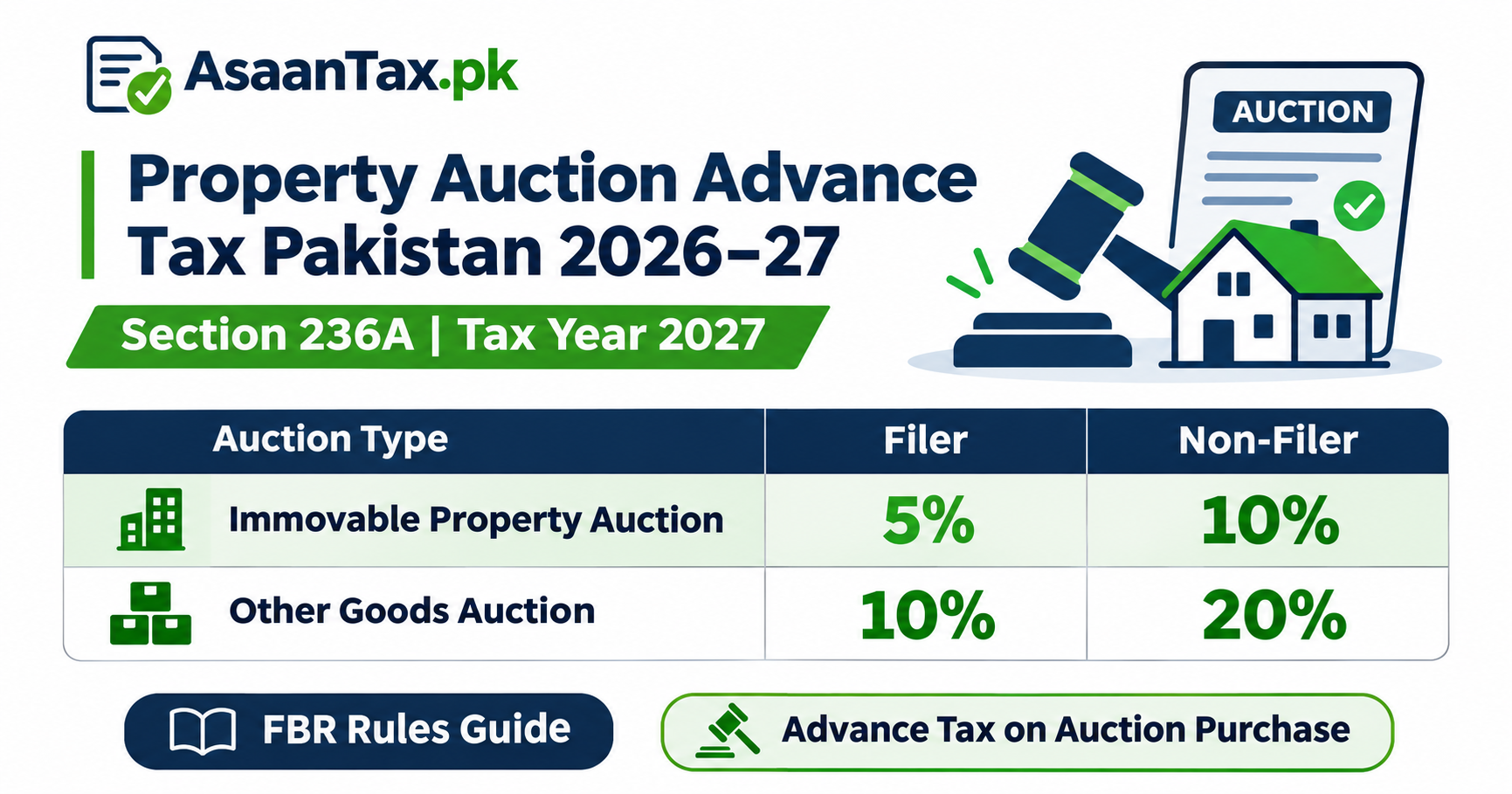
For Tax Year 2027 (July 1, 2026 to June 30, 2027), the ordinary advance withholding tax on immovable property sold by auction is 5% for Active Taxpayers (filers) and 10% for non-ATL persons (non-filers).
For other qualifying goods and movable property sold through auction, the rates are generally 10% for filers and 20% for non-filers.
The applicable rate depends on the type of property, auction transaction and purchaser's tax status.
This complete AsaanTax.pk guide explains the latest Section 236A rates, auction tax calculation, payment responsibilities, installment rules, tax adjustment and the difference between auction tax and ordinary property transfer tax.
What Is Section 236A of the Income Tax Ordinance?
Section 236A governs advance income tax collection when specified property or goods are sold through a public auction or auction by tender.
The provision applies to auction transactions involving government and non-government property, subject to its legal scope.
The person conducting the auction is generally responsible for collecting the applicable advance income tax from the successful purchaser.
Examples can include:
- Government property auctions.
- Public development authority auctions.
- Residential plot auctions.
- Commercial property auctions.
- Auctions of confiscated or attached assets.
- Machinery and equipment auctions.
- Specified goods sold by public auction.
- Auction-based lease awards.
- Auctions or tenders covered by the legislation.
Important: Section 236A applies to qualifying auctions. It should not automatically be applied to every ordinary private property sale merely because a seller informally accepts competing offers.
Latest FBR Section 236A Advance Tax Rates 2026–27
FBR's Withholding Tax Rate Card for Tax Year 2027 provides the following ordinary rates.
| Nature of Auction | Filer (ATL) | Non-Filer |
|---|---|---|
| Immovable property sold through auction | 5% | 10% |
| Other goods or movable property | 10% | 20% |
| Pakistan Railways train management services auction | 5% | 10% |
Applicable period: Financial Year 2026–27.
Legal reference: Section 236A, Division VIII of Part IV of the First Schedule and the applicable Tenth Schedule provisions.
These rates are calculated on the gross auction sale price.
The correct category must be determined before calculating tax.
What Is Immovable Property for Auction Tax?
Immovable property generally includes land and buildings.
Examples may include:
- Residential plots.
- Residential houses.
- Apartments.
- Commercial plots.
- Shops.
- Offices.
- Buildings and certain other real estate interests.
Where qualifying immovable property is sold through a public auction or tender, the ordinary Section 236A rate is 5% for filers and 10% for non-filers.
The fact that the property is residential or commercial does not automatically create separate percentage brackets within this Section 236A category.
Other tax and registration obligations may still differ.
What Is the Tax on Other Goods Sold by Auction?
Section 236A also covers qualifying auctions of goods and property other than immovable property.
Examples may include:
- Industrial machinery.
- Used equipment.
- Scrap material.
- Confiscated goods.
- Office equipment.
- Furniture.
- Vehicles sold through applicable auctions.
- Other qualifying movable assets.
The ordinary rates for this category are:
- Filer: 10%.
- Non-Filer: 20%.
Important: Vehicle auctions may also involve separate motor vehicle taxation and registration provisions, so the full transaction should be reviewed before determining its total tax cost.
How to Calculate Property Auction Tax in Pakistan
The basic formula is:
Section 236A Advance Tax = Gross Auction Sale Price × Applicable Tax Rate
Example 1: Residential Plot Auction for Rs. 1 Crore
Suppose an individual successfully purchases a residential plot through a qualifying public auction.
Winning auction price: Rs. 10,000,000.
Filer rate: 5%.
Calculation:
Rs. 10,000,000 × 5% = Rs. 500,000.
Filer advance tax: Rs. 500,000.
For a non-filer:
Rs. 10,000,000 × 10% = Rs. 1,000,000.
Non-filer advance tax: Rs. 1,000,000.
Difference: Rs. 500,000.
These figures exclude other applicable transaction charges.
Example 2: Commercial Property Auction for Rs. 3 Crore
Suppose a business purchases a commercial property through an eligible auction.
Gross auction price: Rs. 30,000,000.
Filer Calculation
Rs. 30,000,000 × 5%
Advance tax = Rs. 1,500,000.
Non-Filer Calculation
Rs. 30,000,000 × 10%
Advance tax = Rs. 3,000,000.
Difference: Rs. 1,500,000.
The property is commercial, but the same ordinary immovable-property auction percentage category applies.
Example 3: Industrial Machinery Auction for Rs. 50 Lakh
Suppose a manufacturing business purchases machinery through a qualifying auction.
Gross auction sale price: Rs. 5,000,000.
Because machinery is generally movable property rather than immovable property, the ordinary goods-auction rate applies.
Filer
Rs. 5,000,000 × 10%
Tax = Rs. 500,000.
Non-Filer
Rs. 5,000,000 × 20%
Tax = Rs. 1,000,000.
Difference = Rs. 500,000.
The purchaser should also consider applicable sales tax and other transaction-related obligations.
Property Auction Advance Tax – Complete Calculation Table
The following figures are illustrative calculations for qualifying immovable property auctions.
| Gross Auction Price | Filer Tax at 5% | Non-Filer Tax at 10% |
|---|---|---|
| Rs. 1,000,000 | Rs. 50,000 | Rs. 100,000 |
| Rs. 2,500,000 | Rs. 125,000 | Rs. 250,000 |
| Rs. 5,000,000 | Rs. 250,000 | Rs. 500,000 |
| Rs. 10,000,000 | Rs. 500,000 | Rs. 1,000,000 |
| Rs. 20,000,000 | Rs. 1,000,000 | Rs. 2,000,000 |
| Rs. 30,000,000 | Rs. 1,500,000 | Rs. 3,000,000 |
| Rs. 50,000,000 | Rs. 2,500,000 | Rs. 5,000,000 |
| Rs. 100,000,000 | Rs. 5,000,000 | Rs. 10,000,000 |
Note: These are Section 236A advance income tax amounts only, not the total financial cost of purchasing auction property.
Who Is Responsible for Collecting Section 236A Tax?
Section 236A generally places the collection obligation on the person conducting the qualifying public auction or tender.
Depending on the transaction, this may include:
- A government department.
- A local government authority.
- A development authority.
- A company.
- An authorized auction conducting entity.
- A customs authority conducting qualifying auctions.
- Another relevant person covered by the legislation.
The successful buyer is the person from whom the advance tax is collected.
The auction conducting entity must follow the applicable tax collection and deposit requirements.
Example
A public authority auctions a commercial plot.
The successful purchaser is an ATL taxpayer.
The authority generally collects the relevant Section 236A tax at 5% of the gross auction price under the applicable provisions.
The authority is responsible for handling the collected amount in accordance with the prescribed tax payment process.
Does Section 236A Apply to Auction by Tender?
Yes.
Section 236A expressly covers qualifying sales by public auction and auction by tender.
The law also clarifies that renewal of a licence previously sold through public auction or tender is covered by the relevant expression.
Therefore, a transaction should not automatically be excluded merely because the process was described as a tender rather than a traditional public bidding event.
The legal and contractual nature of the transaction must be examined.
What If the Auction Price Is Paid in Installments?
Section 236A contains an important clarification for installment payments.
Where the auction consideration is received in installments, the advance tax is generally collected with each installment.
Example
A qualifying immovable property is auctioned for Rs. 20,000,000.
The buyer is an ATL taxpayer.
Total ordinary Section 236A tax:
Rs. 20,000,000 × 5% = Rs. 1,000,000.
Suppose the buyer pays the sale consideration in four equal installments of Rs. 5,000,000.
| Installment | Auction Payment | Tax at 5% |
|---|---|---|
| First | Rs. 5,000,000 | Rs. 250,000 |
| Second | Rs. 5,000,000 | Rs. 250,000 |
| Third | Rs. 5,000,000 | Rs. 250,000 |
| Fourth | Rs. 5,000,000 | Rs. 250,000 |
| Total | Rs. 20,000,000 | Rs. 1,000,000 |
The actual payment arrangement should follow the contract and applicable law.
Does Section 236A Apply to Confiscated or Attached Property?
Yes.
Section 236A expressly refers to property or goods confiscated or attached, subject to the scope of the provision.
For example, certain property or goods may be sold through official auction proceedings after confiscation or attachment.
The applicable tax depends on the nature of the item and the transaction.
For immovable property, the ordinary 5% or 10% category may apply.
For other auctioned goods, the ordinary 10% or 20% category may apply.
Other customs, sales tax or legal requirements can also arise.
Does Section 236A Apply to Government Property Auctions?
Yes, where the transaction falls within the provision.
The law is not restricted to property owned by private businesses.
Qualifying auctions may involve government departments, local governments, development authorities and other entities.
For example, a government authority may auction a commercial plot or specified equipment.
The correct withholding rate depends on the type of property being sold and purchaser status.
Is an Auctioned Lease Covered by Section 236A?
Section 236A contains an explanation that the sale of property includes awarding a lease to a person.
It also refers to leases involving the right to collect tolls, fees or other levies.
Therefore, certain lease awards through qualifying auctions can fall within the provision.
Special Rule for Toll Collection Rights
Under Section 236A(3), advance tax collected on a lease of the right to collect tolls is treated as final tax.
This final-tax treatment should not automatically be applied to every ordinary property auction or other lease transaction.
The exact nature of the right awarded must be reviewed.
Section 236A vs Section 236C vs Section 236K
A common mistake is treating all property transactions as subject to the same advance tax section.
However, these provisions have different purposes.
| Section | Main Transaction | General Person Charged |
|---|---|---|
| Section 236A | Qualifying public auction or tender | Successful buyer |
| Section 236C | Sale or transfer of immovable property | Seller |
| Section 236K | Purchase or transfer of immovable property | Purchaser |
Section 236A
Applies to qualifying auctions and uses the applicable auction tax schedule.
Section 236C
Generally deals with advance tax on the sale or transfer of immovable property under the relevant provisions.
Section 236K
Generally deals with advance tax collected from the purchaser on acquisition or transfer of immovable property.
Important: The fact that Section 236A applies does not by itself prove that every other property-related tax is automatically excluded.
A qualifying auction can require review of more than one tax provision, together with any exemptions, non-duplication rules and applicable transaction circumstances.
Does Section 236A Replace Capital Gains Tax?
No.
Section 236A is generally an advance tax collection mechanism associated with the auction transaction.
Capital Gains Tax concerns the taxable gain arising from disposal of an asset under the relevant provisions.
For example, the seller's income tax consequences may be different from the advance tax collected from the buyer.
Therefore, Section 236A should not automatically be described as the complete final tax payable on every auction transaction.
Is Section 236A Tax Adjustable in an Income Tax Return?
Section 236A(2) provides for credit of the advance tax collected against tax payable by the purchaser for the relevant tax year, subject to the statutory provisions.
This means that ordinary Section 236A tax is generally creditable in the applicable circumstances.
However, there are exceptions, including the special final-tax treatment of the right to collect tolls.
Example
A qualifying taxpayer has Rs. 500,000 of Section 236A tax collected during the year.
The taxpayer's annual tax liability before the eligible credit is Rs. 700,000.
Assuming the entire payment is legally creditable:
Annual tax liability: Rs. 700,000.
Less Section 236A tax: Rs. 500,000.
Illustrative remaining liability: Rs. 200,000.
Important: The ability to claim a credit does not automatically guarantee a cash refund.
Refunds and adjustments remain subject to the applicable provisions and verification.
How to Pay Section 236A Auction Tax
The auction conducting authority or person responsible for collection should follow the applicable FBR payment procedure.
The process generally involves:
Step 1: Identify the Auction Transaction
Confirm the gross sale price, asset classification and purchaser.
Step 2: Check ATL Status
Verify whether the purchaser appears on the Active Taxpayers List.
Step 3: Calculate the Applicable Tax
Apply the relevant Section 236A rate.
Step 4: Create the Required FBR Payment Slip
Use the appropriate electronic tax payment process available through FBR IRIS.
Step 5: Enter the Correct Tax Section
Use Section 236A and the appropriate payment classification.
Step 6: Verify Payment Information
Check the taxpayer, amount, relevant period and transaction details.
Step 7: Complete Payment
Pay through an authorized banking or electronic payment channel.
Step 8: Retain Payment Evidence
Keep the applicable PSID, CPR and transaction records.
The precise user interface may differ depending on whether the payer is a withholding agent, government authority or another eligible entity.
What Is a PSID and CPR?
A PSID is a Payment Slip ID generated through the applicable FBR payment system.
A CPR is a Computerized Payment Receipt confirming a completed tax payment.
These records help reconcile the advance tax collected.
The successful purchaser should obtain the relevant proof of tax collection and payment.
A generated payment slip without completed payment does not by itself establish that tax has been deposited.
How to Report Section 236A in Tax Year 2027 Return
If the purchaser is required to file an income tax return, the relevant creditable advance tax should be reviewed and recorded under the appropriate tax payment section.
Step 1: Collect Auction Documents
Obtain the auction letter, bid acceptance, payment records and tax deduction evidence.
Step 2: Log In to FBR IRIS
Visit:
Step 3: Select the Correct Tax Year
Tax Year 2027 generally covers July 1, 2026 to June 30, 2027.
Step 4: Record Relevant Income
Enter taxable income according to the applicable legal provisions.
Step 5: Report Eligible Advance Tax
Record the relevant Section 236A tax payment using the correct category and documentary evidence.
Step 6: Report Assets Where Required
If the auction involved acquisition of an asset, disclose it in the Wealth Statement or other relevant financial records where legally required.
Step 7: Reconcile Payments
Match the amount claimed with the official tax collection records.
Step 8: Submit the Return
Review and submit the return through the applicable IRIS process.
Actual form fields and reporting requirements should be confirmed when the Tax Year 2027 filing forms become available.
What If an Auction Buyer Is a Non-Filer?
A purchaser not appearing on ATL generally faces the enhanced non-ATL rates shown in the current withholding tax rate card.
For immovable property auctions:
- ATL: 5%.
- Non-ATL: 10%.
For other qualifying goods auctions:
- ATL: 10%.
- Non-ATL: 20%.
A taxpayer should verify their official ATL position before bidding.
Merely possessing an NTN does not automatically establish active ATL status.
How to Check ATL Status Before an Auction
Online Method
Visit the official FBR IRIS verification portal:
Select Active Taxpayer List (Income Tax).
Enter the required CNIC or NTN and complete the verification.
SMS Method
For individuals, the published FBR SMS format is:
ATL 1234567890123
Send to 9966, replacing the example with the actual 13-digit CNIC without dashes.
For companies and AOPs, use the appropriate NTN-based format.
Are All Auction-Related Charges Included in Section 236A?
No.
The successful bidder may also need to pay other charges depending on the transaction.
These can include:
- Auction participation or processing fees.
- Security deposits.
- Applicable sales tax.
- Stamp duty.
- Registration charges.
- Transfer fees.
- Other statutory duties.
- Contractually specified administrative charges.
The applicable charges should be verified from the auction notice and relevant law.
Do not assume that paying Section 236A advance tax completes every financial or registration requirement.
Important Documents for Property Auction Buyers
Before participating in a property auction, a buyer should review:
- Official auction notice.
- Property identification and location.
- Title or ownership documentation.
- Applicable terms and conditions.
- Bid security requirements.
- Payment schedule.
- FBR tax treatment.
- ATL status.
- Stamp duty and registration requirements.
- Possession and transfer conditions.
- Encumbrances, litigation or other restrictions.
- Applicable authority approvals.
A property auction can involve legal risks beyond tax rates.
Consider independent legal verification before paying a substantial auction deposit.
Common Section 236A Tax Mistakes
Taxpayers should avoid:
- Applying the ordinary Section 236C seller rate to a property auction without reviewing Section 236A.
- Using the immovable-property rate for machinery or other movable goods.
- Ignoring the buyer's ATL status.
- Calculating tax on an incorrect sale-price amount.
- Confusing advance tax with final Capital Gains Tax.
- Assuming every lease auction receives the same final-tax treatment.
- Failing to account for installment payment rules.
- Losing the PSID or CPR.
- Claiming tax credit without supporting payment evidence.
- Ignoring stamp duty and other applicable costs.
- Assuming tax payment alone establishes legal title.
- Filing under the wrong tax year.
Watch Related Property Tax Video – Tax with Naeem
For Urdu-language guidance on property-related advance income tax, watch the following video from Tax with Naeem:
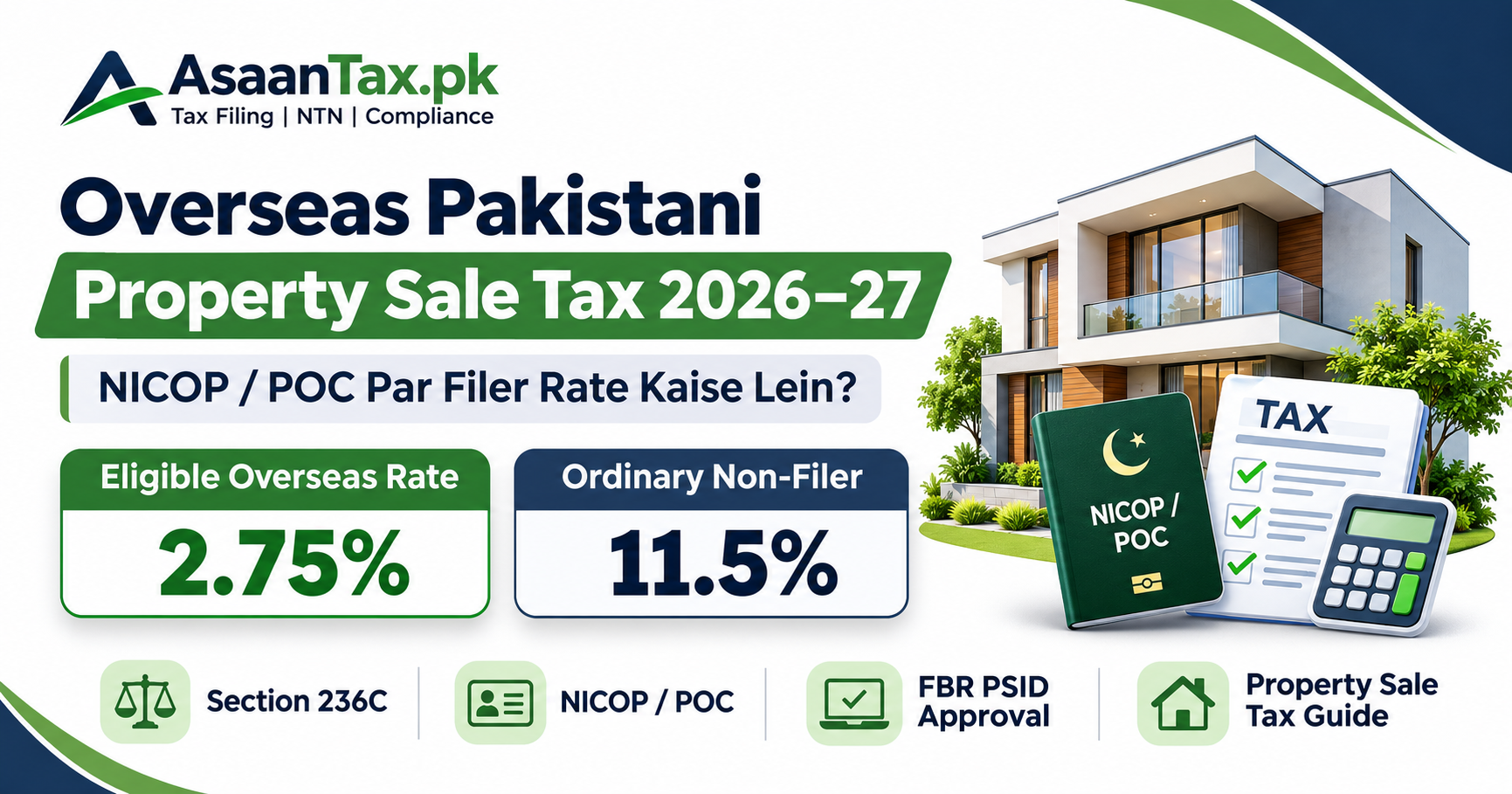
236C Property Tax 2026–27 – Property Sale Tax 2.75% Filer and 11.5% Non-Filer
https://www.youtube.com/watch?v=Aizklp2P5qE
The video explains general Section 236C property sale withholding tax.
Important: Section 236C is different from Section 236A. This video is related background material, not a specific tutorial on auction tax rates.
For Section 236A tutorials from Tax with Naeem, use the channel search:
https://www.youtube.com/results?search_query=Tax+with+Naeem+Section+236A+Auction+Tax
Always verify the applicable legal section and tax year before following a video tutorial.
How AsaanTax.pk Can Help With Property Auction Tax
Planning to purchase immovable property or goods through an auction?
Unsure whether the 5%, 10% or 20% Section 236A rate applies?
AsaanTax.pk provides guidance on FBR income tax compliance, property transaction tax and advance withholding tax calculations.
Our services include:
- Section 236A auction tax guidance.
- Filer and non-filer tax comparison.
- Property advance income tax calculations.
- NTN registration assistance.
- Active Taxpayer List verification.
- Tax payment documentation guidance.
- Income tax return filing.
- Wealth Statement preparation.
- General property tax compliance.
- FBR withholding tax guidance.
Need Help Understanding Auction Tax?
Visit AsaanTax.pk for information on property taxation, income tax return filing and applicable FBR compliance requirements.
Website: https://www.asaantax.pk/
AsaanTax.pk is an independent tax services website and is not affiliated with the Federal Board of Revenue or the Government of Pakistan.
Official Sources and References
- FBR – Withholding Tax Rate Card Tax Year 2027
- FBR – Income Tax Ordinance, 2001
- FBR – Finance Act 2026 and Related Finance Acts
- FBR – IRIS Portal
- Pakistan Board of Investment – Advance Tax on Auction Sale
- Tax with Naeem – Section 236C Property Tax Video
Last updated: November 4, 2026.
Disclaimer: This article is general information, not a transaction-specific tax determination. Section 236A rates depend on the legal nature of the auction, purchaser status, statutory provisions and applicable exemptions. Other tax obligations, including Sections 236C and 236K, may require separate examination. The creditability or finality of tax depends on the transaction and applicable law. Verify your specific auction terms and tax treatment with FBR or a qualified tax professional before completing a purchase.